Solver Spotlight: Shobhana Gupta

Solver Spotlight: Shobhana Gupta

Shobhana Gupta
Shobhana Gupta is a physician scientist and currently serves as the Open Innovation and Community Applications manager with Earth Science Division’s Applied Sciences Program at NASA Headquarters.

Shobhana Gupta is a physician scientist and currently serves as the Open Innovation and Community Applications manager with Earth Science Division’s Applied Sciences Program at NASA Headquarters. Shobhana manages crowdsourcing activities including prize competitions to invite talents and experiences outside of the NASA community for the discovery and development of applications of Earth observations for decision-making. She is also a star solver, having provided a number of valuable ideas and solutions to her peers through NASA Spark. NASA Spark as an internal, agency-wide platform that provides NASA employees an unconventional and inventive way to share knowledge and advance projects. Check out what Shobhana has to say about open innovation and the NASA Spark community.

What is your role at NASA?

I serve as the Manager of NASA Earth Action’s Prizes and Challenges Program, where we use crowdsourcing mechanisms to invite talents and experiences outside of the NASA community to participate in the discovery and development of Earth observations-based applications for decision-making.  I also serve as the Associate Program Manager of NASA’s Equity and Environmental Justice Program, to support projects that apply NASA data for advancing awareness and challenges related to human health or environmental outcomes that are unique to, or disproportionately affect, underserved communities, including persons of color, low-income persons, Indigenous persons or members of Tribal nations. I completed my medical and graduate training at Vanderbilt University School of Medicine (Department of Microbiology and Immunology) and a postdoctoral fellowship at Yale University School of Medicine (Department of Neurology) before joining NASA in 2015 as an AAAS Science and Technology Policy Fellow. I supported the Health and Air Quality Program to enhance decision-making about environmental health and infectious diseases, as well as managed NASA’s International Space Apps Challenge Program in 2017.

Why do you like participating on NASA Spark?

I truly believe that the best outcomes can be achieved if we are open and invite collaboration on not just the work we have done, but the work that we are doing. This includes sharing our current challenges and harnessing the knowledge and skills of people from different backgrounds, fields of expertise, and different experiences to find solutions. Instead of trying to find resources or solutions by myself or within my team, NASA Spark allows me to expand my network and benefit from ideas from colleagues across ALL of NASA – that’s incredible!

You’re a multi-time winner! What does that mean to you? Why do you keep coming back and sharing your ideas?

I love participating in NASA Spark campaigns because it is a great way to leverage the work we are doing or have completed for greater impact across NASA.  If we have created a resource that gives another team a head start in their work, it’s a win-win. Our team can show the value of our work, and the other team can save their time and resources.

How can other NASA employees best utilize NASA Spark?

NASA Spark can be the NASA “watercooler” for employees across all programs and centers in the agency.  We can post challenges we are stuck on, ideas we are trying to develop, or any other calls for input to our entire brilliant, skilled, multidisciplinary expert workforce – for free and for minimal effort! We should all sign up to learn about and contribute to new campaigns from our colleagues, including building on ideas that others have submitted. NASA Spark is a great platform to network across the agency – your coworkers are just collaborators waiting to happen!

What does innovation mean to you?

Innovation, to me, is doing something new while constantly moving towards doing better.  Whether it is applying existing tools and ideas in a novel way or developing completely new solutions – innovation should make our work easier and outcomes more impactful. Open innovation by sharing our work and challenges with people from unrelated fields and backgrounds, encouraging them to apply their perspectives to manipulate our questions and share solutions, can in turn empower us to achieve superior outcomes.

If you are a NASA employee and interested in learning more about NASA Spark, visit spark.nasa.gov.

Powered by WPeMatico

Get The Details…
Sarah Douglas
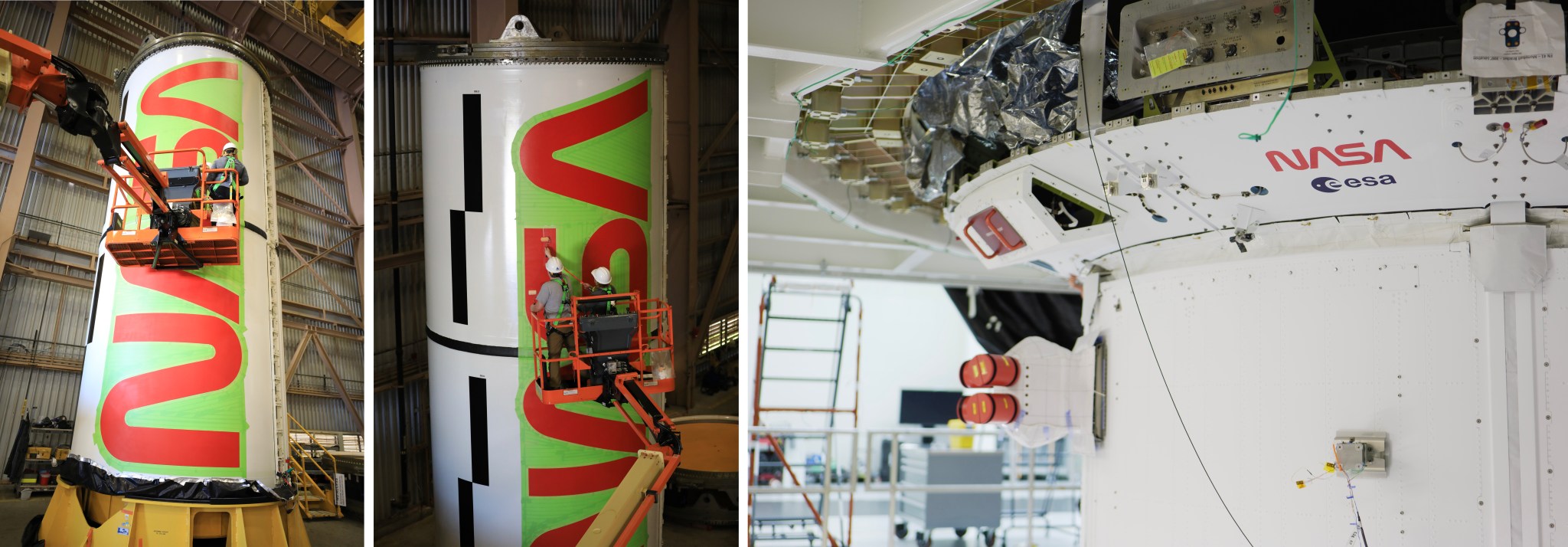
Teams Add Iconic NASA ‘Worm’ Logo to Artemis II Rocket, Spacecraft

Teams Add Iconic NASA ‘Worm’ Logo to Artemis II Rocket, Spacecraft

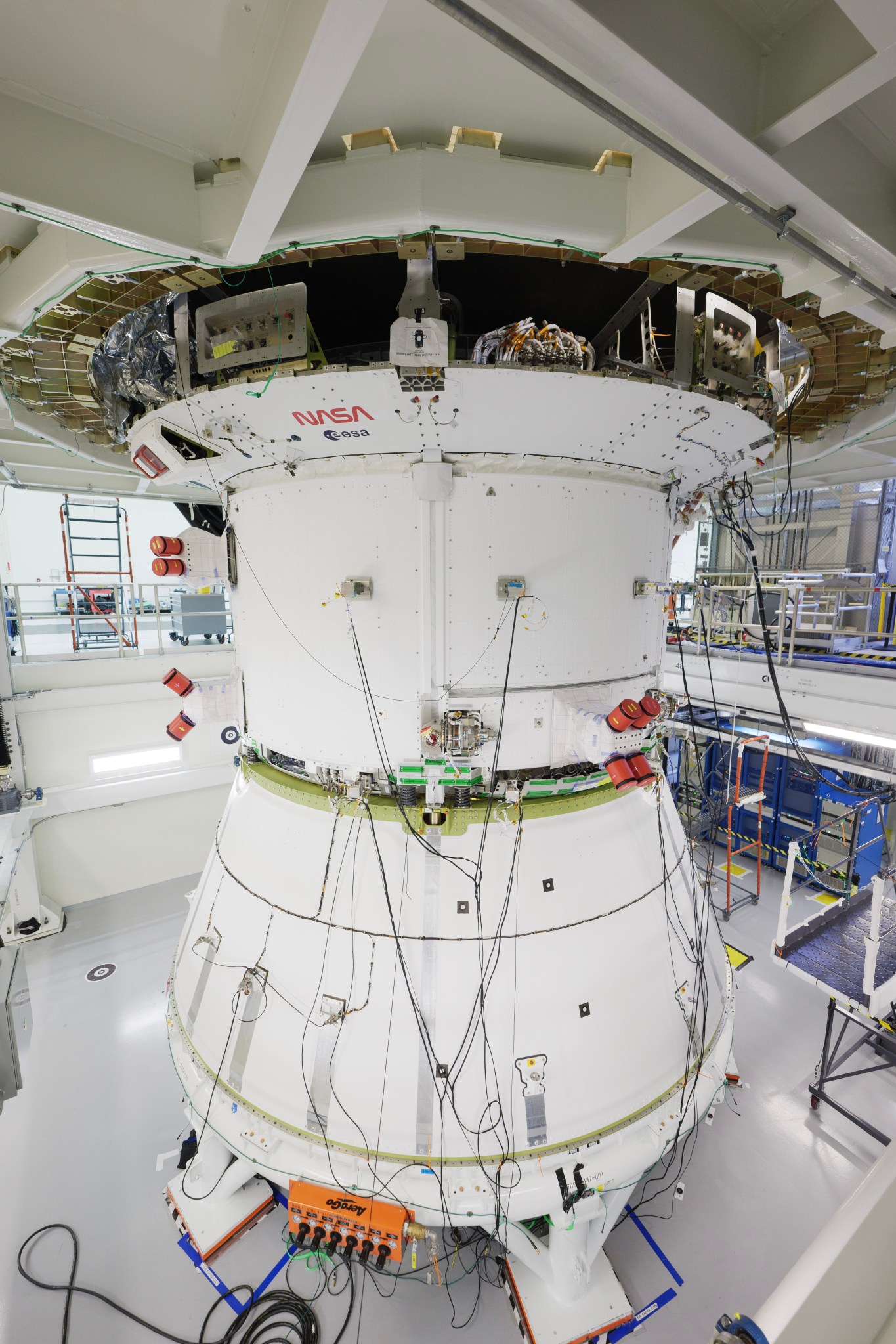
At right: The Orion spacecraft for NASA’s Artemis II mission received its latest makeover. Teams adhered the agency’s iconic “worm” logo and ESA (European Space Agency) insignia on the spacecraft’s crew module adapter on Sunday, Jan. 28, inside the Neil Armstrong Operations and Checkout Building at NASA’s Kennedy Space Center in Florida.
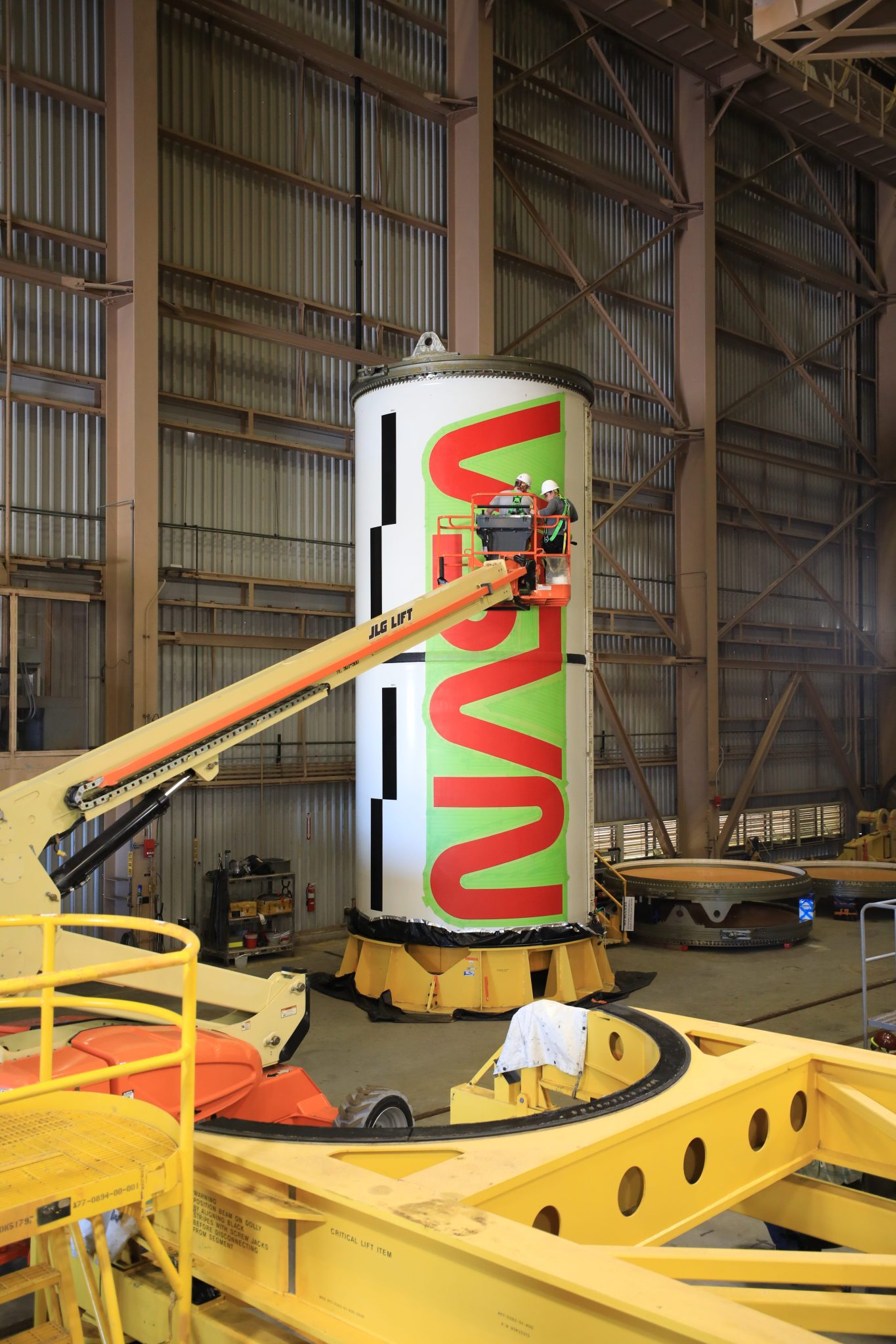
In the left two photos, workers with NASA’s Exploration Ground Systems (EGS) paint the bright red NASA “worm” logo on the side of an Artemis II solid rocket booster segment inside the Rotation, Processing and Surge Facility (RPSF) at Kennedy Space Center in Florida on Tuesday, Jan. 30, 2024. The EGS team used a laser projector to mask off the logo with tape, then painted the first coat of the iconic design. The booster segments will help propel the Space Launch System (SLS) rocket on the Artemis II mission to send four astronauts around the Moon as part of the agency’s effort to establish a long-term science and exploration presence at the Moon, and eventually Mars. In the right photo, the Orion spacecraft for NASA’s Artemis II mission received its latest makeover. Teams adhered the agency’s iconic “worm” logo and ESA (European Space Agency) insignia on the spacecraft’s crew module adapter on Sunday, Jan. 28, inside the Neil Armstrong Operations and Checkout Building at NASA’s Kennedy Space Center in Florida.
NASA/Glenn Benson and Rad Sinyak

Art and science merge as teams add the NASA “worm” logo on the SLS (Space Launch System) solid rocket boosters and the Orion spacecraft’s crew module adapter at NASA’s Kennedy Space Center in Florida for the agency’s Artemis II mission.

The iconic logo was introduced in 1975 by the firm of Danne & Blackburn as a modern emblem for the agency. It emerged from a nearly 30-year retirement in 2020 for limited use on select missions and products.

NASA’s Exploration Ground Systems and prime contractor Jacobs began painting the red logotype onto the segments that form the Moon rocket’s two solid rocket boosters Jan. 22. To do so, crews used a laser projector to first mark off the location of the logo with tape, then applied two coats of paint and finished by adding several coats of clear primer. Each letter of the worm logo measures approximately 6 feet and 10 inches in height and altogether, stretches 25 feet from end to end, or a little less than the length of one of the rocket’s booster motor segments.

The location of the worm logo will be moderately different from where it was during Artemis I. While it will still be located on each of the rocket’s 17 story boosters, the modernist logo will be placed toward the front of the booster systems tunnel cover. The SLS boosters are the largest, most powerful solid propellant boosters ever flown and provide more than 75% of the thrust at launch.

Workers with NASA’s Exploration Ground Systems (EGS) paint the bright red NASA “worm” logo on the side of an Artemis II solid rocket booster segment inside the Rotation, Processing and Surge Facility (RPSF) at Kennedy Space Center in Florida on Tuesday, Jan. 30, 2024. The EGS team used a laser projector to mask off the logo with tape, then painted the first coat of the iconic design. The booster segments will help propel the Space Launch System (SLS) rocket on the Artemis II mission to send four astronauts around the Moon as part of the agency’s effort to establish a long-term science and exploration presence at the Moon, and eventually Mars.
NASA/Glenn Benson

Around the corner inside the Neil Armstrong Operations and Checkout Building at Kennedy, personnel adhered the worm logo and ESA (European Space Agency) insignia Jan. 28 on the spacecraft’s crew module adapter. The adapter houses electronic equipment for communications, power, and control, and includes an umbilical connector that bridges the electrical, data, and fluid systems between the main modules.

In October 2023, technicians joined the crew and service modules together. The crew module will house the four astronauts as they journey around the Moon and back to Earth on an approximately 10-day journey. The spacecraft’s service module, provided by ESA, will supply the vehicle with electricity, propulsion, thermal control, air, and water in space.

The Orion spacecraft for NASA’s Artemis II mission received its latest makeover. Teams adhered the agency’s iconic “worm” logo and ESA (European Space Agency) insignia on the spacecraft’s crew module adapter on Sunday, Jan. 28, inside the Neil Armstrong Operations and Checkout Building at NASA’s Kennedy Space Center in Florida.
NASA/Rad Sinyak

NASA is working to land the first woman, first person of color, and first international partner astronaut on the Moon through Artemis. SLS and the Orion spacecraft are central to NASA’s deep space exploration plans, along with advanced spacesuits and rovers, the Gateway space station planned for orbit around the Moon, and commercial human landing systems.

Powered by WPeMatico

Get The Details…
Elyna N. Niles-Carnes

Hubble Views a Massive Star Forming

Hubble Views a Massive Star Forming

2 min read

Hubble Views a Massive Star Forming

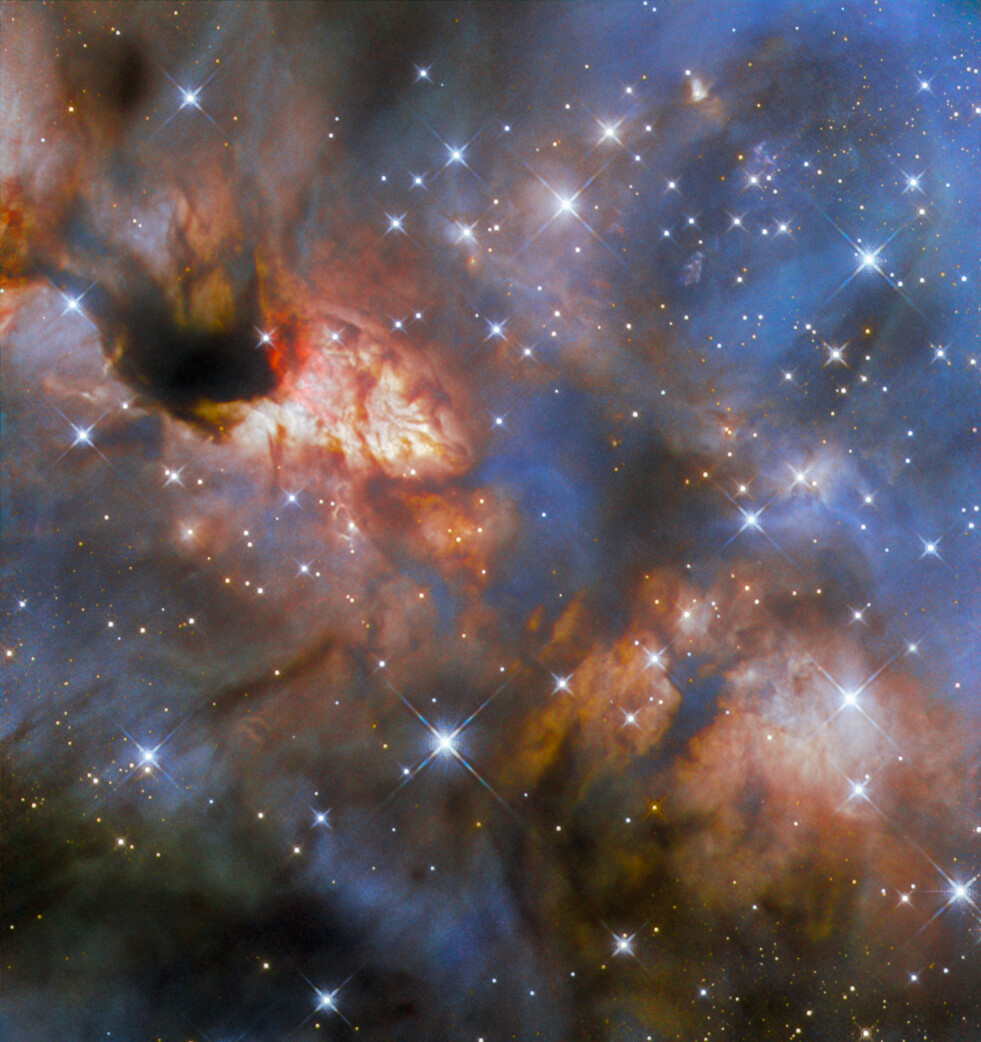
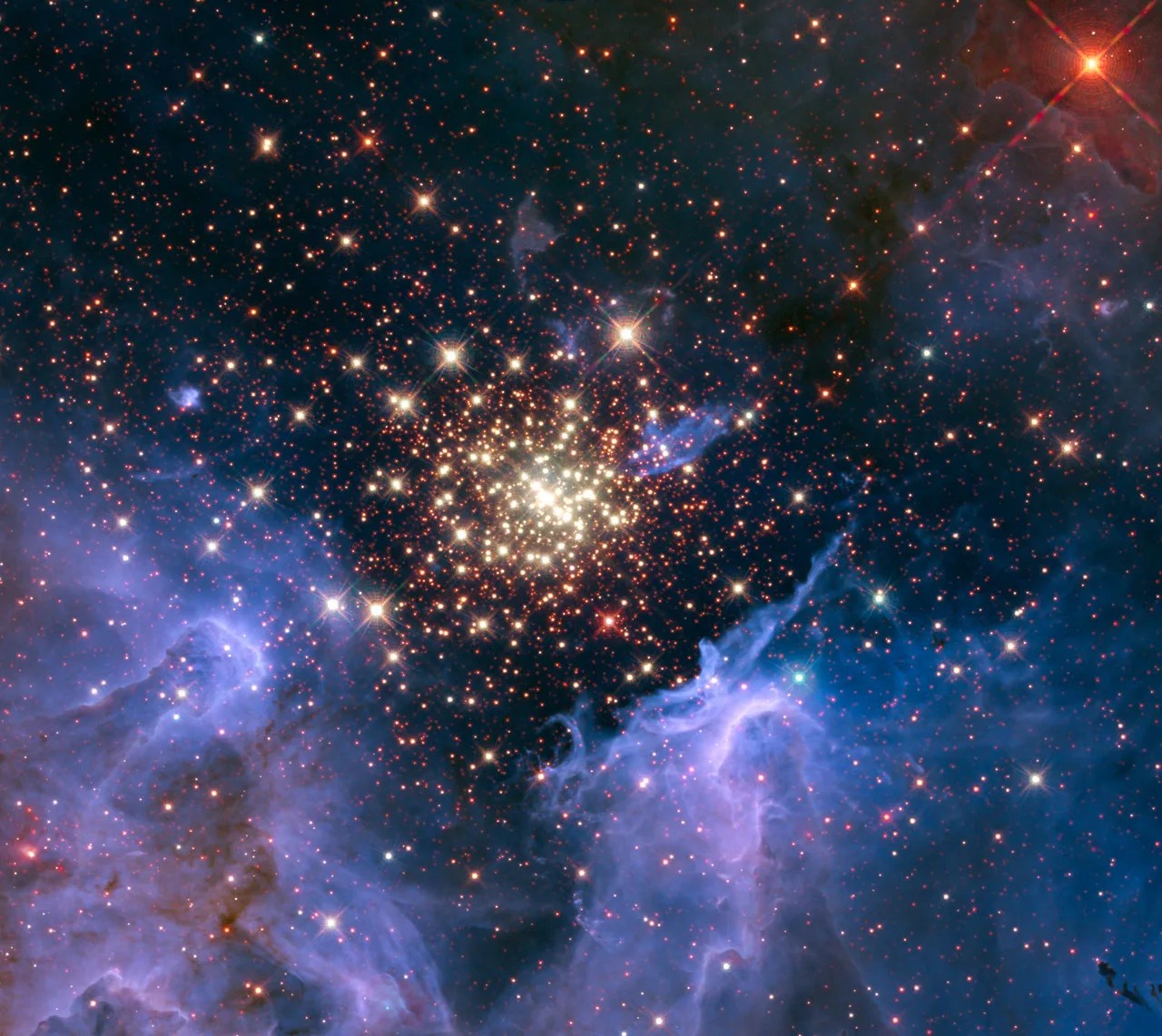
A nebula with stars. The center of the image from top-left to bottom-right glows brightly with the light of newly forming stars and is partially obscured by dark dust. Colored layers of gas and dust billow out across the rest of the image. Foreground stars with large diffraction spikes speckle the nebula.
This image from the NASA/ESA Hubble Space Telescope is a relatively close star-forming region known as IRAS 16562-3959.
ESA/Hubble & NASA, R. Fedriani, J. Tan

This image from the NASA/ESA Hubble Space Telescope is teeming with color and activity. It features a relatively close star-forming region known as IRAS 16562-3959, which lies within the Milky Way about 5,900 light-years from Earth in the constellation Scorpius.

Observations from Hubble’s Wide Field Camera 3 make up this image. Its detailed nuance of color is the result of four separate filters. These thin slivers of highly specialized material can slide in front of the instrument’s light sensors, allowing very specific wavelengths of light to pass through with each observation. This is useful because certain wavelengths of light can tell us about the region’s composition, temperature, and density.

At the center of the image, IRAS 16562-3959 likely hosts a massive star – about 30 times the mass of our Sun – that is still in the process of forming. The shadowy clouds appear dark because there is so much light-obscuring dust blocking the near-infrared wavelengths of light Hubble observed. However, near-infrared light does leak out mainly on two sides – upper left and lower right – where a powerful jet from the massive protostar cleared away the dust. Multi-wavelength images like this incredible Hubble scene help us gain a better understanding of how the most massive, brightest stars in our galaxy form.

Text credit: European Space Agency (ESA)

Media Contact:

Claire Andreoli
NASA’s Goddard Space Flight CenterGreenbelt, MD
claire.andreoli@nasa.gov

Share

Details

Last Updated
Feb 16, 2024
Editor
Andrea Gianopoulos
Location
Goddard Space Flight Center

Powered by WPeMatico

Get The Details…

NASA Welcomes Uruguay Foreign Minister for Artemis Accords Signing

NASA Welcomes Uruguay Foreign Minister for Artemis Accords Signing

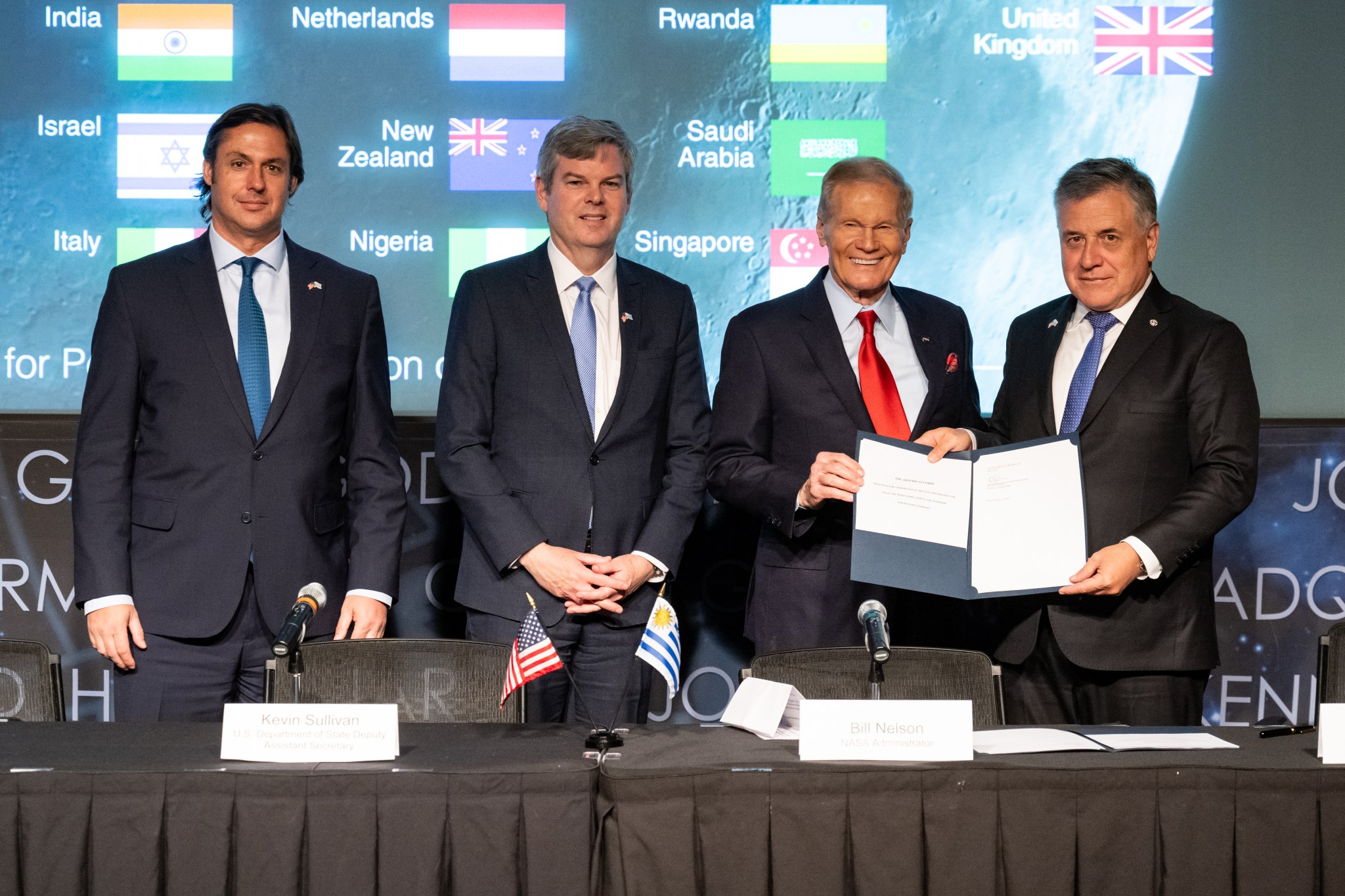
From left to right, Uruguayan Ambassador to the United States Andrés Augusto Durán Hareau, U.S. Department of State Deputy Assistant Secretary Kevin Sullivan, NASA Administrator Bill Nelson, and Uruguayan Foreign Minister Omar Paganini pose for a photo during an Artemis Accords signing ceremony, Thursday, Feb. 15, 2024, at the Mary W. Jackson NASA Headquarters building in Washington. Uruguay is the 36th country to sign the Artemis Accords, which establish a practical set of principles to guide space exploration cooperation among nations participating in NASA’s Artemis program. Credits: NASA/Keegan Barber

During a ceremony at NASA Headquarters in Washington Thursday, Uruguay became the 36th country to sign the Artemis Accords. NASA Administrator Bill Nelson participated in the signing ceremony for the agency, and Omar Paganini, foreign minister, signed the Artemis Accords on behalf of Uruguay.

The accords establish a practical set of principles to guide space exploration cooperation among nations.

Also participating in the event were:

  • NASA Deputy Administrator Pam Melroy
  • Karen Feldstein, associate administrator for NASA’s Office of International and Interagency Relations
  • Kevin Sullivan, U.S. Department of State deputy assistant secretary
  • Andrés Augusto Durán Hareau, Uruguayan ambassador to the U.S.
  • Heide Fulton, U.S. ambassador to Uruguay

“NASA welcomes Uruguay as the newest member of the Artemis Accords family,” said Nelson. “The United States and Uruguay share a commitment to democracy and peace, and now, we expand these principles in the cosmos to commit to the safe and transparent exploration of space.”

The Artemis Accords were established in 2020 by the United States together with seven other original signatories. Since then, the Accords signatories have held focused discussions on how best to implement the Artemis Accords principles.

“We are honored to have the opportunity to introduce space cooperation as a new chapter in the robust bilateral agenda between Uruguay and the U.S.,” said Paganini. “We are sure that this signing ceremony is not an end in itself, but the beginning of a new bilateral track based on knowledge-intensive activities and new opportunities for our people.”

The Artemis Accords reinforce and implement key obligations in the 1967 Outer Space Treaty. They also strengthen the commitment by the United States and signatory nations to the Registration Convention, the Rescue and Return Agreement, as well as best practices NASA and its partners support, including the public release of scientific data.

More countries are expected to sign the accords in the months and years ahead, which are advancing safe, peaceful, and prosperous activities in space. Learn more about the Artemis Accords at:

https://www.nasa.gov/artemis-accords

-end-

Faith McKie / Roxana Bardan
Headquarters, Washington
202-358-1600
faith.mckie@nasa.gov / roxana.bardan@nasa.gov

Powered by WPeMatico

Get The Details…
Tiernan P. Doyle

Stem Cell Science and Human Research Studies Ahead of Cargo Arrival

Stem Cell Science and Human Research Studies Ahead of Cargo Arrival

The seven-member Expedition 70 crew gathers for a dinner time portrait inside the International Space Station's Unity module. In the front row from left are, Flight Engineers Konstantin Borisov of Roscosmos, Jasmin Moghbeli of NASA, and Satoshi Furukawa from JAXA (Japan Aerospace Exploration Agency). In the back row are, Commander Andreas Mogensen from ESA (European Space Agency), NASA Flight Engineer Loral O'Hara, and Roscosmos Flight Engineers Oleg Kononenko and Nikolai Chub.
The seven-member Expedition 70 crew gathers for a dinner time portrait inside the International Space Station’s Unity module. In the front row from left are, Flight Engineers Konstantin Borisov of Roscosmos, Jasmin Moghbeli of NASA, and Satoshi Furukawa from JAXA (Japan Aerospace Exploration Agency). In the back row are, Commander Andreas Mogensen from ESA (European Space Agency), NASA Flight Engineer Loral O’Hara, and Roscosmos Flight Engineers Oleg Kononenko and Nikolai Chub.

A cargo craft loaded with nearly three tons of food, fuel, and supplies is currently in orbit heading to the International Space Station, targeting early Saturday for docking. As the Expedition 70 crew members await the arrival of Progress 87, stem cell science, heart rate data collection and eye exam activities topped their research schedule on Thursday.

Progress 87 successfully launched from the Baikonur Cosmodrome in Kazakhstan at 10:25 p.m. EST Wednesday, Feb. 14. On Saturday, Feb. 17, the cargo craft will automatically dock to the aft port of the Zvezda service module at 1:12 a.m., with cosmonauts Oleg Kononenko and Nikolai Chub on duty to monitor the spacecraft’s arrival.

Aboard station, four orbital residents spent most of the day on the Mesenchymal Stem Cells in Microgravity Induced Bone Loss (MABL-A) investigation. MABL-A—delivered aboard Northrop Grumman’s 20th Commercial Resupply Mission—assesses the effects of microgravity on bone marrow stem cells. In the morning, NASA astronaut Loral O’Hara collected BioCell samples inside the habitat with assistance from JAXA (Japan Aerospace Exploration Agency) Flight Engineer Satoshi Furkawa. In the afternoon, NASA astronaut Jasmin Moghbeli took over the BioCell sampling work with assistance from ESA (European Space Agency) Commander Andreas Mogensen.

Mogensen also spent part of the day photographing Plant-Microbe Interactions in Space (APEX-10) petri plates—another investigation that launched aboard Northrop Grumman’s 20th resupply mission—to examine whether beneficial microbes can mitigate some of the negative effects the space environment can have on plant growth and development.

In the afternoon, O’Hara conducted an array of activities for the CIPHER investigation, including the collection of heart rate data and completing an eye exam. CIPHER, or Complement of Integrated Protocols for Human Exploration Research, is an all-encompassing, total-body approach that examines how humans adapt to spaceflight.

In the Roscosmos segment, Chub worked with Flight Engineer Konstantin Borisov to film an educational video that demonstrates the capabilities of Roscosmos scientific hardware aboard station. Meanwhile, Kononenko conducted some routine maintenance in Zarya module. Near the end of the day, Borisov examined the Earth’s nighttime atmosphere in near-ultraviolet for an ongoing investigation aboard the orbital lab.


Learn more about station activities by following the space station blog, @space_station and @ISS_Research on X, as well as the ISS Facebook and ISS Instagram accounts.

Get weekly video highlights at: https://roundupreads.jsc.nasa.gov/videoupdate/

Get the latest from NASA delivered every week. Subscribe here: www.nasa.gov/subscribe

Powered by WPeMatico

Get The Details…

Abby Graf