Medical Tests, Microbiology Top Research Schedule Aboard Station

Medical Tests, Microbiology Top Research Schedule Aboard Station

ESA (European Space Agency) astronaut and Expedition 74 flight engineer Sophie Adenot inserts biological research samples into a science freezer inside the International Space Station’s Destiny laboratory module. The freezer, formally known as the Minus Eighty-degree Laboratory Freezer for ISS (MELFI), maintains experiment samples at ultra‑cold temperatures, significantly enhancing microgravity research capabilities and preserving biological specimens for analysis back on Earth.
ESA (European Space Agency) astronaut Sophie Adenot inserts biological research samples into a science freezer inside the International Space Station’s Destiny laboratory module.
ESA/Sophie Adenot

Medical tests and microbiology topped the research schedule for the Expedition 74 crew aboard the International Space Station on Tuesday. The seven crewmates also worked on spacesuits, cargo operations, and life support maintenance.

NASA flight engineer Chris Williams kicked off his shift drawing a blood sample from NASA flight engineer Jessica Meir for processing in a centrifuge and preservation in a science freezer for later analysis. Williams later collected, processed, and stowed his urine samples for the CIPHER study that measures and compares astronaut health before, during, and after a spaceflight. Doctors regularly analyze a crew member’s biomedical samples collected throughout a mission constantly gaining insight into microgravity’s effect on the human body.

Williams later joined Meir and NASA flight engineer Jack Hathaway as they reorganized cargo packed inside the Leonardo Permanent Multipurpose Module. The trio cleared air vents in Leonardo for proper airflow, trashed obsolete hardware, inventoried items, and photographed problem areas for inspection.

Hathway and Meir later partnered together and filled a liquid cooling and ventilation garment, a spacesuit’s inner layer that regulates a spacewalker’s temperature, with water. The duo also attached shoulder pads to the cooling garment and installed a spacesuit on a support stand inside the Quest airlock for future maintenance.

Flight engineer Sophie Adenot of ESA (European Space Agency) began her shift working on cargo consolidation to optimize space inside the Columbus laboratory module. After lunch, Adenot inspected and cleaned the Tranquility module’s ventilation system then checked the operation of the Exploration Potable Water Dispenser, a technology demonstration to advance water sanitization methods, reduce microbial growth, and dispense hot water into crew food and drink bags.

Station commander Sergey Kud-Sverchkov and flight engineer Sergei Mikaev, both Roscosmos cosmonauts, joined each other and collected microbe samples in the Nauka, Zvezda, and Zarya modules. The samples will be analyzed to understand the orbital outpost’s microbial environment and learn how to protect crew health and space station hardware.

Roscosmos flight engineer Andrey Fedyaev spent his shift primarily on orbital plumbing duties. Fedyaev first checked the functionality of water stowage tanks and inspected their hoses and connectors. Next, he purged residual fluids and gases inside water recycling hardware to ensure its continuing safe operation.

Learn more about station activities by following the space station blog, @space_station on X, as well as the ISS Facebook and ISS Instagram accounts.

Get the latest from NASA delivered every week. Subscribe here.

Powered by WPeMatico

Get The Details…

Mark A. Garcia

Crew Kicks Off Week with Cargo Mission Training and Spacewalk Cleanup

Crew Kicks Off Week with Cargo Mission Training and Spacewalk Cleanup

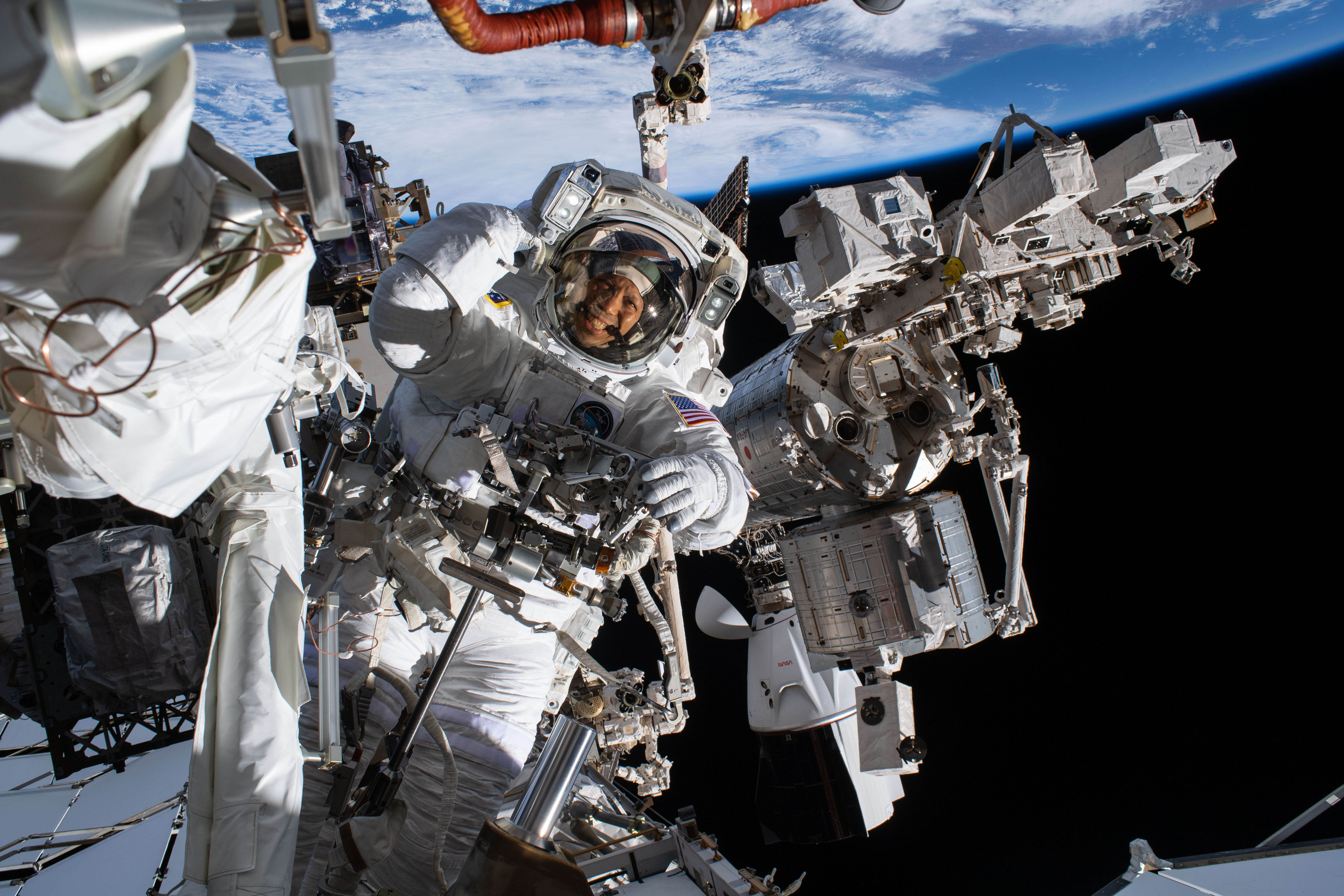
NASA astronaut Jessica Meir waves at the camera during a seven-hour, two-minute spacewalk outside the International Space Station on March 18, 2026.
NASA/Jack Hathaway

Expedition 74 started the week training for the arrival of the next U.S. cargo mission and continuing to clean up after last week’s spacewalk. The orbital residents also practiced medical emergency procedures, unloaded supplies from a new Roscosmos resupply ship, and ensured the International Space Station remains in tip-top shape.

Northrop Grumman’s Cygnus XL cargo spacecraft is the next mission targeted to launch to the orbital outpost no earlier than Wednesday, April 8 at 8:49 a.m. EDT. NASA flight engineers Chris Williams and Jack Hathaway joined each other on Monday and reviewed the upcoming Cygnus XL mission, trained for its rendezvous procedures, and familiarized themselves with the equipment they will use to monitor Cygnus’ arrival. Cygnus will be delivering advanced microgravity research gear to study quantum physics, test stem cell therapies, promote astronaut health, and more.

NASA flight engineer Jessica Meir spent Monday servicing a pair of spacesuits that she and Williams wore during a seven-hour and two-minute spacewalk on  March 18. She first cleaned and flushed the suit’s water-cooling loops that regulate an astronaut’s body temperature in the extreme environment of space. Next, she emptied and refilled the suit’s water system to remove gas bubbles and contaminants keeping its life‑support system healthy and reliable.

Flight engineer Sophie Adenot of ESA (European Space Agency) focused on a variety scientific experiments throughout Monday that explore different microgravity phenomena. Adenot first collected data and powered down hardware from an investigation that is studying ways to quickly download large amounts of data from space. Next, she swapped research samples inside a science freezer then inventoried and trashed used biomedical gear that examined the crew’s cardiovascular health. Adenot finally recorded a video message for students on Earth describing why conducting science in space is important.

All four astronauts also joined Roscosmos cosmonaut Andrey Fedyaev for a mid-afternoon emergency drill reviewing how to use and where to locate medical hardware. The five crewmates also practiced CPR, or cardiopulmonary resuscitation, and discussed individual roles and responsibilities in the event of a medical situation in low Earth orbit.

Fedyaev began his shift replacing smoke detectors and gas masks inside the Nauka science module. The two-time station visitor wrapped up his duties in the orbital outpost’s Roscosmos segment and checked the quality of drinking water.

Station commander Sergey Kud-Sverchkov serviced electrical components and checked the operation of the Elektron oxygen generator inside the Zvezda service module. Afterward, Kud-Sverchkov studied using artificial intelligence tools to improve crew operations and communications with mission controllers. Roscosmos flight engineer Sergei Mikaev spent his day offloading some of the three tons of food, fuel, and supplies packed inside the Progress 94 resupply ship that docked to the Poisk module on March 24.

Learn more about station activities by following the space station blog, @space_station on X, as well as the ISS Facebook and ISS Instagram accounts.

Get the latest from NASA delivered every week. Subscribe here.

Powered by WPeMatico

Get The Details…

Mark A. Garcia

Crew Off-Duty, Cosmonauts Work Cargo and Station Upkeep

Crew Off-Duty, Cosmonauts Work Cargo and Station Upkeep

NASA astronaut Chris Williams smiles at the camera while conducting a spacewalk outside the International Space Station. Credit: NASA/Jessica Meir
NASA astronaut Chris Williams smiles at the camera while conducting a spacewalk outside the International Space Station.
NASA/Jessica Meir

Four Expedition 74 crew members are enjoying an off-duty day following a busy week of science prep, post-spacewalk closeout procedures, cargo operations, and more. Three other International Space Station residents set their sights on an array of maintenance tasks throughout the day.

NASA astronauts Chris Williams, Jessica Meir, and Jack Hathaway, along with European Space Agency (ESA) astronaut Sophie Adenot all had the day off on Friday. The quartet exercised and spent the day relaxing.

NASA continues to assess potential dates for U.S. spacewalk 95 outside the International Space Station as teams prepare for the installation of future roll-out solar arrays. The agency has been reviewing the standard spacesuit preparations and other procedures needed following U.S. spacewalk 94 along with other station activities including cargo, research, and maintenance activities

On March 18, NASA astronauts Jessica Meir and Chris Williams successfully completed U.S. spacewalk 94, preparing the 2A power channel and performing additional tasks. This work will enable the future installation of roll-out solar arrays to provide additional power for the orbiting laboratory, supporting critical systems and its safe, controlled deorbit. NASA will share the updated date and time for spacewalk 95 once scheduling is finalized.

In the Roscosmos segment, space station commander Sergey Kud-Sverchkov removed and replaced an AC compressor. He then proceeded to take a health assessment that analyzes how a crew member works individually and with their teammates before conducting some maintenance on the treadmill.

Flight engineer Andrey Fedyaev worked in the Nauka module to replace stowage battery units and test video cameras the crew uses to document work and life aboard the orbital complex.

Flight engineer Sergei Mikaev reviewed the schedule for next week, organized and cleaned up files on station computers, and configured cameras and hardware crewmembers use to take photos of Earth. He ended his day on Progress 94 cargo operations, unloading food and supplies that were delivered earlier this week, and installed a payload that will assist with acquiring images of Earth in the visible and near-infrared ranges.

Science, supplies, and equipment are soon to be delivered to the International Space Station aboard a Northrop Grumman Cygnus XL spacecraft. NASA’s Northrop Grumman Commercial Resupply Services 24 mission is targeted to lift off from Space Launch Complex 40 at Cape Canaveral Space Force Station in Florida no earlier than Wednesday, April 8 at 8:49 a.m. EDT.

In addition to food, supplies, and equipment for the crew, Cygnus will deliver research to the space station, including a new module to advance quantum science that could improve computing technology and aid in the search for dark matter and hardware to produce a greater number of therapeutic stem cells for blood diseases and cancer. Cygnus also will carry model organisms to study the gut microbiome and a receiver that could enhance space weather models that protect critical space infrastructure, such as GPS and radar.

Learn more about station activities by following the space station blog@space_station on X, as well as the ISS Facebook and ISS Instagram accounts.

Get the latest from NASA delivered every week. Subscribe here.

Powered by WPeMatico

Get The Details…

Abby Graf

Expedition 74 Works Health Research and Cargo Operations on Thursday

Expedition 74 Works Health Research and Cargo Operations on Thursday

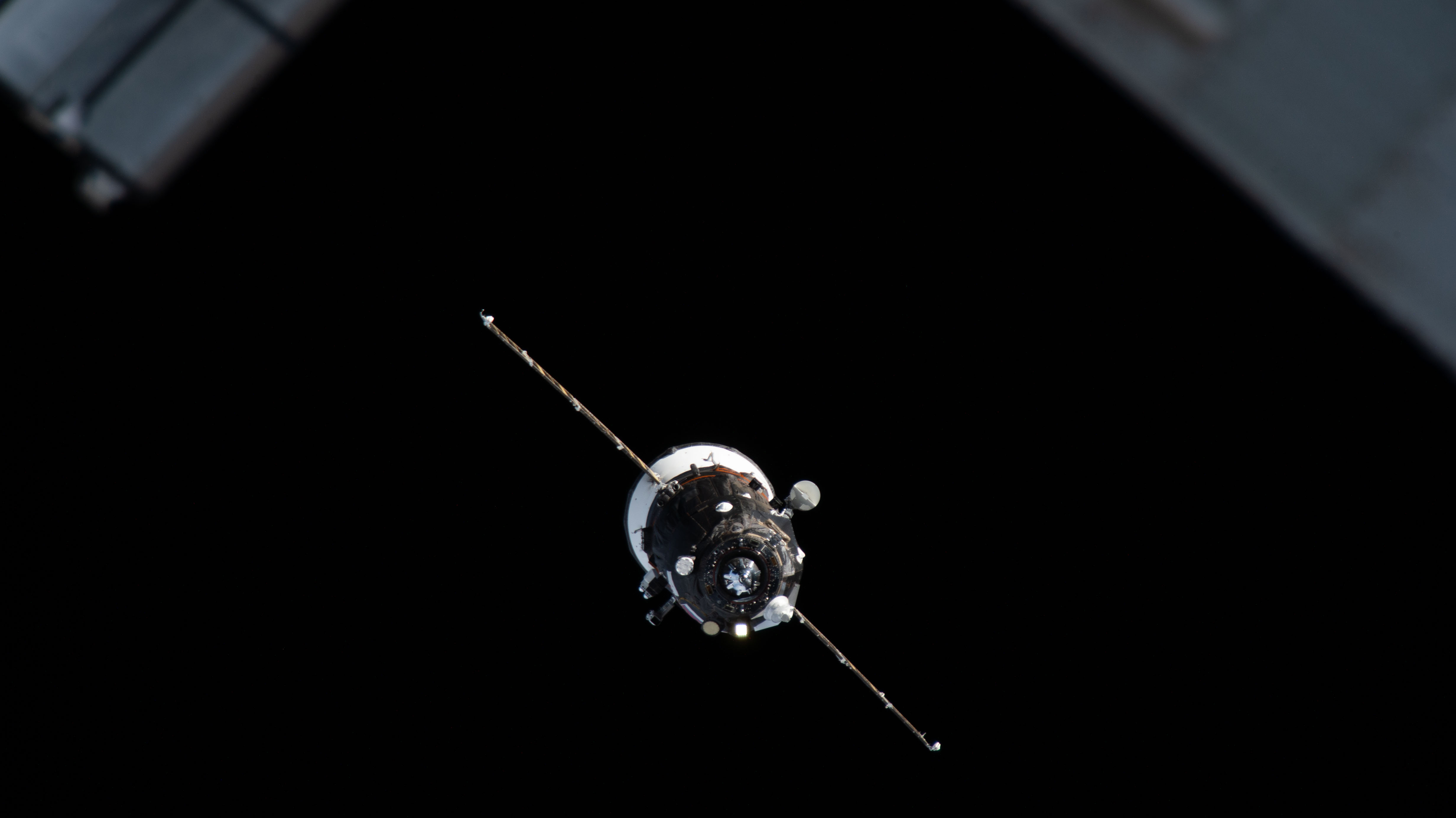
The Progress 94 cargo spacecraft, loaded with nearly three tons of food, fuel, and supplies, nears the International Space Station ahead of its docking on March 24, 2026. Credit: NASA
The Progress 94 cargo spacecraft, loaded with nearly three tons of food, fuel, and supplies, nears the International Space Station ahead of its docking on March 24, 2026.
NASA

Expedition 74 Works Health Research and Cargo Operations on Thursday

Health research, biology experiments, cleaning, and cargo operations were the main tasks on Thursday’s schedule aboard the International Space Station. The Expedition 74 crew worked an array of activities that look at how the human body reacts to space, analyzed samples for microbial growth, and unloaded a cargo delivery.

NASA astronaut Jessica Meir and European Space Agency (ESA) astronaut kicked off the day collecting biological samples to take a deeper look at how the human body and its functions react and adapt to spaceflight. Afterward, Adenot prepped the samples before stowing them in the orbital lab’s Minus Eighty-Degree Freezer for future analysis.

Meir moved into the Destiny laboratory module to collect water samples from the Potable Water Dispenser. Adenot later processed those samples to assess for any microbial growth. Adenot then began to gather items for an upcoming tech demonstration that uses environmental sensors to collect CO2 measurements.

In the Kibo module, NASA astronaut Chris Williams spent part of his day moving and consolidating stowage. He then removed modules from the Nanoracks main frame to make room for new installations. Williams completed his two-hours of daily exercise on the station’s Advanced Resistive Exercise Device (ARED) and treadmill, to help maintain cardiovascular health and bone and muscle density in zero gravity.

NASA astronaut Jack Hathaway kicked off the day with his two hours of exercise on ARED and the station’s bicycle, CEVIS. Later on, he cleaned vent fans in the Unity module. Near the end of the day, he moved into the Permanent Multipurpose Module to organize stowage and clean with Meir.

Cargo operations were ongoing in the Roscosmos segment throughout the day. In the morning, station commander Sergey Kud-Sverchkov and flight engineer Sergei Mikaev worked together to disassemble the docking mechanism inside the Poisk module. The duo, along with flight engineer Andrey Fedyaev, then spent the day unloading cargo from the recently arrived Progress 94 spacecraft, in addition to a few other tasks, including food consolidation, general maintenance, and data transfers.

Learn more about station activities by following the space station blog@space_station on X, as well as the ISS Facebook and ISS Instagram accounts.

Get the latest from NASA delivered every week. Subscribe here.

Powered by WPeMatico

Get The Details…

Abby Graf

Science and Operational Prep Work Top Wednesday’s Schedule

Science and Operational Prep Work Top Wednesday’s Schedule

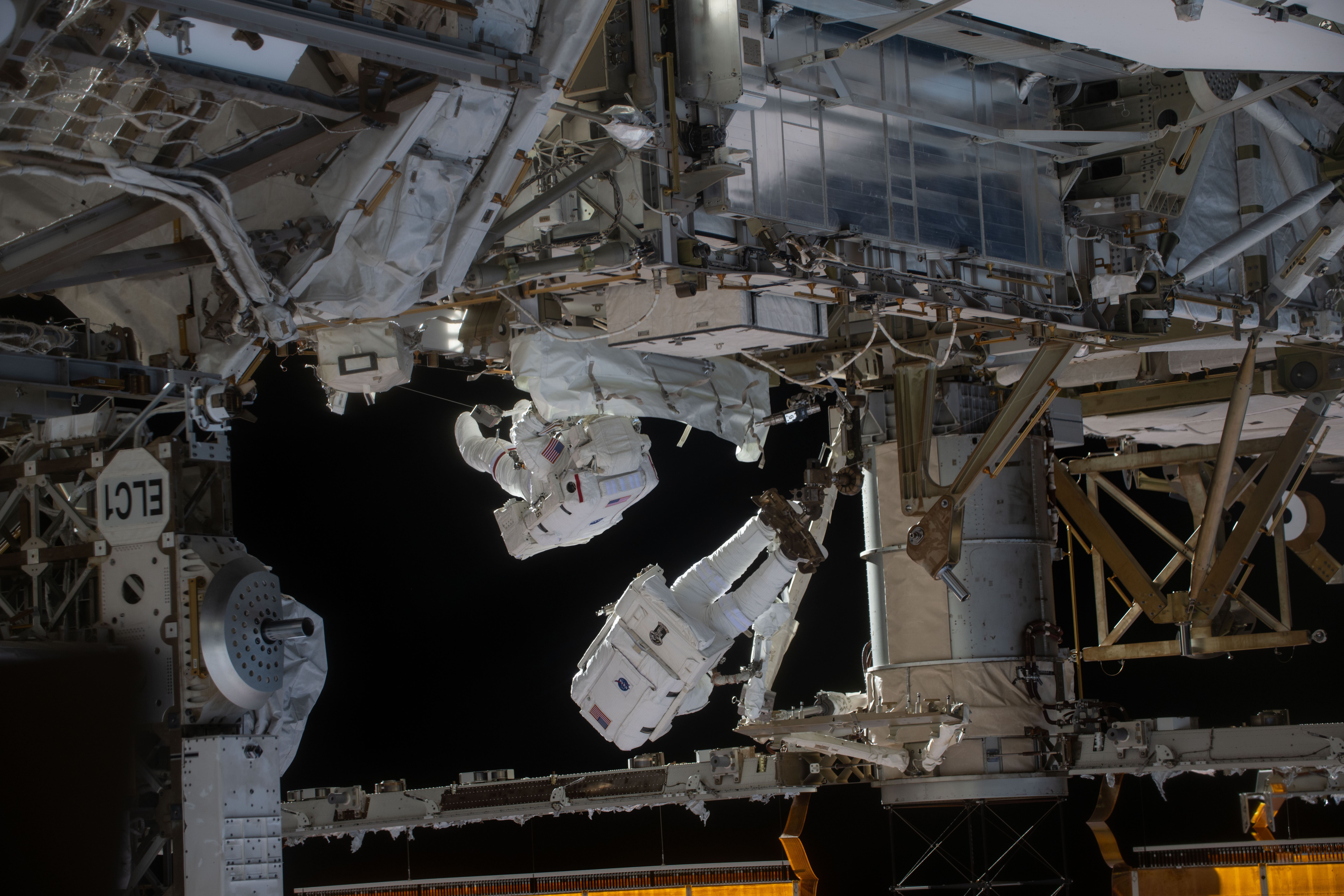
NASA astronauts Jessica Meir and Chris Williams are pictured outside the International Space Station during a seven-hour, two-minute spacewalk on March 18, 2026. Credit: NASA/Jack Hathaway
NASA astronauts Jessica Meir and Chris Williams are pictured outside the International Space Station during a seven-hour, two-minute spacewalk on March 18, 2026.
NASA/Jack Hathaway

Science preparation and procedure reviews topped the schedule aboard the International Space Station on Wednesday. The seven Expedition 74 crew members conducted a variety of tasks to ready for upcoming experiments and to conduct cargo operations.

NASA astronauts Jack Hathaway and Jessica Meir worked separately throughout the day to consolidate food and complete post-spacewalk work following the March 18 spacewalk to install a modification kit on the 2A power channel of the space station ahead of future solar array upgrades. This work included the inspection of the suit glove heaters, data recorders, cameras, and helmet lights.

To prepare for upcoming experiment operations, European Space Agency (ESA) astronaut Sophie Adenot spent the morning cleaning and inserting samples into the Soft Matter Dynamics experiment containers, which explore the dynamics of droplets and their size evolution in emulsions. After donning the RelaxPro actigraphy device earlier this week, Adenot transferred the data to ground teams for analysis. She then familiarized herself with spacesuit systems before loading software onto payload hard drives.

In the Kibo module, NASA astronaut Chris Williams spent a large portion of the day installing new data management system racks, which are used to house and manage data for various science experiments. Later in the day, he worked on food consolidation then inspected medical hardware.

Following yesterday’s arrival of the Progress 94 cargo spacecraft,  space station commander Sergey Kud-Sverchkov and flight engineer Sergei Mikaev reviewed cargo transfer and stowage plans as they gear up to unload the nearly three tons of food, fuel, and supplies delivered by the spacecraft.

Later on, Kud-Sverchkov and flight engineer Andrey Fedyaev photographed landmarks across Earth for documentation. Fedyaev also spent time throughout the day conducting some orbital plumbing and reconfiguring station cameras.

Learn more about station activities by following the space station blog@space_station on X, as well as the ISS Facebook and ISS Instagram accounts.

Get the latest from NASA delivered every week. Subscribe here.

Powered by WPeMatico

Get The Details…

Abby Graf