How NASA Tracked the Most Intense Solar Storm in Decades

How NASA Tracked the Most Intense Solar Storm in Decades

5 Min Read

How NASA Tracked the Most Intense Solar Storm in Decades

NASA’s Solar Dynamics Observatory captured these images of the solar flare on May 14, 2024 — as seen in the bright flash on the right side. These images show a subset of extreme ultraviolet light that highlights the extremely hot material in flares and which is colorized in royal blue and gold. This flare shows ongoing activity from the same region active during the storm.
Credits:
NASA/SDO

May 2024 has already proven to be a particularly stormy month for our Sun. During the first full week of May, a barrage of large solar flares and coronal mass ejections (CMEs) launched clouds of charged particles and magnetic fields toward Earth, creating the strongest solar storm to reach Earth in two decades — and possibly one of the strongest displays of auroras on record in the past 500 years.

We’ll be studying this event for years. It will help us test the limits of our models and understanding of solar storms.
Teresa Nieves-Chinchilla

Teresa Nieves-Chinchilla

Acting Director of NASA’s Moon to Mars (M2M) Space Weather Analysis Office

“We’ll be studying this event for years,” said Teresa Nieves-Chinchilla, acting director of NASA’s Moon to Mars (M2M) Space Weather Analysis Office. “It will help us test the limits of our models and understanding of solar storms.”

From May 3 through May 9, 2024, NASA’s Solar Dynamics Observatory observed 82 notable solar flares. The flares came mainly from two active regions on the Sun called AR 13663 and AR 13664. This video highlights all flares classified at M5 or higher with nine categorized as X-class solar flares.
NASA’s Goddard Space Flight Center

The first signs of the solar storm started late on May 7 with two strong solar flares. From May 7 – 11, multiple strong solar flares and at least seven CMEs stormed toward Earth. Eight of the flares in this period were the most powerful type, known as X-class, with the strongest peaking with a rating of X5.8. (Since then, the same solar region has released many more large flares, including an X8.7 flare — the most powerful flare seen this solar cycle — on May 14.)

On May 14, 2024, the Sun emitted a strong solar flare. This solar flare is the largest of Solar Cycle 25 and is classified as an X8.7 flare.
NASA’s Goddard Space Flight Center

Traveling at speeds up to 3 million mph, the CMEs bunched up in waves that reached Earth starting May 10, creating a long-lasting geomagnetic storm that reached a rating of G5 — the highest level on the geomagnetic storm scale, and one that hasn’t been seen since 2003.

“The CMEs all arrived largely at once, and the conditions were just right to create a really historic storm,” said Elizabeth MacDonald, NASA heliophysics citizen science lead and a space scientist at NASA’s Goddard Space Flight Center in Greenbelt, Maryland.

When the storm reached Earth, it created brilliant auroras seen around the globe. Auroras were even visible at unusually low latitudes, including the southern U.S. and northern India. The strongest auroras were seen the night of May 10, and they continued to illuminate night skies throughout the weekend. Thousands of reports submitted to the NASA-funded Aurorasaurus citizen science site are helping scientists study the event to learn more about auroras.

“Cameras — even standard cell phone cameras — are much more sensitive to the colors of the aurora than they were in the past,” MacDonald said. “By collecting photos from around the world, we have a huge opportunity to learn more about auroras through citizen science.”

Red and green streaks of an aurora radiate out from the center of the photo. Black silhouettes of trees line the edge.
A coronal aurora appeared over southwestern British Columbia on May 10, 2024.
NASA/Mara Johnson-Groh

By one measure of geomagnetic storm strength, called the disturbance storm time index which dates back to 1957, this storm was similar to historic storms in 1958 and 2003. And with reports of auroras visible to as low as 26 degrees magnetic latitude, this recent storm may compete with some of the lowest-latitude aurora sightings on record over the past five centuries, though scientists are still assessing this ranking.

“It’s a little hard to gauge storms over time because our technology is always changing,” said Delores Knipp, a research professor in the Smead Aerospace Engineering Science Department and a senior research associate at the NCAR High Altitude Observatory, in Boulder, Colorado. “Aurora visibility is not the perfect measure, but it allows us to compare over centuries.”

MacDonald encourages people to continue submitting aurora reports to Aurorasaurus.org, noting that even non-sightings are valuable for helping scientists understand the extent of the event.

Leading up to the storm, the National Oceanic and Atmospheric Administration’s Space Weather Prediction Center, which is responsible for forecasting solar storm impacts, sent notifications to operators of power grids and commercial satellites to help them mitigate potential impacts.

Warnings helped many NASA missions brace for the storm, with some spacecraft preemptively powering down certain instruments or systems to avoid issues. NASA’s ICESat-2 — which studies polar ice sheets — entered safe mode, likely because of increased drag due to the storm.  

Looking Forward

Better data on how solar events influence Earth’s upper atmosphere is crucial to understanding space weather’s impact on satellites, crewed missions, and Earth- and space-based infrastructure. To date, only a few limited direct measurements exist in this region. But more are coming. Future missions, such as NASA’s Geospace Dynamics Constellation (GDC) and Dynamical Neutral Atmosphere-Ionosphere Coupling (DYNAMIC), will be able to see and measure exactly how Earth’s atmosphere responds to the energy influxes that occur during solar storms like this one. Such measurements will also be valuable as NASA sends astronauts to the Moon with the Artemis missions and, later, to Mars.
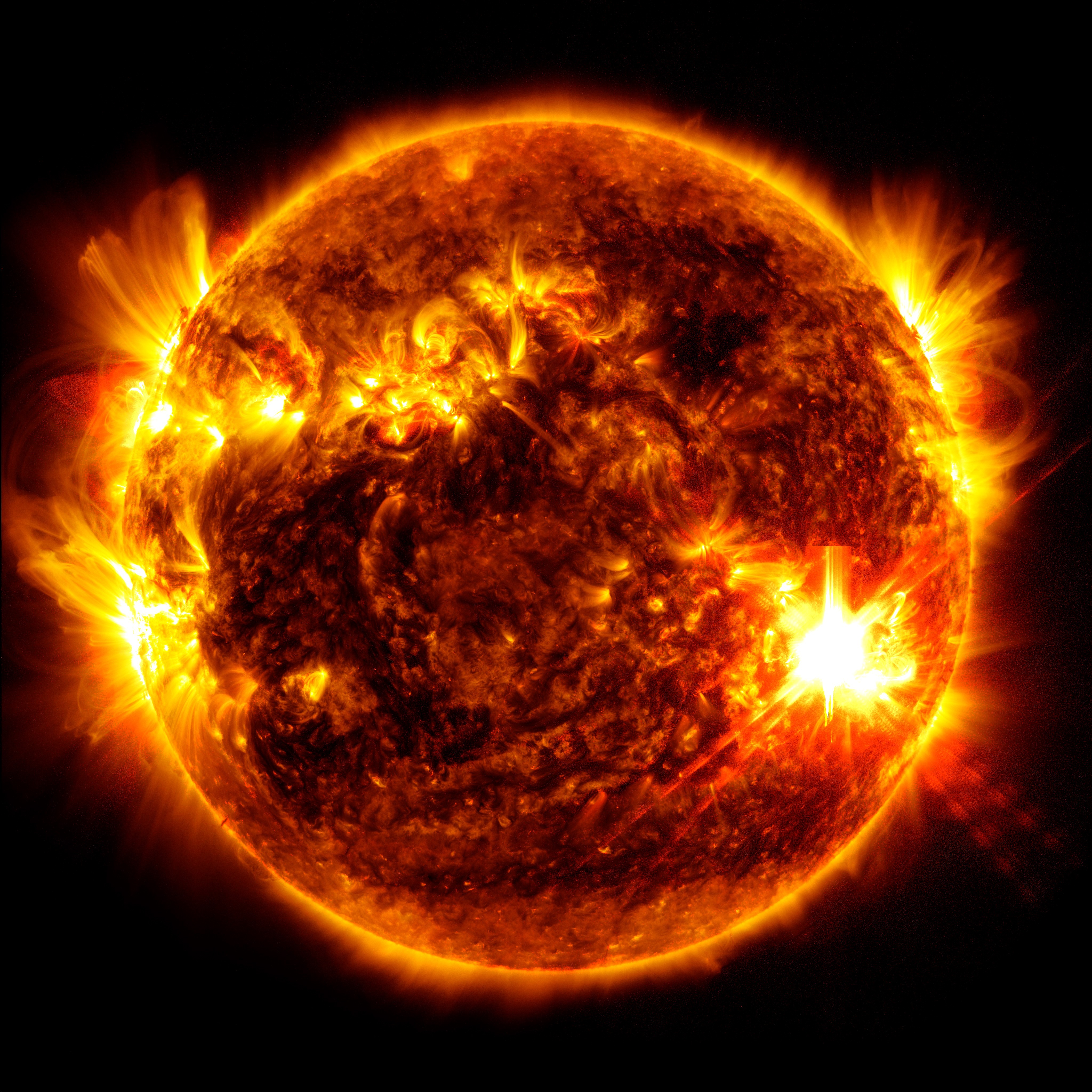
An image of the Sun shows a bright flash in the bottom right side where a solar flare erupts.
NASA’s Solar Dynamics Observatory (SDO) captured this image of an X5.8 solar flare peaking at 9:23 p.m. EDT on May 10, 2024. The image shows a subset of extreme ultraviolet light that highlights the extremely hot material in flares.
NASA SDO

The solar region responsible for the recent stormy weather is now turning around the backside of the Sun, where its impacts can’t reach Earth. However, that doesn’t mean the storm is over. NASA’s Solar TErrestrial RElations Observatory (STEREO), currently located at about 12 degrees ahead of Earth in its orbit, will continue watching the active region an additional day after it is no longer visible from Earth.

“The active region is just starting to come into view of Mars,” said Jamie Favors, director for the NASA Space Weather Program at NASA Headquarters in Washington. “We’re already starting to capture some data at Mars, so this story only continues.”

By Mara Johnson-Groh
NASA’s Goddard Space Flight Center, Greenbelt, Md.

Media Contact:
Sarah Frazier
NASA’s Goddard Space Flight Center, Greenbelt, Md.

Keep Exploring

Discover More Topics From NASA

Powered by WPeMatico

Get The Details…

FY2024 TEAM II NOFO Announcement

FY2024 TEAM II NOFO Announcement

2 min read

Preparations for Next Moonwalk Simulations Underway (and Underwater)

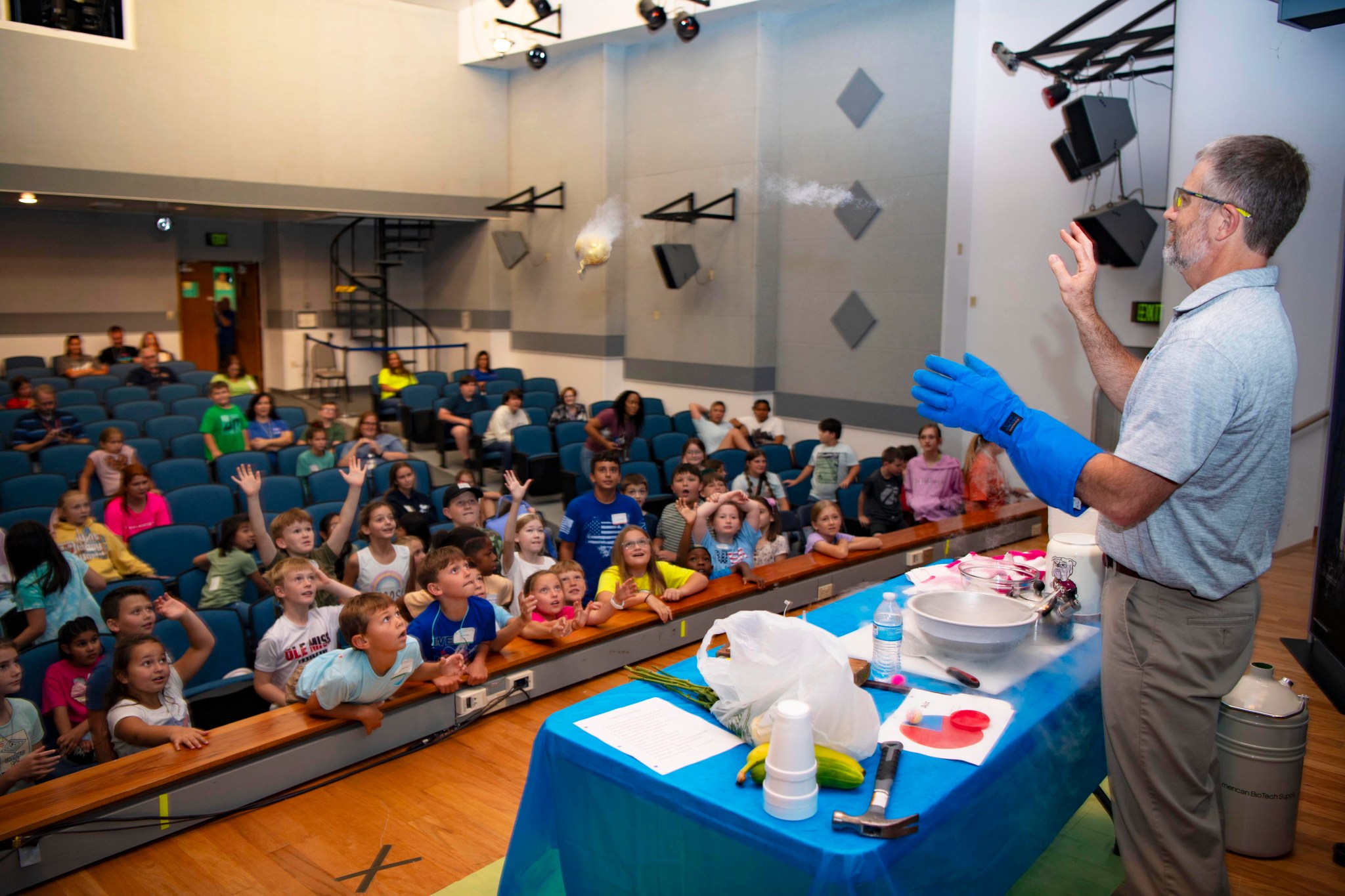
Allen Forsman demonstrates a cryogenics experiment as Take Our Children to Work Day participants watch on in amazement.

Next Gen STEM’s Teams Engaging Affiliated Museums and Informal Institutions (TEAM II) program is pleased to announce an upcoming FY2024 Notice of Funding Opportunity (NOFO) that will expand the current program from a two-tier to a three-tier system by adding a mid-level funding tier. The NOFO is expected to be released in the third quarter of FY2024 (April-June). The new mid-level funding tier was created in response to feedback from the informal education community.

The new “STEM Innovator” tier will fund awards of approximately $250,000. In addition, the highest tier award will be designated the “National Connector” award and fund initiatives up to $900,000.  The “Community Anchor” tier will continue to offer awards up to $50,000. The Community Anchor tier opportunity will be offered each fiscal year, and the STEM Innovator and National Connector tiers will be offered in alternating years. The FY2024 NOFO will include the Community Anchor and STEM Innovator tiers and the FY2025 NOFO will focus on the Community Anchor and National Connector tiers. By adding the mid-level tier, NASA and Next Gen STEM aim to broaden the number and type of awards made to Informal Education Institutions for creating innovative, NASA-inspired programming for K-12 students and their families.

Powered by WPeMatico

Get The Details…
Kaitlyn Adams

NASA Recognizes 5 Early Career Planetary Scientists

NASA Recognizes 5 Early Career Planetary Scientists

3 min read

NASA Recognizes 5 Early Career Planetary Scientists

NASA has selected five early-career scientists for its 2023 Planetary Science Early Career Award (ECA) based on their demonstrated leadership, involvement in the planetary science community, and potential for future impact.

The ECA program supports exceptional early-career scientists who play a meaningful role in the planetary science community to pursue professional development in areas relevant to NASA’s Planetary Science Division. The goal of each proposal is to identify a need in the community and propose a project to address that need. Each project is facilitated by a grant of up to $200,000 to each of the selected principal investigators.

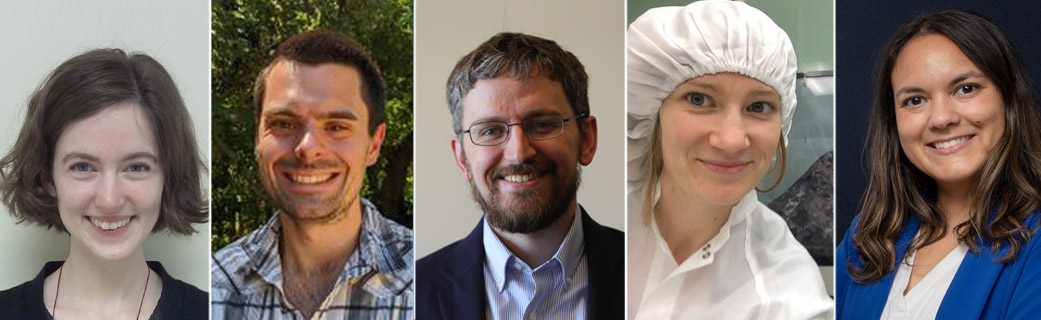
Emily Costello, Christopher Fowler, Peter James, Kelly Miller, Laura Rodriguez
NASA’s 2023 Planetary Science Early Career Award (ECA) winners: Emily Costello, Christopher Fowler, Peter James, Kelly Miller, Laura Rodriguez

The selected projects span the full breadth of planetary science research, and the principal investigators are based at U.S. universities and research institutes:

Emily Costello, University of Hawai’i at Manoa: Dr. Costello’s project, “Navigating by Moonlight: The Art of Planetary Science,” will link planetary science and art to the local indigenous culture native to Oahu, Hawai’i.

Christopher Fowler, West Virginia University in Morgantown: Dr. Fowler’s project, “Bringing Planetary Science to West Virginia,” will increase the visibility of and capacity for planetary science research at West Virginia University and engage underserved high school students in West Virginia with planetary science data sets and NASA missions.

Peter James, Baylor University in Waco, Texas: Dr. James’ project suite of research tasks, “Origins of porosity on rocky planetary surfaces,” will address the creation and evolution of porosity in the crusts of rocky planets. This project will also involve the development of a cratering workshop (“Crater Bootcamp”) with undergraduate students at the University of Texas Permian Basin in Odessa and outreach talks through Mayborn Museum in central Texas.

Kelly Miller, Southwest Research Institute in San Antonio: Dr. Miller’s project, “Carbon-Based Connections: From Earth to the Outer Solar System,” will establish carbon-based connections across the solar system and will include outreach efforts with middle schools in San Antonio.

Laura Rodriguez, Lunar and Planetary Institute in Houston: Dr. Rodriguez’s project, “Supporting Planetary Science and Mission Work with the Astrobiology Spectral Database,” will create an Astrobiology Spectral Database to house and facilitate exploration of mass spectrometry and nuclear magnetic resonance spectroscopy data.

Individuals interested in applying for NASA’s ECA program must have a funded ROSES (Research Opportunities in Space and Earth Science) award from the past two ROSES cycles and must be within 10 years of receiving their terminal degree. Proposals for ECA-2024 are due Dec. 5, 2024.

For more information about NASA’s planetary science, visit:

https://science.nasa.gov/planetary-science/

Karen Fox / Charles Blue
Headquarters, Washington
202-358-1257 / 202-802-5345
karen.c.fox@nasa.gov / charles.e.blue@nasa.gov

Powered by WPeMatico

Get The Details…

Immunology, Space Biology, and Cleaning for Crew on Thursday

Immunology, Space Biology, and Cleaning for Crew on Thursday


The southern coast of Africa is pictured from the International Space Station's
The southern coast of Africa is pictured from the International Space Station’s “window to the world,” or cupola, as it soared 265 miles above.

Expedition 71 continued microgravity research on Thursday as the crew spent the day on immunology work and space biology. Two crew members also worked on the orbital upkeep tasks that began earlier in the week.

Aboard the International Space Station, one investigation, Immunity Assay, takes a closer look at immune changes that happen in flight through the processing of biological samples. NASA Flight Engineer Matthew Dominick started the day by collecting samples for Immunity Assay, then NASA Flight Engineer Jeanette Epps processed and installed the sample tubes into Kubik. Understanding how the human body reacts to spaceflight is one step in ensuring spacefarers stay safe and healthy on future long-duration missions in low Earth orbit, to the Moon, and eventually, to Mars.

After immunology work wrapped, Epps moved into the Kibo Laboratory to assemble Hicari sample cartridges for upcoming operations. Hicari, an experiment led by the JAXA (Japanese Aerospace Exploration Agency), investigates high-quality crystal growth of semiconductors.

Meanwhile, Dominick worked with NASA Flight Engineer Tracy C. Dyson to charge and prep batteries and install data recorders in two spacesuits for a round of upcoming spacewalks this summer. The duo then spent the rest of the afternoon inside the station’s cupola, detailing and cleaning its seven windows.

In the Columbus Laboratory Module, NASA Flight Engineer Mike Barratt collected water samples from the water processing tank, then spent the day extracting and sequencing DNA from the samples to identify bacteria and fungi as part of the GiSMOS investigation. Characterizing microbial communities in the water system is critical to sustaining the health of crew members and vehicles on future missions aboard the orbiting complex.

Human health research continued in the Roscosmos segment as two cosmonauts—Oleg Kononenko and Nikolai Chub—spent part of their day donning a device that assesses cardiovascular function in microgravity. Chub then reconfigured some of the cameras used by crewmembers in space and practiced his piloting techniques during a Pilot-T session, while his crewmate, Alexander Grebenkin, completed some maintenance in the Nauka module.

On Earth, NASA, Boeing, and ULA (United Launch Alliance) teams continue working toward the agency’s Boeing Crew Flight Test to the International Space Station. The teams are targeting launch no earlier than 4:43 p.m. EDT Tuesday, May 21. For more information, please visit the Crew Flight Test blog.


Learn more about station activities by following the space station blog, @space_station and @ISS_Research on X, as well as the ISS Facebook and ISS Instagram accounts.

Get weekly updates from NASA Johnson Space Center at: https://roundupreads.jsc.nasa.gov/

Get the latest from NASA delivered every week. Subscribe here: www.nasa.gov/subscribe

Powered by WPeMatico

Get The Details…

Abby Graf

Students Across US to Hear from NASA Astronaut Aboard Space Station

Students Across US to Hear from NASA Astronaut Aboard Space Station

An image of NASA astronaut Jeanette Epps using the glovebox BioFabrication Facility in the Columbus European Laboratory during Expedition 71 on April 10, 2024.
Credits: NASA/Michael Barratt

Students of a volunteer service organization will have the opportunity next week to hear from NASA astronaut Jeanette Epps aboard the International Space Station.

The Earth-to-space call will stream live at 11:40 a.m. EDT on Tuesday, May 21, on NASA+, NASA Television, the NASA app, and the agency’s website.

Media interested in covering the event must RSVP no later than 5 p.m., Monday, May 20, by contacting Kimberly Sweet at knoelsweet@gmail.com or 601-260-1208.

Junior chapters of The Links, Incorporated, and the National Society of Black Engineers across the United States will ask pre-recorded questions and host a live viewing event. The Links is an international, not-for-profit, volunteer service organization focused on the culture and economic survival of African Americans and other people of African ancestry.

For more than 23 years, astronauts have continuously lived and worked aboard the space station, testing technologies, performing science, and developing skills needed to explore farther from Earth. Astronauts aboard the orbiting laboratory communicate with NASA’s Mission Control Center in Houston 24 hours a day through SCaN (Space Communications and Navigation) Near Space Network.

Important research and technology investigations taking place aboard the International Space station benefits people on Earth and lays the groundwork for other agency missions. As part of NASA’s Artemis campaign, the agency will send astronauts to the Moon to prepare for future human exploration of Mars. Inspiring Artemis Generation explorers and ensuring the United States will continue to lead in space exploration and discovery.

See videos and lesson plans highlighting space station research at:

https://www.nasa.gov/stemonstation

-end-

Gerelle Dodson
Headquarters, Washington
202-358-1600
gerelle.q.dodson@nasa.gov

Sandra Jones 
Johnson Space Center, Houston
281-483-5111
sandra.p.jones@nasa.gov

Powered by WPeMatico

Get The Details…
Tiernan P. Doyle