Intuitive Machines Launches to the Moon

Intuitive Machines Launches to the Moon

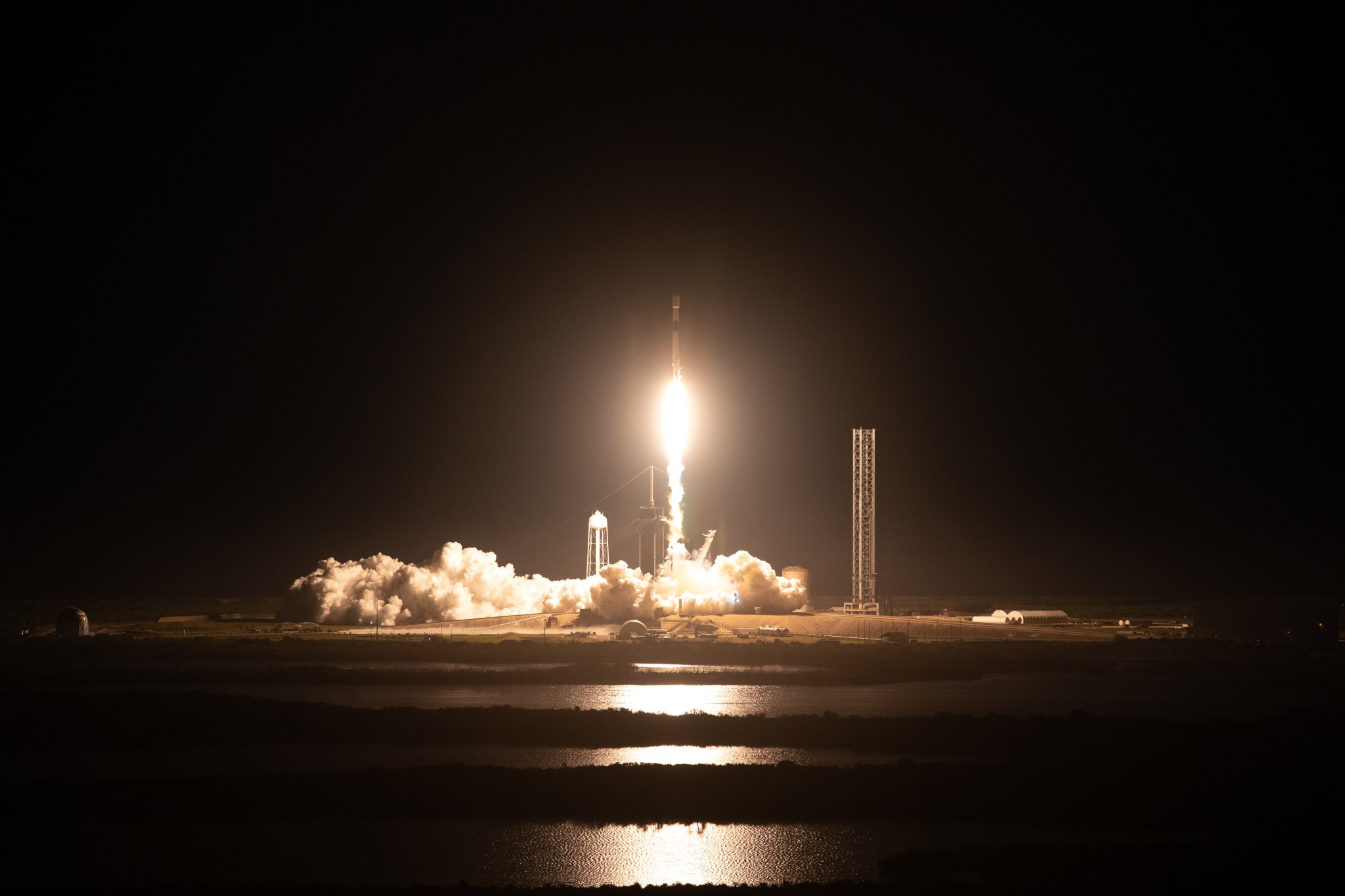
A SpaceX Falcon 9 rocket carrying the Intuitive Machines Nova-C lander takes off from the launch pad at night. The flames coming from the bottom of the rocket (the bright spot at center) light up the surrounding area, illuminating clouds of white vapor that spread outward along the ground. The light also reflects off water in the foreground. Credit: NASA/Kim Shiflett
NASA/Kim Shiflett

At 1:05 a.m. EST on Thursday, Feb. 15, 2024, Intuitive Machines’ Nova-C lunar lander, named Odysseus, lifted off on a SpaceX Falcon 9 rocket from NASA’s Kennedy Space Center in Florida. As part of NASA’s Commercial Lunar Payload Services (CLPS) initiative and Artemis campaign, Intuitive Machines’ first lunar mission will carry NASA science to the Moon to study plume-surface interactions, space weather/lunar surface interactions, radio astronomy, precision landing technologies, and a communication and navigation node for future autonomous navigation technologies.

Odysseus is scheduled to land on the Moon’s South Pole region near the lunar feature known as Malapert A on Thursday, Feb. 22. This relatively flat and safe region is within the otherwise heavily cratered southern highlands on the side of the Moon visible from Earth. Landing near Malapert A will also help mission planners understand how to communicate and send data back to Earth from a location where Earth is low on the lunar horizon.

Image Credit: NASA/Kim Shiflett

Powered by WPeMatico

Get The Details…
Monika Luabeya

NASA Joins Group to Advance Wildfire Coordination, Capabilities

NASA Joins Group to Advance Wildfire Coordination, Capabilities

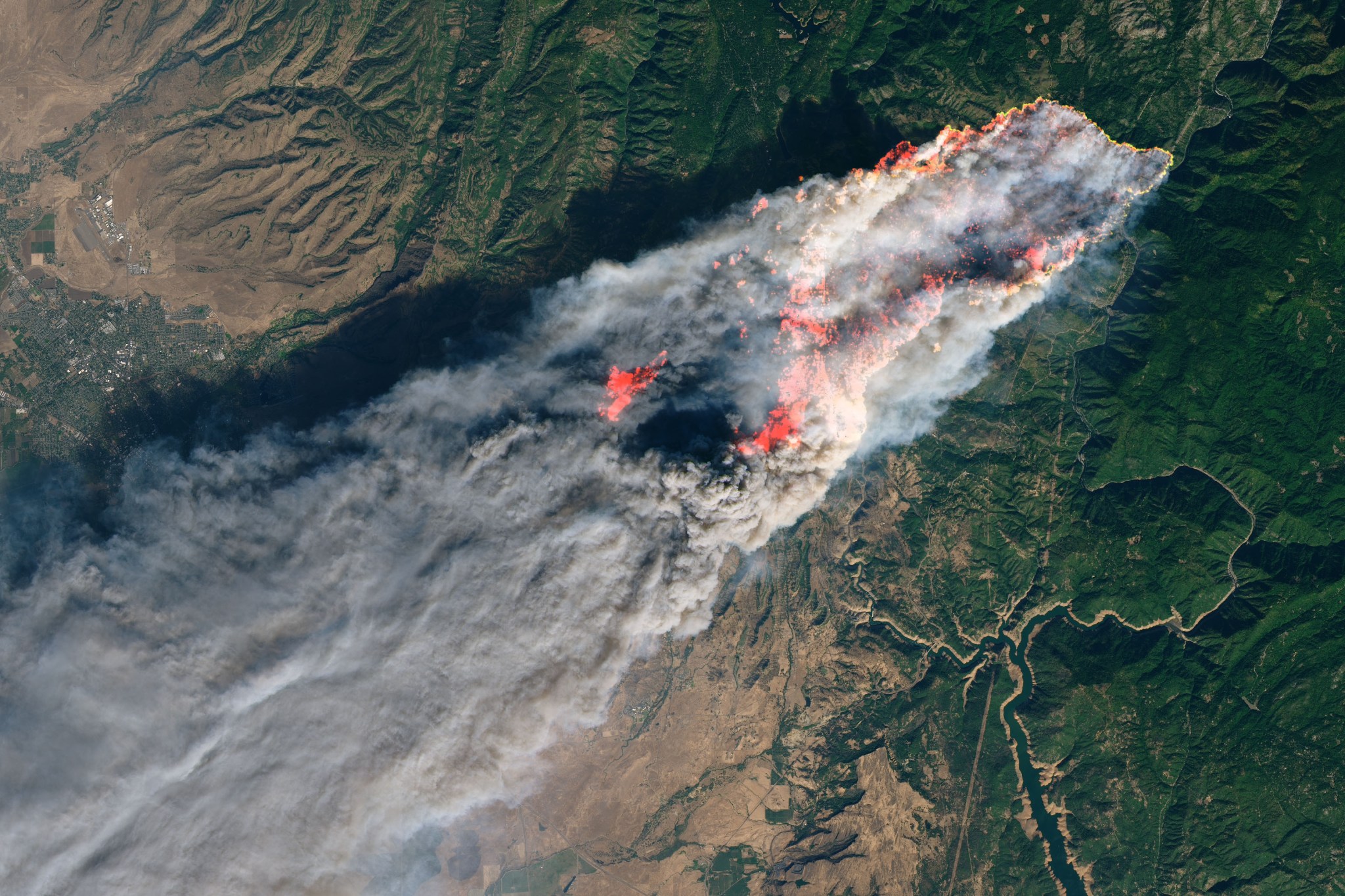
The Camp Fire, which erupted 90 miles (140 kilometers) north of Sacramento, California, as seen from the Landsat 8 spacecraft, which was launched by NASA and operated by the U.S. Geological Survey.
Credit: NASA Earth Observatory image by Joshua Stevens, using Landsat data from the U.S. Geological Survey, and MODIS data from NASA EOSDIS/LANCE and GIBS/Worldview.

NASA is now an associate member of the National Wildfire Coordinating Group, giving the agency new opportunities to collaborate with federal agencies and other partners to better understand wildland fires and leverage technology and innovation to prevent and manage them for the benefit of humanity.

The interagency group provides national leadership to enable interoperable wildland fire operations among federal, state, local, tribal, and territorial partners. The group works to support the National Cohesive Wildland Fire Management Strategy’s goals of restoring and maintaining resilient landscapes, creating fire-adapted communities, and responding to wildfires safely and effectively.

“As wildfires become larger and more frequent, NASA is working to apply our scientific and technological knowledge toward this national challenge, and integral to our approach is forging collaborative partnerships,” said NASA Deputy Administrator Pam Melroy. “Harnessing our Earth observation capabilities and cutting-edge technology in safe air operations, we are poised to make new connections that will bolster wildfire fighting efforts across the government.”

NASA’s inclusion in the coordination group is a step toward enhancing interagency collaboration. As a member, NASA will have opportunities to develop solutions with wildland fire management agencies as partners to share its research and technologies to aid in the development of standards for wildland fire management. NASA has a rich history of research, development, and technology transfer in the areas of Earth science, space technologies, and aeronautics that will support the group’s mission. 

To support the National Wildfire Coordinating Group, NASA will leverage the combined contributions of research and development, data gathering and distribution, and technology transfer from three NASA mission directorates in the areas of earth science, space technologies, and aeronautics. The interagency group membership will help augment NASA’s Wildland Fire Management Initiative, which supports the development, demonstration, and commercialization of wildland fire technology through awards to small businesses, research institutions, and other technology innovators.

“A crucial aspect of the National Wildfire Coordination Group’s role is developing standards for the wildland fire community to enable interoperability,” said Aitor Bidaburu, executive board chair for the group. “With NASA, it will significantly enhance the common operating framework for the interagency wildland fire community.”

NASA’s inclusion also directly supports recommendations the President’s Council of Advisors on Science and Technology made in their 2023 report Modernizing Wildland Firefighting to Protect our Firefighters. Specifically, it recommends agencies:

  • Immediately assess, adapt, and field currently available technologies
  • Strengthen the full operational sequence of wildland firefighting
  • Accelerate improvement of predictive wildfire modeling tools
  • Encourage development and field demonstration of prototype systems to expand the nation’s wildfire response capacity

Primary members of the coordination group include the Department of Agriculture Forest Service, Bureau of Indian Affairs, Bureau of Land Management, National Park Service, U.S. Fish and Wildlife Service, National Association of State Foresters, U.S. Fire Administration, Intertribal Timber Council, the International Association of Fire Chiefs, and the Defense Department. Associate members include the Commerce Department’s National Weather Service, and the Department of the Interior’s Office of Wildland Fire.

-end-

Rob Margetta
Headquarters, Washington
202-763-5012
robert.j.margetta@nasa.gov

Share

Details

Last Updated

Feb 15, 2024

Editor
Jennifer M. Dooren

Related Terms

Powered by WPeMatico

Get The Details…
Jennifer M. Dooren

ROSES-24 is live and OTPS has funding opportunities in sustainability!

ROSES-24 is live and OTPS has funding opportunities in sustainability!

3 min read

Preparations for Next Moonwalk Simulations Underway (and Underwater)

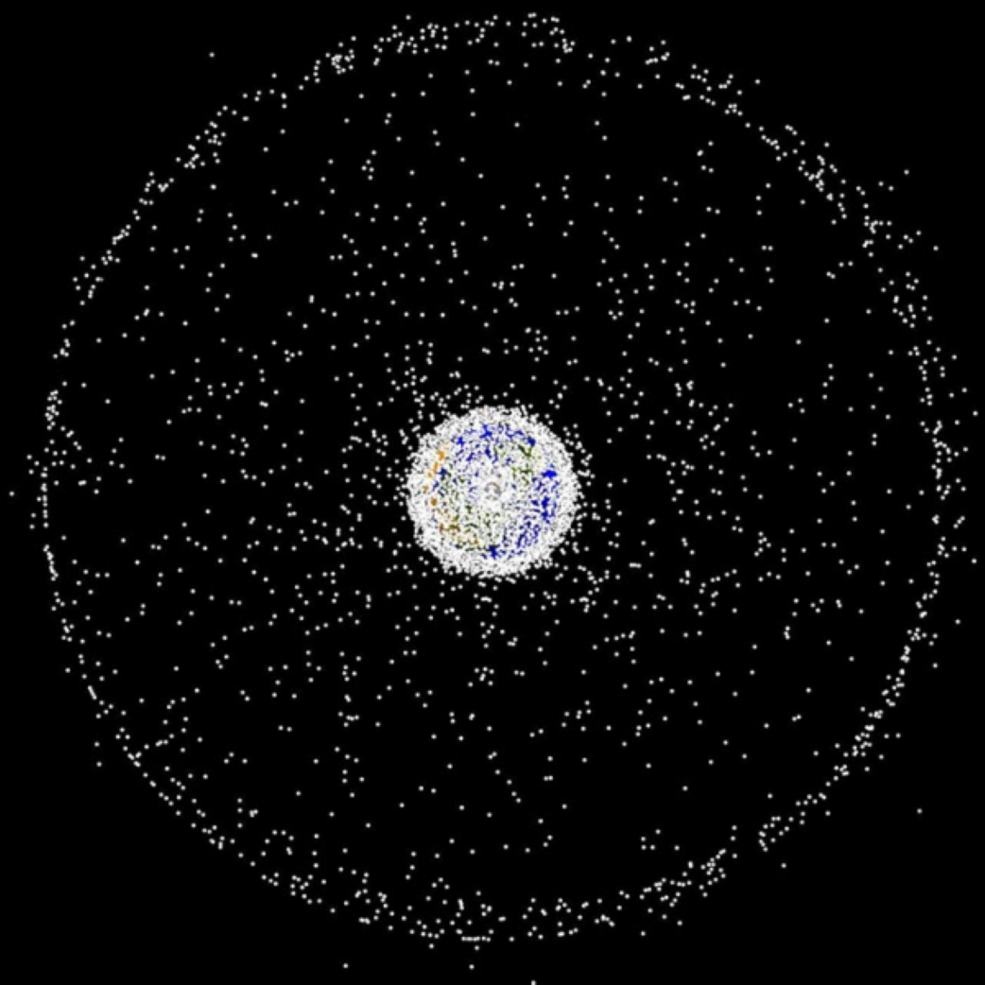
A computer generated image of objects in Earth orbit that are currently being tracked.
A computer generated image of objects in Earth orbit that are currently being tracked. 
Credits: NASA ODPO

NASA’s Office of Technology, Policy & Strategy is soliciting research and analysis related to the social, economic and policy aspects of space sustainability. This topic area is further refined into two separate elements: orbital space sustainability and lunar surface sustainability. OTPS will provide up to $300K (orbital) and $200K (lunar surface) for between 1-3 proposals in each element. Key questions are featured below. 

Orbital Space Sustainability: Economic, Social and Policy Research and Analyses

Proposals should be responsive to one of the following questions:

  • What are current policy, regulatory or legal gaps to improve space sustainability in various orbital regimes (LEO, MEO, GEO, Cislunar, and/or Lunar) and what specific measures should be taken to address them? Proposers may address one or several orbital regimes. 
  • Considering various scenarios for the space environment in the 2040 timeframe, what policies, regulations or other support are forecasted to be needed? Research should take into consideration that potential policies for space sustainability may be incentivized or rendered unnecessary by advancements in technological capabilities and differing assumptions about the future operational environment; therefore, the research should assess the robustness of various policy proposals under realistic assumptions.
  • What are the costs to spacecraft operators from interacting with debris in GEO and Cislunar space? What are the benefits of potential risk-reducing actions?
  • How effective are various policy tools and mechanisms (for example, performance bonds, incentives to improve PMD compliance/fees for bad behavior, global minimum tax, and environmental liability insurance)? How might such interventions impact the business of satellite owners and operators or government owners and operators?

Lunar Surface Sustainability: Economic, Social and Policy Research and Analyses

The sustainable development of the lunar surface acknowledges that current operations may impact our ability to conduct future operations (indeed current operations may also impact other current operations. Whether we seek to protect critical areas for scientific investigation (e.g., Permanently Shadowed Regions), preserve lunar heritage areas (e.g., Apollo sites) or incorporate other technical, economic, or cultural considerations may all factor into our mission planning, policy and potential regulatory approaches. Analyses may help disentangle and characterize the goals of sustainability, develop frameworks for evaluating the sustainability of operations, or compare and contrast the different definitions of sustainability. Proposals should consider both human and robotic missions.

All proposals must be submitted to one of the ROSES calls (F.21 or F.17) by May 17, 2024. Proposers can submit different proposals to each element. However, duplicate proposals submitted to both elements will only be considered for a single element (NASA will make most appropriate determination).

To submit proposals, visit:

Orbital Sustainability

https://nspires.nasaprs.com/external/solicitations/summary!init.do?solId={63F3CFBC-9BC2-7518-9DD5-D1B4887109E5}&path=open

Lunar Surface Sustainability

https://nspires.nasaprs.com/external/solicitations/summary!init.do?solId={48D6B21B-0171-D79D-E111-BCDFCC02E0F0}&path=open

Share

Details

Last Updated

Feb 15, 2024

Editor
Bill Keeter

Related Terms

Powered by WPeMatico

Get The Details…
Bill Keeter

NASA Selects Texas A&M as First Approved Exploration Park Facility

NASA Selects Texas A&M as First Approved Exploration Park Facility

Feb. 15, 2024

RELEASE: J24-003

Director Wyche signing ceremony for Exploration Park
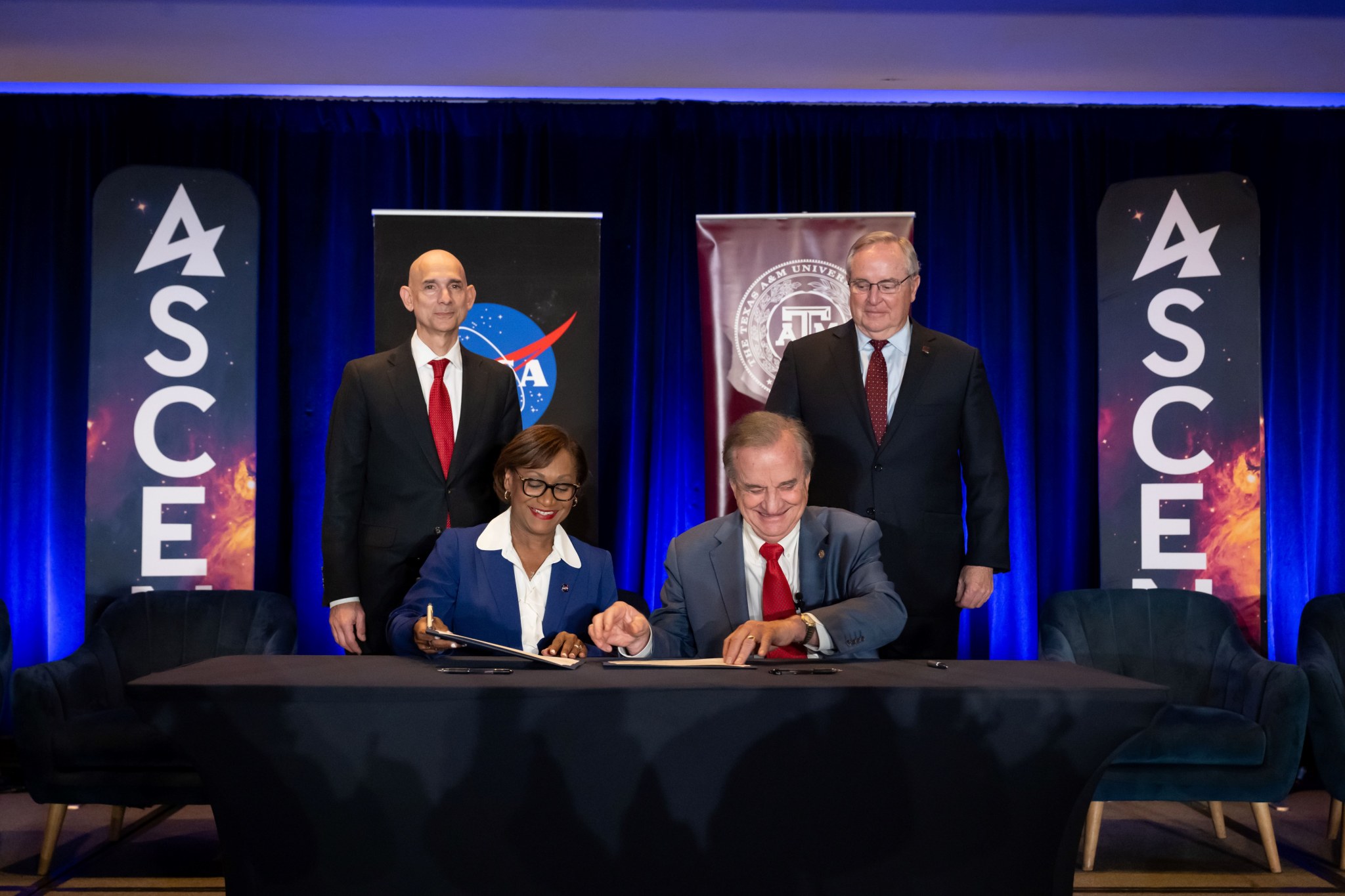
NASA and the Texas A&M University System sign an agreement for a 240-acre Exploration Park on underutilized land at NASA’s Johnson Space Center in Houston. From left: Texas State Rep. Greg Bonnen, NASA Johnson Director Vanessa Wyche, Texas A&M University System Chancellor John Sharp, and Texas A&M University President Mark Welsh III. The announcement of the new lease agreement will allow the A&M System and others to use NASA Johnson land to create facilities for a collaborative environment that increases commercial access and enhances the United States’ commercial competitiveness in the space and aerospace industries. The announcement took place at the AIAA-hosted Ascend Texas (ASCENDxTexas) Conference at South Shore Harbour Conference Center.

NASA Selects Texas A&M as First Approved Exploration Park Facility

NASA and the Texas A&M University System announced an agreement Thursday, Feb. 15, to lease underutilized land in Exploration Park, a 240-acre development at the agency’s Johnson Space Center in Houston. The A&M System will develop a facility to enable human spaceflight research and development that enables the commercial space economy.   

The lease agreement will allow the A&M System and others to use NASA Johnson land to create facilities for a collaborative development environment that increases commercial access and enhances the United States’ commercial competitiveness in the space and aerospace industries. 

NASA Johnson Director Vanessa Wyche, Texas A&M University System Chancellor John Sharp, and Texas A&M University President Mark Welsh III announced the new collaboration at the AIAA-hosted Ascend Texas (ASCENDxTexas) Conference at South Shore Harbour Conference Center.

“For more than 60 years, NASA Johnson has been the hub of human spaceflight,” Wyche said. “Exploration Park will be the next spoke in the larger wheel of a robust and durable space economy that will benefit not only exploration of the Moon, Mars and the asteroids, but all of humanity as the benefits of space exploration research roll home to Earth.”

As the home of Mission Control Center for the agency’s human space missions, astronaut training, human health and space medicine, and leadership of premiere human spaceflight programs and missions, NASA Johnson leads the way for human space exploration. Leveraging this unique role and location, Exploration Park will play a key role in helping the human spaceflight community attain U.S. goals for the commercialization and development of a robust space economy by creating an infrastructure that fosters a multi-use environment where academic researchers, aerospace companies and entrepreneurs can collaborate with NASA and solve space exploration’s greatest challenges.

“The Texas A&M University System has a long history of supporting space-related research, and Texas A&M University has been a space grant university since 1989,” Sharp said. “This new agreement and planned facility will allow us to build on our space tradition and help us to be a major part of the commercial space economy.” NASA issued an announcement for proposals for use of the undeveloped and underutilized land near Saturn Lane on June 9, 2023, and has just completed negotiations with the Texas A&M University System Board of Regents to formalize the lease agreement. The parcel is outside of Johnson’s controlled access area and adjacent to its main campus. NASA will lease the land to the A&M System for an initial period of 20 years, with two additional 20-year options, for a potential total of 60 years.

“For the last 35 years, Texas A&M University has honored its space-grant mission by becoming a powerhouse in human and robotic space exploration,” Welsh said. “This agreement enables us to leverage faculty expertise, establish strategic partnerships and develop resources to foster new discoveries, technological innovations and a future workforce that will benefit Texas and the nation. We are grateful to NASA, the Board of Regents and the State of Texas for their vision and support of Texas A&M’s work in space exploration.”

In the coming years, NASA and its academic, commercial, and international partners will see the completion of the International Space Station Program, the commercial development of low Earth orbit, and the first human Artemis campaign missions establishing a sustainable human presence on the Moon in preparation for human missions to Mars.

Johnson already is leading the commercialization of space with the commercial cargo and crew programs and private astronaut missions to the space station. The center also is supporting the development of commercial space stations in low Earth orbit, and lunar-capable commercial spacesuits and lunar landers that will be provided as services to both NASA and the private sector to accelerate human access to space. Through the development of Exploration Park, the center will broaden the scope of the human spaceflight community that is tackling the many difficult challenges ahead.

-end-

Kelly Humphries

Johnson Space Center, Houston
281-483-5111
kelly.o.humphries@nasa.gov

Powered by WPeMatico

Get The Details…
Kelly O. Humphries

NASA Experiment Sheds Light on Highly Charged Moon Dust

NASA Experiment Sheds Light on Highly Charged Moon Dust

Photo of New Shepard crew capsule
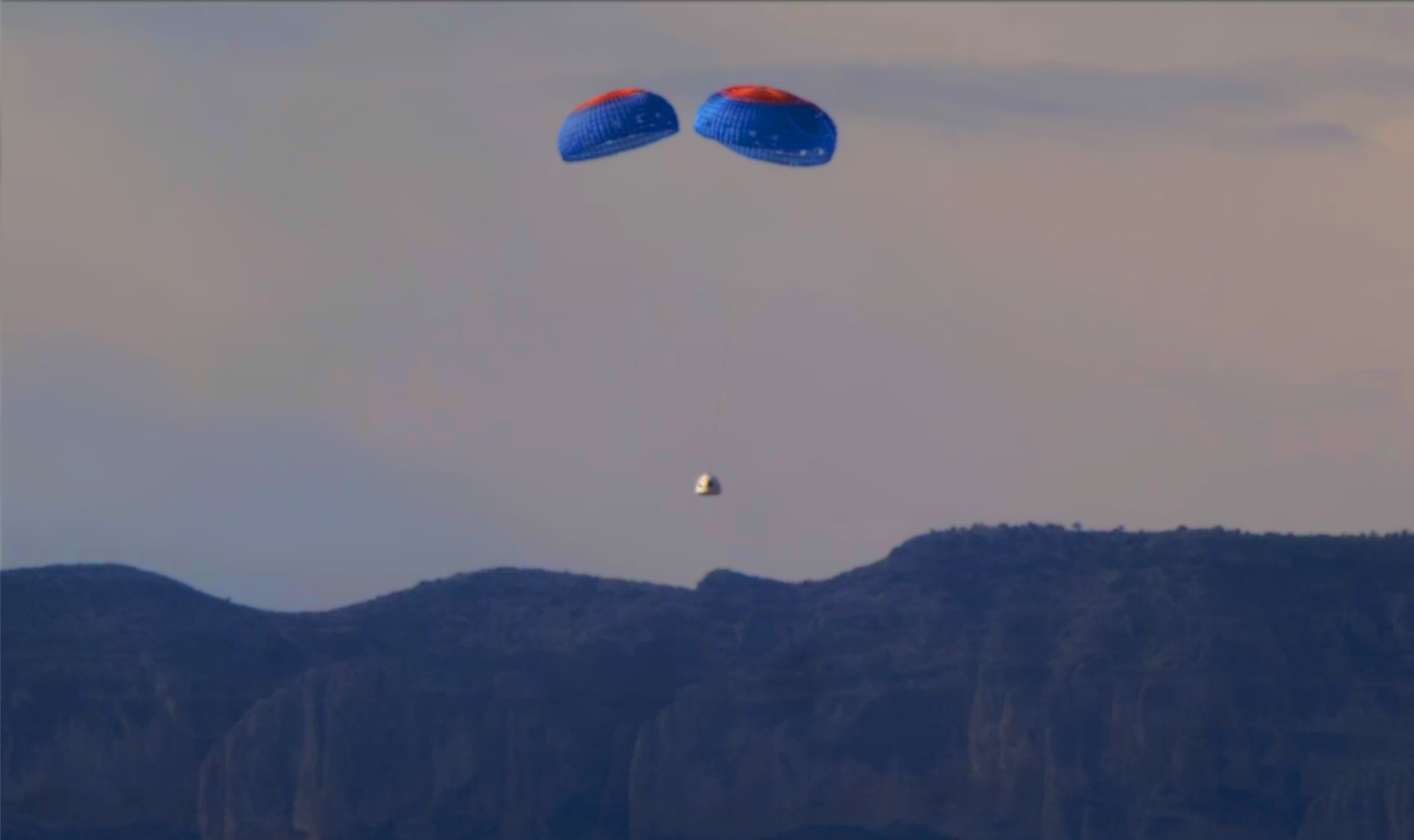
The New Shepard crew capsule descends under parachutes during its launch Tuesday, Dec. 19, 2023.
Photo Credit: Blue Origin

Researchers are studying data from a recent suborbital flight test to better understand lunar regolith, or Moon dust, and its potentially damaging effects as NASA prepares to send astronauts back to the lunar surface under the Artemis campaign. The experiment, developed jointly by NASA and the University of Central Florida, sheds light on how these abrasive dust grains interact with astronauts, their spacesuits, and other equipment on the Moon. 

The Electrostatic Regolith Interaction Experiment (ERIE) was one of 14 NASA-supported payloads launched on Dec. 19 aboard Blue Origin’s New Shepard uncrewed rocket from Launch Site One in West Texas. During the flight test, ERIE collected data to help researchers at the agency’s Kennedy Space Center in Florida study tribocharging, or friction-induced charges, in microgravity.  

The Moon is highly charged by phenomena such as solar wind and ultraviolet light from the Sun. Under those conditions, regolith grains are attracted to lunar explorers and their equipment – think of it as similar to the static created by rubbing a balloon on a person’s head. Enough regolith can cause instruments to overheat or not function as intended.  

“For example, if you get dust on an astronaut suit and bring it back into the habitat, that dust could unstick and fly around the cabin,” said Krystal Acosta, a researcher for NASA’s triboelectric sensor board component inside the ERIE payload. “One of the major problems is that there’s no way to electrically ground anything on the Moon. So even a lander, rover, or really any object on the Moon will have polarity to it. There’s no good solution to the dust charging problem right now.” 

A Kennedy team designed and built the triboelectric sensor board inside the ERIE payload, which reached an altitude of 351,248 feet aboard New Shepard. In the microgravity phase of this flight, dust grains simulating regolith particles brushed up against eight insulators within ERIE, creating a tribocharge. The electrometer measured the negative and positive charge of the simulated regolith as it traveled through an electric field applied during microgravity. 

“We want to know what causes the dust to charge, how it moves around, and where it ultimately settles. The dust has rough edges that can scratch surfaces and block thermal radiators,” said Jay Phillips, lead of Electrostatics Environments and Spacecraft Charging at NASA Kennedy. 

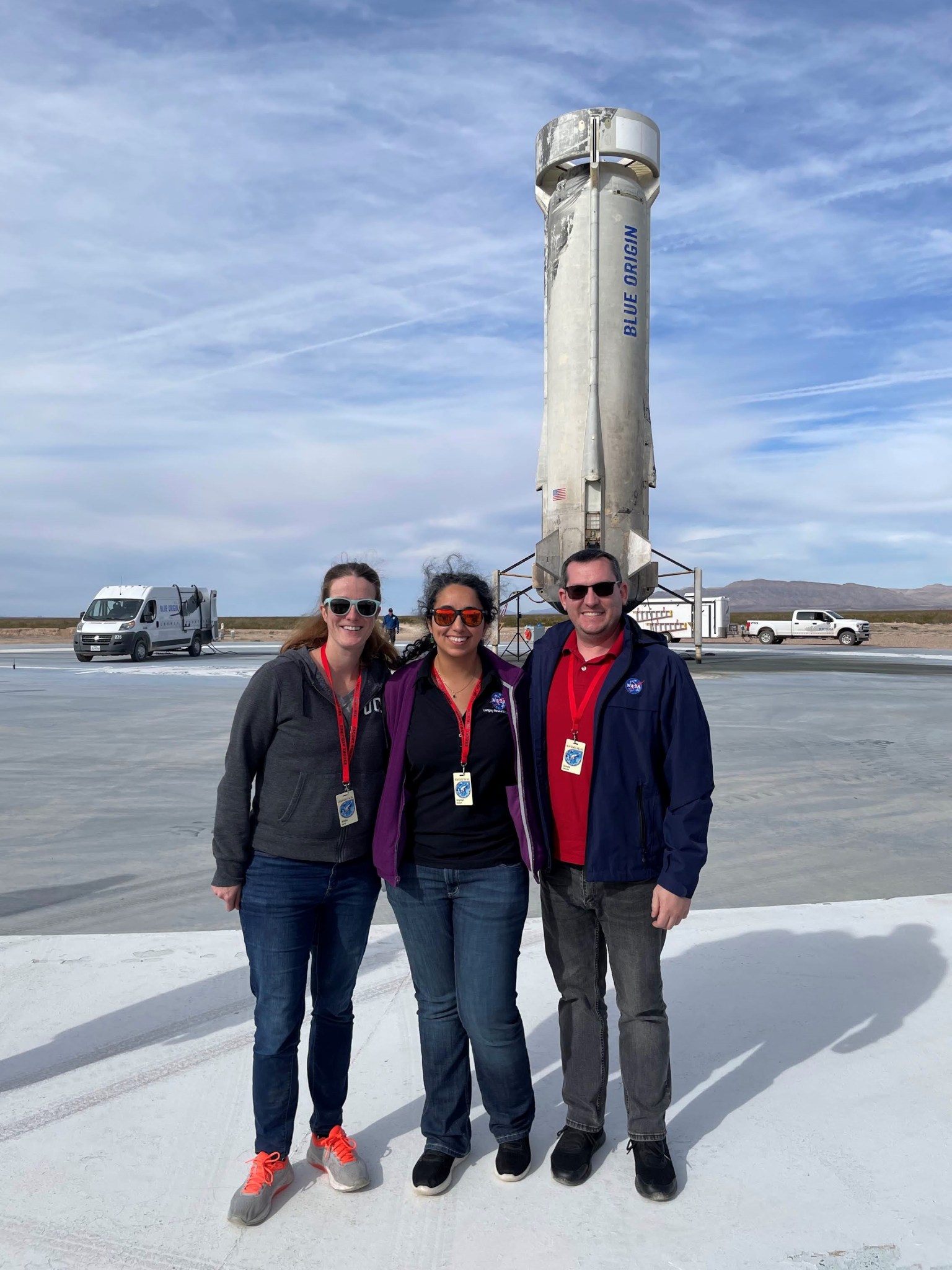
University of Florida and NASA physicists who worked on the ERIE payload pose with Blue Origin booster after launch Tuesday, Dec. 19, 2023.
University of Central Florida (UCF) and NASA physicists who worked on the ERIE payload pose with Blue Origin booster after launch Tuesday, Dec. 19, 2023. From left to right, Addie Dove, UCF PI for ERIE, Krystal Acosta, NASA researcher, and Jay Phillips, NASA researcher.

The ERIE payload spent approximately three minutes in microgravity during the New Shepard capsule’s suborbital flight, which lasted about 10 minutes before landing safely back on Earth in the Texas desert. A camera recorded the interactions, and Philips and his team are reviewing the data.  

The results will inform applications for future missions destined for the lunar surface. For example, by using triboelectric sensors on a rover’s wheels, astronauts can measure the positive and negative charges between the vehicle and regolith on the lunar surface. The end goal is to develop technologies that will help keep it from sticking to and damaging astronaut suits and electronics during missions. 

The flight was supported by the Flight Opportunities program, part of NASA’s Space Technology Mission Directorate, which rapidly demonstrates space technologies with industry flight providers. 

Powered by WPeMatico

Get The Details…
Elyna N. Niles-Carnes