Crew Wraps Final Spacewalk Preparations

Crew Wraps Final Spacewalk Preparations

NASA astronaut and Expedition 74 flight engineer Jessica Meir’s reflection is captured in a spacesuit helmet visor. The visor assembly is coated with a microscopic layer of gold that reflects infrared radiation to protect an astronaut’s eyes while allowing visible light to pass through. Meir was working inside the International Space Station's Quest airlock, installing leg and arm components on the spacesuit and swapping components from one suit to another.
NASA astronaut and Expedition 74 flight engineer Jessica Meir’s reflection is captured in a spacesuit helmet visor. The visor assembly is coated with a microscopic layer of gold that reflects infrared radiation to protect an astronaut’s eyes while allowing visible light to pass through. Meir was working inside the International Space Station’s Quest airlock, installing leg and arm components on the spacesuit and swapping components from one suit to another.
NASA/Jack Hathaway

Tuesday brought the final preparations for tomorrow’s spacewalk where two NASA astronauts will exit the International Space Station and enter the vacuum of space for space station solar array upgrade work. The Expedition 74 crew members prepped spacesuits and reviewed procedures while working in some time for maintenance and science activities.

NASA astronauts Jessica Meir and Chris Williams will power on their spacesuits tomorrow morning for a planned six-and-a-half-hour spacewalk. The duo will exit the Quest airlock to install a modification kit and route cables on the port side of the station. It will be Meir’s fourth spacewalk and Williams’ first.

NASA’s live coverage will begin at 6:30 a.m. on  NASA+Amazon Prime, and the agency’s YouTube channel. U.S. spacewalk 94 will begin at approximately 8 a.m. 

To gear up for tomorrow’s spacewalk, Meir and Williams readied their spacesuits and equipment and also finalized the configuration of tools they’ll use while in the vacuum of space. Later on, the duo was joined by NASA astronaut Jack Hathaway and European Space Agency (ESA) astronaut Sophie Adenot to review procedural timelines and checklists.

Hathaway and Adenot teamed up throughout the day to complete a round of camera and lighting training. The duo also inspected and cleaned the orbital complex’s ventilation system.

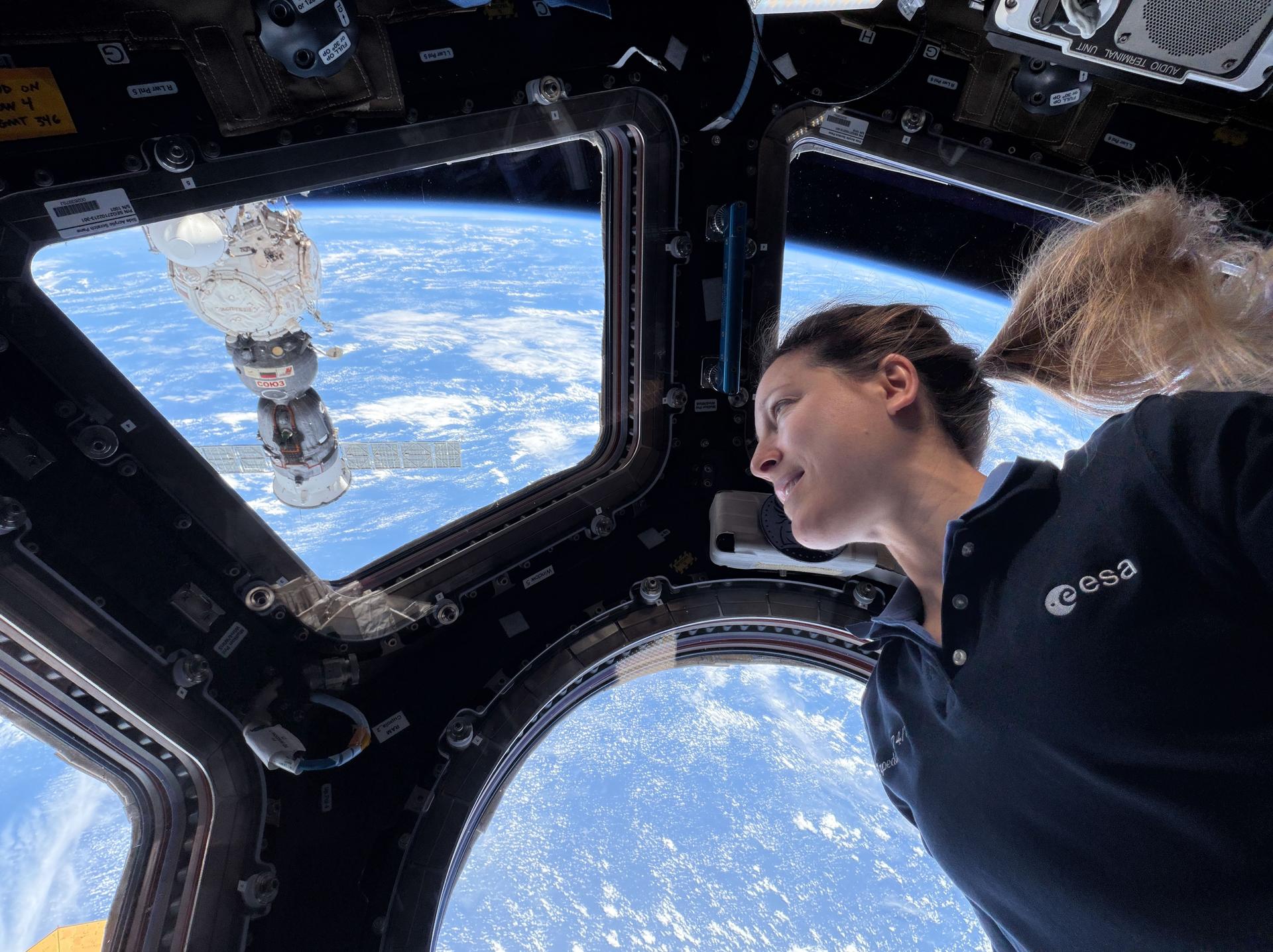
In the cupola, Adenot scheduled in some time to photograph the Moon. As part of the Earthshine experiment, crew members will take photographs of the lunar surface during different phases to study changes in Earth’s reflectance of light. The photos are then analyzed by ground teams to help scientists improve climate models. 

In the morning, Commander Sergey Kud-Sverchkov worked with flight engineer Sergei Mikaev to load up and prepare flight simulation training software. Later on, the two cosmonauts worked in the Zvezda Service Module to gather equipment for future inspections. Kud-Sverchkov then took inventory of cargo to be loaded into the Progress 93 cargo spacecraft while Mikaev filmed his crewmates as they conducted science, maintenance, and exercise to document life aboard the space station. Flight engineer Andrey Fedyaev spent his day conducting maintenance before attaching sensors to his forehead, fingers and toes to capture blood flow data for health analysis.

Learn more about station activities by following the space station blog@space_station on X, as well as the ISS Facebook and ISS Instagram accounts.

Get the latest from NASA delivered every week. Subscribe here.

Powered by WPeMatico

Get The Details…

Abby Graf

Progress 92 Cargo Spacecraft Undocks, Crew Preps for Upcoming Spacewalk

Progress 92 Cargo Spacecraft Undocks, Crew Preps for Upcoming Spacewalk

NASA astronauts Jessica Meir and Chris Williams, both Expedition 74 flight engineers, familiarize themselves with the hardware they will use to install a modification kit and route cables on the port side of the International Space Station. The duo will conduct a spacewalk using the hardware to prepare the orbital outpost for a future roll‑out solar array that will be installed during a later spacewalk.
NASA/Jack Hathaway

Spacewalk preparations and the undocking of a cargo spacecraft kicked off the week for the Expedition 74 crew aboard the International Space Station.

The unpiloted Progress 92 cargo spacecraft undocked from the Poisk module at 9:24 a.m. EDT today. The spacecraft backed away from the station for a deorbit maneuver and a planned destructive re-entry into Earth’s atmosphere to dispose of trash loaded by the crew. 

Aboard the orbital outpost, NASA astronauts Chris Williams and Jessica Meir spent most of their day gearing up for this week’s planned spacewalk. The duo collected vital signs, replaced spacesuit batteries, and worked together in the Quest airlock to continue the configuration of tools they’ll use while in the vacuum of space. Williams and Meir will exit the Quest airlock around 8:00 a.m. Wednesday, March 18, to install a modification kit and route cables on the port side of the station. Their work readies for the next roll-out solar array to be installed during a later spacewalk.

NASA will preview the upcoming spacewalks during a news conference today at 2:00 p.m. Stream on the agency’s YouTube.

In the Tranquility module, NASA astronaut Jack Hathaway spent most of the day conducting maintenance on the station’s water recovery system. He later swapped out some spacesuit helmet lights before moving into the Destiny laboratory module to change out cassettes in ADSEP-2, or the Advanced Space Experiment Processor. The multipurpose facility uses cassettes to house and process various samples for biological and physical science experiments, such as cell and tissue culturing, protein crystal growth, microorganism and bacteria studies, and more.

European Space Agency (ESA) astronaut Sophie Adenot measured her cardiovascular health on Monday. Ahead of a cycle session on the orbital complex’s bicycle, CEVIS, she donned the Bio-Monitor, which includes an instrumented garment and headband to track an array of vital signs, including heart activity, blood pressure, physical activity levels, and more. She later logged the data then stowed the hardware for future use before joining Hathaway to assist with maintenance.

The station’s three cosmonauts kept busy Monday with a variety of activities. Commander Sergey Kud-Sverchkov started the day photographing payload equipment for documentation and inspected voltage converters. He was later joined by flight engineer Sergei Mikaev to log daily work activities and test communications software. Mikaev also teamed up with flight engineer Andrey Fedyaev to conduct physical fitness assessments, wearing sensors that track their blood pressure and electrical activity in their hearts.

Learn more about station activities by following the space station blog@space_station on X, as well as the ISS Facebook and ISS Instagram accounts.

Get the latest from NASA delivered every week. Subscribe here.

Powered by WPeMatico

Get The Details…

Abby Graf

Roscosmos Progress Cargo Spacecraft Departs Station

Roscosmos Progress Cargo Spacecraft Departs Station

March 16, 2026: International Space Station Configuration. Three spaceships are parked at the space station including the SpaceX Crew-12 Dragon, the Soyuz MS-28 crew ship, and the Progress 93 resupply ship.
NASA

The unpiloted Roscosmos Progress 92 spacecraft undocked from the International Space Station at 9:24 a.m. EDT Monday, backing away for a deorbit maneuver and a planned destructive re-entry into Earth’s atmosphere to dispose of trash loaded by the crew. 

The spacecraft launched in July 2025 on a Soyuz rocket from the Baikonur Cosmodrome in Kazakhstan, carrying about three tons of food, fuel, and supplies for the space station’s crew. After a two-day journey, it arrived at the orbiting laboratory and automatically docked to the space-facing port of the Poisk module. 

Learn more about station activities by following the space station blog, @space_station on X, as well as the ISS Facebook and ISS Instagram accounts.

Get the latest from NASA delivered every week. Subscribe here.

Powered by WPeMatico

Get The Details…

Mark A. Garcia

Week Wraps with Space Biology, Spacewalk Preps, and Space Station Reboost

Week Wraps with Space Biology, Spacewalk Preps, and Space Station Reboost

NASA astronauts Chris Williams and Jessica Meir, both Expedition 74 flight engineers, inspect and configure a spacesuit jetpack, known as the Simplified Aid for EVA Rescue (SAFER), inside the International Space Station’s Destiny laboratory module. The jetpacks attach to the rear of spacesuits and serve as a safety mechanism that allows a spacewalker to maneuver back to the station in the unlikely event they become untethered from their worksite.
NASA astronauts Chris Williams and Jessica Meir inspect and configure a spacesuit jetpack inside the International Space Station’s Destiny laboratory module. The jetpacks attach to the rear of spacesuits and serve as a safety mechanism that allows a spacewalker to maneuver back to the station in the unlikely event they become untethered from their worksite.
NASA/Chris Williams

Science hardware maintenance filled the day for the Expedition 74 crew following the release of two cargo spacecraft in less than a week at the International Space Station. The orbital residents also continued more reviews for next week’s spacewalk, kept up their ongoing human research program, and readied another spacecraft for departure.

Northrop Grumman’s Cygnus XL cargo spacecraft completed its resupply mission to the orbital outpost when the Candarm2 robotic arm released it into Earth orbit at 7:06 a.m. EDT on Thursday, March 12. It will reenter the atmosphere for a fiery, but safe demise above the South Pacific Ocean on Saturday. JAXA’s (Japan Aerospace Exploration Agency) HTV-X1 cargo spacecraft left the space station on Friday, March 6, when the Canadarm2 released it. HTV-X1 will orbit Earth for several more weeks of remotely controlled science experiments before an atmospheric reentry above the South Pacific.

Working inside the orbiting lab’s Kibo laboratory module, NASA flight engineers Chris Williams and Jack Hathaway completed the workweek servicing a variety of research gear ensuring continuous operations of microgravity science. Williams swapped a large centrifuge for a smaller centrifuge inside Kibo’s Saibo rack to support future biology experiments. Hathaway replaced an obsolete high-definition video camera with an upgraded one inside Kibo’s airlock that will be placed outside of the station to capture Earth imagery and spacecraft arriving and departing at the orbital outpost.

Williams then joined NASA flight engineer Jessica Meir at the end of their shift and called down to mission controllers to discuss procedures for a spacewalk scheduled on Wednesday, March 18. The team reviewed the spacewalking tools and tasks necessary to install a modification kit and route cables on the port side of the orbital outpost. The external maintenance work will enable the next roll-out solar array to be installed on a future spacewalk after it is delivered on a SpaceX Dragon spacecraft.

Earlier, Meir began her shift with flight engineer Sophie Adenot of ESA (European Space Agency) in the Columbus laboratory module and helped her set up the PhysioTool health monitoring experiment. Meir helped Adenot attach portable sensors on her body measuring a variety of health parameters including heart, lung, and brain activity. Results may enable more comprehensive biomedical data of the effects of living and working in weightlessness.

Roscosmos cosmonauts Sergey Kud-Sverchkov and Sergei Mikaev wrapped up a weeklong cardiac study observing how weightlessness impacts a crew member’s circulatory system. The station commander and flight engineer, respectively, once again attached sensors on their forehead, fingers, and toes that sent their blood flow data by Bluetooth adaptor to a laptop computer for analysis. Kud-Sverchkov started his shift checking the operation of lights throughout the station’s Roscosmos segment. Mikaev prepared the trash-packed Progress 92 cargo spacecraft for its upcoming departure by disconnecting docking components and closing the hatch.

Roscosmos flight engineer Andrey Fedyaev kicked off his shift replacing orbital plumbing components and checking their functionality inside the Zarya module. Next, Fedyaev transferred fluids between tanks and removed air bubbles as part of maintenance for the Zvezda service module’s Elektron oxygen generator. Finally, the two-time station resident filmed his crewmates as they were going about science, maintenance, and exercise activities to document life onboard the International Space Station.

The International Space Station is orbiting higher today after the Progress 93 cargo spacecraft, docked to the Zvezda service module’s aft port, fired its engines for 10 minutes, 30 seconds at 11:58 a.m. EDT. The reboost increased the space station’s altitude by half a mile at apogee and nine-tenths of a mile at perigee, leaving the station in an orbit of 266 x 257 statute miles. 

Powered by WPeMatico

Get The Details…

Mark A. Garcia

Canadarm2 Releases Cygnus XL Spacecraft Ending Cargo Mission

Canadarm2 Releases Cygnus XL Spacecraft Ending Cargo Mission

The Cygnus XL cargo spacecraft departs the International Space Station after its release from the Canadarm2 robotic arm.
The Cygnus XL cargo spacecraft, with its prominent cymbal-shaped UltraFlex solar arrays, departs the International Space Station after its release from the Canadarm2 robotic arm.
NASA+

At 7:06 a.m. EDT, Northrop Grumman’s Cygnus XL was released from the Canadarm2 robotic arm, which earlier detached the cargo spacecraft from the Earth-facing port of the International Space Station’s Unity module. At the time of release, the station was flying about 260 miles over the south Atlantic Ocean.

The Cygnus XL spacecraft successfully departed the space station more than seven months after arriving at the orbiting laboratory to deliver about 11,000 pounds of supplies, scientific investigations, commercial products, hardware and other cargo for NASA and its international partners.

The spacecraft will be commanded to deorbit on Saturday, March 14, to dispose of several thousand pounds of trash during its re-entry into Earth’s atmosphere, where it will harmlessly burn up.

Learn more about station activities by following the space station blog, @space_station on X, as well as the ISS Facebook and ISS Instagram accounts.

Get the latest from NASA delivered every week. Subscribe here.

Powered by WPeMatico

Get The Details…

Mark A. Garcia