Spacewalk Preps and Health Checks Using Augmented Reality, Artificial Intelligence

Spacewalk Preps and Health Checks Using Augmented Reality, Artificial Intelligence

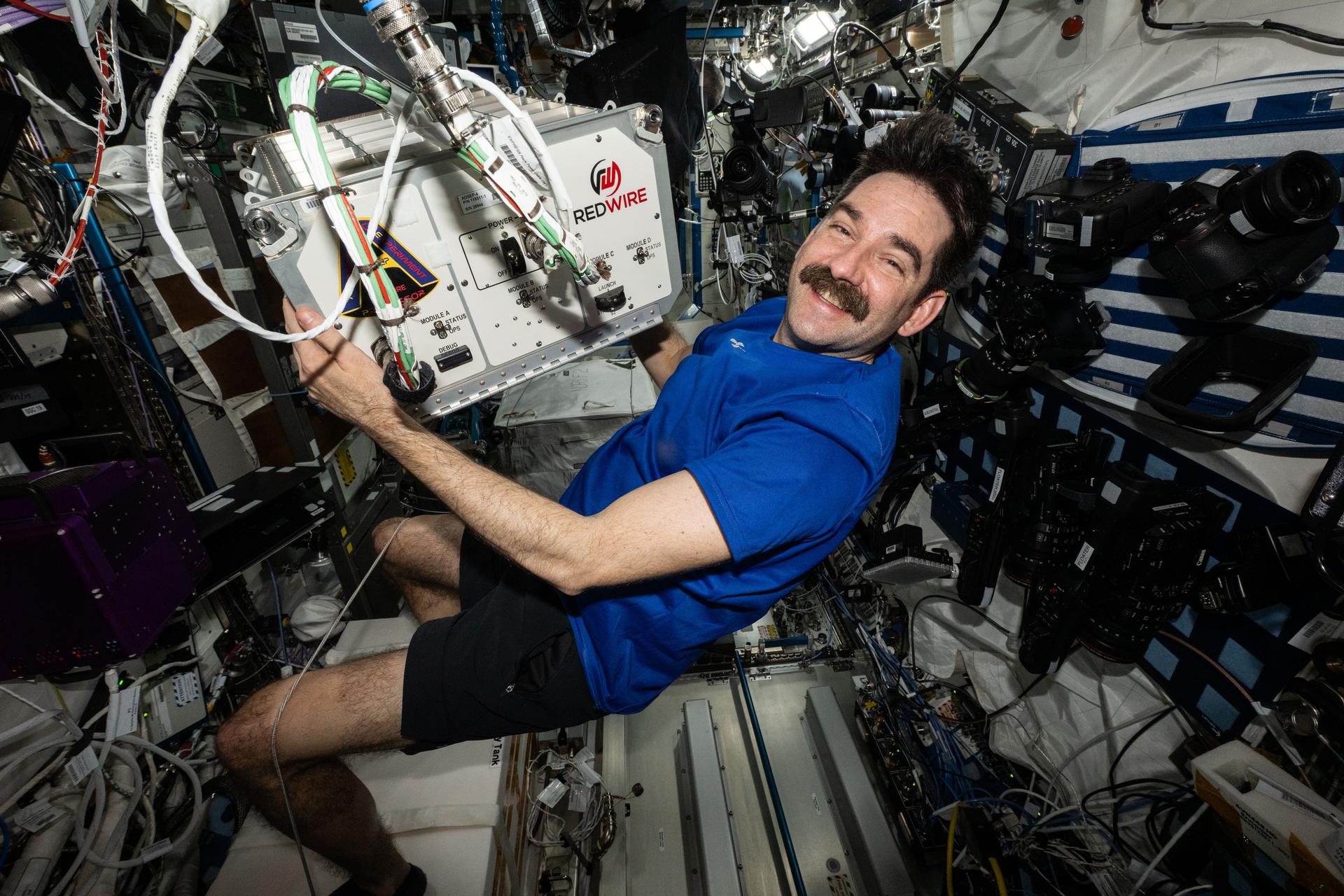
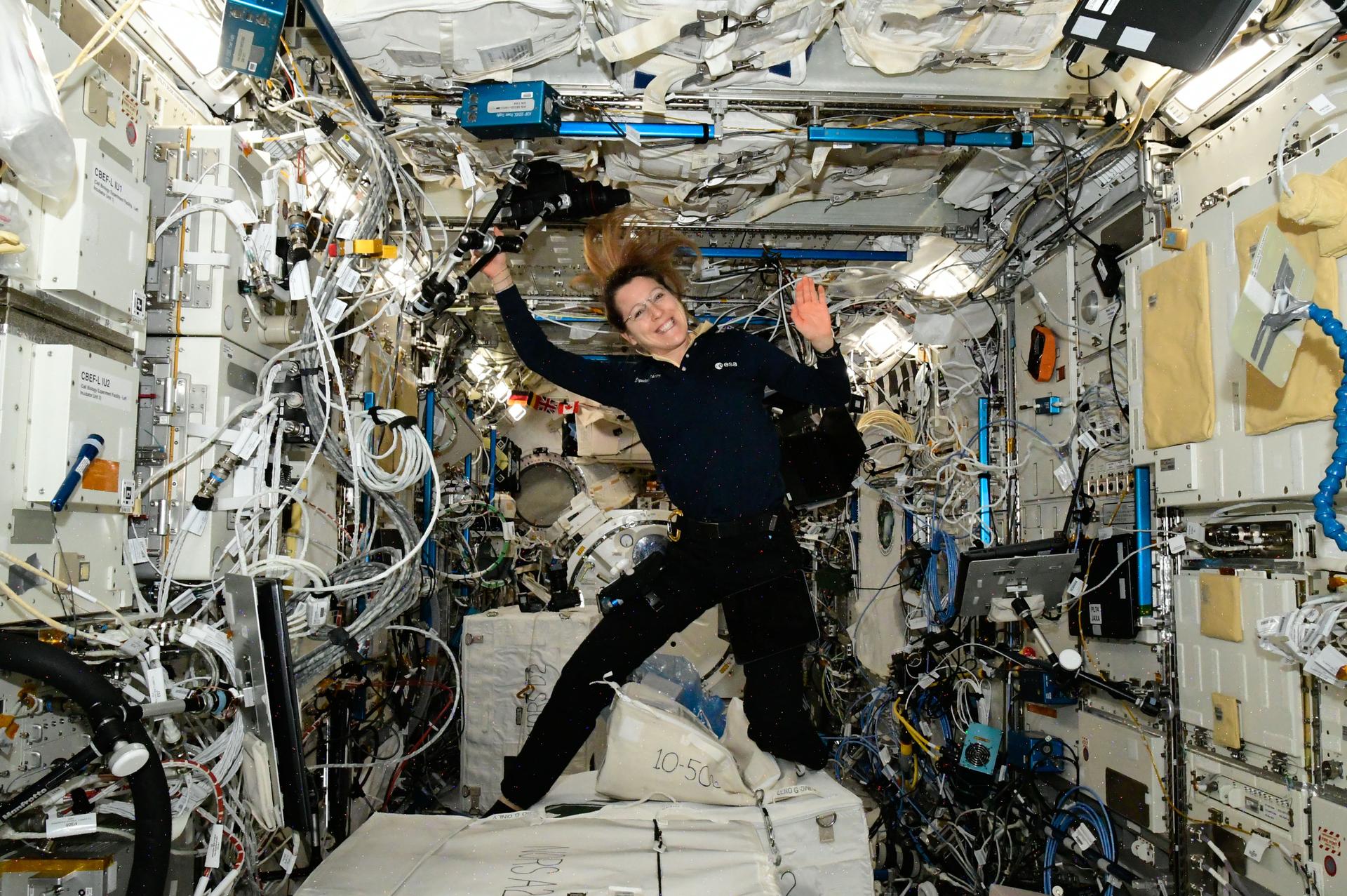
NASA astronaut and Expedition 74 flight engineer Jack Hathaway smiles for a portrait inside the International Space Station’s cupola while photographing a sample chamber for the Rhodium Biomanufacturing 03 biotechnology experiment. The investigation uses living systems such as microorganisms and cell cultures to produce materials and biomolecules on a commercial scale. Results may support the production of food, pharmaceuticals, and other materials during long‑duration spaceflight.
NASA astronaut Jack Hathaway smiles for a portrait inside the International Space Station’s cupola while photographing scientific hardware for a biomanufacturing experiment.
NASA/Jack Hathaway

Spacewalk preparations are underway aboard the International Space Station as two astronauts check their spacesuits and review procedures. The Expedition 74 crew also experimented with augmented reality and artificial intelligence to conduct health checks in space. Meanwhile, a U.S. cargo spacecraft nears it departure this week.

NASA flight engineers Jessica Meir and Chris Williams joined each other on Monday working on a pair of spacesuits and reviewing procedures for a spacewalk targeted for March 18. The duo partnered up in the Quest airlock and cleaned the suit cooling loops that regulate an astronaut’s temperature during a spacewalk. Meir and Williams also refilled suit components with water, inspected a suit helmet, and prepared Quest for the upcoming spacewalk operations.

The astronauts also reviewed the procedures they will use after they exit Quest in their spacesuits for a six-and-a-half-hour spacewalk. Meir and Williams will install a modification kit and route cables on the port side of the orbital outpost for a future roll-out solar array. The seventh roll-out solar array will be installed on a later spacewalk to augment the main solar arrays’ power generation capabilities.

Flight engineers Jack Hathaway of NASA and Sophie Adenot of ESA (European Space Agency) took turns performing augmented‑reality‑guided ultrasound scans using the EchoFinder-2 biomedical device inside the Columbus laboratory module. After each crew member scanned the other’s abdomen and vascular system, artificial intelligence analyzed the ultrasound image and confirmed organ identification. The objective of the human research study is to reduce reliance on ground support for medical procedures as a space crew flies farther away from Earth.

Roscosmos cosmonauts Sergey Kud-Sverchkov and Sergei Mikaev teamed up on a pair of biology experiments Monday both observing the human circulatory system in weightlessness. First, the station commander and flight engineer measured their blood pressure and more while wearing arm, wrist, and finger cuffs. Afterward, the duo applied sensors to their forehead, fingers, and toes that sent their blood flow data by Bluetooth adaptor to a laptop computer where it was recorded for analysis. Doctors will use the biomedical data to understand how living in space affects vascular health.

Flight engineer Andrey Fedyaev primarily spent his day on life support maintenance throughout the orbital outpost’s Roscosmos segment. During the first half of his shift, Fedyaev serviced the Elektron oxygen generator purging the device of nitrogen and repressurizing its components inside the Zvezda service module. After lunchtime, he filtered and transferred water between tanks to ensure the station’s drinking‑water supply chain remains clean and uncontaminated.

Northrop Grumman’s Cygnus XL cargo spacecraft is due to depart the station Thursday, March 12, ending a near six-month stay that began on Sept. 18, 2025. The astronauts will finalize packing Cygnus with trash and disposable cargo midweek then configure the spacecraft for its robotic removal from the Unity module. Afterward, robotics controllers will remotely command the Canadarm2 robotic arm to uninstall Cygnus from Unity then release it into Earth orbit for a fiery, but safe reentry above the South Pacific Ocean.

Watch NASA’s live coverage of undocking and departure beginning at 6:45 a.m. EDT on NASA+Amazon Prime, and the agency’s YouTube channel. Learn how to watch NASA content through a variety of online platforms, including social media.

Learn more about station activities by following the space station blog, @space_station on X, as well as the ISS Facebook and ISS Instagram accounts.

Get the latest from NASA delivered every week. Subscribe here.

Powered by WPeMatico

Get The Details…

Mark A. Garcia

Canadian Robotic Arm Releases Japan’s Spacecraft for Departure

Canadian Robotic Arm Releases Japan’s Spacecraft for Departure

Japan's HTV-X1 cargo spacecraft departs the International Space Station after its release from the Canadarm2 robotic arm with Earth in the background.
Japan’s HTV-X1 cargo spacecraft departs the International Space Station after its release from the Canadarm2 robotic arm with Earth in the background.
NASA+

At 12 p.m. EST, JAXA’s (Japan Aerospace Exploration Agency’s) HTV-X1 cargo spacecraft was released from the International Space Station’s Canadarm2 robotic arm, which earlier detached it from the Earth-facing port of the orbiting laboratory’s Harmony module. At the time of release, the station was flying about 260 miles over the Pacific Ocean. 

The HTV-X1 spacecraft successfully departed the station more than four months after arriving to deliver more than 9,000 pounds of supplies, scientific investigations, commercial products, hardware and other cargo for NASA and its international partners. 

Learn more about station activities by following the space station blog, @space_station on X, as well as the ISS Facebook and ISS Instagram accounts.

Get the latest from NASA delivered every week. Subscribe here.

Powered by WPeMatico

Get The Details…

Mark A. Garcia

Canadian Robotic Arm Releases Japan’s Spacecraft for Departure

Canadian Robotic Arm Releases Japan’s Spacecraft for Departure

Japan's HTV-X1 cargo spacecraft departs the International Space Station after its release from the Canadarm2 robotic arm with Earth in the background.
Japan’s HTV-X1 cargo spacecraft departs the International Space Station after its release from the Canadarm2 robotic arm with Earth in the background.
NASA+

At 12 p.m. EST, JAXA’s (Japan Aerospace Exploration Agency’s) HTV-X1 cargo spacecraft was released from the International Space Station’s Canadarm2 robotic arm, which earlier detached it from the Earth-facing port of the orbiting laboratory’s Harmony module. At the time of release, the station was flying about 260 miles over the Pacific Ocean. 

The HTV-X1 spacecraft successfully departed the station more than four months after arriving to deliver more than 9,000 pounds of supplies, scientific investigations, commercial products, hardware and other cargo for NASA and its international partners. 

Learn more about station activities by following the space station blog, @space_station on X, as well as the ISS Facebook and ISS Instagram accounts.

Get the latest from NASA delivered every week. Subscribe here.

Powered by WPeMatico

Get The Details…

Mark A. Garcia

Japan Spacecraft Departing Station Soon on NASA+

Japan Spacecraft Departing Station Soon on NASA+

The new HTV-X1 cargo spacecraft from JAXA (Japan Aerospace Exploration Agency), carrying about 12,800 pounds of science, supplies, and hardware for the Expedition 73 crew, is pictured in the grip of the Canadarm2 robotic arm. JAXA astronaut and Expedition 73 Flight Engineer Kimiya Yui (not pictured) commanded Canadarm2 to gently reach out and capture HTV-X1 when the spacecraft reached a point about 10 meters away from the International Space Station.
The HTV-X1 cargo spacecraft from JAXA (Japan Aerospace Exploration Agency) is pictured in the grip of the Canadarm2 robotic arm after arriving at the International Space Station on Oct. 29, 2025.
NASA

NASA’s live coverage of the departure of JAXA’s (Japan Aerospace Exploration Agency’s) uncrewed HTV-X1 cargo spacecraft from the International Space Station is underway on NASA+Amazon Prime, and the agency’s YouTube channel.  

Release from the space station’s Canadarm2 robotic arm is scheduled for 12 p.m. EST. Coverage will conclude after the spacecraft departs the vicinity of the space station. 

Flight controllers on the ground sent commands on Thursday, March 5, for the station’s Canadarm2 robotic arm to detach HTV-X1 from the Harmony module’s Earth-facing port and maneuver the spacecraft into position for release. NASA astronaut Chris Williams will monitor the spacecraft’s systems during its departure. 

The HTV-X1 spacecraft will remain in orbit for more than three months acting as a scientific platform for JAXA’s experiments. Following the command for deorbit, the spacecraft will dispose of several thousand pounds of trash during re-entry into Earth’s atmosphere, where it will burn up harmlessly. 

The spacecraft arrived at the station Oct. 29, 2025, after launching Oct. 25 atop an H3 rocket from Japan’s Tanegashima Space Center.

Learn more about station activities by following the space station blog, @space_station on X, as well as the ISS Facebook and ISS Instagram accounts.

Get the latest from NASA delivered every week. Subscribe here.

Powered by WPeMatico

Get The Details…

Mark A. Garcia

Japan Spacecraft Departing Station Soon on NASA+

Japan Spacecraft Departing Station Soon on NASA+

The new HTV-X1 cargo spacecraft from JAXA (Japan Aerospace Exploration Agency), carrying about 12,800 pounds of science, supplies, and hardware for the Expedition 73 crew, is pictured in the grip of the Canadarm2 robotic arm. JAXA astronaut and Expedition 73 Flight Engineer Kimiya Yui (not pictured) commanded Canadarm2 to gently reach out and capture HTV-X1 when the spacecraft reached a point about 10 meters away from the International Space Station.
The HTV-X1 cargo spacecraft from JAXA (Japan Aerospace Exploration Agency) is pictured in the grip of the Canadarm2 robotic arm after arriving at the International Space Station on Oct. 29, 2025.
NASA

NASA’s live coverage of the departure of JAXA’s (Japan Aerospace Exploration Agency’s) uncrewed HTV-X1 cargo spacecraft from the International Space Station is underway on NASA+Amazon Prime, and the agency’s YouTube channel.  

Release from the space station’s Canadarm2 robotic arm is scheduled for 12 p.m. EST. Coverage will conclude after the spacecraft departs the vicinity of the space station. 

Flight controllers on the ground sent commands on Thursday, March 5, for the station’s Canadarm2 robotic arm to detach HTV-X1 from the Harmony module’s Earth-facing port and maneuver the spacecraft into position for release. NASA astronaut Chris Williams will monitor the spacecraft’s systems during its departure. 

The HTV-X1 spacecraft will remain in orbit for more than three months acting as a scientific platform for JAXA’s experiments. Following the command for deorbit, the spacecraft will dispose of several thousand pounds of trash during re-entry into Earth’s atmosphere, where it will burn up harmlessly. 

The spacecraft arrived at the station Oct. 29, 2025, after launching Oct. 25 atop an H3 rocket from Japan’s Tanegashima Space Center.

Learn more about station activities by following the space station blog, @space_station on X, as well as the ISS Facebook and ISS Instagram accounts.

Get the latest from NASA delivered every week. Subscribe here.

Powered by WPeMatico

Get The Details…

Mark A. Garcia