


Quantum Physics, Biomedicine, and Computer Gear Fill Wednesday’s Schedule
Physics, biomedicine, and computer networking were the dominant projects for the Expedition 74 crew aboard the International Space Station on Wednesday. The orbital residents also continued unpacking cargo from a pair of resupply ships while keeping up life support maintenance.
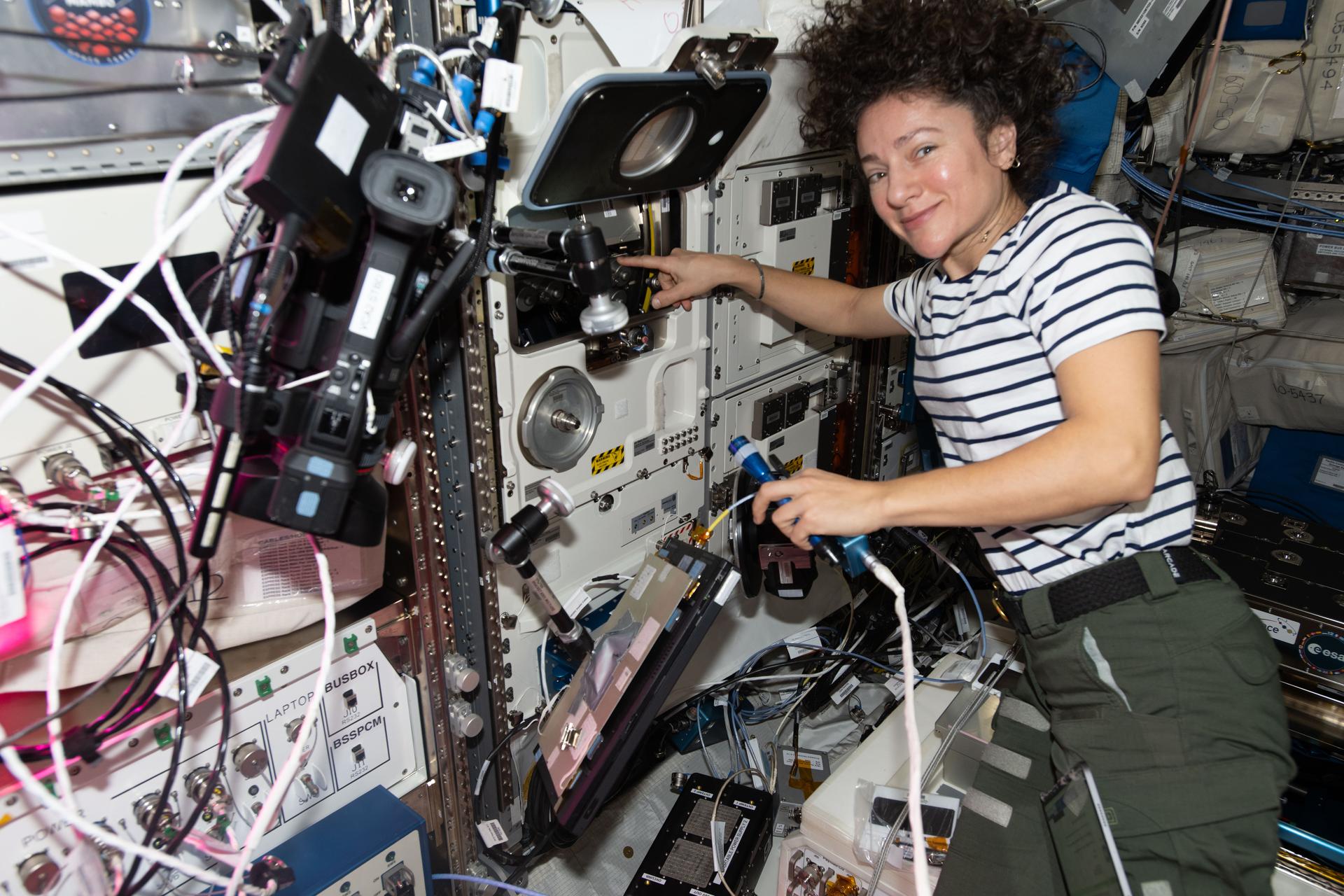
NASA flight engineer Jessica Meir spent her shift servicing hardware for a pair of advanced space physics investigations. Meir reviewed procedures and trained to connect delicate fiber optic cables inside the Cold Atom Lab that chills atoms to near absolute zero for quantum research into atomic wave functions, general relativity, and the search for dark matter. The sensitive cables emit light that helps trap, move, and measure the chilled atoms with high accuracy. Next, she set up research gear inside the Microgravity Science Glovebox to explore how weightlessness affects tiny particles floating in a Jello-like substance, known as a colloidal solid. Results may lead to advanced manufacturing techniques leading to new medicines, better food textures, and improved personal‑care products on Earth and in space.
Flight engineer Sophie Adenot from ESA (European Space Agency) continued her biomedical research exploring how to create intravenous (IV) fluid, or a saline solution, using a spacecraft’s clean drinking water to treat medical conditions in space. She collected fluid samples generated by the new Intravenous Fluid Generation – Mini device to analyze how evenly mixed the IV fluid is. The technology demonstration seeks to promote crew self-sufficiency farther away from Earth, reduce a crew’s dependence on cargo missions, and avoid expiration of medical supplies on a spacecraft.
Adenot earlier began installing new computer hardware inside the Columbus laboratory module to update a ground controller’s ability to monitor scientific payloads and download research data in real time. NASA flight engineer Chris Williams replaced ethernet cables in between Columbus and the Harmony module to upgrade communications with the orbital outpost’s computers, experiment hardware, and more. Williams also pedaled on the new European Enhanced Exploration Exercise Device’s (E4D) exercise cycle for the first time at the end of his shift. The E4D is being tested for its ability to support crew workouts on missions to the Moon, Mars, and beyond.
Williams also partnered with NASA flight engineer Jack Hathaway taking apart then examining a handheld barcode and radio‑tag scanner that helps manage inventory aboard the space station. Hathaway also inspected the Tranquility module’s advanced resistive exercise device that mimics working out with free weights in Earth’s gravity. He wrapped up his shift unloading cargo delivered inside Northrop Grumman’s Cygnus XL resupply ship on April 13.
Roscosmos cosmonauts Sergey Kud-Sverchkov and Sergei Mikaev worked together unloading crew clothing, food containers, scientific supplies, and more from inside the Progress 95 cargo spacecraft that arrived on Monday. The duo also installed air ducts between Progress 95 and the International Space Station and reconfigured the spacecraft’s docking hardware. Roscosmos flight engineer Andrey Fedyaev worked throughout Wednesday on life support duties transferring water between tanks, disinfecting water tanks, and cleaning ventilation fan screens inside the Rassvet module.
Learn more about station activities by following the space station blog, @space_stationon X, as well as the ISS Facebookand ISS Instagram accounts.
Get the latest from NASA delivered every week. Subscribe here.
Powered by WPeMatico
Mark A. Garcia
