Wizards Behind the Curtain: Johnson’s Administrative Team Makes Missions Possible

Wizards Behind the Curtain: Johnson’s Administrative Team Makes Missions Possible

For every NASA astronaut who serves as a public face of human spaceflight, there are thousands of people working behind the scenes to make the agency’s missions a success. Even the smallest tasks impact NASA’s ability to explore and innovate for the benefit of humanity.

The team of administrative assistants and secretaries who work at the Johnson Space Center in Houston are acutely aware of this fact.

Whether they are coordinating meetings, arranging travel, or preparing materials and information for Johnson’s leaders, this team of over 90 individuals takes pride in providing critical support for the agency’s programs and managers. “We work hand-in-hand with management to get them where they need to go and ensure they have what they need to continue doing their important work,” said Carla Burnett, an executive assistant in the Center Director’s Office who is also the lead for all of Johnson’s administrative staff.

A woman stands on a football field with a banner featuring late President John F. Kennedy in the background.
Carla Burnett participates in NASA’s celebration of the 60th anniversary of President John F. Kennedy’s historic Moon speech, held at Rice Stadium in Houston on Sept. 12, 2022.
Image courtesy of Carla Burnett

Burnett has turned her long-standing passion for administrative work into a 41-year career at Johnson. She was just a youngster when she started working in the Astronaut Office mailroom – an opportunity that came through her high school’s Office Education Program. “Being a meek and mild high school student, sitting there with the astronauts, going through all of their fan mail – I was in awe! It was an absolute honor,” she said. That experience and earning recognition as her high school’s Office Education Student of the Year confirmed for Burnett that administrative work was the right career path for her. She said that fidelity and perseverance launched her from the Astronaut Office mailroom to a position as a crew secretary for two space shuttle flights. “Being a servant and helping others is what I really love about administrative work,” she said.

Today, Burnett supports Johnson’s senior executives and serves as a central resource for the rest of the administrative team. “They are all very self-sufficient and work within their own organizations,” she explained, but she may coordinate team-wide meetings, celebrations, or trainings, and she is always available to help answer questions. “We work consistently as a cohesive team. We are knowledgeable and, may I add, exceptional at what we do because we do it for the benefit and success of our Johnson family, NASA, and a plethora of communities!”

Burnett’s dedication to service is reflected across the administrative team, as is a commitment to caring for others. Edwina Gaines, administrative assistant for the Extravehicular Activity and Human Surface Mobility Program, said that being an instrument of team success and the opportunity to build long-lasting friendships are the most rewarding parts of her job. “That connection to people is important,” she said. “It’s important for me to know who I’m supporting or working with.”

A woman takes a selfie in front of a balloon backdrop.
Edwina Gaines snaps a selfie during a professional development event for administrative professionals in 2023.

Gaines joined the Johnson team as a contractor nearly 20 years ago thanks to an opportunity that arose from her volunteer work at church. A church partner, the Houston Area Urban League, was helping a NASA subcontractor fill a secretarial position through the Small Business Administration’s HUBZone Program. Gaines got the job.

Since then, she has supported four programs and two institutional organizations, getting to know several agency leaders quite well. Gaines said she paid attention to little details – like which managers preferred printed materials over presentations, how they organized their offices, and when they typically stopped for coffee or something to eat – and worked to stay one step ahead of them. She recalled one occasion when she realized a manager had not taken a break in five hours and brought her something to drink. “It’s about taking care of the people who are doing the mission. If you don’t take care of yourself, you can’t complete the mission,” she said.

Rick Pettis, the administrative officer for the Center Operations Directorate, appreciates being part of a great team. Pettis has worked at Johnson since 2014, when he retired from the U.S. Navy after 23 years. “I enjoy helping people with problem solving,” he said. “Every day there will be someone who calls me to ask, ‘How do I get this done?’”

A man in business attire poses for a picture next to an astronaut's spacesuit.
Rick Pettis poses with a spacesuit display.
Image courtesy of Rick Pettis

The administrative team’s work involves other highlights, as well. “When I met my first astronaut, I was in awe,” said Dottie Workman, a secretary supporting Johnson’s External Relations Office. “I couldn’t believe that someone so important was walking around the campus just like everyone else. He was so nice – he shook my hand and took the time to talk to me.”

Workman has been a civil servant for 52 years and 29 of those have been spent at Johnson. “My career has taken me all over the United States and Germany,” she said. “When my son was in the military and stationed at Ft. Sam Houston in San Antonio he said, ‘Mom, why don’t you move to Texas?’ I didn’t have a good reason to say no, so here I am!”

A secretary at Johnson Space Center poses for a picture with former NFL Houston Texans player J.J. Watt.
Dottie Workman met J.J. Watt, former professional football player with the Houston Texans, during his visit to Johnson Space Center.
Image courtesy of Dottie Workman.

Outside of meeting and interacting with astronauts, Workman said being able to share NASA with her family and friends is her favorite part of working at Johnson. “It is always exciting to see their reaction,” she said.

Burnett is thankful for a united team that understands the value of their work. “I’m grateful to work with a group of professionals who know the significance of propelling today’s men and women into the next generation of deep space for years to come,” she said. “We are Artemis proud!”

Powered by WPeMatico

Get The Details…
Linda E. Grimm
Hubble Pinpoints a Dim, Starry Mini-galaxy

Hubble Pinpoints a Dim, Starry Mini-galaxy

2 min read

Hubble Pinpoints a Dim, Starry Mini-galaxy

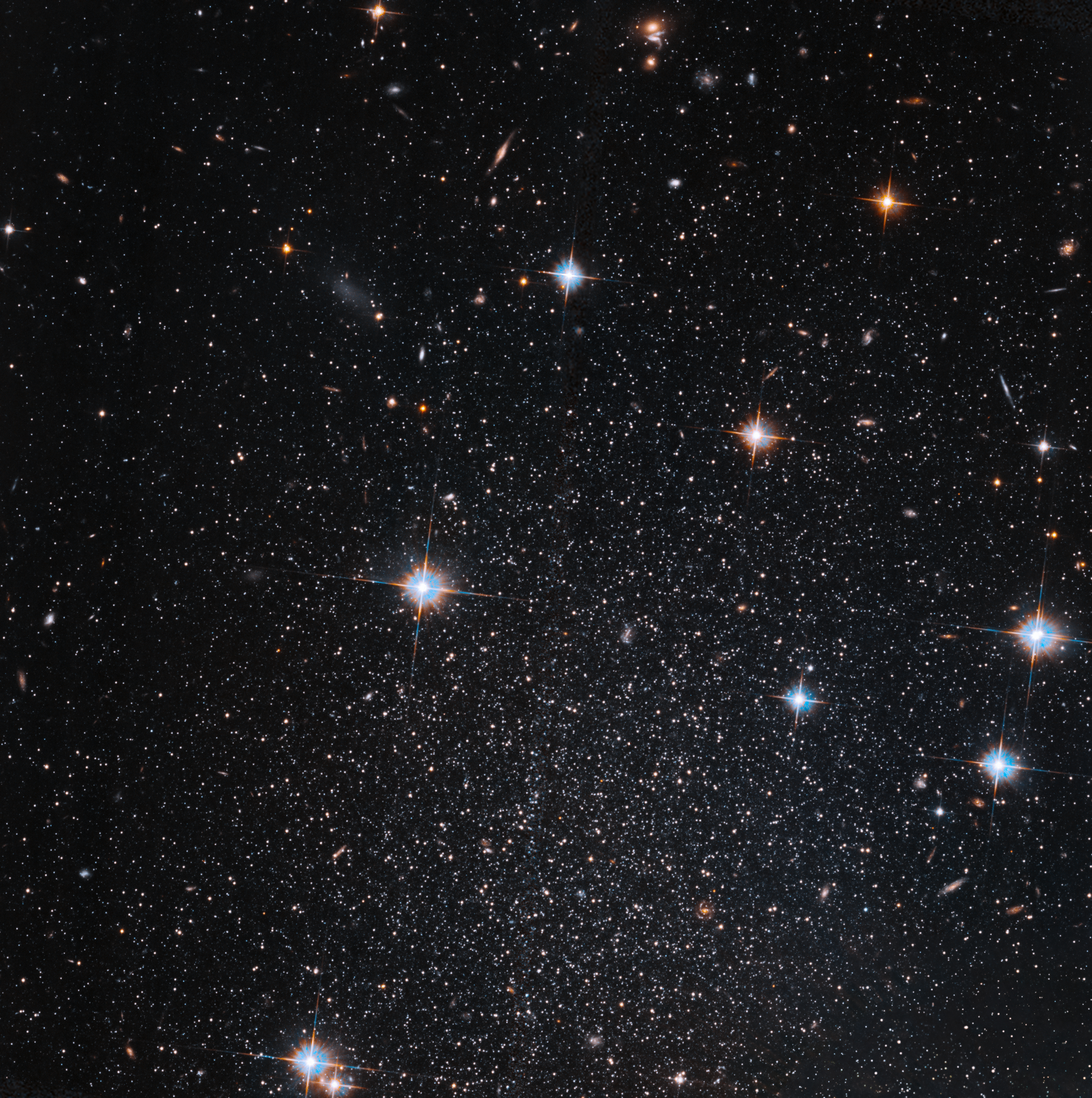
Several stars shine against black space. A few foreground stars with diffraction spikes throughout.
NASA, ESA, and D. Weisz (University of California – Berkeley); Processing: Gladys Kober (NASA/Catholic University of America)

A glittering collection of stars shines against a background of much more distant galaxies in this view from NASA’s Hubble Space Telescope of the Pegasus Dwarf spheroidal galaxy, also known as Andromeda VI. 

The Andromeda galaxy, also known as Messier 31, is the Milky Way’s closest grand spiral galaxy neighbor, and is host to at least 13 dwarf galaxies that orbit around it. The Pegasus Dwarf spheroidal galaxy is one of these mini-galaxies. Dwarf spheroidal galaxies are the dimmest and least massive galaxies known. They tend to have elliptical shapes and relatively smooth distributions of stars. Dwarf spheroidal galaxies are usually devoid of gas and dominated by old and intermediate-age stars, although some have experienced small amounts of recent star formation. 

The Pegasus Dwarf Spheroidal galaxy was discovered in 1998 and has been characterized as having a small amount of heavy elements and little of the gas needed  to form another generation of stars ― though more than many of the dwarf spheroidal galaxies within our Local Group of galaxies. Researchers suspect that Andromeda’s gravitational field may have stripped the star-forming gases from it, leaving a dearth of material to build more than a few generations of stars. In comparison, some of the dwarf spheroidal companion galaxies of the Milky Way found at comparable distances do contain some intermediate-age stars, but this could be because Andromeda is so massive and extended that its gravitational effects extend farther. 

The jury is still out on how dwarf spheroidal galaxies form. Theories include collisions between galaxies that break off small fragments, the gravitational influence of larger galaxies on small disk-shaped dwarf galaxies, and processes associated with the birth of small systems among collections of dark matter. Andromeda and the Milky Way are the only galaxies close enough for astronomers to view these dim satellite galaxies, so clues to their formation will have to come from close neighbors like this one.

Hubble studied this galaxy as part of an examination of the entire Andromeda system of satellites in order to investigate such critical matters as dark matter, reionization, and the growth of galactic ecosystems across cosmic time.

Explore More

Media Contact:

Claire Andreoli
NASA’s Goddard Space Flight CenterGreenbelt, MD
claire.andreoli@nasa.gov

Share

Details

Last Updated
Aug 27, 2024
Editor
Michelle Belleville

Powered by WPeMatico

Get The Details…

DETAIL OPPORTUNITY: NASA OFFICE OF THE GENERAL COUNSEL

DETAIL OPPORTUNITY: NASA OFFICE OF THE GENERAL COUNSEL

2 min read

Preparations for Next Moonwalk Simulations Underway (and Underwater)

The National Aeronautics and Space Administration (NASA) seeks applicants interested in six to twelve month reimbursable details with the Office of General Counsel (OGC).  Applicants must be current Federal Employees. Applicants should receive the approval of their supervisor before applying. Consisting of a Headquarters Office and nine Center-level legal offices, NASA OGC provides advice and legal support on cutting edge issues in support of NASA’s mission of research and exploration on behalf of the United States.  Ideal candidates will be experienced legal practitioners ready to make an immediate contribution in one of the following areas.

  • Artificial Intelligence and Cybersecurity. Candidates for this detail area are prepared to offer insight in interpreting rapidly changing regulatory requirements, drafting guidance, anticipating future use cases, and working with various stakeholders and technical experts to define agency needs.  Because of overlapping regulatory requirements and related governance schemes, familiarity with cyber-security requirements would also be highly valued in this detail.
  • Employment Law.  Candidates for this detail area have experience in providing high impact litigation services to the federal government.  Experience with EEOC, MSPB, and federal court proceedings are highly desired.
  • Ethics.  Candidates for this detail area are experienced ethics attorneys capable of training and advising agency personnel on ethics matters in connection with NASA’s challenging mission and diverse ecosystem of partners and stakeholders.
  • Procurement. Candidates for this detail area are experienced procurement attorneys interested in providing short term assistance for the coming fiscal year as NASA’s dynamic team of lawyers supports major acquisitions of technology and space capabilities.

NASA prefers that these details be in person, with telework available consistent with Agency policy, but would consider a remote detail in some circumstances.  In addition to Headquarters in Washington, D.C., NASA has locations in Alabama, California, Florida, Maryland, Mississippi, Ohio, Texas, and Virginia. 

All applicants must possess a Juris Doctor (J.D.) or equivalent and be a member in good standing of a state bar (any jurisdiction).  To apply, please email a cover letter, resume, and recent writing sample of no more than five (5) pages to hq-ogc-legalops@mail.nasa.gov.  In your cover letter please indicate which detail area(s) interest you. Interested applicants may indicate more than one area of interest.

Please submit your application by September 9, 2024.

Powered by WPeMatico

Get The Details…
Justyna M. Ragiel-Smith

Monday Sees Physical Science Prep and Training for Station Crew

Monday Sees Physical Science Prep and Training for Station Crew

 Boeing's Starliner spacecraft that launched NASA's Crew Flight Test astronauts Butch Wilmore and Suni Williams to the International Space Station is pictured docked to the Harmony module's forward port. This long-duration photograph was taken at night from the orbital complex as it soared 258 miles above western China.
Boeing’s Starliner spacecraft that launched NASA’s Crew Flight Test astronauts Butch Wilmore and Suni Williams to the International Space Station is pictured docked to the Harmony module’s forward port. This long-duration photograph was taken at night from the orbital complex as it soared 258 miles above western China.

A suite of training and conferences kept the International Space Station residents busy on Monday as they embark on a new week of work in microgravity. Though a light duty science day, some crew members did schedule in time to assess how spaceflight affects the human body and prep for upcoming physical science investigations.

In the morning, NASA astronaut Jeanette Epps set up hardware for the CIPHER investigation and then conducted an exam on NASA astronaut Mike Barratt to assess how microgravity affects the vestibular system, including spatial orientation, cognitive function, and changes in head-eye coordination.

NASA astronaut Tracy C. Dyson spent some time in the Tranquility module troubleshooting the toilet pressure sensor, then replaced experiment samples and igniter tips in SoFIE, a physical science payload used to study the ignition and flammability of spacecraft materials. Meanwhile, NASA astronaut Matthew Dominick spent some time replacing Packed Bed Retractor Experiment hardware, another physical science investigation that looks at the behaviors of gases and liquids in microgravity.

Boeing Crew Flight Test Commander Butch Wilmore and Pilot Suni Williams spent Monday powering up communication software and holding a conference with ground teams as they begin their formal integration into the Expedition 71/72 crew.

NASA announced on Saturday that Boeing’s Starliner spacecraft will return to Earth uncrewed, allowing the agency and Boeing to continue gathering testing data on Starliner during its upcoming flight home, while also not accepting more risk than necessary for its crew. Wilmore and Williams will continue their work aboard the orbiting laboratory through February 2025 and fly home aboard a Dragon spacecraft with two other crew members assigned to the agency’s SpaceX Crew-9 mission. Starliner is expected to depart from the space station and make a safe, controlled autonomous re-entry and landing in early September. Since their arrival, the duo has been supporting station research, maintenance, Starliner system testing, and a host of other orbital activities.

To prepare for upcoming missions in September, Barratt, Epps, Dyson, Dominick, Wilmore, and Williams, along with cosmonaut Alexander Grebenkin, all completed a round of SpaceX Dragon overview training throughout the day. The septet then joined forces in the evening to review Dragon emergency procedures and hold a conference with ground teams to discuss future Dragon configuration.

Afterward, the septet was joined by station Commander Oleg Kononenko and Flight Engineer Nikolai Chub of Roscosmos to discuss emergency response and coordination amongst all crew members.

Kononenko and Chub also partnered throughout the day to inspect and replace hardware in the Zvezda service module and install software to a few station computers.

Soyuz MS-26 prime and backup crew members flew to their launch site in Baikonur, Kazakhstan to begin final prelaunch training ahead of the launch of NASA astronaut Don Pettit and Roscosmos cosmonauts Alexei Ovchinin and Ivan Vagner, currently scheduled for Wednesday, Sept. 11.


Learn more about station activities by following the space station blog, @space_station and @ISS_Research on X, as well as the ISS Facebook and ISS Instagram accounts.

Get weekly updates from NASA Johnson Space Center at: https://roundupreads.jsc.nasa.gov/

Get the latest from NASA delivered every week. Subscribe here: www.nasa.gov/subscribe

Powered by WPeMatico

Get The Details…

Abby Graf

NASA Seeks Input for Astrobee Free-flying Space Robots

NASA Seeks Input for Astrobee Free-flying Space Robots

4 Min Read

NASA Seeks Input for Astrobee Free-flying Space Robots

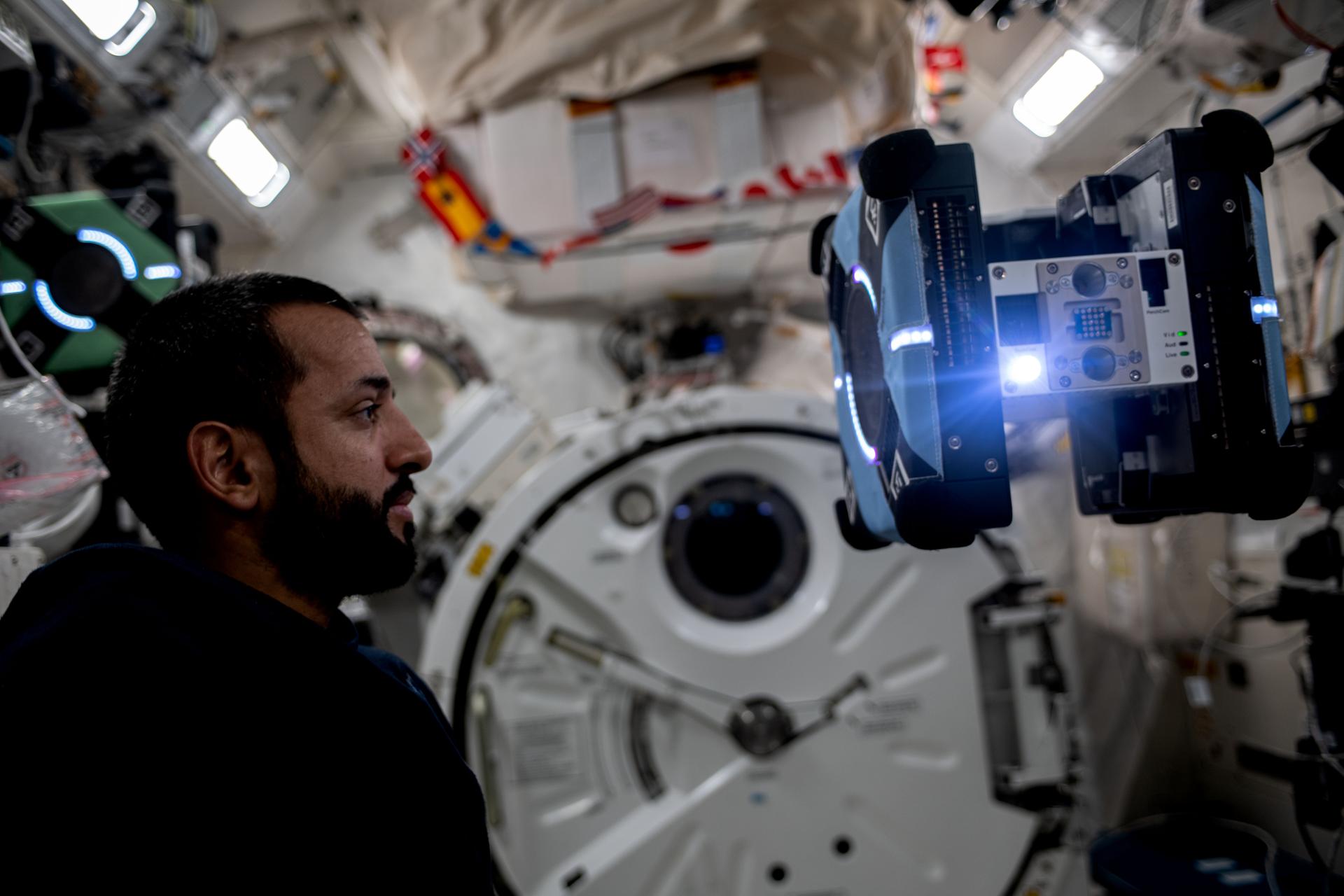
iss069e010815 (May 16, 2023) — UAE (United Arab Emirates) astronaut and Expedition 69 Flight Engineer Sultan Alneyadi observes a free-flying Astrobee robotic assistant during the testing of its operations for an upcoming student competition to control the robotic devices.

Credits:
NASA

NASA is seeking input from American companies for the operation and use of a system of free-flying robots aboard the International Space Station as the agency continues to foster scientific, educational, and technological developments in low Earth orbit for the benefit of all.

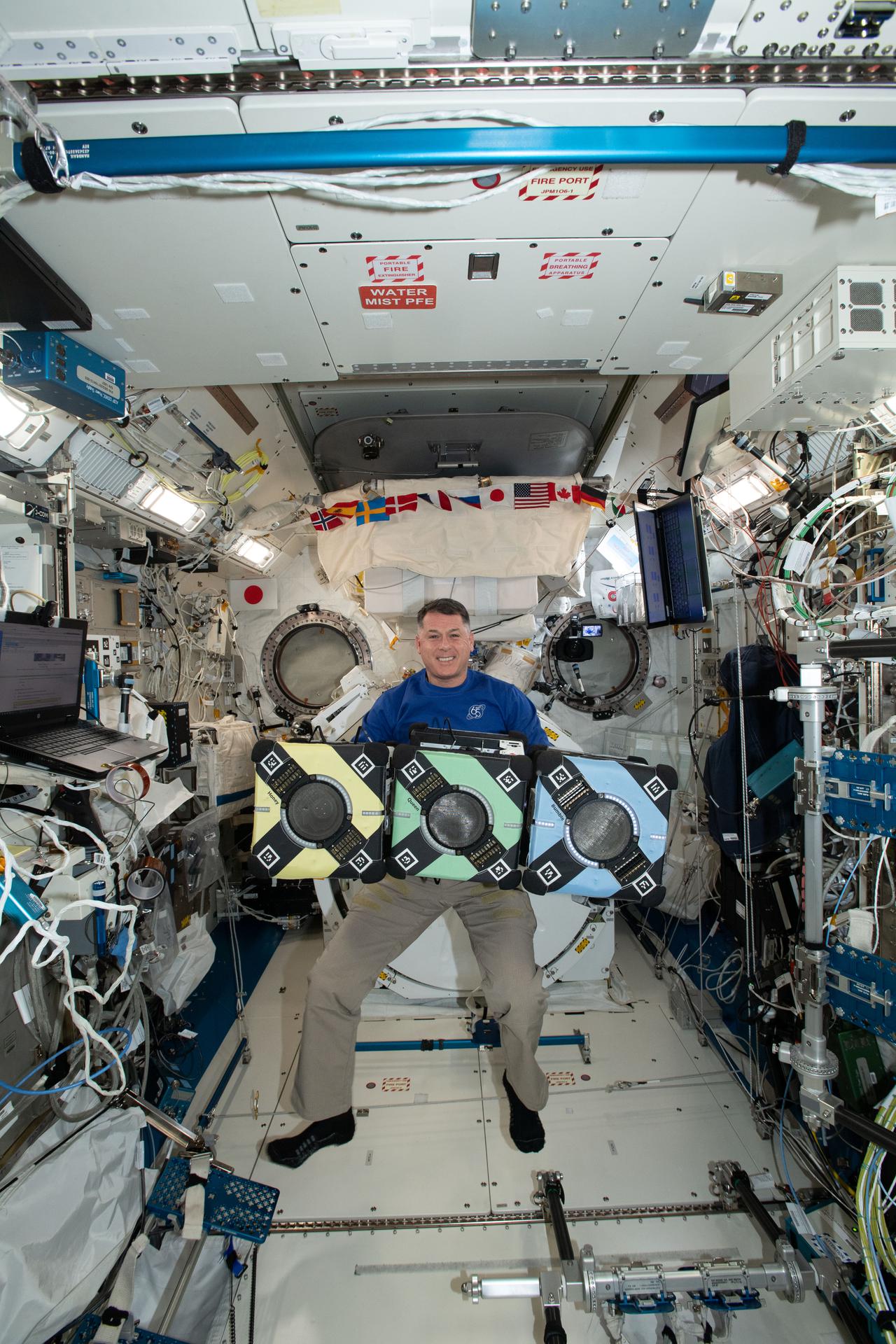
The colorful, cube-shaped robots – named “Bumble,” “Honey,” and “Queen” – are part of the Astrobee system helping astronauts and researchers perform technology demonstrations, scientific research, and STEM (science, technology, engineering and mathematics) activities in the unique environment of space since 2018.

“Dozens of institutions collaborate with NASA to use the Astrobee system to test new hardware and software technologies,” said Jose Benavides, project manager for the Astrobee facilities at NASA’s Ames Research Center in California’s Silicon Valley, where the system was designed and built. “I’m excited to hear how respondents think Astrobee can continue to advance robotics in space.”

NASA issued a Request for Information to inform strategic planning, inviting industry to provide information to help shape the maturation of robotics in zero gravity to achieve the greatest scientific and exploration value. Responses are due Sept. 27, 2024. To learn more about the Request for Information, visit:

https://sam.gov/opp/7893fe01e7bf4ae69029b5d8915e62c5/view

iss065e389375 (9/20/2021) — NASA astronaut Shane Kimbrough poses with the Astrobee robotic free-flyers in support of the Kibo Robot Programming Challenge (Robo-Pro Challenge). The Kibo-RPC, allows students to create programs to control Astrobee, a free-flying robot aboard the International Space Station (ISS).

The battery-powered robots in the Astrobee system fly around the space station’s modules using electric fans for propulsion and “see” their surroundings using lights, cameras, and other sensors. They have interchangeable “arms” that provide ways for the robots to hold objects or keep steady for tasks requiring stability, and magnets to ensure they stay securely docked when recharging.

Working autonomously, or via remote control by astronauts, flight controllers, or researchers on the ground, the robots can be used to off-load time-consuming tasks. For instance, the robots can work independently or collaboratively to assist with routine chores like space station monitoring, maintenance, inventory, experiment documentation, or moving cargo throughout the station. This allows astronauts more time to tackle complex work that only humans can perform.

Astrobee’s versatile design has allowed thousands of hours of testing on hundreds of microgravity experiments. Many have involved astronauts, but the facility also is regularly used by researchers and student teams across the world competing for the opportunity to run their programs on the robots in space.

Further developing human-robotic technology will pave the way for future crewed and uncrewed spacecraft maintenance and exploration tasks done by robots both off-planet and in deep space»

Jonathan Barlow

Jonathan Barlow

Astrobee Project Manager

For example, NASA’s ISAAC (Integrated System for Autonomous and Adaptive Caretaking) project, used the Astrobees to study how robots could assist spacecraft, vehicle systems, and ground operators. The technology could help NASA use robot caretakers for critical spacecraft in the agency’s Moon-to-Mars plans, including the Gateway lunar space station and Mars transit habitat vehicle, especially during the months-long periods when these spacecraft will be uncrewed.

“Our ISAAC work has proved out its technology in a high-fidelity space environment because of the ready availability of the capable Astrobee robots,” said Trey Smith, project manager for ISAAC at NASA Ames.

The project demonstrated using multiple Astrobees to autonomously collect the first robot-generated survey of a spacecraft interior. Other ISAAC firsts include the first use of a robot to locate the source of a sound in space, in collaboration with the Bosch USA SoundSee payload team, and the first time robots navigated between modules of a space station. Future robots could use ISAAC technology to transfer cargo between space vehicles or respond to a time-critical fault like a leak due to a micrometeoroid impact, all without human assistance.

“With Astrobee, we’ve learned about flying multiple robots in space alongside humans,” said Jonathan Barlow, project manager for Astrobee at NASA Ames. “Further developing human-robotic technology will pave the way for future crewed and uncrewed spacecraft maintenance and exploration tasks done by robots both off-planet and in deep space.”

The Astrobee Facility, operated out of NASA’s Ames Research Center, provides a free-flying robotic system for space station research and STEM outreach.  NASA’s Game Changing Development Program, part of the agency’s Space Technology Mission Directorate, funded Astrobee. NASA’s International Space Station Utilization Office provides ongoing funding.

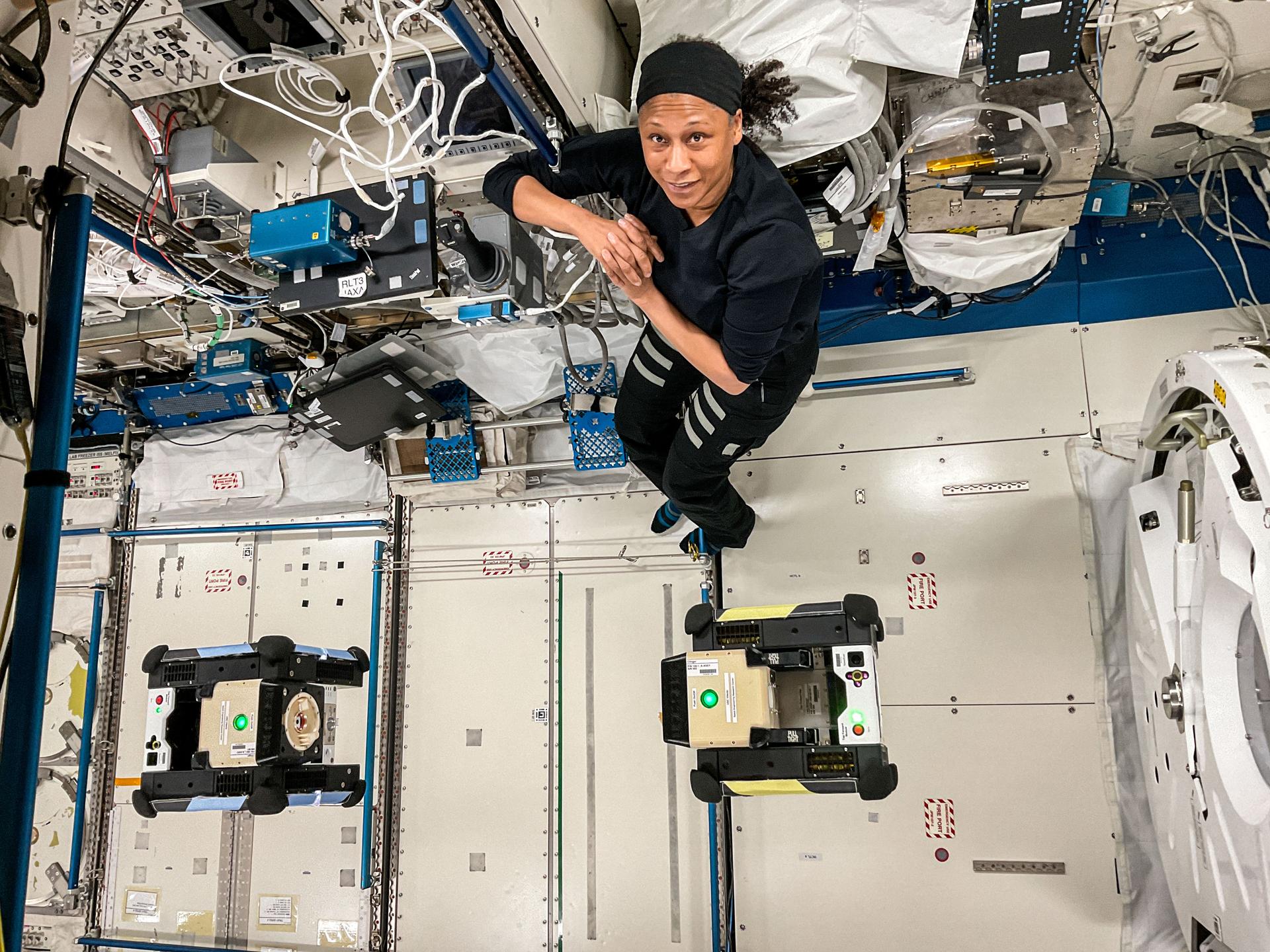
iss071e464314 (Aug. 12, 2024) — NASA astronaut and Expedition 71 Flight Engineer Jeanette Epps monitors a pair of Astrobee robotic free-flying assistants as they demonstrate autonomous docking maneuvers inside the International Space Station’s Kibo laboratory module. The cube-shaped, toaster-sized devices were operating with a connecting interface system, called CLINGERS with an embedded navigation sensor, that may benefit construction in space.

Powered by WPeMatico

Get The Details…
Rachel Hoover