NASA, Blue Origin Invite Media to New Glenn Launch of Mars Mission

NASA, Blue Origin Invite Media to New Glenn Launch of Mars Mission
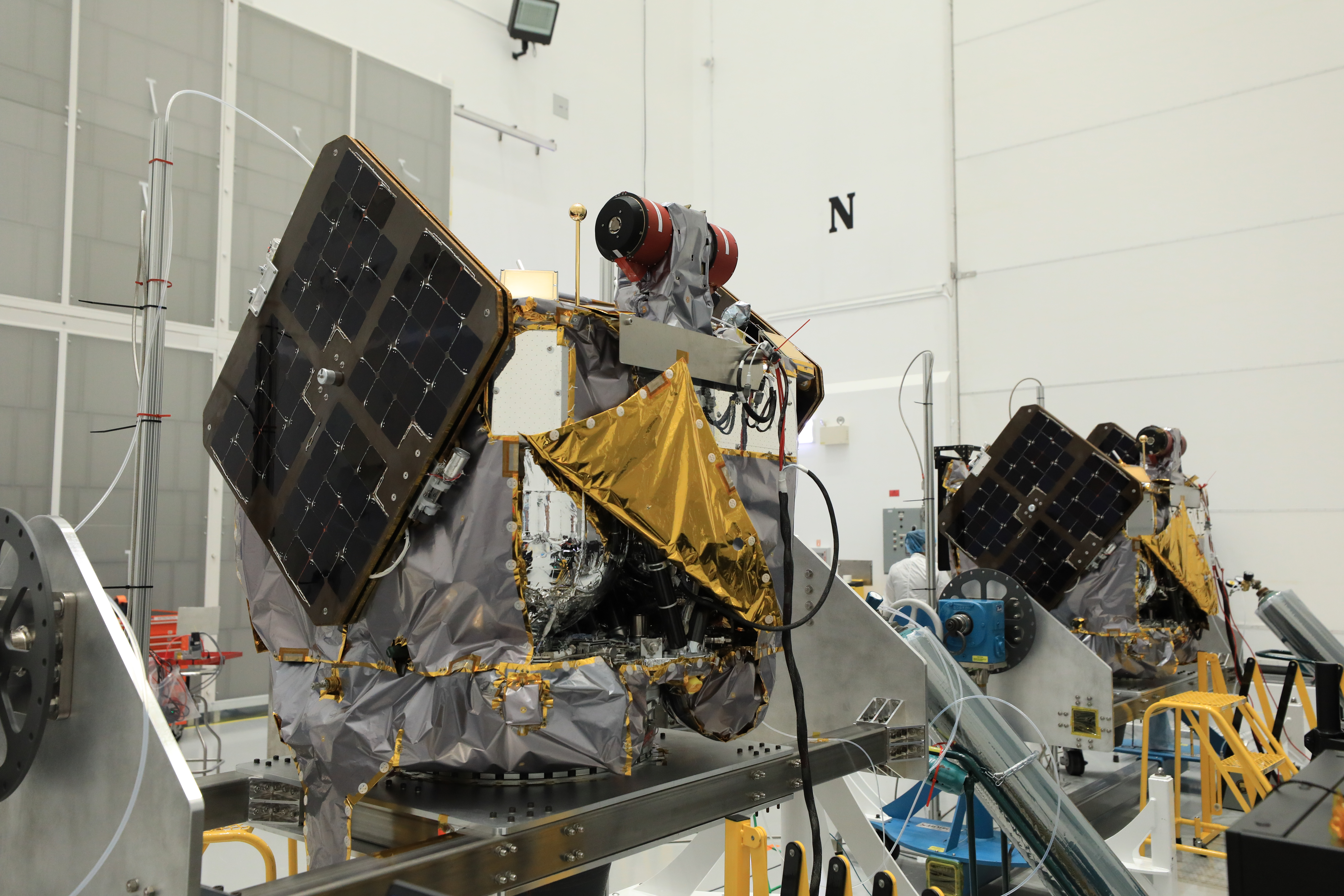
NASA’s ESCAPADE (Escape and Plasma Acceleration and Dynamics Explorers) identical dual spacecraft are inspected and processed on dollies in a high bay of the Astrotech Space Operations Facility near the agency’s Kennedy Space Center in Florida on Thursday, Aug. 22. As the first multi-spacecraft orbital science mission to Mars, ESCAPADE’s twin orbiters will take simultaneous observations from different locations around the planet and reveal the real-time response to space weather and how the Martian magnetosphere changes over time.
Credits: NASA/Kim Shiflett

NASA and Blue Origin are preparing for the agency’s ESCAPADE (Escape and Plasma Acceleration and Dynamics Explorers) mission, which begins on the inaugural launch of the company’s New Glenn rocket. The mission will study the solar wind’s interaction with the magnetosphere on Mars.

Blue Origin is targeting no earlier than Sunday, Oct. 13, for the launch of New Glenn-1 from Space Launch Complex 36 at Cape Canaveral Space Force Station in Florida.

Media interested in covering ESCAPADE launch activities for both NASA and Blue Origin must apply for media credentials. Deadlines for accreditation are as follows:

  • U.S. media and U.S. citizens representing international media must apply by 5 p.m. EDT on Monday, Sept. 30.
  • International media without U.S. citizenship must apply by 5 p.m. on Tuesday, Sept. 10.

Media accreditation requests should be submitted online at:

https://media.ksc.nasa.gov

A copy of NASA’s media accreditation policy is available online. For questions about accreditation, please email: ksc-media-accreditat@mail.nasa.gov. For other mission questions, please contact NASA Kennedy’s newsroom: 321-867-2468.

The ESCAPADE mission will use two identical spacecraft to investigate how the solar wind interacts with the hybrid magnetosphere on Mars and how this interaction drives the planet’s atmospheric escape. The mission is funded by NASA’s Heliophysics Division and is part of the NASA Small Innovative Missions for Planetary Exploration program. The ESCAPADE mission is led by the University of California, Berkeley’s Space Sciences Laboratory, and the spacecraft is designed by Rocket Lab. The agency’s Launch Services Program, based at NASA Kennedy, secured the launch service under the VADR (Venture-class Acquisition of Dedicated and Rideshare) contract.

NASA will post updates on launch preparations for the twin Martian orbiters on the ESCAPADE blog.

For more information about ESCAPADE, visit:

https://science.nasa.gov/mission/escapade

Para obtener información sobre cobertura en español en el Centro Espacial Kennedy o si desea solicitar entrevistas en español, comuníquese con Antonia Jaramillo at: antonia.jaramillobotero@nasa.gov, 321-501-8425, o Messod Bendayan, 256-930-1371.

-end-

Karen Fox
Headquarters, Washington
202-358-1600
karen.fox@nasa.gov

Laura Aguiar / Leejay Lockhart
Kennedy Space Center, Florida
321-867-2468
laura.aguiar@nasa.gov / leejay.lockhart@nasa.gov

Sarah Frazier
Goddard Space Flight Center
202-853-7191
sarah.frazier@nasa.gov

Powered by WPeMatico

Get The Details…
Tiernan P. Doyle

NASA Invites Public Input on Low Earth Orbit Microgravity Strategy

NASA Invites Public Input on Low Earth Orbit Microgravity Strategy

A waxing gibbous moon rises over the Indian Ocean as the International Space Station orbited 266 miles above.
Credit: NASA

As NASA and its partners continue to conduct groundbreaking research aboard the International Space Station, the agency announced Monday it is seeking U.S. industry, academia, international partners, and other stakeholders’ feedback on newly developed goals and objectives that will help guide the next generation of human presence in low Earth orbit.

“From the very beginning, NASA’s flagship human spaceflight programs have built upon each other, expanding our knowledge and experience of humans living and working in space,” said NASA Deputy Administrator Pam Melroy. “As commercial industry is constructing new human-enabled platforms for low Earth orbit, NASA must answer the question: what should our goals and objectives be to advance our future science and exploration missions?”

NASA published draft high-level goals and objectives outlining 42 key points in six main areas: science, exploration-enabling research and technology development, commercial low Earth orbit infrastructure, operations, international cooperation, and workforce and engagement.

“Feedback is essential for shaping our long-term microgravity research and development activities,” said Ken Bowersox, associate administrator, Space Operations Mission Directorate at NASA Headquarters in Washington. “We are committed to refining our objectives with input from both within NASA and external partners, ensuring alignment with industry and international goals. After reviewing feedback, we will finalize our strategy later this year.”

The agency will conduct two invite-only workshops in September to discuss feedback on the draft goals and objectives. The first workshop is with international partners, and the second will engage U.S. industry and academic representatives.

NASA employees also are invited to provide input through internal agency channels. This approach reflects NASA’s commitment to harnessing diverse perspectives to navigate the rapidly evolving low Earth orbit environment.

“Organizations are increasingly recognizing the transformative benefits of space, with both governments and commercial activities leveraging the International Space Station as a testbed,” said Robyn Gatens, International Space Station director and acting director of commercial spaceflight at NASA Headquarters. “By developing a comprehensive strategy, NASA is looking to the next chapter of U.S. human space exploration to help shape the agency’s future in microgravity for the benefit of all.”

Stakeholders may submit comments by close of business on Friday, Sept. 27 to:

https://www.leomicrogravitystrategy.org/

-end-

Amber Jacobson
Headquarters, Washington
202-358-1600
amber.c.jacobson@nasa.gov

Powered by WPeMatico

Get The Details…
Jessica Taveau

Sols 4284–4286: Environmental Science Extravaganza

Sols 4284–4286: Environmental Science Extravaganza

4 min read

Sols 4284–4286: Environmental Science Extravaganza

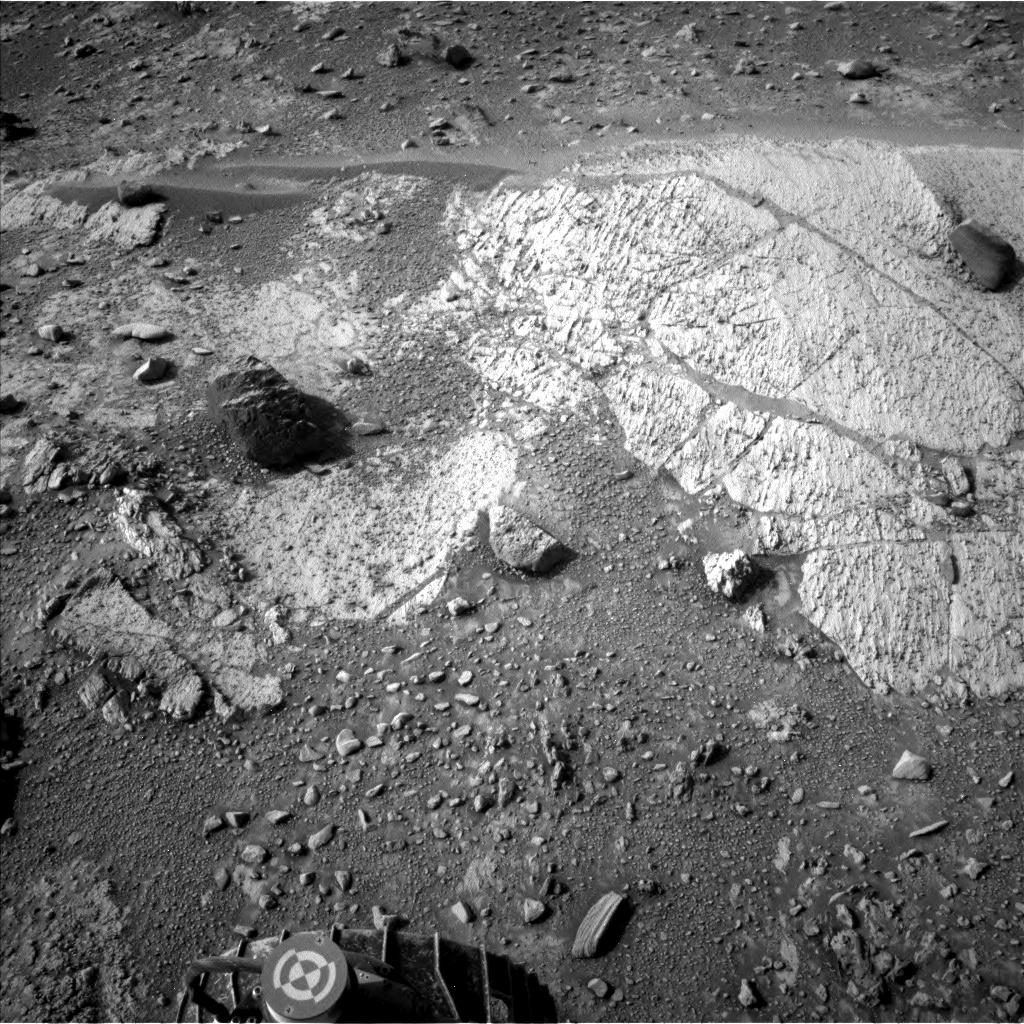
This image was taken by Left Navigation Camera onboard NASA’s Mars rover Curiosity on Sol 4282 (2024-08-22 23:39:35 UTC).
NASA/JPL-Caltech

Earth planning date: Friday, Aug. 23, 2024

One of the many challenges of operating a rover on another planet is that we don’t always know where we’re going to be located before planning starts each day. Although we do plan our drives in advance, Curiosity doesn’t blindly follow the orders that we deliver. If an unsafe situation is detected, such as if the wheels slip too much in the sand or if the rover tries to drive along too steep of a slope, it will end the drive early and wait for us back on Earth to assess the situation. Although we prefer for the rover to end up parked exactly where we told it to, safety is always the first priority.

Coming into planning today, it looked like it was going to be smooth riding. Before planning began, we received an email from our localization team informing us that Monday’s short drive away from Kings Canyon appeared to have completed successfully, so everyone was ready to start poking around in our new workspace. It wasn’t long before we realized that we were facing a bit of an unusual situation. Although the drive completed, we were missing almost all of our post-drive imaging. When a drive completes, we take a set of Navcam, Mastcam, and Hazcam images of our new location that we then use to determine the targets that we want to perform contact science and remote sensing on and to plan our drives. Without those images, there are very few activities that we can plan. Fortunately, we did receive one Navcam image near our new workspace (which you can see in the cover image above), so the geology and mineralogy (GEO) team had something to work with, though their ability to select targets was still severely limited.

For me, on the environmental science (ENV) team, this was great news. Almost all of our observations are completely untargeted, so we don’t really care where exactly the rover is located. As such, we were given an opportunity to make lemonade out of the lemons that the mission was handed today. In a reversal from our usual roles, GEO planned out their limited set of activities then passed the rest of the science time over to ENV. This was particularly exciting given that, as was noted on Wednesday, we’ve initiated a dust storm watch. The dust storm developing on the other side of Mars is likely the annual “C” storm. The last time a dust storm went global this late in the year was during the Viking era, so we expect that this storm will stay regional rather than becoming global. Still, because global dust storms happen so infrequently, we’ve initiated a storm watch so that we’re ready just in case the unexpected happens.

Although GEO’s activities are limited in this plan, the team did the best with what little data they had available. These activities include ChemCam LIBS and Mastcam observations of “Lembert Dome” (some nodular light-toned bedrock), “Wilts Col” (a dark-toned float block that we got ChemCam passive spectra of back on sol 4259), and “Return Creek” (another float block). We’re also taking ChemCam passive spectra and Mastcam images of a dark-toned float block “Matlock Lake.” In preparation for planning on Monday, we’re also taking a Mastcam survey of the workspace. Because we had to pull our arm activities and the drive we had planned, the CheMin team was also able to fit in an empty cell analysis activity that they had been looking for time to execute.

ENV’s activities are nothing unusual, but they are numerous. We were able to fit in about three-and-a-half hours of dust devil movies over these three sols, as well as about an hour-and-a-half of cloud movies, including some shortly before sunset when we rarely are able to take movies. In addition, we have a handful of Navcam line-of-sight and Mastcam tau observations to monitor the developing dust storm.

In classic just-too-late form, the missing data finally appeared right as we were finalizing the plan. Not of any use to us today (though the views from our new location are as stunning as ever), but we’re set up for a return to normal operations on Monday.

Written by Conor Hayes, Graduate Student at York University

Share

Details

Last Updated
Aug 26, 2024

Related Terms

Powered by WPeMatico

Get The Details…

Sols 4282-4283: Bumping Away from Kings Canyon

Sols 4282-4283: Bumping Away from Kings Canyon

3 min read

Sols 4282-4283: Bumping Away from Kings Canyon

Sol 4280: Mars Hand Lens Imager (MAHLI)
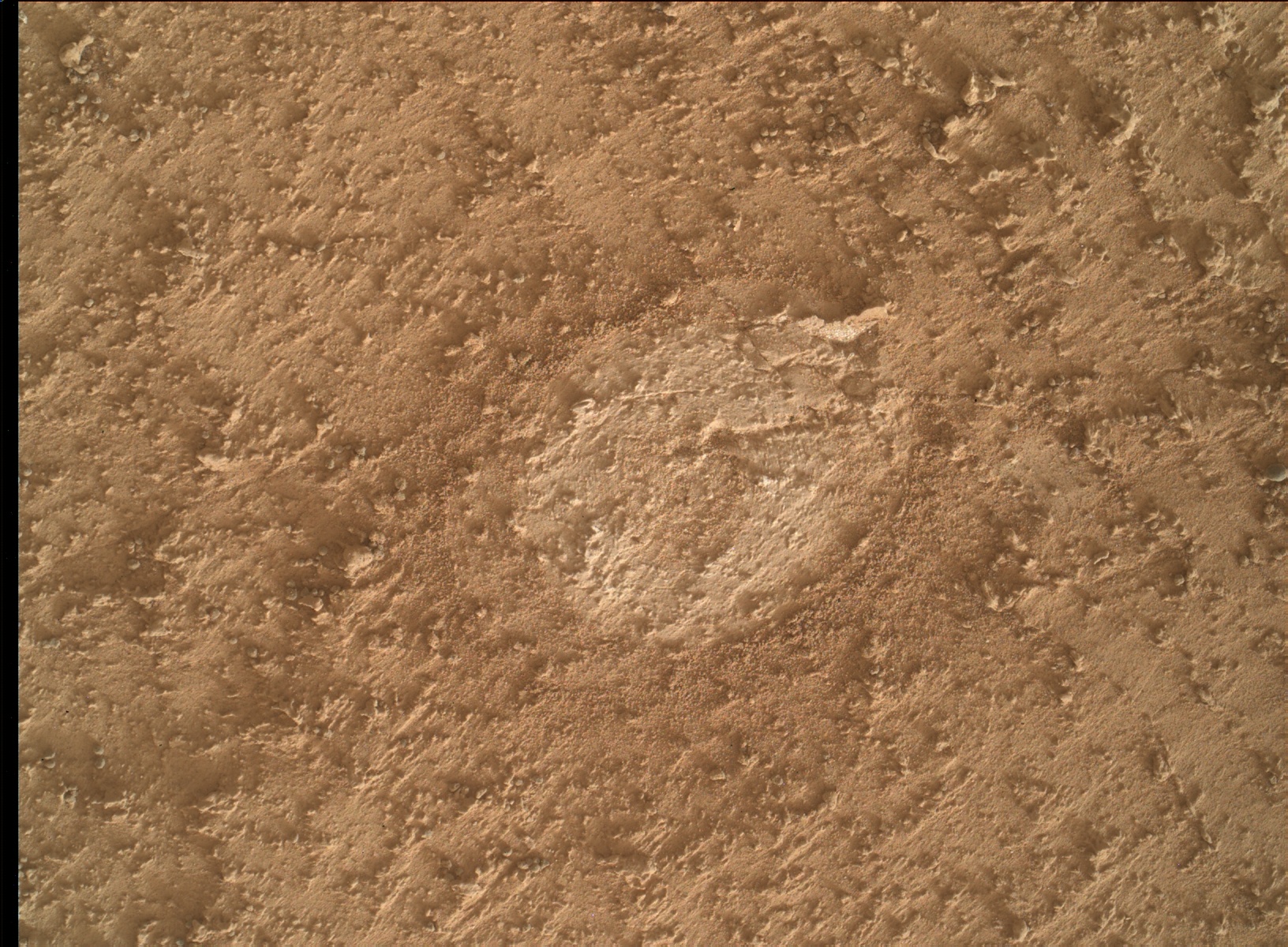
NASA’s Mars rover Curiosity acquired this image using its Mars Hand Lens Imager (MAHLI), located on the turret at the end of the rover’s robotic arm, on August 21, 2024, Sol 4280 of the Mars Science Laboratory Mission, at 00:18:12 UTC.
NASA/JPL-Caltech/MSSS

Earth planning date: Wednesday, Aug. 21, 2024

Having stayed in place for quite a few sols during our Kings Canyon drill campaign, we’re looking forward to doing a bump (ie: a short drive) and accomplishing some science in a new region. I’m on the SA-SPaH (ie: robotic arm) downlink team, which assess and reports on the success of robotic arm and drilling activities, including being closely involved in drilling campaigns. For awhile there was talk of doing a second Kings Canyon drill, but ultimately our planners decided against it. Though I always love getting involved with drill campaigns, we’re excited about our bump, which will take us near the “Fourth Recess Lake” area.

On sol 4282, we have some arm activities scheduled before a ~10 meter drive. During our first arm backbone, the rover will perform contact science on our “Marck Lake” target, including a DRT brushing and APXS integration. “Marck Lake” is a target just to the left of our existing Kings Canyon drill hole and supports our science studies for continuing to investigate this area’s lithology. We’ll also be doing some LIBS measurements on our drill tailings. This is to get extra data for supporting CheMin and SAM measurements. 

After our arm activities, we’re taking advantage of a dust storm watch to do some extra environmental science. This watch comes because of a regional dust storm – visible even from the Earth – that has potential to evolve into a global dust storm. While it’s unusual to see global storms at this time of years, large planet encircling dust storms occur on Mars every three Mars years (about five and a half Earth years) on average. Even if they don’t turn into planet encircling events, regional dust storms on Mars can still grow quite large. The last regional dust storm on Mars occurred in early January of 2022 and had a surface area nearly twice the size of the United States. See this report from NASA for more information.

Towards the end of 4282, we will execute a ~10 meter drive towards the “Fourth Recess Lake” region. This area has numerous bright-toned clasts we’re excited to investigate for evidence of excess sulfur. For sol 4283, we have planned a ChemCam AEGIS activity, allowing autonomous target selection for upcoming geochemical spectrometry. If you’re interested in learning more about ChemCam AEGIS, check out this article.

Written by Remington Free, Operations Systems Engineer at NASA Jet Propulsion Laboratory

Share

Details

Last Updated
Aug 26, 2024

Related Terms

Powered by WPeMatico

Get The Details…

Solar Panels for NASA’s Roman Space Telescope Pass Key Tests

Solar Panels for NASA’s Roman Space Telescope Pass Key Tests

Roman solar panels in a clean room

Both versions of the Solar Array Sun Shield for NASA’s Nancy Grace Roman Space Telescope appear in this photo, taken in the largest clean room at NASA’s Goddard Space Flight Center. The flight version lies flat in the foreground, while the qualification assembly stands upright in the background. The flight panels will shade the mission’s instruments and power the observatory.
NASA/Chris Gunn

NASA’s Nancy Grace Roman Space Telescope’s Solar Array Sun Shield has successfully completed recent tests, signaling that the assembly is on track to be completed on schedule. The panels are designed to power and shade the observatory, enabling all the mission’s observations and helping keep the instruments cool.

The Roman team has two sets of these panels –– one that will fly aboard the observatory and another as a test structure, used specifically for preliminary assessments.

Engineers at NASA’s Goddard Space Flight Center in Greenbelt, Maryland, evaluated the test version in a thermal vacuum chamber, which simulates the hot and cold temperatures and low-pressure environment the flight panels will experience in space. Since the panels will be stowed for launch, the team practiced deploying them in space-like conditions.

Solar panels in test chamber
The solar panels for NASA’s Nancy Grace Roman Space Telescope are undergoing assessment in a test chamber at the agency’s Goddard Space Flight Center in this photo.
NASA/Chris Gunn

Meanwhile, a vendor built up the flight version by fitting the panels with solar cells. After delivery to Goddard, technicians tested the solar cells by flashing the panels with a bright light that simulates the Sun.

“We save a significant amount of time and money by using two versions of the panels, because we can do a lot of preliminary tests on a spare while moving further in the process with the flight version,” said Jack Marshall, the Solar Array Sun Shield lead at NASA Goddard. “It streamlines the process and also avoids risking damage to the panels that will go on the observatory, should testing reveal a flaw.”

Next spring, the flight version of the Solar Array Sun Shield will be installed on the Roman spacecraft. Then, the whole spacecraft will go through thorough testing to ensure it will hold up during launch and perform as expected in space.

To virtually tour an interactive version of the telescope, visit:

https://roman.gsfc.nasa.gov/interactive

By Ashley Balzer
NASA’s Goddard Space Flight Center, Greenbelt, Md.

Media contact:

Claire Andreoli
claire.andreoli@nasa.gov
NASA’s Goddard Space Flight Center, Greenbelt, Md.
301-286-1940

Share

Details

Last Updated

Aug 26, 2024

Editor
Ashley Balzer
Contact
Ashley Balzer
Location
Goddard Space Flight Center

Powered by WPeMatico

Get The Details…
Ashley Balzer