NASA Develops Pod to Help Autonomous Aircraft Operators 

NASA Develops Pod to Help Autonomous Aircraft Operators 

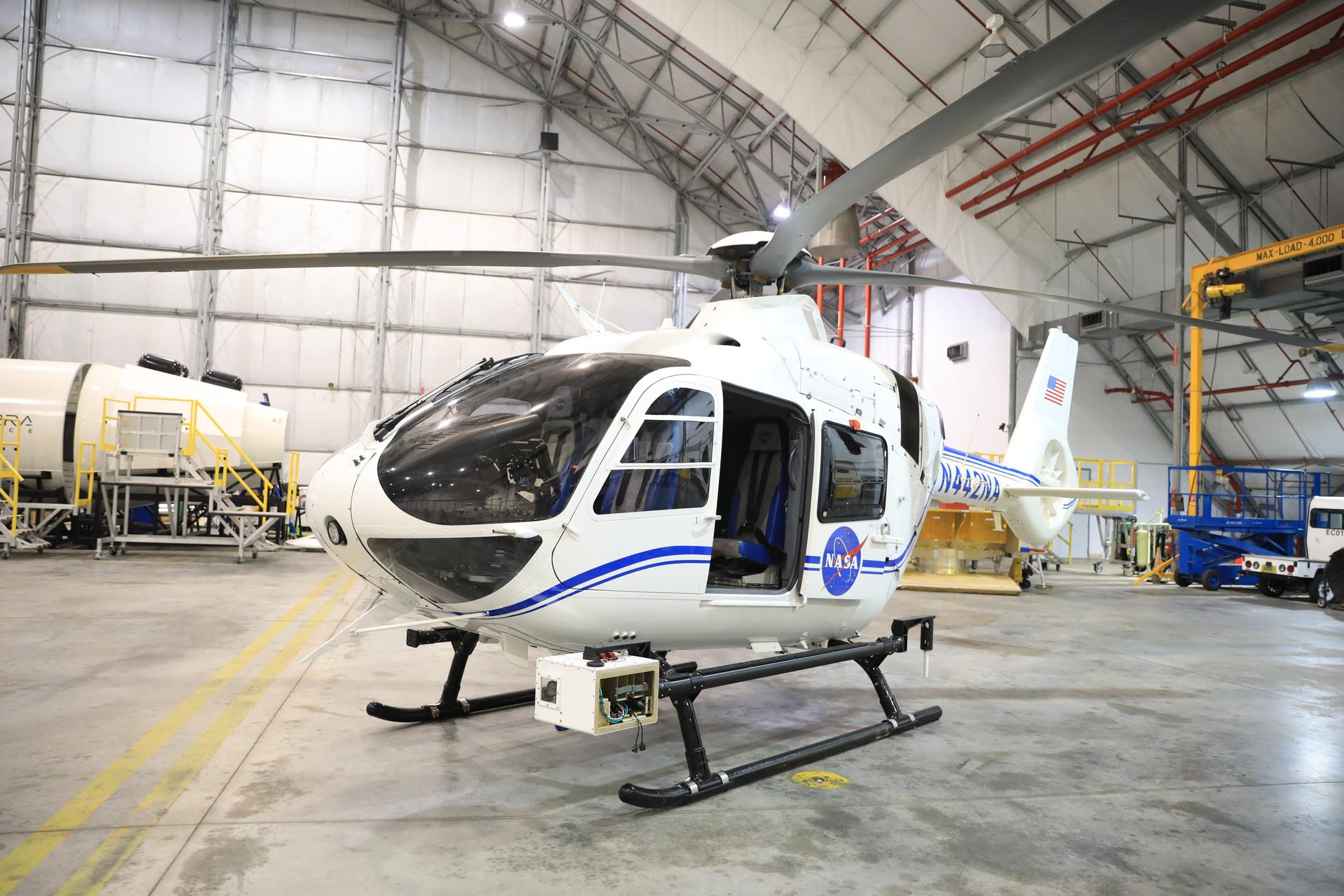
A white helicopter with blue stripe and NASA logo sits inside of an aircraft hangar with grey cement floors and white roofing with metal beams. The helicopter has four grey blades and has a black base. A white cube is attached to the black base and holds wires and cameras. No one sits inside the helicopter, but the door is open, and a grey seat is shown along with four black, tinted windows. There is an American flag on the helicopter’s tail.
The NASA Airborne Instrumentation for Real-world Video of Urban Environments (AIRVUE) sensor pod is attached to the base of a NASA helicopter at NASA’s Kennedy Space Center in Cape Canaveral, Florida in April 2024 before a flight to test the pod’s cameras and sensors. The AIRVUE pod will be used to collect data for autonomous aircraft like air taxis, drones, or other Advanced Air Mobility aircraft.
NASA/Isaac Watson

For self-flying aircraft to take to the skies, they need to learn about their environments to avoid hazards. NASA aeronautics researchers recently developed a camera pod with sensors to help with this challenge by advancing computer vision for autonomous aviation.  

This pod is called the Airborne Instrumentation for Real-world Video of Urban Environments (AIRVUE). It was developed and built at NASA’s Armstrong Flight Research Center in Edwards, California. Researchers recently flew it on a piloted helicopter at NASA’s Kennedy Space Center in Cape Canaveral, Florida for initial testing.  

The team hopes to use the pod to collect large, diverse, and accessible visual datasets of weather and other obstacles. They will then use that information to create a data cloud for manufacturers of self-flying air taxis or drones, or other similar aircraft, to access. Developers can use this data to evaluate how well their aircraft can “see” the complex world around them.  

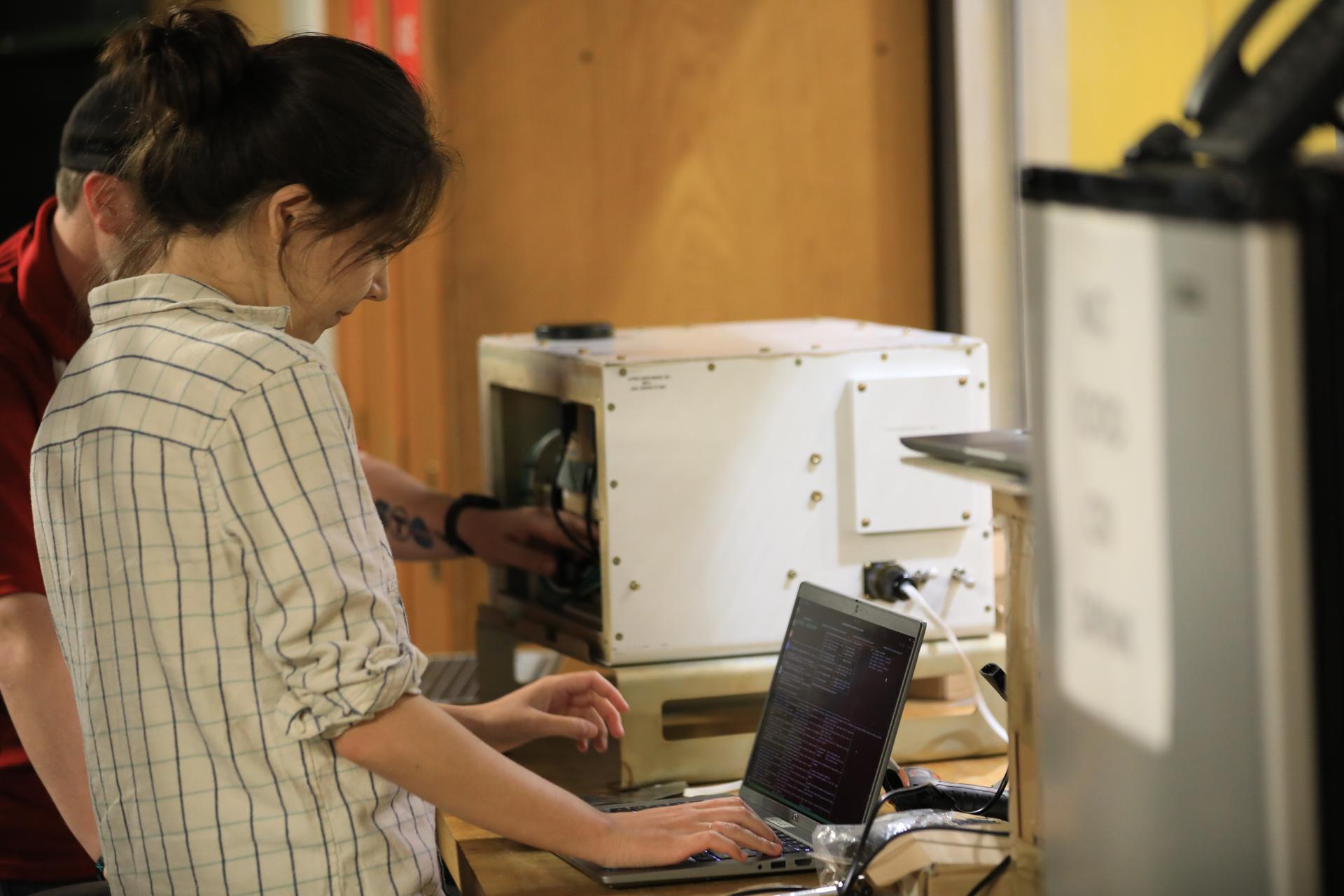
A woman with brown hair pulled into a bun, wearing a white, collared shirt with black lines, stands in the foreground of the photo. She is working on a grey laptop computer with black screen with computer coding shown. Behind her, on the left side, is the side of a man’s head and he is wearing a red polo. On the right side, behind her computer, is a white cube with wires and the man is placing his hand inside.
NASA researchers Elizabeth Nail (foreground) and A.J. Jaffe (background) prepare the NASA Airborne Instrumentation for Real-world Video of Urban Environments (AIRVUE) sensor pod for testing at NASA’s Kennedy Space Center in Cape Canaveral, Florida, in April 2024.
NASA/Isaac Watson

“Data is the fuel for machine learning,” said Nelson Brown, lead NASA researcher for the AIRVUE project. “We hope to inspire innovation by providing the computer vision community with realistic flight scenarios. Accessible datasets have been essential to advances in driver aids and self-driving cars, but so far, we haven’t seen open datasets like this in aviation.” 

The computer algorithms that will enable the aircraft to sense the environment must be reliable and proven to work in many flight circumstances. NASA data promises that fidelity, making this an important resource for industry. When a company conducts data collection on their own, it’s unlikely they share it with other manufacturers. NASA’s role facilitates this accessible dataset for all companies in the Advanced Air Mobility industry, ensuring the United States stays at the forefront of innovation. 

Once the design is refined, through evaluation and additional testing, the team hopes to make more pods that ride along on various types of aircraft to collect more visuals and grow the digital repository of data.

Powered by WPeMatico

Get The Details…
Dede Dinius

La NASA decide traer de vuelta la nave Starliner a la Tierra sin tripulación

La NASA decide traer de vuelta la nave Starliner a la Tierra sin tripulación

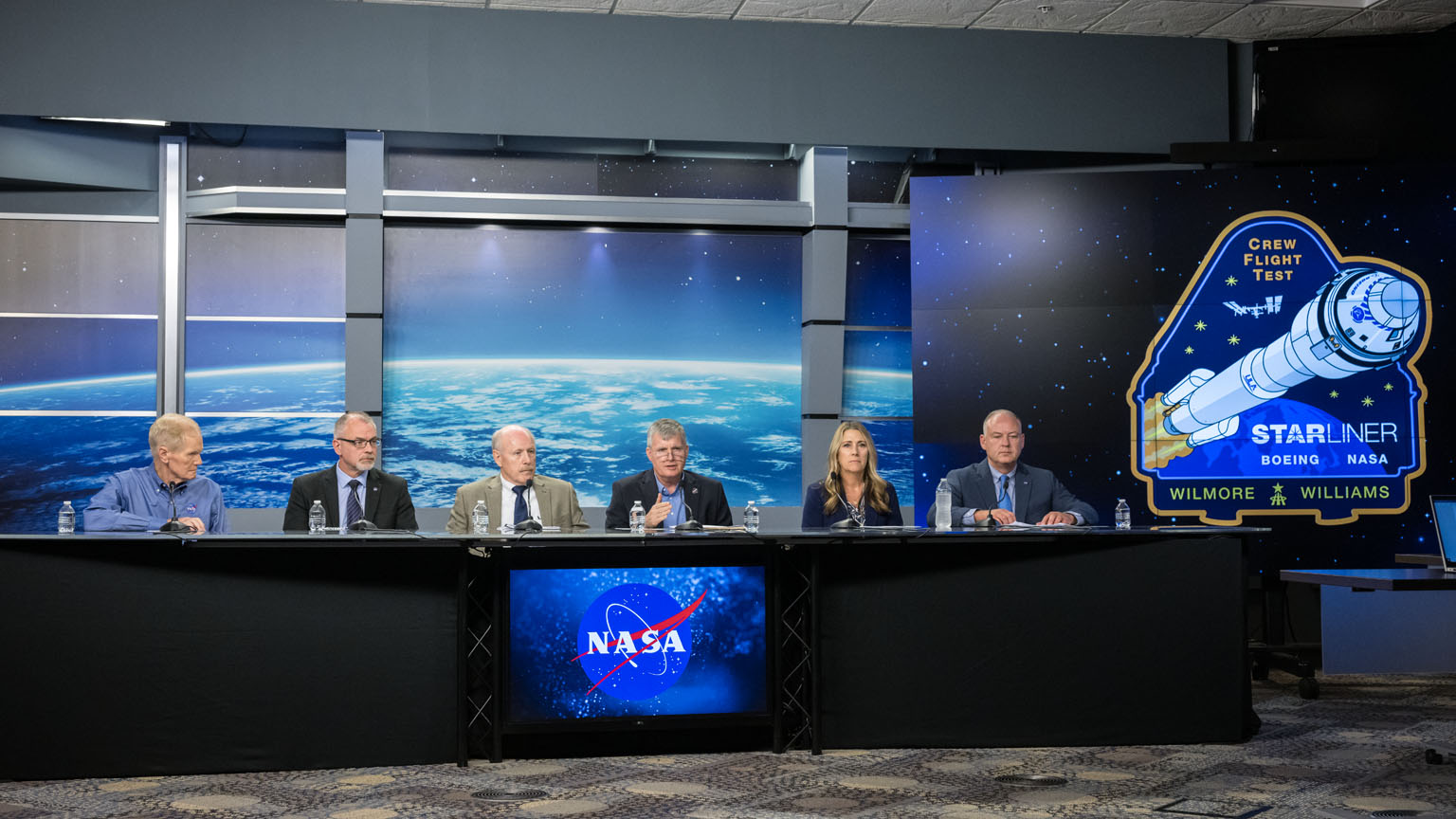
A group of NASA leaders sit at a table to conduct a live news conference at NASA Johnson.
El administrador de la NASA, Bill Nelson, y altos directivos participan en una rueda de prensa en directo el sábado 24 de agosto de 2024, en el Centro Espacial Johnson de la agencia en Houston, donde ofrecieron una actualización sobre la prueba de vuelo de la tripulación Boeing de la NASA.
Crédito: NASA

Read this release in English here.

La NASA traerá la nave espacial Starliner de Boeing de vuelta a la Tierra sin los astronautas Butch Wilmore y Suni Williams a bordo, según anunció la agencia el sábado. Este retorno sin tripulación permite a la NASA y a Boeing seguir recopilando datos de pruebas sobre Starliner durante su próximo vuelo de regreso a casa, al tiempo que no implica más riesgo del necesario para su tripulación.

Wilmore y Williams, que viajaron a la Estación Espacial Internacional en junio a bordo de la prueba de vuelo tripulado Boeing de la NASA, han estado ocupados, entre otras actividades, prestando apoyo a la investigación y el mantenimiento de la estación, así como las pruebas de sistema y análisis de datos de Starliner.

“Los vuelos espaciales son arriesgados, incluso en sus momentos más seguros y rutinarios. Un vuelo de prueba, por su propia naturaleza, no es ni seguro ni rutinario. La decisión de que Butch y Suni permanezcan a bordo de la Estación Espacial Internacional y de que la nave Starliner de Boeing regrese a casa sin tripulación es el resultado de nuestro compromiso con la seguridad, la cual es nuestro valor fundamental y nuestra estrella guía”, declaró Bill Nelson, Administrador de la NASA. “Estoy agradecido a los equipos de la NASA y de Boeing por todo su increíble y minucioso trabajo”.

Wilmore y Williams continuarán su trabajo oficialmente como parte de la tripulación de la Expedición 71/72 hasta febrero de 2025. Volverán a casa a bordo de una nave espacial Dragon con otros dos miembros de la tripulación asignados a la misión SpaceX Crew-9 de la agencia. Se espera que Starliner parta de la estación espacial y lleve a cabo una reentrada y un aterrizaje autónomos, seguros y controlados a principios de septiembre.

La NASA y Boeing detectaron fugas de helio y experimentaron problemas con los motores de control de actitud de la nave el 6 de junio, cuando Starliner se aproximaba a la estación espacial. Desde entonces, los equipos de ingeniería han completado una cantidad significativa de trabajo, incluyendo la revisión de una colección de datos, la realización de pruebas de vuelo y tierra, la organización de revisiones independientes con expertos en propulsión de la agencia, y el desarrollo de varios planes de contingencia de retorno. La incertidumbre y la falta de consenso entre los expertos no cumplen los requisitos de seguridad y rendimiento de la agencia para los vuelos espaciales tripulados, lo que ha llevado a la dirección de la NASA a transferir a los astronautas a la misión Crew-9.

“Las decisiones de este tipo nunca son fáciles, pero quiero encomendar a nuestros equipos de la NASA y Boeing por su análisis exhaustivo, discusiones transparentes y enfoque en la seguridad durante la prueba de vuelo tripulado”, dijo Ken Bowersox, administrador asociado de la Dirección de Misiones de Operaciones Espaciales de la NASA. “Hemos aprendido mucho sobre la nave espacial durante su travesía hasta la estación y sus operaciones acopladas. También seguiremos recopilando más datos sobre Starliner durante su regreso sin tripulación, y mejoraremos el sistema para futuros vuelos a la estación espacial.”

Starliner está diseñada para funcionar de manera autónoma y previamente completó dos vuelos sin tripulación. La NASA y Boeing trabajarán conjuntamente para ajustar la planificación del final de la misión y los sistemas de Starliner para prepararse para el regreso no tripulado en las próximas semanas. Starliner debe regresar a la Tierra antes del lanzamiento de la misión Crew-9 para garantizar la disponibilidad de un puerto de atraque en la estación.

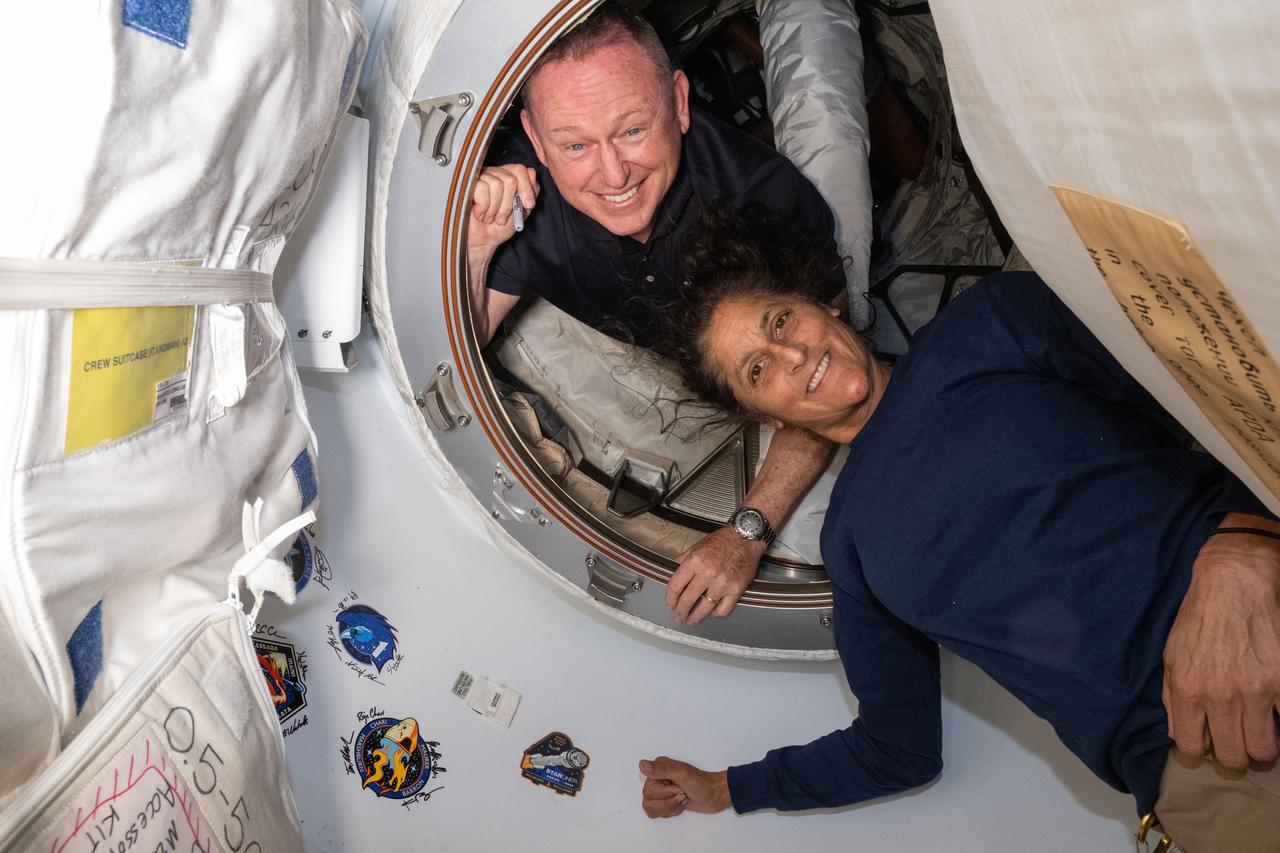
NASA's Boeing Crew Flight Test astronauts (from top) Butch Wilmore and Suni Williams pose on June 13, 2024 for a portrait inside the vestibule between the forward port on the International Space Station's Harmony module and Boeing's Starliner spacecraft.
Los astronautas del vuelo de prueba tripulado Boeing de la NASA, Butch Wilmore (arriba) y Suni Williams (abajo), posan el 13 de junio de 2024 para un retrato dentro del vestíbulo entre el puerto delantero del módulo Harmony de la Estación Espacial Internacional y la nave espacial Starliner de Boeing.
Crédito: NASA

“Starliner es una nave espacial muy capaz y, en última instancia, esto se reduce a la necesidad de un mayor nivel de certeza para llevar a cabo un retorno con tripulación”, dijo Steve Stich, gerente del Programa de Tripulación Comercial de la NASA. “Los equipos de la NASA y Boeing han completado una enorme cantidad de pruebas y análisis, y esta prueba de vuelo está proporcionando información crítica sobre el rendimiento de Starliner en el espacio. Nuestros esfuerzos ayudarán a preparar el regreso sin tripulación y beneficiarán en gran medida a futuras acciones correctivas para la nave espacial.”

El Programa de Tripulación Comercial de la NASA exige que las naves espaciales efectúen un vuelo de prueba con tripulación para demostrar que el sistema está preparado para vuelos regulares desde y hacia la estación espacial. Tras el regreso de Starliner, la agencia revisará todos los datos relacionados con la misión para determinar qué medidas adicionales son necesarias para cumplir los requisitos de certificación de la NASA.

La misión SpaceX Crew-9 de la agencia, originalmente programada con cuatro tripulantes, despegará no antes del martes 24 de septiembre. La agencia proveerá más información sobre la tripulación Crew-9 cuando se ultimen los detalles.

La NASA y SpaceX están ahora trabajando en varios aspectos antes del lanzamiento, como reconfigurar los asientos en la nave Crew-9 Dragon y ajustar el manifiesto para transportar carga adicional, efectos personales y trajes espaciales específicos de Dragon para Wilmore y Williams. Además, la NASA y SpaceX utilizarán nuevas instalaciones en el Complejo de Lanzamiento Espacial 40 en la Estación de la Fuerza Espacial de Cabo Cañaveral en Florida para lanzar Crew-9, lo que brindará mayor flexibilidad operativa en torno al lanzamiento planeado de Europa Clipper por parte de la NASA.

La misión Crew-9 será la novena misión de rotación a la estación espacial en el marco del Programa de Tripulación Comercial de la NASA, que colabora con la industria aeroespacial estadounidense para lograr el objetivo de un servicio de transporte seguro, fiable y rentable hacia y desde el puesto orbital mediante cohetes y naves espaciales de fabricación estadounidense que despegan desde territorio de Estados Unidos.

Durante más de dos décadas, la Estación Espacial Internacional ha tenido personas viviendo y trabajando a bordo, impulsando el conocimiento científico y poniendo a prueba nuevas tecnologías, logrando avances en la investigación que no son posibles en la Tierra. La estación es un banco de pruebas fundamental para que la NASA comprenda y supere los retos de los vuelos espaciales de larga duración, así como para expandir las oportunidades comerciales en la órbita terrestre baja. A medida que las empresas comerciales se centran en proporcionar servicios de transporte espacial humano y destinos como parte de una economía robusta de órbita terrestre baja, la campaña Artemis de la NASA está en marcha hacia la Luna, donde la agencia se preparará para la futura exploración con seres humanos de Marte.

Para más información (en inglés) sobre el Programa de Tripulación Comercial de la NASA, visita:

https://www.nasa.gov/commercialcrew

Meira Bernstein / Josh Finch
Sede, Washington
202-358-1100
meira.b.bernstein@nasa.gov / joshua.a.finch@nasa.gov

Steve Siceloff / Danielle Sempsrott / Stephanie Plucinsky
Centro Espacial Kennedy, Florida
321-867-2468
steven.p.siceloff@nasa.gov / danielle.c.sempsrott@nasa.gov / stephanie.n.plucinsky@nasa.gov

Leah Cheshier / Sandra Jones
Centro Espacial Johnson, Houston
281-483-5111
leah.d.cheshier@nasa.gov / sandra.p.jones@nasa.gov

Powered by WPeMatico

Get The Details…
Sarah A. Loff

Station Science Top News: August 23, 2024

Station Science Top News: August 23, 2024

Researchers successfully produced cellulose from bacteria cultured on the International Space Station for four weeks. The bacteria used in the experiment, K. hansenii, is known to produce the highest amount of cellulose and could be considered for large-scale production in microgravity to support the development of materials used in construction, clothing, and the supply of energy.

Ice Cubes Experiment Cube #4, #5- Kirara, a temperature-controlled module typically used for protein crystallization, was used here to incubate the target bacteria. Researchers developed a customized methodology that consisted of adjusting gas and air in various culture vessels in low-temperature conditions. Future studies could help to promote large scale production of bacterial cellulose to support deep space exploration.

Researchers studied two properties of oil-in-water emulsions in microgravity (i.e., drop size and drop displacement at a constant speed and direction), finding that while oil drops grow over time, drop displacement decreases. This was an unexpected observation in microgravity where neither sedimentation nor creaming occurs. These results could improve knowledge of fluid mechanics relevant to industrial processes on Earth and enable technologies for space exploration.

Fluid Science Laboratory (FSL) Soft Matter Dynamics – Particle STAbilised Emulsions and Foams (PASTA) studies the dynamics of droplets to enhance understanding of coalescence and size evolution in emulsions. Emulsions are systems where two unmixable fluids are combined via small droplets inside the second liquid. Researchers explained that drop growth was the result of aggregation (or coalescence) between small drops colliding with each other. Enhanced understanding of coalescence, a property that is associated with the stability of surfactants such as oils, dyes, and detergents, can lead to a safer environment and sustainability of certain emulsion technologies in multiple arenas such as the food, pharmaceutical, paint, and lubrication industries.

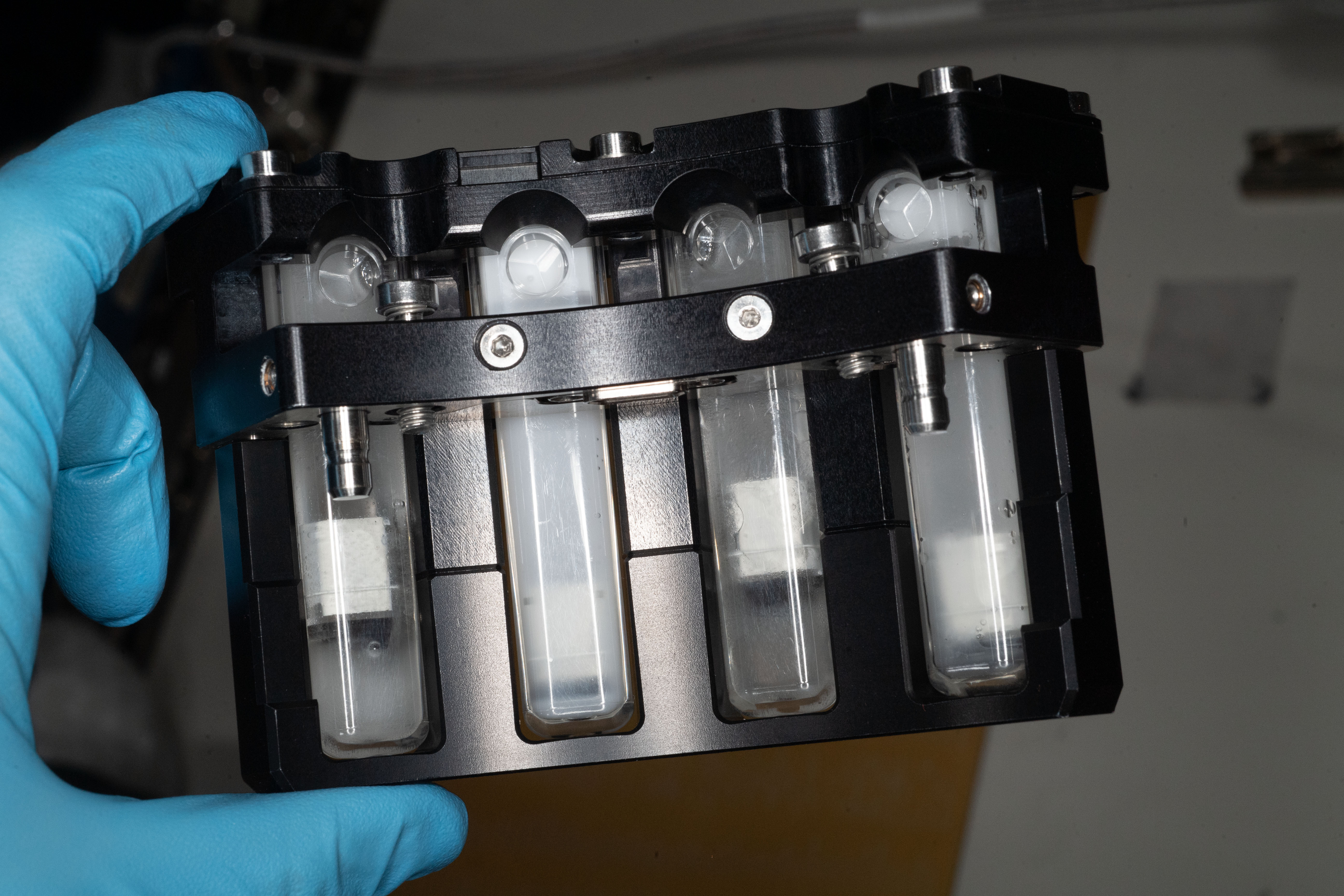
Picture of a latex glove-covered hand holding a black container with four clear tubes inset.
Documentation of a sample that was removed from the Fluid Science Laboratory (FSL) during operations to exchange samples inside the FSL Soft Matter Dynamics (SMD) experiment container.
NASA/Samantha Cristoferetti

Nystagmus, a condition associated with vestibular imbalance and cerebellar dysfunction characterized by rapid and uncontrollable eye movements, was detected in about 45% of crew members soon after landing. Correct diagnosis of this condition enables the development of strategies and countermeasures for a speedy recovery after spaceflight.

In the Field Test investigation, researchers investigated the complexity, severity, and duration of physical changes that occurred in astronauts after spaceflight. Astronauts and cosmonauts that live in space for extended periods experience physical changes that have noticeable effects once they return to Earth’s gravity, including changes to vision, balance, coordination, blood pressure, and the ability to walk. Some crew members showed nystagmus in several gaze positions, with significant recovery identified 10 to 13 days postflight. These results expand researchers’ understanding of vestibular disorders, adaptations to spaceflight, and dynamics of recovery after prolonged microgravity exposure.

Two women touch fingers while participating in a field test to assess physical changes that can occur during spaceflight.
NASA Human Health and Performance Directorate personnel assess hardware used in the Field Test investigation.
NASA/Lauren Harnett

Powered by WPeMatico

Get The Details…
Linda E. Grimm

Dr. Irene Duhart Long

Dr. Irene Duhart Long

Dr. Long, an African American woman with curly hair, poses for a picture while leaning over a white microscope. She wears large aviator-shaped glasses and a black and white patterned top and pants.
NASA

Dr. Irene Duhart Long was the first female and the first minority to hold the position of chief medical officer at NASA’s Kennedy Space Center in Florida, as well as the first African American female to serve in the Senior Executive Service at the center. These distinctions were only two of many firsts in her 31-year-long career at NASA.

While she broke barriers in her own life, she also advocated for others to have more opportunities. She helped create the Spaceflight and Life Sciences Training Program at Kennedy, in partnership with Florida Agricultural and Mechanical University, a program that encouraged more women and minority college students to explore careers in science. She also motivated and mentored her coworkers, taking a strong interest in their trajectory at NASA.

“One of the admirable qualities of Irene Long was her inclusion mentality regarding women in the workplace,” Kennedy Employee Assistance Counselor Patricia Bell said. “She was a front runner in advocating for women.” Long helped coordinate an educational women’s forum, focused on health, mental well-being and other topics of interest for women. Long died Aug. 4, 2020, at age 69.

For Womens Equality Day, read more about Dr. Long’s legacy at NASA.

Image Credit: NASA

Powered by WPeMatico

Get The Details…
Monika Luabeya

Cassiopeia A, Then the Cosmos: 25 Years of Chandra X-ray Science

Cassiopeia A, Then the Cosmos: 25 Years of Chandra X-ray Science

5 Min Read

Cassiopeia A, Then the Cosmos: 25 Years of Chandra X-ray Science

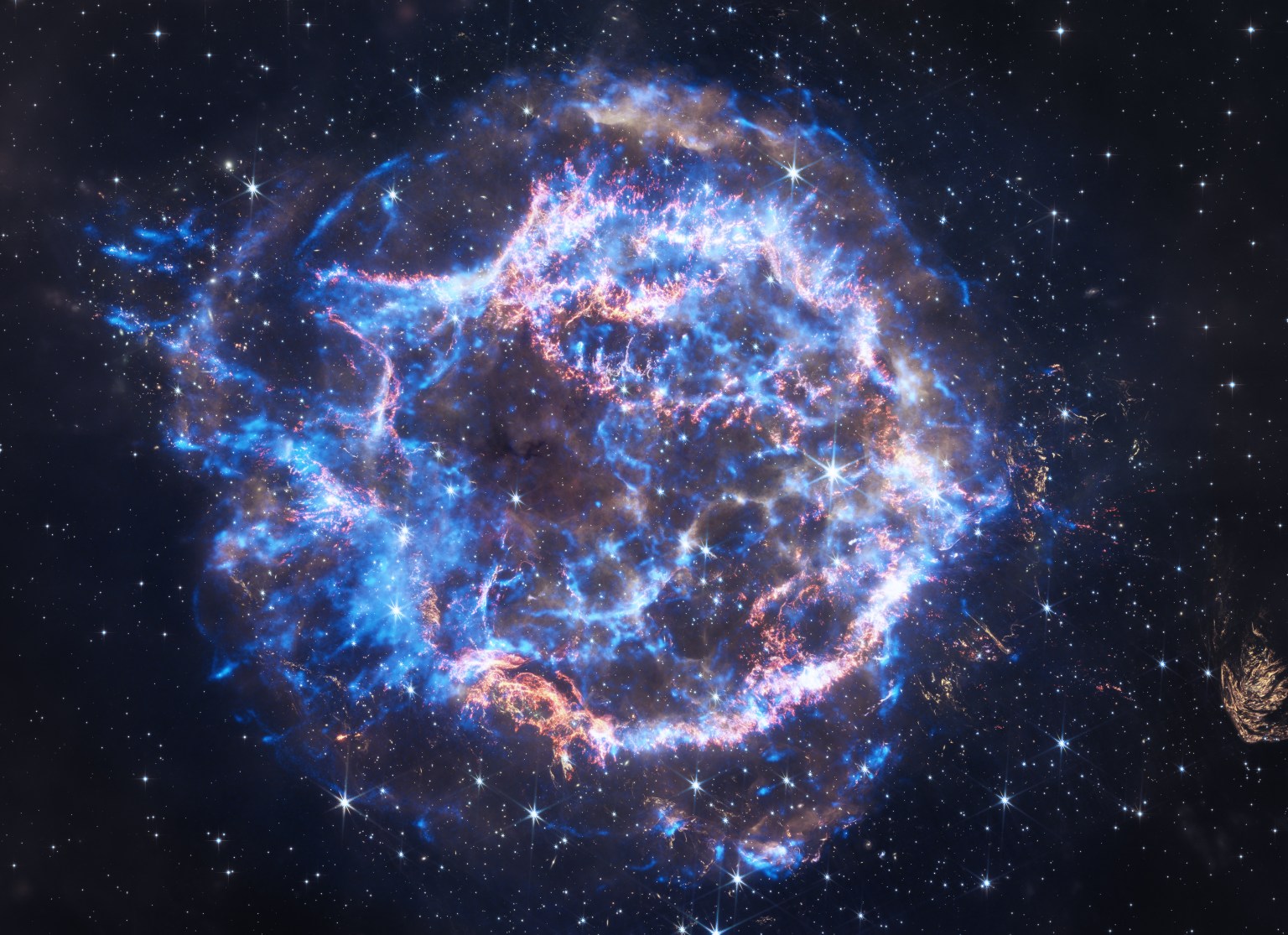
This image features the Cassiopeia A supernova, an expanding ball of matter and energy ejected from an exploding star. Here, rings of neon blue and brilliant white emit veins of polished gold. The rings and their arching veins encircle a place of relative calm at the center of the supernova remnant. This hole at the center of the circle, and the three-dimensionality conveyed by the rings and their arching veins, give this image of Cassiopeia A the look of a giant, crackling, electric blue donut. X-rays detected by Chandra show debris from the destroyed star and the blast wave from the explosion.

By Rick Smith

On Aug. 26, 1999, NASA’s Chandra X-ray Observatory opened its powerful telescopic eye in orbit and captured its awe-inspiring “first light” images of Cassiopeia A, a supernova remnant roughly 11,000 light-years from Earth. That first observation was far more detailed than anything seen by previous X-ray telescopes, even revealing – for the first time ever – a neutron star left in the wake of the colossal stellar detonation.

Those revelations came as no surprise to Chandra project scientist Martin Weisskopf, who led Chandra’s development at NASA’s Marshall Space Flight Center in Huntsville, Alabama. “When you build instrumentation that’s 10 times more sensitive than anything that was done before, you’re bound to discover something new and exciting,” he said. “Every step forward was a giant step forward.”

Twenty-five years later, Chandra has repeated that seminal moment of discovery again and again, delivering – to date – nearly 25,000 detailed observations of neutron stars, quasars, supernova remnants, black holes, galaxy clusters, and other highly energetic objects and events, some as far away as 13 billion light-years from Earth.

Chandra has further helped scientists gain tangible evidence of dark matter and dark energy, documented the first electromagnetic events tied to gravitational waves in space, and most recently aided the search for habitable exoplanets – all vital tools for understanding the vast, interrelated mechanisms of the universe we live in.

This image features the Cassiopeia A supernova, an expanding ball of matter and energy ejected from an exploding star. Here, rings of neon blue and brilliant white emit veins of polished gold. The rings and their arching veins encircle a place of relative calm at the center of the supernova remnant. This hole at the center of the circle, and the three-dimensionality conveyed by the rings and their arching veins, give this image of Cassiopeia A the look of a giant, crackling, electric blue donut. X-rays detected by Chandra show debris from the destroyed star and the blast wave from the explosion.
NASA’s Chandra X-ray Observatory has observed Cassiopeia A for more than 2 million total seconds since its “first light ” images of the supernova remnant on Aug. 26, 1999. Cas A is some 11,000 light-years from Earth. Chandra X-rays are depicted in blue and composited with infrared images from NASA’s James Webb Space Telescope in orange and white.
Credits: X-ray: NASA/CXC/SAO; Infrared: NASA/ESA/CSA/STScI/D. Milisavljevic (Purdue Univ.), I. De Looze (University of Ghent), T. Temim (Princeton Univ.); Image Processing: NASA/CXC/SAO/J. Schmidt, K. Arcand, and J. Major

“Chandra’s first image of Cas A provided stunning demonstration of Chandra’s exquisite X-ray mirrors, but it simultaneously revealed things we had not known about young supernova remnants,” said Pat Slane, director of the CXC (Chandra X-ray Center) housed at the Smithsonian Astrophysical Observatory in Cambridge, Massachusetts. “In a blink, Chandra not only revealed the neutron star in Cas A; it also taught us that young neutron stars can be significantly more modest in their output than what previously had been understood. Throughout its 25 years in space, Chandra has deepened our understanding of fundamental astrophysics, while also greatly broadening our view of the universe.”

To mark Chandra’s silver anniversary, NASA and CXC have shared 25 of its most breathtaking images and debuted a new video, “Eye on the Cosmos.

Chandra often is used in conjunction with other space telescopes that observe the cosmos in different parts of the electromagnetic spectrum, and with other high-energy missions such as ESA’s (European Space Agency’s) XMM-Newton; NASA’s Swift, NuSTAR (Nuclear Spectroscopic Telescope Array), and IXPE (Imaging X-ray Polarization Explorer) imagers, and NASA’s NICER (Neutron Star Interior Composition Explorer) X-ray observatory, which studies high-energy phenomena from its vantage point aboard the International Space Station.

Chandra remains a unique, global science resource, with a robust data archive that will continue to serve the science community for many years.

“NASA’s project science team has always strived to conduct Chandra science as equitably as possible by having the world science community collectively decide how best to use the observatory’s many tremendous capabilities,” said Douglas Swartz, a USRA (Universities Space Research Association) principal research scientist on the Chandra project science team.

These images were released to commemorate the 25th anniversary of Chandra. They represent the wide range of objects that the telescope has observed over its quarter century of observations. X-rays are an especially penetrating type of light that reveals extremely hot objects and very energetic physical processes. The images range from supernova remnants, like Cassiopeia A, to star-formation regions like the Orion Nebula, to the region at the center of the Milky Way. This montage also contains objects beyond our own Galaxy including other galaxies and galaxy clusters.
Credits: X-ray: NASA/CXC/UMass/Q.D. Wang; Image processing: NASA/CXC/SAO/N. Wolk

“Chandra will continue to serve the astrophysics community long after its mission ends,” said Andrew Schnell, acting Chandra program manager at Marshall. “Perhaps its greatest discovery hasn’t been discovered yet. It’s just sitting there in our data archive, waiting for someone to ask the right question and use the data to answer it. It could be somebody who hasn’t even been born yet.”

That archive is impressive indeed. To date, Chandra has delivered more than 70 trillion bytes of raw data. More than 5,000 unique principal investigators and some 3,500 undergraduate and graduate students around the world have conducted research based on Chandra’s observations. Its findings have helped earn more than 700 PhDs and resulted in more than 11,000 published papers, with half a million total citations.

Weisskopf is now an emeritus researcher who still keeps office hours every weekday despite having retired from NASA in 2022. He said the work remains as stimulating now as it was 25 years ago, waiting breathlessly for those “first light” images.

NASA’s Chandra X-ray Observatory data, seen here in violet and white, is joined with that of NASA’s Hubble Space Telescope (red, green, and blue) and Imaging X-ray Polarimetry Explorer (purple) to show off the eerie beauty of the Crab Nebula. The nebula is the result of a bright supernova explosion first witnessed and documented in 1054 A.D.
Credits: X-ray: (Chandra) NASA/CXC/SAO, (IXPE) NASA/MSFC; Optical: NASA/ESA/STScI; Image Processing: NASA/CXC/SAO/J. Schmidt, K. Arcand, and L. Frattare

“We’re always trying to put ourselves out of business with the next bit of scientific understanding,” he said. “But these amazing discoveries have demonstrated how much NASA’s astrophysics missions still have to teach us.”

The universe keeps turning – and Chandra’s watchful eye endures.

More about Chandra

Chandra, managed for NASA by Marshall in partnership with the CXC, is one of NASA’s Great Observatories, along with the Hubble Space Telescope and the now-retired Spitzer Space Telescope and Compton Gamma Ray Observatory. It was first proposed to NASA in 1976 by Riccardo Giacconi, recipient of the 2002 Nobel Prize for Physics based on his contributions to X-ray astronomy, and Harvey Tananbaum, who would later become the first director of the Chandra X-ray Center. Chandra was named in honor of the late Nobel laureate Subrahmanyan Chandrasekhar, who earned the Nobel Prize in Physics in 1983 for his work explaining the structure and evolution of stars.

Learn more about the Chandra X-ray Observatory and its mission here:

https://www.nasa.gov/chandra

https://cxc.harvard.edu

News Media Contact

Lane Figueroa
Marshall Space Flight Center, Huntsville, Alabama
256-544-0034
lane.e.figueroa@nasa.gov

Share

Details

Last Updated

Aug 26, 2024

Powered by WPeMatico

Get The Details…
Lee Mohon