NASA, SpaceX Extend US Media Deadline for Crew-9 Launch to Station

NASA, SpaceX Extend US Media Deadline for Crew-9 Launch to Station

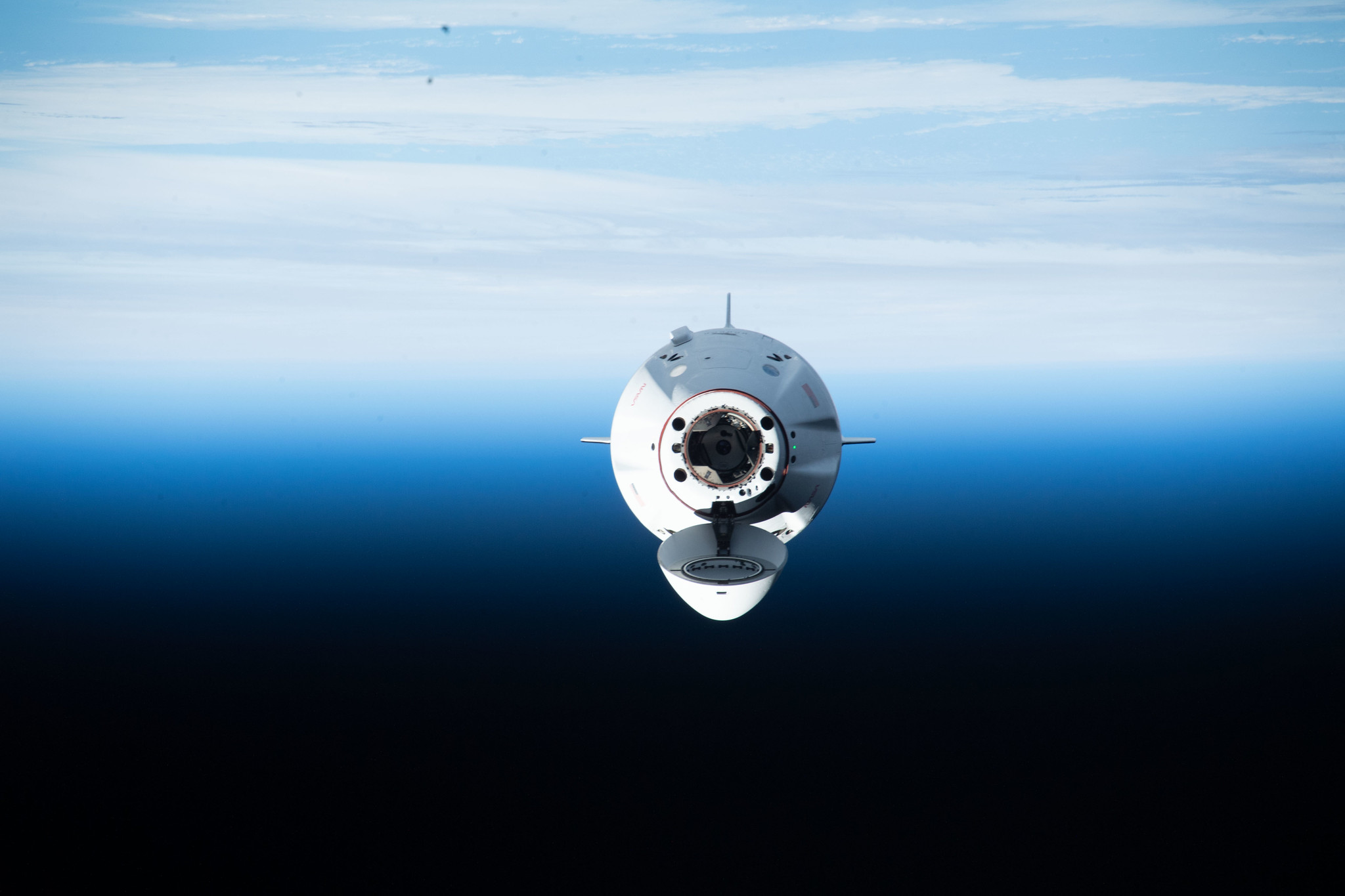
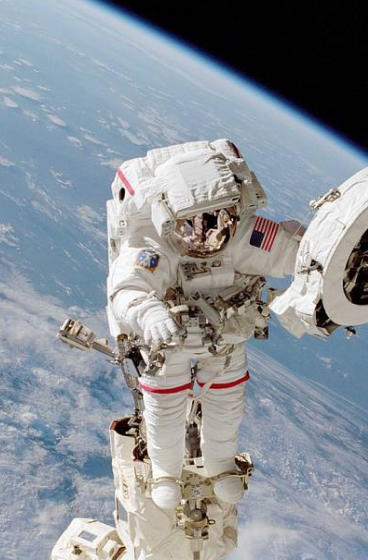
The SpaceX Dragon Endurance crew ship, carrying four Crew-5 members, approaches the International Space Station with the Earth’s horizon in the background. Credit: NASA/Kjell Lindgren

NASA is extending U.S. media accreditation for the launch of the agency’s ninth rotational mission of a SpaceX Falcon 9 rocket and Dragon spacecraft that will carry astronauts to the International Space Station. This mission is part of NASA’s Commercial Crew Program.

The application period for U.S. media and U.S. citizens representing international media organizations is extended until 11:59 p.m. EDT on Tuesday, Sept. 3. Media members who have already applied do not need to reapply. All new accreditation requests must be submitted online at:

https://media.ksc.nasa.gov

Launch of NASA’s SpaceX Crew-9 mission, originally slated with four crew members, is targeted for no earlier than Tuesday, Sept. 24, from Space Launch Complex-40 at Cape Canaveral Space Force Station in Florida.

NASA announced astronauts Butch Wilmore and Suni Williams will remain on station and return home in February 2025 aboard Dragon with two other crew members assigned to the Crew-9 mission, during a news conference on Aug. 24. The agency will share more information about the Crew-9 complement when details are finalized.

NASA and SpaceX currently are working on several items before launch, including reconfiguring seats on the Dragon and adjusting the manifest to carry additional cargo, personal effects, and Dragon-specific spacesuits for Wilmore and Williams.

NASA’s media accreditation policy is available online. For questions about accreditation or special logistical requests, email: ksc-media-accreditat@mail.nasa.gov. Requests for space for satellite trucks, tents, or electrical connections also are due by Sept. 3.

For other questions, please contact NASA Kennedy’s newsroom at: 321-867-2468.

Para obtener información sobre cobertura en español en el Centro Espacial Kennedy o si desea solicitar entrevistas en español, comuníquese con Antonia Jaramillo: 321-501-8425, o Messod Bendayan: 256-930-1371.

For launch coverage and more information about the mission, visit:

https://www.nasa.gov/commercialcrew

-end-

Joshua Finch / Claire O’Shea
Headquarters, Washington
202-358-1100
joshua.a.finch@nasa.gov / claire.a.o’shea@nasa.gov

Steve Siceloff / Danielle Sempsrott / Stephanie Plucinsky
Kennedy Space Center, Florida
321-867-2468
steven.p.siceloff@nasa.gov / danielle.c.sempsrott@nasa.gov / stephanie.n.plucinsky@nasa.gov

Leah Cheshier
Johnson Space Center, Houston
281-483-5111
leah.d.cheshier@nasa.gov

Powered by WPeMatico

Get The Details…
Abbey A. Donaldson

15 Years Ago: STS-128 Delivers Cargo to Enable Six-Person Space Station Crew

15 Years Ago: STS-128 Delivers Cargo to Enable Six-Person Space Station Crew

On Aug. 28, 2009, space shuttle Discovery began its 37th trip into space. The 17A mission to the International Space Station was the 30th shuttle flight to the orbiting lab. During the 14-day mission, the seven-member STS-128 crew worked with Expedition 20, the first six-person crew aboard the station, during nine days of docked operations. In addition to completing a one-for-one long-duration crew member exchange, they delivered more than seven tons of supplies, including three new payload racks and three systems to maintain a six-person crew aboard the space station. They completed three spacewalks to perform maintenance on the facility, prepare the station for the arrival of the next module, and retrieve two science experiments for return to Earth.
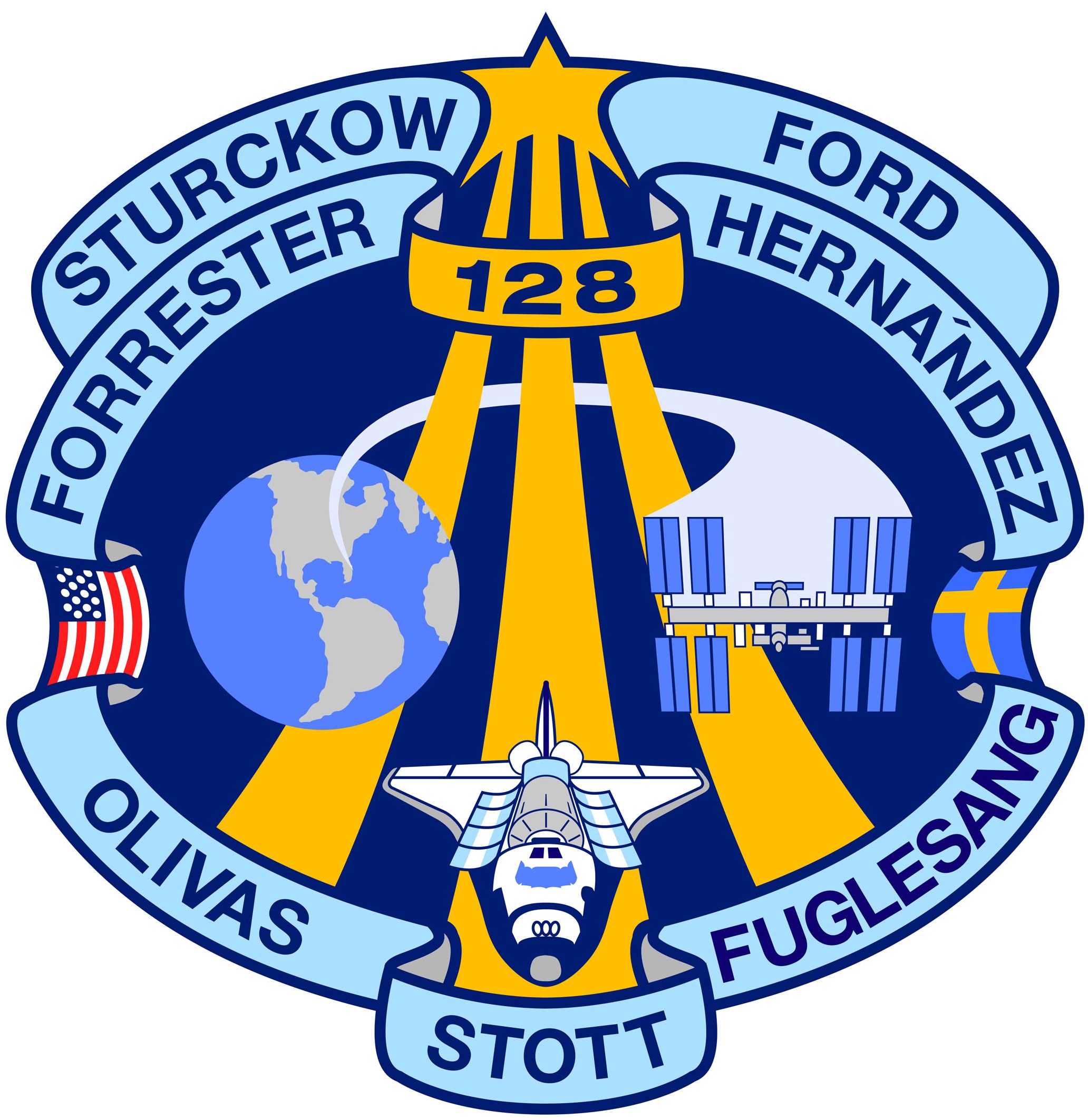
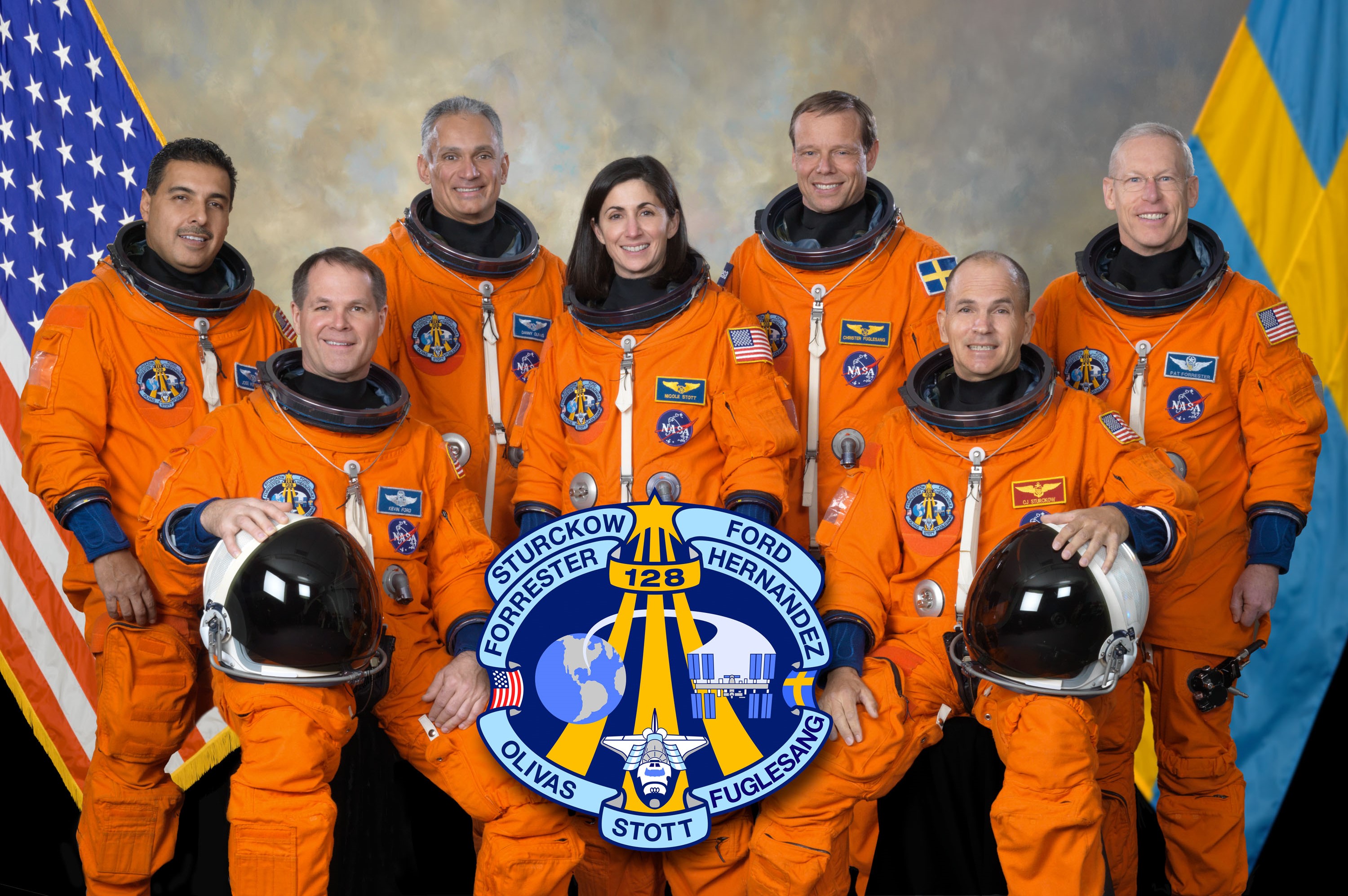
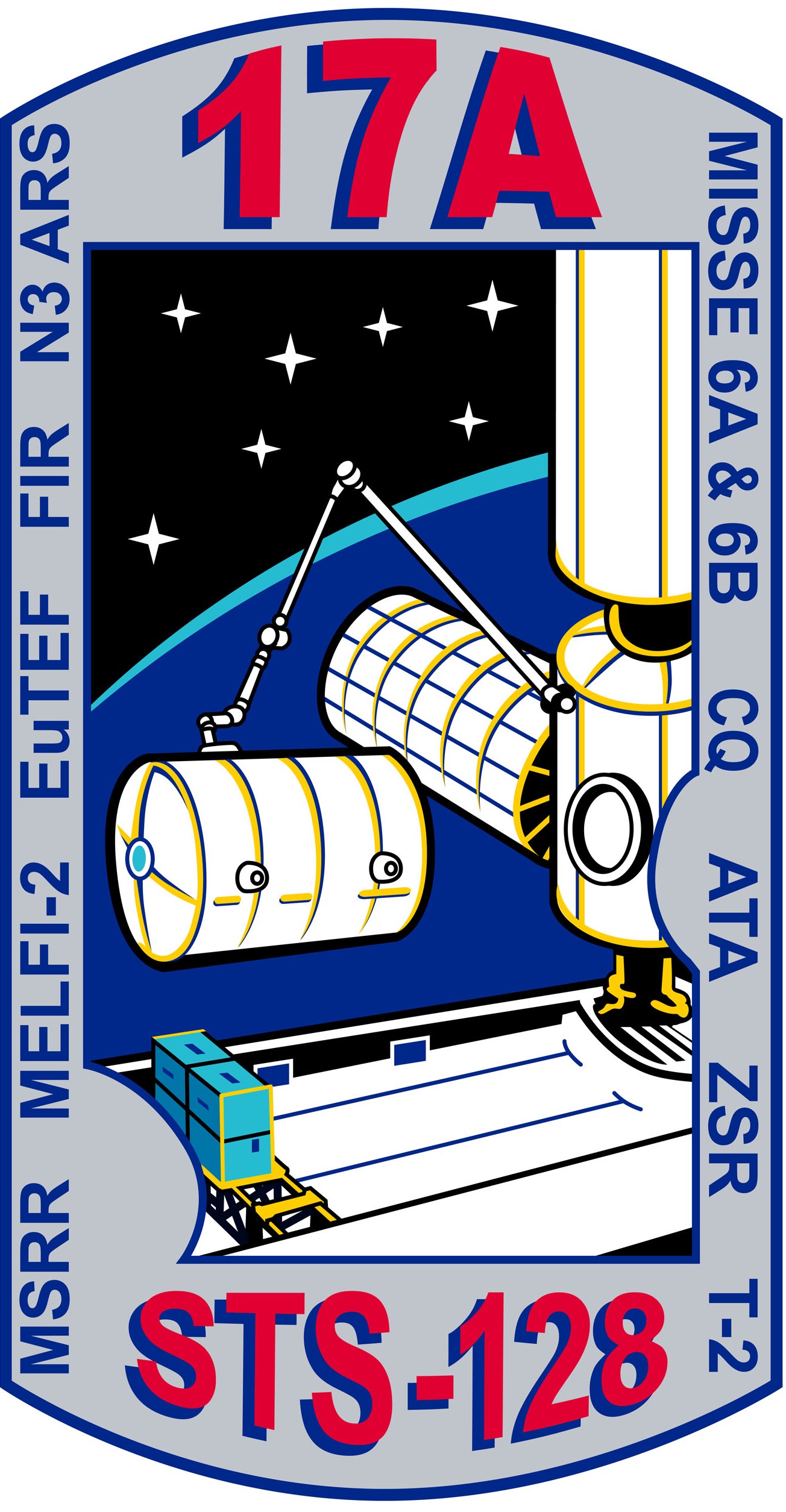
The STS-128 crew patch Official photograph of the STS-128 crew The 17A mission patch
Left: The STS-128 crew patch. Middle: Official photograph of the STS-128 crew of José M. Hernández, left, Kevin A. Ford, John D. “Danny” Olivas, Nicole P. Stott, A. Christer Fuglesang of Sweden representing the European Space Agency, Frederick “Rick” W. Sturckow, and Patrick G. Forrester. Right: The 17A mission patch.

The seven-person STS-128 crew consisted of Commander Frederick “Rick” W. Sturckow, Pilot Kevin A. Ford, and Mission Specialists Patrick G. Forrester, José M. Hernández, John D. “Danny” Olivas, and A. Christer Fuglesang of Sweden representing the European Space Agency (ESA), and Nicole P. Stott. Primary objectives of the mission included the launch to the station of facilities required to maintain a permanent six-person crew and the exchange of Stott for Timothy L. Kopra who had been aboard the space station since July 2009 as a member of Expedition 20. The facilities, launched inside the Leonardo Multi-Purpose Logistics Module (MPLM), included an additional Crew Quarters, the T2 COLBERT treadmill, and an Air Revitalization System rack. Three payload racks – the Materials Science Research Rack, the Fluids Integrated Rack, and the second Minus Eighty-degree Laboratory Freezer for ISS – also rode inside the MPLM for transfer to the station to expand its research capabilities.

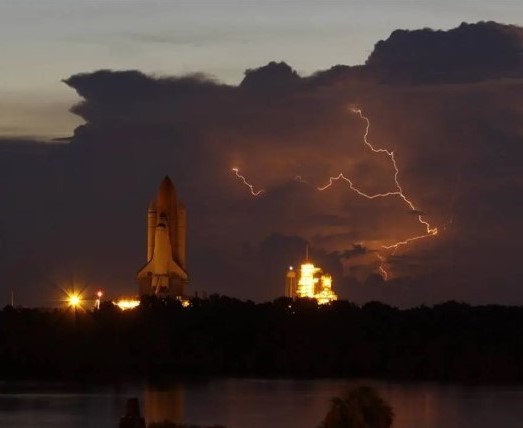
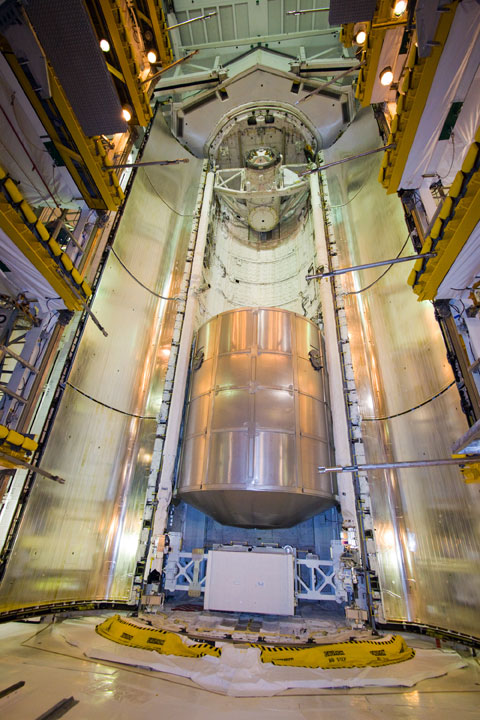
The STS-128 crew at the conclusion of the Terminal Countdown Demonstration Test at NASA’s Kennedy Space Center in Florida Space shuttle Discovery during the rollout to Launch Pad 39A The Leonardo Multi-Purpose Logistics Module in Discovery’s payload bay at Launch Pad 39A
Left: The STS-128 crew at the conclusion of the Terminal Countdown Demonstration Test at NASA’s Kennedy Space Center in Florida. Middle: Space shuttle Discovery during the rollout to Launch Pad 39A. Right: The Leonardo Multi-Purpose Logistics Module in Discovery’s payload bay at Launch Pad 39A.

Discovery returned from its previous mission, STS-119, on March 28, 2009, and workers towed it to the Orbiter Processing Facility at NASA’s Kennedy Space Center (KSC). The orbiter rolled over to the Vehicle Assembly Building on July 26, and after mating with its external tank and twin solid rocket boosters, rolled out to Launch Pad 39A on Aug. 4, targeting Aug. 25 for launch. Three days later, the seven-member crew participated in the Terminal Countdown Demonstration Test, essentially a dress rehearsal of the actual countdown for launch, returned to Houston for final training. They arrived at KSC on Aug 19 to prepare for launch.
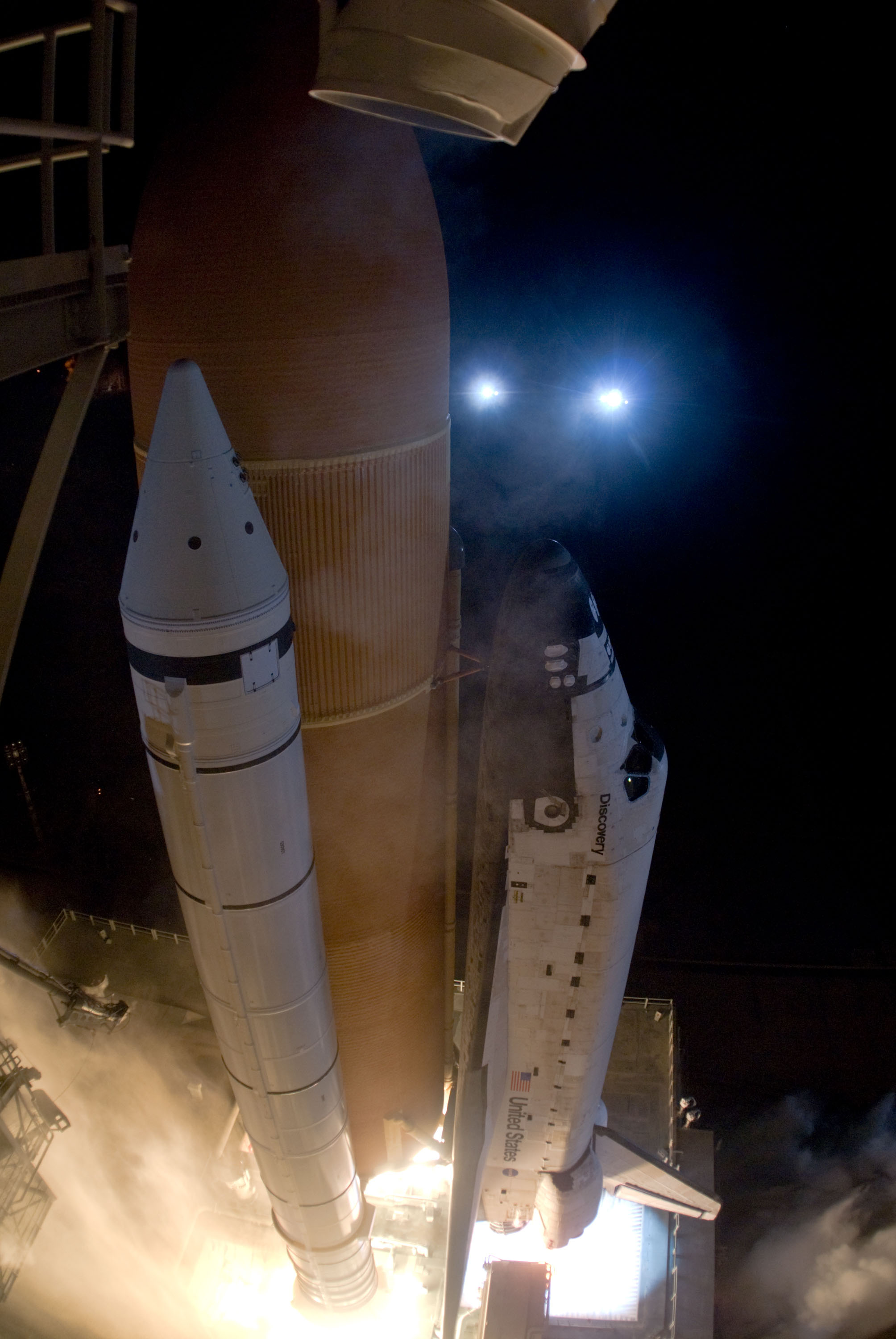
Liftoff of space shuttle Discovery on STS-128 Discovery streaks into the night sky
Left: Liftoff of space shuttle Discovery on STS-128. Right: Discovery streaks into the night sky.

Clouds and lighting in the launch area forced a scrub of the first launch attempt on Aug. 25, while a faulty valve indicator scrubbed the next day’s attempt. On Aug. 28, at 11:59 p.m. EDT, space shuttle Discovery lifted off from Launch Pad 39A to begin its 37th trip into space, carrying its seven-member crew on the 17A space station outfitting and resupply mission. Eight and a half minutes later, Discovery and its crew had reached orbit. This marked Sturckow’s fourth time in space, Forrester’s third, Olivas’ and Fuglesang’s second, while Ford, Hernández, and Stott enjoyed their first taste of weightlessness.

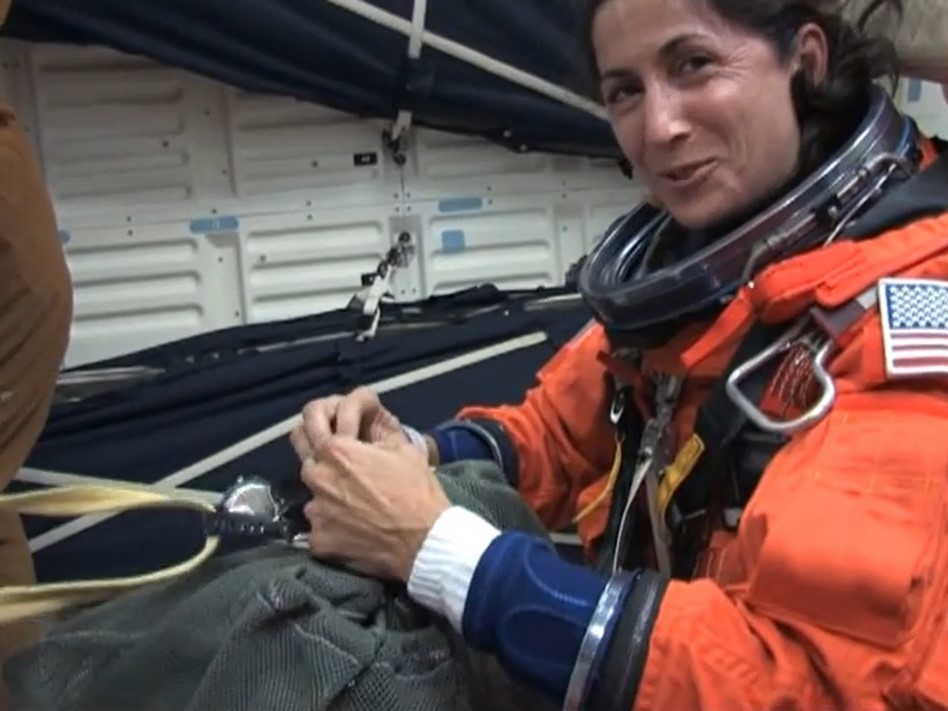
Kevin A. Ford José M. Hernández Nicole P. Stott
First time space flyers Kevin A. Ford, left, José M. Hernández, and Nicole P. Stott enjoying the first few minutes of weightlessness shortly after reaching orbit.

After reaching orbit, the crew opened the payload bay doors and deployed the shuttle’s radiators, and removed their bulky launch and entry suits, stowing them for the remainder of the flight. The astronauts spent five hours on their second day in space conducting a detailed inspection of Discovery’s nose cap and wing leading edges, with Ford, Forrester, and Hernández taking turns operating the Shuttle Remote Manipulator System (SRMS), or robotic arm, and the Orbiter Boom Sensor System (OBSS).
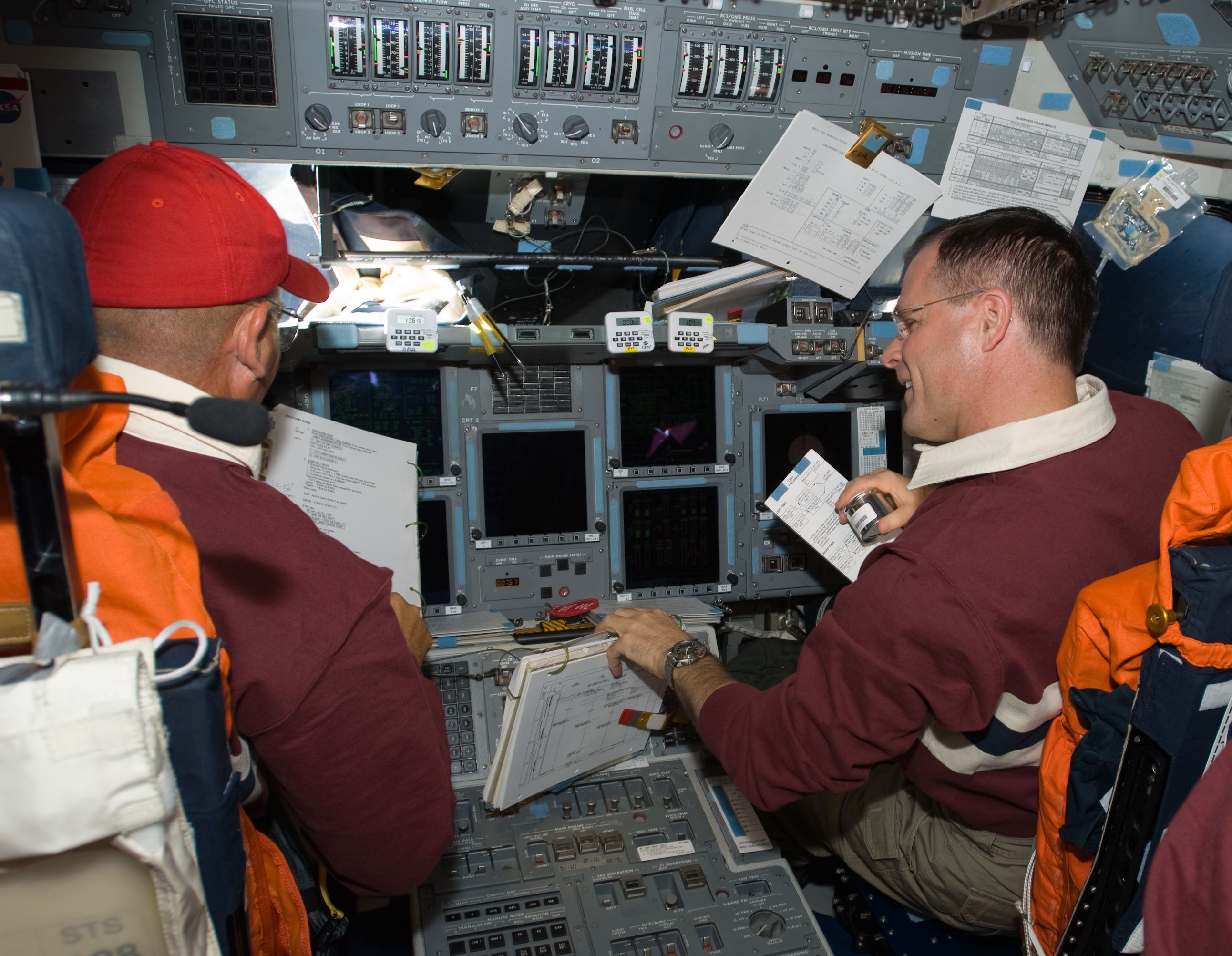
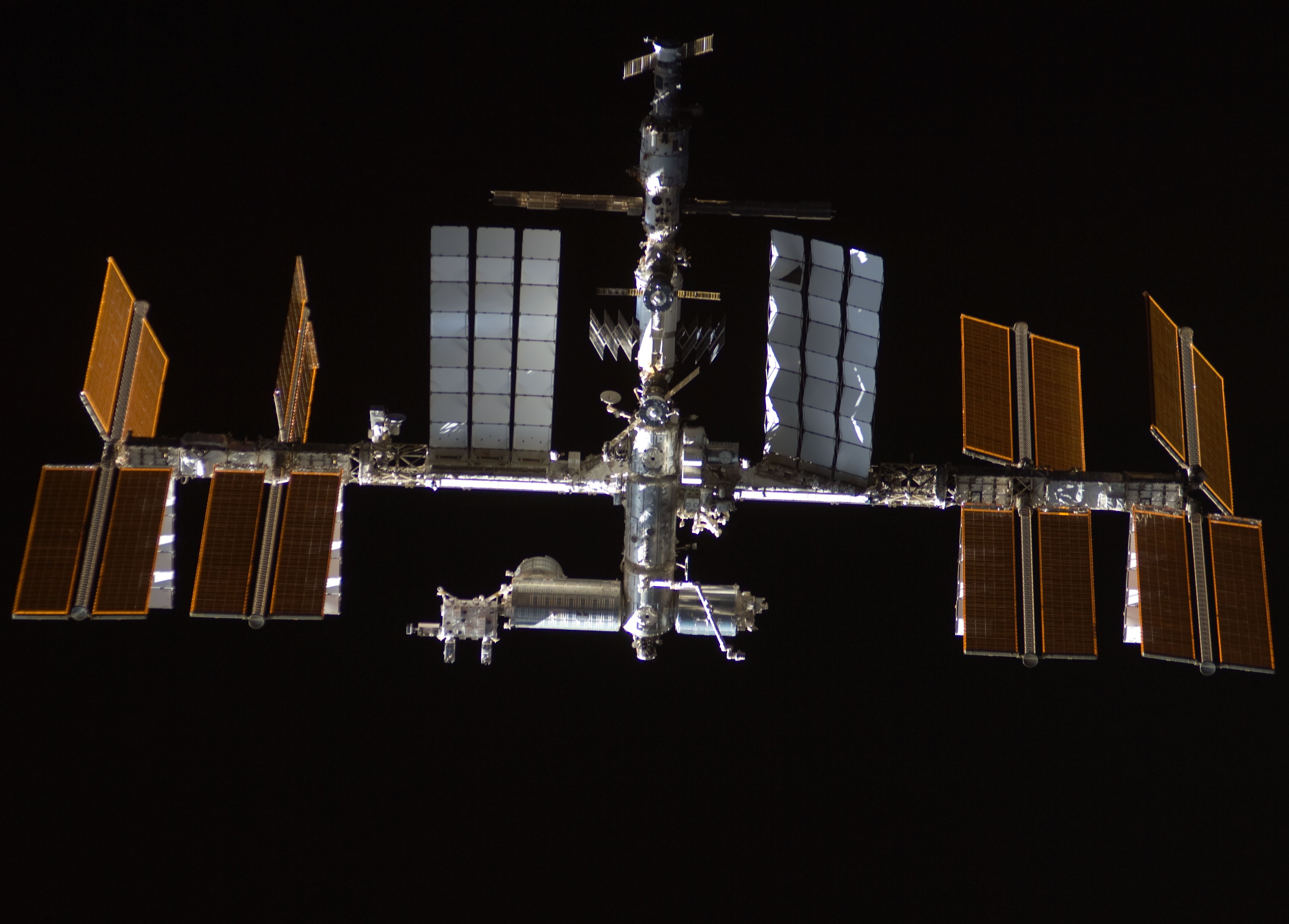
Frederick “Rick” W. Sturckow, left, and Kevin A. Ford perform maneuvers for the rendezvous with the space station Discovery as seen from the space station during the rendezvous The space station as seen from Discovery during the rendezvous
Left: Frederick “Rick” W. Sturckow, left, and Kevin A. Ford perform maneuvers for the rendezvous with the space station. Middle: Discovery as seen from the space station during the rendezvous. Right: The space station as seen from Discovery during the rendezvous.

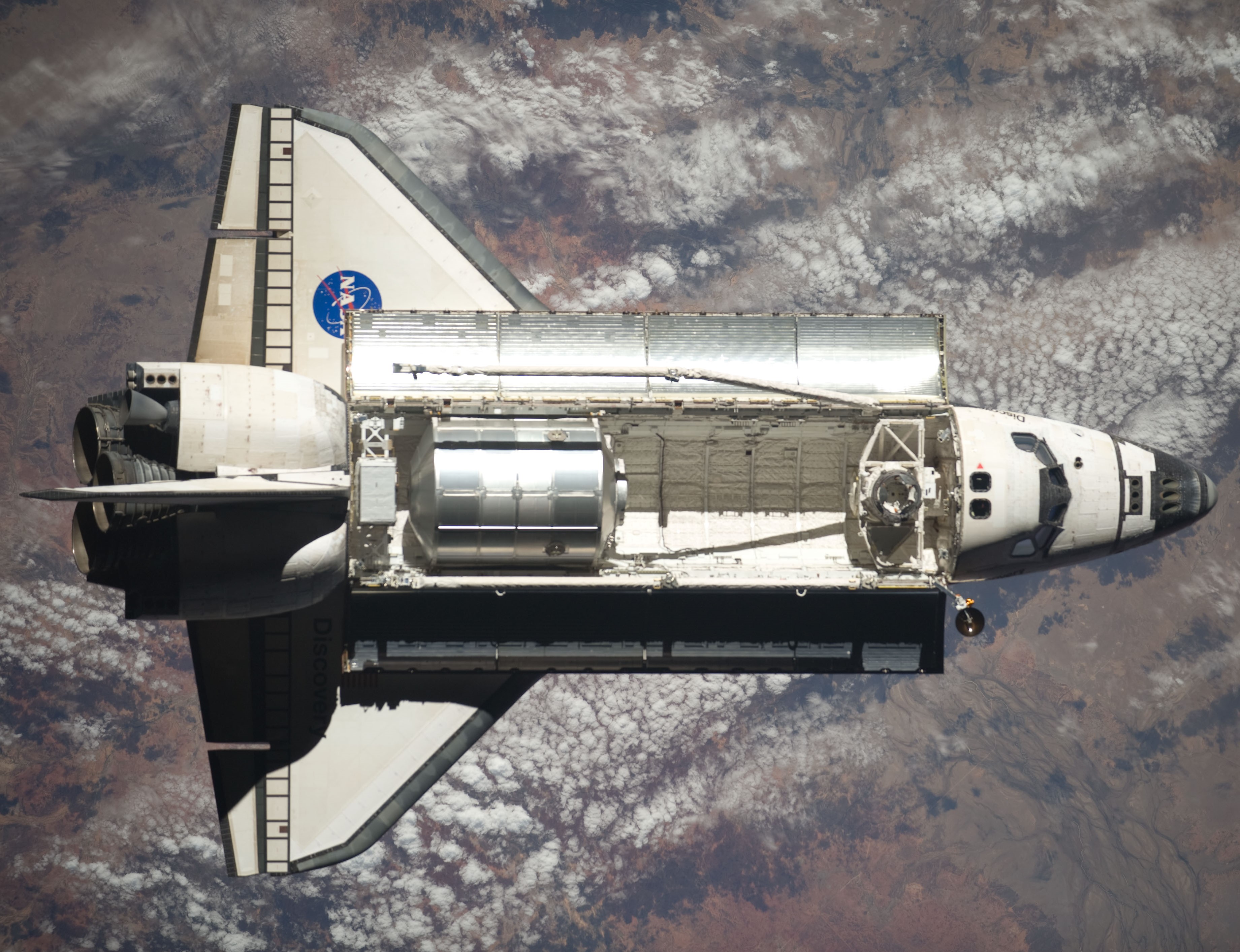
On the mission’s third day, Sturckow assisted by his crewmates brought Discovery in for a docking with the space station. The docking occurred on the 25th anniversary of Discovery’s first launch on the STS-41D mission on Aug. 30, 1984. During the rendezvous, Sturckow stopped the approach at 600 feet and completed the Rendezvous Pitch Maneuver so astronauts aboard the station could photograph Discovery’s underside to look for any damage to the tiles. Shortly after docking, the crews opened the hatches between the two spacecraft and the six-person station crew welcomed the seven-member shuttle crew. After exchanging Soyuz spacesuits and seat liners, Stott joined the Expedition 20 crew and Kopra the STS-128 crew.
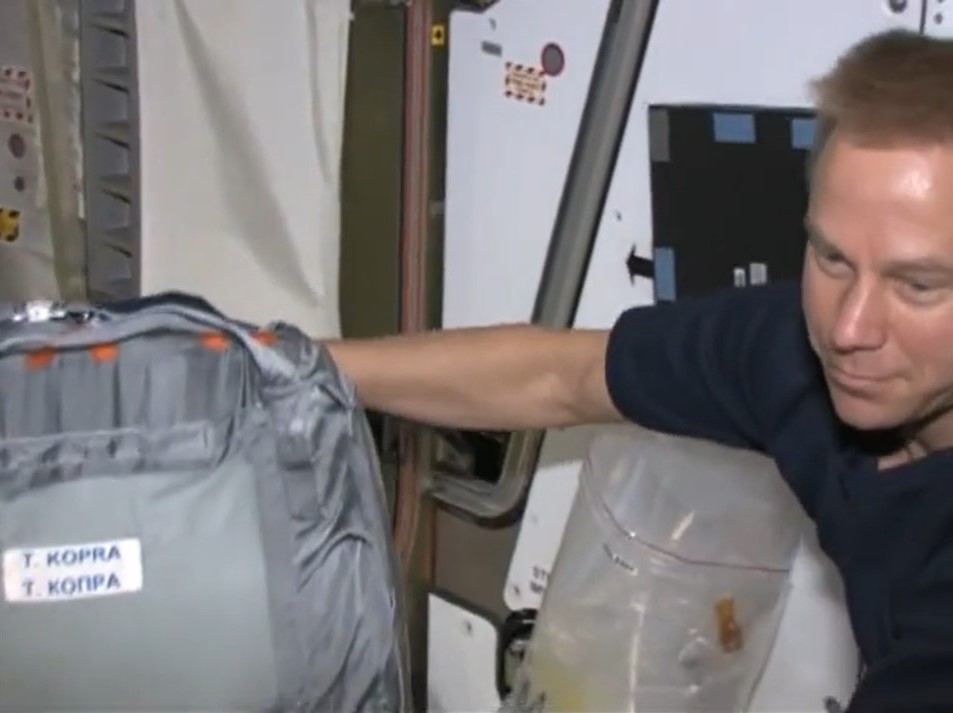
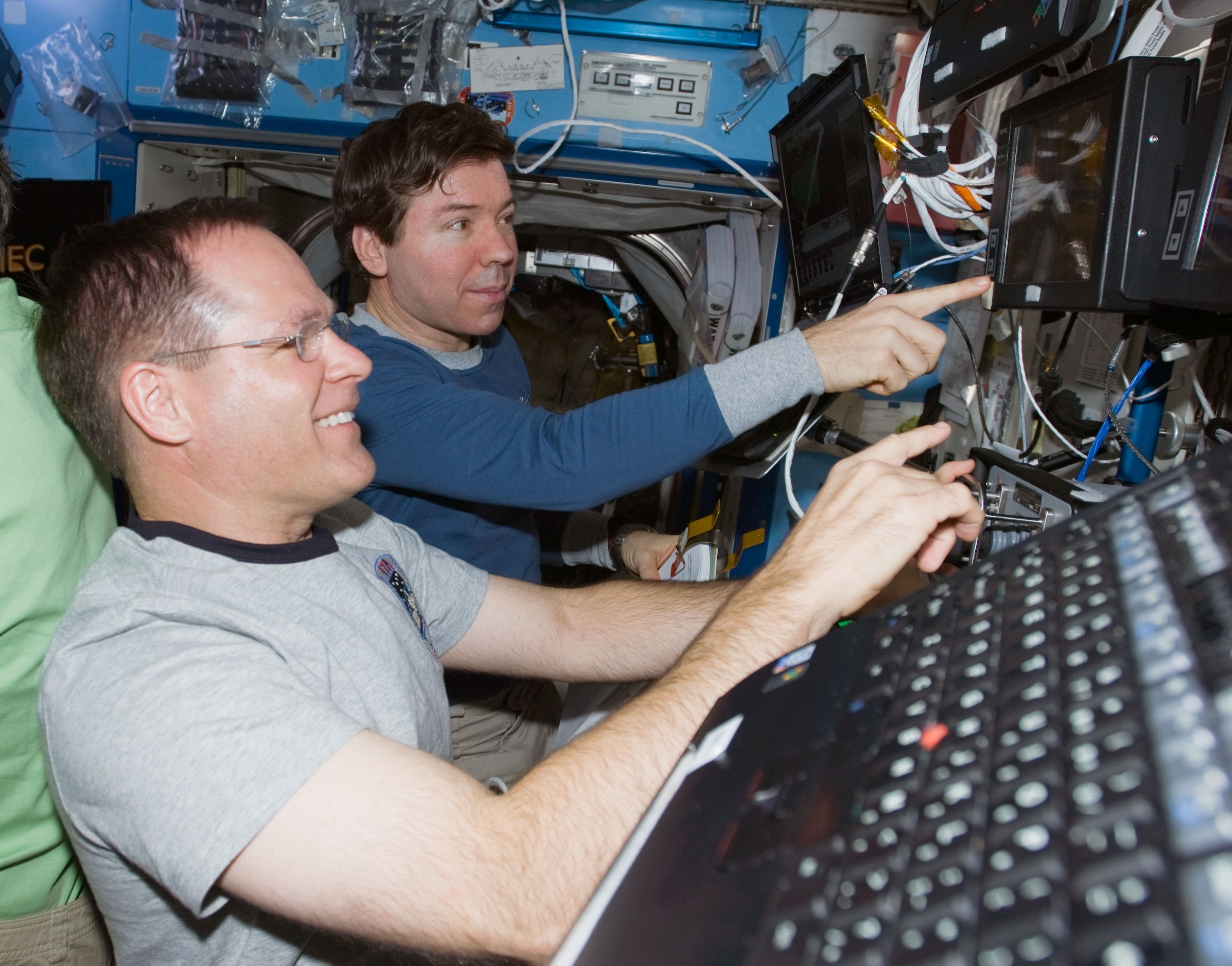
Transfer of Timothy L. Kopra’s Soyuz seat liner and spacesuit from the space station to the space shuttle Kevin A. Ford, left, and Michael R. Barratt operate the station’s robotic arm The MPLM approaches the Node 2 nadir berthing port
Left: Transfer of Timothy L. Kopra’s Soyuz seat liner and spacesuit from the space station to the space shuttle makes him an STS-128 crew member for return to Earth. Middle:Kevin A. Ford, left, and Michael R. Barratt operate the station’s robotic arm to transfer the Leonardo Multi-Purpose Logistics Module (MPLM) from the shuttle payload bay to the space station. Right: The MPLM approaches the Node 2 nadir berthing port.

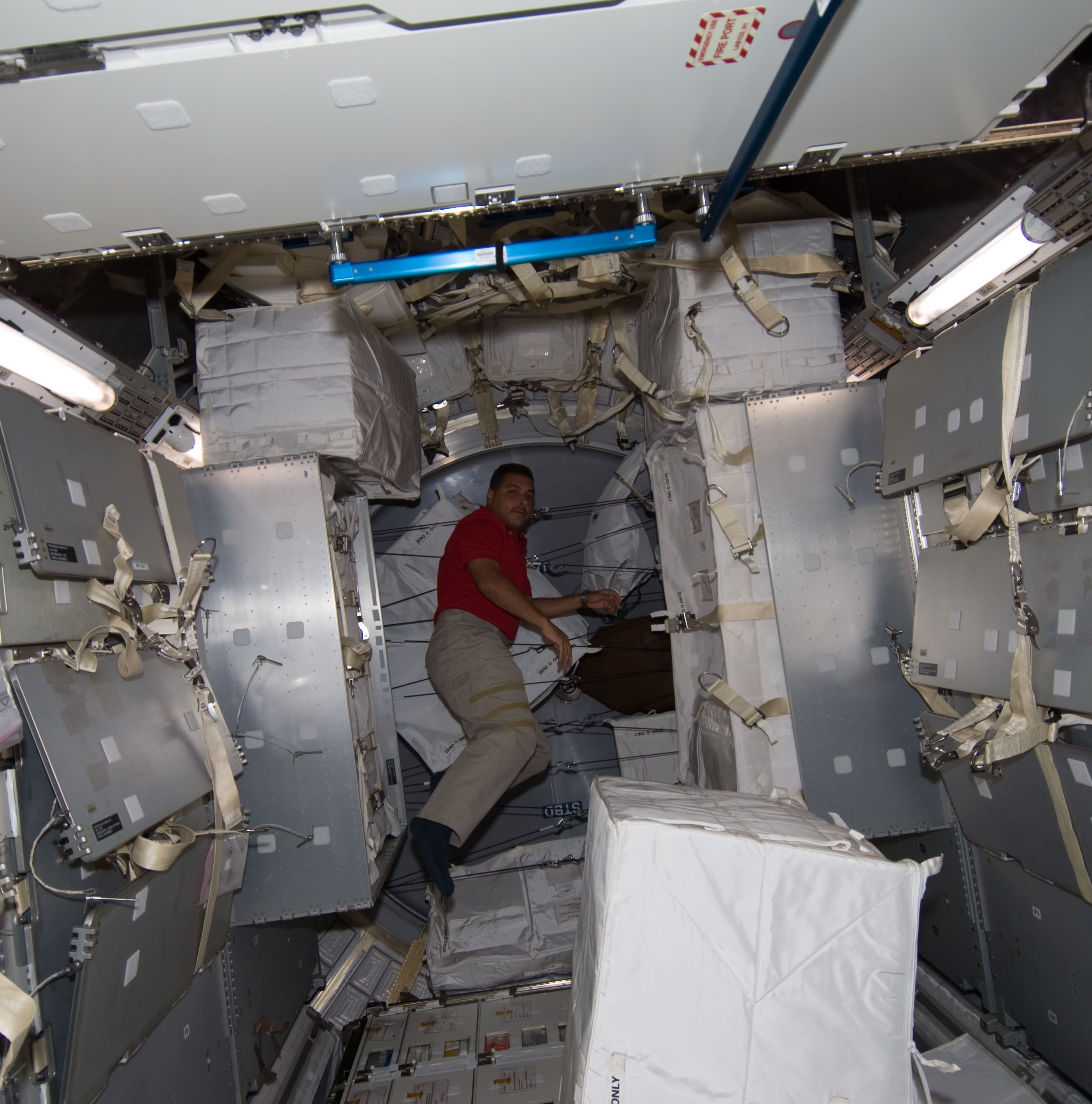
Frank DeWinne, left, and A. Christer Fuglesang, both of the European Space Agency, open the hatch to the Leonardo Multi-Purpose Logistics Module José M. Hernández inside the MPLM to monitor transfer operations DeWinne, left, and Fuglesang begin the transfer of the T2 COLBERT treadmill from the MPLM to the space station
Left: Frank DeWinne, left, and A. Christer Fuglesang, both of the European Space Agency, open the hatch to the Leonardo Multi-Purpose Logistics Module. Middle: José M. Hernández inside the MPLM to monitor transfer operations. Right: DeWinne, left, and Fuglesang begin the transfer of the T2 COLBERT treadmill from the MPLM to the space station.

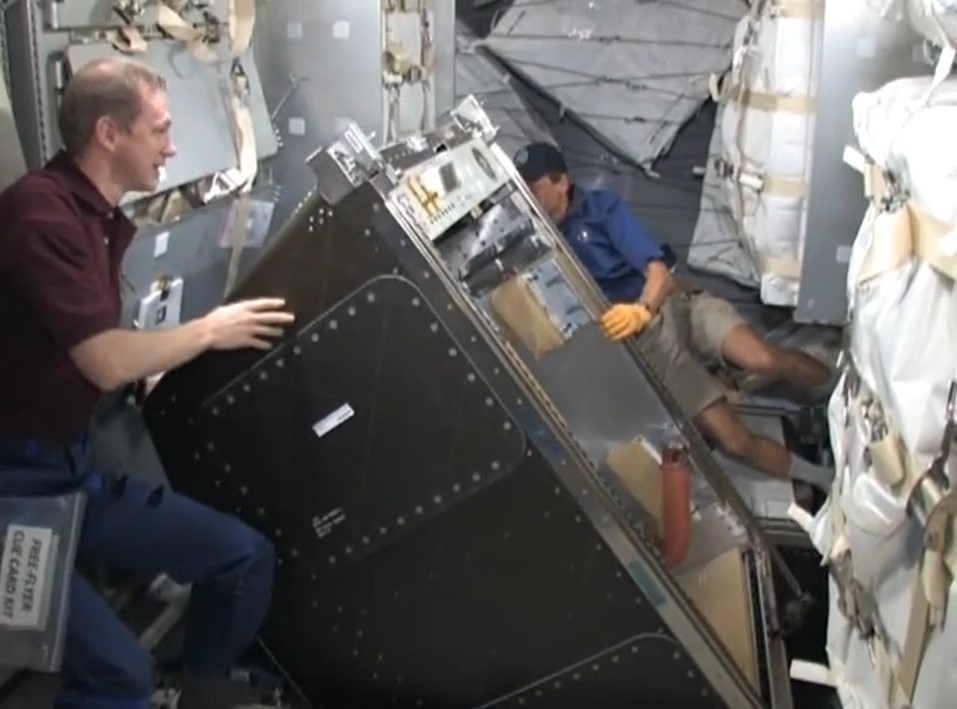
The day after docking, Ford and Expedition 20 Flight Engineer Michael R. Barrrat used the space station’s robotic arm to grapple the MPLM in the shuttle’s payload bay. They transferred it to the station, berthing it at the Harmony Node 2 module’s nadir port. The crew activated the MPLM and Fuglesang and Expedition 20 Commander Frank L. DeWinne of Belgium representing ESA opened the hatches, enabling the start of cargo transfers.

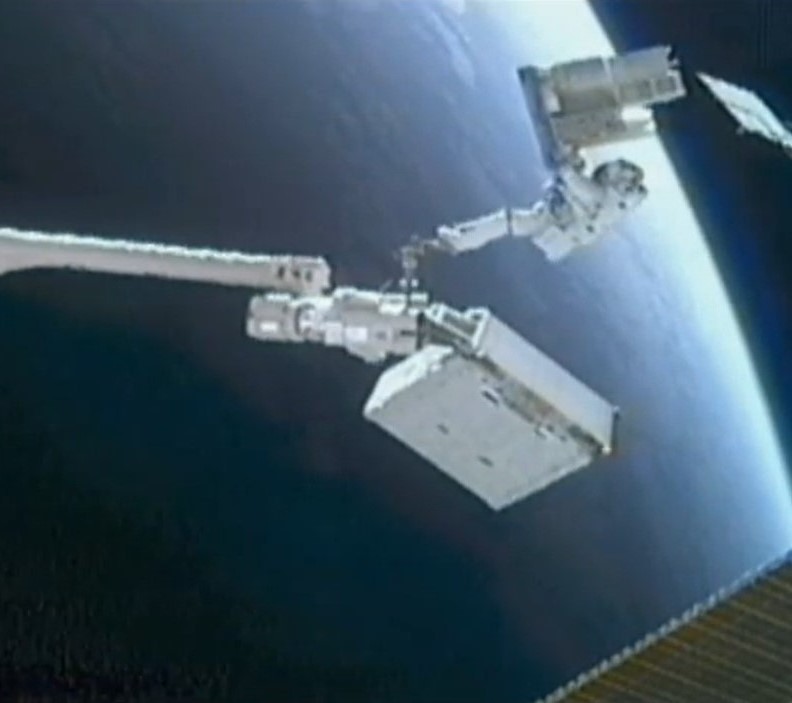
John D. “Danny” Olivas, left, and Nicole P. Stott remove the EuTEF experiment from the Columbus module Stott rides the station robotic arm carrying the EuTEF experiment, with the removed Ammonia Tank Assembly attached to it An open MISSE container showing the various exposure samples Stott carrying one of the two closed MISSE containers
Left: During the first spacewalk, John D. “Danny” Olivas, left, and Nicole P. Stott remove the EuTEF experiment from the Columbus module. Middle left: Stott rides the station robotic arm carrying the EuTEF experiment, with the removed Ammonia Tank Assembly attached to it. Middle right: An open MISSE container showing the various exposure samples. Right: Stott carrying one of the two closed MISSE containers.

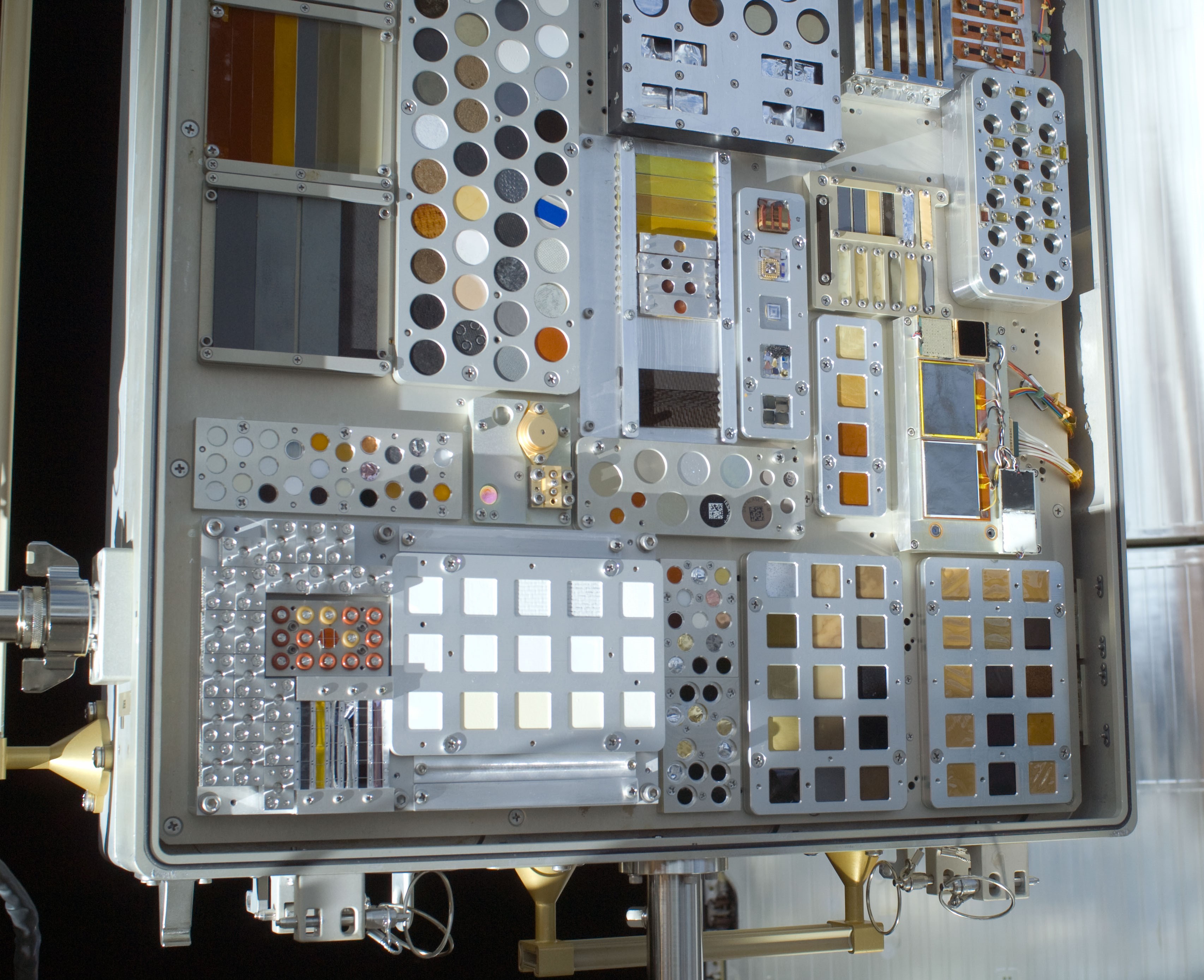
During the mission’s first spacewalk on flight day five, Olivas and Stott first removed a used Ammonia Tank Assembly (ATA) from the P1 truss segment. With Ford and Expedition 20 Flight Engineer Robert B. Thirsk of the Canadian Space Agency operating the space station’s robotic arm, they moved Stott to the end of the Columbus module, where she and Olivas removed the European Technology Exposure Facility (EuTEF) science payload. Ford and Thirsk translated Stott to the shuttle’s payload bay where she and Olivas stowed it for return to Earth. The pair returned to Columbus to close and retrieve the two Materials on International Space Station Experiments (MISSE) and stowed them in the payload bay for return. This first spacewalk lasted 6 hours 35 minutes. Meanwhile, other crew members busied themselves with transferring racks and cargo from the MPLM to the space station.

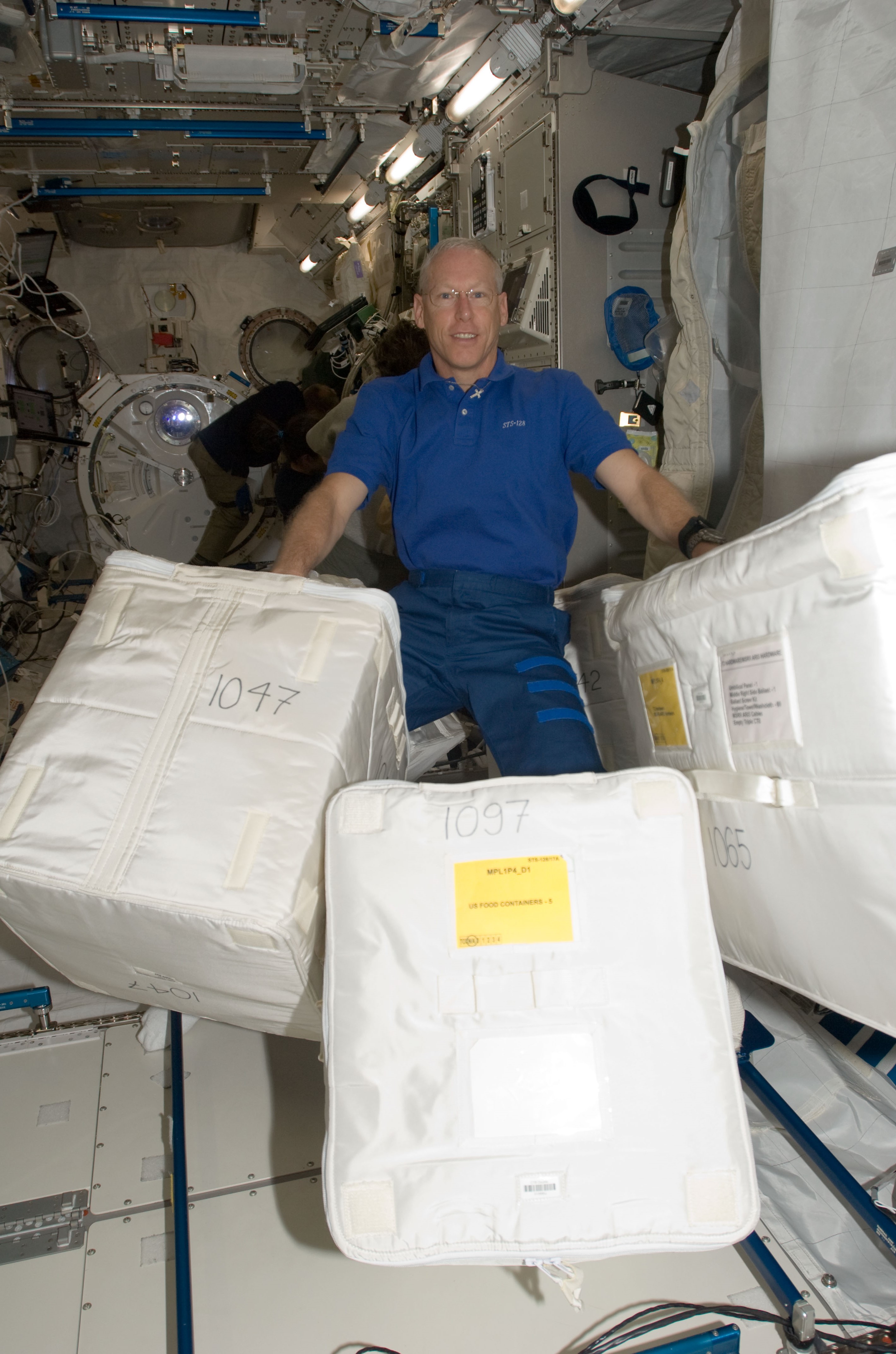
A. Christer Fugelsang of the European Space Agency shows off his installation of the Air Revitalization System rack in the Kibo module Patrick G. Forrester with three bags during cargo transfer operations During handover operations, outgoing space station crew member Timothy L. Kopra, middle, shows incoming crew member Nicole P. Stott how to give a proper haircut in space
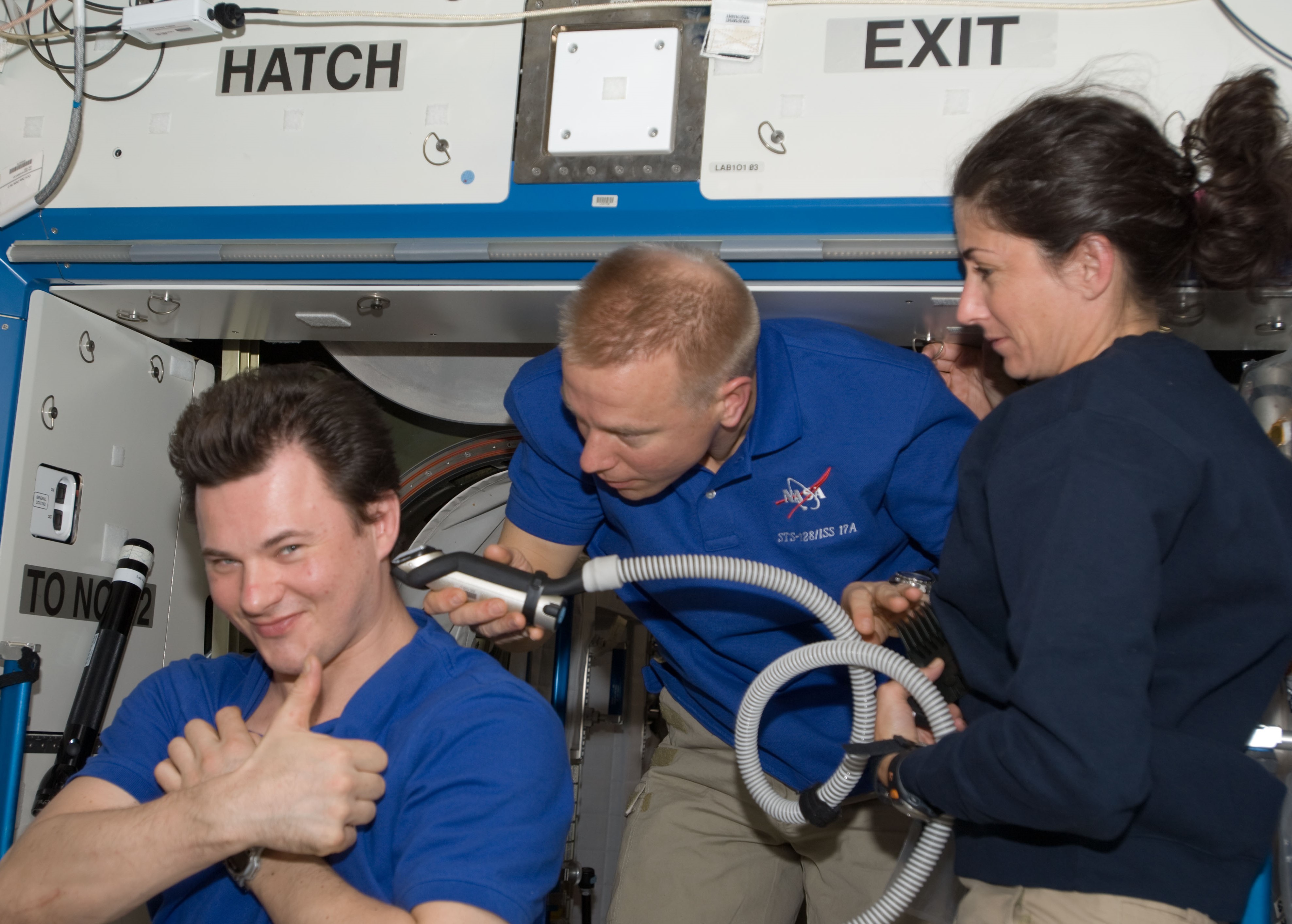
Left: A. Christer Fugelsang of the European Space Agency shows off his installation of the Air Revitalization System rack in the Kibo module. Middle: Patrick G. Forrester with three bags during cargo transfer operations. Right: During handover operations, outgoing space station crew member Timothy L. Kopra, middle, shows incoming crew member Nicole P. Stott how to give a proper haircut in space.
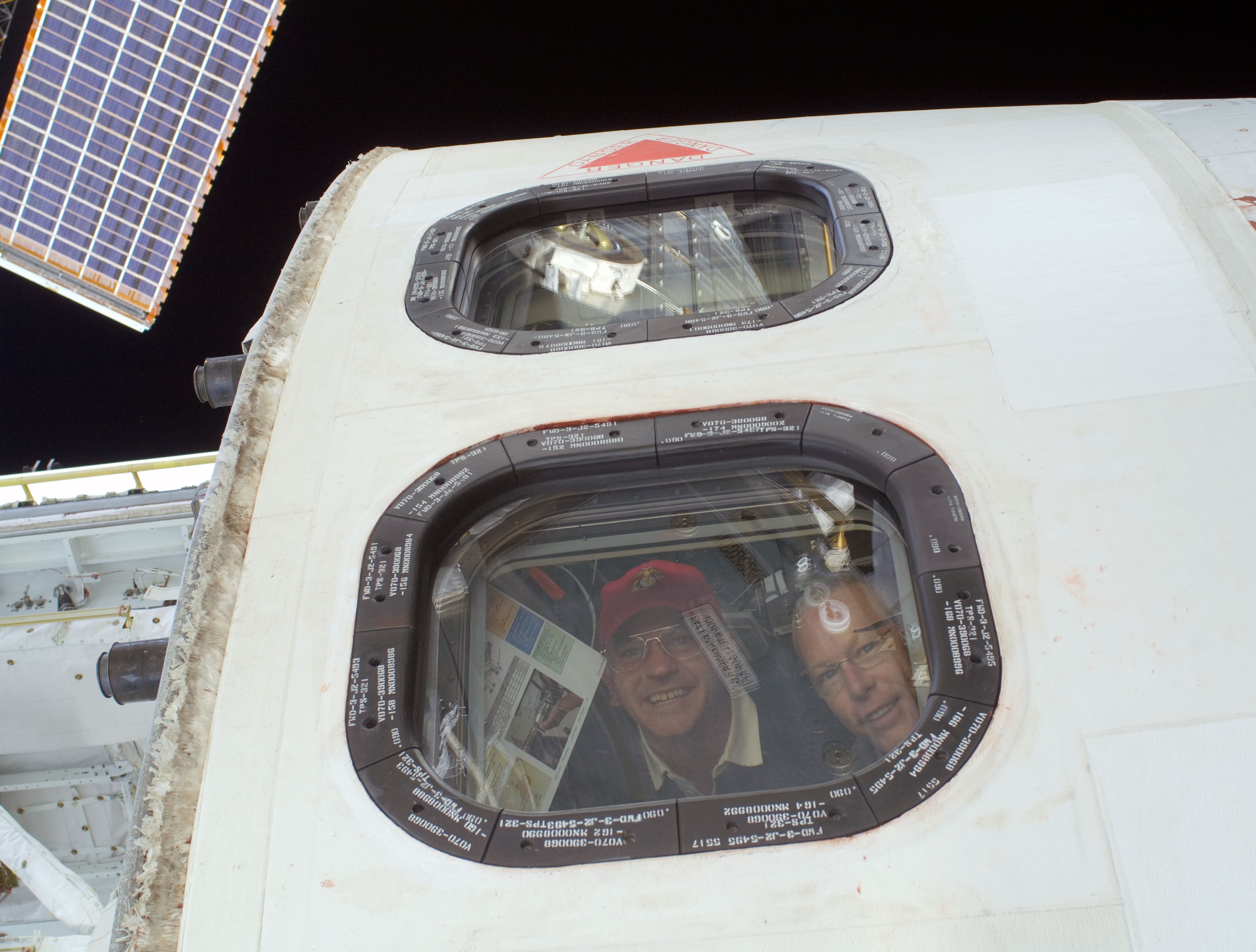
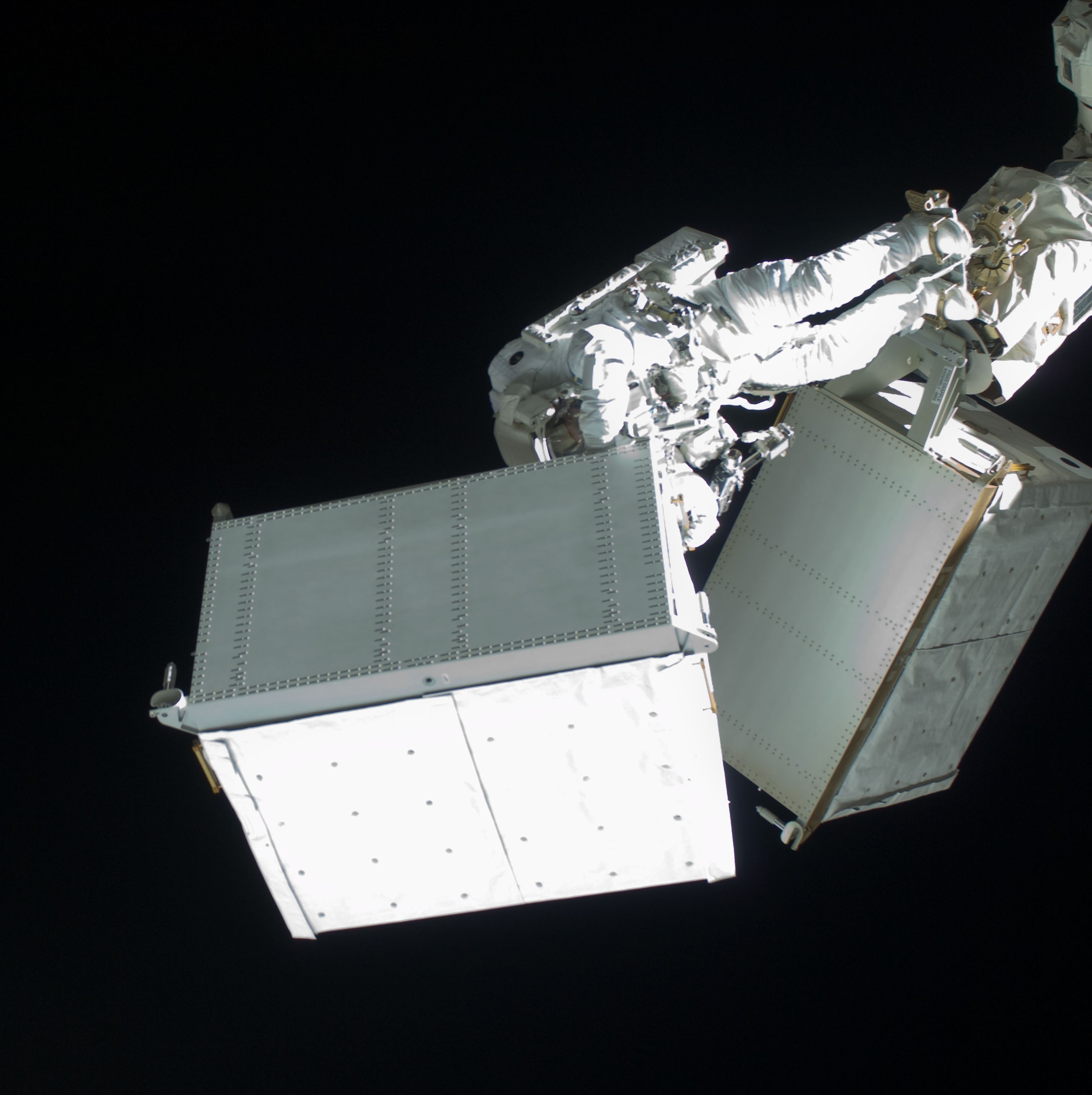
Frederick “Rick” W. Sturckow, left, and Patrick G. Forrester seen through an overhead window A. Christer Fuglesang carries both the old and the new Ammonia Tank Assemblies (ATA) on the end of the space station robotic arm Fuglesang stowing the old ATA in the shuttle’s payload bay
Left: Frederick “Rick” W. Sturckow, left, and Patrick G. Forrester seen through an overhead window. Middle: During the mission’s second spacewalk, A. Christer Fuglesang carries both the old and the new Ammonia Tank Assemblies (ATA) on the end of the space station robotic arm. Right: Fuglesang stowing the old ATA in the shuttle’s payload bay.

Cargo transfers continued throughout flight day six, including the three payload racks. On flight day seven, Olivas and Fuglesang conducted the mission’s second spacewalk, lasting 6 hours 39 minutes. They completed the swap out of the ATA, with Fuglesang riding the station arm carrying both the old and the new units, before they installed the new unit on the P1 truss, and then returned with the old unit to stow it in the payload bay.
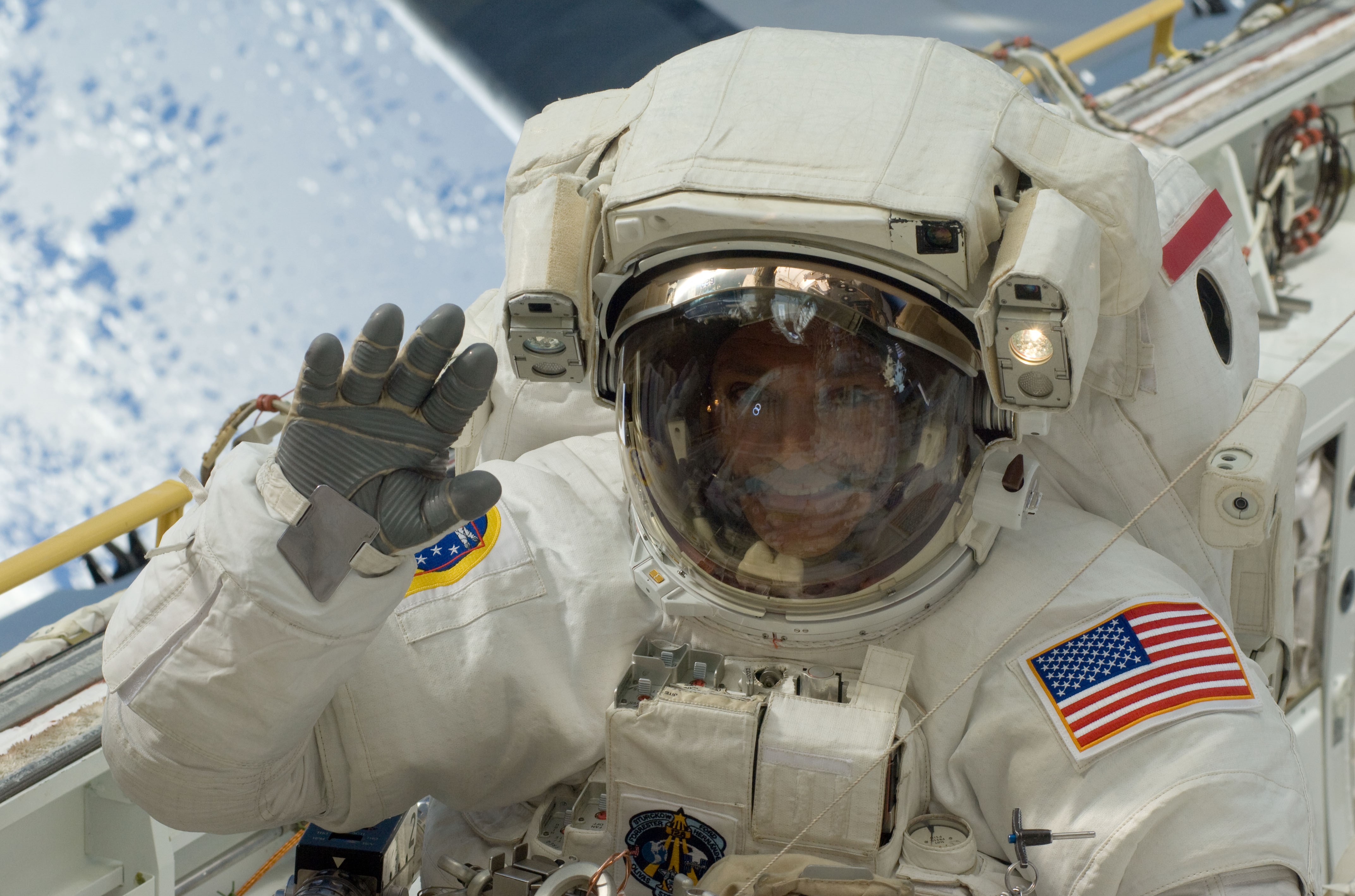
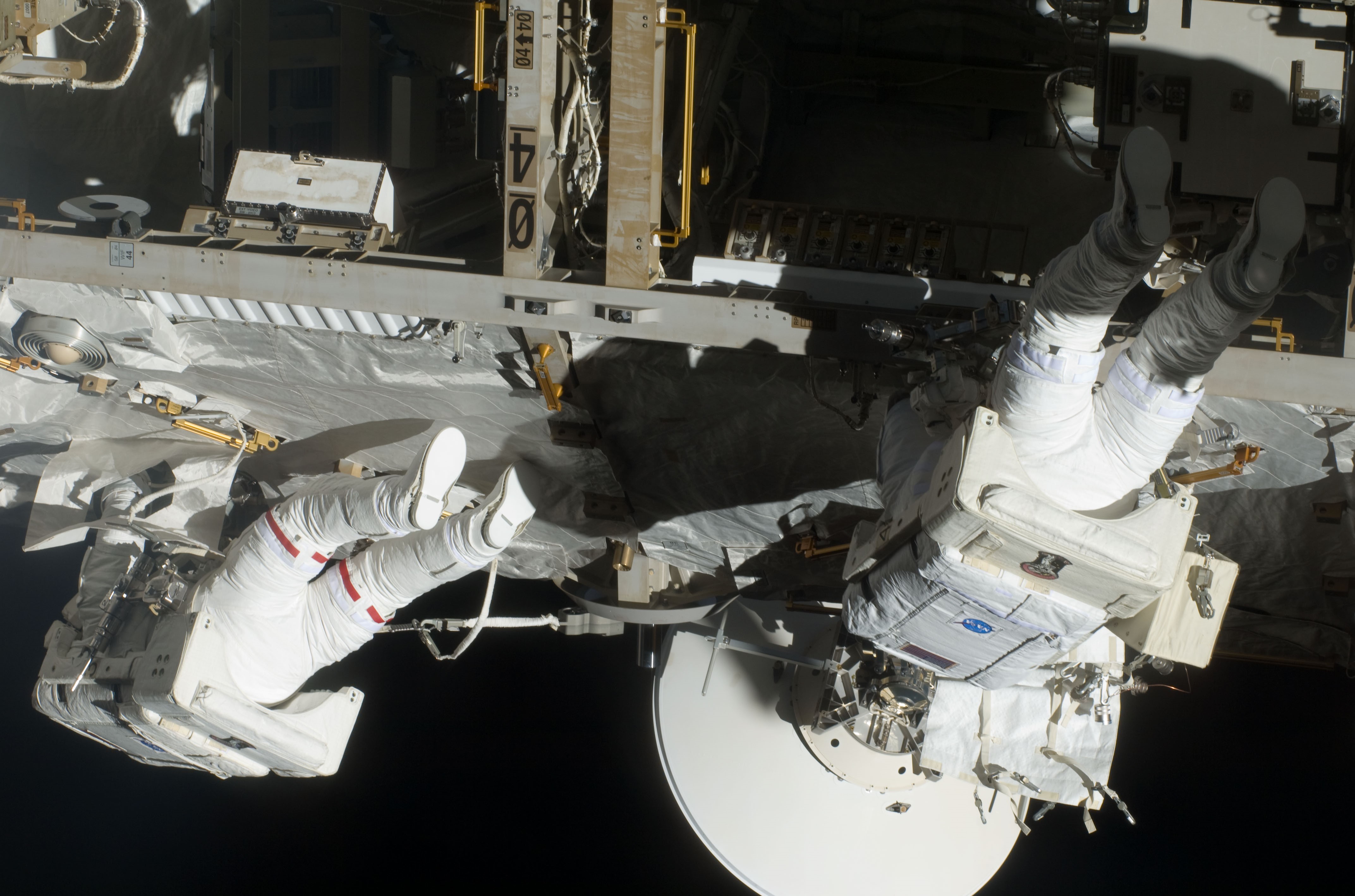
John D. “Danny” Olivas works in the shuttle’s payload bay during the mission’s third spacewalk Olivas, left, and A. Christer Fuglesang work on the space station truss
Left: John D. “Danny” Olivas works in the shuttle’s payload bay during the mission’s third spacewalk. Right: Olivas, left, and A. Christer Fuglesang work on the space station truss.

With cargo transfers continuing on flight day eight, the next day Olivas and Fuglesang stepped outside for the mission’s third and final spacewalk. They completed a variety of tasks, including routing cables to accommodate the Tranquility Node 3 module scheduled to arrive on a future space shuttle flight, and installing GPS antennas on the S0 truss. This spacewalk lasted 7 hours 1 minute, bringing the total spacewalking time for STS-128 to 20 hours 15 minutes. The crew enjoyed a well-deserved off-duty day on flight day 10.
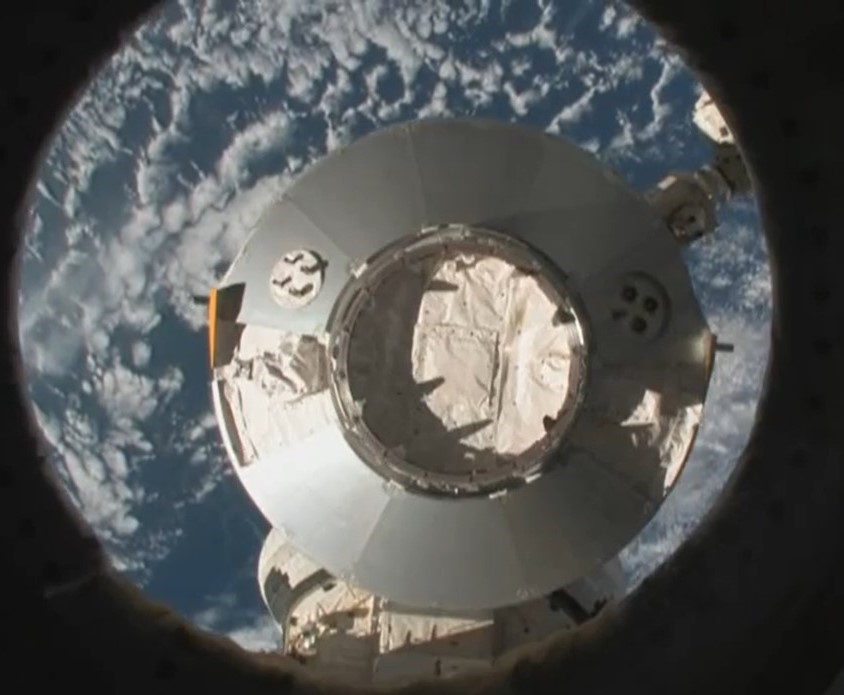
Astronauts robotically stow the Leonardo Multi-Purpose Logistics Module (MPLM) back in Discovery’s payload bay A. Christer Fuglesang, left, and Nicole P. Stott operate the space station’s robotic arm
Left: Astronauts robotically stow the Leonardo Multi-Purpose Logistics Module (MPLM) back in Discovery’s payload bay. Right: A. Christer Fuglesang, left, and Nicole P. Stott operate the space station’s robotic arm to stow the MPLM in the payload bay.

The astronauts completed the final transfers on Sept. 8, the mission’s 11th flight day, they deactivated the MPLM, and closed its hatch. Operating the space station’s robotic arm, Stott and Fuglesang transferred the MPLM from the station back to the shuttle’s payload bay. On Sept. 10, the next vehicle to occupy that port, the Japanese H-II Transfer Vehicle-1 (HTV-1), launched from the Tanegashima Space Center, arriving at the station one week later.
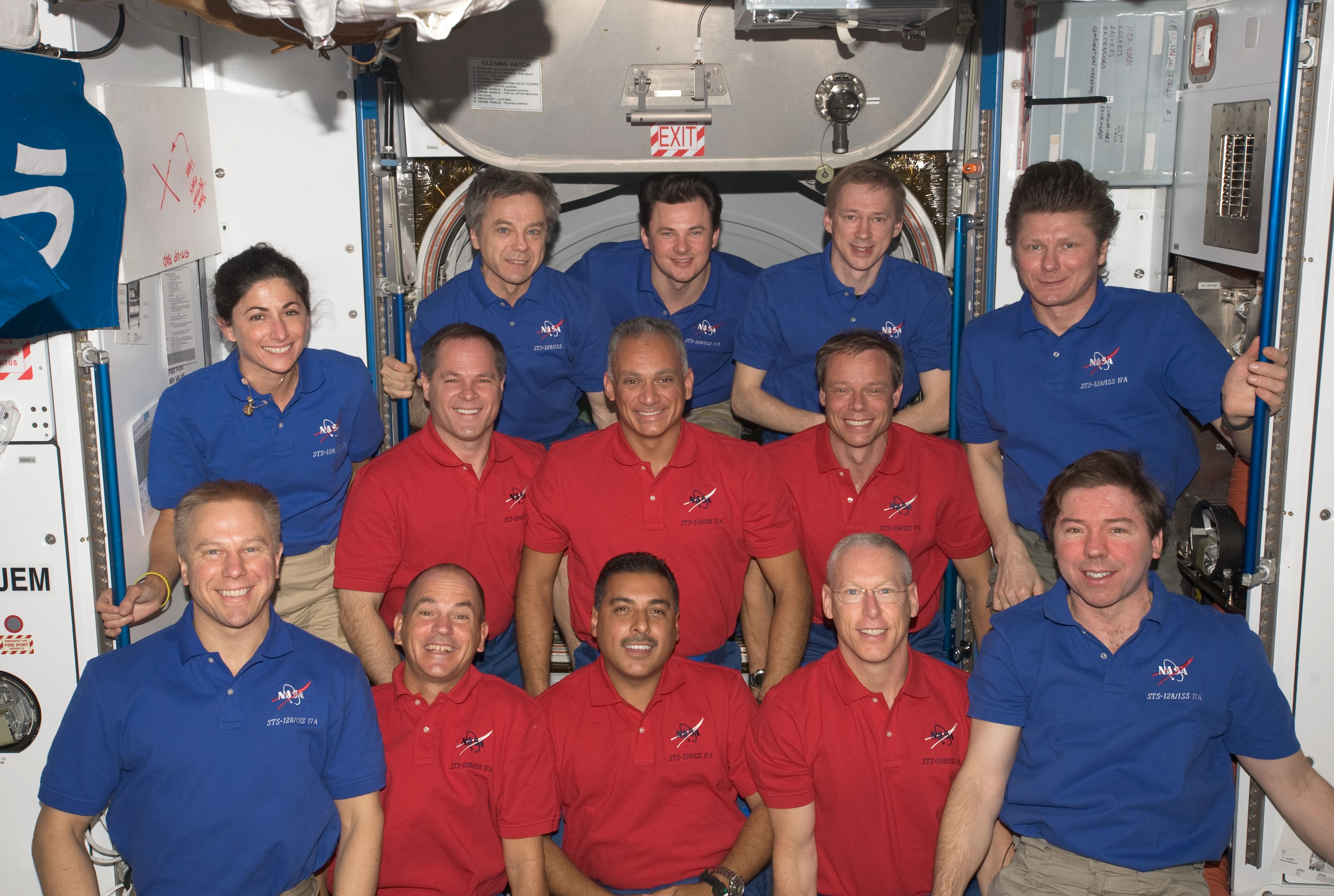
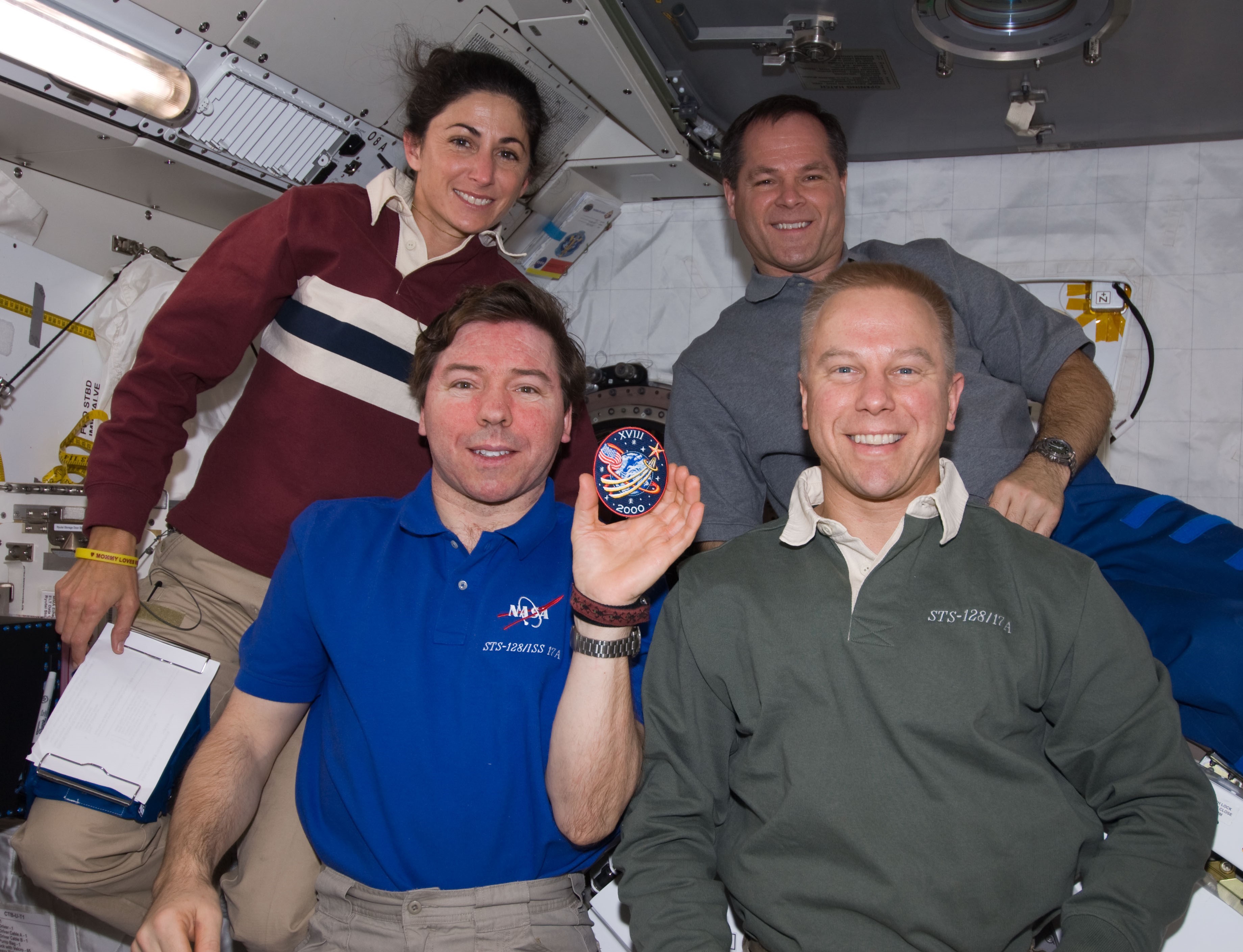
The 13 members of Expedition 20, blue shirts, and STS-128, red shirts, pose for a final photograph before saying their farewells Four members of the astronaut class of 2000 in space together
Left: The 13 members of Expedition 20, blue shirts, and STS-128, red shirts, pose for a final photograph before saying their farewells. Right: Four members of the astronaut class of 2000 in space together.
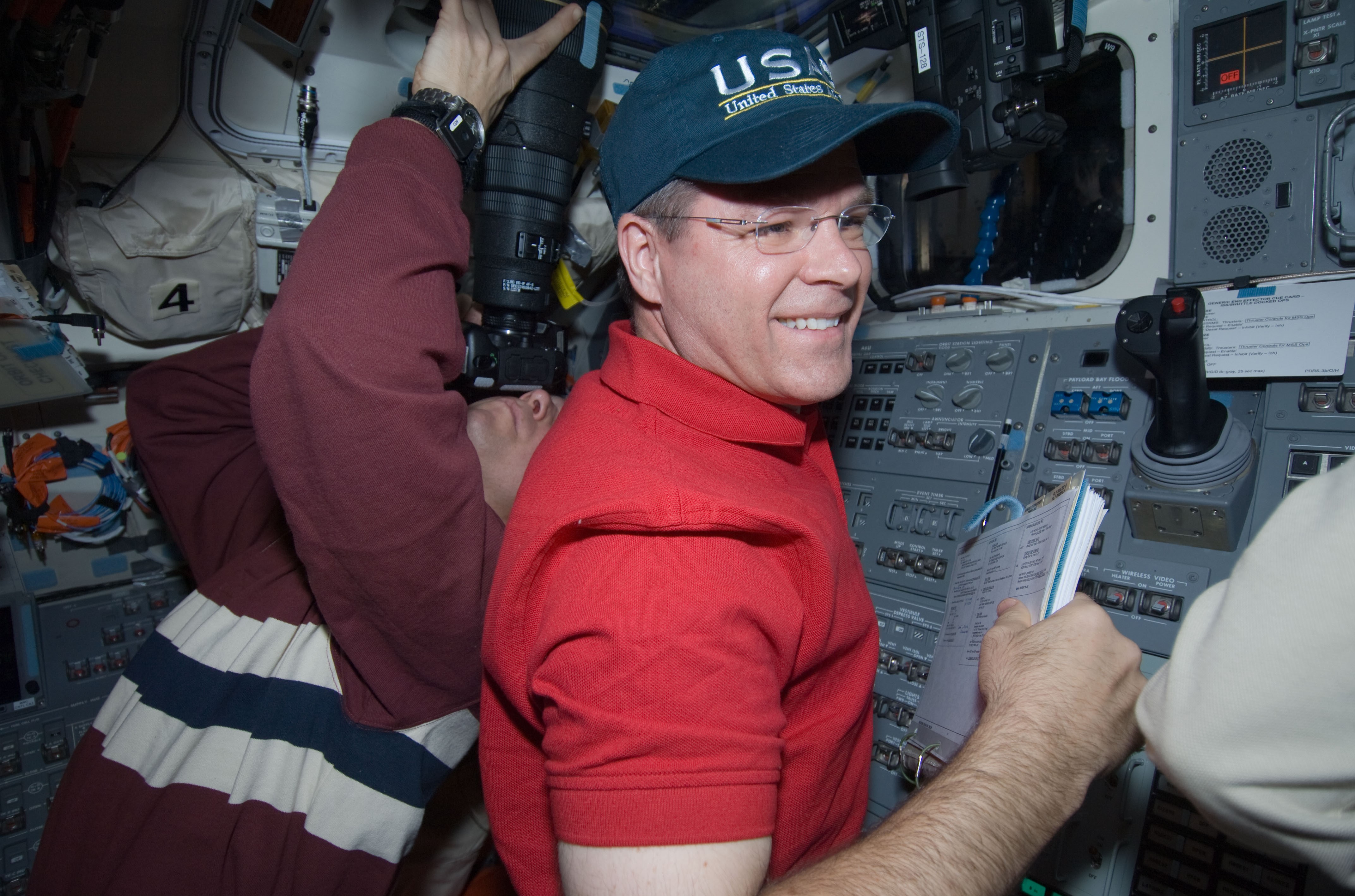
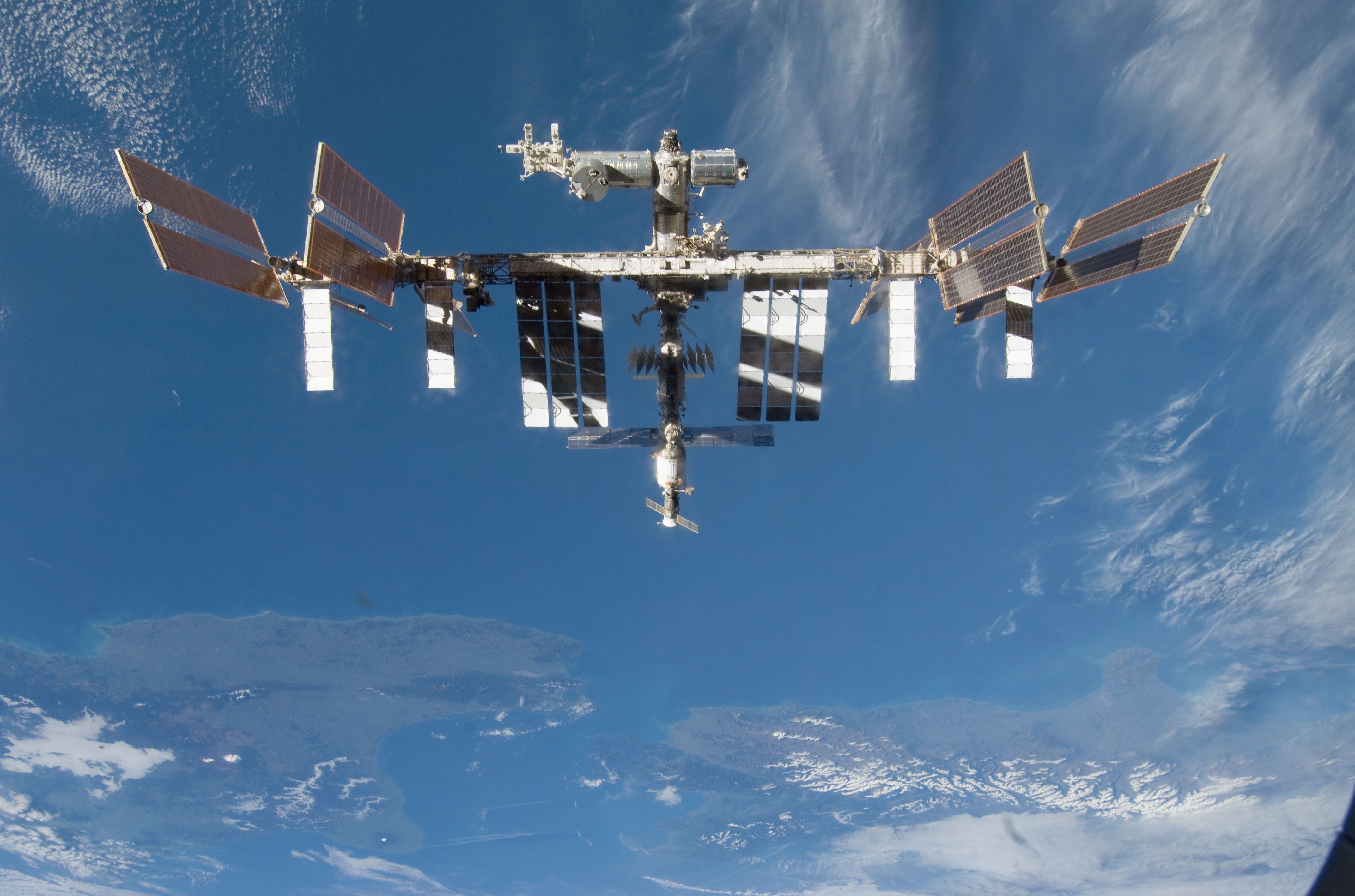
Kevin A. Ford pilots Discovery for the undocking and flyaround The space station seen from Discovery during the flyaround
Left: Kevin A. Ford pilots Discovery for the undocking and flyaround. Right: The space station seen from Discovery during the flyaround.

That same day, they held a brief farewell ceremony, parted company, and closed the hatches between the two spacecraft. The next day, with Ford at the controls, Discovery undocked from the space station, having spent nine days as a single spacecraft. Ford completed a flyaround  of the station, with the astronauts photographing it to document its condition. A final separation burn sent Discovery on its way. Ford, Forrester, and Hernández used the shuttle’s arm to pick up the OBSS and perform a late inspection of Discovery’s thermal protection system. On flight day 13, Sturckow and Ford tested Discovery’s reaction control system thrusters and flight control surfaces in preparation for the next day’s entry and landing. The entire crew busied themselves with stowing all unneeded equipment. Bad weather at KSC delayed the landing by a day, and more bad weather diverted the landing to Edwards Air Force Base in California.
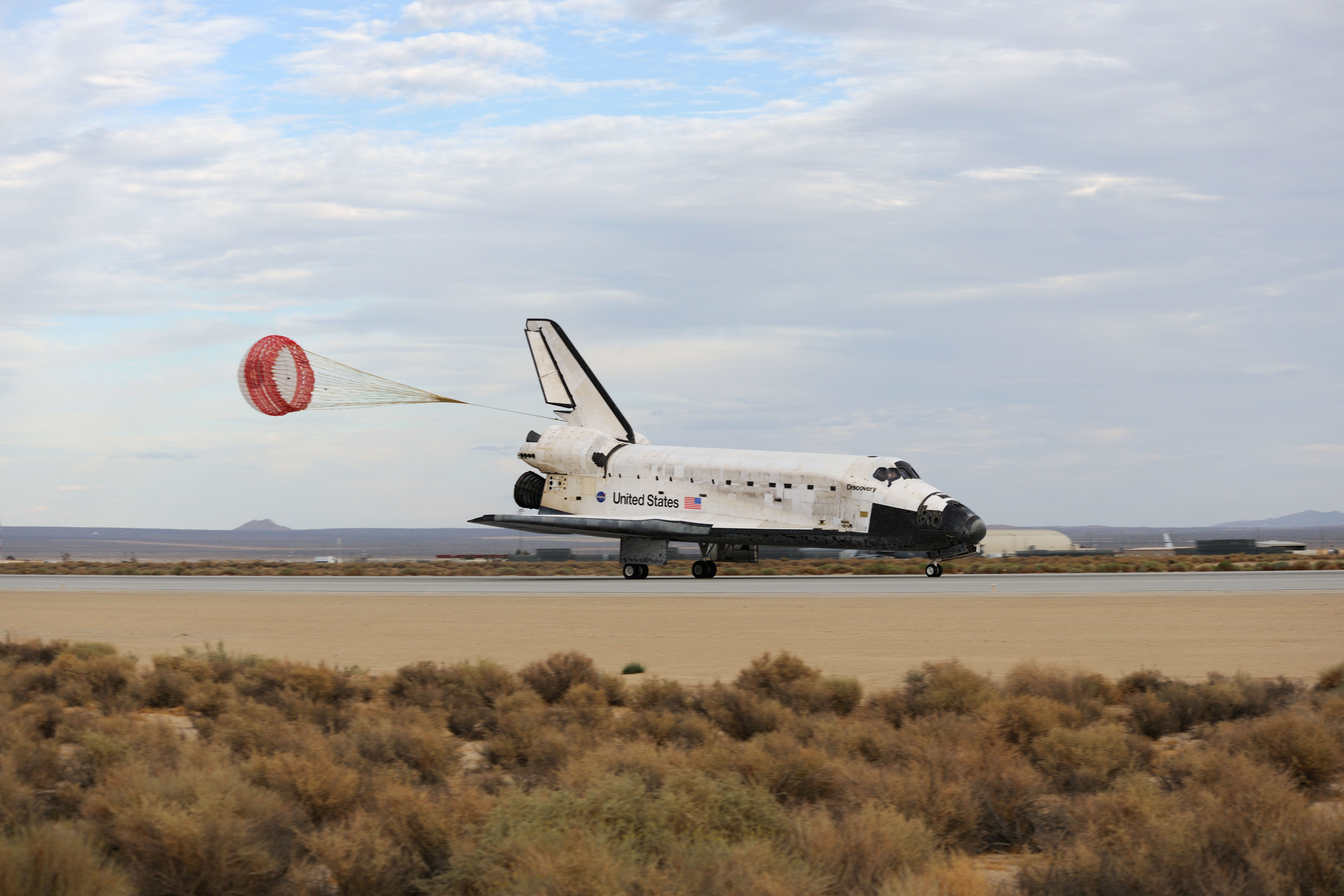
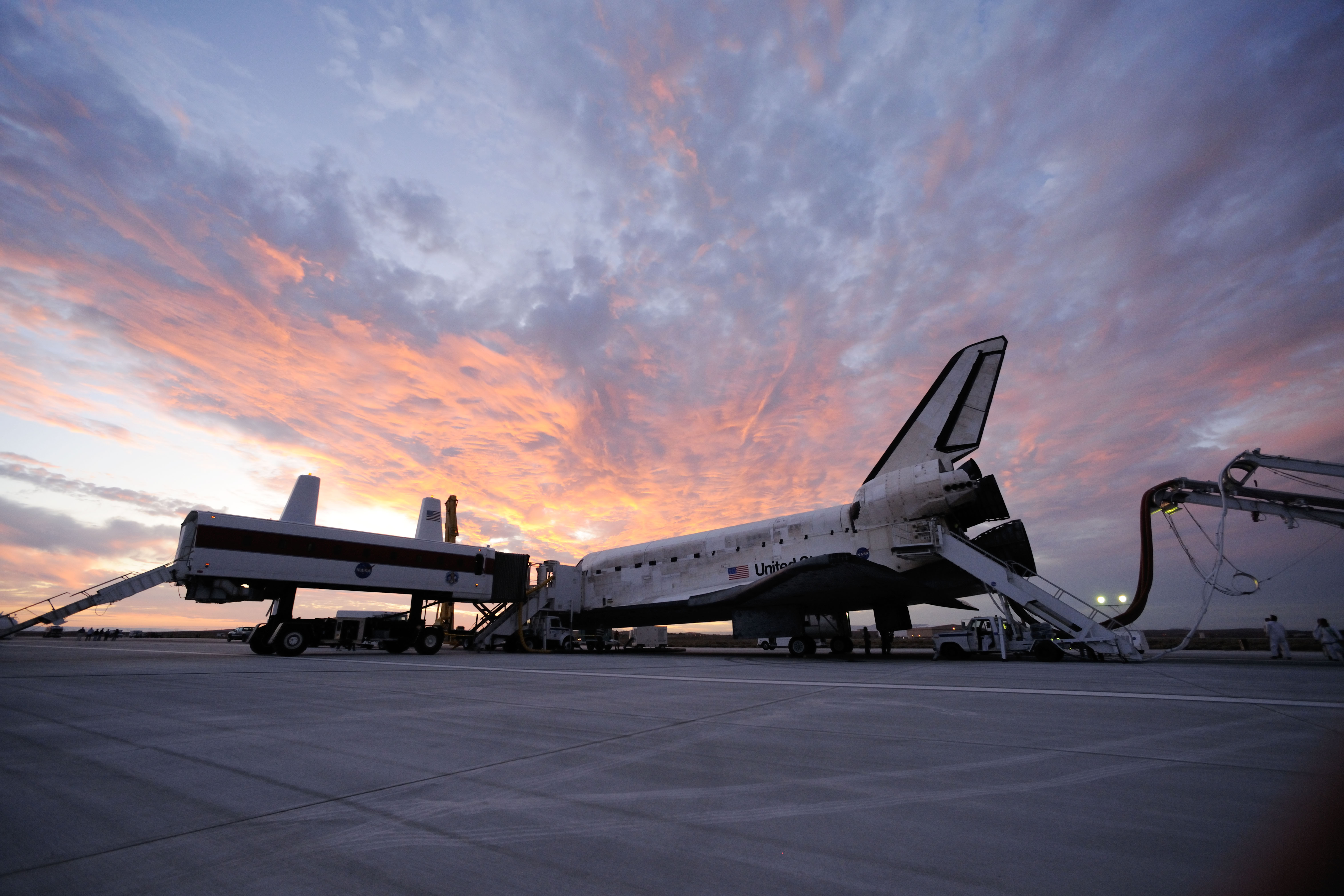
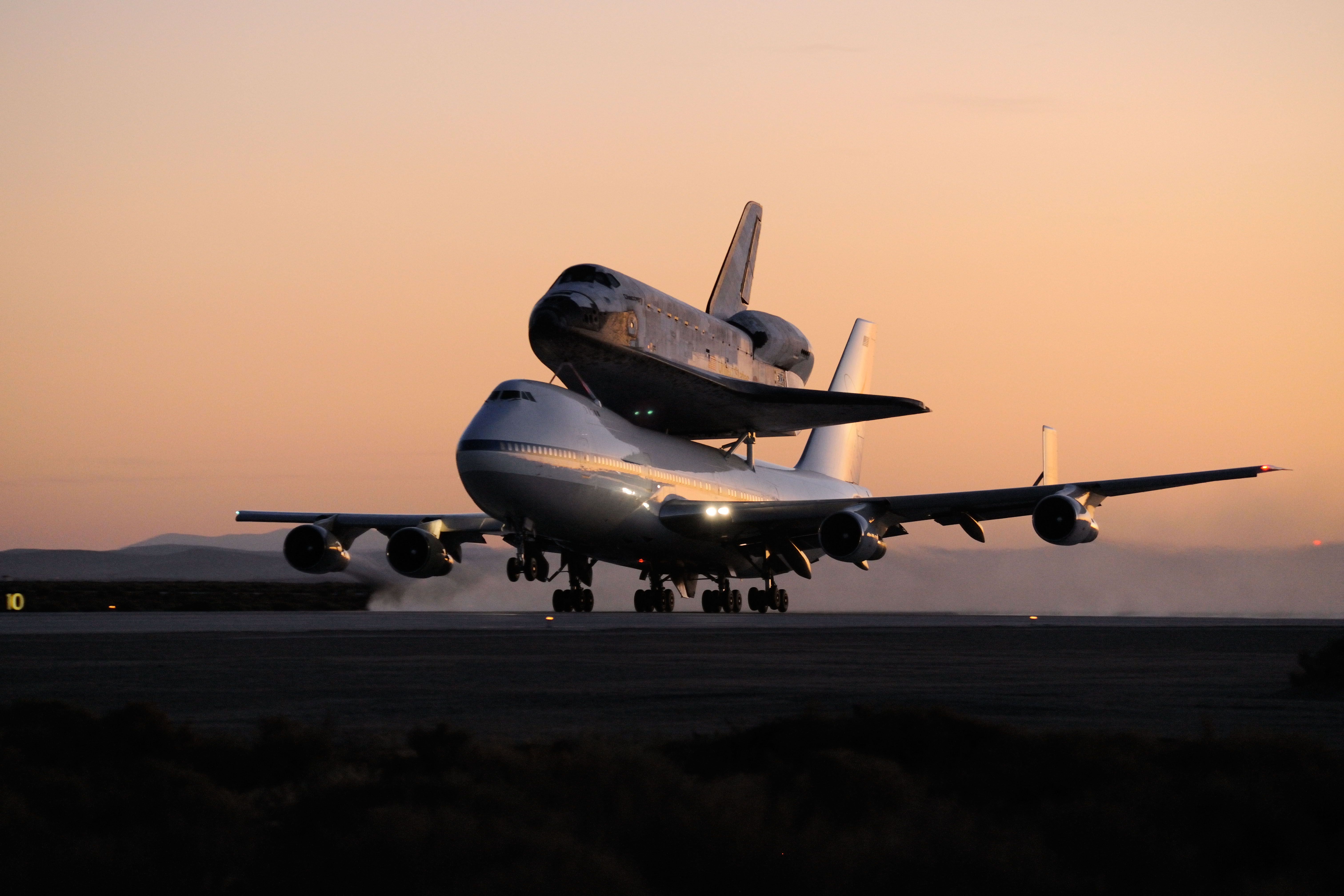
Discovery touches down at Edwards Air Force Base in California The Crew Transport Vehicle Discovery atop its Shuttle Carrier Aircraft
Left: Discovery touches down at Edwards Air Force Base in California. Middle: The Crew Transport Vehicle has approached Discovery to enable the astronauts to exit the vehicle. Right: Discovery atop its Shuttle Carrier Aircraft departs Edwards for NASA’s Kennedy Space Center in Florida.
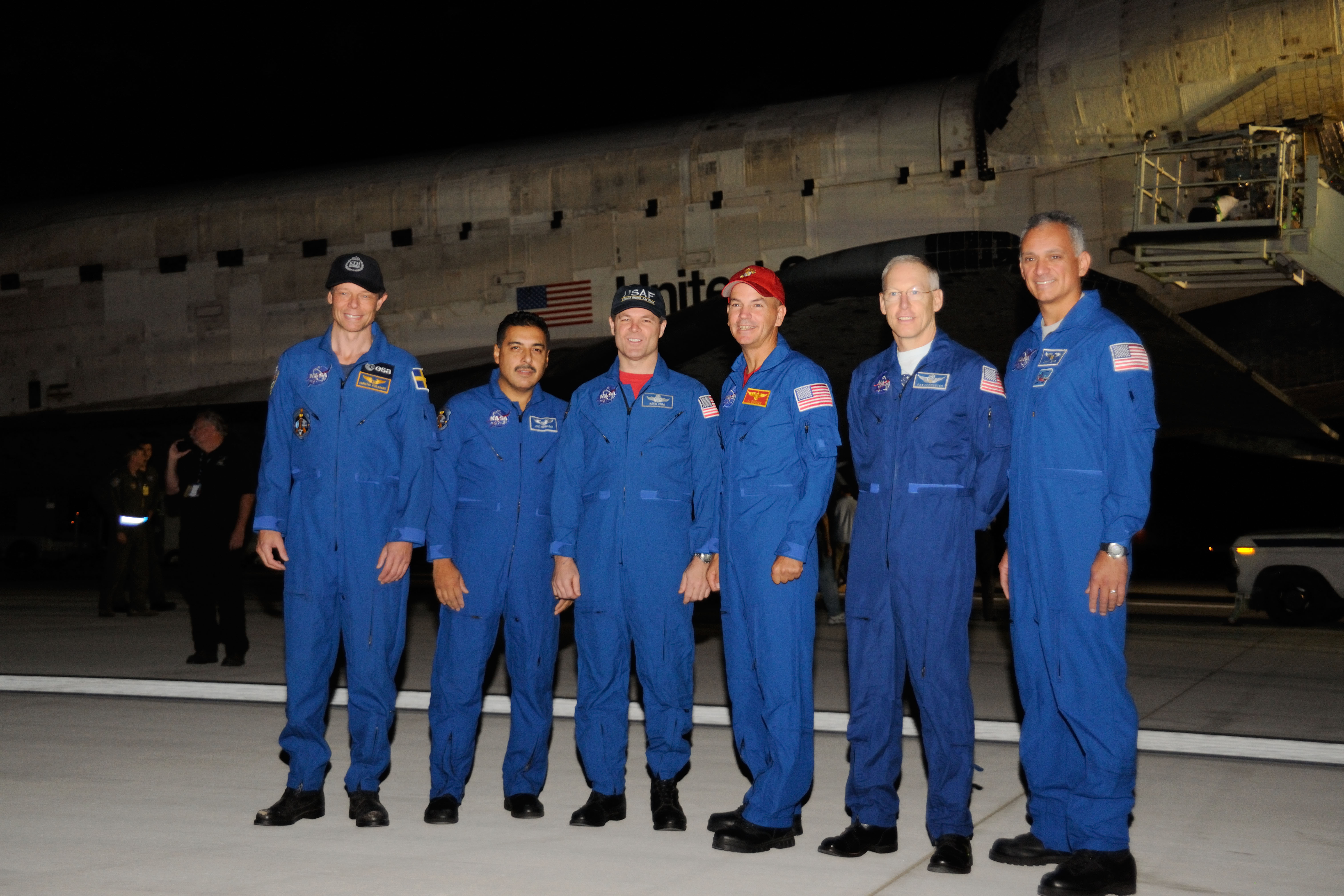
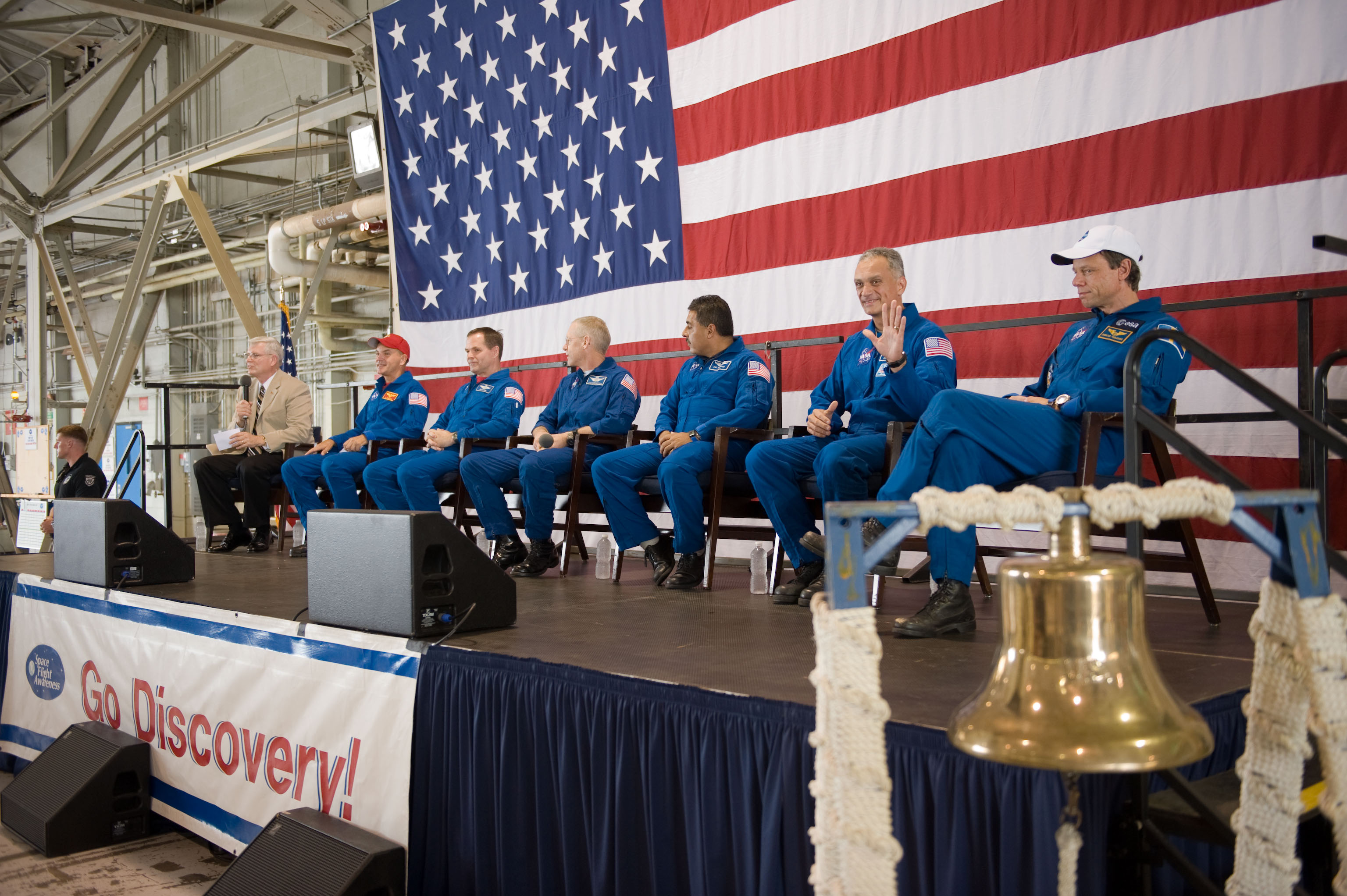
Six of the STS-128 astronauts pose with Discovery on the runway at Edwards Air Force Base in California The welcome home ceremony for the STS-128 crew at Ellington Field in Houston
Left: Six of the STS-128 astronauts pose with Discovery on the runway at Edwards Air Force Base in California. Right: The welcome home ceremony for the STS-128 crew at Ellington Field in Houston.

On Sept. 11, the astronauts closed Discovery’s payload bay doors, donned their launch and entry suits, and strapped themselves into their seats, a special recumbent one for Kopra who had spent the last two months in weightlessness. Sturckow fired Discovery’s two Orbital Maneuvering System engines to bring them out of orbit and head for a landing half an orbit later. He guided Discovery to a smooth touchdown at Edwards, as it turned out the final space shuttle landing at the California facility. The landing capped off a very successful STS-128 mission of 13 days, 20 hours, 54 minutes. They orbited the planet 219 times. Kopra spent 58 days, 2 hours, 50 minutes in space, completing 920 orbits of the Earth. Workers placed Discovery atop a Shuttle Carrier Aircraft, a modified Boeing 747, to ferry it back to KSC where it landed on Sept. 21. Engineers began preparing it for its next flight, STS-131 in April 2010.

Enjoy the crew narrate a video about the STS-128 mission.

Powered by WPeMatico

Get The Details…
Kelli Mars
Work Is Under Way on NASA’s Next-Generation Asteroid Hunter

Work Is Under Way on NASA’s Next-Generation Asteroid Hunter

6 min read

Preparations for Next Moonwalk Simulations Underway (and Underwater)

The mirrors for NASA’s Near-Earth Object Surveyor space telescope are being installed and aligned, and work on other spacecraft components is accelerating.

NASA’s new asteroid-hunting spacecraft is taking shape at NASA’s Jet Propulsion Laboratory in Southern California. Called NEO Surveyor (Near-Earth Object Surveyor), this cutting-edge infrared space telescope will seek out the hardest-to-find asteroids and comets that might pose a hazard to our planet. In fact, it is the agency’s first space telescope designed specifically for planetary defense.

Targeting launch in late 2027, the spacecraft will travel a million miles to a region of gravitational stability — called the L1 Lagrange point — between Earth and the Sun. From there, its large sunshade will block the glare and heat of sunlight, allowing the mission to discover and track near-Earth objects as they approach Earth from the direction of the Sun, which is difficult for other observatories to do. The space telescope also may reveal asteroids called Earth Trojans, which lead and trail our planet’s orbit and are difficult to see from the ground or from Earth orbit.

NEO Surveyor relies on cutting-edge detectors that observe two bands of infrared light, which is invisible to the human eye. Near-Earth objects, no matter how dark, glow brightly in infrared as the Sun heats them. Because of this, the telescope will be able to find dark asteroids and comets, which don’t reflect much visible light. It also will measure those objects, a challenging task for visible-light telescopes that have a hard time distinguishing between small, highly reflective objects and large, dark ones.

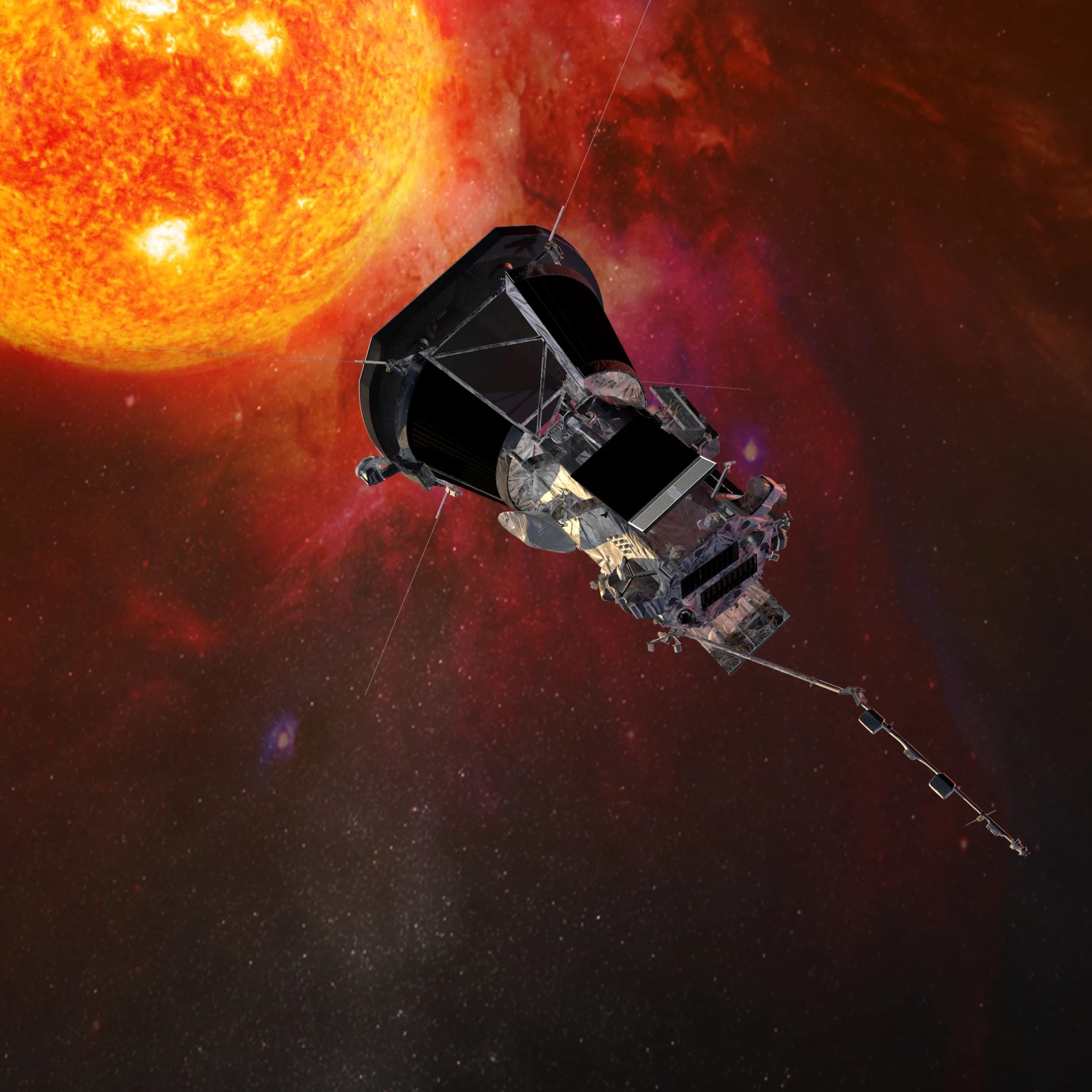
This artist’s concept depicts NASA’s NEO Surveyor in deep space
This artist’s concept depicts NASA’s NEO Surveyor in deep space. The black-paneled angular structure in the belly of the spacecraft is the instrument enclosure that is being built at JPL. The mission’s infrared telescope will be installed inside the enclosure.
NASA/JPL-Caltech

“NEO Surveyor is optimized to help us to do one specific thing: enable humanity to find the most hazardous asteroids and comets far enough in advance so we can do something about them,” said Amy Mainzer, principal investigator for NEO Surveyor and a professor at the University of California, Los Angeles. “We aim to build a spacecraft that can find, track, and characterize the objects with the greatest chance of hitting Earth. In the process, we will learn a lot about their origins and evolution.”

Coming Into Focus

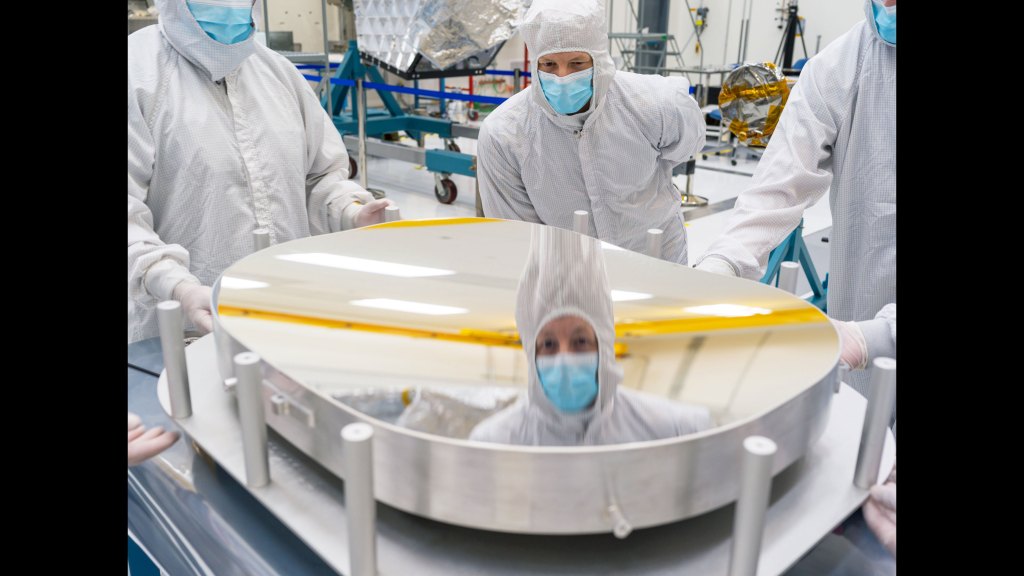
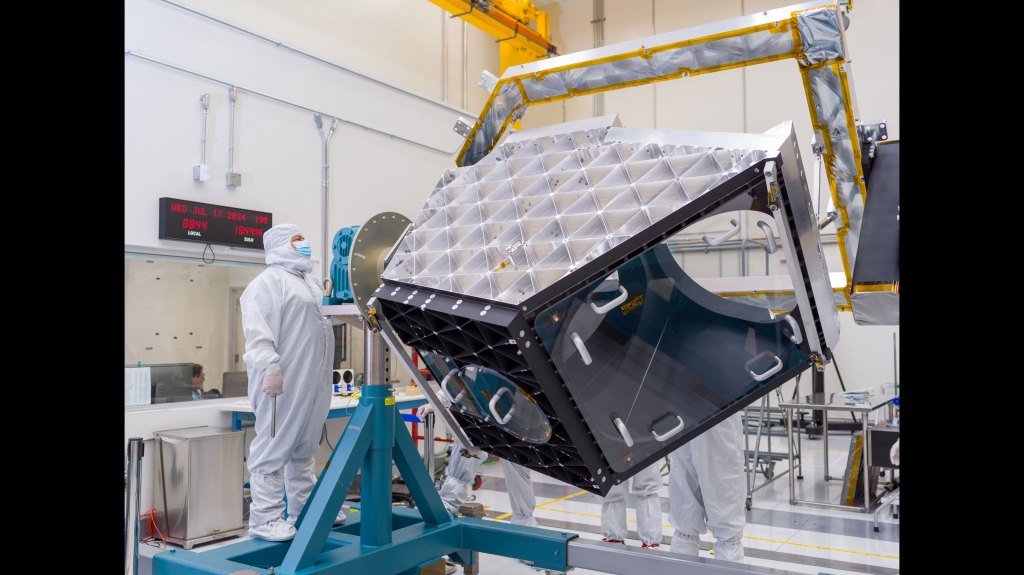
The spacecraft’s only instrument is its telescope. About the size of a washer-and-dryer set, the telescope’s blocky aluminum body, called the optical bench, was built in a JPL clean room. Known as a three-mirror anastigmat telescope, it will rely on curved mirrors to focus light onto its infrared detectors in such a way that minimizes optical aberrations.

“We have been carefully managing the fabrication of the spacecraft’s telescope mirrors, all of which were received in the JPL clean room by July,” said Brian Monacelli, principal optical engineer at JPL. “Its mirrors were shaped and polished from solid aluminum using a diamond-turning machine. Each exceeds the mission’s performance requirements.”

Monacelli inspected the mirror surfaces for debris and damage, then JPL’s team of optomechanical technicians and engineers attached the mirrors to the telescope’s optical bench in August. Next, they will measure the telescope’s performance and align its mirrors.

Complementing the mirror assembly are the telescope’s mercury-cadmium-telluride detectors, which are similar to the detectors used by NASA’s recently retired NEOWISE (short for Near-Earth Object Wide-field Infrared Survey Explorer) mission. An advantage of these detectors is that they don’t necessarily require cryogenic coolers or cryogens to lower their operational temperatures in order to detect infrared wavelengths. Cryocoolers and cryogens can limit the lifespan of a spacecraft. NEO Surveyor will instead keep its cool by using its large sunshade to block sunlight from heating the telescope and by occupying an orbit beyond that of the Moon, minimizing heating from Earth.

The telescope will eventually be installed inside the spacecraft’s instrument enclosure, which is being assembled in JPL’s historic High Bay 1 clean room where NASA missions such as Voyager, Cassini, and Perseverance were constructed. Fabricated from dark composite material that allows heat to escape, the enclosure will help keep the telescope cool and prevent its own heat from obscuring observations.

Once it is completed in coming weeks, the enclosure will be tested to make sure it can withstand the rigors of space exploration. Then it will be mounted on the back of the sunshade and atop the electronic systems that will power and control the spacecraft.

“The entire team has been working hard for a long time to get to this point, and we are excited to see the hardware coming together with contributions from our institutional and industrial collaborators from across the country,” said Tom Hoffman, NEO Surveyor’s project manager at JPL. “From the panels and cables for the instrument enclosure to the detectors and mirrors for the telescope — as well as components to build the spacecraft — hardware is being fabricated, delivered, and assembled to build this incredible observatory.”

Assembly of NEO Surveyor can be viewed 24 hours a day, seven days a week, via JPL’s live cam.

More About NEO Surveyor

The NEO Surveyor mission marks a major step for NASA toward reaching its U.S. Congress-mandated goal to discover and characterize at least 90% of the near-Earth objects more than 460 feet (140 meters) across that come within 30 million miles (48 million kilometers) of our planet’s orbit. Objects of this size can cause significant regional damage, or worse, should they impact the Earth.

The mission is tasked by NASA’s Planetary Science Division within the Science Mission Directorate; program oversight is provided by the Planetary Defense Coordination Office, which was established in 2016 to manage the agency’s ongoing efforts in planetary defense. NASA’s Planetary Missions Program Office at the agency’s Marshall Space Flight Center provides program management for NEO Surveyor.

The project is being developed by JPL and is led by principal investigator Amy Mainzer at UCLA. Established aerospace and engineering companies have been contracted to build the spacecraft and its instrumentation, including BAE Systems, Space Dynamics Laboratory, and Teledyne. The Laboratory for Atmospheric and Space Physics at the University of Colorado, Boulder will support operations, and IPAC-Caltech in Pasadena, California, is responsible for processing survey data and producing the mission’s data products. Caltech manages JPL for NASA.

More information about NEO Surveyor is available at:

https://science.nasa.gov/mission/neo-surveyor

News Media Contacts

Ian J. O’Neill
Jet Propulsion Laboratory, Pasadena, Calif.
818-354-2649
ian.j.oneill@jpl.nasa.gov

Karen Fox / Alana Johnson
NASA Headquarters, Washington
202-358-1600 / 202-358-1501
karen.c.fox@nasa.govalana.r.johnson@nasa.gov

2024-114

Powered by WPeMatico

Get The Details…
Anthony Greicius

New NASA Study Tallies Carbon Emissions From Massive Canadian Fires

New NASA Study Tallies Carbon Emissions From Massive Canadian Fires

4 min read

Preparations for Next Moonwalk Simulations Underway (and Underwater)

Wildfire smoke from Nova Scotia
An astronaut aboard the International Space Station photographed wildfire smoke from Nova Scotia billowing over the Atlantic Ocean in May 2023. Warm weather and lack of rain fueled blazes across Canada last year, burning 5% of the country’s forests.
NASA

Extreme wildfires like these will continue to have a large impact on global climate.

Stoked by Canada’s warmest and driest conditions in decades, extreme forest fires in 2023 released about 640 million metric tons of carbon, NASA scientists have found. That’s comparable in magnitude to the annual fossil fuel emissions of a large industrialized nation. NASA funded the study as part of its ongoing mission to understand our changing planet.

The research team used satellite observations and advanced computing to quantify the carbon emissions of the fires, which burned an area roughly the size of North Dakota from May to September 2023. The new study, published on Aug. 28 in the journal Nature, was led by scientists at NASA’s Jet Propulsion Laboratory in Southern California.

Carbon monoxide from Canada wildfires curls thousands of miles across North America in this animation showing data from summer 2023. Lower concentrations are shown in purple; higher concentrations are in yellow. Red triangles indicate fire hotspots.
NASA’s Goddard Space Flight Center

They found that the Canadian fires released more carbon in five months than Russia or Japan emitted from fossil fuels in all of 2022 (about 480 million and 291 million metric tons, respectively). While the carbon dioxide (CO2) emitted from both wildfires and fossil fuel combustion cause extra warming immediately, there’s an important distinction, the scientists noted. As the forest regrows, the amount of carbon emitted from fires will be reabsorbed by Earth’s ecosystems. The CO2 emitted from the burning of fossil fuels is not readily offset by any natural processes.

An ESA (European Space Agency) instrument designed to measure air pollution observed the fire plumes over Canada. The TROPOspheric Monitoring Instrument, or TROPOMI, flies aboard the Sentinel 5P satellite, which has been orbiting Earth since 2017. TROPOMI has four spectrometers that measure and map trace gases and fine particles (aerosols) in the atmosphere.

The scientists started with the end result of the fires: the amount of carbon monoxide (CO) in the atmosphere during the fire season. Then they “back-calculated” how large the emissions must have been to produce that amount of CO. They were able to estimate how much CO2 was released based on ratios between the two gases in the fire plumes.  

“What we found was that the fire emissions were bigger than anything in the record for Canada,” said Brendan Byrne, a JPL scientist and lead author of the new study. “We wanted to understand why.”

Warmest Conditions Since at Least 1980

Wildfire is essential to the health of forests, clearing undergrowth and brush and making way for new plant life. In recent decades, however, the number, severity, and overall size of wildfires have increased, according to the U.S. Department of Agriculture. Contributing factors include extended drought, past fire management strategies, invasive species, and the spread of residential communities into formerly less developed areas.

To explain why Canada’s fire season was so intense in 2023, the authors of the new study cited tinderbox conditions across its forests. Climate data revealed the warmest and driest fire season since at least 1980. Temperatures in the northwest part of the country — where 61% of fire emissions occurred — were more than 4.5 degrees Fahrenheit (2.6 degrees Celsius) above average from May through September. Precipitation was also more than 3 inches (8 centimeters) below average for much of the year.

Driven in large part by these conditions, many of the fires grew to enormous sizes. The fires were also unusually widespread, charring some 18 million hectares of forest from British Columbia in the west to Quebec and the Atlantic provinces in the east. The area of land that burned was more than eight times the 40-year average and accounted for 5% of Canadian forests.

“Some climate models project that the temperatures we experienced last year will become the norm by the 2050s,” Byrne said. “The warming, coupled with lack of moisture, is likely to trigger fire activity in the future.”

If events like the 2023 Canadian forest fires become more typical, they could impact global climate. That’s because Canada’s vast forests compose one of the planet’s important carbon sinks, meaning that they absorb more CO2 from the atmosphere than they release. The scientists said that it remains to be seen whether Canadian forests will continue to absorb carbon at a rapid rate or whether increasing fire activity could offset some of the uptake, diminishing the forests’ capacity to forestall climate warming.

News Media Contacts

Jane J. Lee / Andrew Wang
Jet Propulsion Laboratory, Pasadena, Calif.
818-354-0307 / 626-379-6874
jane.j.lee@jpl.nasa.gov / andrew.wang@jpl.nasa.gov

Written by Sally Younger

2024-113

Share

Details

Last Updated

Aug 28, 2024

Powered by WPeMatico

Get The Details…
Anthony Greicius

Eclipse Soundscapes AudioMoth Donations Will Study Nature at Night

Eclipse Soundscapes AudioMoth Donations Will Study Nature at Night

3 min read

Eclipse Soundscapes AudioMoth Donations Will Study Nature at Night

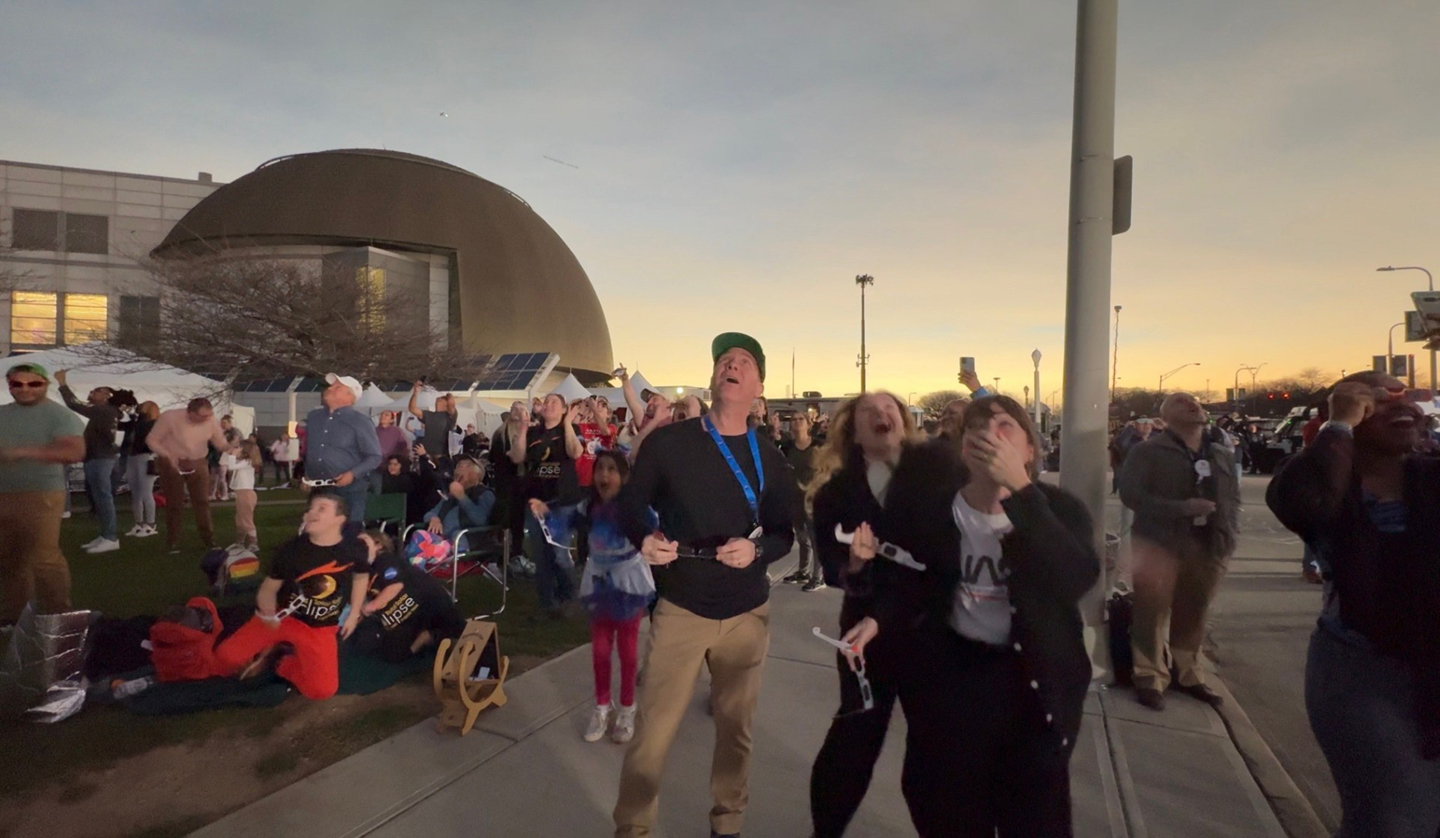
During the April 8, 2024 total solar eclipse, approximately 770 AudioMoth recording devices were used to capture sound data as part of the Eclipse Soundscapes Project — a multisensory participatory science (also known as “citizen science”) project that is studying how eclipses impact life on Earth. Following the eclipse, participants had the option to keep or send back their AudioMoth device for donation. Fifty-two AudioMoths were sent back to Eclipse Soundscapes (ES) so that ES could donate them to projects or communities for future scientific usage. Eighteen of those AudioMoths have been donated to Dark Sky Missouri, an initiative to protect our night skies and the creatures that depend on them. On Wednesday, August 21, 2024, at 3 p.m. EST, Eclipse Soundscapes hosted a webinar with Dark Sky Missouri founder Don Ficken to learn more about how these AudioMoths will contribute to future participatory science.

Don Ficken is a Missouri Master Naturalist and amateur astronomer who found the Eclipse Soundscapes Project through SciStarter, an organization that helps bring together millions of curious and concerned people in the world to engage in real-world research questions through citizen science. He participated as a Data Collector in 2024. “[The Eclipse Soundscapes Project] opened up a door for me because I never really thought about sound acoustics in this way,” Ficken said.

It occurred to Ficken that acoustics could help bolster Dark Sky Missouri’s efforts to study and conserve night time wildlife. One of these efforts, Lights Out Heartland, encourages homeowners and businesses to minimize artificial light usage in order to protect migrating birds from collisions due to disorienting bright lights. Ficken hopes to use the AudioMoths to capture the birds’ nocturnal flight calls as they fly over locations like the Gateway Arch, Shaw Nature Reserve, and Missouri Botanical Gardens.

Dark Sky Missouri also hopes to take more general surveys of nature at night by placing AudioMoths in parks and natural areas. Even though parks are not typically open or staffed at night, the AudioMoths could help map the locations and movements of wildlife, creating talking points and learning opportunities for staff and visitors alike.

Both initiatives will be piloted during the fall bird migration, with the goal of developing a framework for an expanded long term project. While there are no opportunities for the general public to get involved in the projects just yet, Ficken says participatory scientists can benefit from the multisensory methods employed in the Eclipse Soundscapes Project. “I think that the thing that they should think about is really the door that acoustics would be opening for them,” he said. “In other words, you don’t have to just visually look at daytime. Think about sound. Think about night.” For more information on how Dark Sky Missouri will use the AudioMoth recorders, read the Eclipse Soundscapes blog post.

The Eclipse Soundscapes Project is supported by NASA under cooperative agreement award number 80NSSC21M0008 and is part of NASA’s Science Activation Portfolio. Learn more about how Science Activation connects NASA science experts, real content, and experiences with community leaders to do science in ways that activate minds and promote deeper understanding of our world and beyond: https://science.nasa.gov/learn

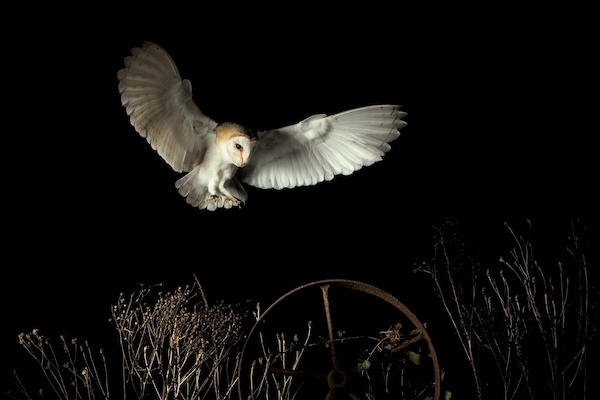
A barn owl flying at night.
Dark Sky Missouri will use the donated Eclipse Soundscapes AudioMoths to study bird calls and behavior at night.

Share

Details

Last Updated

Aug 28, 2024

Editor
NASA Science Editorial Team

Powered by WPeMatico

Get The Details…