NASA’s Webb Provides Another Look Into Galactic Collisions

NASA’s Webb Provides Another Look Into Galactic Collisions
4 Min Read

NASA’s Webb Provides Another Look Into Galactic Collisions

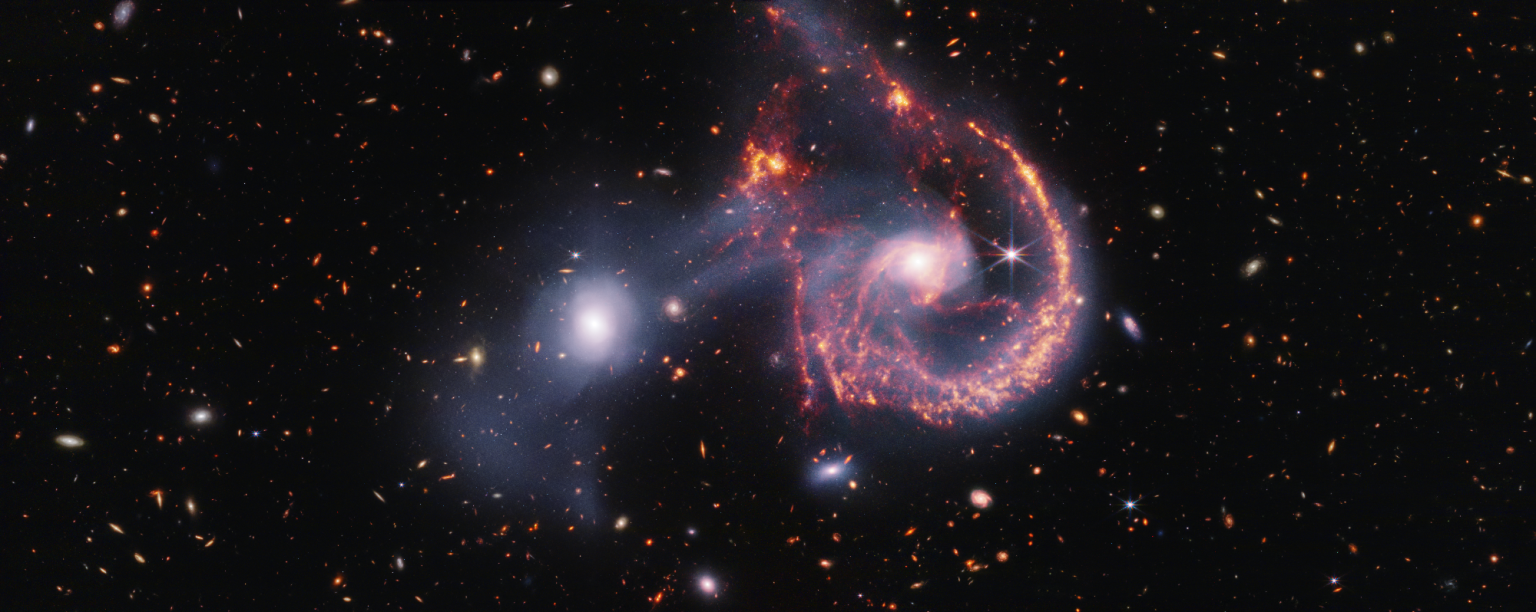
A pair of interacting galaxies. The larger of the two galaxies is slightly right of center, and composed of a hazy, bright, white center and a ring of gaseous filaments, which are different shades of red and orange. Toward the bottom left and bottom right of the ring are filaments of gas spiraling inward toward the core. At the top left of the ring is a noticeable gap, bordered by two large, orange pockets of dust and gas. The smaller galaxy to its left is made of hazy white gas and dust, which becomes more diffuse farther away from its center. To this galaxy’s bottom left, there is a smaller, more diffuse gas cloud that wafts outward toward the edges. Many red, orange, and white galaxies are spread throughout, with some hazier in composition and others having more defined spiral patterns.
This composite image of Arp 107 reveals a wealth of information about the star-formation and how these two galaxies collided hundreds of million years ago (full image below).
Credits:
NASA, ESA, CSA, STScI

Smile for the camera! An interaction between an elliptical galaxy and a spiral galaxy, collectively known as Arp 107, seems to have given the spiral a happier outlook thanks to the two bright “eyes” and the wide semicircular “smile.” The region has been observed before in infrared by NASA’s Spitzer Space Telescope in 2005, however NASA’s James Webb Space Telescope displays it in much higher resolution. This image is a composite, combining observations from Webb’s MIRI (Mid-Infrared Instrument) and NIRCam (Near-Infrared Camera).

Image A: Arp 107 (NIRCam and MIRI Image)
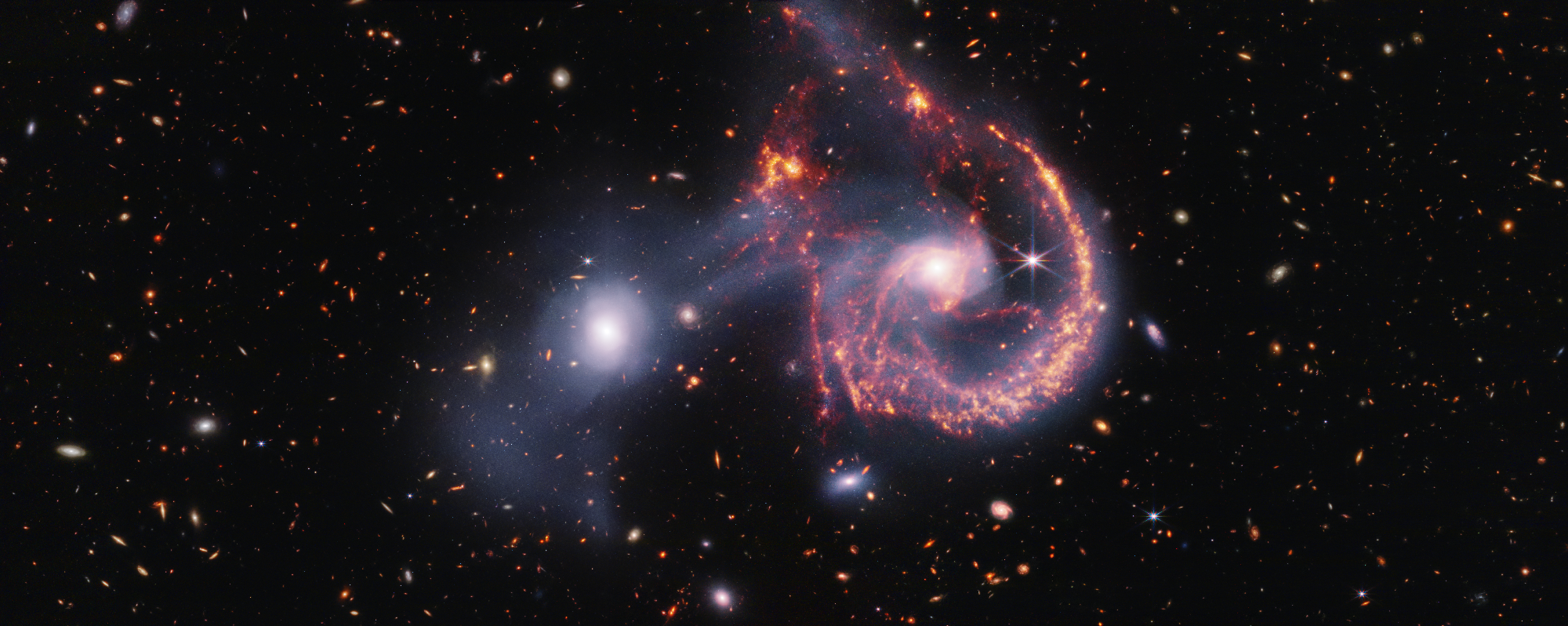
A pair of interacting galaxies. The larger of the two galaxies is slightly right of center, and composed of a hazy, bright, white center and a ring of gaseous filaments, which are different shades of red and orange. Toward the bottom left and bottom right of the ring are filaments of gas spiraling inward toward the core. At the top left of the ring is a noticeable gap, bordered by two large, orange pockets of dust and gas. The smaller galaxy to its left is made of hazy white gas and dust, which becomes more diffuse farther away from its center. To this galaxy’s bottom left, there is a smaller, more diffuse gas cloud that wafts outward toward the edges. Many red, orange, and white galaxies are spread throughout, with some hazier in composition and others having more defined spiral patterns.
This composite image of Arp 107, created with data from the James Webb Space Telescope’s NIRCam (Near-Infrared Camera) and MIRI (Mid-Infrared Instrument), reveals a wealth of information about the star-formation and how these two galaxies collided hundreds of million years ago.
NASA, ESA, CSA, STScI

NIRCam highlights the stars within both galaxies and reveals the connection between them: a transparent, white bridge of stars and gas pulled from both galaxies during their passage. MIRI data, represented in orange-red, shows star-forming regions and dust that is composed of soot-like organic molecules known as polycyclic aromatic hydrocarbons. MIRI also provides a snapshot of the bright nucleus of the large spiral, home to a supermassive black hole.

Image B: Arp 107 (MIRI Image)

A pair of interacting galaxies. The larger of the two galaxies is slightly right of center, and is composed of a bright, white center and a ring of blue, gaseous filaments. The center of this galaxy shows Webb’s eight-pronged diffraction pattern. There are three filaments of gas and dust moving from the ring toward the center. At the top left of the ring is a noticeable gap, bordered by two large, blue pockets of dust and gas. The smaller galaxy is made of hazy, light blue gas and dust. Many red, green, blue, and yellow galaxies are spread throughout, with some being hazier in composition and others having more defined spiral patterns.
This image of Arp 107, shown by Webb’s MIRI (Mid-Infrared Instrument), reveals the supermassive black hole that lies in the center of the large spiral galaxy to the right. This black hole, which pulls much of the dust into lanes, also display’s Webb’s characteristic diffraction spikes, caused by the light that it emits interacting with the structure of the telescope itself.
NASA, ESA, CSA, STScI

The spiral galaxy is classified as a Seyfert galaxy, one of the two largest groups of active galaxies, along with galaxies that host quasars. Seyfert galaxies aren’t as luminous and distant as quasars, making them a more convenient way to study similar phenomena in lower energy light, like infrared.

This galaxy pair is similar to the Cartwheel Galaxy, one of the first interacting galaxies that Webb observed. Arp 107 may have turned out very similar in appearance to the Cartwheel, but since the smaller elliptical galaxy likely had an off-center collision instead of a direct hit, the spiral galaxy got away with only its spiral arms being disturbed. 

The collision isn’t as bad as it sounds. Although there was star formation occurring before, collisions between galaxies can compress gas, improving the conditions needed for more stars to form. On the other hand, as Webb reveals, collisions also disperse a lot of gas, potentially depriving new stars of the material they need to form.

Webb has captured these galaxies in the process of merging, which will take hundreds of millions of years. As the two galaxies rebuild after the chaos of their collision, Arp 107 may lose its smile, but it will inevitably turn into something just as interesting for future astronomers to study.

Arp 107 is located 465 million light-years from Earth in the constellation Leo Minor.

Video: Tour the Arp 107 Image

Video tour transcript
Credit: NASA, ESA, CSA, STScI, Danielle Kirshenblat (STScI)

The James Webb Space Telescope is the world’s premier space science observatory. Webb is solving mysteries in our solar system, looking beyond to distant worlds around other stars, and probing the mysterious structures and origins of our universe and our place in it. Webb is an international program led by NASA with its partners, ESA (European Space Agency) and CSA (Canadian Space Agency).

Downloads

Right click any image to save it or open a larger version in a new tab/window via the browser’s popup menu.

View/Download all image products at all resolutions for this article from the Space Telescope Science Institute.

Media Contacts

Laura Betz – laura.e.betz@nasa.gov, Rob Gutrorob.gutro@nasa.gov
NASA’s Goddard Space Flight Center, Greenbelt, Md.

Matthew Brownmabrown@stsci.edu, Christine Pulliamcpulliam@stsci.edu
Space Telescope Science Institute, Baltimore, Md.

Related Information

Video: What happens when galaxies collide?

Interactive: Explore “Interacting Galaxies: Future of the Milky Way”

Other images: Hubble’s view of Arp 107 and Spitzer’s view of Arp 107

Video: Galaxy Collisions: Simulations vs. Observations

Article: More about Galaxy Evolution

Video: Learn more about galactic collisions

More Webb News

More Webb Images

Webb Science Themes

Webb Mission Page

Related For Kids

What is a galaxy?

What is the Webb Telescope?

SpacePlace for Kids

En Español

¿Qué es una galaxia?

Ciencia de la NASA

NASA en español 

Space Place para niños

Powered by WPeMatico

Get The Details…

NASA Astronaut Tracy C. Dyson’s Scientific Mission aboard Space Station

NASA Astronaut Tracy C. Dyson’s Scientific Mission aboard Space Station

4 min read

Preparations for Next Moonwalk Simulations Underway (and Underwater)


NASA astronaut and Expedition 71 Flight Engineer Tracy C. Dyson smiles for a portrait in the vestibule between the Kibo laboratory module and the Harmony module aboard the International Space Station.
NASA astronaut Tracy C. Dyson smiles for a portrait in the vestibule between the Kibo laboratory module and the Harmony module aboard space station.
NASA

NASA astronaut Tracy C. Dyson is returning home after a six-month mission aboard the International Space Station. While on orbit, Dyson conducted an array of experiments and technology demonstrations that contribute to advancements for humanity on Earth and the agency’s trajectory to the Moon and Mars. 

Here is a look at some of the science Dyson conducted during her mission: 

Heart-Shaped Bioprints 

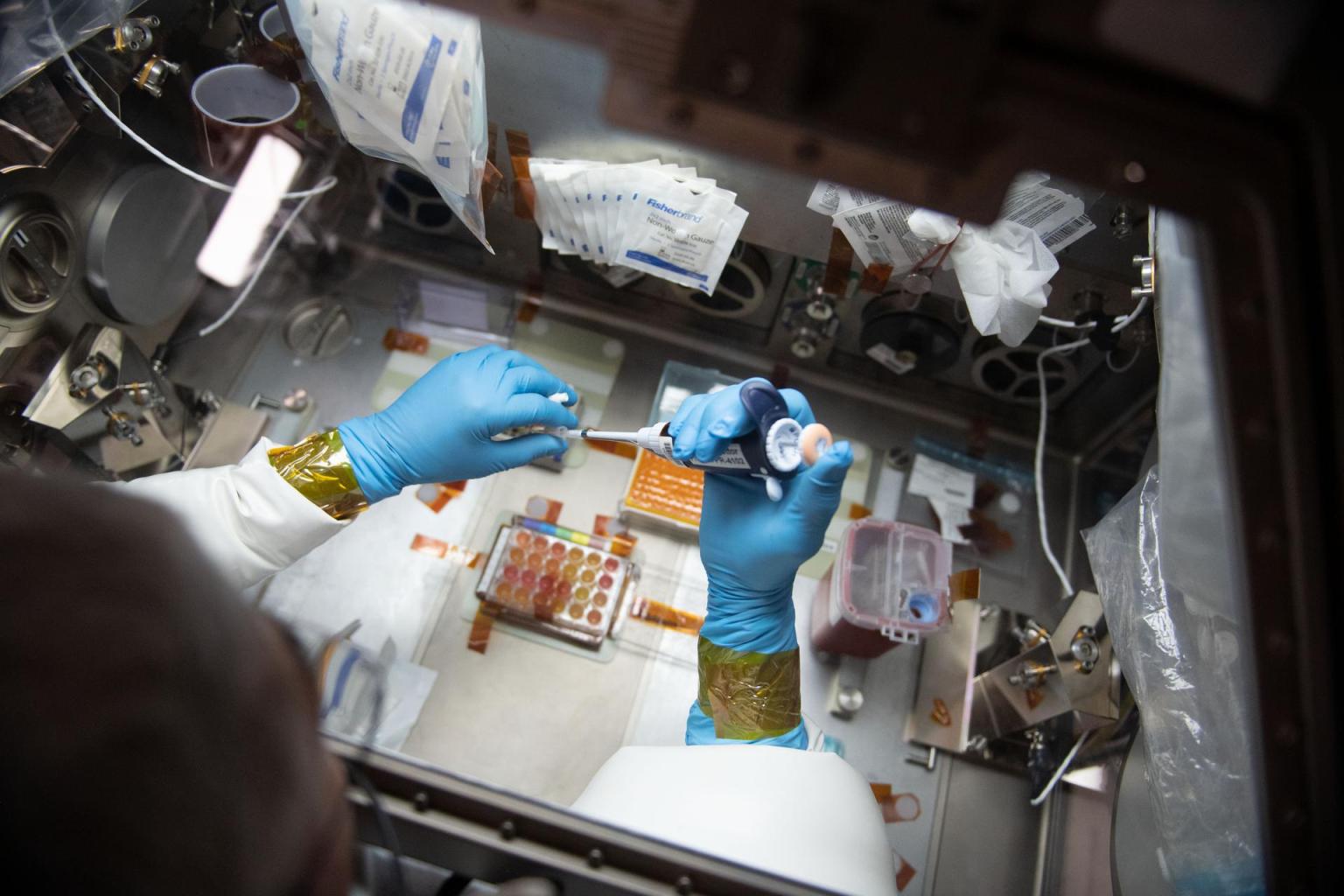
Expedition 71 Flight Engineer and NASA astronaut Tracy C. Dyson works in the BioFabrication Facility's portable glovebag located in the International Space Station's Columbus laboratory module. She was working on the Redwire Cardiac Bioprinting Investigation that may offer the ability to print food and medicines for future space crews. Results may also enable the bioprinting of replacement organs and tissues potentially alleviating the shortage of donor organs on Earth.
NASA

NASA astronaut Tracy C. Dyson operates the BioFabrication Facility for the Redwire Cardiac Bioprinting Investigation, which 3D prints cardiovascular tissue samples. In microgravity, bio inks used for 3D printing are less likely to settle and retain their shape better than on Earth. Cardiovascular disease is currently the number one cause of death in the United States, and findings from this space station investigation could one day lead to 3D-printed organs such as hearts for patients awaiting transplants. 

Wicking in Weightlessness 

Expedition 71 Flight Engineer and NASA astronaut Tracy C. Dyson works on the Gaucho Lung investigation studying ways to improve the delivery of respiratory system drugs potentially offering benefits to both the health care and food industries.
NASA

NASA astronaut Tracy C. Dyson handles hardware for the Wicking in Gel-Coated Tubes (Gaucho Lung) experiment. This study uses a tube lined with various gel thicknesses to simulate the human respiratory system. A fluid mass known as a liquid plug is then observed as it either blocks or flows through the tube. Data regarding the movement and trailing of the liquid plug allows researchers to design better drug delivery methods to address respiratory ailments. 

Programming for Future Missions 

iss071e046270 (May 1, 2024) -- NASA astronaut and Expedition 71 Flight Engineer Tracy C. Dyson performs a Zero Robotics tech demonstration with Astrobee. Zero Robotics allows students on Earth to write software to control one of three free-flying Astrobee robots aboard the International Space Station. As part of an ongoing educational activity, students can then observe the performance of the robot without directly interacting with it.
NASA
Dyson is centered and wearing a red long-sleeve shirt, her hair in a ponytail. She smiles while holding a blue microphone device with her left hand. In the background are cables and equipment.
NASA

NASA astronaut Tracy C. Dyson runs student-designed software on the free-flying Astrobee robot. This technology demonstration is part of Zero Robotics, a worldwide competition that engages middle school students in writing computer code to address unique specifications. Winning participants get to run their software on an actual Astrobee aboard the space station. This educational opportunity helps inspire the next generation of technology innovators.     

Robo-Extensions

NASA astronaut and Expedition 71 Flight Engineer Tracy C. Dyson is pictured inside the International Space Station's Columbus laboratory module. She was exploring ways to control a robot on the ground from a spacecraft. Dyson coordinated with robotics engineers on Earth remotely manipulating a robot using a computer while testing its ergonomic features and haptic feedback for conditions such as wind and gravity. Results may inform future exploration missions to the Moon, Mars, and beyond.
NASA

As we venture to the Moon and Mars, astronauts may rely more on robots to ensure safety and preserve resources. Through the Surface Avatar study, NASA astronaut Tracy C. Dyson controls a robot on Earth’s surface from a computer aboard station. This technology demonstration aims to toggle between manipulating multiple robots and “diving inside” a specific bot to control as an avatar. This two-way demonstration also evaluates how robot operators respond their robotic counterparts’ efficiency and general output. Applications for Earth use include exploration of inhospitable zones and search and rescue missions after disasters.  

Capturing Earth’s Essence

Suni Williams wearing a navy-blue sweater holds a camera close to her face with her right hand and aims it out an illuminated circular window. To her right, Tracy Dyson has her hair in a ponytail while wearing a gray sweater and holding a camera to her face with her right hand. Metallic panels, electronics, and cords are seen in the background.
NASA

For Crew Earth Observations, astronauts take pictures of Earth from space for research purposes. NASA astronauts Suni Williams (left) and Tracy C. Dyson (right) contribute by aiming handheld cameras from the space station’s cupola to photograph our planet. Images help inform climate and environmental trends worldwide and provide real-time natural disaster assessments. More than four million photographs have been taken of Earth by astronauts from space.  

Multi-faceted Crystallization Processor 

NASA astronaut and Expedition 71 Flight Engineer Tracy C. Dyson displays a sample processor for the Pharmaceutical In-space Laboratory experiment that is exploring the production and manufacturing of medicines to benefit astronauts in space and humans on Earth. She installed the processor in the Advanced Space Experiment Processor, or ADSEP, that can house a variety of research samples and be delivered to the International Space Station and returned to Earth aboard the SpaceX Dragon cargo craft.
NASA

NASA astronaut Tracy C. Dyson holds a cassette for Pharmaceutical In-Space Laboratory – 04 (ADSEP-PIL-04), an experiment to crystallize the model proteins lysozyme and insulin. Up to three cassettes with samples can be processed simultaneously in the Advanced Space Experiment Processor (ADSEP), each at an independent temperature. Because lysozyme and insulin have well-documented crystal structures, they can be used to evaluate the hardware’s performance in space. Successful crystallization with ADSEP could lead to production and manufacturing of versatile crystals with pharmaceutical applications.  

Cryo Care  

iss071e040122 (April 23, 2024) --- Expedition 71 Flight Engineers Tracy C. Dyson and Matthew Dominick, both NASA astronauts, collect research samples preserved inside science freezers aboard the International Space Station. The duo then transferred the samples and packed them inside the SpaceX Dragon cargo spacecraft for return to Earth and analysis in laboratories.
NASA

NASA astronauts Tracy C. Dyson and Matthew Dominick preserve research samples in freezers aboard the space station. Cryopreservation is essential for maintaining the integrity of samples for a variety of experiments, especially within the field of biology. The orbiting laboratory has multiple freezer options with varying subzero temperatures. Upon return, frozen samples are delivered back to their research teams for further analysis.    

Welcoming New Science 

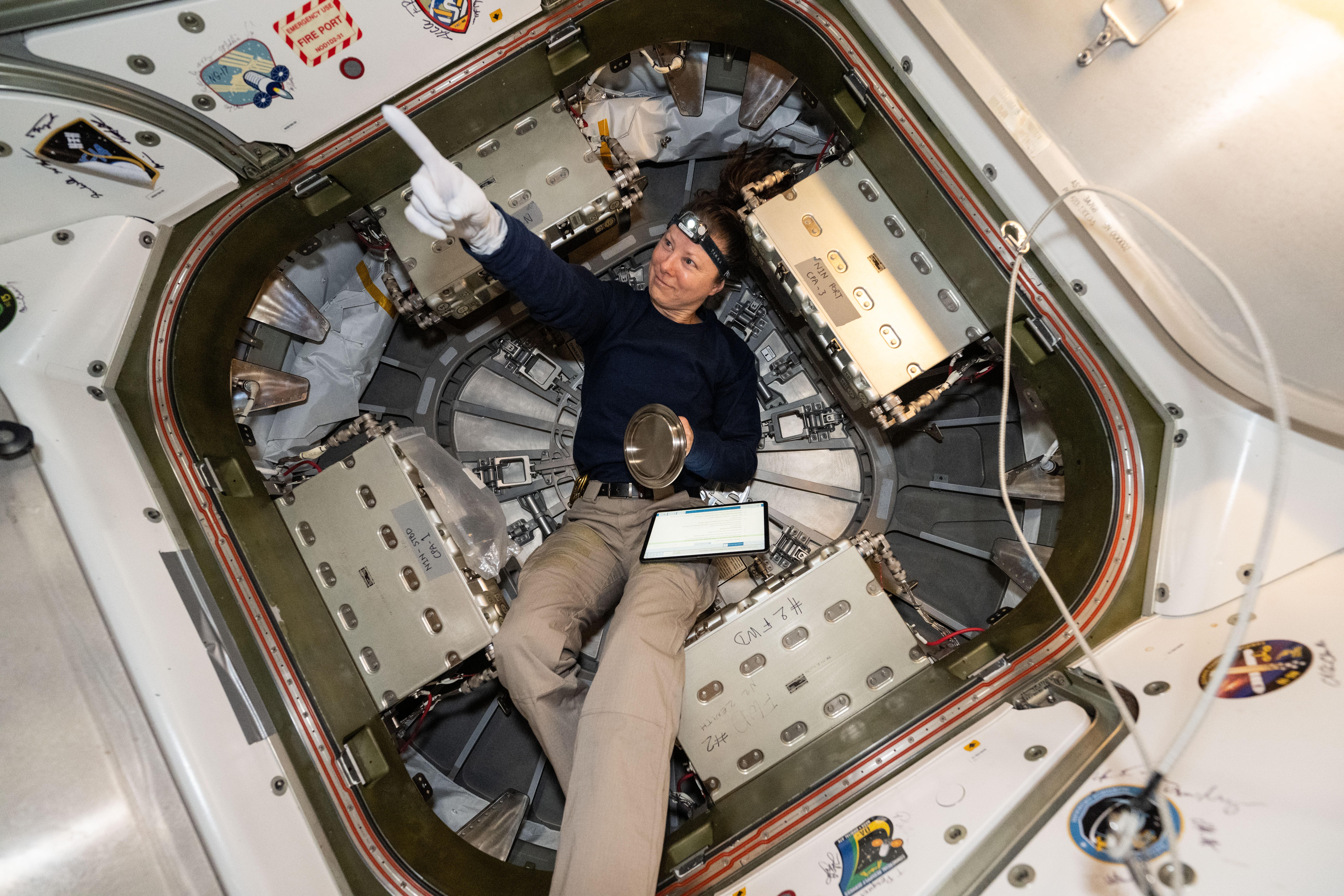
NASA astronaut and Expedition 71 Flight Engineer Tracy C. Dyson is pictured inside the vestibule between the Unity module and Northrop Grumman's Cygnus space freighter. She had just closed Cygnus' hatch in preparation for its depressurization and departure from the International Space Station.
NASA

NASA astronaut Tracy C. Dyson is pictured between the Unity module and Northrop Grumman’s Cygnus spacecraft in preparation for depressurization and departure from the International Space Station. On long-duration missions, visiting vehicles provide necessities for crew daily living as well as new science experiments and supplies for ongoing research. This vehicle brought experiments to test water recovery technology, produce stem cells in microgravity, study the effects of spaceflight on microorganism DNA, and conduct science demonstrations for students.   

Diana Garcia 

International Space Station Research Communications Team

NASA’s Johnson Space Center 

Powered by WPeMatico
Get The Details…
Andrea Lloyd

Reinventing the Clock: NASA’s New Tech for Space Timekeeping

Reinventing the Clock: NASA’s New Tech for Space Timekeeping

5 Min Read

Reinventing the Clock: NASA’s New Tech for Space Timekeeping

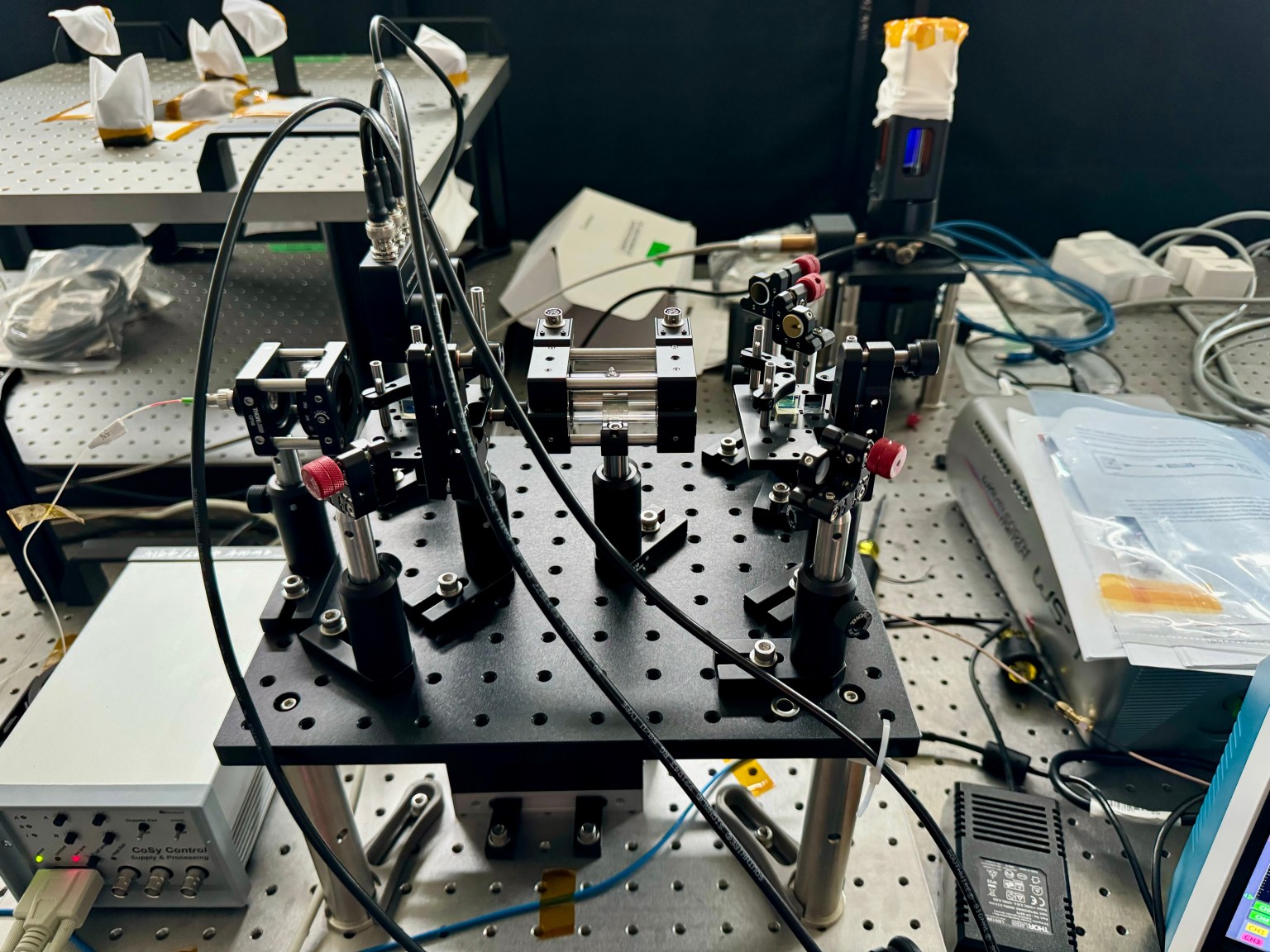
This image shows the Optical Atomic Strontium Ion Clock (OASIC), a small clear rectangular prism with wires and tubes surrounding it. The device is placed on a cluttered laboratory table, with other scientific instruments scattered about.

The Optical Atomic Strontium Ion Clock is a higher-precision atomic clock that is small enough to fit on a spacecraft.

Credits:
NASA/Matthew Kaufman

Here on Earth, it might not matter if your wristwatch runs a few seconds slow. But crucial spacecraft functions need accuracy down to one billionth of a second or less. Navigating with GPS, for example, relies on precise timing signals from satellites to pinpoint locations. Three teams at NASA’s Goddard Space Flight Center in Greenbelt, Maryland, are at work to push timekeeping for space exploration to new levels of precision.

  • One team develops highly precise quantum clock synchronization techniques to aid essential spacecraft communication and navigation.
  • Another Goddard team is working to employ the technique of clock synchronization in space-based platforms to enable telescopes to function as one enormous observatory.
  • The third team is developing an atomic clock for spacecraft based on strontium, a metallic chemical element, to enable scientific observations not possible with current technology.

The need for increasingly accurate timekeeping is why these teams at NASA Goddard, supported by the center’s Internal Research and Development program, hone clock precision and synchronization with innovative technologies like quantum and optical communications.

Syncing Up Across the Solar System

“Society requires clock synchronization for many crucial functions like power grid management, stock market openings, financial transactions, and much more,” said Alejandro Rodriguez Perez, a NASA Goddard researcher. “NASA uses clock synchronization to determine the position of spacecraft and set navigation parameters.”

If you line up two clocks and sync them together, you might expect that they will tick at the same rate forever. In reality, the more time passes, the more out of sync the clocks become, especially if those clocks are on spacecraft traveling at tens of thousands of miles per hour. Rodriguez Perez seeks to develop a new way of precisely synchronizing such clocks and keeping them synced using quantum technology.

Work on the quantum clock synchronization protocol takes place in this lab at NASA’s Goddard Space Flight Center in Greenbelt, Md.
NASA/Matthew Kaufman

In quantum physics, two particles are entangled when they behave like a single object and occupy two states at once. For clocks, applying quantum protocols to entangled photons could allow for a precise and secure way to sync clocks across long distances.

The heart of the synchronization protocol is called spontaneous parametric down conversion, which is when one photon breaks apart and two new photons form. Two detectors will each analyze when the new photons appear, and the devices will apply mathematical functions to determine the offset in time between the two photons, thus synchronizing the clocks.

While clock synchronization is currently done using GPS, this protocol could make it possible to precisely synchronize clocks in places where GPS access is limited, like the Moon or deep space.

Syncing Clocks, Linking Telescopes to See More than Ever Before

When it comes to astronomy, the usual rule of thumb is the bigger the telescope, the better its imagery.

“If we could hypothetically have a telescope as big as Earth, we would have incredibly high-resolution images of space, but that’s obviously not practical,” said Guan Yang, an optical physicist at NASA Goddard. “What we can do, however, is have multiple telescopes in various locations and have each telescope record the signal with high time precision. Then we can stich their observations together and produce an ultra-high-res image.”

The idea of linking together the observations of a network of smaller telescopes to affect the power of a larger one is called very long baseline interferometry, or VLBI.

For VLBI to produce a whole greater than the sum of its parts, the telescopes need high-precision clocks. The telescopes record data alongside timestamps of when the data was recorded. High-powered computers assemble all the data together into one complete observation with greater detail than any one of the telescopes could achieve on its own. This technique is what allowed the Event Horizon Telescope’s network of observatories to produce the first image of a black hole at the center of our galaxy.

Using the Event Horizon Telescope, scientists obtained an image of the black hole at the center of galaxy M87.
The Event Horizon Telescope (EHT) — a planet-scale array of eight ground-based radio telescopes forged through international collaboration — was designed to capture images of a black hole. Although the telescopes making up the EHT are not physically connected, they are able to synchronize their recorded data with atomic clocks.
EHT Collaboration

Yang’s team is developing a clock technology that could be useful for missions looking to take the technique from Earth into space which could unlock many more discoveries.

An Optical Atomic Clock Built for Space Travel

Spacecraft navigation systems currently rely on onboard atomic clocks to obtain the most accurate time possible. Holly Leopardi, a physicist at NASA Goddard, is researching optical atomic clocks, a more precise type of atomic clock.

While optical atomic clocks exist in laboratory settings, Leopardi and her team seek to develop a spacecraft-ready version that will provide more precision.

The team works on OASIC, which stands for Optical Atomic Strontium Ion Clock. While current spacecraft utilize microwave frequencies, OASIC uses optical frequencies.

The Optical Atomic Strontium Ion Clock is a higher-precision atomic clock that is small enough to fit on a spacecraft.
NASA/Matthew Kaufman

“Optical frequencies oscillate much faster than microwave frequencies, so we can have a much finer resolution of counts and more precise timekeeping,” Leopardi said.

The OASIC technology is about 100 times more precise than the previous state-of-the-art in spacecraft atomic clocks. The enhanced accuracy could enable new types of science that were not previously possible.

“When you use these ultra-high precision clocks, you can start looking at the fundamental physics changes that occur in space,” Leopardi said, “and that can help us better understand the mechanisms of our universe.”

The timekeeping technologies unlocked by these teams, could enable new discoveries in our solar system and beyond.

By Matthew Kaufman, with additional contributions from Avery Truman
NASA’s Goddard Space Flight Center, Greenbelt, Md.

Share

Details

Last Updated

Sep 18, 2024

Editor
Rob Garner
Contact
Rob Garner
Location
Goddard Space Flight Center

Powered by WPeMatico
Get The Details…
Rob Garner

Space Science Advancing Health as Two Crews Near Station Departure

Space Science Advancing Health as Two Crews Near Station Departure

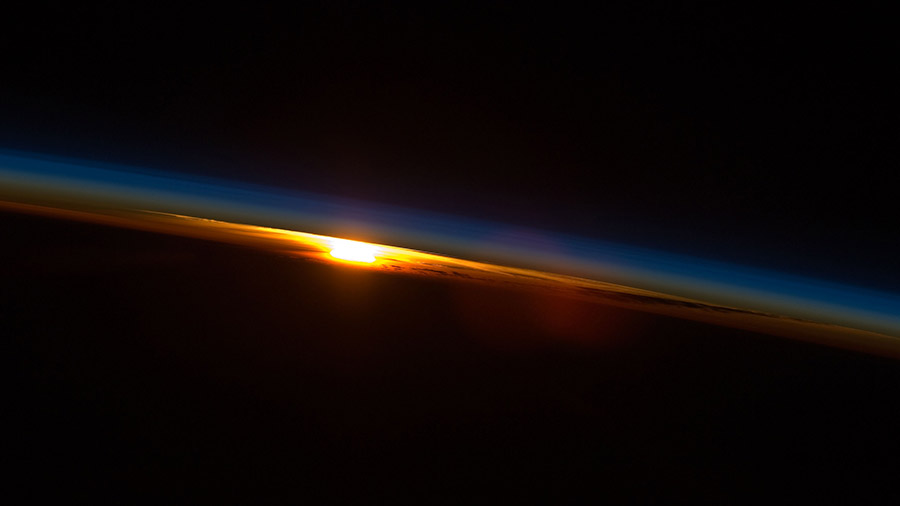
In this photograph from 2009, the sun sets below Earth's horizon illuminating the atmosphere as the space station orbited above the Indian Ocean coast of South Africa.
In this photograph from 2009, the sun sets below Earth’s horizon illuminating the atmosphere as the space station orbited above the Indian Ocean coast of South Africa.

The 12-member Expedition 71 crew aboard the International Space Station spent Tuesday observing how their bodies are adapting to weightlessness, configuring life support systems, and training to use safety hardware.

NASA and its international partners have collected and analyzed decades of health data from hundreds of space crew members. Whether its just a few days or a year or more of living and working in space, researchers take these valuable insights and apply the new knowledge to keep space crews healthier and promote advanced treatments for ailments on Earth.

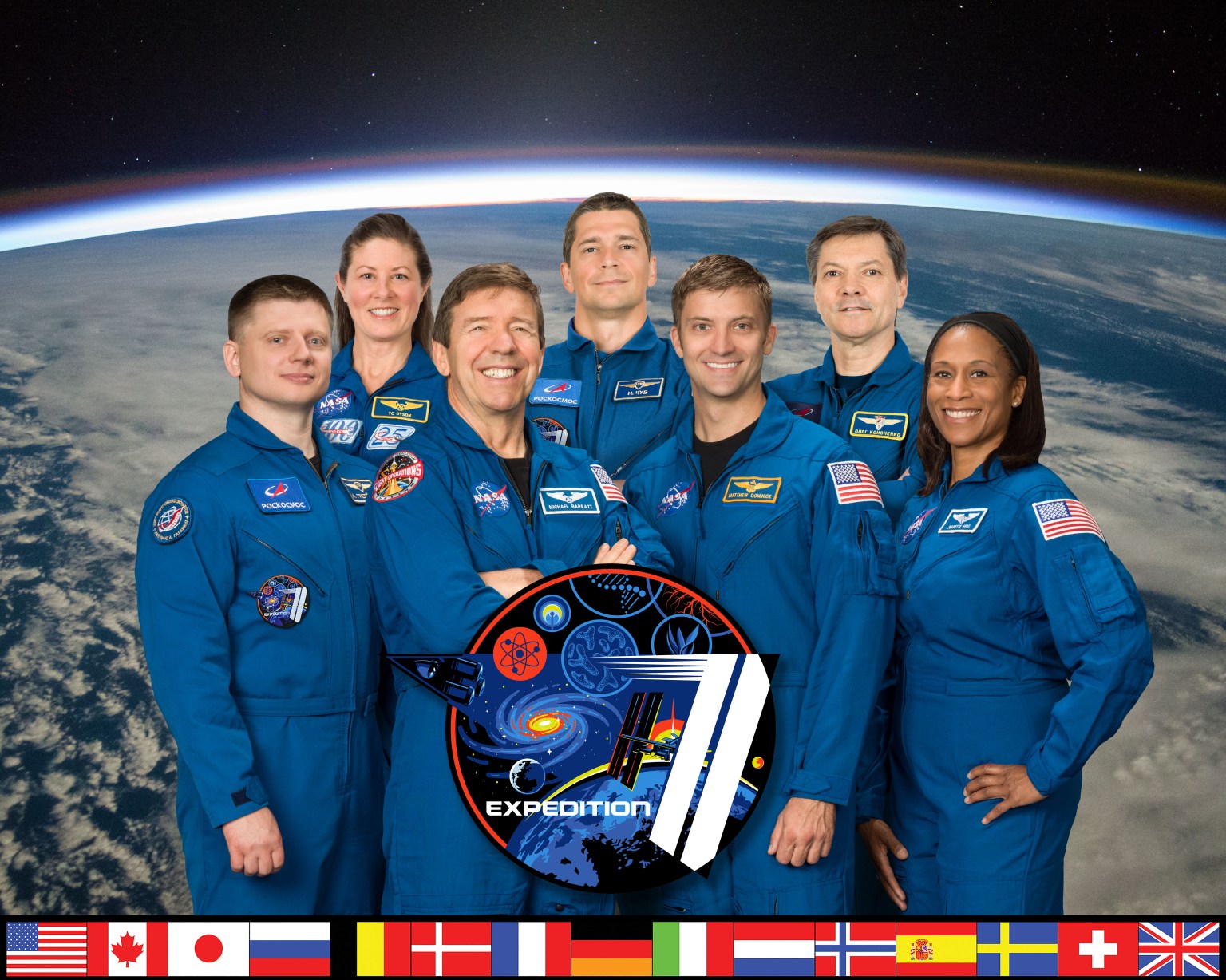
Four crewmates due to return to Earth in October tried on a unique suit today that may help them adjust more rapidly to the 1G gravity environment after a six-and-a-half-month space mission. The suit, called an orthostatic intolerance garment, may alleviate blood pressure issues and other symptoms some astronauts have experienced in the first few hours and days after landing back on Earth. NASA’s SpaceX Crew-8 quartet with NASA astronauts Matthew Dominick, Mike Barratt, and Jeanette Epps and Roscosmos cosmonaut Alexander Grebenkin began their station mission on March 5 when they docked to the orbital outpost aboard the SpaceX Dragon Endeavour spacecraft.

However, before the SpaceX crew leaves another trio will depart the space station next week. NASA Flight Engineer Tracy C. Dyson will ride the Soyuz MS-25 crew ship back to Earth with cosmonauts Oleg Kononenko and Nikolai Chub. The threesome stepped up their departure preparations this week packing cargo and personal items inside the Soyuz and reviewing spacecraft descent and landing procedures. Dyson will complete her third mission after six months in space while Kononenko, a veteran of five station missions, and Chub, a first-time space flyer, will have continuously orbited Earth for just over one year.

The station’s two newest cosmonauts, Alexey Ovchinin and Ivan Vagner, have also been helping doctors understand how space crews adapt to microgravity since they arrived at the space station on Sept. 11 with NASA astronaut Don Pettit. The cosmonauts on Tuesday attached sensors to their foreheads and wore goggles that tracked their eye movements providing details about how a crew member’s sense of balance adapts to the lack of gravity. The mission-experienced pair later studied how space affects the circulatory system and how blood flows to the extremities.

Pettit, who is on his fourth space station visit, started his day exploring ways to maximize the effectiveness of exercising in weightlessness. Later, at the end of his shift, he joined Ovchinin and Vagner and familiarized themselves with safety hardware and equipment locations throughout the orbital lab.

NASA astronauts Butch Wilmore and Suni Williams, who have been living on the station since June 6, spent the day primarily on lab maintenance tasks. Wilmore worked in the Permanent Multipurpose Module organizing and stowing food packs then he studied Dragon spacecraft operations. Williams partnered with Dominick throughout the day servicing on oxygen generator and preparing it for upcoming parts replacement.

15 years ago today, the Canadarm2 robotic arm reached out to grapple a visiting cargo craft and install it on the space station for the first time. That spacecraft, Japan’s HII-Transfer Vehicle 1, was also JAXA’s (Japan Aerospace Exploration Agency) first resupply ship to launch and replenish the space station’s crew at the time, Expedition 20. NASA’s International Space Station Program Manager Dana Weigel remarked about that achievement today on X.


Learn more about station activities by following the space station blog@space_station and @ISS_Research on X, as well as the ISS Facebook and ISS Instagram accounts.

Get weekly video highlights at: https://roundupreads.jsc.nasa.gov/videoupdate/

Get the latest from NASA delivered every week. Subscribe here: www.nasa.gov/subscribe

Powered by WPeMatico

Get The Details…

Mark Garcia

Measuring Moon Dust to Fight Air Pollution

Measuring Moon Dust to Fight Air Pollution

3 min read

Preparations for Next Moonwalk Simulations Underway (and Underwater)

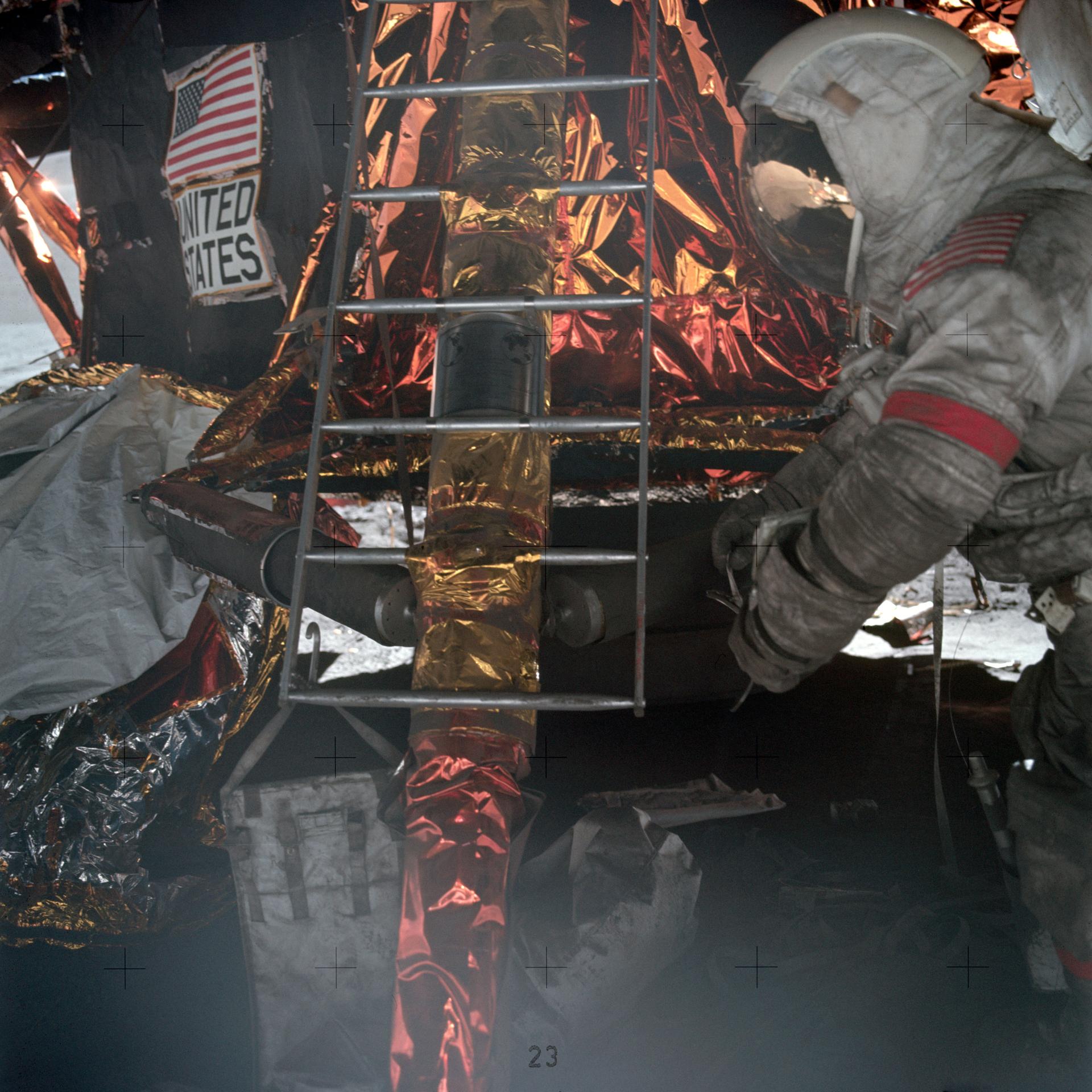
An Apollo astronaut preparing to climb the ladder into the lunar module's ascent stage, his spacesuit is covered in lunar dust.
While astronaut Gene Cernan was on the lunar surface during the Apollo 17 mission, his spacesuit collected loads of lunar dust. The gray, powdery substance stuck to the fabric and entered the capsule causing eye, nose, and throat irritation dubbed “lunar hay fever.” Credit: NASA
Credit: NASA

Moon dust, or regolith, isn’t like the particles on Earth that collect on bookshelves or tabletops – it’s abrasive and it clings to everything. Throughout NASA’s Apollo missions to the Moon, regolith posed a challenge to astronauts and valuable space hardware.

During the Apollo 17 mission, astronaut Harrison Schmitt described his reaction to breathing in the dust as “lunar hay fever,” experiencing sneezing, watery eyes, and a sore throat. The symptoms went away, but concern for human health is a driving force behind NASA’s extensive research into all forms of lunar soil.

The need to manage the dust to protect astronaut health and critical technology is already beneficial on Earth in the fight against air pollution.

Working as a contributor on a habitat for NASA’s Next Space Technologies for Exploration Partnerships (NextSTEP) program, Lunar Outpost Inc. developed an air-quality sensor system to detect and measure the amount of lunar soil in the air that also detects pollutants on Earth. 

Originally based in Denver, the Golden, Colorado-based company developed an air-quality sensor called the Space Canary and offered the sensor to Lockheed Martin Space for its NextSTEP lunar orbit habitat prototype. After the device was integrated into the habitat’s environmental control system, it provided distinct advantages over traditional equipment.

Rebranded as Canary-S (Solar), the sensor is now meeting a need for low-cost, wireless air-quality and meteorological monitoring on Earth. The self-contained unit, powered by solar energy and a battery, transmits data using cellular technology. It can measure a variety of pollutants, including particulate matter, carbon monoxide, methane, sulfur dioxide, and volatile organic compounds, among others. The device sends a message up to a secure cloud every minute, where it’s routed to either Lunar Outpost’s web-based dashboard or a customer’s database for viewing and analysis.

The oil and gas industry uses the Canary-S sensors to provide continuous, real-time monitoring of fugitive gas emissions, and the U.S. Forest Service uses them to monitor forest-fire emissions.

“Firefighters have been exhibiting symptoms of carbon monoxide poisoning for decades. They thought it was just part of the job,” explained Julian Cyrus, chief operating officer of Lunar Outpost. “But the sensors revealed where and when carbon monoxide levels were sky high, making it possible to issue warnings for firefighters to take precautions.”

The Canary-S sensors exemplify the life-saving technologies that can come from the collaboration of NASA and industry innovations. 

Share

Details

Last Updated

Sep 17, 2024

Powered by WPeMatico

Get The Details…
Andrew Wagner