10 Years Ago: Orion Flies its First Mission

10 Years Ago: Orion Flies its First Mission

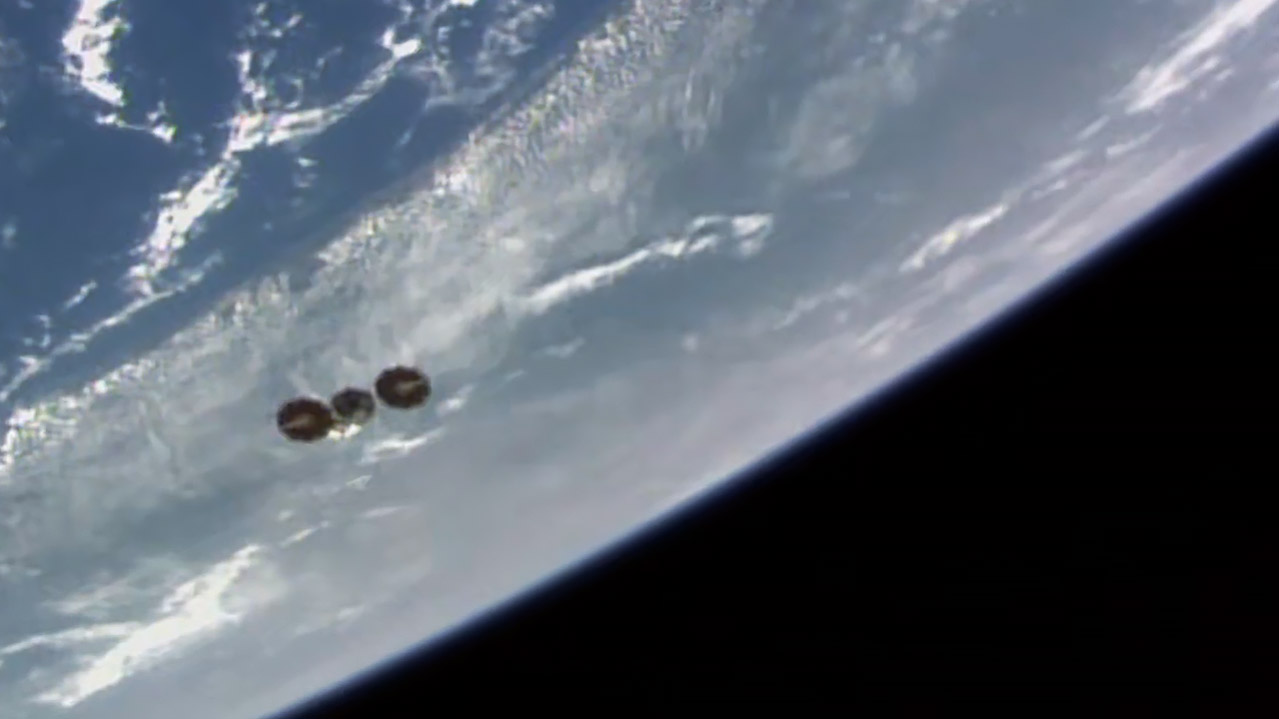
A new American human-rated spacecraft made its first foray into space on Dec. 5, 2014. Under contract to NASA, Lockheed Martin builds Orion as the vehicle to take American astronauts back to the Moon and eventually beyond. Orion’s overall shape harkens back to the Apollo Command and Service Modules, but using today’s technology is a larger and far more capable vehicle for NASA’s Artemis Program.

Orion’s first mission, called Engineering Flight Test-1 (EFT-1), used a Delta-IV Heavy booster, at the time the most powerful operational rocket. The 4.5-hour mission demonstrated Orion’s space-worthiness, tested the spacecraft’s heat shield during reentry into the Earth’s atmosphere, and proved the capsule’s recovery systems. Although the EFT-1 mission didn’t include a crew, the Orion capsule flew higher and faster than any human-rated spacecraft in more than 40 years.

A spacecraft is launching from a launch pad. Fire and smoke billows around the rocket as it lifts into the air.
The United Launch Alliance Delta IV Heavy rocket with NASA’s Orion spacecraft mounted atop, lifts off from Cape Canaveral Air Force Station’s Space Launch Complex 37B in Florida.
NASA/Bill Ingalls

At 7:05 a.m. EST on Dec. 5, 2014, the three-core first stage of the Delta-IV Heavy rocket ignited, lifting the Orion spacecraft off from Launch Complex 37B at Cape Canaveral Air Force, now Space Force, Station (CCAFS) in Florida to begin the EFT-1 mission. Three minutes and fifty-eight seconds after liftoff, the two side boosters separated as the center core continued firing for another 93 seconds. The second stage ignited thirteen seconds after separation to begin the first of three planned burns. During the first burn, the Service Module’s protective fairing separated, followed by the Launch Abort System. Lasting about 11 and a half minutes, this first burn of the second stage placed the spacecraft into a preliminary 115-by-552-mile parking orbit. While completing one revolution around the Earth, controllers in Mission Control at NASA’s Johnson Space Center in Houston, led by Flight Director Michael L. Sarafin, verified the functioning of the spacecraft’s systems. The second stage ignited a second time, firing for 4 minutes and 42 seconds to raise Orion’s apogee or high point above the Earth to 3,600 miles. During the coast to apogee, Orion remained attached to the second stage and completed its first crossing through the inner Van Allen radiation belt.

A group of employees sit around individual monitors in an office. The office has a large screen on the far wall with images projected on it. The screen shows a map of the earth. The employees are all focused.
Mission Control at NASA’s Johnson Space Center in Houston, Texas during the EFT-1 mission.
NASA/Mark Sowa

Three hours and five minutes after launch, Orion reached its apogee and began its descent back toward Earth, separating from the second stage about 18 minutes later. The second stage conducted a one-minute disposal burn to ensure it didn’t interfere with the spacecraft’s trajectory. During the passage back through the Van Allen belt, Orion fired its thrusters for 10 seconds to adjust its course for reentry. At an altitude of 400,000 feet, the spacecraft encountered the first tendrils of the Earth’s atmosphere at a point called Entry Interface, traveling at 20,000 miles per hour (mph). A buildup of ionized gases caused by the reentry heating resulted in a communications blackout with Orion for about two and a half minutes. The spacecraft experienced maximum heating of about 4,000 degrees Fahrenheit, proving the worthiness of the heat shield. After release of Orion’s forward bay cover, two drogue parachutes deployed to slow and stabilize the spacecraft. Next followed deployment of the three main parachutes that slowed the spacecraft to 20 mph. Splashdown occurred 4 hours and 24 minutes after launch about 600 miles southwest of San Diego, California. A video of the Orion EFT-1 mission can be viewed here.

A white spacecraft in the shape of a capsule is hanging from two large parachutes that are red and white in color. The spacecraft is about to splash into the blue ocean.
Crew module splashing down during EFT-1 in the Pacific ocean.
NASA

Standing by to recover the Orion capsule, U.S. Navy Divers assigned to Explosive Ordnance Disposal Mobile Unit 11 and Fleet Combat Camera Pacific and crew members from amphibious transport dock U.S.S. Anchorage (LPD-23) stepped into action, first placing a flotation collar around the spacecraft. After securing a tow line to the capsule, the sailors towed it aboard the amphibious well deck of Anchorage, which set sail for Naval Base San Diego arriving there on Dec 8. Engineers from NASA and Lockheed Martin conducted a preliminary inspection of the spacecraft during the cruise to San Diego and found that it survived its trip into space in excellent condition.

People in a high-speed boat are approaching a grey spacecraft shaped like a capsule that is on the water. The capsule has an American flag on it and inflated orange balloons on the top. Two other smaller boats are behind the first boat on standby. The boats are there to help the crew in the grey capsule exit the spacecraft.
U.S. Navy divers approach the Orion capsule during recovery operations.
U.S. Navy

The Orion EFT-1 mission met all its objectives and received many accolades. “Today was a great day for America,” said Flight Director Sarafin from his console at Mission Control. “It is hard to have a better day than today,” said Mark S. Geyer, Orion program manager. “We’re already working on the next capsule,” said W. Michael “Mike” Hawes, Lockheed Martin’s Orion program manager, adding, “We’ll learn a tremendous amount from what we did today.” NASA Associate Administrator for Human Exploration and Operations William H. Gerstenmaier praised all personnel involved with the EFT-1 mission, “What a tremendous team effort.” NASA Administrator Charles F. Bolden summarized his thoughts about the mission, “Today’s flight test of Orion is a huge step for NASA and a really critical part of our work to pioneer deep space.”

A group of people are standing around the weathered Orion capsule sitting on top of a white structure in a large hangar. A wide opening is at the mouth of the hangar where the group of people are standing.
Former NASA Administrator Charles F. Bolden inspects Orion EFT-1 capsule at NASA’s Kennedy Space Center in Florida.
NASA

After its arrival at Naval Base San Diego, workers placed the Orion capsule aboard a truck that delivered it to NASA’s Kennedy Space Center (KSC) in Florida on Dec. 18. After engineers conducted a thorough inspection of the spacecraft at KSC, workers trucked it to the Lockheed Martin facility in Littleton, Colorado, where it arrived on Sept. 1, 2015. Engineers completed final inspections and decontamination of the vehicle. The KSC Visitor Complex has the capsule on display.

The white Orion capsule with the red NASA logo floats in space against a black background. The Moon and Earth are in the background to the right of the capsule. The Earth is smaller than the Moon. The Moon sits to the left of the Earth.
The Orion capsule during the Artemis I mission, with the Moon and Earth in the background.
NASA

The next time an Orion spacecraft flew in space during the Artemis I mission, the Space Launch System (SLS) carried it into orbit after launch from KSC’s Launch Complex 39B. The thunderous night launch took place on Nov. 16, 2022. The first in a series of increasingly complex missions, Artemis I provided a foundation for human deep space exploration and demonstrated our commitment and capability to extend human existence to the Moon and beyond. The uncrewed Orion spacecraft spent 25.5 days in space, including 6 days in a retrograde orbit around the Moon, concluding with a splashdown in the Pacific Ocean on Dec. 11, exactly 50 years after the Apollo 17 Moon landing.

Four crew members in blue jumpsuits are standing next to each other in front of the Orion capsule.
The Artemis II crew poses in front of the Orion capsule at NASA’s Kennedy Space Center in Florida.
NASA/Kim Shiflett

On April 3, 2023, NASA named the four-person crew for the Artemis II mission, the first flight to take humans beyond low Earth orbit since Apollo 17 in December 1972. The crew includes NASA astronauts G. Reid Wiseman as commander, Victor J. Glover as pilot, and Christina H. Koch as a mission specialist as well as Canadian Space Agency astronaut Jeremy R. Hansen as the other mission specialist. The four will take an Orion spacecraft on a 10-day journey around the Moon to human rate the spacecraft and SLS.

Interested in learning more about the Artemis Program? Go to https://www.nasa.gov/humans-in-space/artemis/

Powered by WPeMatico

Get The Details…
Heather Kinney

Space Station Trajectory Data

Space Station Trajectory Data

The long exposure photograph taken by NASA astronaut Matthew Dominick shows star trails, streaks of city lights, and two Roscosmos crew ships, the Soyuz MS-26 docked to the Rassvet module (foreground) and the Soyuz MS-25 (background) docked to the Prichal docking module, as the International Space Station orbited 265 miles above central China.
iss071e650763 (Sept. 14, 2024) — The long exposure photograph taken by NASA astronaut Matthew Dominick shows star trails, streaks of city lights, and two Roscosmos crew ships, the Soyuz MS-26 docked to the Rassvet module (foreground) and the Soyuz MS-25 (background) docked to the Prichal docking module, as the International Space Station orbited 265 miles above central China.
NASA

Space Station trajectory data is now available to the public!

This data, called an ephemeris, is generated by the ISS Trajectory Operations and Planning Officer (TOPO) flight controllers in the Mission Control Center at NASA’s Johnson Space Center. TOPO keeps track of where the ISS is, where it is going to be, and most importantly makes sure it isn’t at risk of colliding with other objects in space. At ISS’s altitude, a very thin atmosphere is still present. This thin atmosphere creates drag and over time can cause TOPO’s predicted ISS trajectory to accumulate error. Because of this, TOPO updates the predicted trajectory approximately three times a week, so the ISS Flight Control Team has the best trajectory estimate possible. An accurate trajectory is essential for maintaining communications links, planning visiting vehicle rendezvous, and ensuring ISS’s path is clear of any potential collisions.

The links above and below are to the most current posted ephemeris. The ephemeris is in the CCSDS Orbital Ephemeris Message (OEM) standard and is available in .txt and .xml file formats. Each file contains header lines with the ISS mass in kg, drag area in m2, and drag coefficient used in generating the ephemeris. The header also contains lines with details for the first and last ascending nodes within the ephemeris span. Following this is a listing of upcoming ISS translation maneuvers, called “reboosts,” and visiting vehicle launches, arrivals, and departures.

After the header, ISS state vectors in the Mean of J2000 (J2K) reference frame are listed at four-minute intervals spanning a total length of 15 days. During reboosts (translation maneuvers), the state vectors are reported in two-second intervals. Each state vector lists the time in UTC; position X, Y, and Z in km; and velocity X, Y, and Z in km/s.

Orbit Ephemeris Message (OEM)

Users of this data should monitor this page for information regarding any future changes to the file format. Past data postings can be found archived on data.nasa.gov by searching “ISS COORDS.”

NOTE: NASA is providing this information for use by the general public. The OEM data format is supported natively by many commercial spaceflight software applications. Please consult your application’s support documentation for specific details on how to deploy this data.

Powered by WPeMatico

Get The Details…
Mark A. Garcia

How do I Spot The Station?

How do I Spot The Station?

What does all this sighting information mean?

SpotTheStation! Time:  Wed Apr 25 7:45 PM, Visible: 4 min,  Max Height: 66 degrees,  Appears: WSW,  Disappears NE.”

Spot The station

Spot The station

Download the App

The International Space Station is seen in this 30 second exposure as it flies over Elkton, VA early in the morning, Saturday, August 1, 2015.
NASA/Bill Ingalls
  • Time is when the sighting opportunity will begin in your local time zone. All sightings will occur within a few hours before or after sunrise or sunset. This is the optimum viewing period as the sun reflects off the space station and contrasts against the darker sky.
  • Visible is the maximum time period the space station is visible before crossing back below the horizon.
  • Max Height is measured in degrees (also known as elevation). It represents the height of the space station from the horizon in the night sky. The horizon is at zero degrees, and directly overhead is ninety degrees. If you hold your fist at arm’s length and place your fist resting on the horizon, the top will be about 10 degrees.
  • Appears is the location in the sky where the station will be visible first. This value, like maximum height, also is measured in degrees from the horizon. The letters represent compass directions — N is north, WNW is west by northwest, and so on.
  • Disappears represents where in the night sky the International Space Station will leave your field of view.
The International Space Station orbits with an inclination of 51.6 degrees. This means that, as it orbits, the farthest north and south of the Equator it will ever go is 51.6 degrees latitude. If you live north or south of 51.6 degrees, the ISS will never go directly over your head- this includes places like Alaska. Spot The Station may not properly inform you of all visible space station passes in these locations. Spot The Station's sighting opportunities pages will give you a list of all possible space station sightings for your location.
The International Space Station orbits with an inclination of 51.6 degrees. This means that, as it orbits, the farthest north and south of the Equator it will ever go is 51.6 degrees latitude. If you live north or south of 51.6 degrees, the ISS will never go directly over your head- this includes places like Alaska. Spot The Station may not properly inform you of all visible space station passes in these locations. Spot The Station’s sighting opportunities pages will give you a list of all possible space station sightings for your location.
NASA

Important: The International Space Station orbits with an inclination of 51.6 degrees. This means that, as it orbits, the farthest north and south of the Equator it will ever go is 51.6 degrees latitude. If you live north or south of 51.6 degrees, the ISS will never go directly over your head- this includes places like Alaska. Spot The Station may not properly inform you of all visible space station passes in these locations. Spot The Station’s sighting opportunities pages will give you a list of all possible space station sightings for your location.

The space station looks like an airplane or a very bright star moving across the sky, except it doesn’t have flashing lights or change direction. It will also be moving considerably faster than a typical airplane (airplanes generally fly at about 600 miles (965 km) per hour; the space station flies at 17,500 miles (28,000 km) per hour).

Powered by WPeMatico

Get The Details…
Mark A. Garcia

Spot the Station Frequently Asked Questions

Spot the Station Frequently Asked Questions

Aurora in brilliant green photographed from orbit with Earth below and crater visible on landscape
An astronaut aboard the International Space Station adjusted the camera for night imaging and captured the green veils and curtains of an aurora that spanned thousands of kilometers over Quebec, Canada.
NASA

Why is the space station up there?

The space station is Earth’s only microgravity laboratory. This football field-sized platform hosts a plethora of science and technology experiments that are continuously being conducted by crew members, or are automated. Research aboard the orbiting laboratory holds benefits for life back on Earth, as well as for future space exploration. The space station serves as a testbed for technologies and allows us to study the impacts of long-term spaceflight to humans, supporting NASA’s mission to push human presence farther into space. Learn more about the research happening on the space station, and opportunities to conduct your science there.

The sighting opportunity schedule indicates that the space station passed over my house last night; I’m signed up for alerts but didn’t get one, why not?

You will only receive an alert if the space station will reach a max height of at least 40° on flyover. Flyovers reaching at least 40° provide the best chance for a sighting opportunity because they are visible above most landscapes and buildings. Check the “Max Height” column of your sighting opportunity schedule for the flyovers that are 40° or more.

The flyover schedule indicates the space station is both appearing and disappearing from the same direction, how is that possible? E.g. – Time: Mon Jul 15 11:57 PM, Visible: 2 min, Max Height: 51°, Appears: 51° above ENE, Disappears: 11° above ENE

The Spot the Station software rounds off directions to the nearest cardinal and intracardinal directions. This can result in it seeming as though the ISS will be appearing and disappearing in the same direction even though it is traveling across the sky. This typically happens on flyovers with a short window of visibility because the ISS is quickly moving into (or out of) the Earth’s dark shadow where, from our location on the ground, we can’t observe its full pass across the sky.

How often can I expect to see the space station?

The space station is visible because it reflects the light of the Sun – the same reason we can see the Moon. However, unlike the Moon, the space station isn’t bright enough to see during the day. It can only be seen when it is dawn or dusk at your location. As such, it can range from one sighting opportunity a month to several a week, since it has to be both dark where you are, and the space station has to happen to be going overhead.

Why aren’t there any sighting opportunities for my location?

It needs to be dark where you are and the space station needs to be overhead in order for you to see it. Since the space station’s orbit takes it all around the globe, it can be passing over you at times when it will not be visible- either in the middle of the day or the middle of the night. The space station must be 40 degrees or more above the horizon for it to be visible. Spot The Station will only send out notifications when you will have an opportunity to see the space station, not every time it will be overhead.

Do I need a telescope to see the space station?

No, you can see the space station with your bare eyes, no equipment required.

Can you explain how to identify the space station in the sky? Did I see the space station last night?

The space station looks like an airplane or a very bright star moving across the sky, except it doesn’t have flashing lights or change direction. It will also be moving considerably faster than a typical airplane (airplanes generally fly at about 600 miles (965 km) per hour; the space station flies at 17,500 miles (28,000 km) per hour).

Can you explain how to read the alert messages?

What does all this sighting information mean?

  • Time is when the sighting opportunity will begin in your local time zone. All sightings will occur within a few hours before or after sunrise or sunset. This is the optimum viewing period as the sun reflects off the space station and contrasts against the darker sky.
  • Visible is the maximum time period the space station is visible before crossing back below the horizon.
  • Max Height is measured in degrees (also known as elevation). It represents the height of the space station from the horizon in the night sky. The horizon is at zero degrees, and directly overhead is ninety degrees. If you hold your fist at arm’s length and place your fist resting on the horizon, the top will be about 10 degrees.
  • Appears is the location in the sky where the station will be visible first. This value, like maximum height, also is measured in degrees from the horizon. The letters represent compass directions — N is north, WNW is west by northwest, and so on.
  • Disappears represents where in the night sky the International Space Station will leave your field of view.
The International Space Station orbits with an inclination of 51.6 degrees. This means that, as it orbits, the farthest north and south of the Equator it will ever go is 51.6 degrees latitude. If you live north or south of 51.6 degrees, the ISS will never go directly over your head- this includes places like Alaska. Spot The Station may not properly inform you of all visible space station passes in these locations. Spot The Station's sighting opportunities pages will give you a list of all possible space station sightings for your location.
The International Space Station orbits with an inclination of 51.6 degrees. This means that, as it orbits, the farthest north and south of the Equator it will ever go is 51.6 degrees latitude. If you live north or south of 51.6 degrees, the ISS will never go directly over your head- this includes places like Alaska. Spot The Station may not properly inform you of all visible space station passes in these locations. Spot The Station’s sighting opportunities pages will give you a list of all possible space station sightings for your location.
NASA

How fast is the space station travelling?

The ISS circles the Earth every 90 minutes. It travels at about 17,500 miles (28,000 km) per hour, which gives the crew 16 sunrises and sunsets every day. In the more than 15 years that people have been living onboard, the Station has circumnavigated the Earth tens of thousands of times. You can see more facts about the ISS on the Space Station: Facts and Figures webpage .

Does the station appear and then disappear because of the light of the Moon?

The space station is visible because it is reflecting light from the Sun. This is the same reason that the Moon appears to shine. Even when the Moon hasn’t risen, you’ll still be able to see the space station.

I haven’t received any emails or text messages.

If you signed up, entered your registration code and received an on-screen confirmation message then you’re signed up! Chances are the International Space Station just hasn’t passed over your location at dawn or dusk yet. Read the FAQ “Why aren’t there any sighting opportunities for my location” for more information.

If you signed up with your email address, check your spam folder to see if alert messages are going there. Add SpotTheStation@hq.nasa.gov to your list of allowed senders to prevent alerts from going to spam or junk email.

I haven’t received the code for sign up / renewal / unsubscribe?

If you signed up by email make sure the email containing the code didn’t end up in your spam folder. This email will appear to come from noreply@nasa.gov.

Add the SpotTheStation@hq.nasa.gov email address to your list of allowed senders.

If it has been more than one hour and you haven’t received the requested code please try the process again and if you’re still have problems, email us at SpotTheStation@hq.nasa.gov for assistance.

What if my city isn’t listed?

If your specific city or town isn’t listed, register using the next closest one. The space station is visible for an approximate 50 mile (80 km) radius around each of the listed locations.

When are alerts sent out?

Alerts are generally sent about 24 hours before the International Space Station pass. This means you’ll receive the message the night before for a morning pass and the morning of for an evening pass.

If you are not receiving the alerts on time, see related FAQs for an explanation.

Why am I receiving the alerts hours or even days after sightings?

Spot The Station alerts are sent out 24 hours before an upcoming space station pass. Unfortunately, some email providers queue messages in an unpredictable way. Adding SpotTheStation@hq.nasa.gov to list of allowed senders or contacts list might help.

You can also obtain a two-week schedule of space station passes from the website. Please see the next FAQ for details.

How can I receive a two-week schedule of upcoming sightings?

Visit the Sighting Opportunities page and enter your location to find out when the space station will be passing over you during the next two weeks.

You can bookmark this page or print the schedule for easy access.

Can I register more than one location to the same email address or phone number?

Unfortunately, no. Only one location can be registered per email address or mobile phone number. However, if you have multiple email addresses and/or both an email address and a mobile phone, you can register each of them to receive alerts for different locations.

I am getting errors when I try to register, renew or cancel my alerts.

“The email address / mobile number you entered is not valid” – Make sure you have entered a properly formatted email or SMS address. Mobile phone numbers do not require any formatting, you can simply enter as a string of digits; special characters like parenthesis and dashes are not required.

“The email address / mobile number you provided cannot be found” – You are attempting to renew or cancel alerts for an email address or mobile number that does not appear to be registered.

“It looks like you have already attempted this process but not yet completed it. Please check your email or text messages for an 8-digit code and instructions to complete the process or wait 24-hours and try again.” – You will receive this error message if you try to initiate the same request more than three times without entering your 8-digit code to complete the process. Please complete your request now or wait 24-hours and try again.

“The code you entered is not valid. Please try again.” – If you have received this message, verify the correct 8-digit code is entered and that the code is less than 24-hours old. Codes expire after 24-hours at which point a new code will be required.

“You must cancel your current alert before creating a new one or create a new alert using a different email address or mobile number.” – You can only sign up for one alert per email address or mobile number. If you want to change the alert you are receiving you have to cancel the existing alert and sign up for a new one. If you wish to have alerts sent to you for more than one location you can sign up using different email addresses or mobile numbers.

“You have already completed your sign up / renewal / cancellation” – You will receive this error message if you attempt to enter your 8-digit code more than once. No further action is required.

“You have exceeded the number of incomplete requests allowed from your IP address. Please wait 24-hours and try again.” – To prevent spam, Spot The Station limits the number of incomplete requests allowed from each IP address. Please complete your request now or wait 24-hours and try your request again

If you are receiving other error messages or continue to have trouble, please let us know.

What time zone is used for alert notifications?

All of the Spot The Station information is listed in the local time zone for the selected location. Spot The Station automatically adjusts for Daylight Saving Time.

What email address should I add to my “Allow/Safe Senders List” so I can make sure my alerts don’t end up in the spam folder?

The correct address is SpotTheStation@hq.nasa.gov

How do I change my email address or phone number?

In order to update your email address or phone number, you need to register using a different email address or mobile phone number. If you choose, you can cancel your original alert.

I moved, how can I change my location?

In order to change your location you need to cancel your existing alert and register again using the new location information.

What is my SMS Address?

Your SMS Address is an email address used to send text messages to mobile phones. The format is your 10-digit mobile number followed by the email address of your mobile carrier. For example, an AT&T SMS address would be 12345678910@text.att.net. Check with your individual carrier for their format.

Will I get charged for the mobile phone text alerts?

Check with your mobile carrier and the service plan you have to find out if you are charged for text messages. NASA’s Spot The Station is not responsible for any charges associated with the alerts.

How will I know when it’s necessary for me to renew my alert registration?

Your registration is good for one year. Spot The Station will email you when it is time to renew your registration so you can continue to receive alerts. This is a one-step process; all you need to do is follow the link in the renewal message.

How do I unsubscribe from alerts?

You can stop receiving email or mobile phone alerts by canceling them here. You will be sent an email or text message, simply follow the link provided in that message to complete your request.

Powered by WPeMatico

Get The Details…
Mark A. Garcia

Dragon Departure Adjusted to Next Week, Crew Works Science and Spacewalk Preps

Dragon Departure Adjusted to Next Week, Crew Works Science and Spacewalk Preps

Astronauts Suni Williams and Tracy C. Dyson look out the cupola, the International Space Station's
Astronauts Suni Williams and Tracy C. Dyson look out the cupola, the International Space Station’s “window to the world,” while orbiting above the Atlantic Ocean on Sept. 1, 2024.

The science-packed SpaceX Dragon spacecraft will wait another week before departing the International Space Station as mission managers monitor weather conditions at the splashdown sites. Meanwhile, the Expedition 72 crew geared up for a spacewalk planned later in December and serviced an array of science hardware and exercise equipment.

Mission managers waved off the planned return of the Dragon resupply spacecraft on Friday, Dec. 6, due to forecasted unfavorable weather conditions at the splashdown site off the coast of Florida. NASA and SpaceX now are targeting Thursday, Dec. 12, for the next return opportunity due to an extended period of high sun exposure at the space station over the next week. NASA’s live coverage of Dragon’s undocking and departure begins at 10:50 a.m. EST on NASA+ as the spacecraft autonomously undocks from the Harmony module’s forward port around 11:05 a.m. on Thursday. Learn how to watch NASA content through a variety of platforms, including social media.

NASA astronauts completed installing science freezers packed with research samples and powered lockers with completed experiments inside Dragon. The crewmates also loaded a host of station hardware inside the spacecraft and secured it for the return to Earth. NASA and SpaceX support personnel will retrieve Dragon after its return to Earth and send the preserved scientific specimens and orbital gear to labs for analysis and maintenance.

Meanwhile, research continued on the space station as NASA astronauts and flight engineers Don Pettit and Butch Wilmore split their day working on a pair of space physics experiments. Wilmore first opened up the Microgravity Science Glovebox and removed research components for a study that explored ways to separate viruses from biological fluids and improve disease detection methods. Pettit followed and then installed new hardware in the glovebox that will support an investigation that may enable bulk crystal growth and large-scale semiconductor manufacturing in space.

NASA astronaut and station commander Suni Williams spent a second day in the Quest airlock for more spacesuit work ahead of a series of spacewalk planned for early next year. Williams, a three-time space station resident, first swapped a data recorder box from one suit to another. Afterward, she inspected and serviced the spacesuit’s life support gear following the previous day’s suit resizing and configuration work.

NASA astronaut and flight engineer Nick Hague began his shift in the Tranquility module performing a six-month inspection on the COLBERT treadmill’s hardware and components. Hague then wrapped up his day inspecting tethers and gathering tools for a pair of cosmonauts who preparing for a spacewalk planned before Christmas.

Roscosmos cosmonauts and flight engineers Alexey Ovchinin and Ivan Vagner spent most of Thursday studying for the year’s last spacewalk planned for Thursday, Dec. 19. The duo collected tools from Hague and reviewed procedures that would see the spacewalkers spend about six-and-a-half hours in space removing external science experiments and relocating European robotic arm hardware on the station’s Roscosmos segment.

Roscosmos cosmonaut Aleksandr Gorbunov completed an Earth observation session imaging in different wavelengths the effects of natural and human-caused impacts on the landscape below. The first-time space flyer moved on and inspected power supply units in the Zarya module and filled an oxygen generator in the Zvezda service module.


Learn more about station activities by following the space station blog@space_station and @ISS_Research on X, as well as the ISS Facebook and ISS Instagram accounts.

Get the latest from NASA delivered every week. Subscribe here: www.nasa.gov/subscribe

Powered by WPeMatico

Get The Details…

Mark Garcia