NASA JPL Unveils the Dr. Edward Stone Exploration Trail

NASA JPL Unveils the Dr. Edward Stone Exploration Trail

A series of plaques stretching through the heart of the agency’s Jet Propulsion Laboratory offers highlights of the space explorer’s career and the Voyager mission he led.

Family members, colleagues, and local dignitaries gathered on Friday, Dec. 6, at NASA’s Jet Propulsion Laboratory in Southern California for the unveiling of a memorial honoring Ed Stone, best known as the longtime project scientist of the agency’s Voyager mission. Stone died in June 2024 at age 88 after leading the mission for half a century and leading JPL for a decade.

Stretching through the heart of the lab, the Dr. Edward Stone Exploration Trail traces the arc of Stone’s distinguished career and the long journeys of the twin Voyager space probes. Designed with simple line drawings, 24 disc-shaped plaques along the trail offer career and mission highlights while evoking the Golden Record aboard both spacecraft.

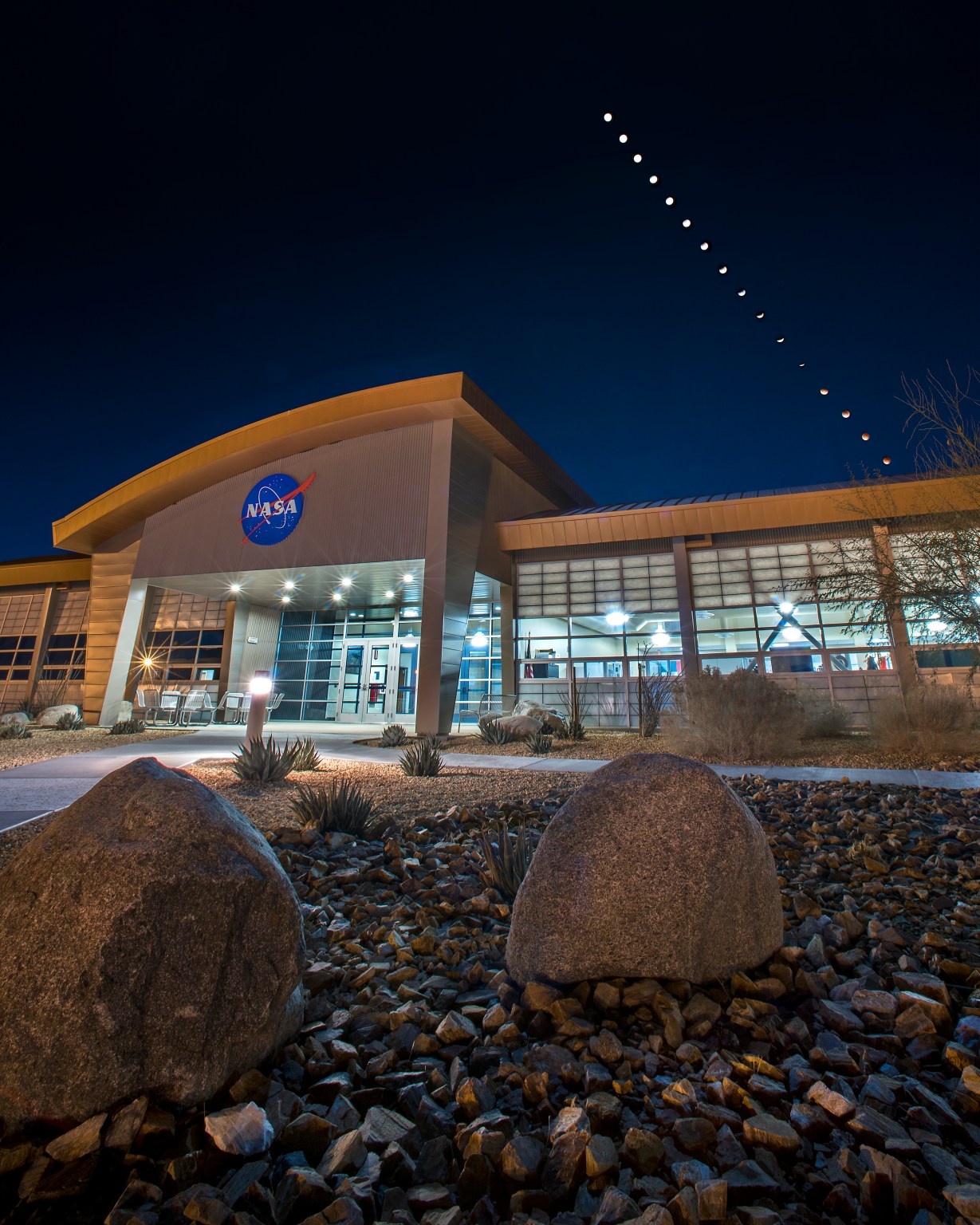
The Dr. Edward Stone Exploration Trail begins in front of the building where Stone served as JPL’s director.
NASA/JPL-Caltech

Launched in the summer of 1977, Voyager 1 and 2 have since traveled more than 15.4 billion and 12.9 billion miles (24 billion and 20 billion kilometers), respectively — farther than any other human-made object. The plaques trace their trajectories to Jupiter and Saturn as well as their diverging paths, with Voyager 2 heading toward Uranus and Neptune as Voyager 1 made a beeline for interstellar space. Other stops along the trail honor Stone’s work creating the W.M. Keck Observatory in 1985, his appointment as JPL’s director in 1991, and his being honored with the Distinguished Service Award 2013.

“To follow in the footsteps of Ed Stone is to walk the path of an extraordinary person who dedicated his time on Earth to reaching for the stars, and who paved the way for others to do the same,” said Laurie Leshin, director of JPL. “This trail is a testament to Ed’s bold curiosity, visionary leadership, and passion for science that have enabled us to explore farther into the cosmos than ever before. It’s also a reminder of his influence on so many of our endeavors to reach new frontiers in space.”

Embedded in the pavement, 24 additional plaques trace the approximate trajectories of the Voyager spacecraft. The shape and design language of the plaques evoke the design of the Gold Record.
NASA/JPL-Caltech

Blazing a Trail

Stone’s penchant for walking was one of the topics that came up when members of JPL’s Office of the Director, its DesignLab, and the Voyager team began discussing ways to honor his outsize contributions to JPL and science. From those initial brainstorming sessions came the question, “How can we do something to memorialize him at JPL that gets people to walk?” recalled DesignLab’s graphic manager, Lauren Shapiro.

The distances between the plaques are roughly proportional the distances between the events they highlight, and the team even tried to make flight trajectories of the probes as accurate as possible, given the challenges of avoiding buildings and the like.

Designer Kaelyn Richards relied on the Voyager Golden Record as a guide for the visual language. “I referenced a lot of old scientific diagrams that were made by artists in the ’70s and ’80s, and I used a solar system modeling program to show the exact position of the planets on the day that the ‘Pale Blue Dot’ was taken,” she said, referring to the plaque honoring the famous 1990 image Voyager 1 took of Earth from beyond Neptune.

“Everyone seemed to agree that Voyager was Ed Stone. Yes, he did so much more, but this was really his biggest legacy,” Shapiro said. “So we’re honoring both the mission and the person alongside each other. And they both, in a poetic way, have had very long, incredible lives.”

Voyager 1 and 2 both carry the Golden Record, a 12-inch gold-plated copper disk intended to communicate a story of our world to extraterrestrials with sounds and images that portray the diversity of life and culture on Earth.
NASA/JPL-Caltech

After retiring as Voyager’s project scientist, Stone returned to teaching and research at Caltech, which manages JPL for NASA.

Before attending the unveiling, Caltech President Thomas Rosenbaum said, “Ed was a whirlwind of activity. I have many good memories of running after Ed in the midst of conversation as he charged across campus. Ed’s ambition, drive, and vision were accompanied by his warmth, humility, and commitment to Caltech and our students. He served as a mentor for generations of scholars who have gone on to be leaders in their fields. He conveyed a curiosity and a thirst for discovery that inspired.”

Stone had joined the Caltech faculty as an assistant professor in 1967 and, from 1983 to 1988, chaired the Division of Physics, Mathematics and Astronomy. He went on to serve as vice president for astronomical facilities from 1988 to 1990 and as vice provost for special projects from 2004 to 2022. In 2023, Caltech established a new faculty position, the Edward C. Stone Professorship.

But there was another academic honor that Stone also cherished: the 2012 naming of the Edward Stone Middle School in his hometown of Burlington, Iowa. A short walk from the plaque marking that milestone is the final stop of the Exploration Trail, its simple inscription reading: “Ed Stone’s leadership and pursuit of scientific knowledge expanded humanity’s understanding of the universe. His legacy lives on through the Voyager mission, and the countless people he has inspired.”

News Media Contacts

Matthew Segal / Calla Cofield
Jet Propulsion Laboratory, Pasadena, Calif.
818-354-8307 / 626-808-2469
matthew.j.segal@jpl.nasa.gov / calla.e.cofield@jpl.nasa.gov

2024-165

Share

Details

Last Updated

Dec 06, 2024

Powered by WPeMatico

Get The Details…
Naomi Hartono

Orange Lava, Blue Lagoon

Orange Lava, Blue Lagoon

Lava cuts a jagged orange gash across a grayish landscape in this satellite view of Iceland's Reykjanes peninsula on Nov. 24, 2024. A plume of white smoke - gas - streams toward the bottom of the picture.
NASA/Michala Garrison, using Landsat data from the U.S. Geological Survey and VIIRS day-night band data from the Suomi National Polar-orbiting Partnership

Lava encroaches on the Blue Lagoon, a popular tourist destination in Iceland, in this Nov. 24, 2024, Landsat 9 image overlaid with an infrared signal. The infrared signal helps distinguish the lava’s heat signature.

A volcanic fissure burst open on Iceland’s Reykjanes peninsula four days prior, heralded by a series of earthquakes. A plume of gas, consisting primarily of sulfur dioxide, streamed from the lava. The Reykjanes peninsula eruption is the seventh in a series of events that began in December 2023.

Image credit: NASA/Michala Garrison, using Landsat data from the U.S. Geological Survey and VIIRS day-night band data from the Suomi National Polar-orbiting Partnership

Powered by WPeMatico

Get The Details…
Monika Luabeya

La NASA identifica causa de pérdida de material del escudo térmico de Orion de Artemis I

La NASA identifica causa de pérdida de material del escudo térmico de Orion de Artemis I

El 28 de junio de 2024, la nave espacial Orion de Artemis II es retirada de la Celda de Ensamblaje Final y Pruebas del Sistema (FAST, por sus siglas en inglés) y colocada en la cámara de altitud oeste dentro del Edificio de Operaciones y Revisión del Centro Espacial Kennedy de la NASA en Florida. Dentro de la cámara de altitud, la nave espacial se sometió a una serie de pruebas que simulaban las condiciones de vacío del espacio profundo.
Crédito de la foto: NASA / Rad Sinyak

Read this story in English here.

Tras extensos análisis y pruebas, la NASA ha identificado la causa técnica de la pérdida imprevista de material carbonizado en el escudo térmico de la nave espacial Orion de Artemis I.

Los ingenieros determinaron que, cuando Orion regresaba de su misión sin tripulación alrededor de la Luna, los gases generados dentro del material ablativo exterior del escudo térmico, denominado Avcoat, no pudieron ventilarse y disiparse como estaba previsto. Esto permitió que se acumulara presión y se produjeran grietas, lo que causó que parte del material carbonizado se desprendiera en varios lugares.

“Nuestros primeros vuelos de Artemis son una campaña de prueba, y el vuelo de prueba de Artemis I nos dio la oportunidad de comprobar nuestros sistemas en el entorno del espacio profundo antes de incorporar a la tripulación en futuras misiones”, dijo Amit Kshatriya, administrador asociado adjunto de la Oficina del programa De la Luna a Marte, en la sede de la NASA en Washington. “La investigación sobre el escudo térmico ayudó a garantizar que comprendiéramos completamente la causa y la naturaleza del problema, así como el riesgo que les pedimos a nuestras tripulaciones que asuman cuando emprendan su viaje a la Luna”.

Los hallazgos

Los equipos técnicos adoptaron un enfoque metódico para comprender e identificar el origen del problema de pérdida de material carbonizado, incluyendo el muestreo detallado del escudo térmico de Artemis I, la revisión de las imágenes y los datos de los sensores de la nave espacial, y pruebas y análisis exhaustivos en tierra.

Durante Artemis I, los ingenieros utilizaron la técnica de guiamiento de reentrada atmosférica doble para el regreso de Orion a la Tierra. Esta técnica ofrece más flexibilidad ya que amplía el alcance del vuelo de Orion después del punto de reentrada para llevarlo hasta un lugar de amerizaje en el océano Pacífico. Con esta maniobra, Orion se sumergió en la parte superior de la atmósfera de la Tierra y utilizó la resistencia atmosférica para reducir su velocidad. A continuación, Orion utilizó la sustentación aerodinámica de la cápsula para rebotar y salir de nuevo de la atmósfera, para luego volver a entrar en el descenso final con paracaídas para su amerizaje.

Utilizando los datos de la respuesta del material Avcoat de Artemis I, el equipo de investigación pudo simular el entorno de la trayectoria de entrada de Artemis I —una parte clave para comprender la causa del problema— dentro de la instalación de chorro en arco del Centro de Investigación Ames de la NASA en California. Observaron que, durante el período entre las inmersiones en la atmósfera, las tasas de calentamiento disminuyeron y la energía térmica se acumuló dentro del material Avcoat del escudo térmico. Esto condujo a la acumulación de gases que forman parte del proceso de ablación (desgaste) previsto. Debido a que el Avcoat no tenía “permeabilidad”, la presión interna se acumuló y produjo el agrietamiento y el desprendimiento desigual de la capa exterior.

Los equipos técnicos realizaron extensas pruebas en tierra para simular el fenómeno de rebote en la reentrada antes de la misión Artemis I. Sin embargo, hicieron pruebas a velocidades de calentamiento mucho más altas que las que la nave espacial experimentó durante su vuelo. Las altas velocidades de calentamiento puestas a prueba en tierra permitieron que el material carbonizado permeable se formara y se desgastara como estaba previsto, liberando la presión del gas. El calentamiento menos severo observado durante la reentrada real de Artemis I desaceleró el proceso de formación de material carbonizado, al tiempo que siguió creando gases en esta capa de material. La presión del gas se acumuló hasta el punto de agrietar el Avcoat y liberar partes de la capa carbonizada. Las mejoras recientes en la instalación de chorro en arco han permitido una reproducción más precisa de los entornos de vuelo registrados por Artemis I, de modo que este comportamiento de agrietamiento pudo demostrarse en pruebas en tierra.

Si bien Artemis I no estaba tripulado, los datos del vuelo mostraron que, si la tripulación hubiera estado a bordo, habría estado a salvo. Los datos de la temperatura de los sistemas del módulo de tripulación dentro de la cabina también estaban dentro de los límites y se mantenían estables, con temperaturas alrededor de los 24 grados centígrados (75 grados Fahrenheit). El desempeño del escudo térmico superó las expectativas.

Los ingenieros comprenden tanto el fenómeno material como el entorno con el que interactúan los materiales durante la entrada a la atmósfera. Al cambiar el material o el entorno, pueden predecir cómo responderá la nave espacial. Los equipos de la NASA acordaron por unanimidad que la agencia puede desarrollar un análisis de vuelo aceptable que mantenga a la tripulación segura utilizando el actual escudo térmico de Artemis II con cambios operativos para su entrada en la atmósfera.

El proceso de investigación de la NASA

Poco después de que los ingenieros de la NASA descubrieran las condiciones del escudo térmico de Artemis I, la agencia comenzó un extenso proceso de investigación, el cual contó con un equipo multidisciplinario de expertos en sistemas de protección térmica, aerotermodinámica, pruebas y análisis térmicos, análisis de estrés (fatiga de materiales), pruebas y análisis de materiales, y muchos otros campos técnicos relacionados. El Centro de Ingeniería y Seguridad de la NASA también participó para aportar su experiencia técnica, incluyendo evaluación no destructiva, análisis térmico y estructural, análisis de árbol de fallas y otros métodos de respaldo de las pruebas.

“Nos tomamos muy en serio nuestro proceso de investigación del escudo térmico, con la seguridad de la tripulación como la fuerza impulsora que mueve esta investigación”, dijo Howard Hu, gerente del Programa Orion del Centro Espacial Johnson de la NASA en Houston. “El proceso fue extenso. Le dimos al equipo el tiempo necesario para investigar todas las causas posibles, y trabajaron incansablemente para asegurarse de que entendiéramos el fenómeno y los pasos necesarios para mitigar este problema en futuras misiones”.

El escudo térmico de Artemis I estaba muy cargado de instrumentos para este vuelo, e incluía sensores de presión, extensómetros y termopares a diferentes profundidades del material ablativo. Los datos de estos instrumentos acrecentaron el análisis de muestras físicas, lo que permitió al equipo validar modelos informáticos, crear reconstrucciones de entornos, proporcionar perfiles de temperatura interna y dar información sobre el momento de la pérdida de material carbonizado.

Alrededor de 200 muestras de Avcoat fueron extraídas del escudo térmico de Artemis I en el Centro de Vuelo Espacial Marshall de la NASA en Alabama para su análisis e inspección. El equipo llevó a cabo una evaluación no destructiva para “ver” dentro del escudo térmico.

Uno de los hallazgos más importantes que arrojó el examen de estas muestras fue que algunas superficies en la zona del Avcoat permeable, las cuales habían sido identificadas antes del vuelo, no sufrieron agrietamiento ni pérdida de material carbonizado. Dado que estas superficies eran permeables al comienzo de la entrada en la atmósfera, los gases producidos por la ablación pudieron ventilarse adecuadamente, eliminando la acumulación de la presión, el agrietamiento y la pérdida de material carbonizado.

Los ingenieros hicieron ocho campañas separadas de pruebas térmicas posteriores al vuelo para respaldar el análisis del origen de estas condiciones, y completaron 121 pruebas individuales. Estas pruebas fueron llevadas a cabo en instalaciones en diferentes lugares de Estados Unidos que cuentan con capacidades únicas, entre ellas: la Instalación de Calentamiento Aerodinámico en el Complejo de Chorro en Arco del centro Ames, para poner a prueba perfiles de calentamiento convectivo con diversos gases de prueba; el Laboratorio de Evaluación de Materiales Endurecidos por Láser en la Base de la Fuerza Aérea Patterson-Wright en Ohio, con el fin de poner a prueba perfiles de calentamiento radiativo y proporcionar radiografías en tiempo real; y la Instalación de Calentamiento por Interacción del centro Ames, para poner a prueba perfiles combinados de calentamiento convectivo y radiativo en el aire en bloques completos, esto es, aplicando todas las pruebas en cada bloque de material.

Los expertos en aerotermia también completaron dos campañas de pruebas en el túnel de viento hipersónico del Centro de Investigación Langley de la NASA en Virginia y en las instalaciones de pruebas aerodinámicas del CUBRC en Buffalo, Nueva York, para realizar pruebas con una diversidad de configuraciones de pérdida de material carbonizado, y mejorar y validar los modelos analíticos. También se realizaron pruebas de permeabilidad en el centro Kratos en Alabama, en la Universidad de Kentucky y en el centro Ames para caracterizar aún mejor el volumen elemental y la porosidad del Avcoat. La instalación de pruebas del centro de investigaciones Advanced Light Source, una instalación para usuarios científicos del Departamento de Energía de Estados Unidos en el Laboratorio Nacional Lawrence Berkeley, también fue utilizada por los ingenieros para examinar el comportamiento del calentamiento del Avcoat a nivel microestructural.

En la primavera de 2024, la NASA creó un equipo de revisión independiente que realizó una revisión exhaustiva del proceso de investigación, los hallazgos y los resultados de la agencia. La revisión independiente fue dirigida por Paul Hill, un exdirectivo de la NASA que se desempeñó como director principal de vuelo del transbordador espacial para el programa Return to Flight (Regreso a los vuelos) después del accidente del Columbia, quien también dirigió la Dirección de Operaciones de Misiones de la NASA y es miembro actual del Panel Asesor de Seguridad Aeroespacial de la agencia. La revisión se llevó a cabo durante un período de tres meses a fin de evaluar las condiciones del escudo térmico posteriores al vuelo, los datos del entorno para la entrada a la atmósfera, la respuesta térmica del material ablativo y el avance de las investigaciones de la NASA. El equipo de revisión estuvo de acuerdo con los hallazgos de la NASA sobre la causa técnica del comportamiento físico del escudo térmico.

Avances en el escudo térmico

Al saber que la permeabilidad de Avcoat es un parámetro clave para evitar o minimizar la pérdida de material carbonizado, la NASA tiene la información correcta para garantizar la seguridad de la tripulación y mejorar el desempeño de los futuros escudos térmicos del programa Artemis. A lo largo de su historia, la NASA ha aprendido de cada uno de sus vuelos e incorporado mejoras en el hardware y las operaciones. Los datos recopilados a lo largo del vuelo de prueba de Artemis I han proporcionado a los ingenieros información valiosísima para guiar futuros diseños y refinamientos. Los datos de desempeño del vuelo de retorno lunar y un sólido programa de calificación de pruebas en tierra, mejorado después de la experiencia del vuelo de Artemis I, están respaldando las mejoras en la producción del escudo térmico de Orion. Los futuros escudos térmicos para el regreso de Orion en las misiones de alunizaje de Artemis están en producción para lograr una uniformidad y permeabilidad consistente. El programa de calificación se está completando actualmente, junto con la producción de bloques de Avcoat más permeables, en la Instalación de Ensamblaje Michoud de la NASA en Nueva Orleans.

Para obtener más información sobre las campañas Artemis de la NASA, visita el sitio web (en inglés):

https://www.nasa.gov/artemis

-fin-

Meira Bernstein / Rachel Kraft / María José Viñas
Sede, Washington
202-358-1600
meira.b.bernstein@nasa.gov / rachel.h.kraft@nasa.gov / maria-jose.vinasgarcia@nasa.gov

Powered by WPeMatico

Get The Details…
Erika Peters

NASA’s IXPE Details Shapes of Structures at Newly Discovered Black Hole

NASA’s IXPE Details Shapes of Structures at Newly Discovered Black Hole

5 min read

Preparations for Next Moonwalk Simulations Underway (and Underwater)

NASA’s IXPE (Imaging X-ray Polarimetry Explorer) has helped astronomers better understand the shapes of structures essential to a black hole – specifically, the disk of material swirling around it, and the shifting plasma region called the corona.

The stellar-mass black hole, part of the binary system Swift J1727.8-1613, was discovered in the summer of 2023 during an unusual brightening event that briefly caused it to outshine nearly all other X-ray sources. It is the first of its kind to be observed by IXPE as it goes through the start, peak, and conclusion of an X-ray outburst like this.

This illustration shows NASA’s Imaging X-ray Polarimetry Explorer (IXPE) spacecraft, at lower left, observing the newly discovered binary system Swift J1727.8-1613 from a distance. At the center is a black hole surrounded by an accretion disk, shown in yellow and orange, and a hot, shifting corona, shown in blue. The black hole is siphoning off gas from its companion star, seen behind the black hole as an orange disk. Jets of fast-moving, superheated particles stream from both poles of the black hole.
This illustration shows NASA’s Imaging X-ray Polarimetry Explorer (IXPE) spacecraft, at lower left, observing the newly discovered binary system Swift J1727.8-1613 from a distance. At the center is a black hole surrounded by an accretion disk, shown in yellow and orange, and a hot, shifting corona, shown in blue. The black hole is siphoning off gas from its companion star, seen behind the black hole as a red sphere. Jets of fast-moving, superheated particles stream from both poles of the black hole.
Credit: Marie Novotná

Swift J1727 is the subject of a series of new studies published in The Astrophysical Journal and Astronomy & Astrophysics. Scientists say the findings provide new insight into the behavior and evolution of black hole X-ray binary systems.

“This outburst evolved incredibly quickly,” said astrophysicist Alexandra Veledina, a permanent researcher at the University of Turku, Finland. “From our first detection of the outburst, it took Swift J1727 just days to peak. By then, IXPE and numerous other telescopes and instruments were already collecting data. It was exhilarating to observe the outburst all the way through its return to inactivity.”

Until late 2023, Swift J1727 briefly remained brighter than the Crab Nebula, the standard X-ray “candle” used to provide a baseline for units of X-ray brightness. Such outbursts are not unusual among binary star systems, but rarely do they occur so brightly and so close to home – just 8,800 light years from Earth. The binary system was named in honor of the Swift Gamma-ray Burst Mission which initially detected the outburst with its Burst Alert Telescope on Aug. 24, 2023, resulting in the discovery of the black hole.

X-ray binary systems typically include two close-proximity stars at different stages of their lifecycle. When the elder star runs out of fuel, it explodes in a supernova, leaving behind a neutron star, white dwarf, or black hole. In the case of Swift J1727, the powerful gravity of the resulting black hole stripped material from its companion star, heating the material to more than 1.8 million degrees Fahrenheit and producing a vast outpouring of X-rays. This matter formed an accretion disk and can include a superheated corona. At the poles of the black hole, matter also can escape from the binary system in the form of relativistic jets.

IXPE, which has helped NASA and researchers study all these phenomena, specializes in X-ray polarization, the characteristic of light that helps map the shape and structure of such ultra-powerful energy sources, illuminating their inner workings even when they’re too distant for us to see directly.

Because light itself can’t escape their gravity, we can’t see black holes. We can only observe what is happening around them and draw conclusions about the mechanisms and processes that occur there. IXPE is crucial to that work.

Alexandra Veledina

Alexandra Veledina

NASA Astrophysicist

“Because light itself can’t escape their gravity, we can’t see black holes,” Veledina said. “We can only observe what is happening around them and draw conclusions about the mechanisms and processes that occur there. IXPE is crucial to that work.”

Two of the IXPE-based studies of Swift J1727, led by Veledina and Adam Ingram, a researcher at Newcastle University in Newcastle-upon-Tyne, England, focused on the first phases of the outburst. During the brief period of months when the source became exceptionally bright, the corona was the main source of observed X-ray radiation.

“IXPE documented polarization of X-ray radiation traveling along the estimated direction of the black hole jet, hence the hot plasma is extended in the accretion disk plane,” Veledina said. “Similar findings were reported in the persistent black hole binary Cygnus X-1, so this finding helps verify that the geometry is the same among short-lived eruptive systems.”

The team further monitored how polarization values changed during Swift J1727’s peak outburst. Those conclusions matched findings simultaneously obtained during studies of other energy bands of electromagnetic radiation.

A third and a fourth study, led by researchers Jiří Svoboda and Jakub Podgorný, both of the Czech Academy of Sciences in Prague, focused on X-ray polarization at the second part of the Swift J1727’s outburst and its return to a highly energetic state several months later. For Podgorný’s previous efforts using IXPE data and black hole simulations, he recently was awarded the Czech Republic’s top national prize for a Ph.D. thesis in the natural sciences.

The polarization data indicated that the geometry of the corona did not change significantly between the beginning and the end of the outburst, even though the system evolved in the meantime and the X-ray brightness dropped dramatically in the later energetic state.

The results represent a significant step forward in our understanding of the changing shapes and structures of accretion disk, corona, and related structures at black holes in general. The study also demonstrates IXPE’s value as a tool for determining how all these elements of the system are connected, as well as its potential to collaborate with other observatories to monitor sudden, dramatic changes in the cosmos.

“Further observations of matter near black holes in binary systems are needed, but the successful first observing campaign of Swift J1727.8–1613 in different states is the best start of a new chapter we could imagine,” said Michal Dovčiak, co-author of the series of papers and leader of the IXPE working group on stellar-mass black holes, who also conducts research at the Czech Academy of Sciences.

More about IXPE

IXPE, which continues to provide unprecedented data enabling groundbreaking discoveries about celestial objects across the universe, is a joint NASA and Italian Space Agency mission with partners and science collaborators in 12 countries. IXPE is led by NASA’s Marshall Space Flight Center in Huntsville, Alabama. Ball Aerospace, headquartered in Broomfield, Colorado, manages spacecraft operations together with the University of Colorado’s Laboratory for Atmospheric and Space Physics in Boulder.

Learn more about IXPE’s ongoing mission here:

https://www.nasa.gov/ixpe

Elizabeth Landau
NASA Headquarters
elizabeth.r.landau@nasa.gov
202-358-0845

Lane Figueroa
NASA’s Marshall Space Flight Center
256-544-0034
lane.e.figueroa@nasa.gov

Powered by WPeMatico

Get The Details…
Beth Ridgeway

NASA, USAID Launch SERVIR Central American Hub

NASA, USAID Launch SERVIR Central American Hub

3 min read

Preparations for Next Moonwalk Simulations Underway (and Underwater)

A group of people in a conference room sit in chairs looking at the speaker with the image of the Earth from space behind them.
U.S. Ambassador to El Salvador, William H. Duncan, speaks to attendees at the SERVIR Central America launch in San Salvador.
SERVIR

SERVIR, NASA’s flagship partnership with the U.S. Agency for International Development (USAID), launched a new regional center, or hub, in Central America on Dec. 3. The new hub is in partnership with the Tropical Agricultural Research and Higher Education Center in Turrialba, Costa Rica, and is supported by the USAID Central America and Mexico Regional Program. The launch event took place in San Salvador, El Salvador.

The event introduced guests to the structure and mission of the new hub, featuring remarks from SERVIR Global Program Manager Dan Irwin and video overviews of some of its planned projects. Karen St Germain, director of NASA’s Earth Science Division and U.S. Ambassador to El Salvador, William H. Duncan, provided recorded remarks congratulating the new program.  

Central America holds a special place in SERVIR’s history. Over three decades ago, Dan Irwin, research scientist at NASA’s Marshall Space Flight Center in Huntsville, Alabama, and SERVIR’s founder and Global Program Manager, was working in Guatemala to use satellite data to map a new forest reserve. During this time, Irwin met with representatives from Central American environmental ministries to demonstrate how NASA Earth data could help to address environmental challenges and reduce disaster risk.

“In this meeting, I realized that NASA has a vast library of Earth data, but this information wasn’t being used by experts across the globe who have the best understanding of local development issues. I wanted to find a way to bridge that gap,” Irwin shared.

Under Irwin’s leadership, NASA and USAID partnered to create the SERVIR program, which was formally established in 2005. SERVIR’s mission is to “connect space to village,” increasing global access to NASA Earth data to support locally led environmental and development efforts.

An older bald man with a black suit and red tie gestures at the photo of the Earth behind him.
SERVIR Global Program Manager Dan Irwin from NASA’s Marshall Space Flight Center speaks about the history of the SERVIR program at the Central America launch in San Salvador.
SERVIR

SERVIR soon expanded its partnerships across the globe, with regional hubs in South America, Asia, and Africa.

SERVIR Central America will work to serve more than 40 million people throughout the region, collaborating with governments, universities, and civil society organizations to support existing natural resource management and development decision-making. The hub will support resilience against environmental challenges including  hurricanes, droughts, deforestation, and biodiversity loss.

SERVIR Central America will also strengthen the region’s technical capacity to use Earth observations and promote opportunities in science, technology, engineering, and math. The hub will expand the use of geospatial technology by young people and other groups with limited access to these tools.

“The launch of SERVIR Central America marks a milestone in the collaboration between space-based technology and Central America’s local needs,” said Irwin. “This initiative represents NASA and USAID’s commitment to putting advanced technology at the service of the region.”

To learn more about SERVIR, visit:

https://www.nasa.gov/servir

Elizabeth Vlock
Headquarters, Washington
202-358-1600
elizabeth.a.vlock@nasa.gov

Lane Figueroa
Huntsville, Alabama
256.544.0034
lane.e.figueroa@nasa.gov

Powered by WPeMatico

Get The Details…
Beth Ridgeway