NASA Invites Media to International Observe the Moon Night
NASA will host an International Observe the Moon Night celebration from 5:30 to 8 p.m. CST on Saturday, Sept. 19, at the U.S. Space & Rocket Center, the official visitor center for NASA’s Marshall Space Flight Center in Huntsville, Alabama.
International Observe the Moon Night celebrates the Moon, the science behind it, and its connection to space exploration and human culture. NASA’s free public event will include agency experts delivering talks on lunar science and exploration and highlighting lunar observations made by the Artemis II crew in April.
Media interested in covering the event should confirm their attendance with Joel Wallace, joel.w.wallace@nasa.gov, in the NASA Marshall newsroom by 3 p.m., Friday, Sept. 18. Media must report to the Davidson Center to participate in the event. Visitor parking is available at the U.S. Space & Rocket Center.
NASA will have opportunities for media to capture visuals and interview agency experts. Activities available for coverage include hands-on STEM activities, a science stage show, an event photo booth, and face-painting.
The event also features Janet Ivey, the host of the television children’s series, “Janet’s Planet.” The Von Braun Astronomical Society will be on-site with telescopes, providing attendees with guided tours of the Moon, planets, and other celestial objects.
The evening is presented by the Planetary Missions Program Office at NASA Marshall.
For more information about International Observe the Moon Night, visit:
Celebrate International Observe the Moon Night with NASA
In April, the world watched as four humans circled the Moon for the first time in over 50 years with NASA’s Artemis II mission. On Saturday, Sept. 19, the public is invited to look up again with NASA events across the country, including the International Observe the Moon Night celebration held at NASA’s Goddard Space Flight Center Visitor Center in Greenbelt, Maryland.
This year, NASA will celebrate International Observe the Moon Night with people around the world on Sept. 19.
NASA/Vi Nguyen
International Observe the Moon Night is an annual celebration that brings people together to learn about the Moon and explore our connection to Earth’s nearest celestial neighbor. Since the program began in 2010, people around the world have participated through lunar observations, hands-on activities, artwork, music, and more.
At NASA Goddard, this year’s celebration will highlight the agency’s ongoing exploration of the Moon, including the historic Artemis II mission. Visitors can peer behind the scenes to learn more about what it took to make Artemis II’s journey around the Moon a success and discover how Goddard scientists and engineers are helping advance our understanding of the Moon, solar system, and beyond.
The event will run from 6 p.m. to 9 p.m. EDT.
Throughout the event at NASA Goddard, visitors can take part in interactive hands-on activities, create artwork and crafts, and capture selfies at a photo kiosk. Telescopes will also be set up outside (depending on weather), giving attendees an opportunity to observe the Moon and other astronomical objects up close. Inside the Visitor Center, guests can even see a real Apollo 14 Moon rock on display.
At 6:30 p.m., Dr. Amanda Nahm, planetary scientist at NASA Headquarters, will explore the lunar science and Moon joy from Artemis II.
At 7:30 p.m., Ernie Wright, scientific visualizer at NASA Goddard, will offer a more technical look at how scientists use real data to create videos and visualizations of the Moon.
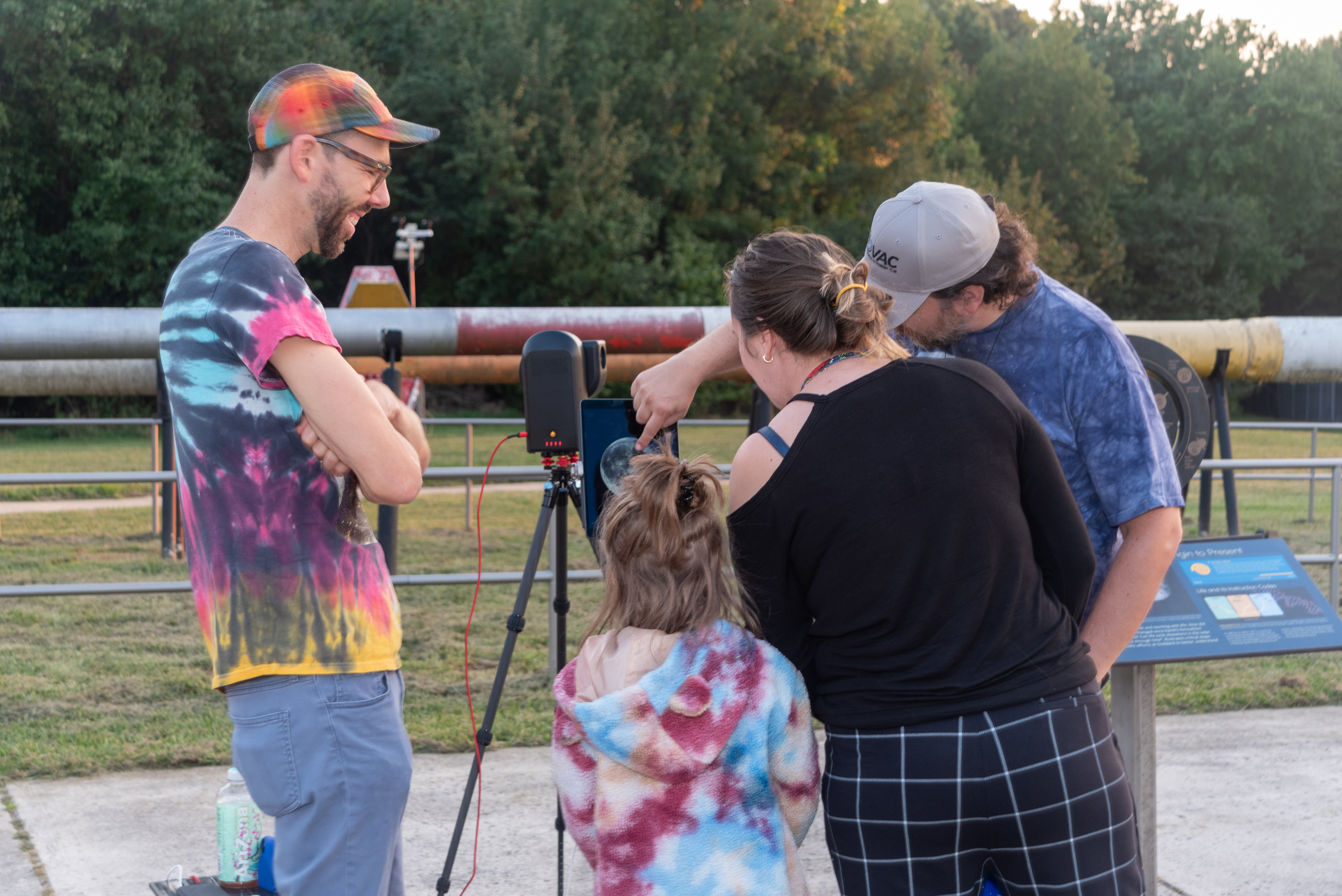
A family observes the Moon through a telescope at NASA’s Goddard Space Flight Center in Greenbelt, Md. during the International Observe the Moon Night celebration on Saturday, Sept. 14, 2024.
NASA/Britt Griswold
The event will also offer a chance to learn more about the groundbreaking research happening at NASA Goddard as scientists work to unlock the secrets of the Moon with missions like the Lunar Reconnaissance Orbiter (LRO) and explore our solar system and the universe beyond.
International Observe the Moon Night at Goddard is free and family friendly. Registration is not required, although registering in advance will help the Visitor Center team plan for the event. The event will take place rain or shine, and free parking is available at the Visitor Center.
For people who cannot travel to Greenbelt, there are opportunities to participate in International Observe the Moon Night from all around the planet. Join lunar observers around the world by observing the Moon with friends and family, attending a virtual event or finding an event in your area. Learn more and register your participation at go.nasa.gov/ObserveTheMoon.
International Observe the Moon Night is sponsored by NASA’s LRO mission and the Solar System Exploration Division of NASA’s Goddard Space Flight Center, with support from many partners. The celebration is a way for people to pause and look up at our future destination, as NASA prepares for deep space missions to the Moon and beyond.
Artemis III Crew Visits NASA Kennedy’s Vehicle Assembly Building
NASA/Kim Shiflett
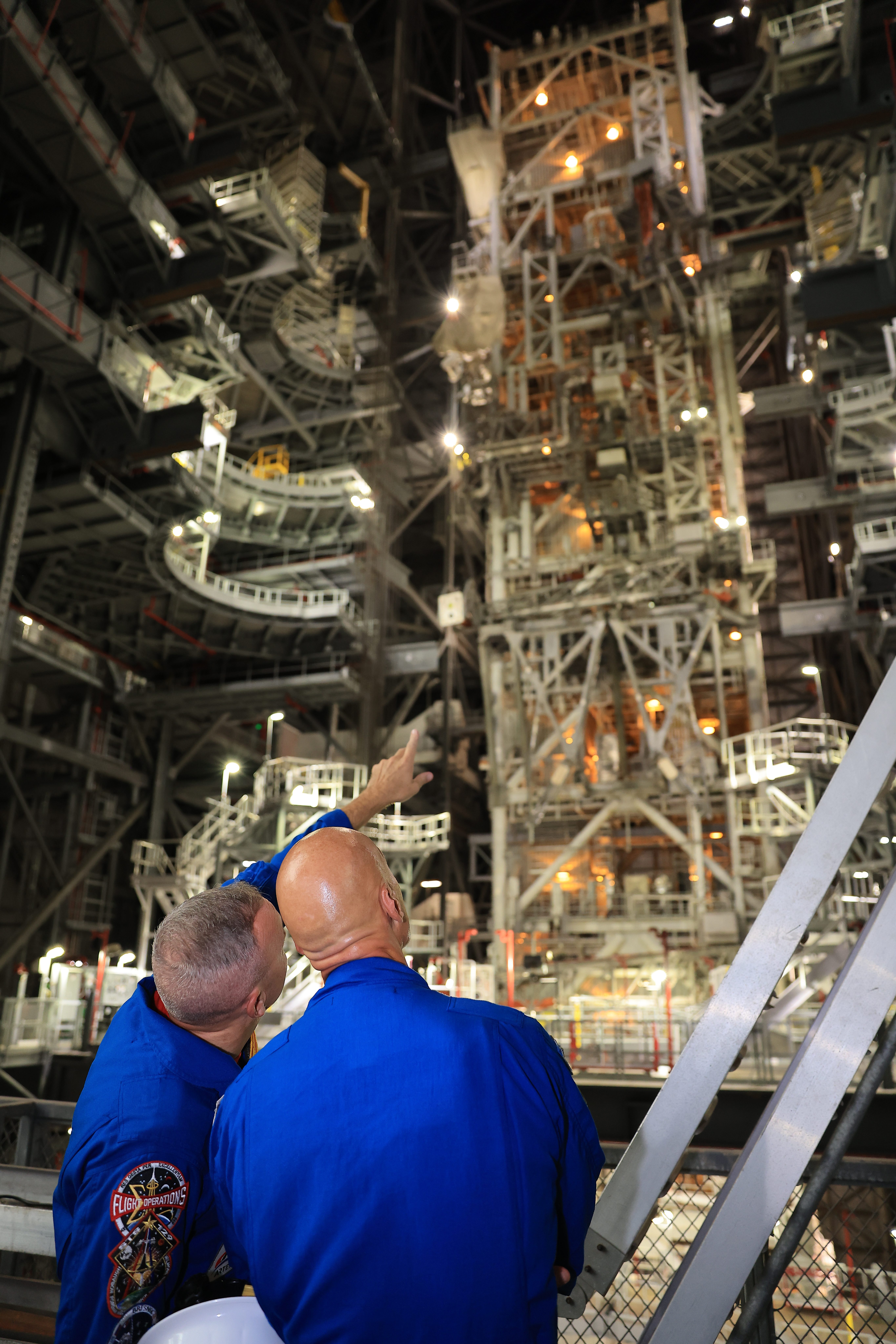
NASA astronaut Randy Bresnik (left) and ESA (European Space Agency) astronaut Luca Parmitano view progress on the solid rocket booster integration in High Bay 3 inside the Vehicle Assembly Building at NASA’s Kennedy Space Center in Florida on Wednesday, Sept. 2, 2026.
Bresnik, Parmitano, and NASA astronauts Andre Douglas, Frank Rubio, and Bob Hines made the first visit to Kennedy by the entire crew and backup crew members of the Artemis III mission. Artemis III will launch four crew members aboard the Orion spacecraft to carry out a series of objectives in low Earth orbit designed to demonstrate critical systems needed for future lunar landings, beginning with Artemis IV.
NASA’s Webb Reveals Dynamic Panorama of Star Formation
5 Min Read
NASA’s Webb Reveals Dynamic Panorama of Star Formation
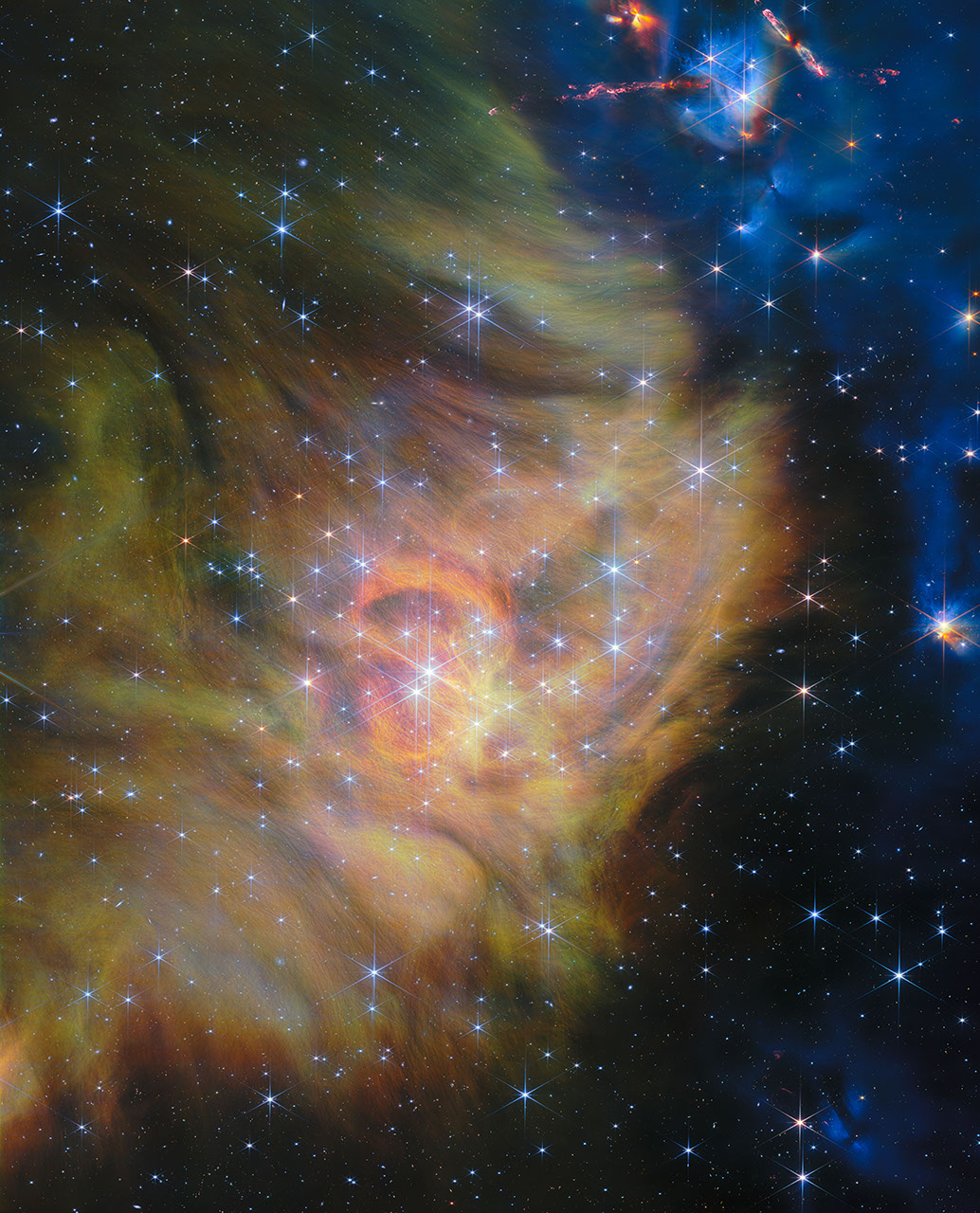
NASA’s James Webb Space Telescope recently observed IC 348, a star-forming region just 1,000 light-years away from Earth. Webb’s sharp vision revealed tiny brown dwarfs, some just twice Jupiter’s mass, and young stars ejecting powerful jets crashing into surrounding gas and dust.
Credits: Image: NASA, ESA, CSA, Kevin Luhman (PSU), Catarina Alves de Oliveira (ESA), Mahdi Zamani (ESA/Webb)
This starry view of the nearby star-forming region IC 348 is one of the largest images released to date from NASA’s James Webb Space Telescope. Using Webb, astronomers searched IC 348 for brown dwarfs, which are less massive than the smallest stars. The researchers discovered brown dwarfs just twice the mass of Jupiter, bringing the study of these curious objects into a new mass range and revealing new insights about the star formation process.
The star-forming region IC 348 is located just 1,000 light-years away in the constellation Perseus. In regions like IC 348, cold clouds of molecular hydrogen gas collapse to form new stars, creating glowing, sculpted scenes like this one. The star-formation process can create widely varied objects, from massive stars that expire after only a few million years in core-collapse supernova explosions to the smallest and most common stars, which are long lived and produce powerful stellar storms.
IC 348 (NIRCam Image)
NASA’s James Webb Space Telescope recently observed IC 348, a star-forming region just 1,000 light-years away from Earth. Webb’s sharp vision revealed tiny brown dwarfs, some just twice Jupiter’s mass, and young stars ejecting powerful jets crashing into surrounding gas and dust.
Image: NASA, ESA, CSA, Kevin Luhman (PSU), Catarina Alves de Oliveira (ESA), Mahdi Zamani (ESA/Webb)
The smallest stars weigh in at around 8 percent of the Sun’s mass. Below this mass lies a strange class of objects called brown dwarfs. Brown dwarfs form in the same way stars do, through the collapse of molecular clouds. However, unlike stars, the cores of brown dwarfs never become hot enough to fuse ordinary hydrogen into helium (though many briefly fuse deuterium, or heavy hydrogen, early in their lives).
What’s still not clear, and what researchers hoped to learn by using Webb’s sensitive instruments to study IC 348, is how small the smallest objects created by the star-formation process are. In other words, how small is the smallest brown dwarf?
The team used Webb’s NIRCam (Near-Infrared Camera) in 2024 to capture the warm glow of young brown dwarfs and newborn stars seen in this new image of IC 348. After selecting candidate brown dwarfs based on their colors and brightness, they followed up with Webb’s NIRSpec (Near-Infrared Spectrograph) in 2025 to conduct spectroscopic observations to study the masses of the brown dwarfs.
These deep Webb observations revealed something remarkable to the researchers: brown dwarfs with masses as low as just twice the mass of Jupiter or only 0.19 percent of the Sun’s mass — far smaller than theory predicts brown dwarfs should be. These are the least massive brown dwarfs known and their existence poses a challenge to models of how stars form.
In addition to the discovery of these unexpectedly lightweight brown dwarfs, the Webb observations contained even more surprises. One of the lightest newfound brown dwarfs showed signs of a disk, suggesting that small planets could be forming around an object that is itself only the mass of a planet.
While inspecting the spectra of IC 348’s brown dwarfs, the research team also found a feature they attributed to an unidentified hydrocarbon — molecules made only of hydrogen and carbon atoms. This specific feature has only been seen in the atmospheres of the lowest-mass brown dwarfs, suggesting that these extreme objects might exist in a spectral class of their own.
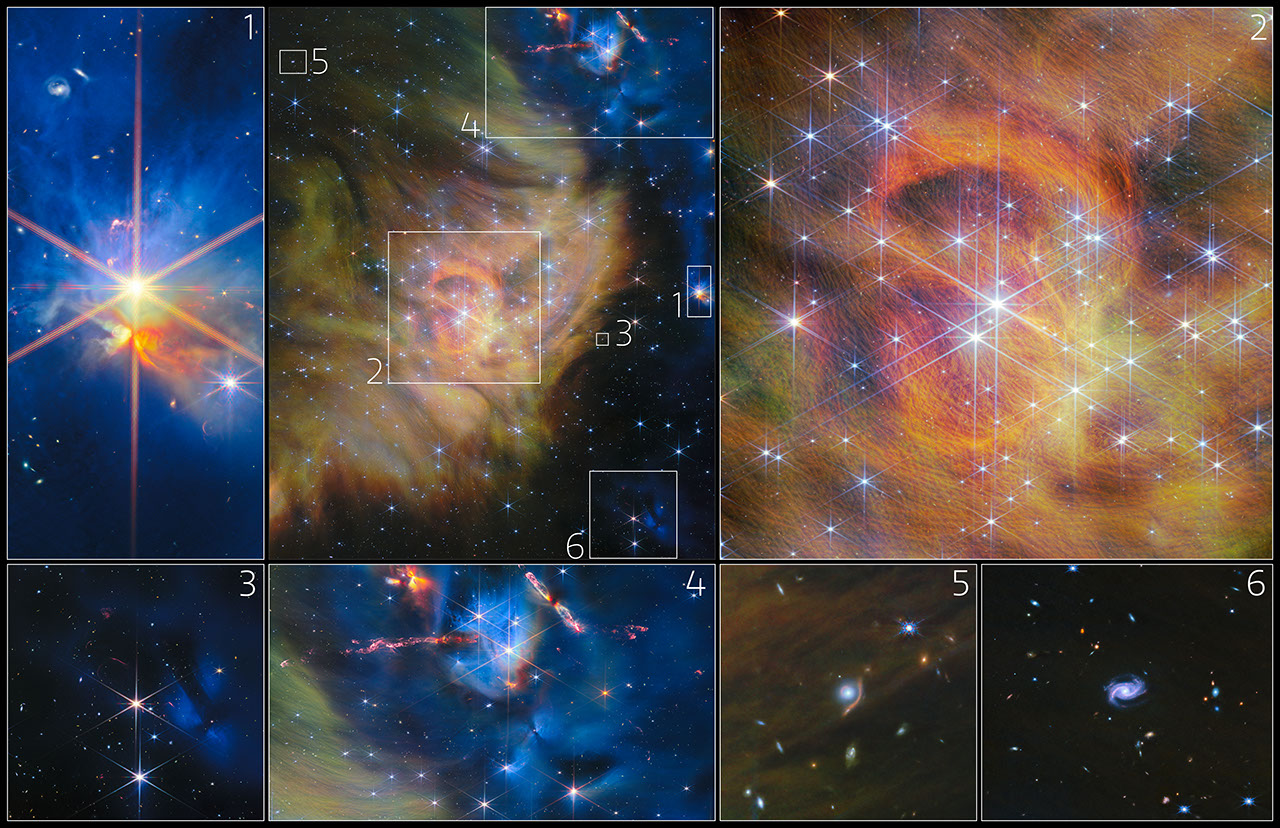
The stars and brown dwarfs of IC 348 aren’t the only attractions in this image. A brilliantly detailed collection of protostars occupies the upper right corner. Several of these protostars are accompanied by Herbig-Haro objects, which are luminous regions that form when jets from growing newborn stars crash into the gas and dust around the star.
The long, narrow feature that is oriented horizontally in this corner is the Herbig-Haro object HH 797. Upon close inspection, this source is revealed to be two protostars with nearly parallel outflows. Just to the right of HH 797 is the propeller-shaped source HH 211, which features both narrow jets and broader outflows.
IC 348 Collage
This collage features a collection of insets from NASA’s James Webb Space Telescope’s image of star-forming region IC 348: embedded stars, a central star cluster, faint outflows, Herbig-Haro objects, gravitational lensing, and spiral galaxies.
Image: NASA, ESA, CSA, Kevin Luhman (PSU), Catarina Alves de Oliveira (ESA), Mahdi Zamani (ESA/Webb)
The data used to create this image comes from the Webb General Observer Program 4866. In addition to studying the lowest-mass objects created through the star-formation process, this program also seeks to understand how the populations of planetary-mass objects like brown dwarfs vary between star-forming regions, as well as the origins of the hydrocarbon feature in the lowest-mass brown dwarfs.
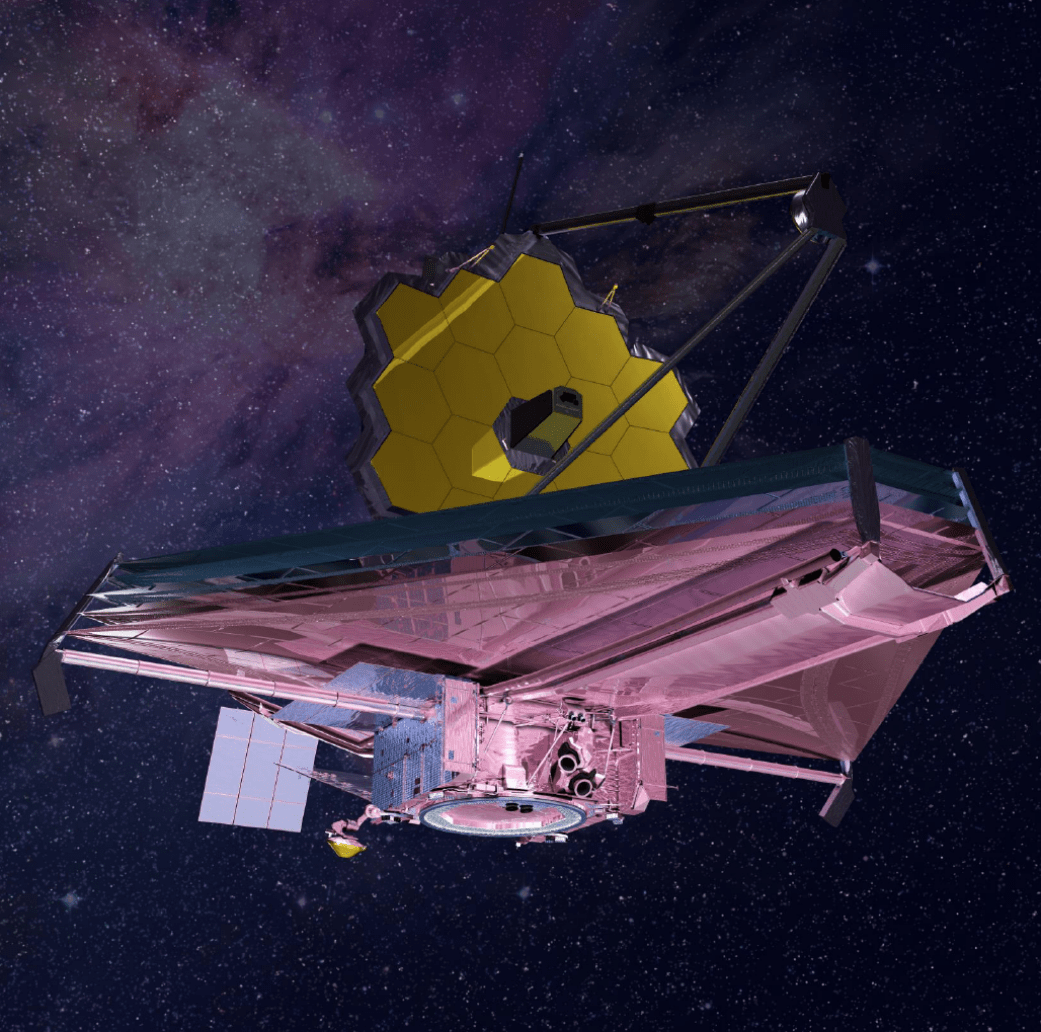
The James Webb Space Telescope is the world’s premier space science observatory. Webb is solving mysteries in our solar system, looking beyond to distant worlds around other stars, and probing the mysterious structures and origins of our universe and our place in it. Webb is an international program led by NASA with its partners, ESA (European Space Agency) and CSA (Canadian Space Agency).
The following sections contain links to download this article’s images and videos in all available resolutions followed by related information links, media contacts, and if available, research paper and Spanish translation links.
Related Images & Videos
IC 348 (NIRCam Image)
NASA’s James Webb Space Telescope recently observed IC 348, a star-forming region just 1,000 light-years away from Earth. Webb’s sharp vision revealed tiny brown dwarfs, some just twice Jupiter’s mass, and young stars ejecting powerful jets crashing into surrounding gas and dust.
IC 348 Collage
This collage features a collection of insets from NASA’s James Webb Space Telescope’s image of star-forming region IC 348: embedded stars, a central star cluster, faint outflows, Herbig-Haro objects, gravitational lensing, and spiral galaxies.
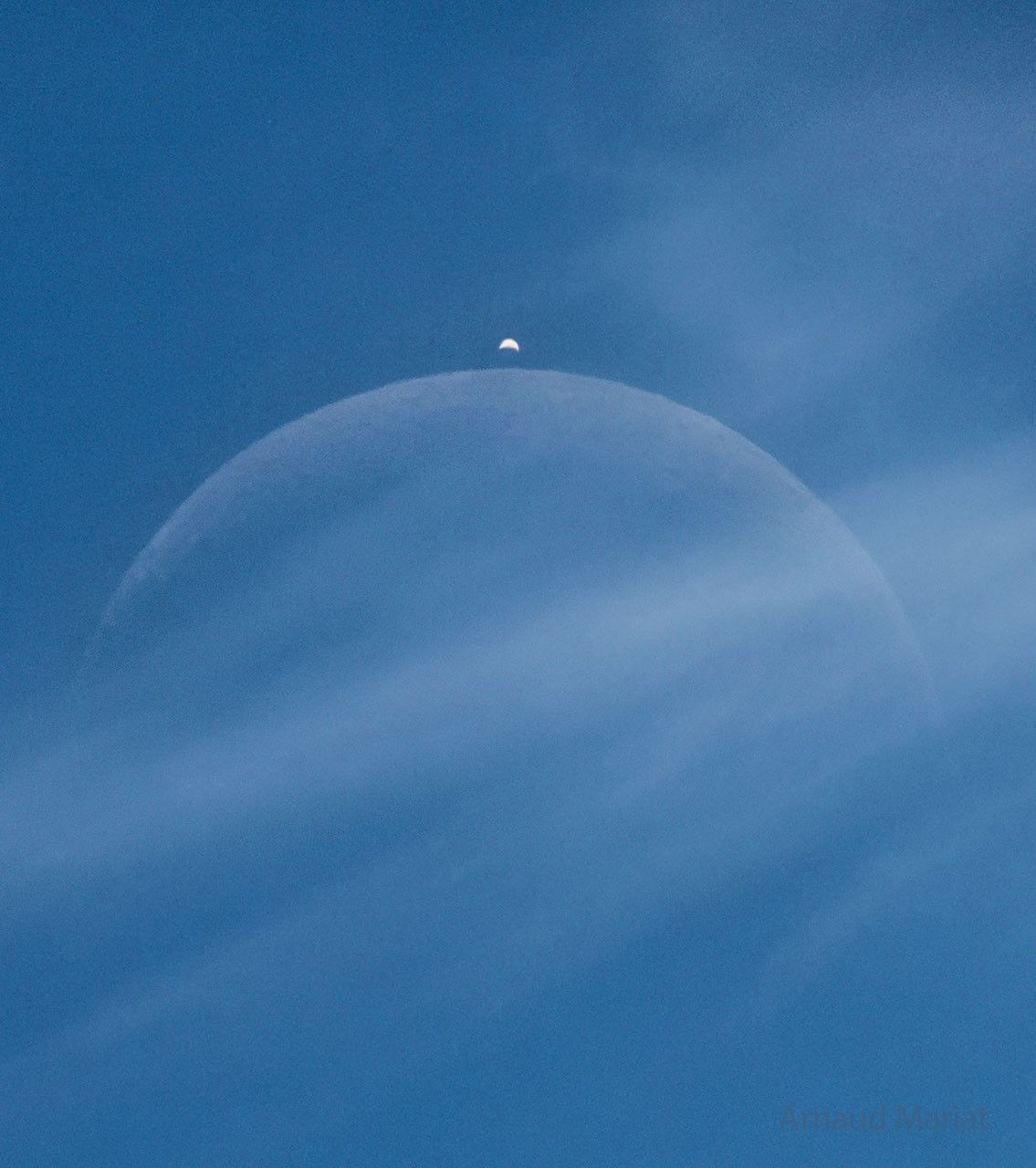
APOD: 2026 September 15 – A Daytime Eclipse: Moon Occults Venus
APOD
Astronomy Picture of the Day
Discover the cosmos! Each day a different image or photograph of our fascinating universe is featured, along with a brief explanation written by a professional astronomer.
A Daytime Eclipse: Moon Occults Venus
There was something behind the clouds. Upon close inspection, it was the Moon, which was hard to see yesterday around noon above the small village of Cessy, France. But soon, it was not only the Moon. As expected, a bright dot suddenly appeared from behind the Moon — the planet Venus far in the distance. Captured in the single featured exposure, both appeared to show a crescent phase. The Moon’s crescent was quite slight — with only about 10 percent of its face illuminated by the Sun. In contrast, Venus’s crescent was more full — showing about 25 percent illumination. Venus appeared brighter because it is nearer the Sun and because its clouds are more reflective than the dark lunar surface. An occultation of Venus by the Moon is visible to only about 10 percent of the Earth, but in yesterday’s event even most of that was experiencing daytime.