


Microbiology DNA and Chemistry for Health Insights Tops Research Schedule
Microbiology dominated the research schedule aboard the International Space Station on Thursday helping doctors protect health on Earth and in space. The Expedition 74 crew also tested a new spacesuit, packed a U.S. cargo spacecraft, and kept up lab maintenance throughout the orbital outpost.
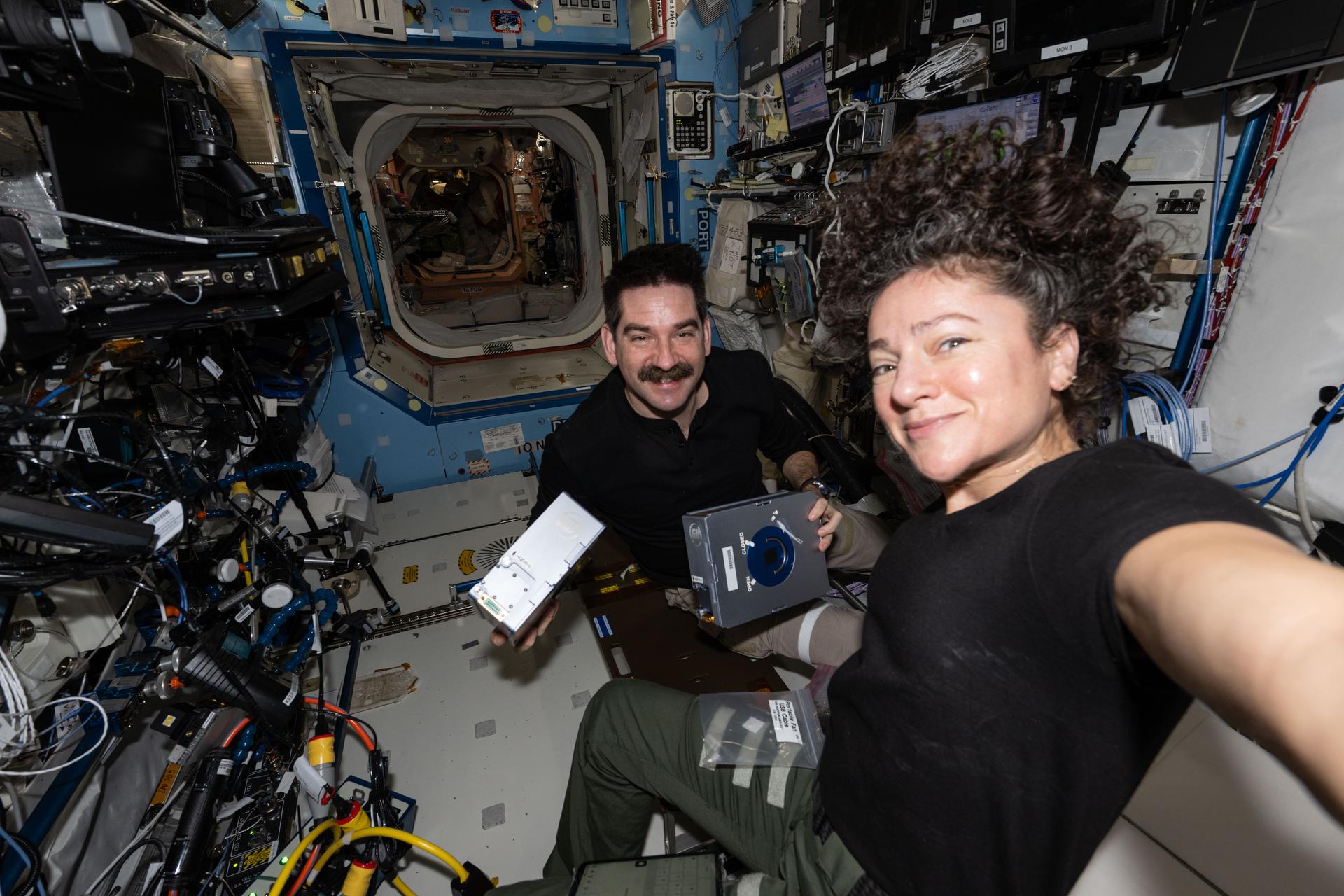
Scientists are comparing bacteria samples grown onboard the orbiting lab to similar samples living in simulated microgravity chambers on Earth to learn how microbes respond to space-like conditions. ESA (European Space Agency) astronaut Sophie Adenot kicked off the Odyssey biotechnology investigation processing microbe samples inside the Kibo laboratory module’s Life Science Glovebox (LSG) to document their genetic function. Next, NASA flight engineer Chris Williams collected the microbes for preservation and cleaned the research hardware inside the LSG for continuing operations. Finally, NASA flight engineer Jessica Meir took over and completed the day’s genetic study treating the sensitive samples to observe their chemical response. She immediately stowed the microbes for preservation afterward inside the LSG’s science freezer that she had installed the day before. Insights gained from the new study may lead to new ways of protecting humans and equipment exposed to harsh conditions on and off the Earth.
After completing her microbe work, Adenot moved to the Columbus laboratory module and tried on a prototype spacesuit designed by ESA to be worn inside a spacecraft. She tested the EuroSuit for its ease of donning on and off, as well as its comfort and mobility, then documented her experience for engineers to review. Results will inform the final design of the suit to meet the ergonomic requirements of living and working in space.
Williams also continued packing cargo inside a SpaceX Dragon cargo spacecraft with assistance from NASA flight engineer Jack Hathaway. Dragon is being loaded with several thousand pounds of station gear and science experiments that will be returned to Earth for analysis by engineers and scientists. Hathaway spent the majority of his shift inside the Tranquility module swapping orbital plumbing components and transferring water between tanks for life support maintenance.
Meir began her shift servicing fluid-containing sample processing hardware that is supporting the observation of pharmaceutical crystal growth to promote the production of advanced cancer therapies in weightlessness. Next, she activated tubes filled with microbial and botanical samples for a variety of student-designed experiments inside the Harmony module.
Roscosmos cosmonaut and station commander Sergey Kud-Sverchkov inspected and cleaned ventilation equipment then repaired a thermal sensor inside the Zvezda service module. Flight engineer Sergei Mikaev disinfected surfaces inside the Zarya module and checked the functionality of video hardware. Flight engineer Andrey Mikaev spent his shift on orbital plumbing and oxygen generator maintenance in the space station’s Roscosmos segment.
Learn more about station activities by following the space station blog, @space_stationon X, as well as the ISS Facebook and ISS Instagram accounts.
Get the latest from NASA delivered every week. Subscribe here.
Powered by WPeMatico
Mark A. Garcia
