Crew Replaces Scientific Hardware; Cargo Craft Readies for Launch

Crew Replaces Scientific Hardware; Cargo Craft Readies for Launch

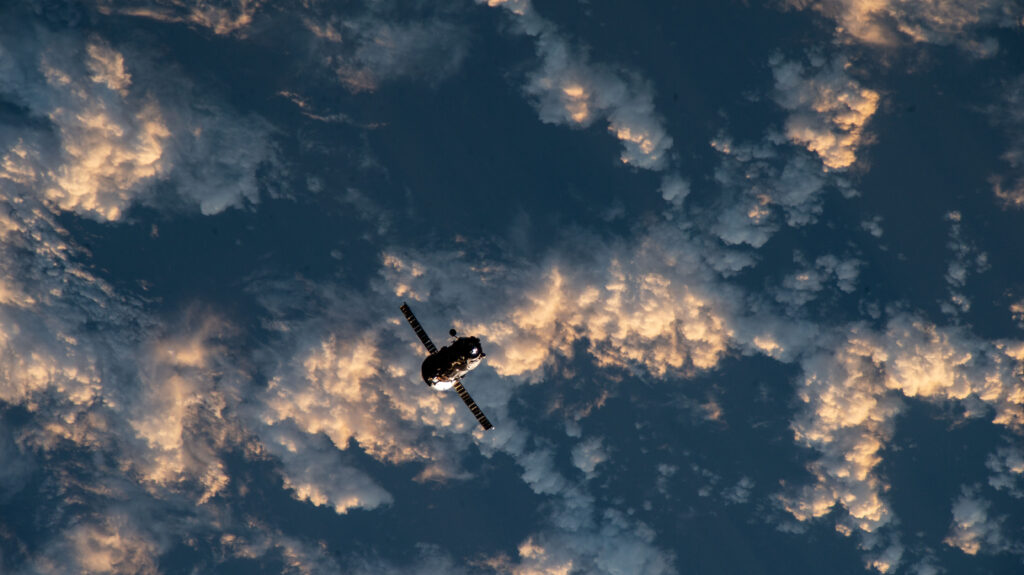
The ISS Progress 81 resupply ship from Roscosmos is pictured 265 miles above the Pacific Ocean after undocking from the Zvezda service module's rear port on Feb. 7, 2023.
The ISS Progress 81 resupply ship from Roscosmos is pictured 265 miles above the Pacific Ocean after undocking from the Zvezda service module’s rear port on Feb. 7, 2023.

The Expedition 70 crew is counting down to the arrival of new cargo as Progress nears its launch on Wednesday. Aboard the International Space Station, scientific hardware replacements and cargo audits topped the schedule for the seven orbital residents.

The Progress 87 cargo craft is scheduled to launch from the Baikonur Cosmodrome in Kazakhstan at 10:25 p.m. EST on Wednesday, Feb. 14. Loaded with nearly three tons of food, fuel, and supplies, Progress will dock to the station around 1:12 a.m. Saturday, Feb. 17, where it will remain for approximately six months.

In the Kibo Laboratory, Flight Engineer Satoshi Furukawa of JAXA (Japan Aerospace Exploration Agency) spent the day working on the Electrostatic Levitation Furnace (ELF). ELF allows safe thermophysical research in microgravity, providing scientists and engineers the opportunity to observe what happens to materials exposed to high temperatures in the space environment. With assistance from Flight Engineer Loral O’Hara of NASA, Furukawa retrieved ELF, then replaced sensor controllers on the device before reinstalling it.

O’Hara completed some orbital plumbing tasks in the morning, and after assisting Furukawa, she swapped the sleeves in the Life Sciences Glovebox, which is a sealed work area astronauts use to conduct various life sciences and technology investigations.

In the Destiny module, Commander Andreas Mogensen of ESA (European Space Agency) installed new sample cartridges in the Materials Science Laboratory, a payload used for materials research in microgravity. Afterward, Mogensen collected water samples from the station’s Potable Water Dispenser, before completing a VR for Exercise and VR Mental Care session.

As part of ongoing science, crew members study burning in microgravity to determine how material flammability is affected by fuel temperatures through an experiment called SoFIE-GEL. In the morning, Flight Engineer Jasmin Moghbeli of NASA replaced experiment samples for the investigation. She then moved on to cargo ops, unloading supplies and science that were delivered aboard Northrop Grumman’s 20th commercial resupply mission.

In the Roscosmos segment, the trio of cosmonauts—Oleg Kononenko, Nikolai Chub, and Konstantin Borisov—kept busy with inventory and cargo audits throughout the day. Borisov also ran a Pilot-T session, an ongoing experiment that allows crew members to practice piloting techniques.


Learn more about station activities by following the space station blog, @space_station and @ISS_Research on X, as well as the ISS Facebook and ISS Instagram accounts.

Get weekly video highlights at: https://roundupreads.jsc.nasa.gov/videoupdate/

Get the latest from NASA delivered every week. Subscribe here: www.nasa.gov/subscribe

Powered by WPeMatico

Get The Details…

Abby Graf

A Floridian Sunset

A Floridian Sunset

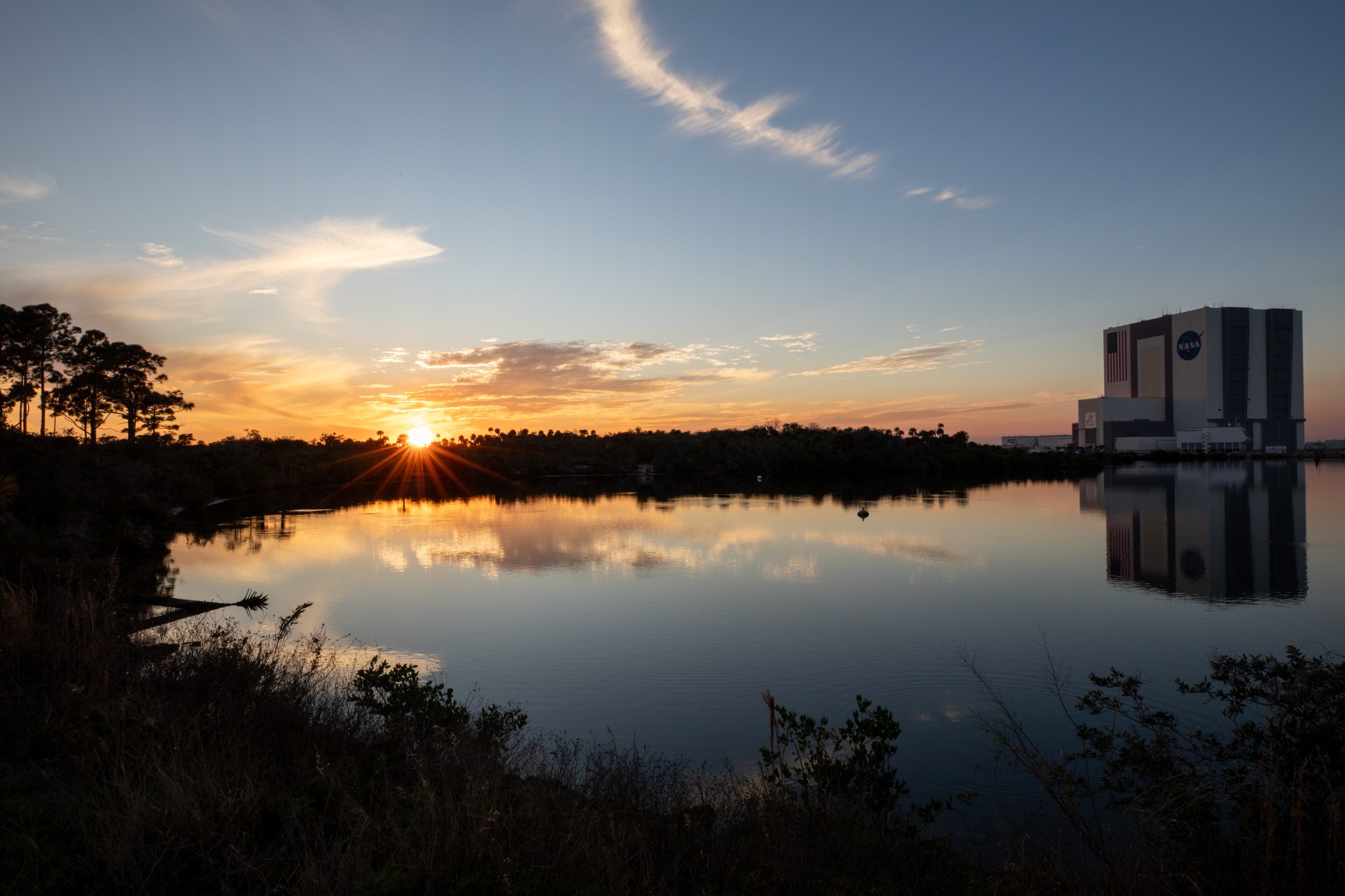
Slightly left of center, the Sun sets behind some vegetation. The sky is a dusty pale blue with a few clouds in it. Trees and plants arc around a body of water, and the Vehicle Assembly Building (VAB) stands at the right edge of the image. The VAB is a very tall, white and gray linear building with a United States flag and NASA meatball logo painted on the front.
NASA/Ben Smegelsky

A NASA photographer captured the sunset on Tuesday, Jan. 30, 2024, near the Vehicle Assembly Building (VAB) at the agency’s Kennedy Space Center in Florida. The iconic building, completed in 1966 and currently used for assembly of NASA’s Space Launch System rocket for Artemis missions, is still the only building in which rockets were assembled that carried humans to the surface of another world.

The VAB stands 525 feet tall and contains 130 million cubic feet of interior space. It sports a large American flag – a 209-foot-tall, 110-foot-wide stars and stripes painted on the exterior of its south side. Each star measures six feet across, and the blue field is the size of a basketball court. The flag originally was painted onto the VAB in 1976 for the Bicentennial Exposition on Space and Technology. A 12,300-square-foot NASA logo also adorns the south side of the facility.

The VAB has received a number of distinctions. It was listed in the National Register of Historic Places on Jan. 21, 2000. In January 2020, the American Society of Civil Engineers designated the VAB as a National Historic Civil Engineering Landmark. The Florida Association of The American Institute of Architects honored the facility and its adjacent Launch Control Center with a “Test of Time” design award, recognizing the contributions of the architects and engineers of these unique buildings.

Learn more about this distinctive building.

Image Credit: NASA/Ben Smegelsky

Powered by WPeMatico

Get The Details…
Monika Luabeya

NASA Telescopes Find New Clues About Mysterious Deep Space Signals

NASA Telescopes Find New Clues About Mysterious Deep Space Signals

6 min read

Preparations for Next Moonwalk Simulations Underway (and Underwater)

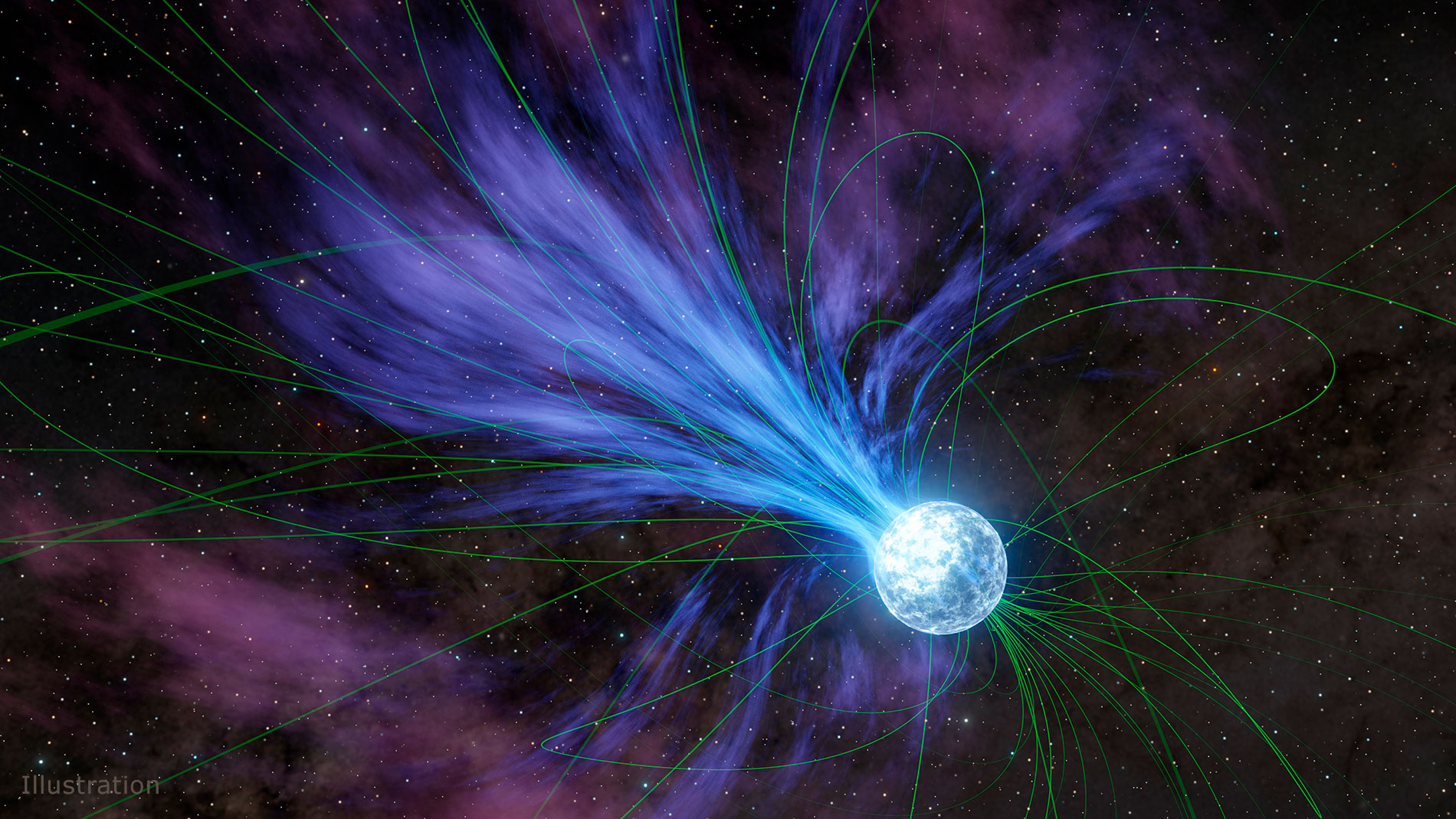
Artist's concept of magnetar is depicted losing material into space
In an ejection that would have caused its rotation to slow, a magnetar is depicted losing material into space in this artist’s concept. The magnetar’s strong, twisted magnetic field lines (shown in green) can influence the flow of electrically charged material from the object, which is a type of neutron star.
NASA/JPL-Caltech

Using two of the agency’s X-ray telescopes, researchers were able to zoom in on a dead star’s erratic behavior as it released a bright, brief burst of radio waves.

What’s causing mysterious bursts of radio waves from deep space? Astronomers may be a step closer to providing one answer to that question. Two NASA X-ray telescopes recently observed one such event – known as a fast radio burst – mere minutes before and after it occurred. This unprecedented view sets scientists on a path to better understand these extreme radio events.

While they only last for a fraction of a second, fast radio bursts can release about as much energy as the Sun does in a year. Their light also forms a laserlike beam, setting them apart from more chaotic cosmic explosions.

Because the bursts are so brief, it’s often hard to pinpoint where they come from. Prior to 2020, those that were traced to their source originated outside our own galaxy – too far away for astronomers to see what created them. Then a fast radio burst erupted in Earth’s home galaxy, originating from an extremely dense object called a magnetar – the collapsed remains of an exploded star.

In October 2022, the same magnetar – called SGR 1935+2154 – produced another fast radio burst, this one studied in detail by NASA’s NICER (Neutron Star Interior Composition Explorer) on the International Space Station and NuSTAR (Nuclear Spectroscopic Telescope Array) in low Earth orbit. The telescopes observed the magnetar for hours, catching a glimpse of what happened on the surface of the source object and in its immediate surroundings, before and after the fast radio burst. The results, described in a new study published Feb. 14 in the journal Nature, are an example of how NASA telescopes can work together to observe and follow up on short-lived events in the cosmos.

The burst occurred between two “glitches,” when the magnetar suddenly started spinning faster. SGR 1935+2154 is estimated to be about 12 miles (20 kilometers) across and spinning about 3.2 times per second, meaning its surface was moving at about 7,000 mph (11,000 kph). Slowing it down or speeding it up would require a significant amount of energy. That’s why study authors were surprised to see that in between glitches, the magnetar slowed down to less than its pre-glitch speed in just nine hours, or about 100 times more rapidly than has ever been observed in a magnetar.

“Typically, when glitches happen, it takes the magnetar weeks or months to get back to its normal speed,” said Chin-Ping Hu, an astrophysicist at National Changhua University of Education in Taiwan and the lead author of the new study. “So clearly things are happening with these objects on much shorter time scales than we previously thought, and that might be related to how fast radio bursts are generated.”

Spin Cycle

When trying to piece together exactly how magnetars produce fast radio bursts, scientists have a lot of variables to consider.

For example, magnetars (which are a type of neutron star) are so dense that a teaspoon of their material would weigh about a billion tons on Earth. Such a high density also means a strong gravitational pull: A marshmallow falling onto a typical neutron star would impact with the force of an early atomic bomb.

The strong gravity means the surface of a magnetar is a volatile place, regularly releasing bursts of X-rays and higher-energy light. Before the fast radio burst that occurred in 2022, the magnetar started releasing eruptions of X-rays and gamma rays (even more energetic wavelengths of light) that were observed in the peripheral vision of high-energy space telescopes. This increase in activity prompted mission operators to point NICER and NuSTAR directly at the magnetar.

“All those X-ray bursts that happened before this glitch would have had, in principle, enough energy to create a fast radio burst, but they didn’t,” said study co-author Zorawar Wadiasingh, a research scientist at the University of Maryland, College Park and NASA’s Goddard Space Flight Center. “So it seems like something changed during the slowdown period, creating the right set of conditions.”

What else might have happened with SGR 1935+2154 to produce a fast radio burst? One factor might be that the exterior of a magnetar is solid, and the high density crushes the interior into a state called a superfluid. Occasionally, the two can get out of sync, like water sloshing around inside a spinning fishbowl. When this happens, the fluid can deliver energy to the crust. The paper authors think this is likely what caused both glitches that bookended the fast radio burst.

If the initial glitch caused a crack in the magnetar’s surface, it might have released material from the star’s interior into space like a volcanic eruption. Losing mass causes spinning objects to slow down, so the researchers think this could explain the magnetar’s rapid deceleration.

But having observed only one of these events in real time, the team still can’t say for sure which of these factors (or others, such as the magnetar’s powerful magnetic field) might lead to the production of a fast radio burst. Some might not be connected to the burst at all.

“We’ve unquestionably observed something important for our understanding of fast radio bursts,” said George Younes, a researcher at Goddard and a member of the NICER science team specializing in magnetars. “But I think we still need a lot more data to complete the mystery.”

More About the Mission

A Small Explorer mission led by Caltech and managed by NASA’s Jet Propulsion Laboratory in Southern California for the agency’s Science Mission Directorate in Washington, NuSTAR was developed in partnership with the Danish Technical University and the Italian Space Agency (ASI). The spacecraft was built by Orbital Sciences Corp. in Dulles, Virginia. NuSTAR’s mission operations center is at the University of California, Berkeley, and the official data archive is at NASA’s High Energy Astrophysics Science Archive Research Center at NASA’s Goddard Space Flight Center. ASI provides the mission’s ground station and a mirror data archive. Caltech manages JPL for NASA.

For more information about the NuSTAR mission, visit:

https://www.nustar.caltech.edu/

NICER, an Astrophysics Explorer Mission of Opportunity, is an external payload on the International Space Station. NICER is managed by and operated at NASA’s Goddard Space Flight Center; its data is archived at NASA’s HEASARC. NASA’s Explorers program provides frequent flight opportunities for world-class scientific investigations from space utilizing innovative, streamlined, and efficient management approaches within the heliophysics and astrophysics science areas.

For more information about the NICER mission, visit:

https://www.nasa.gov/nicer

News Media Contact

Calla Cofield
Jet Propulsion Laboratory, Pasadena, Calif.
626-808-2469
calla.e.cofield@jpl.nasa.gov

2024-016

Powered by WPeMatico

Get The Details…
Anthony Greicius

Plan de acción para la equidad 2023 de la NASA se centrará en educación STEM/CTIM

Plan de acción para la equidad 2023 de la NASA se centrará en educación STEM/CTIM

La portada del Plan de acción para la equidad 2023.
Credits: NASA

Read this release in English here.

La NASA publicó su Plan de acción para la equidad 2023 el miércoles, en el cual describe los logros clave en el aumento de la diversidad, la equidad, la inclusión y la accesibilidad en toda la agencia, y sus nuevos compromisos para continuar eliminando los obstáculos y retos injustos a los que se enfrentan las comunidades desatendidas.

“En la NASA, estamos comprometidos con el avance de la equidad para garantizar que nuestro trabajo beneficie a toda la humanidad”, dijo el administrador de la NASA, Bill Nelson. “El Plan de acción para la equidad profundiza nuestro compromiso a largo plazo para identificar y eliminar las barreras sistémicas que limitan las oportunidades para las comunidades desatendidas y subrepresentadas”. Este año, la NASA ha identificado la educación en las áreas de ciencia, tecnología, ingeniería y matemáticas (CTIM, o STEM, como se le conoce en Estados Unidos por sus siglas en inglés) como un área en la cual incentivar la participación e inspirar el talento diverso de nuestros futuros líderes. Estamos invitando a la próxima generación, la generación Artemis, a asumir las audaces misiones del futuro en el cosmos, y aquí en la Tierra”.

El Plan de acción para la equidad es parte del enfoque integral del gobierno de la administración Biden-Harris para el fomento de la equidad. Este plan respalda la Orden Ejecutiva 14091 del presidente de “Mayor fomento de la equidad racial y apoyo a las comunidades desatendidas por medio del gobierno federal”.

A medida que continúa el trabajo de la NASA para el fomento de la equidad para el beneficio de la humanidad, el Plan de acción para la equidad 2023 ofrece las siguientes estrategias para garantizar que más gente pueda trabajar y aprender con esta agencia:

  • Aumentar la utilización e integración de contratistas y empresas de comunidades desatendidas para ampliar la equidad en el proceso de contrataciones públicas de la NASA.
  • Mejorar las subvenciones y los acuerdos de cooperación para fomentar las oportunidades, el acceso y la representación de las comunidades desatendidas.
  • Aumentar la accesibilidad y el uso de los datos de las ciencias de la Tierra.
  • Mejorar las políticas de acceso lingüístico para ampliar el acceso de las poblaciones con dominio limitado del inglés a los programas y actividades de la NASA.
  • Fomentar la participación de los estudiantes para desarrollar una futura fuerza laboral diversa en el área de la ciencia, tecnología, ingeniería y matemáticas.

El Plan de acción para la equidad 2023 también se basa en el éxito del plan de 2022. Estos son algunos de los logros de la NASA desde esa publicación:

  • La Oficina de Programas para Pequeñas Empresas aumentó sus eventos de divulgación en un 80% con respecto al año fiscal 2021, superando la meta del 50% para 2029. Además, desde el año fiscal 2021 hasta el año fiscal 2022, la NASA comprometió 1.900 millones de dólares en contratos de la línea de bienes y servicios reservados para las categorías de pequeñas empresas y programas AbilityOne, los cuales son la mayor fuente de empleo para personas con discapacidades.
  • Desarrolló recursos para crear conciencia sobre los programas de subvenciones e incluyó el Aviso de Oportunidades de Financiamiento en el boletín de Intercambio con Instituciones al Servicio a las Minorías de la agencia. La agencia también aumentó en un 39,9% el monto de las subvenciones otorgadas a las escuelas profesionales y universidades de población históricamente negra entre el año fiscal 2021 y 2022.
  • Otorgó financiamiento a 39 propuestas sobre temas como la calidad del aire, los peligros climáticos, y el calor extremo.
  • Inauguró su primer Centro de Información de la Tierra en la sede de la agencia en Washington, proporcionando recursos accesibles, información fácil de utilizar y datos tanto en línea como en el sitio para uso del público y de los responsables de la toma de decisiones.
  • Desarrolló y actualizó sus Planes de acceso lingüístico en todos sus 10 centros con el fin de establecer una estrategia de comunicaciones más equitativa para llegar a las poblaciones con dominio limitado del inglés.

Para más información sobre el Plan de acción para la Equidad 2023 y para seguir nuestros avances a medida que la NASA continúa con su viaje hacia la Misión Equidad, visita el sitio web:

https://nasa.gov/mission-equity

-fin-

Gerelle Dodson
Sede, Washington
202-358-4637
gerelle.q.dodson@nasa.gov

María José Viñas
Sede, Washington
240-458-0248
maria-jose.vinasgarcia@nasa.gov

Share

Details

Last Updated

Feb 14, 2024

Related Terms

Powered by WPeMatico

Get The Details…
Roxana Bardan

NASA Updates Equity Action Plan, Adds Focus on STEM Education, More

NASA Updates Equity Action Plan, Adds Focus on STEM Education, More

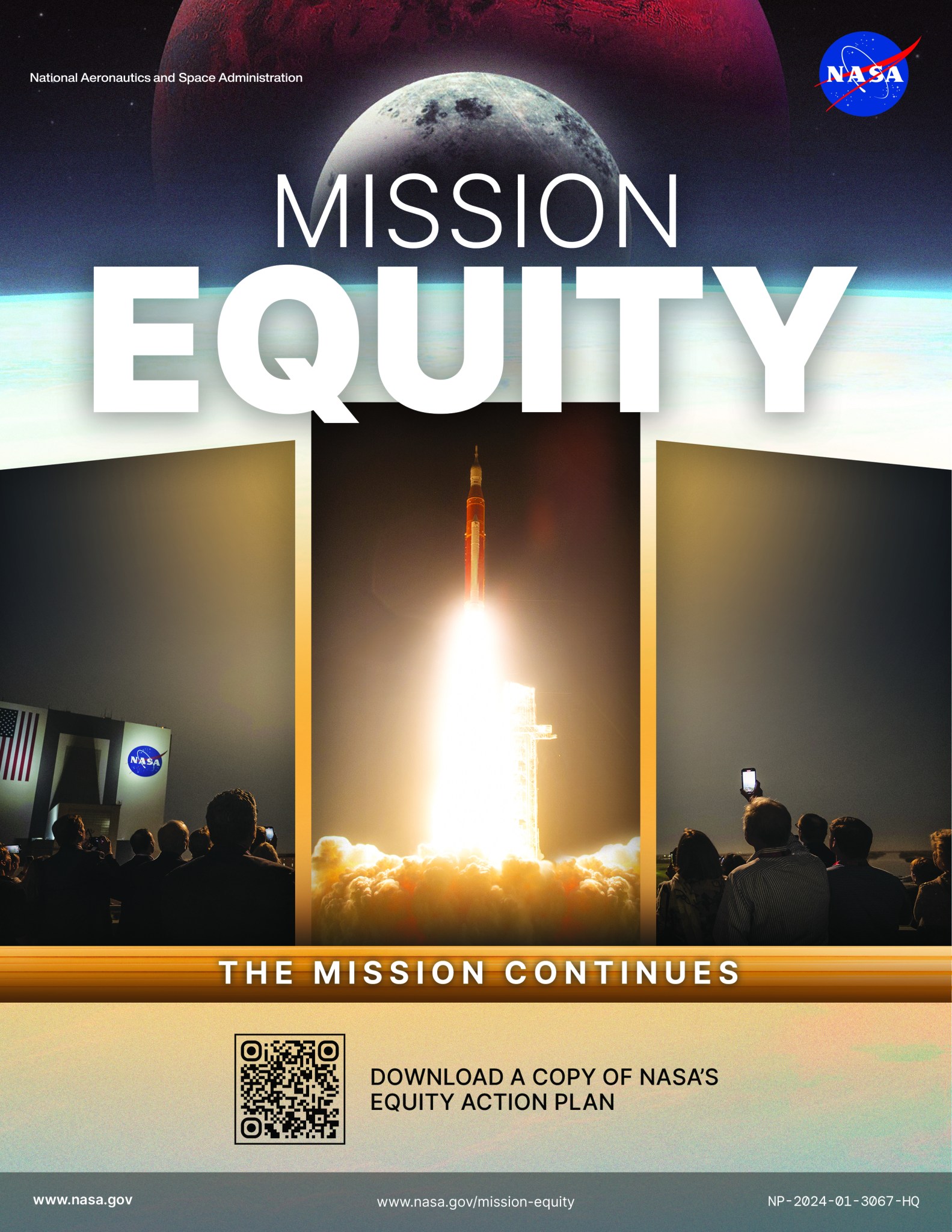
The cover of the 2023 NASA Equity Action Plan.
Credits: NASA

Lee esta nota de prensa en español aquí.

NASA published its 2023 Equity Action Plan Wednesday, which outlines key accomplishments in increasing equity across the agency, and new commitments to continue removing inequitable barriers and challenges facing underserved communities.

“At NASA, we are committed to advancing equity to ensure our work benefits all humanity,” said NASA Administrator Bill Nelson. “The Equity Action plan deepens our long-term commitment to recognize and overcome systemic barriers that limit opportunity in underserved and underrepresented communities. This year, NASA has identified STEM education as an area to engage and inspire the diverse talent of our future leaders. We are inviting the next generation, the Artemis Generation, to take on the daring missions of the future in the cosmos, and here on Earth.”

The equity plan is part of the Biden-Harris Administration’s whole-of-government approach to advancing equity. It supports the President’s Executive Order 14091 on “Further Advancing Racial Equity and Support for Underserved Communities Through the Federal Government.”

NASA’s 2023 Equity Action Plan provides strategies for ensuring more individuals can work with and learn from the agency by:

  • Increasing utilization and integration of contractors and businesses from underserved communities to expand equity in NASA’s procurement process.
  • Enhancing grants and cooperative agreements to advance opportunities, access, and representation for underserved communities.  
  • Increasing the accessibility and use of Earth science data.
  • Improving language access policies to expand access to NASA programs and activities for limited-English proficient populations.
  • Engaging more students to build a diverse future science, technology, engineering, and mathematics workforce.

The 2023 Equity Action Plan builds on the success of the 2022 plan. Some of NASA’s achievements since that publication include:

  • The Office of Small Business Programs increased its outreach events by 80% from fiscal year 2021, surpassing its goal of 50% by 2029. Additionally, from fiscal year 2021 through 2022, NASA obligated $1.9 billion in contracts under the product service line set aside for small business categories and AbilityOne programs, the largest source of employment for individuals with disabilities.
  • Developed resources to bring awareness to grant programs and included Notice of Funding Opportunities in the agency’s Minority Serving Institutions’ Exchange newsletter. The agency also increased the grant award amount to historically Black colleges and universities between fiscal year 2021 and 2022 by 39.9%.
  • Awarded 39 proposals totaling $6.9 million for up to three years on topics such as air quality, climate hazards, and extreme heat.
  • Opened its first Earth Information Center at the agency’s headquarters in Washington, providing accessible resources, user-friendly information, and data, both online and on-site for use by members of the public and decision-makers.
  • Developed and updated its Language Access Plans at all 10 centers to establish a more equitable communication strategy for reaching limited-English proficient populations.

For more information about the 2023 Equity Action Plan, and to follow along as NASA continues its journey toward Mission Equity, visit:

https://nasa.gov/mission-equity

-end-

Gerelle Dodson
Headquarters, Washington
202-358-4637
gerelle.q.dodson@nasa.gov

Share

Details

Last Updated

Feb 14, 2024

Powered by WPeMatico

Get The Details…
Roxana Bardan