NASA Astronauts Capture Cygnus With Robotic Arm; Installation Soon
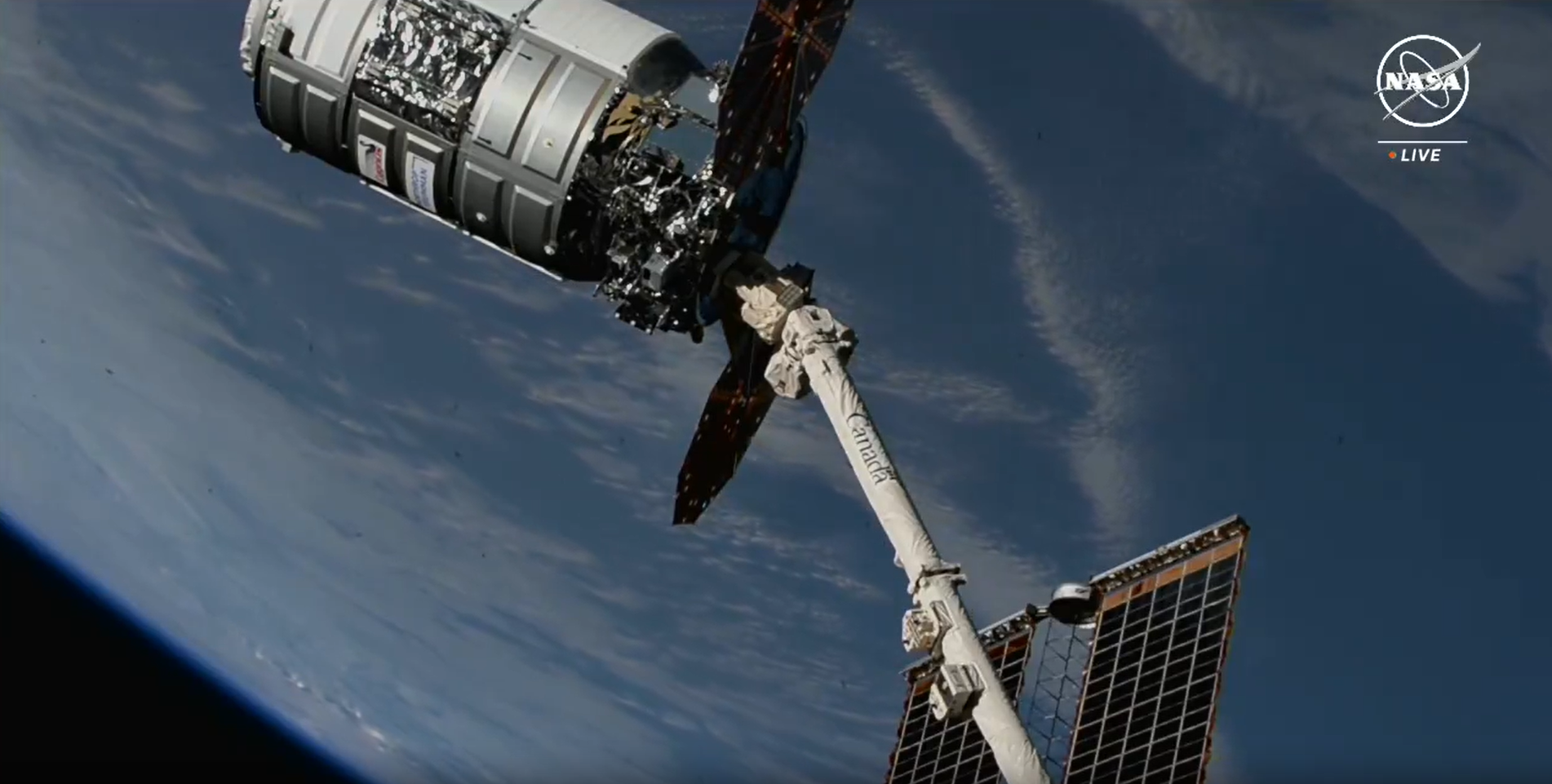
Northrop Grumman’s Cygnus spacecraft is pictured attached to the Canadarm2 robotic arm moments after NASA astronaut Matthew Dominick maneuvered the robotic arm to capture the spacecraft ahead of installation to the Earth-facing port of the Unity module. Credit: NASA TV
At 3:11 a.m. EDT, NASA astronaut Matthew Dominick, with NASA astronaut Jeanette Epps as backup, captured Northrop Grumman’s Cygnus spacecraft using the International Space Station’s Canadarm2 robotic arm as the station was flying about 260 miles over the South Atlantic Ocean.
Mission control in Houston will use the Canadarm2 robotic arm to position Cygnus to its installation orientation and then will guide it in for installation on the station’s Unity module Earth-facing port.
NASA will provide coverage of the spacecraft’s installation beginning at 4:30 a.m. on NASA+, NASA Television, the NASA app, YouTube, X, Facebook, and the agency’s website.
NASA’s Northrop Grumman 21st commercial resupply mission launched at 11:02 a.m. Aug. 4 on a SpaceX Falcon 9 rocket from Space Launch Complex 40 at Cape Canaveral Space Force Station in Florida carrying 8,200 pounds of scientific investigations and cargo to the orbiting laboratory.
Cygnus Spacecraft Approaching Space Station Live on NASA TV
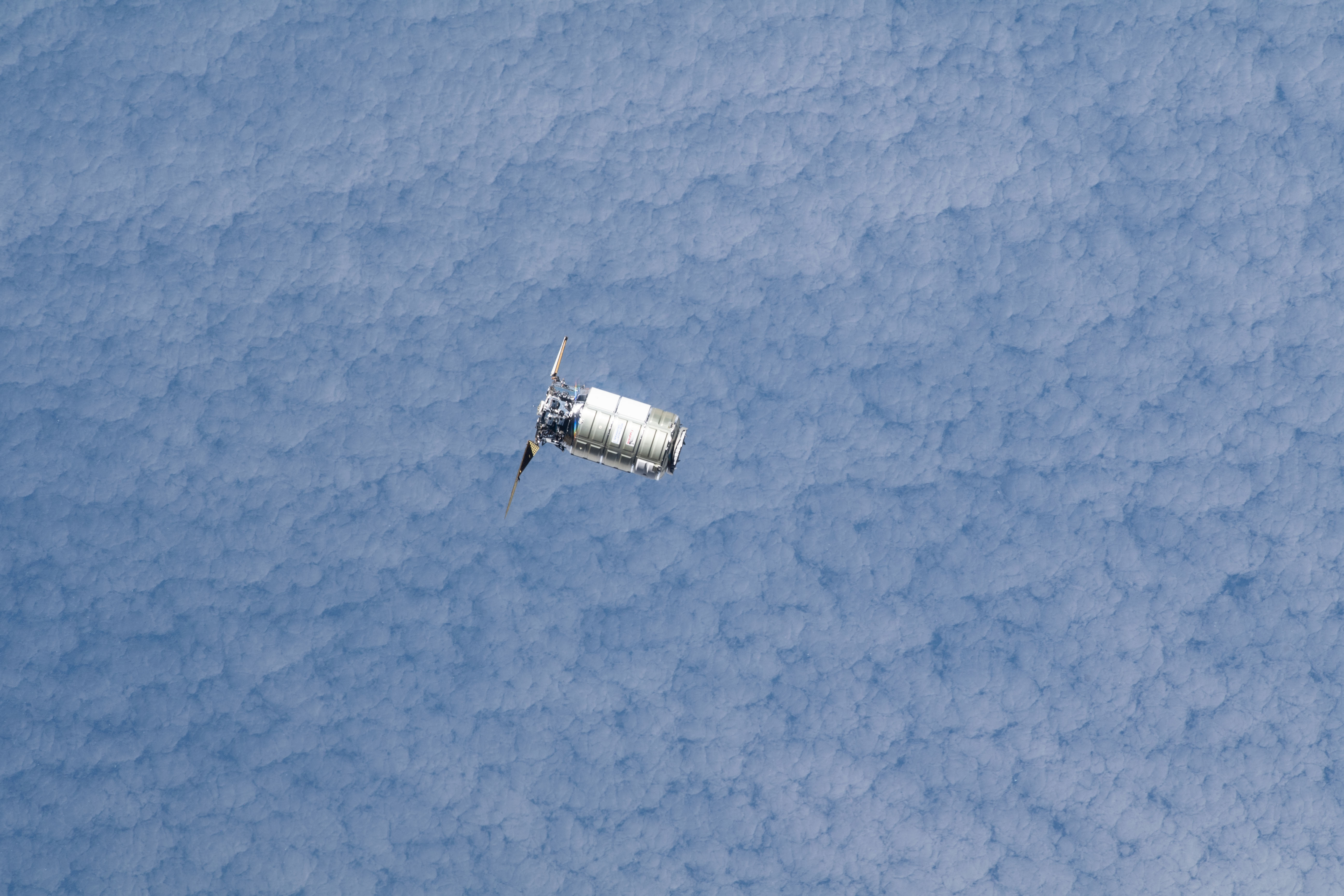
The Northrop Grumman Cygnus space freighter approaches the International Space Station as both spacecraft orbited 272 miles above the southern Indian Ocean.
NASA’s coverage is underway for the capture of Northrop Grumman’s Cygnus spacecraft. At approximately 3:10 a.m. EDT, NASA astronaut Matthew Dominick will capture Cygnus using the International Space Station’s Canadarm2 robotic arm, and NASA astronaut Jeanette Epps is backup. After capture, the spacecraft will be installed on the Unity module’s Earth-facing port.
The spacecraft is carrying 8,200 pounds of scientific investigations and cargo to the orbiting laboratory for Northrop Grumman’s 21st commercial resupply mission for NASA.
The mission launched at 11:02 a.m. Aug. 4 on a SpaceX Falcon 9 rocket from Space Launch Complex 40 at Cape Canaveral Space Force Station in Florida.
NASA will provide coverage of the spacecraft’s installation beginning at 4:30 a.m. on NASA+, NASA Television, the NASA app, YouTube, X, Facebook, and the agency’s website.
Station Awaits Cygnus Cargo Delivery During Science, Hardware Duties
Northrop Grumman’s Cygnus spacecraft launches atop a SpaceX 9 Falcon rocket from Space Launch Complex 40 at Cape Canaveral Space Force Station in Florida on Sunday, Aug. 4, 2024.
A U.S. cargo craft packed with 8,200 pounds of science and supplies is orbiting Earth today heading toward the International Space Station for a Tuesday morning cargo delivery. Meanwhile, the orbital residents started the work week with their normal complement of microgravity research and standard lab maintenance tasks.
Northrop Grumman’s Cygnus space freighter lifted off atop a SpaceX Falcon 9 rocket at 11:02 a.m. EDT on Sunday from Florida. The cargo craft is loaded with a range of new experiments to investigate liquid and gas flows, centripetal force, DNA repair mechanisms, cellular expansion, and more. The weightless environment of the orbital outpost allows investigators to explore phenomena and gain insights not possible in Earth’s gravity conditions.
NASA astronauts Matthew Dominick and Jeanette Epps will be on duty Tuesday morning as Cygnus nears the space station during its automated approach and rendezvous. Dominick will be at the controls of the robotics workstation ready to command the Canadarm2 robotic arm to reach out and grapple Cygnus. Epps will be at Dominick’s side backing him up as the spacecraft completes its slow and methodical space delivery. The two Cygnus teammates had a light-duty day on Monday and went to bed early to get a fresh start and prepare for the spacecraft’s early arrival. After Cygnus is captured, robotics controllers on the ground will take over and remotely command the Canadarm2 and guide Cygnus to a berthing on the Unity module’s Earth-facing port.
The Cygnus spacecraft has completed two delta velocity burns, and it remains on track for a capture by the space station’s robotic arm slated for 3:10 a.m. on Tuesday, Aug. 6. The Cygnus spacecraft is in a safe trajectory, and all other systems are operating normally.
Shortly after launch on Sunday, the spacecraft performed as designed by cancelling a scheduled engine burn due to a slightly low initial pressure reading flagged by the Cygnus onboard detection system. Engineers at Northrop Grumman’s mission control center in Dulles, Virginia evaluated the pressure reading, confirmed it was acceptable and re-worked the burn plan to arrive at the space station on the originally planned schedule.
NASA will provide live coverage of the spacecraft’s arrival beginning at 1:30 a.m. Aug. 6 on NASA+, NASA Television, the NASA app, YouTube, X, Facebook, and the agency’s website. Additional updates will be posted as needed.
The rest of the Expedition 71 and NASA’s Boeing Crew Flight Test crews spent Monday on an array of physics and biology studies, as well as hardware cleanup and life support duties.
NASA Flight Engineers Tracy C. Dyson and Mike Barratt participated in eye checks on Monday for the CIPHER suite of 14 human research experiments. Dyson peered into the eyes of Barratt using standard medical imaging hardware found on Earth with real-time assistance from flight surgeons on the ground. Doctors are exploring how living in space affects eye structure and function. Dyson also stowed spacesuit components in the Quest airlock. Barratt reorganized the Permanent Multipurpose Module (PMM) to make room for the new Cygnus cargo then replaced fuel bottles inside the Combustion Integrated Rack.
Boeing Starliner Pilot Suni Williams from NASA assisted Barratt inside the PMM before working throughout the day on orbital plumbing tasks. Starliner Commander Butch Wilmore, also from NASA, installed a light meter in the Veggie space botany facility, obtained light measurements, then adjusted the light settings inside the plant research device. The duo called down to Boeing flight controllers at the end of the day and discussed mission updates.
The three Roscosmos cosmonauts had their day full as the trio tested a pressure suit and serviced life support gear. Station Commander Oleg Kononenko and Flight Engineer Alexander Grebenkin evaluated the lower body negative pressure suit and its ability to reverse the space-caused upward flow of body fluids in space crew members. The specialized suit may also help crews adapt faster to the return to Earth’s gravity. The duo then split up and serviced life support and ventilation systems in the Nauka science module. Flight Engineer Nikolai Chub also worked in Nauka photographing plumbing components before replacing air flow sensors and inspecting video hardware throughout the orbital outpost’s Roscosmos segment.
NASA’s Northrop Grumman Cygnus Continues to Space Station
Northrop Grumman’s Cygnus spacecraft continues on its way to the International Space Station following launch at 11:02 a.m. EDT Aug. 4 on a SpaceX Falcon 9 rocket from Space Launch Complex 40 at Cape Canaveral Space Force Station in Florida. The Cygnus spacecraft completed the deployment of its two solar arrays at 2:21 p.m. the same day.
The Cygnus spacecraft has completed two delta velocity burns, and it remains on track for a capture by the space station’s robotic arm slated for 3:10 a.m. on Tuesday, Aug. 6. The spacecraft is in a safe trajectory, and all other systems are operating normally.
Shortly after launch on Sunday, the spacecraft performed as designed by cancelling a scheduled engine burn due to a slightly low initial pressure reading flagged by the Cygnus onboard detection system. Engineers at Northrop Grumman’s mission control center in Dulles, Virginia evaluated the pressure reading, confirmed it was acceptable and re-worked the burn plan to arrive at the space station on the originally planned schedule.
NASA will provide live coverage of the spacecraft’s arrival beginning at 1:30 a.m. Aug. 6 on NASA+, NASA Television, the NASA app, YouTube, X, Facebook, and the agency’s website. Additional updates will be posted as needed.
NASA astronaut Matthew Dominick will capture Cygnus using the station’s Canadarm2 robotic arm, and NASA astronaut Jeanette Epps is backup. After capture, the spacecraft will be installed on the Unity module’s Earth-facing port.
This is Northrop Grumman’s 21st commercial resupply mission for NASA.
NASA’s Northrop Grumman Cygnus Completes Solar Arrays Deployment
Northrop Grumman’s Cygnus spacecraft completed the deployment of its two solar arrays at 2:21 p.m. EDT after launching at 11:02 a.m. Aug. 4 on a SpaceX Falcon 9 rocket from Space Launch Complex 40 at Cape Canaveral Space Force Station in Florida to the International Space Station for NASA.
Shortly after launch, the spacecraft missed its first burn slated for 11:44 a.m. due to a late entry to burn sequencing. Known as the targeted altitude burn, or TB1, it was rescheduled for 12:34 p.m., but aborted the maneuver shortly after the engine ignited due to a slightly low initial pressure state. There is no indication the engine itself has any problem at this time.
Cygnus is at a safe altitude, and Northrop Grumman engineers are working a new burn and trajectory plan. The team aims to achieve the spacecraft’s original capture time on station, which is currently slated for 3:10 a.m. on Tuesday, Aug. 6.
If all remains on track, NASA will provide live coverage of the spacecraft’s arrival beginning at 1:30 a.m. Aug. 6 on NASA+, NASA Television, the NASA app, YouTube, X, Facebook, and the agency’swebsite. Additional updates will be posted as needed.
NASA astronaut Matthew Dominick will capture Cygnus using the station’s Canadarm2 robotic arm at approximately 3:10 a.m., and NASA astronaut Jeanette Epps is backup. After capture, the spacecraft will be installed on the Unity module’s Earth-facing port.
This is Northrop Grumman’s 21st commercial resupply mission for NASA.