Crew Trains for Cygnus Capture, Keeps Up Space Research

Crew Trains for Cygnus Capture, Keeps Up Space Research
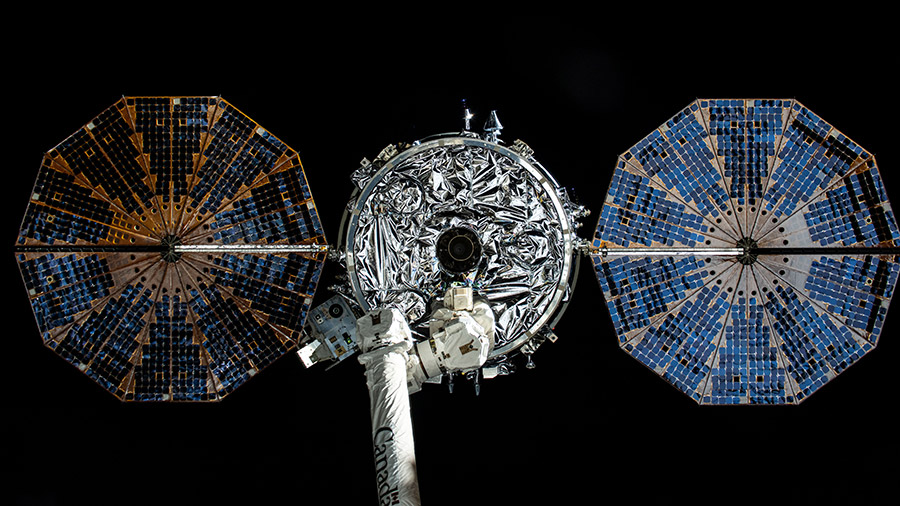
The Cygnus space freighter with its two cymbal-shaped solar arrays is pictured attached to the Canadarm2 robotic arm before its release from the space station's on July 12, 2024.
The Cygnus space freighter with its two cymbal-shaped solar arrays is pictured attached to the Canadarm2 robotic arm before its release from the space station’s on July 12, 2024.

Thursday’s main activities aboard the International Space Station on Thursday were Cygnus cargo craft preparations and microgravity science. Amidst the mission and research duties, the two crews living and working aboard the orbital outpost also kept up standard household duties and plumbing tasks.

Northrop Grumman’s Cygnus resupply ship is targeted to launch atop a SpaceX Falcon 9 rocket at 11:29 a.m. EDT on Saturday from Space Launch Complex 40 at Cape Canaveral Space Force Station in Florida. Cygnus is planned to take a day-and-a-half trip around Earth before arriving at the space station for its robotic capture at 6 a.m. on Monday.

NASA Flight Engineers Matthew Dominick and Jeanette Epps practiced Cygnus capture techniques on Thursday using the Canadarm2 robotic arm and guiding it toward a grapple fixture on the Permanent Multipurpose Module (PMM). Dominick will be commanding the Canadarm2 to capture Cygnus early Monday while Epps will back him up and monitor Cygnus’ approach and rendezvous.

Epps began her day with blood and saliva sample collection work, processing the specimens for analysis, then stowing the samples in a science freezer and the Kubik research incubator for future retrieval. Dominick set up a notebook computer and connected it to the advanced resistive exercise device for an experiment that measures how muscles and bones are impacted when working out in space.

Tracy C. Dyson and Mike Barratt, both Expedition 71 Flight Engineers, worked on science maintenance and housekeeping tasks throughout the day. Dyson swapped samples and components inside a flame research device that safely studies how materials burn in weightlessness aboard the Kibo laboratory module. Barratt measured the airflow in the Harmony module’s port side crew quarters to ensure the upkeep of ventilation systems and maintain crew health.

NASA astronauts Butch Wilmore and Suni Williams, Commander and Pilot for Boeing’s Crew Flight Test, spent their day on a variety of household tasks. Wilmore first organized food stowed in the Unity module and the PMM then installed a light meter on the Veggie botany research facility. Williams deep cleaned Unity temporarily uninstalling racks and hardware to access and wipe down hard to reach areas with disinfectant.

Station Commander Oleg Kononenko from Roscosmos began his day checking laptop computers before spending the afternoon photographing crew activities and inspecting windows in the Zvezda service module. Flight Engineer Nikolai Chub was back on physics research Thursday as he studied how fluids are affected by magnetic and electrical fields in space. Flight Engineer Alexander Grebenkin worked throughout the day an orbital plumbing and life support tasks in the station’s Roscosmos segment.


Learn more about station activities by following the space station blog, @space_station and @ISS_Research on X, as well as the ISS Facebook and ISS Instagram accounts.

Get weekly video highlights at: https://roundupreads.jsc.nasa.gov/videoupdate/

Get the latest from NASA delivered every week. Subscribe here: www.nasa.gov/subscribe

Powered by WPeMatico

Get The Details…

Mark Garcia

Spacesuit Check and Student Robotics Contest Today as Station Orbits Higher

Spacesuit Check and Student Robotics Contest Today as Station Orbits Higher

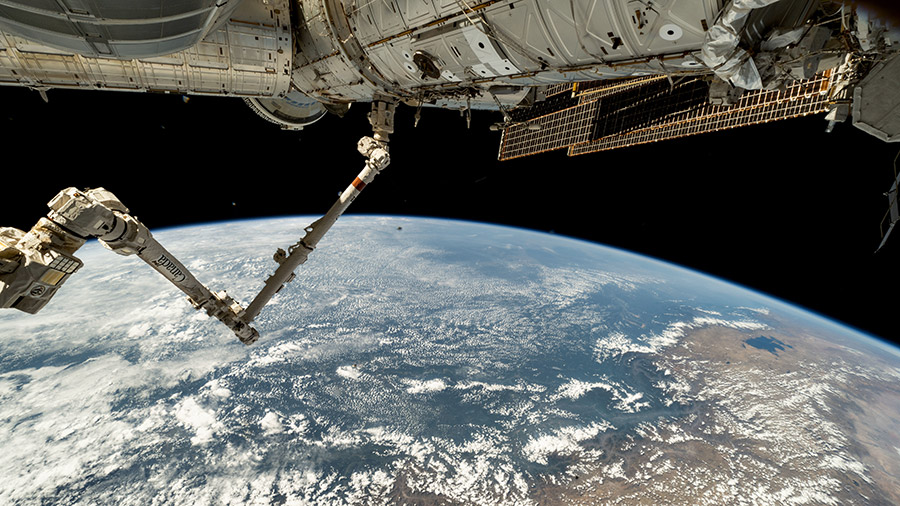
The Canadarm2 robotic arm extends from the Harmony module as the orbital outpost soared above the coast of Peru. Partially obscured in the top background, is the Boeing Starliner spacecraft.

Spacesuits, robotics, and maintenance were the main priorities for the Expedition 71 and NASA’s Boeing Crew Flight Test crews after the International Space Station raised its orbit on Wednesday. The nine orbital residents also split their day on a variety of human research activities and docked crew spaceship activities.

NASA Flight Engineer Matthew Dominick evaluated a spacesuit in the Quest airlock today with assistance from fellow NASA astronaut Mike Barratt. The duo powered up the spacesuit, configured its components, and tested the suit’s communications and life support systems during Dominick’s fit verification.

Astrobee free-flying robotic assistants, powered by fans and a vision-based navigation system, were maneuvering inside the Kibo laboratory module during the Astrobee Zero Robotics 3 finals competition on Wednesday. The Astrobees were controlled and manipulated by winning algorithms written by students on Earth and downloaded to the robotics platform by mission controllers. NASA Flight Engineer Tracy C. Dyson readied the toaster-sized, cube-shaped Astrobees then monitored the contest designed to encourage students to pursue careers in science, engineering, and space exploration.

During the morning, NASA Flight Engineer Jeanette Epps removed blood samples that were stowed overnight inside the Kubik research incubator. She spun those samples in a centrifuge before placing them inside a science freezer for preservation and later analysis to understand microgravity’s effect on humans. Afterward, Epps conducted several hours of airflow measurements inside the crew quarters located in the Harmony module’s deck compartment to maintain ventilation systems and crew health.

Starliner Commander Butch Wilmore and Suni Williams, both NASA astronauts, had their day packed primarily with lab upkeep duties aboard the orbiting outpost. Wilmore spent his morning inspecting advanced plumbing hardware then packed the life support components for return to Earth. Williams set up high-definition video gear inside the Columbus laboratory module then inspected a bar code reader and radio frequency hardware. The duo also partnered up and organized cargo packed inside the Tranquility module before calling down to Boeing mission controllers for a conference.

The space station is orbiting higher today after the docked Progress 87 cargo craft fired its thrusters for over 20 minutes early Wednesday morning. The orbital reboost places the station at the correct altitude to receive the next cargo craft from Roscosmos after it launches in mid-August.

Commander Oleg Kononenko examined the cargo space available inside the Nauka and Rassvet modules to prepare for the upcoming space delivery. The five-time station visitor also inspected the telerobotically operated rendezvous unit, or TORU, in the Zvezda service module. The TORU would be used to remotely control an approaching Roscosmos resupply ship in the unlikely event the spacecraft would be unable to complete its automated docking sequence.

Roscosmos Flight Engineers Nikolai Chub and Aleksander Grebenkin had their day full as they conducted a variety of space research and maintained orbital lab systems on Wednesday. Chub continued studying how magnetic and electrical fields affect fluid physics and serviced life support systems. Grebenkin pointed a digital video camera out a station window and videotaped the condition of the Roscosmos segment modules for analysis.


Learn more about station activities by following the space station blog, @space_station and @ISS_Research on X, as well as the ISS Facebook and ISS Instagram accounts.

Get weekly video highlights at: https://roundupreads.jsc.nasa.gov/videoupdate/

Get the latest from NASA delivered every week. Subscribe here: www.nasa.gov/subscribe

Powered by WPeMatico

Get The Details…

Mark Garcia

Blood Tests, Eye Scans on Station Helping Doctors Improve Crew Health

Blood Tests, Eye Scans on Station Helping Doctors Improve Crew Health

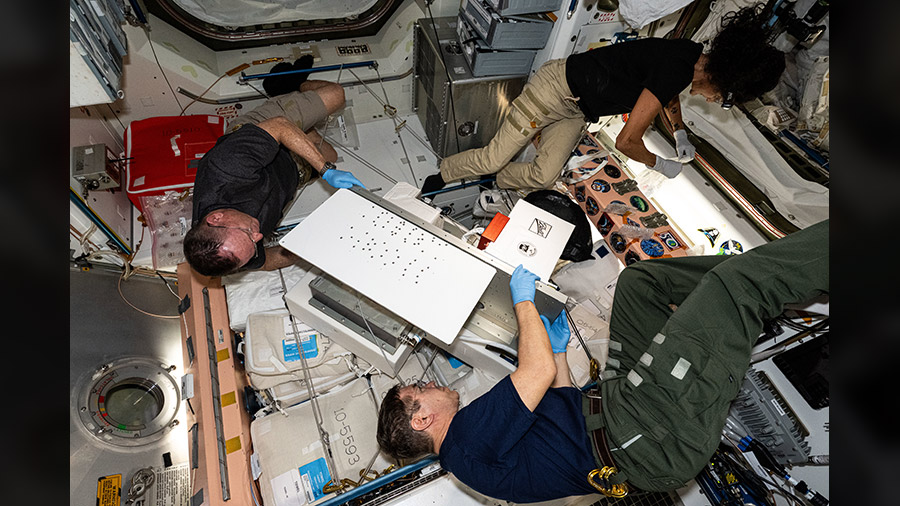
Clockwise from bottom, NASA astronauts Mike Barratt, Butch Wilmore, and Suni Williams work on science maintenance inside the International Space Station's Unity module.
Clockwise from bottom, NASA astronauts Mike Barratt, Butch Wilmore, and Suni Williams work on science maintenance inside the International Space Station’s Unity module.

Blood sample collections and eye scans took a big part of the day on Tuesday as the International Space Station residents continuously explore how living in space affects their bodies. The two crews representing Expedition 71 and NASA’s Boeing Crew Flight Test also trained for robotics activities, serviced spacesuits, and kept up household tasks aboard the orbital outpost.

NASA astronauts Matthew Dominick and Mike Barratt began the day collecting their blood and saliva samples to help scientists understand how microgravity affects cellular immune functions. NASA Flight Engineer Jeanette Epps gathered the samples from the duo, first stowing the saliva specimens in a science freezer, then spinning the blood samples in a centrifuge, before inserting the sample tubes inside the Kubik research incubator for later observations.

The trio joined up again for a series of eye checks with fellow astronauts Butch Wilmore and Suni Williams of NASA and cosmonauts Nikolai Chub and Alexander Grebenkin of Roscosmos. Epps, Dominick, and Chub led the eye scans using the Ultrasound 2 device to image their crewmates’ cornea, lens, and optic nerve. Doctors on Earth monitored the scans in real-time ensuring the crew captured the right imagery to learn how to protect and treat crew vision issues in space.

At the end of the day, Barratt partnered with NASA Flight Engineer Tracy C. Dyson for more eye checks as the duo explored how weightlessness affects the retina’s response to light. Dyson and researchers on the ground observed Barratt as sensors attached to the side of his eyes measured his retinal function during the hourlong test. The eye exam is just one of 14 studies that comprise the CIPHER investigation devoted to astronaut health and well-being.

Barratt and Dominick also teamed up inside the Kibo laboratory module to reroute cables, reorganize cargo, and clean up trash. Dominick then joined Epps on the robotics workstation simulator and practiced techniques to capture the Cygnus space freighter with the Canadarm2 robotic arm. Dyson also got ready for the Cygnus cargo mission, due to launch on Aug. 3 and arrive on Aug. 5, reviewing mission operations and cargo procedures once the Northrop Grumman spacecraft is berthed to the Unity module.

Aside from eye checks, Starliner Commander Butch Wilmore and Pilot Suni Williams hand their hands full all day with station maintenance duties. Wilmore cleaned up cargo and photographed open spaces inside the Columbus laboratory module while Williams worked in the Quest airlock servicing spacesuit components. Next, the duo gathered for a conference with Boeing mission controllers then reviewed the upcoming Cygnus cargo mission.

Grebenkin removed his body sensors and completed a 24-hour session that recorded his heart rate and blood pressure. Afterward, he photographed Earth landmarks using a specialized camera that captures image data beyond the spectral range of the human eye. Chub participated in cargo cleanup duties in the Zarya module then worked on life support and electronic systems maintenance. Commander Oleg Kononenko cleaned fans and filters in Zarya before inspecting and photographing windows in the Zvezda service module. At the end of the day, Kononenko took turns with Chub studying ways to improve communications between international crews and mission controllers.

Powered by WPeMatico

Get The Details…

Mark Garcia

NASA, Boeing Complete Second Docked Starliner Hot Fire Test

NASA, Boeing Complete Second Docked Starliner Hot Fire Test

Image shows Boeing's Starliner crew capsule docked to the Harmony module's forward port at the International Space Station
Boeing’s Starliner crew capsule docked to the Harmony module’s forward port at the International Space Station on July 3, 2024.
Photo credit: NASA

Engineering teams with NASA and Boeing completed a hot fire test of the Starliner spacecraft’s reaction control system jets on July 27 to evaluate the spacecraft’s propulsion system. NASA astronauts Butch Wilmore and Suni Williams, assigned to the agency’s Boeing Crew Flight Test, were seated inside the docked spacecraft during the test as part of preparations before their return aboard Starliner from the International Space Station.

The test involved firing 27 of the spacecraft’s 28 jets for short bursts, moving through them one at a time to check thruster performance and helium leak rates. Preliminary results show all the tested thrusters are back to preflight levels based on thrust and chamber pressure.

As part of the test configuration, all helium manifolds, which control and direct the flow of helium, were opened allowing engineers to continue evaluation of Starliner’s helium supply and leak rates. The teams verified Starliner continues to show the margin needed to support a return trip from the station. Following the test, the helium manifolds were closed and will remain closed until Starliner activates its propulsion system ahead of undocking. Teams also will verify the helium leak rate before Starliner undocks.

Teams are reviewing data from the docked hot fire test and the recent ground testing of a Starliner thruster at NASA’s White Sands Test Facility in New Mexico before holding an agency return readiness review. Following this agency-level review, NASA and Boeing will select a target return date.

While ground teams work to finalize Starliner’s return to Earth, Wilmore and Williams continue to work alongside the Expedition 71 crew, assisting with science investigations and maintenance activities. On July 29, Wilmore and Williams entered their spacecraft and checked its water systems, called down to Boeing mission personnel for a conference, and put on their space suits long enough to perform a pressure test. Wilmore started his morning in the Harmony module, assembling the BioServe centrifuge as Williams reviewed procedures for operating the Astrobee free-flying robotic assistants.

For the latest mission updates, follow the commercial crew blog, @commercial_crew on X, and commercial crew on Facebook.

Powered by WPeMatico

Get The Details…

Danielle Sempsrott

Crews Prep for Cargo Mission and Checks Out Starliner Systems

Crews Prep for Cargo Mission and Checks Out Starliner Systems

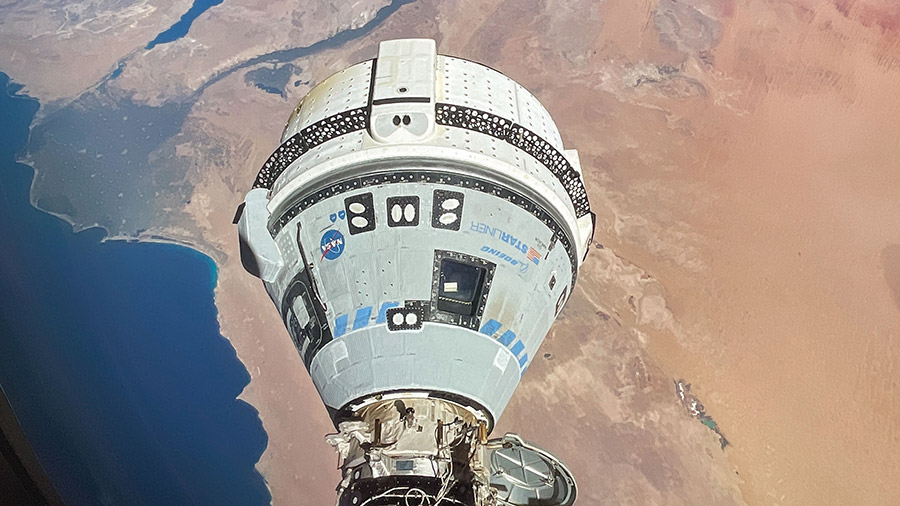
Boeing's Starliner spacecraft is pictured docked to the Harmony module's forward port as the International Space Station orbited above Egypt's Mediterranean coast.
Boeing’s Starliner spacecraft is pictured docked to the Harmony module’s forward port as the International Space Station orbited above Egypt’s Mediterranean coast.

The Expedition 71 crew turned its attention to an upcoming U. S. cargo mission, spacesuit work, and a variety of life science on Monday. NASA’s Boeing Crew Flight Test members began the week servicing their Starliner flight suits and the spacecraft’s life support systems following a morning of light research duties.

The next cargo mission to resupply the residents living and working aboard the International Space Station is counting down to a launch at 11:28 a.m. EDT on Saturday from Kennedy Space Center in Florida. Northrop Grumman’s Cygnus space freighter will launch atop a SpaceX Falcon 9 rocket carrying 8,200 pounds of science, supplies, and hardware for the station. Cygnus will orbit Earth for just over a day-and-a-half before approaching the orbital outpost where the Canadarm2 robotic arm will be waiting to capture the spacecraft.

NASA Flight Engineers Matthew Dominick and Jeanette Epps spent Monday preparing for Cygnus’ arrival reviewing its mission profile and practicing robotic capture maneuvers on a computer. Dominick will command the Canadarm2 to capture Cygnus at 5 a.m. on Aug. 5 while Epps backs him up and monitors the approach and rendezvous activities. Afterward, robotics controllers on the ground will remotely take over Canadarm2 and guide Cygnus toward the Unity module’s Earth-facing port where it will be mated for five-and-a-half months.

NASA Flight Engineer Mike Barratt kicked off his day checking on plumbing hardware stowed in the Zarya module before swapping components and configuring a U.S. spacesuit in the Quest airlock. NASA astronaut Tracy C. Dyson spent her morning in the Columbus laboratory module troubleshooting the MARES rack, or Muscle Atrophy Research and Exercise System, then spent the afternoon installing drawer handle brackets on a pair of Human Research Facility racks.

Starliner Commander Butch Wilmore and Pilot Suni Williams entered their spacecraft Monday afternoon and checked its water systems, called down to Boeing mission personnel for a conference, then wore their flight suits momentarily for a pressure test. Wilmore started his morning in the station’s Harmony module assembling the BioServe centrifuge as Williams reviewed procedures for operating the Astrobee free-flying robotic assistants.

The orbiting lab’s three cosmonauts refocused their activities on Monday to standard space research and lab maintenance duties following a week of inspection tasks in the orbital outpost’s Roscosmos segment. Flight Engineer Nikolai Chub worked all day on science first studying a 3D printer’s ability to manufacture tools in microgravity, then explored how magnetic and electrical fields affect fluid physics, before finally installing hardware to image Earth’s nighttime atmosphere in near-ultraviolet wavelengths. Flight Engineer Alexander Grebenkin attached sensors to himself during the morning for a 24-session measuring his heart rate and blood pressure. Afterward, he pointed a camera outside a station window taking pictures for a pair of Earth observation studies. At the beginning of his shift, station Commander Oleg Kononenko installed radiation detection hardware cables then inventoried food rations.


Learn more about station activities by following the space station blog, @space_station and @ISS_Research on X, as well as the ISS Facebook and ISS Instagram accounts.

Get weekly video highlights at: https://roundupreads.jsc.nasa.gov/videoupdate/

Get the latest from NASA delivered every week. Subscribe here: www.nasa.gov/subscribe

Powered by WPeMatico

Get The Details…

Mark Garcia