Hubble Observes Stars Flaring to Life in Orion

Hubble Observes Stars Flaring to Life in Orion

3 min read

Hubble Observes Stars Flaring to Life in Orion

Just-forming stars, called protostars, dazzle a cloudy landscape in the Orion Molecular Cloud complex (OMC). These three new images from NASA’s Hubble Space Telescope were taken as part of an effort to learn more about the envelopes of gas and dust surrounding the protostars, as well as the outflow cavities where stellar winds and jets from the developing stars have carved away at the surrounding gas and dust.

Scientists used these Hubble observations as part of a broader survey to study protostellar envelopes, or the gas and dust around the developing star. Researchers found no evidence that the outflow cavities were growing as the protostar moved through the later stages of star formation. They also found that the decreasing accretion of mass onto the protostars over time and the low rate of star formation in the cool, molecular clouds cannot be explained by the progressive clearing out of the envelopes.

The OMC lies within the “sword” of the constellation Orion, roughly 1,300 light-years away.

A tumultuous orange cloud of gas and dust is laced with areas of dark dust and scattered with bright stars.
Protostar HOPS 181 is buried in layers of dusty gas clouds, but its energy shapes the material that surrounds it.
NASA, ESA, and T. Megeath (University of Toledo); Processing: Gladys Kober (NASA/Catholic University of America)

This Hubble image shows a small group of young stars amidst molecular clouds of gas and dust. Near the center of the image, concealed behind the dusty clouds, lies the protostar HOPS 181. The long, curved arc in the top left of the image is shaped by the outflow of material coming from the protostar, likely from the jets of particles shot out at high speeds from the protostar’s magnetic poles. The light of nearby stars reflects off and is scattered by dust grains that fill the image, giving the region its soft glow.

A jet streams diagonally out from upper right corner of the orange-colored image to the center, across a field of gas clouds and stars. While most of the image is full of gas, the upper right corner is mostly clear of gas and dust, and more stars are visible in this darker space.
A protostar wrapped in obscuring dust creates a cavity with glowing walls while its jet streams into space.
NASA, ESA, and T. Megeath (University of Toledo); Processing: Gladys Kober (NASA/Catholic University of America)

The bright star in the lower right quadrant called CVSO 188 might seem like the diva in this image, but HOPS 310, located just to the left of center behind the dust, is the true hidden star. This protostar is responsible for the large cavity with bright walls that has been carved into the surrounding cloud of gas and dust by its jets and stellar winds. Running diagonally to the top right is one of the bipolar jets of the protostar. These jets consist of particles launched at high speeds from the protostar’s magnetic poles. Some background galaxies are visible in the upper right of the image.

A bright protostar is nestled within a cavern-like gap in a cloud of gas and dust to the left. To the right, the gas cloud fades away to show a area thick with glittering stars.
A curving cavity in a cloud of gas has been hollowed out by a protostar in this Hubble image.
NASA, ESA, and T. Megeath (University of Toledo); Processing: Gladys Kober (NASA/Catholic University of America)

The bright protostar to the left in this Hubble image is located within the Orion Molecular Clouds. Its stellar winds — ejected, fast-flowing particles that are spurred by the star’s magnetic field — have carved a large cavity in the surrounding cloud. In the top right, background stars speckle the image.

New images added every day between January 12-17, 2026! Follow @NASAHubble on social media for the latest Hubble images and news and see Hubble’s Stellar Construction Zones for more images of young stellar objects.

Explore More

Media Contact:

Claire Andreoli
NASA’s Goddard Space Flight CenterGreenbelt, MD
claire.andreoli@nasa.gov

Powered by WPeMatico

Get The Details…

Fire on Ice: The Arctic’s Changing Fire Regime

Fire on Ice: The Arctic’s Changing Fire Regime

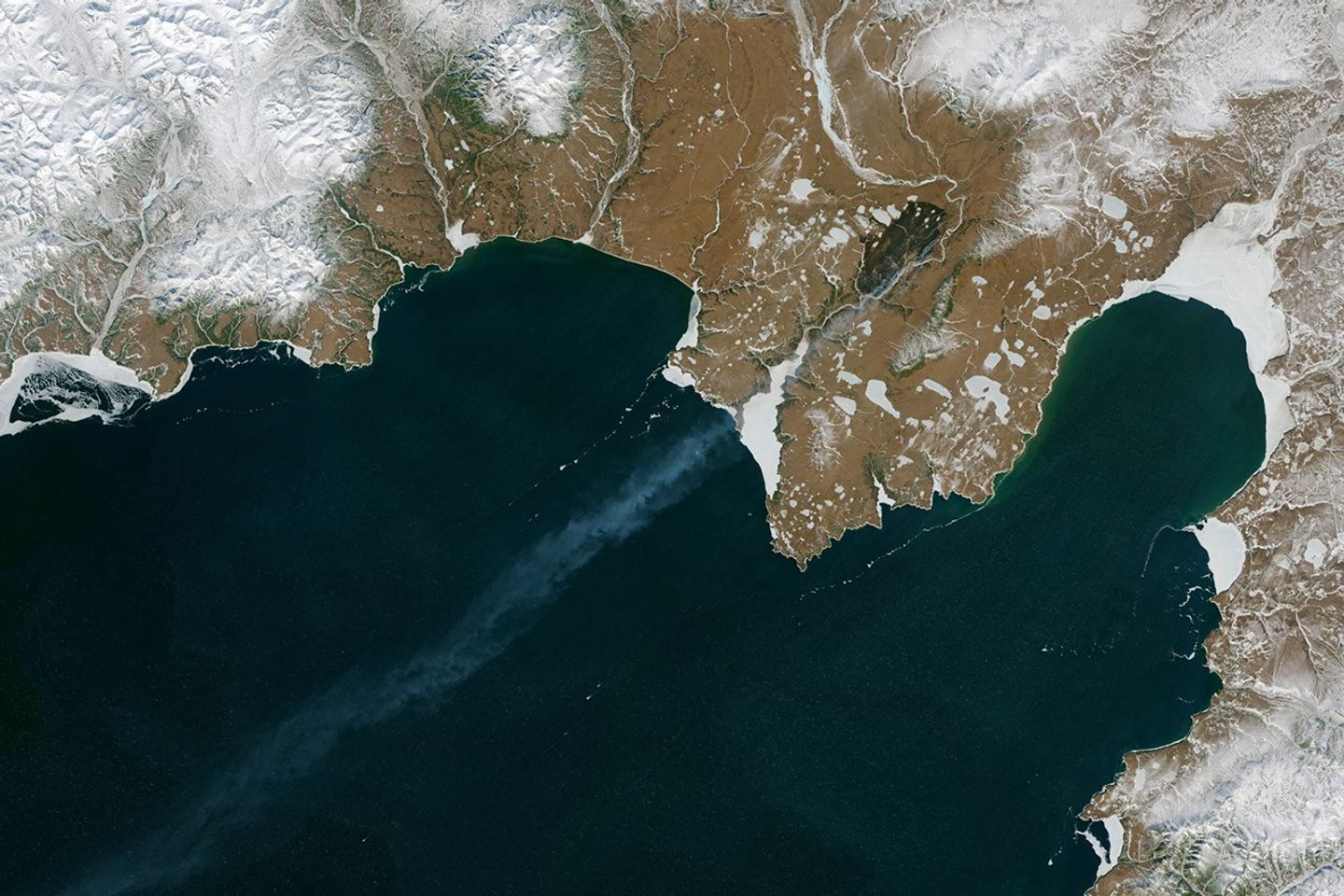
Satellite view of a wildfire burning between frozen terrain and lakes in Siberia’s Magadan Oblast, producing a large smoke plume that extends over the water.
The Operational Land Imager (OLI) on Landsat 8 captured this image of a fire burning in the Magadan Oblast district of Siberia on April 8, 2019.
NASA Earth Observatory image by Joshua Stevens, using Landsat data from the U.S. Geological Survey.

The number of wildland fires burning in the Arctic is on the rise, according to NASA researchers. Moreover, these blazes are burning larger, hotter, and longer than they did in previous decades. 

These trends are closely tied to the region’s rapidly changing climate. The Arctic is warming nearly four times faster than the global average, a shift that directly impacts rain and snow in the region and decreases soil moisture, both of which make the landscape more flammable. Lightning, the primary ignition source of Arctic fires, is also occurring farther north. These findings are detailed in a report published in 2025 by the Arctic Monitoring and Assessment Programme (AMAP), a working group of the Arctic Council. 

“Fire has always been a part of boreal and Arctic landscapes, but now it’s starting to act in more extreme ways that mimic what we’ve seen in the temperate and the tropical areas,” said Jessica McCarty, Deputy Earth Science Division Chief at NASA’s Ames Research Center and an Arctic fire specialist. McCarty, the report’s lead author, worked as part of an international team for AMAP.

But it’s not just the number of fires that concerns scientists; it’s how hot they burn. 

“It’s the intensity that worries us the most because it has the most profound impact on how ecosystems are changing,” said Tatiana Loboda, chair of the Department of Geographical Sciences at the University of Maryland. 


2002-2012
2012-2024

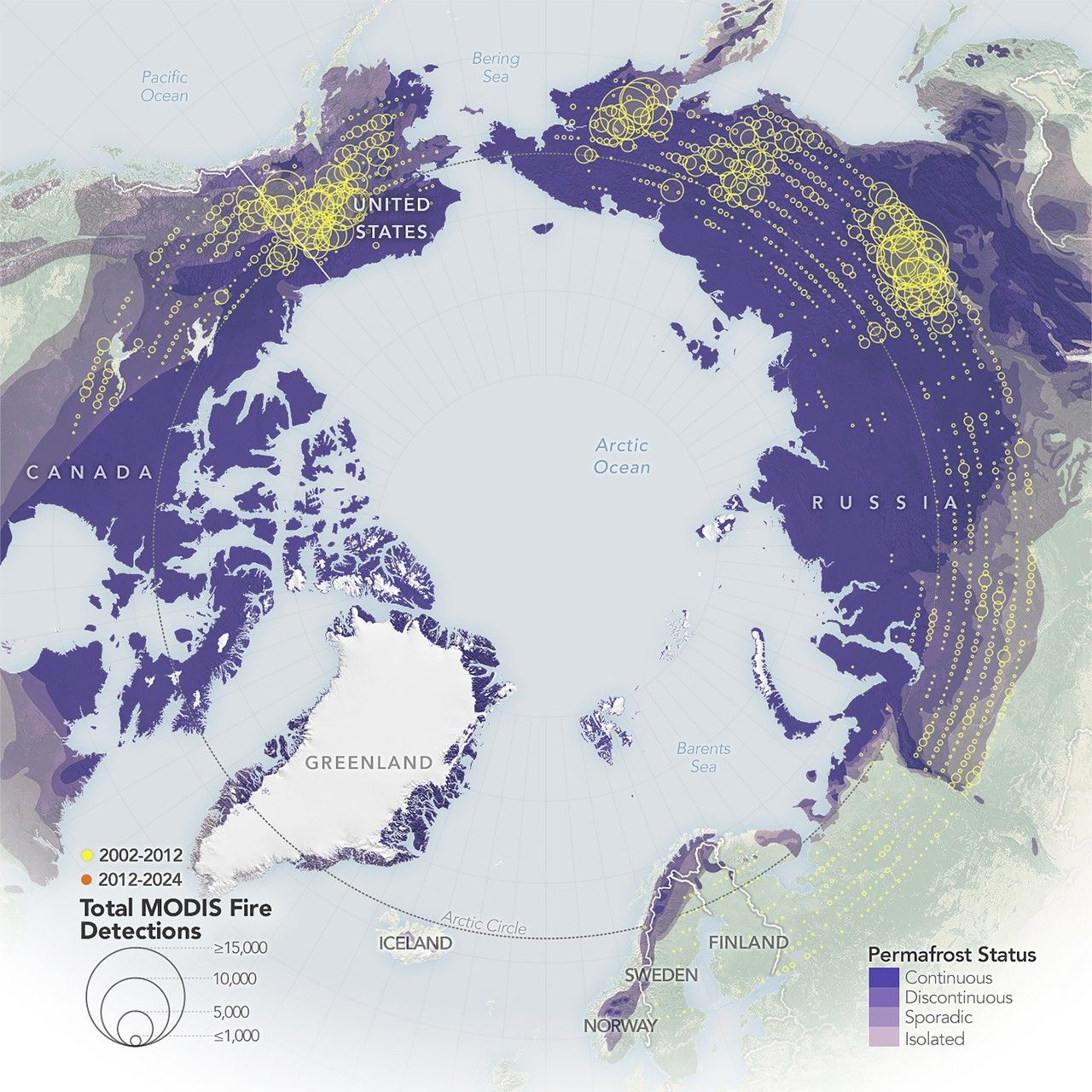
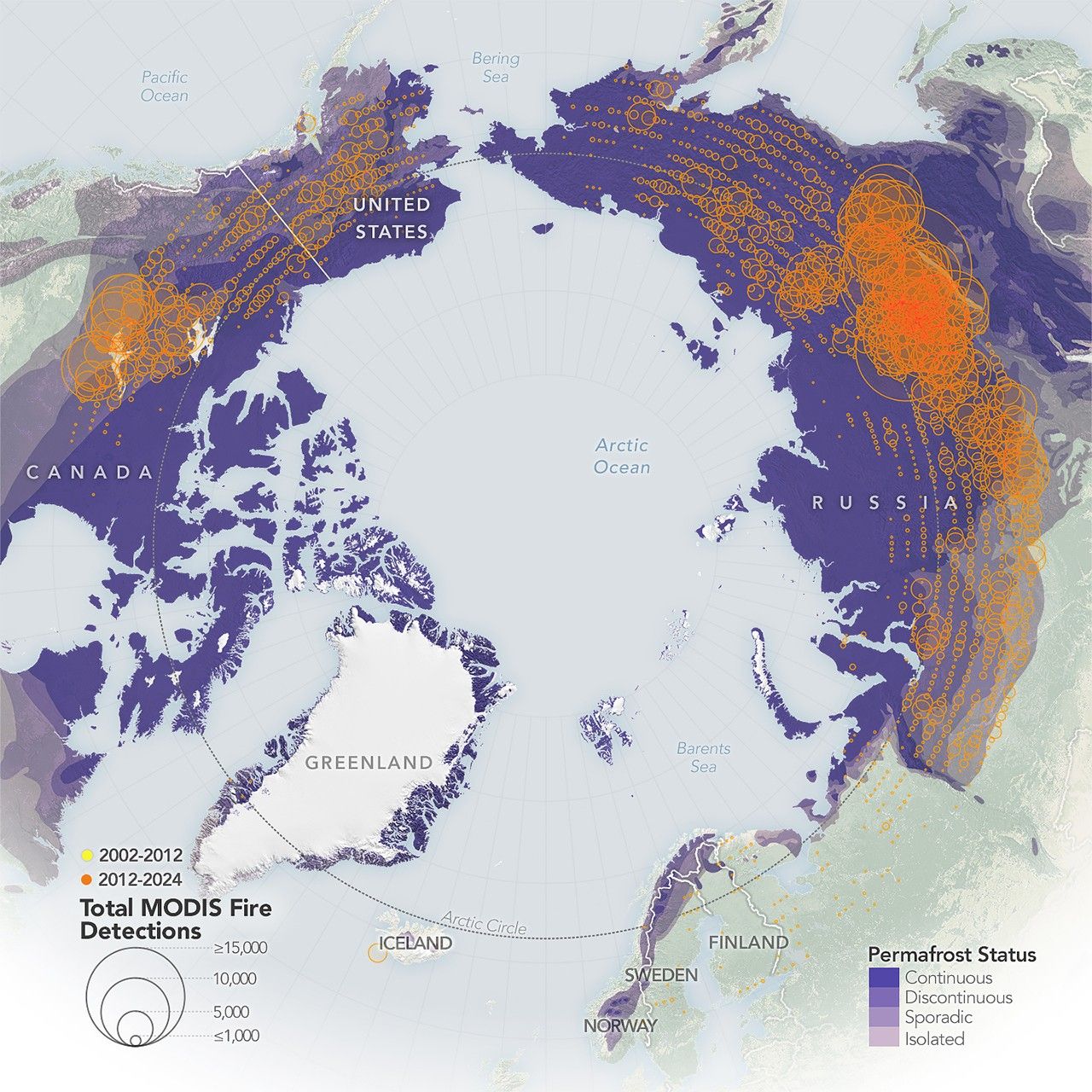
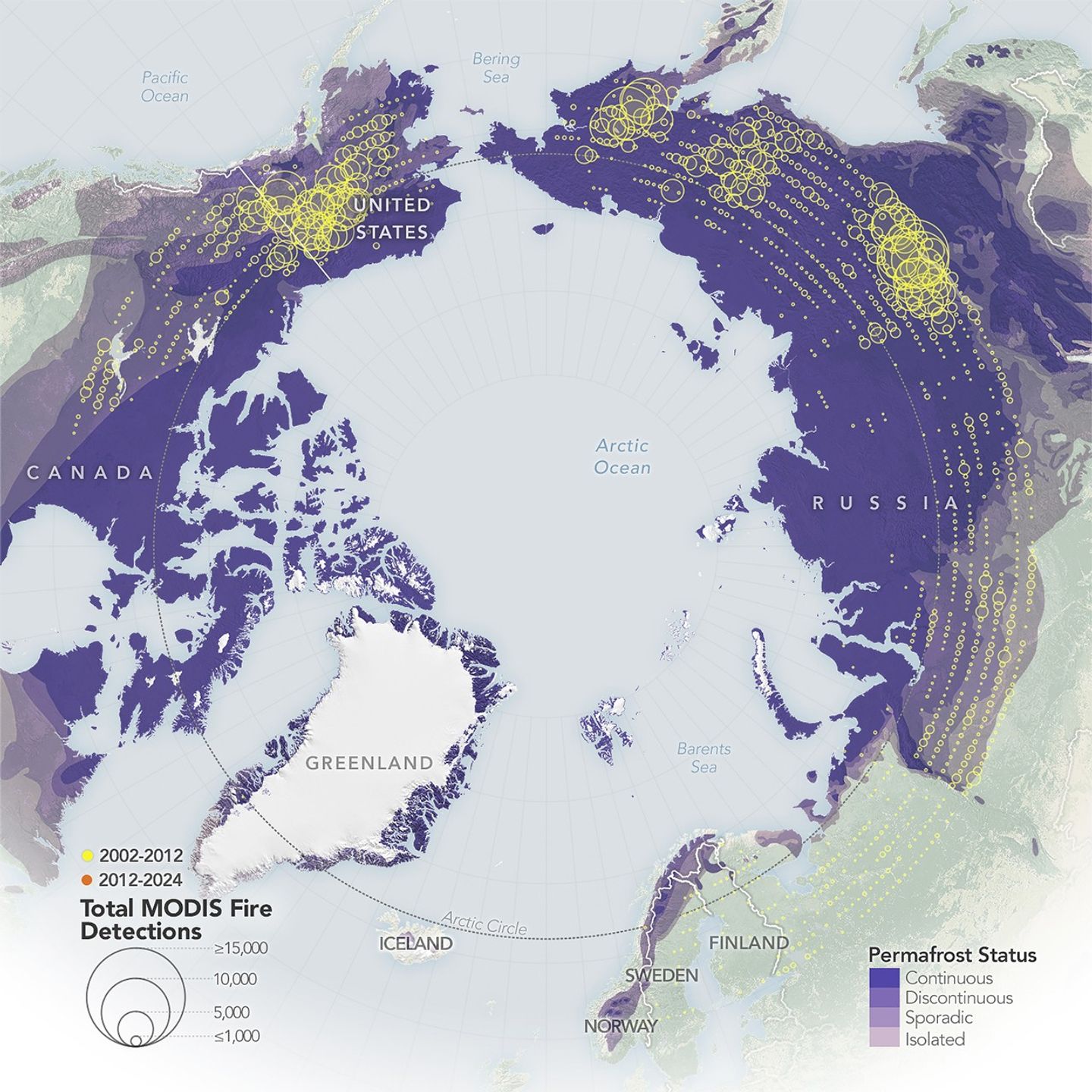
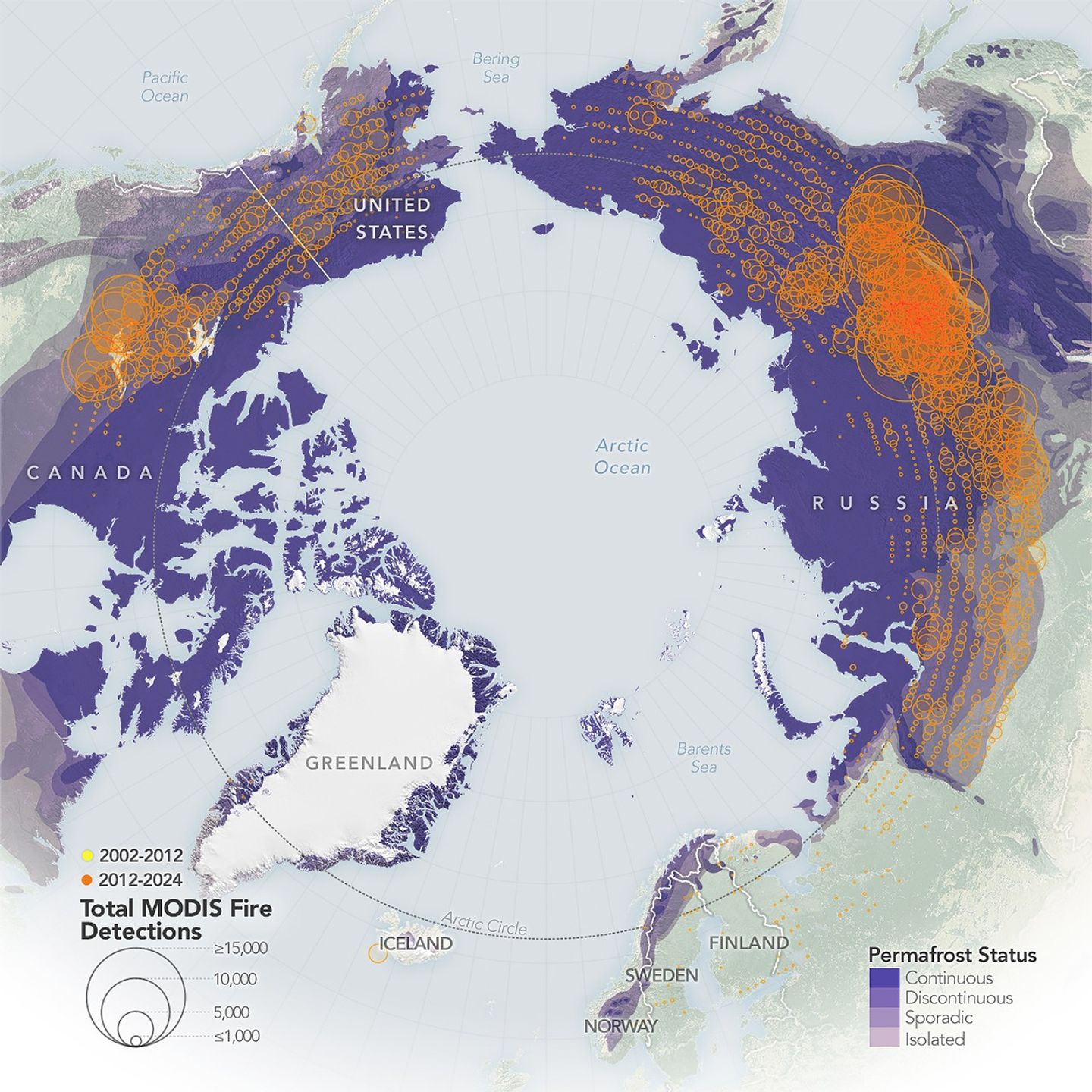
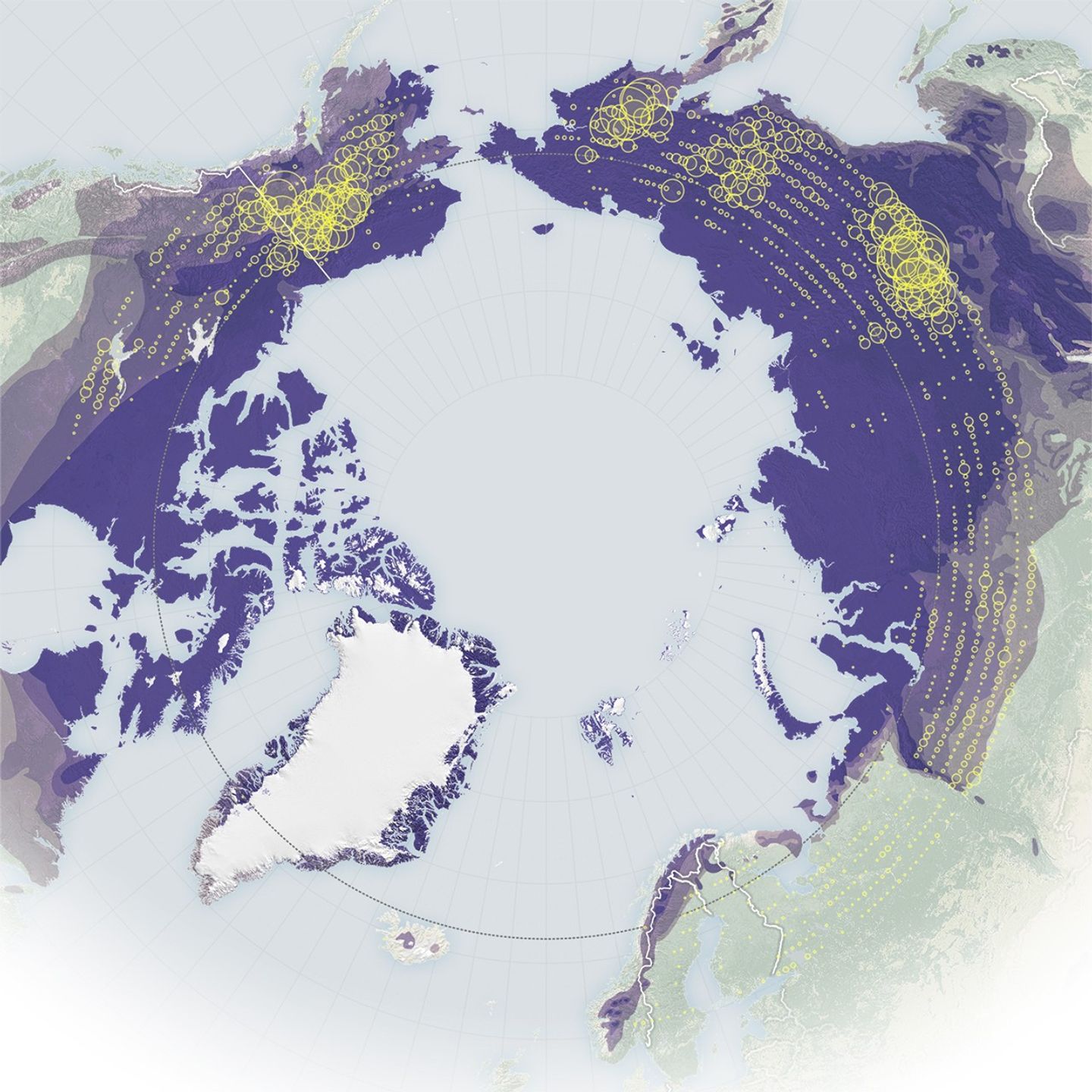
Side-by-side maps centered on the Arctic display satellite-based fire detections from NASA’s MODIS instrument, with yellow circles representing detections acquired from 2002–2012 (left) and red circles for detections acquired from 2012–2024 (right), revealing increased fire activity and a shift toward higher latitudes.
NASA Earth Observatory

Side-by-side maps centered on the Arctic display satellite-based fire detections from NASA’s MODIS instrument, with yellow circles representing detections acquired from 2002–2012 (left) and red circles for detections acquired from 2012–2024 (right), revealing increased fire activity and a shift toward higher latitudes.
NASA Earth Observatory

Side-by-side maps centered on the Arctic display satellite-based fire detections from NASA’s MODIS instrument, with yellow circles representing detections acquired from 2002–2012 (left) and red circles for detections acquired from 2012–2024 (right), revealing increased fire activity and a shift toward higher latitudes.
NASA Earth Observatory
Side-by-side maps centered on the Arctic display satellite-based fire detections from NASA’s MODIS instrument, with yellow circles representing detections acquired from 2002–2012 (left) and red circles for detections acquired from 2012–2024 (right), revealing increased fire activity and a shift toward higher latitudes.
NASA Earth Observatory

2002-2012

2012-2024


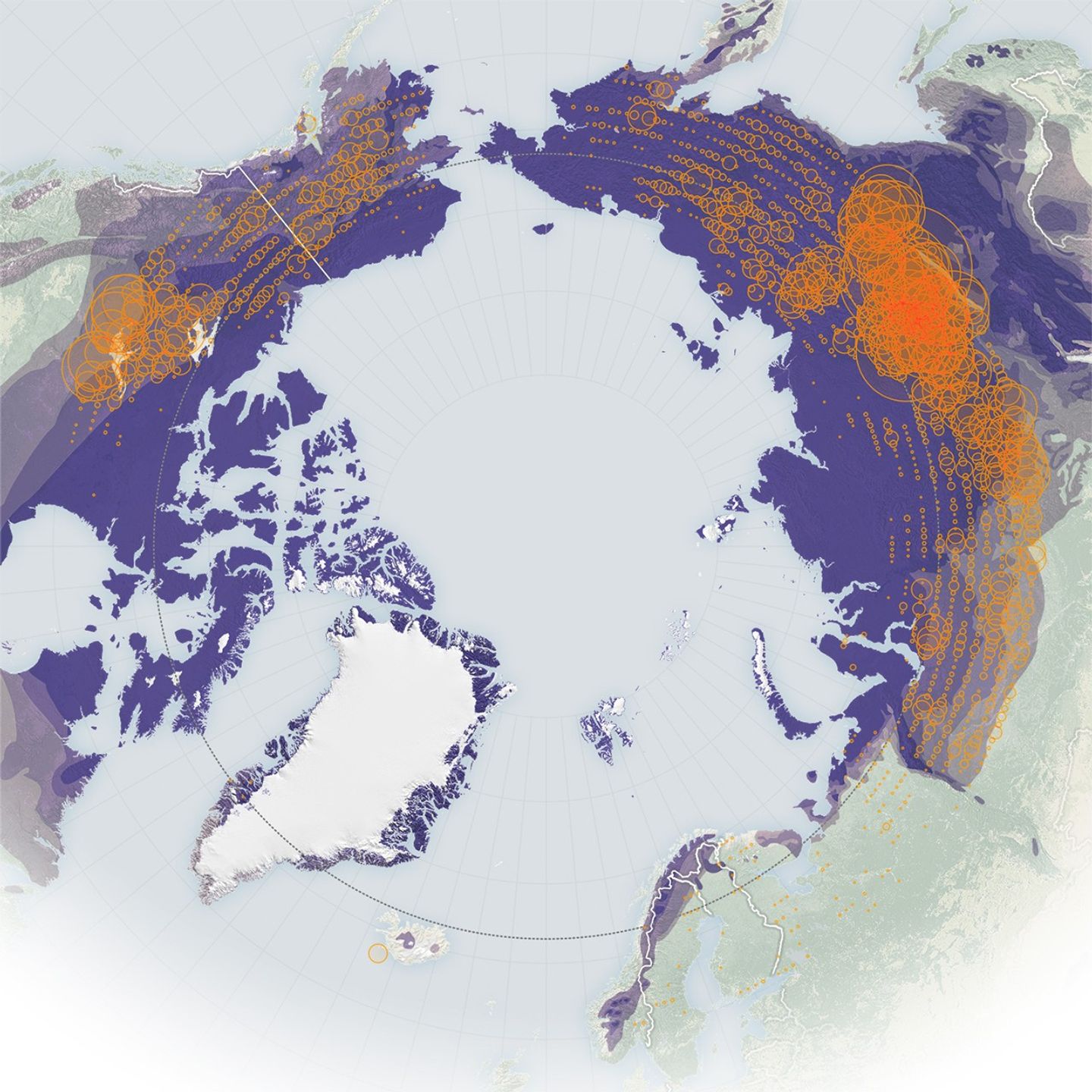
These maps show the number of fires detected by NASA’s MODIS instrument on the Terra and Aqua satellites from 2002 to 2012 (yellow) and 2012 to 2025 (orange), highlighting an increase in fire activity and a poleward shift over time. NASA Earth Observatory maps by Michala Garrison using data from NASA’s Fire Information for Resource Management System (FIRMS).

Arctic ecosystems: How are there fires in the Arctic?

The word ‘Arctic’ often conjures images of glaciers, snow, and a frozen ocean. So how can such a place catch fire?

Officially, the Arctic refers to the region north of 66.5 degrees north, though many Arctic researchers study 60 degrees north and above. While much of the area is covered in snow and ice, the Arctic also boasts a diverse range of ecosystems that change as they extend toward the pole. 

It begins with boreal forests, which are primarily made up of coniferous trees like spruce, fir, and pine. As these forests thin to the north, they give way to shrublands, then to grassland tundra, and eventually to rock, ice, and polar bears.

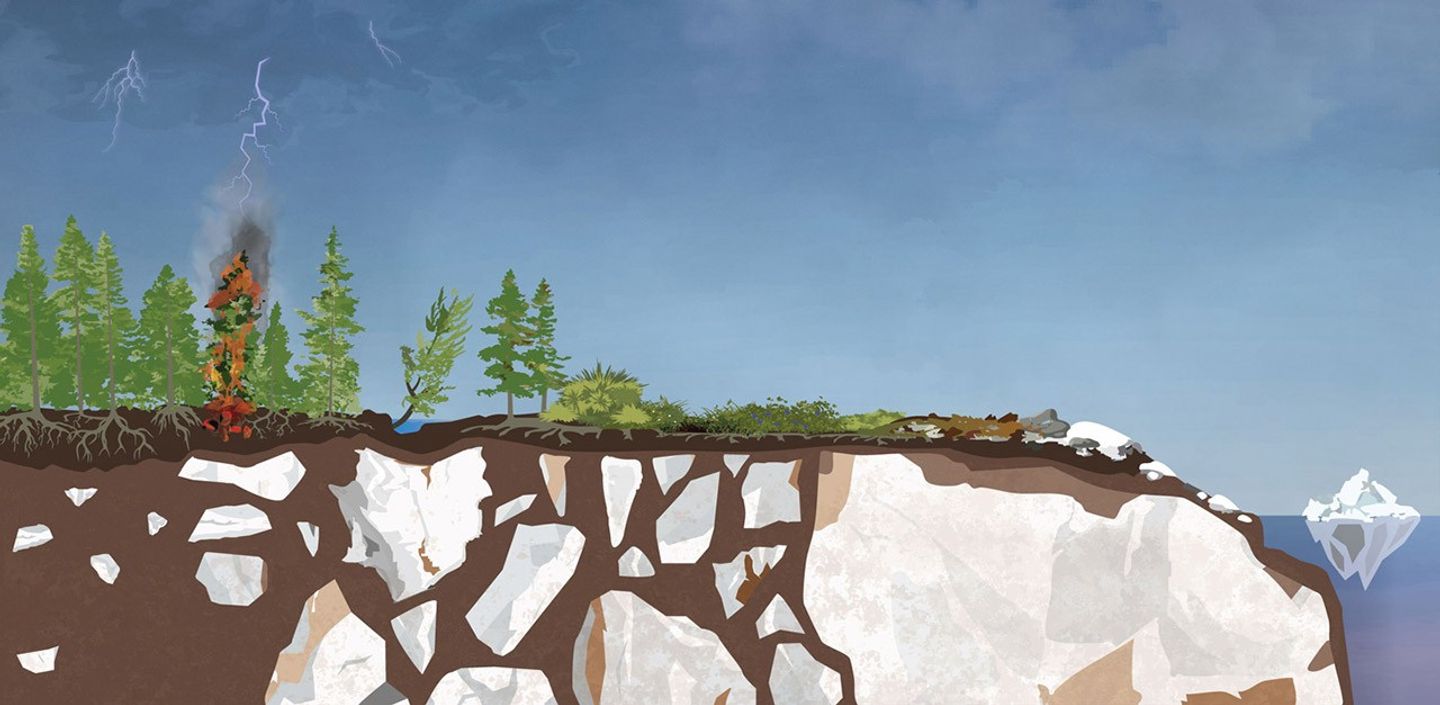
A cartoon-like schematic of an arctic ecosystem shows a cutaway of the ground, revealing a layer with areas of permafrost. This layer is topped by unfrozen soil with trees, one of which has been hit by lightning and is burning. An iceberg and open water are visible to the right.
Illustration by Esther Suh, NASA’s Ames Research Center.

Much of the vegetation is covered in snow during the winter, which thaws in the spring. Exposed, the vegetation dries out in the sunlight. When given an ignition source like a lightning strike, it can quickly become fuel for a fire. 

What is changing?

According to the 2025 AMAP report, an increasingly flammable landscape combined with more lightning strikes is leading to larger, more frequent, and more intense fires than the landscape is adapted for.

“There is variability year to year, but across the decades we are averaging about double the burned area in the North American Arctic compared to the mid-20th century,” said Brendan Rogers, senior scientist at the Woodwell Climate Research Center. 

Low-intensity fires, which the Arctic is accustomed to, leave most of the forest standing, which allows the understory and upper soil layers to recover quickly. 

In contrast, intense fires kill off trees and can trigger a process known as secondary succession, in which new species replace those that died. These fires also burn deep into the carbon-rich soil, change the area’s hydrology, and accelerate snowmelt. In addition, the smoke and habitat damage from massive, hot fires pose significant health risks to human communities and local wildlife.

2017-08-03 00:00:00
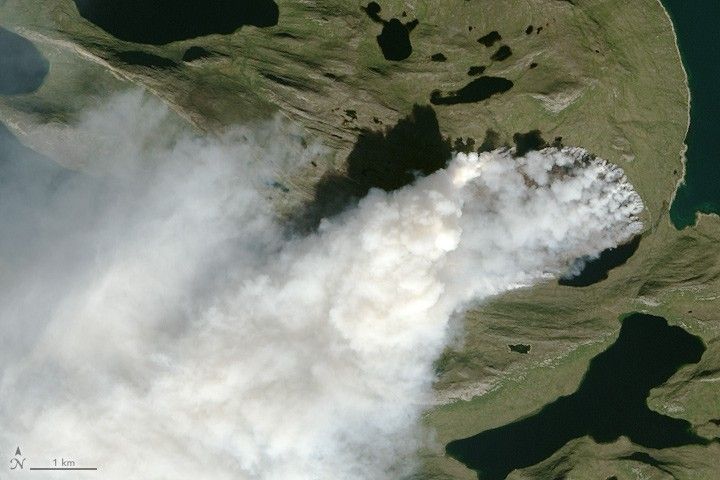
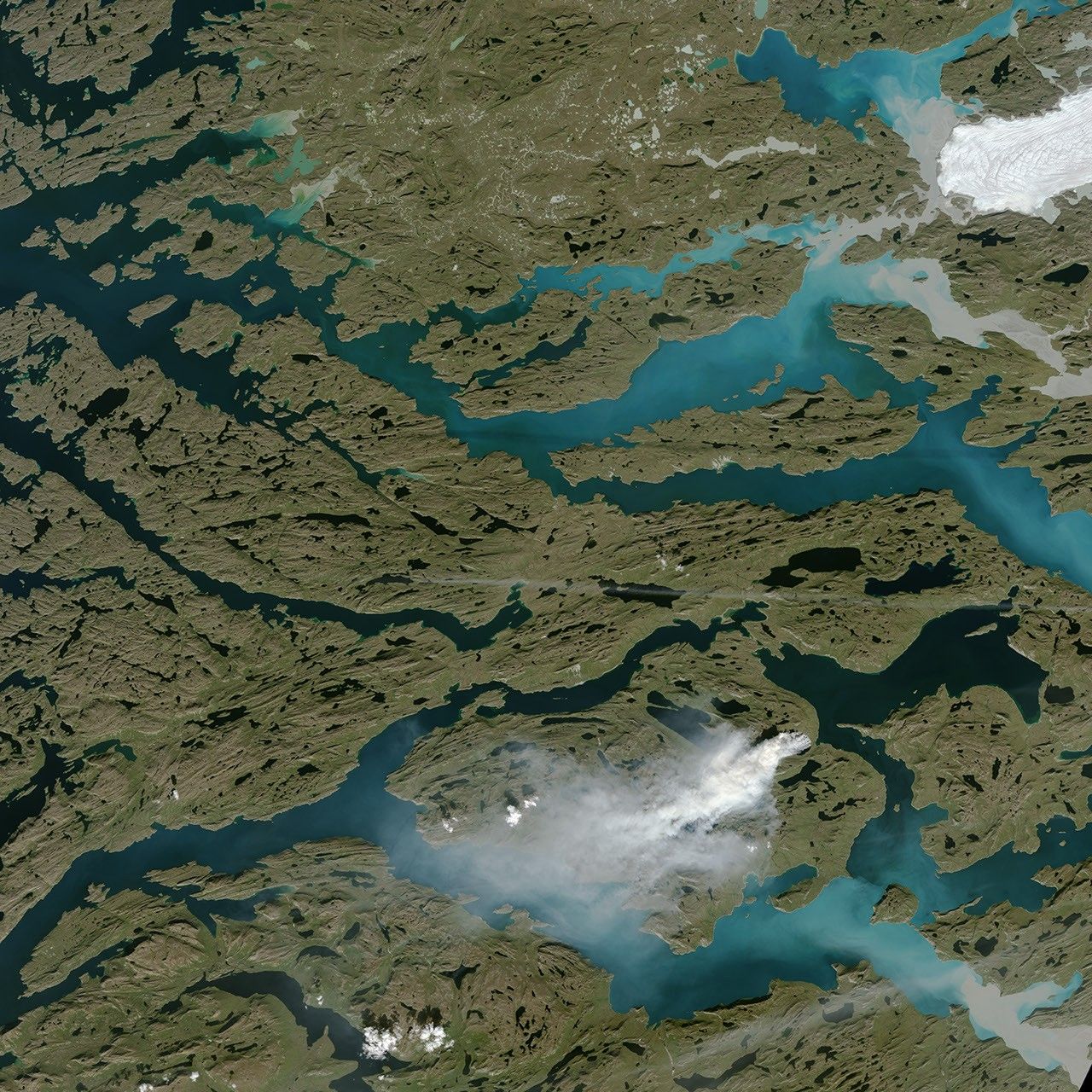
The Operational Land Imager (OLI) on Landsat 8 captured this image of a large wildfire in western Greenland on August 3, 2017. Satellites first detected evidence of the fire on July 31, 2017.
NASA Earth Observatory image by Jesse Allen using Landsat data from the U.S. Geological Survey.

The mid-2010s ushered in a novel fire regime. For instance, Greenland saw significant wildfires in 2015, 2017, and in 2019. Researchers also began observing fires consistently springing up in the Arctic as early as late March, much earlier in the year than historical records show, and burning well after the first snow.  “It’s concerning how frequently these fires burn the same place,” Loboda said. “A lot of areas now burn two, three, or even five times during a very short period. It’s an immense impact: It’s happening across the tundra and the boreal regions, and these areas can’t recover.”

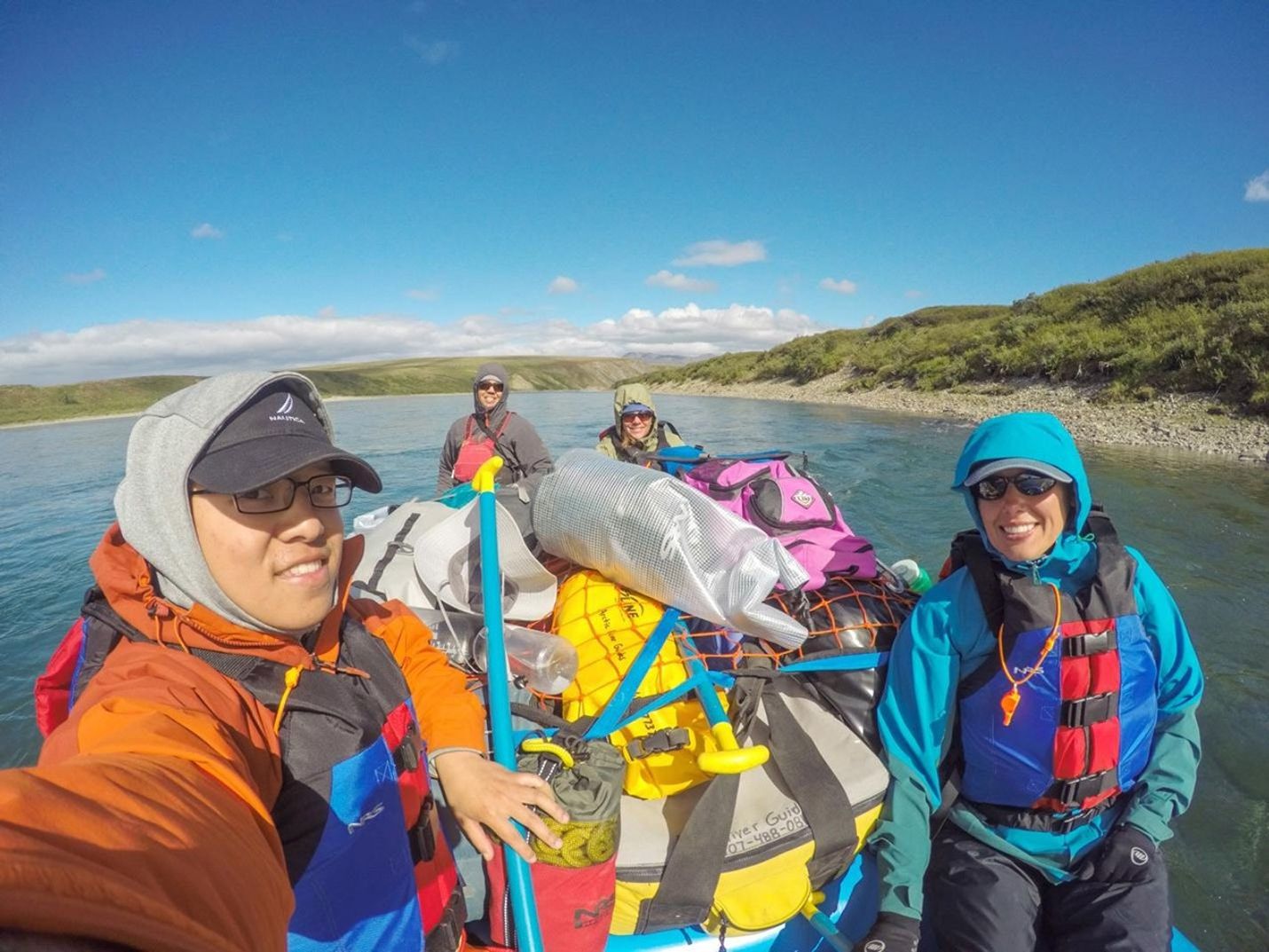
People wearing rain gear and life vests sit on a raft piled high with brightly colored equipment.
In summer 2016, Tatiana Loboda (right) rafted through the North American Arctic to collect samples across tundra sites. The work, part of NASA’s Arctic-Boreal Vulnerability Experiment (ABoVE), investigates how repeat fires impact the ecosystem over short and long timescales.
Photo by Dong Chen (left), University of Maryland.

Peat, permafrost, and zombie fires

What makes Arctic ecosystems, and by extension Arctic fire, unique compared to much of the world is what is happening below ground: specifically in the peat and permafrost. 

Peat is old—thousands and thousands of years old. 

When glaciers retreated at the end of the last ice age, they left behind deposits of old trees, grasses, and other organic matter that have partially decomposed to form carbon-rich soil. Over time, layers of deposits built up into peat, which is now a primary ingredient in soil across the Arctic. 

When intense fires burn into deep peat deposits, they can create a phenomenon called a holdover fire, more commonly known as a zombie fire, in which remnants of fire stay alive throughout the winter. These fires appear extinguished on the surface but continue to smolder underground through the winter, bursting back to life when spring brings drier conditions. 

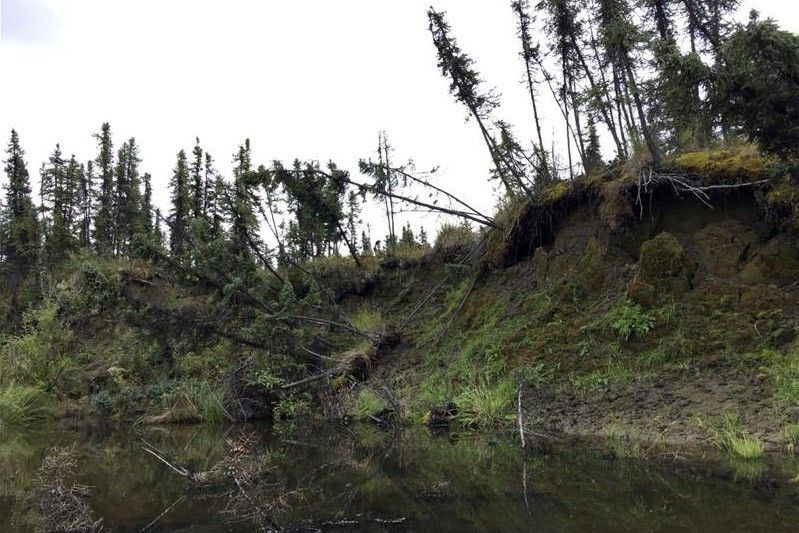
Evergreen trees tilt toward a pond as erosion destabilizes their roots along a steep bank.
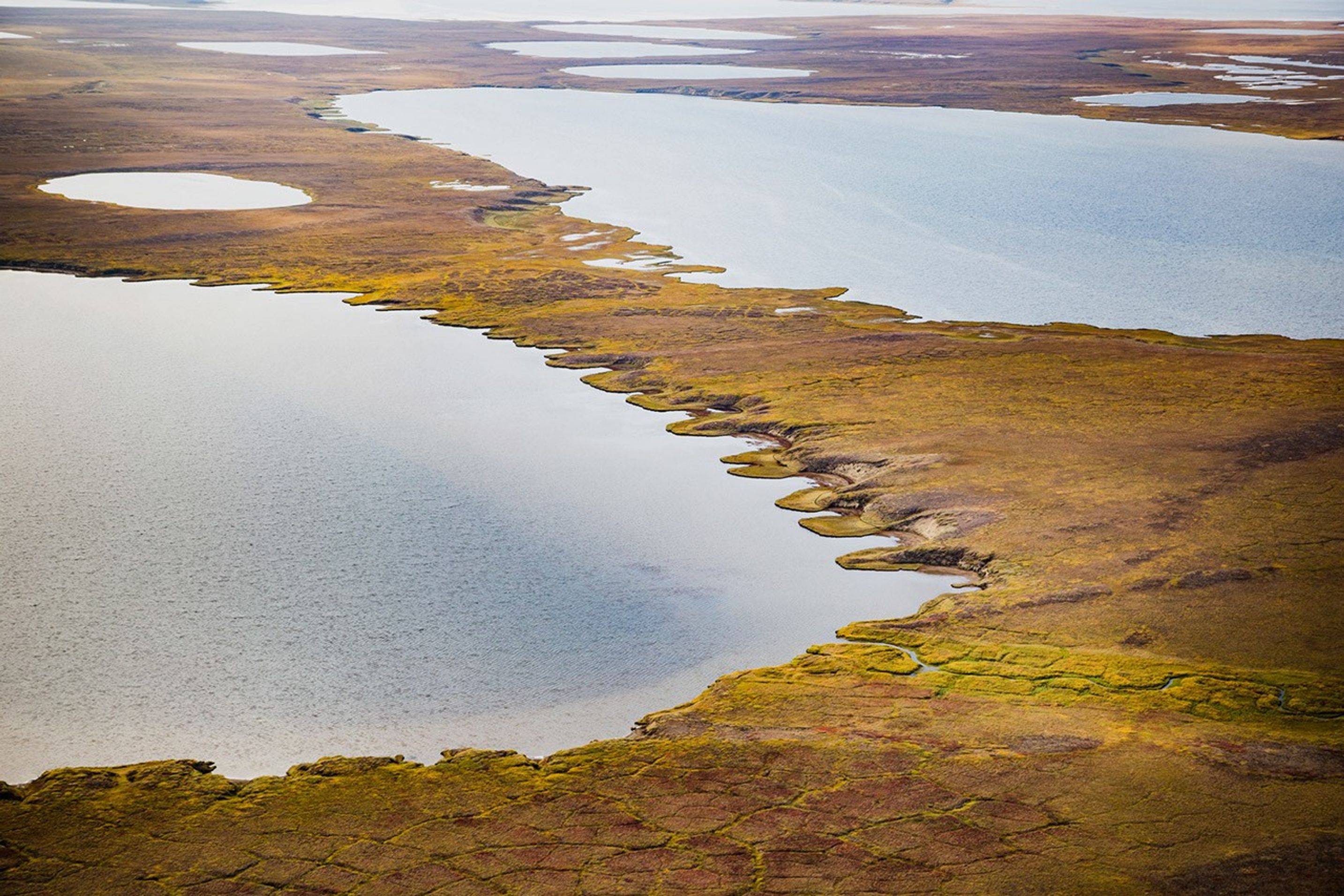
Scalloped pond edges are surrounded by short brown, green, and yellow vegetation.
Thawing permafrost reshapes the surface across ecosystems. Top: Thawing permafrost in a boreal forest causes the surface to cave in, tilting and toppling trees into a “drunken forest.” Bottom: Thawing permafrost in the tundra creates scalloped pond edges, as pockets of ice melt and water moves through the soil to pool on the surface.
Photos by Clayton Elder, NASA’s Ames Research Center.

Permafrost—ground that remains frozen year-round—can be even older. Some permafrost predates the human species, Homo sapiens, remaining continuously frozen for more than 400,000 years. This age is what makes these frozen layers so significant: They’ve been storing ancient organic matter, and the carbon within it, for millennia. 

When organisms die and decompose, that process naturally releases carbon dioxide and methane. In the Arctic, permafrost keeps these organisms literally frozen, which effectively freezes them in time. 

NASA scientist and permafrost expert Clayton Elder describes seeing this effect in the Permafrost Tunnel in Fairbanks, Alaska. “You can walk into the tunnel and see grass embedded in the wall,” Elder said. “It’s still green, but when you carbon date it, it’s 40,000 years old.”

But as the Arctic warms, thaws, and burns, the carbon stored in peat and permafrost releases into the atmosphere. That matters, because what’s locked below the surface is enormous. Together, Arctic peat and permafrost store twice as much carbon as the entirety of Earth’s atmosphere

According to McCarty, this thawing will lead to global change. 

“This is old ice— ice that is part of our hydrologic system and formed a homeostasis of climate that we as a species grew up in,” McCarty said. “There will be changes that we can’t predict: humanity has not experienced the climate the planet is heading towards. It will be interesting to model; there are so many different ways it could go.” 

What’s next? 

To address the challenges of the Arctic, scientists are finding new applications of existing data and developing new technologies.

“NASA satellites form the real backbone of what we understand,” said Rogers. “These satellites have given us a 25-year record of wildfire data, which is invaluable. They are critical for our understanding of how these fire regimes are changing and for thinking through anything in the solution space.”

New satellites and artificial intelligence developments are advancing understanding of ignition sources, fuel availability and flammability, and fire behavior. All of these data are important for monitoring fires and modeling future fire behavior, as well as evaluating the vulnerability of boreal and Arctic ecosystems to increasing levels of fire.

“One of our conclusions is that the observations need to be more targeted,” McCarty said. “We know some of what is happening, but we need to better understand why, and how to monitor these isolated areas. This means we’ll need satellites and field campaigns that are thinking about this more complex fire landscape. What happens in the Arctic will impact the rest of the planet.” 

Story by Milan Loiacono, NASA’s Ames Research Center.

References & Resources

Share

Details

Last Updated
Jan 13, 2026

You might also be interested in

Fires on the Rise in the Far North

3 min read

Satellite-based maps show northern wildland fires becoming more frequent and widespread as temperatures rise and lightning reaches higher latitudes.

Article

Fire on Ice: The Arctic’s Changing Fire Regime

7 min read

An increasingly flammable landscape combined with more lightning strikes is leading to larger, more frequent, and more intense fires than…

Article

A Plume of Bright Blue in Melissa’s Wake

5 min read

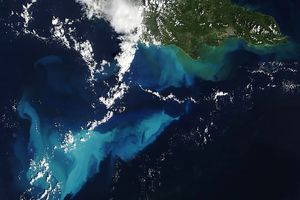
The category 5 hurricane stirred up carbonate sediment near Jamaica in what scientists believe is the largest such event in…

Article

Powered by WPeMatico

Get The Details…

Fires on the Rise in the Far North

Fires on the Rise in the Far North


2002-2012
2012-2024

Side-by-side maps centered on the Arctic display satellite-based fire detections from NASA’s MODIS instrument, with yellow circles representing detections acquired from 2002–2012 (left) and red circles for detections acquired from 2012–2024 (right), revealing increased fire activity and a shift toward higher latitudes.
NASA Earth Observatory

Side-by-side maps centered on the Arctic display satellite-based fire detections from NASA’s MODIS instrument, with yellow circles representing detections acquired from 2002–2012 (left) and red circles for detections acquired from 2012–2024 (right), revealing increased fire activity and a shift toward higher latitudes.
NASA Earth Observatory

Side-by-side maps centered on the Arctic display satellite-based fire detections from NASA’s MODIS instrument, with yellow circles representing detections acquired from 2002–2012 (left) and red circles for detections acquired from 2012–2024 (right), revealing increased fire activity and a shift toward higher latitudes.
NASA Earth Observatory
Side-by-side maps centered on the Arctic display satellite-based fire detections from NASA’s MODIS instrument, with yellow circles representing detections acquired from 2002–2012 (left) and red circles for detections acquired from 2012–2024 (right), revealing increased fire activity and a shift toward higher latitudes.
NASA Earth Observatory

2002-2012

2012-2024

2002-2012 and 2012-2024


Downloads

2002-2012

JPEG

(1 MB)

2012-2024

JPEG

(1 MB)

In the far north, wildfires are breaking old patterns. Satellite data show that wildland fires once scattered across the Arctic are now surging in numbers—particularly in northern Eurasia—and many are burning more intensely than before.

These maps show the number of fires detected by the MODIS (Moderate Resolution Imaging Spectroradiometer) sensors on NASA’s Aqua and Terra satellites. The map on the left shows fire detections from 2002 to 2012 (yellow), while the map on the right shows detections from 2012 to 2024 (orange). The largest circles indicate areas with 15,000 or more detected fires, while the smallest circles represent areas with 1,000 or fewer. Fire detection data are from NASA’s Fire Information for Resource Management System (FIRMS).

Although the geographical distribution of high-latitude wildfires varies from year to year, the maps reveal some clear long-term patterns. In the 2000s, fires north of 60 degrees latitude appeared across both North America and Eurasia, but starting in the early 2010s, their numbers skyrocketed, most dramatically in Eurasia. Even the icy island of Greenland entered a new fire regime during this period, experiencing more large fires, though still too few to be visible on these maps.

Researchers attribute these trends to rising temperatures, which have made northern landscapes more flammable, along with a poleward expansion of lightning—the primary ignition source for these fires. The findings are detailed in a report published in 2025 by the Arctic Monitoring and Assessment Programme (AMAP), a working group of the Arctic Council.

The number of fire detections and their distribution, however, is just one metric of the Arctic’s changing fire regime. According to NASA researchers, fires in this region are also burning larger, hotter, and longer than they did in previous decades.

“Fire has always been a part of the boreal and the Arctic landscape,” said Jessica McCarty, Deputy Earth Science Division Chief at NASA’s Ames Research Center and lead author of the report. “But now it’s starting to act in more extreme ways that mimic what we’ve seen in the temperate and the tropical areas.”

NASA Earth Observatory maps by Michala Garrison, using the MODIS Collection 6.1 Active Fire Product from NASA’s Fire Information for Resource Management System (FIRMS). Story by Milan Loiacono.

References & Resources

You may also be interested in:

Stay up-to-date with the latest content from NASA as we explore the universe and discover more about our home planet.

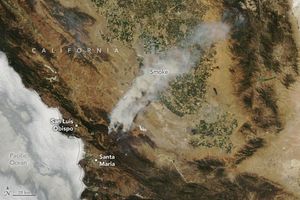
Sprawling Gifford Fire Scorches California

3 min read

The fast-growing blaze charred more than 100,000 acres in the span of a week.

Article

Seeing the Monroe Canyon Fire in a New Light

5 min read

As wildland fires raged in the American West, NASA airborne technology was there to image it in incredible detail.

Article

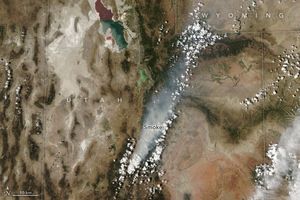
Monroe Canyon Fire Intensifies

3 min read

The blaze in central Utah experienced rapid growth during dry, windy days in late July 2025, creating hazy skies throughout…

Article

Powered by WPeMatico

Get The Details…

La NASA transmitirá en directo el regreso y el amerizaje de Crew 11

La NASA transmitirá en directo el regreso y el amerizaje de Crew 11

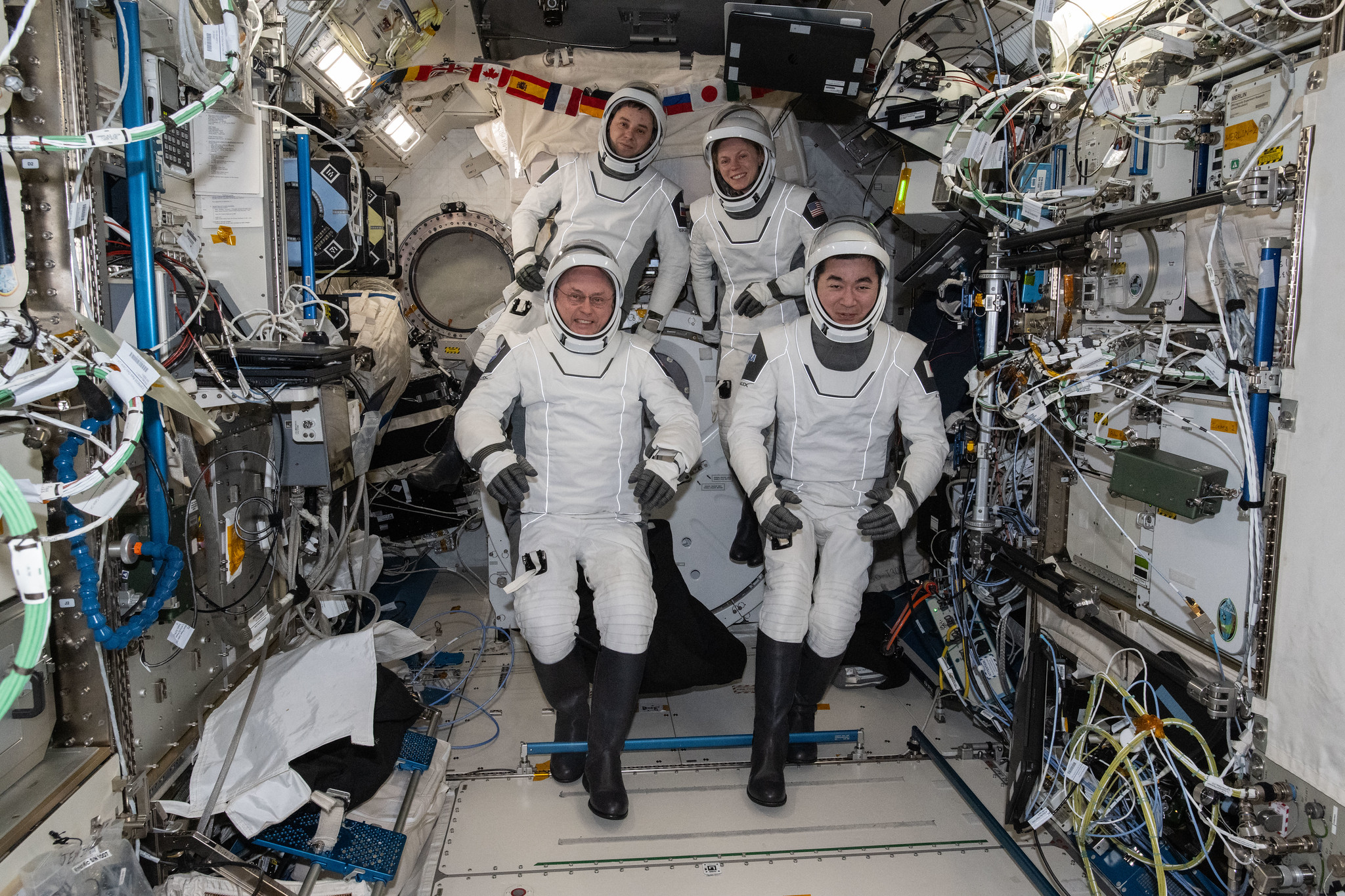
Los cuatro miembros de la tripulación SpaceX Crew-11 se juntaron para una foto de grupo con sus trajes presurizados Dragon durante una comprobación de dichos trajes en el módulo laboratorio Kibo de la Estación Espacial Internacional.
Los cuatro miembros de la tripulación SpaceX Crew-11 se juntaron para una foto de grupo con sus trajes presurizados Dragon durante una comprobación de dichos trajes en el módulo laboratorio Kibo de la Estación Espacial Internacional. En el sentido de las agujas del reloj, desde la parte inferior izquierda, aparecen el astronauta de la NASA Mike Fincke, el cosmonauta de Roscosmos Oleg Platonov, la astronauta de la NASA Zena Cardman y el astronauta de la JAXA (Agencia Japonesa de Exploración Aeroespacial) Kimiya Yui. 
Credit: NASA

Read this press release in English here.

La NASA y SpaceX prevén que, si las condiciones meteorológicas lo permiten, el desacoplamiento de la misión SpaceX Crew 11 de la agencia espacial estadounidense de la Estación Espacial Internacional se produzca no antes de las 5:05 p.m. EST (hora del este) del miércoles 14 de enero.

El 8 de enero, la NASA anunció su decisión de traer de vuelta a la Tierra antes de lo previsto a los integrantes de la misión SpaceX Crew 11 de la agencia desde la estación espacial, mientras los equipos técnicos siguen de cerca un problema médico que afecta a un miembro de la tripulación que actualmente vive y trabaja a bordo del laboratorio orbital. Debido a la confidencialidad médica, no es apropiado que la NASA comparta más detalles sobre el miembro de la tripulación, quien se encuentra estable.

Está planeado que los astronautas de la NASA Zena Cardman y Mike Fincke, el astronauta de JAXA (Agencia Japonesa de Exploración Aeroespacial) Kimiya Yui y el cosmonauta de Roscosmos Oleg Platonov americen frente a la costa de California a las 3:41 a.m. del jueves 15 de enero.

Los responsables de la misión continúan supervisando las condiciones en la zona de recuperación, ya que el desacoplamiento de la nave Dragon de SpaceX depende de las condiciones operativas de la nave espacial, la preparación del equipo de recuperación, las condiciones meteorológicas, el estado del mar y otros factores. La NASA y SpaceX seleccionarán una hora y un lugar concretos para el amerizaje cuando se acerque la fecha del desacoplamiento de la nave espacial de Crew 11.

La cobertura en directo (en inglés) de la NASA del regreso y las actividades relacionadas se retransmitirá en NASA+, Amazon Prime, y el canal de YouTube de la agencia. Aprenda cómo transmitir contenido de la NASA a través de diversas plataformas en línea, incluidas las redes sociales.

La cobertura de la NASA es la siguiente (todas las horas son del este y están sujetas a cambios en función de las operaciones en tiempo real):

Miércoles, 14 de enero

3 p.m. – Comienza la cobertura del cierre de escotilla en NASA+, Amazon Prime, y YouTube.

3:30 p.m. – Cierre de escotilla

4:45 p.m. – Comienza la cobertura del desacoplamiento en NASA+, Amazon Prime, y YouTube.

5:05 p.m. – Desacoplamiento

Tras la finalización de la cobertura del desacoplamiento, la NASA distribuirá las conversaciones (solo en formato audio) entre la tripulación Crew 11, la estación espacial y los controladores de vuelo durante el tránsito de la nave Dragon alejándose del complejo orbital.

Jueves, 15 de enero

2:15 a.m. – Comienza la cobertura del regreso en NASA+, Amazon Prime, y YouTube.

2:51 a.m. – Encendido de desorbitado

3:41 a.m. – Amerizaje

5:45 a.m. – El administrador de la NASA, Jared Isaacman, liderará una rueda de prensa sobre el regreso a la Tierra que se transmitirá en directo a través de NASA+, Amazon Prime, y el canal de YouTube de la agencia.

Para participar virtualmente en la conferencia de prensa, los medios de comunicación deben ponerse en contacto con la sala de prensa del Centro Espacial Johnson de la NASA para obtener los detalles de la llamada antes de las 5 p.m. CST (hora del centro) del 14 de enero, enviando un correo electrónico a jsccommu@mail.nasa.gov o llamando al +1 281-483-5111. Para hacer preguntas, los medios de comunicación deben llamar al menos 10 minutos antes del inicio de la conferencia. La política de acreditación de medios de comunicación de la agencia está disponible en línea (en inglés).

Encuentre la cobertura completa de la misión, el blog de tripulaciones comerciales de la NASA y más información sobre la misión Crew 11 (todo en inglés) en:

https://www.nasa.gov/commercialcrew

-fin-

Joshua Finch / Jimi Russell / María José Viñas
Sede central, Washington
+1 202-358-1100
joshua.a.finch@nasa.gov / james.j.russell@nasa.gov / maria-jose.vinasgarcia@nasa.gov  

Sandra Jones / Joseph Zakrzewski
Centro Espacial Johnson, Houston
+1 281-483-5111
sandra.p.jones@nasa.gov / joseph.a.zakrzewski@nasa.gov

Steve Siceloff
Centro Espacial Kennedy, Fla.
+1 321-867-2468
steven.p.siceloff@nasa.gov

Share

Details

Last Updated

Jan 13, 2026

Editor
Jennifer M. Dooren

Powered by WPeMatico

Get The Details…
Jennifer M. Dooren

NASA to Provide Live Coverage of Crew-11 Return, Splashdown

NASA to Provide Live Coverage of Crew-11 Return, Splashdown

Four SpaceX Crew-11 members gather together for a crew portrait wearing their Dragon pressure suits during a suit verification check inside the International Space Station's Kibo laboratory module.
Four SpaceX Crew-11 members gather together for a crew portrait wearing their Dragon pressure suits during a suit verification check inside the International Space Station’s Kibo laboratory module. Clockwise from bottom left are, NASA astronaut Mike Fincke, Roscosmos cosmonaut Oleg Platonov, NASA astronaut Zena Cardman, and JAXA (Japan Aerospace Exploration Agency) astronaut Kimiya Yui.
Credit: NASA

Lee este comunicado de prensa en español aquí.

NASA and SpaceX are targeting no earlier than 5:05 p.m. EST, Wednesday, Jan. 14, for the undocking of the agency’s SpaceX Crew-11 mission from the International Space Station, pending weather conditions.

On Jan. 8, NASA announced its decision to return the agency’s SpaceX Crew-11 mission to Earth from the space station earlier than originally planned as teams monitor a medical concern with a crew member currently living and working aboard the orbital laboratory, who is stable. Due to medical privacy, it is not appropriate for NASA to share more details about the crew member.

NASA astronauts Zena Cardman and Mike Fincke, JAXA (Japan Aerospace Exploration Agency) astronaut Kimiya Yui, and Roscosmos cosmonaut Oleg Platonov are targeted to splash down off the coast of California at 3:41 a.m. on Thursday, Jan. 15.

Mission managers continue monitoring conditions in the recovery area, as undocking of the SpaceX Dragon depends on spacecraft readiness, recovery team readiness, weather, sea states, and other factors. NASA and SpaceX will select a specific splashdown time and location closer to the Crew-11 spacecraft undocking.

NASA’s live coverage of return and related activities will stream on NASA+, Amazon Prime, and the agency’s YouTube channel. Learn how to stream NASA content through a variety of online platforms, including social media.

NASA’s coverage is as follows (all times Eastern and subject to changed based on real-time operations):

Wednesday, Jan. 14

3 p.m. – Hatch closure coverage begins on NASA+, Amazon Prime, and YouTube.

3:30 p.m. – Hatch closing

4:45 p.m. – Undocking coverage begins on NASA+, Amazon Prime, and YouTube.

5:05 p.m. – Undocking

Following the conclusion of undocking coverage, NASA will distribute audio-only communications between Crew-11, the space station, and flight controllers during Dragon’s transit away from the orbital complex.

Thursday, Jan. 15

2:15 a.m. – Return coverage begins on NASA+, Amazon Prime, and YouTube.

2:51 a.m. – Deorbit burn

3:41 a.m. – Splashdown

5:45 a.m. – NASA Administrator Jared Isaacman will lead a Return to Earth news conference streaming live on NASA+, Amazon Prime, and the agency’s YouTube channel.

To participate virtually in the news conference, media must contact the NASA Johnson newsroom for call details by 5 p.m. CST, Jan. 14, at: jsccommu@mail.nasa.gov or 281-483-5111. To ask questions, media must dial in no later than 10 minutes before the start of the call. The agency’s media credentialing policy is available online.

Find full mission coverage, NASA’s commercial crew blog, and more information about the Crew-11 mission at:

https://www.nasa.gov/commercialcrew

-end-

Joshua Finch / Jimi Russell
Headquarters, Washington
202-358-1100
joshua.a.finch@nasa.gov / james.j.russell@nasa.gov

Sandra Jones / Joseph Zakrzewski
Johnson Space Center, Houston
281-483-5111
sandra.p.jones@nasa.gov / joseph.a.zakrzewski@nasa.gov

Steve Siceloff
Kennedy Space Center, Fla.
321-867-2468
steven.p.siceloff@nasa.gov

Share

Details

Last Updated

Jan 13, 2026

Editor
Jennifer M. Dooren

Powered by WPeMatico

Get The Details…
Jennifer M. Dooren