NASA, Boeing Chart Course for Starliner Return Review

NASA, Boeing Chart Course for Starliner Return Review

Image shows Boeing's Starliner spacecraft that launched NASA's Crew Flight Test astronauts Butch Wilmore and Suni Williams to the International Space Station is pictured docked to the Harmony module's forward port. This long-duration photograph was taken at night from the orbital complex as it soared 258 miles above western China.
Boeing’s Starliner spacecraft that launched NASA’s Crew Flight Test astronauts Butch Wilmore and Suni Williams to the International Space Station is pictured docked to the Harmony module’s forward port on Wednesday, July 3, 2024. Photo credit: NASA

Engineering and spaceflight specialists from NASA and Boeing continue data analysis ahead of a decision this week on the path forward for the Starliner spacecraft’s return from the International Space Station.

NASA’s decision on whether to return Starliner to Earth with astronauts aboard is expected no earlier than Saturday, Aug. 24 at the conclusion of an agency-level review chaired by Ken Bowersox, the associate administrator of NASA’s Space Operations Mission Directorate. The agency flight readiness review is where any formal dissents are presented and reconciled. Other agency leaders who routinely participate in launch and return readiness reviews for crewed missions include NASA’s administrator, deputy administrator, associate administrator, various agency center directors, the Flight Operations Directorate, and agency technical authorities.

NASA will host a televised news conference following the review’s conclusion to discuss the agency’s decision and next steps. More information on the news conference will be shared once confirmed. After the agency-level decision, program and flight control teams will continue preparing for Starliner’s return, including training sessions and other actions as appropriate.

Ahead of the agency-level review, NASA and Boeing are working to finalize and present flight rationale to various teams across the community and to the program control board. Engineering teams have been working to evaluate a new model that represents the thruster mechanics and is designed to more accurately predict performance during the return phase of flight. This data could help teams better understand system redundancy from undock to service module separation. Ongoing efforts to complete the new modelling, characterize spacecraft performance data, refine integrated risk assessments, and determine community recommendations will fold into the agency-level review.

Alongside the crew members of Expedition 71, NASA astronauts Butch Wilmore, commander, and Suni Williams, pilot, continue supporting a host of research, maintenance, and other activities aboard the microgravity laboratory since arriving on Starliner on June 6.

Powered by WPeMatico

Get The Details…
Elyna Niles-Carnes

Light Duty Day Still Sees Space Science and Orbital Reboost

Light Duty Day Still Sees Space Science and Orbital Reboost

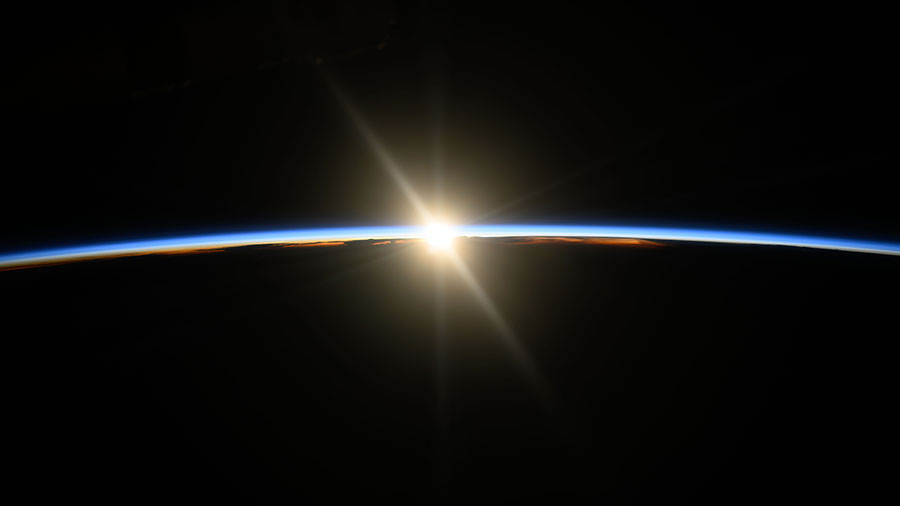
The space station was orbiting above the Pacific Ocean when this photograph captured the first rays of an orbital sunrise illuminating Earth's atmosphere.
The space station was orbiting above the Pacific Ocean when this photograph captured the first rays of an orbital sunrise illuminating Earth’s atmosphere.

Six of the nine crew members living and working aboard the International Space Station had a light duty day on Thursday fitting in some time for science equipment maintenance. Meanwhile, three cosmonauts stayed busy with their full schedule of Roscosmos space research and lab upkeep.

Thursday’s main research activity consisted of cleaning the Electrostatic Levitation Furnace (ELF) planned for Expedition 71 Flight Engineer Tracy C. Dyson and Crew Flight Test Pilot Suni Williams, both from NASA. The duo worked together swapping samples and cleaning the inside of the advanced space research furnace. The ELF heats material samples using a containerless technique to observe their thermophysical properties and reduce imperfections and contamination common in Earth’s gravity. The orbital outpost’s weightless environment may improve the manufacturing of semiconductors, alloys, and more benefitting both Earth and space industries.

Williams’ crewmate Starliner Commander Butch Wilmore of NASA assembled the Sphere Camera-2 during the afternoon. The ultra-high resolution video camera is being tested for its ability to film crew activities possibly leading to advances in lunar and planetary photography and external spacecraft inspections.

NASA Flight Engineers Mike Barratt and Jeanette Epps joined each other for a few moments of examining stem cells samples inside the KERMIT state-of-the-art microscope for a cancer treatment investigation. NASA Flight Engineer Matthew Dominick connected components on the advanced resistive exercise device, or ARED, for an investigation exploring ways to maximize the effects of exercise in microgravity.

Northrop Grumman’s Cygnus space freighter fired its engine for over 19 minutes early Thursday afternoon boosting the orbital outpost’s altitude to 260 miles by 257.9 miles. The orbital reboosts counter atmospheric drag and prepare the space station for upcoming spacecraft activities.

Roscosmos station Commander Oleg Kononenko set up Earth observation hardware to study clouds in the Earth’s upper atmosphere then configured camera and video hardware during his shift on Thursday. Flight Engineer Nikolai Chub continued investigating how microalgae can be used to produce oxygen and consume carbon dioxide improving space life support systems. Flight Engineer Alexander Grebenkin strapped on a sensor-packed cap that recorded his reactions as he practiced futuristic planetary and robotic piloting techniques on a computer.


Learn more about station activities by following the space station blog@space_station and @ISS_Research on X, as well as the ISS Facebook and ISS Instagram accounts.

Get weekly video highlights at: https://roundupreads.jsc.nasa.gov/videoupdate/

Get the latest from NASA delivered every week. Subscribe here: www.nasa.gov/subscribe

Powered by WPeMatico

Get The Details…

Mark Garcia

Beyond the Textbook: DC-8 Aircraft Inspires Students in Retirement

Beyond the Textbook: DC-8 Aircraft Inspires Students in Retirement

3 min read

Preparations for Next Moonwalk Simulations Underway (and Underwater)

A group of 22 students pose on a stairway descending from an aircraft door. The plane and stairway are white, on a sunny tarmac.
Idaho State University class of 2025 poses with their new hands-on learning tool, the DC-8 aircraft, after it was retired from NASA in May 2024 and arrived in Pocatello, Idaho. The university will use the aircraft to provide a hands-on learning experience for students in the university’s aircraft maintenance technology program.
Idaho State University

In May 2024, Idaho State University’s class of 2025 received a new learning tool from NASA. The DC-8 aircraft served the world’s scientific community for decades as a platform under NASA’s Airborne Science Program before retiring to Idaho State University (ISU) to provide a hands-on learning experience for students in the university’s aircraft maintenance technology program. 

“The DC-8 has quickly become a cornerstone of our Aircraft Maintenance Technology program at ISU,” said Jake Dixon, Director of Marketing and Recruitment at the ISU College of Technology. “It has already enhanced our summer classes ahead of its full integration with the start of the new school year this fall.” 

The DC-8 flew its final flight from NASA’s Armstrong Flight Research Center in Edwards, California to Idaho State University in Pocatello, Idaho in May 2024. That flight represented the retirement of the aircraft after 37 years of supporting airborne science missions as a NASA aircraft. 

“The opportunity for students to interact firsthand with the aircraft’s systems and features significantly extends their learning beyond what theory or textbooks can provide,” Dixon said.

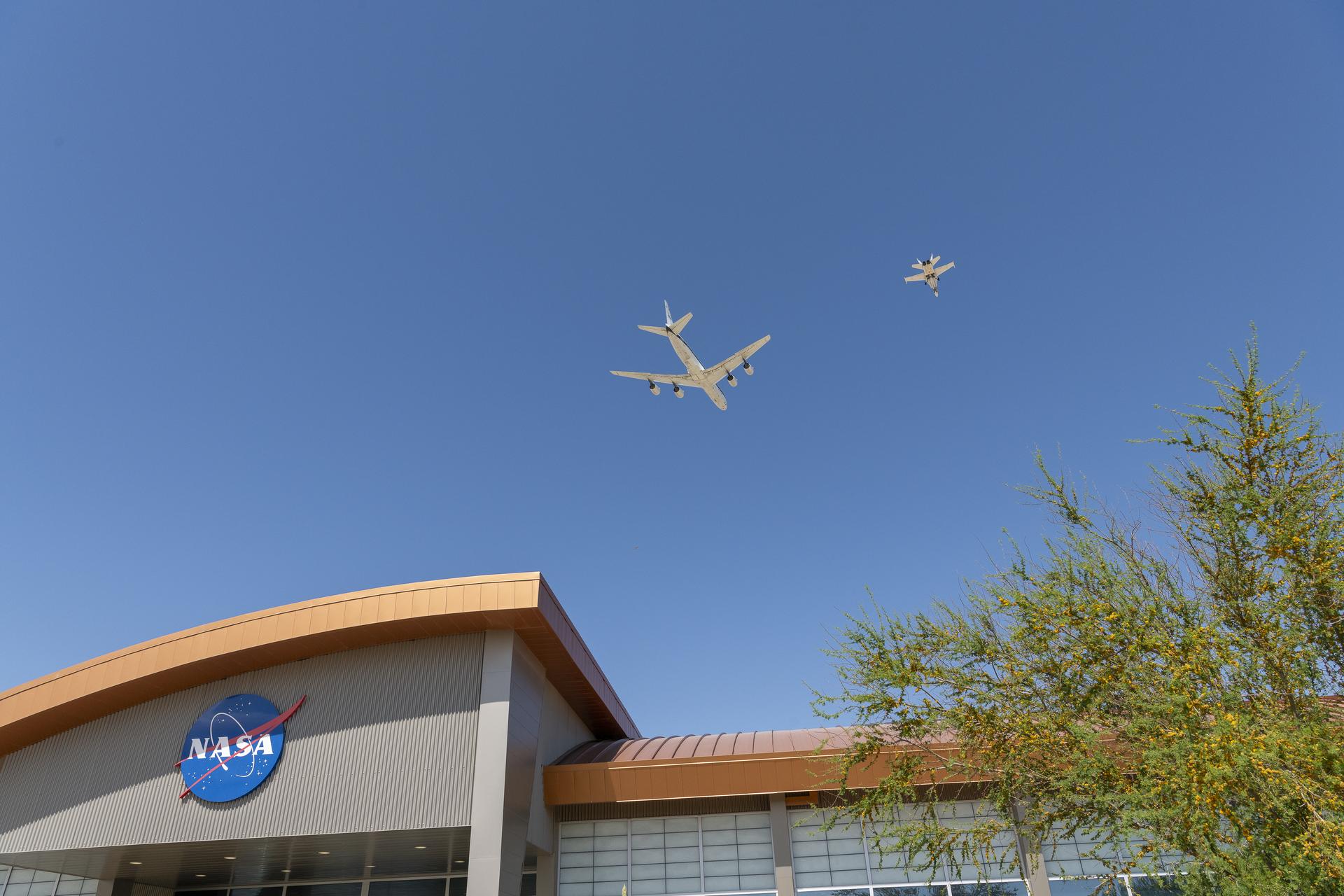
A large white plane and smaller chase plane fly over the top of a building with a NASA logo on the front. A sunny blue sky is behind the building and planes.
The DC-8 flies low for the last time over NASA’s Armstrong Flight Research Center in Edwards, California, before it retires to Idaho State University in Pocatello, Idaho. The DC-8 is providing real-world experience to train future aircraft technicians at the college’s Aircraft Maintenance Technology Program.
NASA/Genaro Vavuris

The DC-8 served as an educational platform for years. Beginning in 2009, the DC-8 functioned as an airborne science laboratory for NASA’s Student Airborne Research Program (SARP), where rising-senior undergraduates were selected to participate in a real science campaign and acquire hands-on research experience. The educational impact of the DC-8 is evident in the professional growth of scientists who have experienced it. 

“Almost everything I’ve learned about using an airplane to collect scientific data can be linked back to my time flying projects on the DC-8.” says Jonathan Zawislak, Flight Director with the Aircraft Operations Center at the National Oceanic and Atmospheric Administration (NOAA). “It has left an indelible mark on the Earth science community and no doubt paved the way for a new generation of scientists, as it did for me and my career as a science aviator.”

NASA Armstrong’s Student Airborne Research Program celebrated 15 years of success in 2023. An eight-week summer internship program, SARP offered upper-level undergraduate students the opportunity to acquire hands-on research experience as part of a scientific campaign using NASA Airborne Science Program flying science laboratories – aircraft outfitted specifically for research projects.
NASA/Carla Thomas

Real-life platforms like the DC-8 are an exciting and meaningful learning tool that enable college students to go beyond the textbook, and they make a lasting impact on communities adjacent to its activities. 

“We have seen so much enthusiasm surrounding the DC-8’s arrival that we are organizing an open house in the future to allow the community and aviation enthusiasts alike to explore this historic aircraft,” said Dixon. “Doing so will help preserve the remarkable legacy of the DC-8, ensuring it continues to inspire and educate for years to come.” 

Whether as a science platform or as a unique aircraft, the DC-8 has a legacy that continues to inspire and educate generations of scientists, engineers, and aviators. 

Learn more about NASA’s SARP program 

Learn more about the retired DC-8 aircraft Learn more about NASA’s Armstrong Flight Research Center

Share

Details

Last Updated

Aug 22, 2024

Powered by WPeMatico

Get The Details…
Dede Dinius

NASA’s EXCITE Mission Prepared for Scientific Balloon Flight

NASA’s EXCITE Mission Prepared for Scientific Balloon Flight

5 min read

NASA’s EXCITE Mission Prepared for Scientific Balloon Flight

Scientists and engineers are ready to fly an infrared mission called EXCITE (EXoplanet Climate Infrared TElescope) to the edge of space. 

EXCITE is designed to study atmospheres around exoplanets, or worlds beyond our solar system, during circumpolar long-duration scientific balloon flights. But first, it must complete a test flight during NASA’s fall 2024 scientific ballooning campaign from Fort Sumner, New Mexico. 

“EXCITE can give us a three-dimensional picture of a planet’s atmosphere and temperature by collecting data the whole time the world orbits its star,” said Peter Nagler, the mission’s principal investigator at NASA’s Goddard Space Flight Center in Greenbelt, Maryland. “Only a handful of these types of measurements have been done before. They require a very stable telescope in a position to track a planet for several days at a time.”

Photo of a telescope in a hanger.
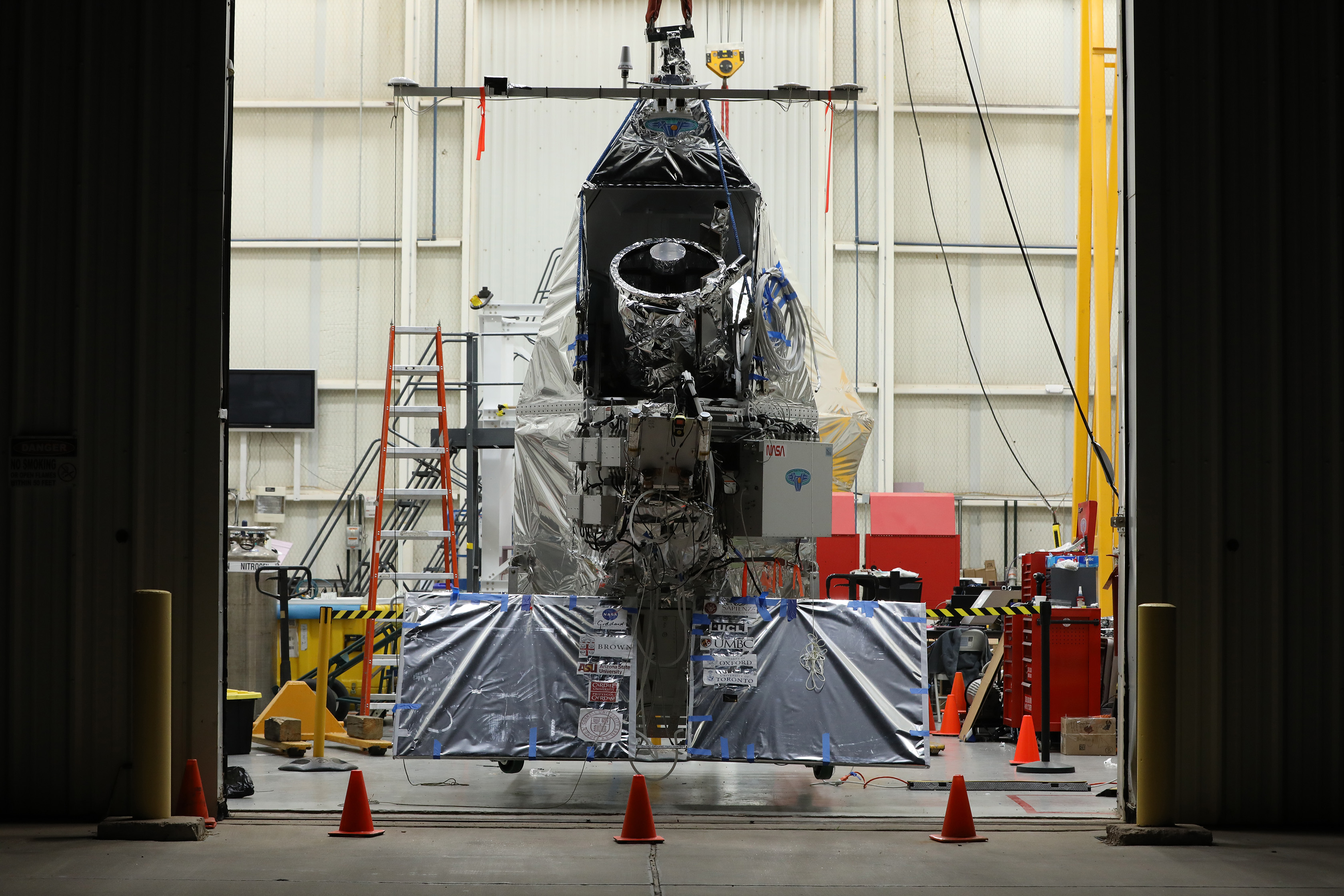
EXCITE (EXoplanet Climate Infrared TElescope) hangs from a ceiling at the Columbia Scientific Balloon Facility’s location in Fort Sumner, New Mexico. The mission team practiced taking observations ahead of flight by looking out the hanger doors at night.
NASA/Jeanette Kazmierczak

EXCITE will study hot Jupiters, giant gas exoplanets that complete an orbit once every one to two days and have temperatures in the thousands of degrees. The worlds are tidally locked, which means the same side always faces the star.

The telescope will observe how heat is distributed across the planet, from the scalding hemisphere facing the star to the relatively cooler nightside. 

It will also determine how molecules in a world’s atmosphere absorb and emit light over the entire orbit, a process called phase-resolved spectroscopy. Not only can this data reveal the presence of compounds — like water, methane, carbon dioxide, and others — but also how they circulate globally as the planet orbits its star.

NASA’s HubbleJames Webb, and retired Spitzer space telescopes have collected a handful of these measurements between them. 

In 2014, for example, Hubble and Spitzer observed an exoplanet called WASP-43 b. To collect data over the world’s 22-hour day, scientists needed 60 hours of Hubble time and 46 hours from Spitzer. Resource-intensive studies like this on space-based observatories are difficult. Time is a limited resource, and studies must compete with hundreds of other requests for that time.  

“During its first science flight, EXCITE aims to fly for over a dozen days from the Columbia Scientific Balloon Facility’s site in Antarctica,” said Kyle Helson, an EXCITE team member and a research scientist at the University of Maryland, Baltimore County and NASA Goddard. “And at the pole, the stars we’ll study don’t set, so our observations won’t be interrupted. We hope that the mission will effectively double the number of phase-resolved spectra available to the science community.”

EXCITE will fly to about 132,000 feet (40 kilometers) via a scientific balloon filled with helium. That takes it above 99.5% of Earth’s atmosphere. At that altitude, the telescope will be able to observe multiple infrared wavelengths with little interference. 

“The telescope collects the infrared light and beams it into the spectrometer, where it kind of goes through a little obstacle course,” said Lee Bernard, an EXCITE team member and a graduate research assistant at Arizona State University in Tempe. “It bounces off mirrors and through a prism before reaching the detector. Everything must be aligned very precisely — just a few millimeters off center and the light won’t make it.”

The spectrometer rests inside a vessel called a cryostat situated behind the telescope. The cryostat cools the spectrometer’s detector — once a flight candidate from Webb’sNIRSpec (Near InfraRed Spectrograph)— to about 350 degrees below zero Fahrenheit (minus 210 degrees Celsius) so it can measure tiny intensity changes in the infrared light. 

Photo of EXCITE’s infrared detector on a lab bench.
The EXCITE infrared detector, shown here, was once a flight candidate from NASA’s James Webb Space Telescope’s NIRSpec (Near InfraRed Spectrograph) instrument. Before being added to the mission’s spectrometer assembly, it was mounted to a copper base and topped with a protective black case. The detector allows EXCITE to collect spectroscopic measurements from 1 to 4 microns — the near-infrared portion of the electromagnetic spectrum.
NASA/Sophia Roberts

The entire telescope and cryostat assembly rests in a rowboat-shaped base where it can rotate along three axes to maintain stable pointing down to 50 milliarcseconds. That’s like holding a steady gaze on a U.S. quarter coin from 65 miles away. 

“Several different institutions contributed to EXCITE’s subsystems,” said Tim Rehm, an EXCITE team member and a graduate research assistant at Brown University in Providence, Rhode Island. “It’s great to see them all assembled and working together. We’re excited to do this test flight, and we’re looking forward to all the future science flights we hope to have.”

The EXCITE instrument was primarily built by NASA Goddard, Brown, Arizona State University, and StarSpec Technologies in Ontario, with additional support from collaborators in the U.S., Canada, Italy, and the United Kingdom.

NASA’s scientific balloons offer frequent, low-cost access to near-space to conduct scientific investigations and technology maturation in fields such as astrophysics, heliophysics, and atmospheric research, as well as training for the next generation of leaders in engineering and science. To follow the missions in the 2024 Fort Sumner fall campaign, visit NASA’s CSBF (Columbia Scientific Balloon Facility) website for real-time updates of a balloon’s altitude and GPS location during flight. 

NASA’s Wallops Flight Facility in Virginia manages the agency’s scientific balloon flight program with 10 to 15 flights each year from launch sites worldwide. Peraton, which operates CSBF in Texas, provides mission planning, engineering services, and field operations for NASA’s scientific balloon program. The CSBF team has launched more than 1,700 scientific balloons over some 40 years of operations. NASA’s balloons are fabricated by Aerostar. The NASA Scientific Balloon Program is funded by the NASA Headquarters Science Mission Directorate Astrophysics Division.

By Jeanette Kazmierczak
NASA’s Goddard Space Flight Center, Greenbelt, Md. 

Media Contact:
Claire Andreoli
301-286-1940
claire.andreoli@nasa.gov
NASA’s Goddard Space Flight Center, Greenbelt, Md.

Share

Details

Last Updated
Aug 22, 2024
Editor
Jeanette Kazmierczak

Powered by WPeMatico

Get The Details…

NASA Selects Three New Venture-Class Launch Service Providers

NASA Selects Three New Venture-Class Launch Service Providers

Image of the NASA logo
Credit: NASA

NASA has selected three additional companies to provide launch services for future agency missions through its VADR (Venture-Class Acquisition of Dedicated and Rideshare) contract.

The companies awarded are:

  • Arrow Science and Technology LLC of Webster, Texas
  • Impulse Space Inc. of Redondo Beach, California
  • Momentus Space LLC of San Jose, California

The VADR contract is a firm-fixed-price, indefinite-delivery/indefinite-quantity instrument with an ordering period through Feb. 3, 2027 and a maximum total value of $300 million across all VADR contracts. NASA selected the new launch providers in accordance with VADR’s on-ramp provision, allowing the agency to add new capabilities not available or identified at the time of the initial award. NASA will issue firm-fixed-price task orders for launch services as needed for future agency and agency-sponsored missions.

The VADR contract builds on NASA’s previous procurement efforts, such as the VCLS (Venture Class Launch Services) and VCLS Demo 2, providing a broad range of Federal Aviation Administration-licensed commercial launch services capable of delivering Class D, CubeSats, and higher risk-tolerant payloads to a variety of orbits. By using a lower level of mission assurance and commercial best practices for launching rockets, these highly flexible contracts help broaden access to space through lower launch costs and serve as an ideal platform for contributing to NASA’s science research and technology development.

NASA’s Launch Services Program, based at the agency’s Kennedy Space Center in Florida, manages the VADR contracts. The program also works with private industry, spacecraft projects, and international partners to launch science payloads ranging from small satellites with colleges and universities to NASA’s highest priority missions.

For more information about NASA’s launch services, visit:

https://go.nasa.gov/46SorXk

-end-

Josh Finch / Julian Coltre
Headquarters, Washington
202-358-1100
joshua.a.finch@nasa.gov / julian.n.coltre@nasa.gov

Patti Bielling / Amanda Griffin
Kennedy Space Center, Florida
321-501-7575 / 321-593-6244
patricia.a.bielling@nasa.gov / amanda.griffin@nasa.gov

Powered by WPeMatico

Get The Details…
Tiernan P. Doyle