Into The Field With NASA: Valley Of Ten Thousand Smokes

Into The Field With NASA: Valley Of Ten Thousand Smokes

4 Min Read

Into The Field With NASA: Valley Of Ten Thousand Smokes

Three people, wearing large backpacks, trek across a snow field between hills of dark rubble. In the background: steep, snow-covered mountains under a blue sky.
NASA scientists begin a day’s field research in Katmai National Park.
Credits:
NASA/Patrick Whelley

In June 2024, the Goddard Instrument Field Team (GIFT) hiked deep into the backcountry of Alaska’s Katmai National Park to study the Valley of Ten Thousand Smokes, site of the largest volcanic eruption of the twentieth century. The team’s task: traverse a vast volcanic debris field layered with glacier ice, gathering data and samples to help us better understand this place on Earth and similar terrain on other worlds.

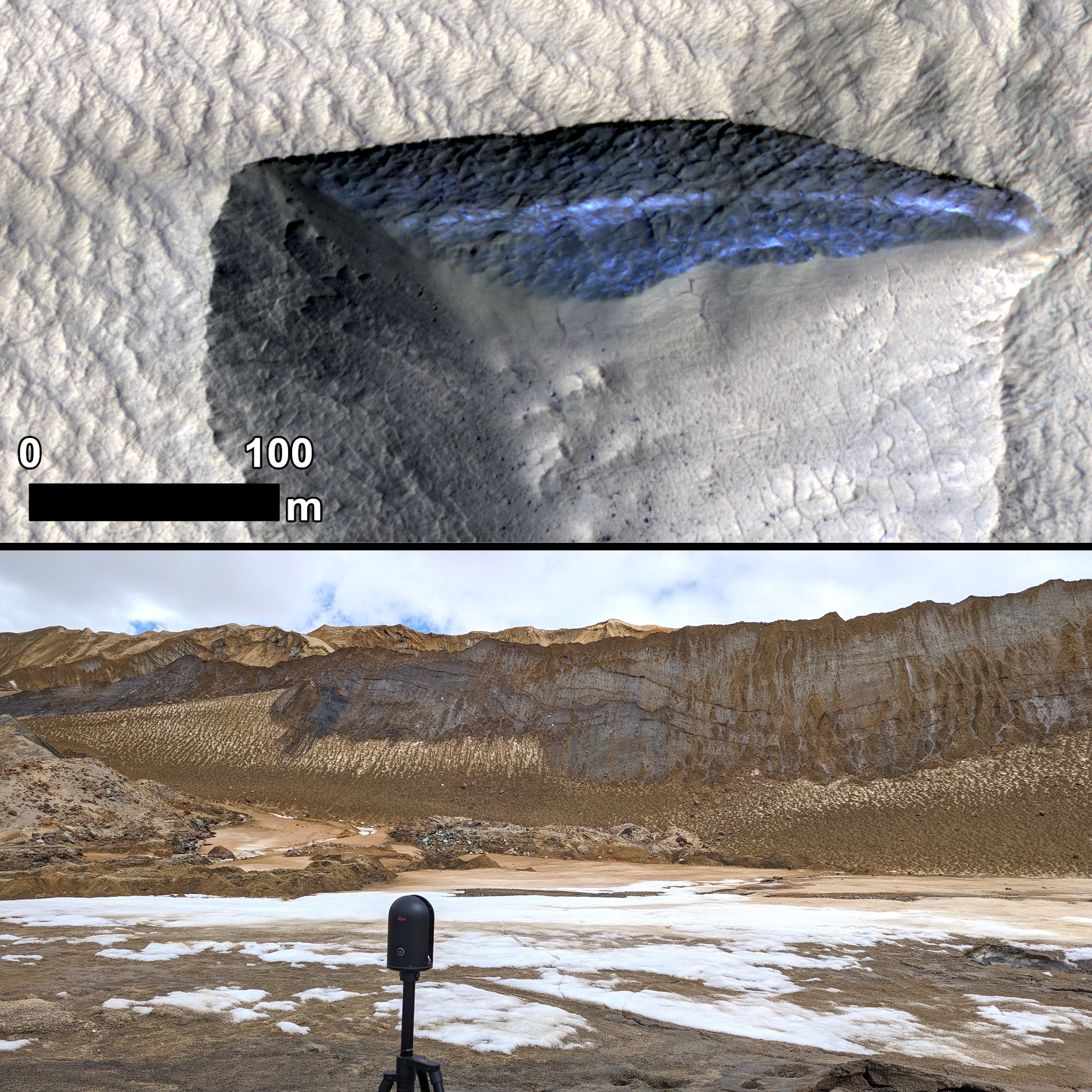
Composite of two images. Top: Aerial image of a grayscale landscape. In the middle, a dominant dark streak has some areas highlighted in purple. A scale bar shows that this feature is a few hundred meters long. Bottom: Ground-level view of an ice cliff face on an ashy, barren landscape. The ice is partially covered in beige dirt. In the foreground is a black, rounded device on a tripod. The ground is rocky with patches of snow.
Buried glaciers on Mars and Earth. Top: Orbital view of partially-exposed ice beneath an eroding deposit on Mars, from HiRISE. Bottom: Edge-on view of a partially buried glacier in Alaska with a LiDAR (Light Detection and Ranging) device in the foreground, from the Goddard Instrument Field Team.

Novarupta, the volcano that erupted here in 1912, ejected more than three cubic miles of ash from Earth’s subsurface. The ice nearby is now insulated by, and mixed with, thick layers of geologically “young” volcanic debris. (For comparison, many of the eruption sites NASA teams study are tens of thousands to millions of years old.) Mars, too, has glaciers and ice sheets covered in layers of airfall materials, including dust and volcanic ash.

On Mars, as on Earth, some of the planet’s history is in disguise. Ancient volcanic materials are buried underneath newer deposits of ashy debris. Patterns in these layers (think thickness or thinness, color and texture, chemical and mineral signatures) hold a lot of information, but the message isn’t always clear. Erosion and other surface processes hide evidence of past eruptions, even enormous ones. Since relatively fresh volcanic material blankets the Valley of Ten Thousand Smokes, it’s an ideal place to observe the early stages of these changes.

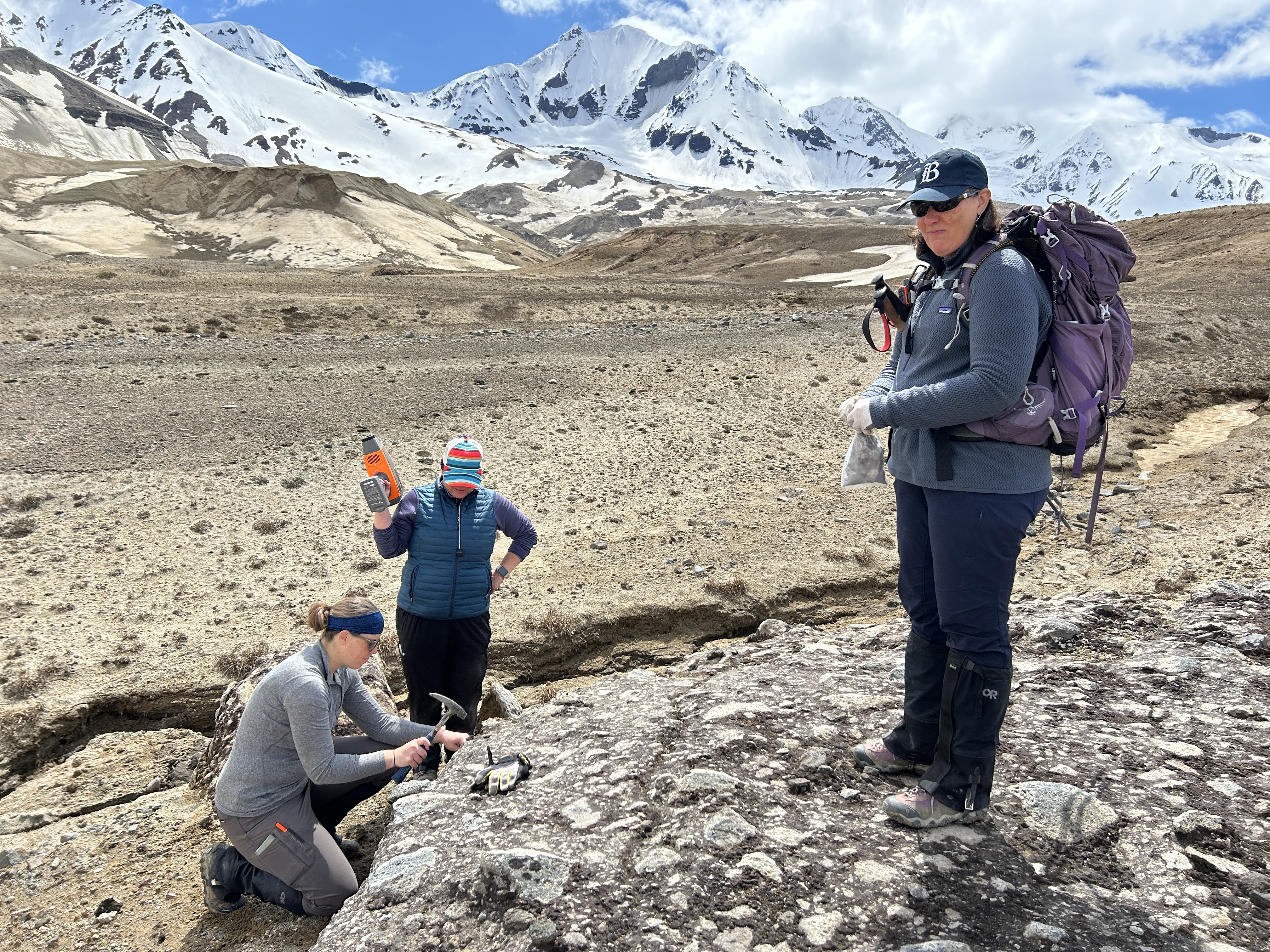
Three people on a barren, rocky landscape with hills of grey ash and snow-covered mountains in the background. The researcher on the left kneels and raises a rock hammer, about to collect a sample. Nearby, another scientist props a portable spectrometer up on her shoulder in between uses-- the spectrometer resembles a large, orange and grey blow dryer. The third scientist holds a bag of rock samples and looks at the camera. She has a large pack on her back and hiking poles under her arm.
Cherie Achilles raises a rock hammer as Alexandra Matiella Novak stands by with a hand-held spectrometer and Alice Baldridge holds a container of rock samples. The hand-held spectrometer gives on-the-spot information about what its targets are made of, helping the team decide which samples to collect and bring back to the lab.

In three days of violent eruption, Novarupta blasted an uncommonly wide variety of clays, minerals, and volcanic rocks throughout the surrounding valley. Since then, hot, sulfurous gases have filtered up through underground channels and escaped into the air via countless fumaroles (a.k.a. the “ten thousand smokes”). Fumaroles, together with erosion and other alteration processes, affect how minerals near Novarupta move and change. Research here can help us understand mineral movement and alteration on Mars and other worlds, too. The range of starting materials and alteration patterns in this valley, all from a single eruption, is difficult to match anywhere else.

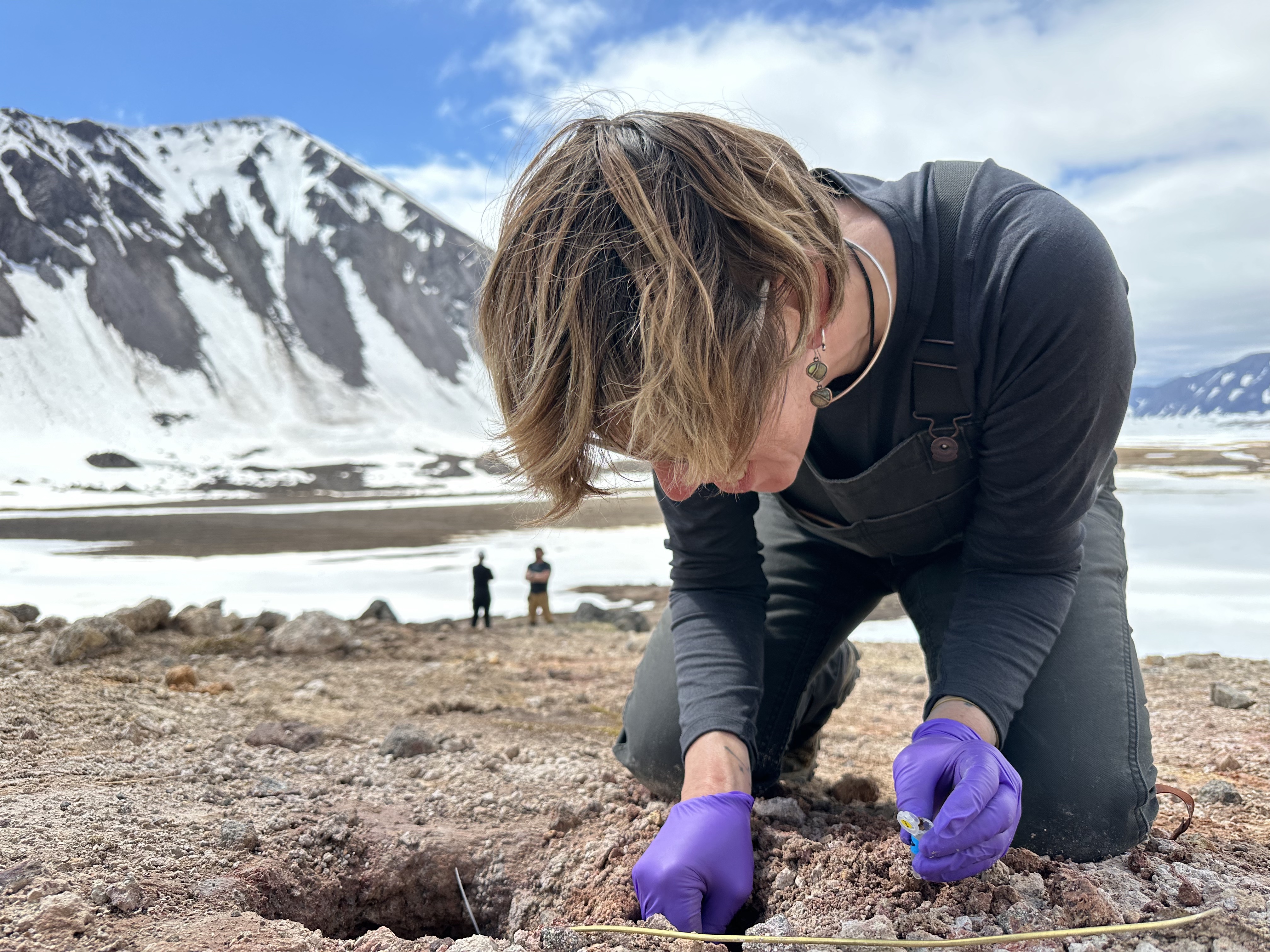
Person kneeling on reddish-brown, rocky ground, near a small hole, with a steep, snow-patched mountain in the background. They are wearing purple nitrile gloves and holding a tiny, open vial in one hand while digging with the other. A golden wire stretches across the dirt and into the hole in the ground.
Heather Graham studies a fumarole – a place where volcanic gases escape from underground – using a hydrogen sulfide collector and sampling equipment. Their goal: check the fumarole for encrusted evidence that microscopic organisms once lived here, consuming energy and changing the rocks’ composition. Research on these kinds of biosignatures helps us understand what the search for life could look like on other worlds.

It’s a tough field site to access, especially with heavy science instruments. GIFT worked closely with local collaborators including Katmai National Park to coordinate the expedition. After years of planning and months of training, twelve field team members gathered and geared up in Anchorage, Alaska. Two tiny airplane flights, one all-terrain bus ride, and sixteen hiking miles later, they set up a base camp. From there, small groups hiked out and back each day, gathering data and sample material from throughout the valley.

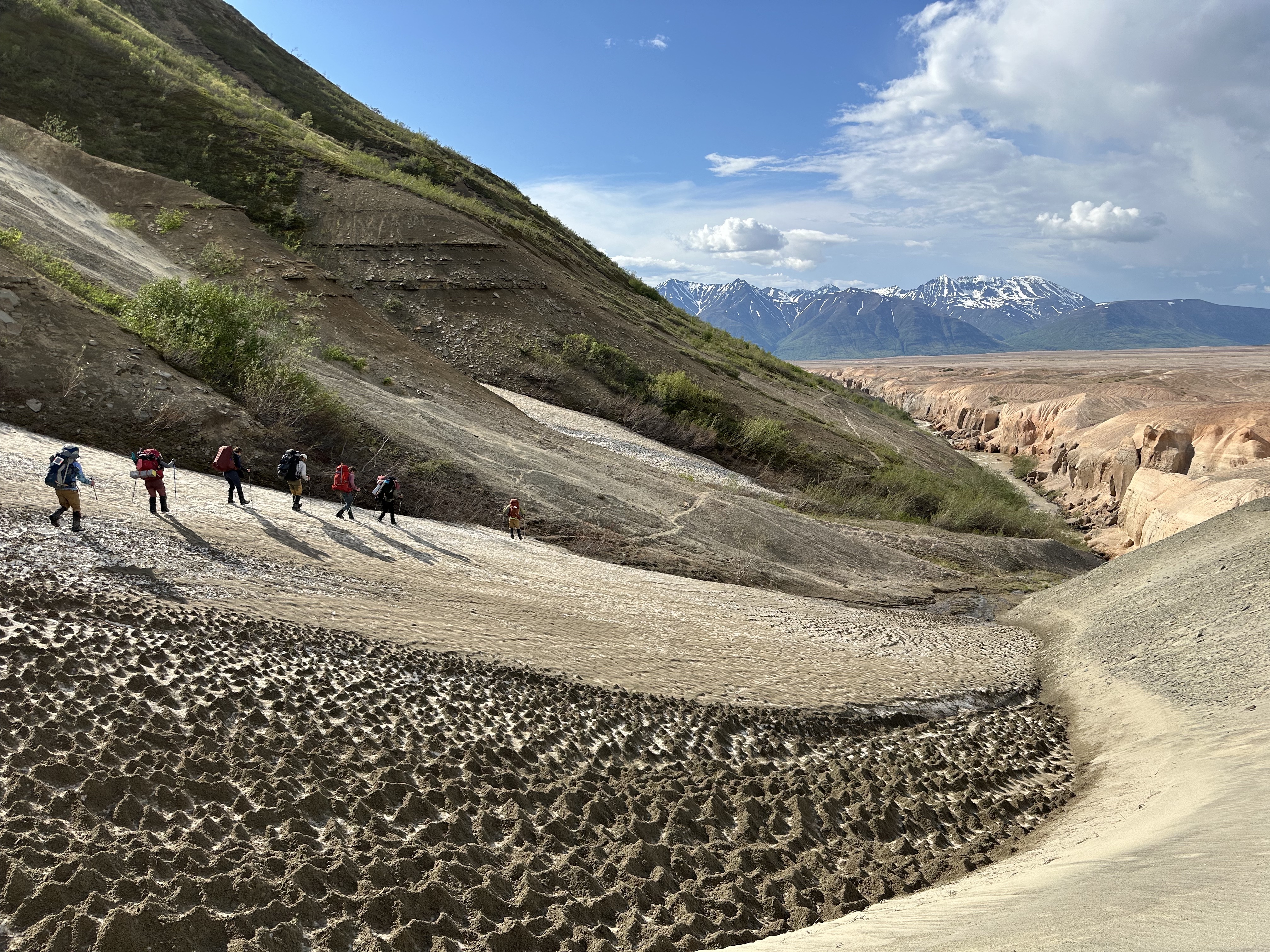
Seven people, with large backpacks, hiking down a hill of lumpy snow dusted with beige volcanic ash. Behind them is a steep wall of dirt with streaks of fresh green shrubbery. The people appear tiny against the landscape and are all in the left half of the image. On the right are overlapping views of three distinct geological formations: a light-colored slope in the foreground, a tan and orange river gorge in the middle ground, and snow-capped mountains in the background, under a partly cloudy sky.
Left to right: Tabb Prissel, Emileigh Shoemaker, Heather Graham, Andrew Johnson, Justin Hayles, Aditi Pandey, and Patrick Whelley hike out of the Valley of Ten Thousand Smokes.

Scientists teamed up to carry large equipment from place to place and bring each other data from far-flung targets. Some results were predictable, like a new library of samples collected from several different “packages” of differently-composed volcanic debris. Some were surprising–like a core sample that came up containing a pocket of empty space instead of buried glacial ice.

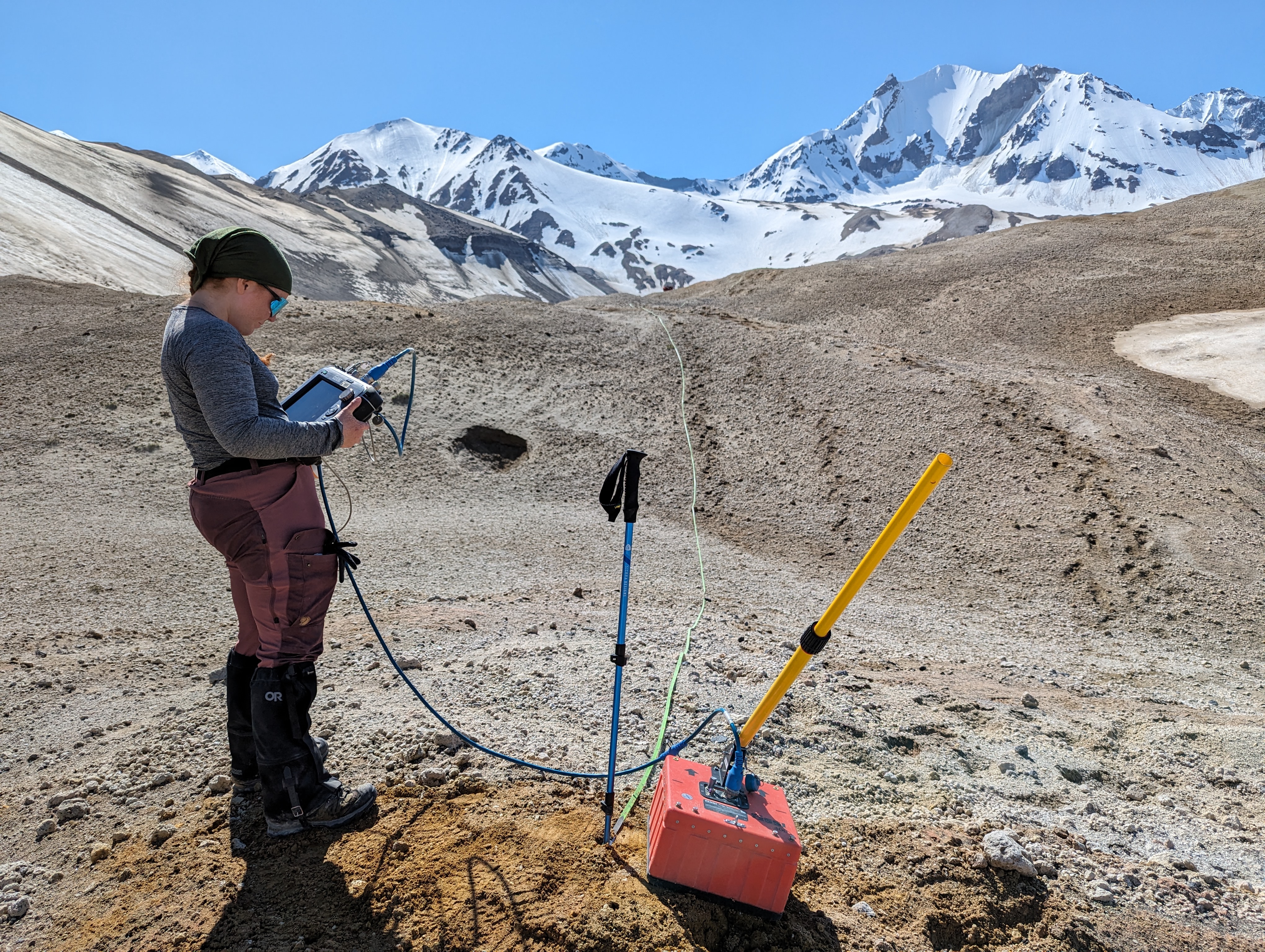
Person holding a bulky computer readout attached via a thick cord to a red plastic box with a push handle, on an expanse of beige volcanic ash, with snowy mountain peaks in the background. A tape measure, anchored to the ground with a trekking pole near the red box, extends over a hill into the distance.
Emileigh Shoemaker and her team use Ground Penetrating Radar (the red box shown here is the GPR antenna) to gather information about long stretches of Earth’s subsurface before physically breaking ground. Here, Shoemaker stands on a huge pile of volcanic ash; hidden beneath the debris is a glacier. GPR data, combined with core samples, soil moisture measurements, and pits dug at strategic locations, can reveal how the glacier is preserved.

Analyzing the samples, processing the data, and putting it all together will take time. This is the beginning of GIFT’s Novarupta research, but it’s a chapter of a science story long in the making. Previous studies of the 1912 eruption and its aftermath influenced this expedition’s science plan. The 2024 data and samples, and the new questions arising from the team’s time in the field, are already shaping ideas about future work. NASA has visited before, too. Apollo astronauts and their geology trainers spent time in the Valley in 1965, finding it an unusually Moon-like place to study.

Fieldwork still plays a role in astronaut training–and in advancing lunar science. For example: Novarupta’s chemistry is partly a result of Earth’s plate tectonics. The Moon has volcanic landscapes with similar chemistry, but no tectonic plates. So, what else could explain the parallel? To help address this question, the 2024 team collected samples and ground-truth data from a range of rock formations comparable to the Moon’s Gruithuisen Domes.

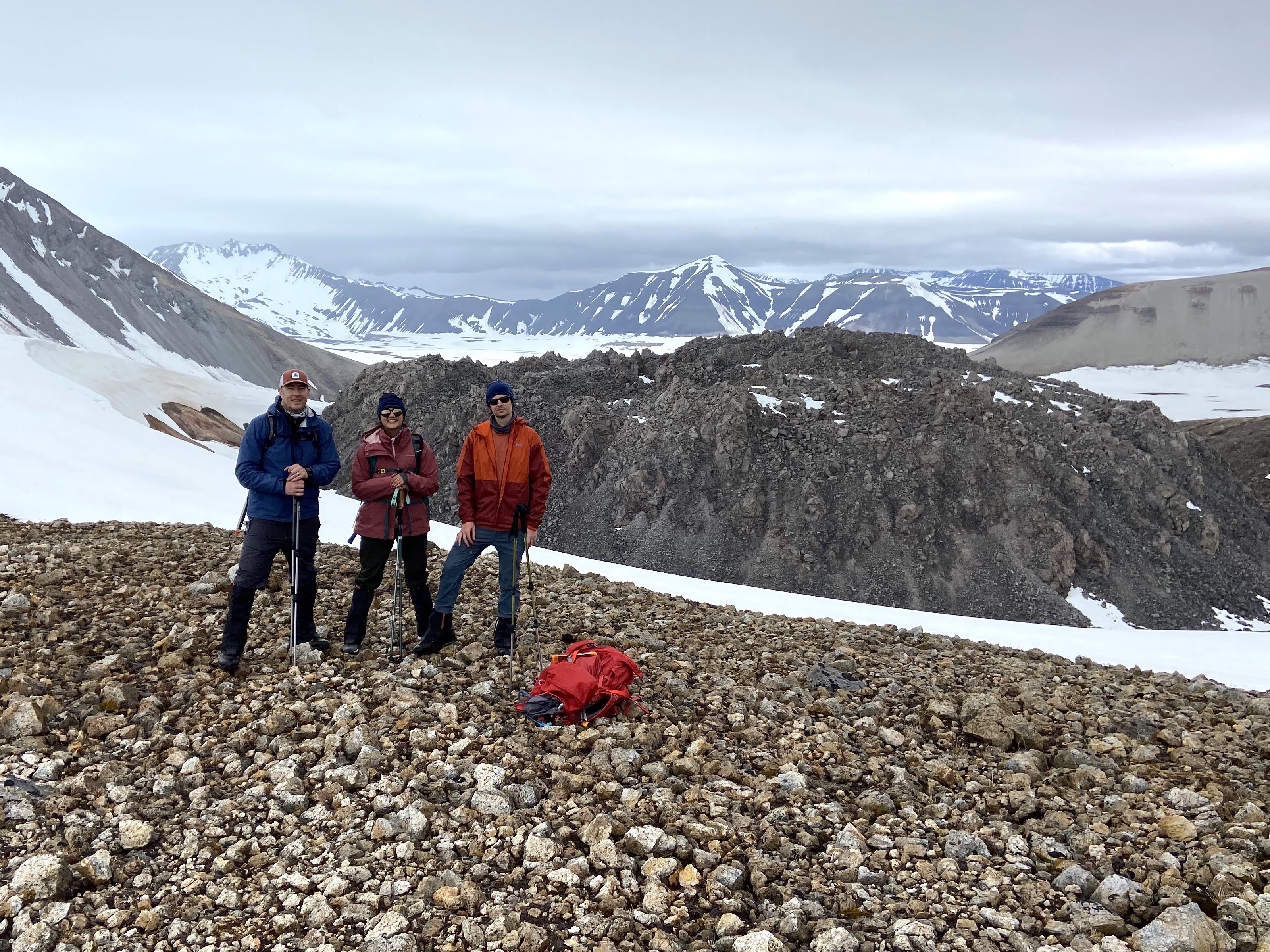
Three people, dressed for outdoor work, on a rocky hill in front of a mountainous landscape under an overcast sky. In the middle distance is a huge, dark-colored pile of rubble, shaped like a low dome.
Tabb Prissel, Aditi Pandey, and Justin Hayles at Novarupta. The dome of dark rubble behind the scientists is what’s left of the volcano itself: in 1912, material erupted from this spot buried miles of glaciated valley.

On Earth, the Moon, Mars, and beyond, geologic processes encode pieces of our solar system’s history. Volcanic deposits store details about a world’s insides at the time of an eruption and evidence of what’s happened at the surface since. Rippling fields of sand dunes, gravel, and ash record the influence of wind where atmospheres exist, like on Venus, Mars, and Titan. Glaciers can tell us about climate history and future–and on Mars, ice research also helps to lay the groundwork for human exploration. It’s much easier to take a close look at these features and processes here on Earth than anywhere else. So, to understand planets (including our own), NASA field scientists start close to home. 

About the Author

Caela Barry

Caela Barry

Keep Exploring

Discover More Topics From NASA

Powered by WPeMatico

Get The Details…

Leadership to Discuss NASA’s Boeing Crew Flight Test

Leadership to Discuss NASA’s Boeing Crew Flight Test

Boeing’s Starliner spacecraft that launched NASA’s Crew Flight Test astronauts Butch Wilmore and Suni Williams to the International Space Station is pictured docked to the Harmony module’s forward port. (Credit: NASA)

NASA Administrator Bill Nelson and leadership will hold an internal Agency Test Flight Readiness Review on Saturday, Aug. 24, for NASA’s Boeing Crew Flight Test. About an hour later, NASA will host a live news conference at 1 p.m. EDT from the agency’s Johnson Space Center in Houston.

Watch the media event on NASA+, NASA Television, the NASA app, YouTube, and the agency’s website. Learn how to stream NASA content through a variety of platforms, including social media.

Media interested in attending the news conference must contact the newsroom at NASA Johnson no later than 1 p.m., Friday, Aug. 23, at 281-483-5111 or jsccommu@mail.nasa.gov. Media participating by phone must RSVP no later than one hour prior to the start of the event. A copy of NASA’s media accreditation policy is online.

NASA and Boeing have gathered data, both in space and on the ground, regarding the Starliner spacecraft’s propulsion and helium systems to better understand the ongoing technical challenges. The review will include a mission status update, review of technical data and closeout actions, as well as certify flight rationale to proceed with undocking and return from the space station.

NASA’s Boeing Crew Flight Test launched on June 5 on a ULA (United Launch Alliance) Atlas V rocket from Space Launch Complex-41 at Cape Canaveral Space Force Station in Florida. It is an end-to-end test of the Starliner system as part of the agency’s Commercial Crew Program. Through partnership with American private industry, NASA is opening access to low Earth orbit and the space station to more people, science, and commercial opportunities.

For NASA’s blog and more information about the mission, visit:

https://www.nasa.gov/commercialcrew

-end-

Meira Bernstein / Josh Finch
Headquarters, Washington
202-358-1100
meira.b.bernstein@nasa.gov / joshua.a.finch@nasa.gov

Leah Cheshier / Sandra Jones
Johnson Space Center, Houston
281-483-5111
leah.d.cheshier@nasa.gov / sandra.p.jones@nasa.gov

Steve Siceloff / Danielle Sempsrott / Stephanie Plucinsky
Kennedy Space Center, Florida
321-867-2468
steven.p.siceloff@nasa.gov / danielle.c.sempsrott@nasa.gov / stephanie.n.plucinsky@nasa.gov

Powered by WPeMatico

Get The Details…

Abbey A. Donaldson

Sunrise Begins

Sunrise Begins

The beginning rays of an orbital sunrise illuminate Earth's atmosphere, a slight, blue arc across the center of the image. Earth is below, totally dark, matching the blackness of space above.
The International Space Station was orbiting on a northeast track 261 miles above the Pacific Ocean when this photograph captured the first rays of an orbital sunrise illuminating Earth’s atmosphere.
NASA/Matthew Dominick

NASA astronaut Matthew Dominick captured the start of this orbital sunrise on Aug. 15, 2024, while aboard the International Space Station.

Crew members aboard the orbital lab have produced hundreds of thousands of images of the land, oceans, and atmosphere of Earth, and even of the Moon through Crew Earth Observations. Their photographs of Earth record how the planet changes over time due to human activity and natural events. This allows scientists to monitor disasters and direct response on the ground and study a number of phenomena, from the movement of glaciers to urban wildlife.

Image Credit: NASA/Matthew Dominick

Powered by WPeMatico

Get The Details…
Monika Luabeya

NASA Moves Artemis II Rocket Adapter, Prepares for Shipment

NASA Moves Artemis II Rocket Adapter, Prepares for Shipment

Crews moved the cone-shaped launch vehicle stage adapter out of NASA Marshall’s Building 4708 to the agency’s Pegasus barge on August 21. The barge will ferry the adapter first to NASA’s Michoud Assembly Facility, where it will pick up additional SLS hardware for future Artemis missions, and then travel to NASA Kennedy. In Florida, teams with NASA’s Exploration Ground Systems will prepare the adapter for stacking and launch.
NASA/Samuel Lott

NASA rolled out a key piece of space flight hardware for the SLS (Space Launch System) rocket for the first crewed mission of NASA’s Artemis campaign from Marshall Space Flight Center in Huntsville, Alabama, on Wednesday, Aug. 21 for shipment to the agency’s Kennedy Space Center in Florida. The cone-shaped launch vehicle stage adapter connects the rocket’s core stage to the upper stage and helps protect the upper stage’s engine that will help propel the Artemis II test flight around the Moon, slated for 2025.

“The launch vehicle stage adapter is the largest SLS component for Artemis II that is made at the center,” said Chris Calfee, SLS Spacecraft Payload Integration and Evolution element manager. “Both the adapters for the SLS rocket that will power the Artemis II and Artemis III missions are fully produced at NASA Marshall. Alabama plays a key role in returning astronauts to the Moon.”

Crews moved the adapter out of NASA Marshall’s Building 4708 to the agency’s Pegasus barge Aug. 21. The barge will ferry the adapter first to NASA’s Michoud Assembly Facility in New Orleans, where crews will pick up additional SLS hardware for future Artemis missions, before traveling to NASA Kennedy. Once in Florida, the adapter will join the recently delivered core stage. There, teams with NASA’s Exploration Ground Systems will prepare the adapter for stacking and launch.

Engineering teams at NASA Marshall are in the final phase of integration work on the launch vehicle stage adapter for Artemis III. The stage adapter is manufactured by prime contractor Teledyne Brown Engineering and the Jacobs Space Exploration Group’s ESSCA (Engineering Services and Science Capability Augmentation) contract using NASA Marshall’s self-reacting friction-stir robotic and vertical weld tools.

Through the Artemis campaign, NASA will land the first woman, first person of color, and its first international partner astronaut on the Moon. The rocket is part of NASA’s deep space exploration plans, along with the Orion spacecraft, supporting ground systems, advanced spacesuits and rovers, Gateway in orbit around the Moon, and commercial human landing systems. NASA’s SLS is the only rocket that can send Orion, astronauts, and supplies to the Moon in a single launch.

For more on SLS, visit: 

https://www.nasa.gov/sls

News Media Contact

Jonathan Deal
Marshall Space Flight Center, Huntsville, Ala. 
256-544-0034  
jonathan.e.deal@nasa.gov

Powered by WPeMatico

Get The Details…
Lee Mohon

Looking Back on Looking Up: The 2024 Total Solar Eclipse

Looking Back on Looking Up: The 2024 Total Solar Eclipse

Feature Article header

9 min read

Looking Back on Looking Up: The 2024 Total Solar Eclipse

Eclipse banner
Credit: NASA’s Glenn Research Center (GRC)

Introduction

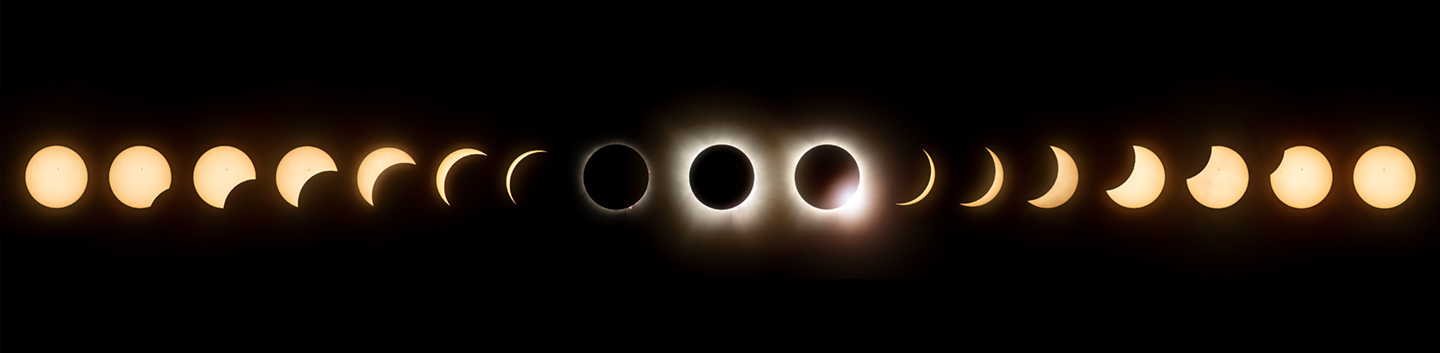
First as a bite, then a half Moon, until crescent-shaped shadows dance through the leaves and the temperature begins to drop – a total solar eclipse can be felt growing in the atmosphere. As the sky darkens in the few minutes before totality, the sounds of animals begin to dissipate along with the vibrancy of red and orange hues, and we enter the mesopic zone, or twilight vision. All is quiet in these cold, silvery-blue moments, until the Moon lines up perfectly with the Sun from our viewpoint on Earth – an odd quirk of the Moon–Earth system, and an occurrence that does not exist elsewhere in the solar system.

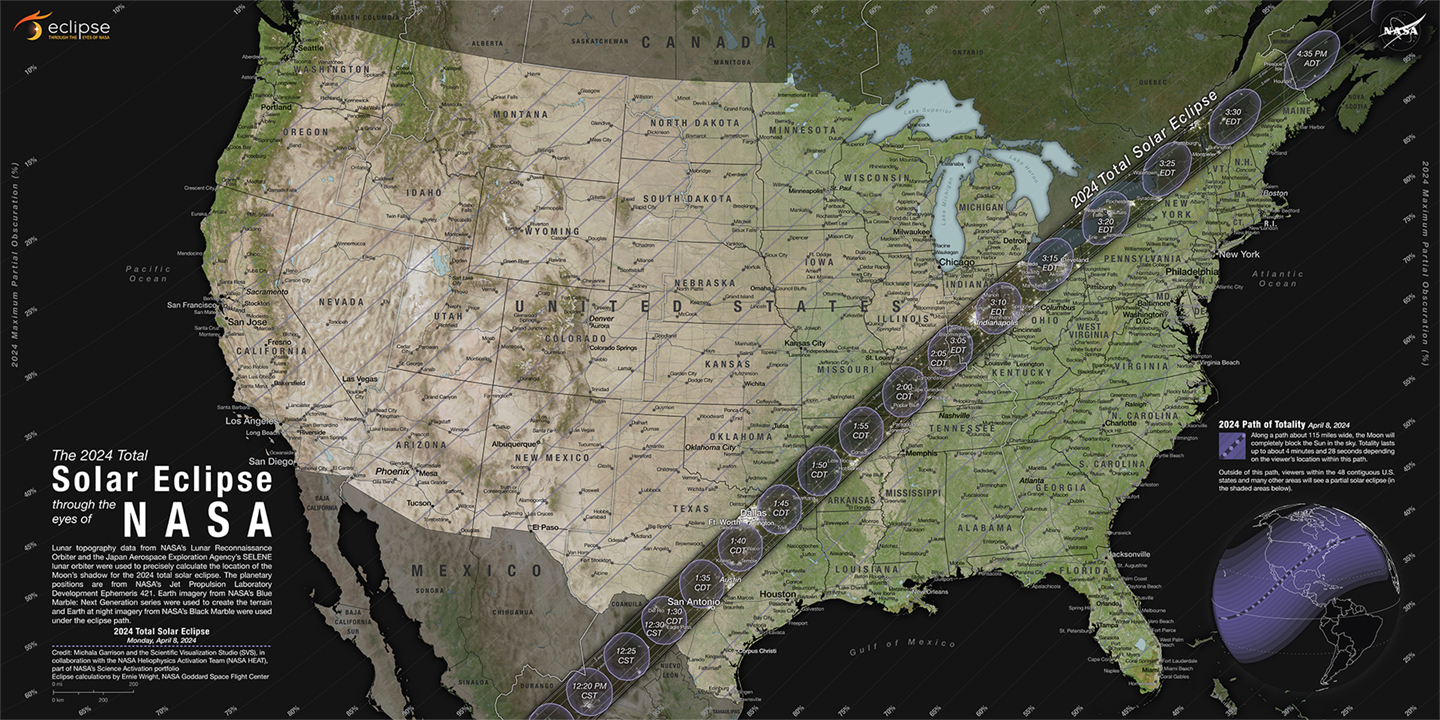
Millions of people gazed up at the sky on April 8, 2024, as a total solar eclipse darkened the skies across a thin ribbon of North America – spanning Mexico’s Pacific coast to the Atlantic coast of Newfoundland, Canada – see Figure 1.

Eclipse figure 1
Figure 1. A total solar eclipse was visible along a narrow track stretching from Texas to Maine on April 8, 2024. A partial eclipse was visible throughout all 48 contiguous U.S. states.
Figure credit: NASA Scientific Visualization Studio

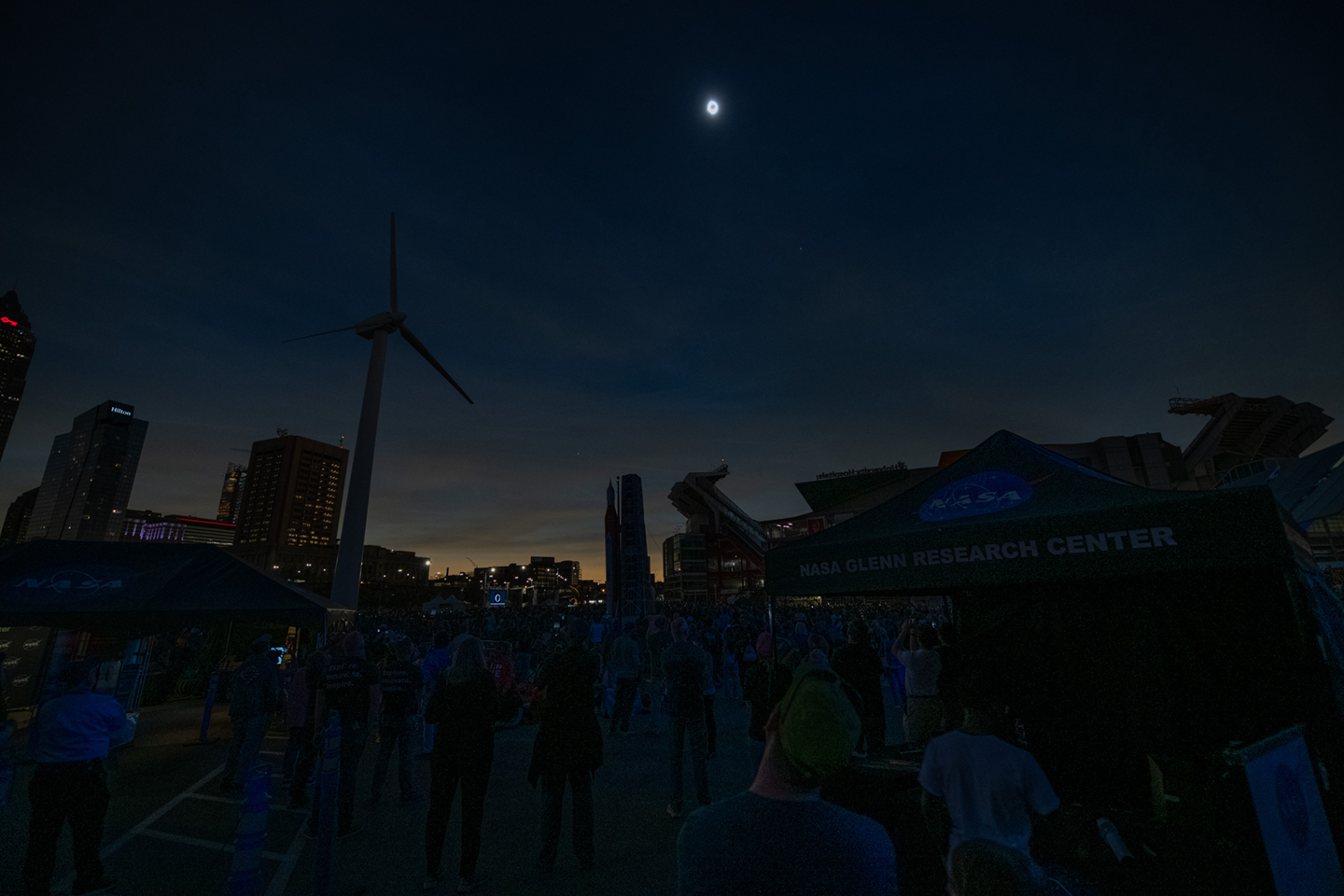
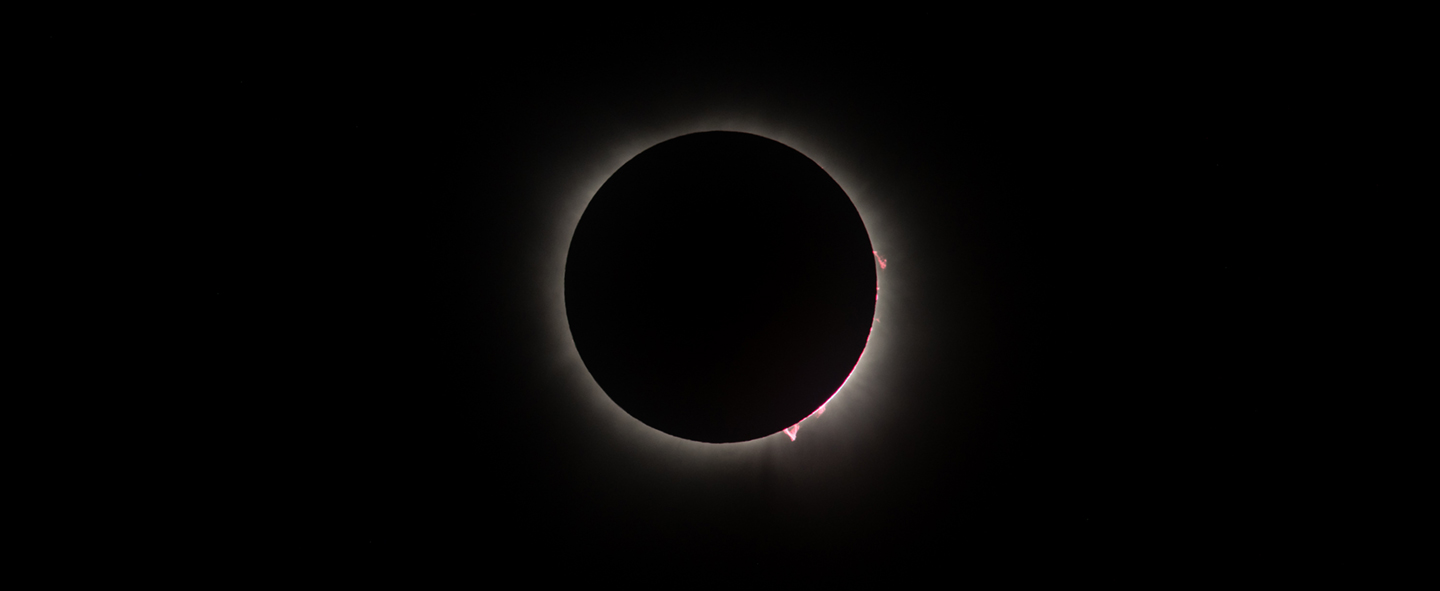
A pearly, iridescent halo lined the perimeter of the Moon as it crossed in front of the Sun, revealing the Sun’s corona – see Photo 1. Solar prominences – bright features made of plasma flowing outwards through tangled structures of magnetic fields along the Sun’s surface – were observable as reddish-pink dots rising from the edges of the eclipsed Sun – see Photo 2.

Eclipse photo 1
Photo 1. The moment of totality in Cleveland, OH.
Photo credit: NASA’s Glenn Research Center (GRC)
Eclipse photo 2
Photo 2. Solar prominence [lower right of the solar disc] seen during totality in Cleveland, OH.
Photo credit: GRC

Snapshots of NASA Science Outreach Along the Path of Totality

Over 400 NASA staff took up positions along the path of totality, hosting various events to engage the public in outreach activities spanning the scope of NASA Science. NASA staff hosted 14 “SunSpot” locations across 7 states (Texas, Arkansas, Ohio, Indiana, Pennsylvania, New York, and Maine), including 224 NASA engagement and Science Activation events. As an example, Zoe Jenkins [NASA Headquarters/Arctic Slope Regional Corporation (ASRC) Federal—Graphic Designer] was stationed in Maine to view the eclipse –see Photos 3–4. More information about events at these SunSpots is available at the eclipse website. The Science Activation Program furthered NASA’s message, reaching all 50 states through public events by sharing information and providing professional development programming for educators. (To learn more about NASA’s Science Activation Program, see NASA Earth Science and Education Update: Introducing the Science Activation Program, The Earth Observer, 35:6, 6–12.)

Eclipse photo 3
Photo 3. NASA Eclipse celebration at the SunSpot in Houlton, ME.
Photo credit: Zoe Jenkins/NASA Headquarters (HQ)/Arctic Slope Regional Corporation (ASRC) Federal
Eclipse photo 4
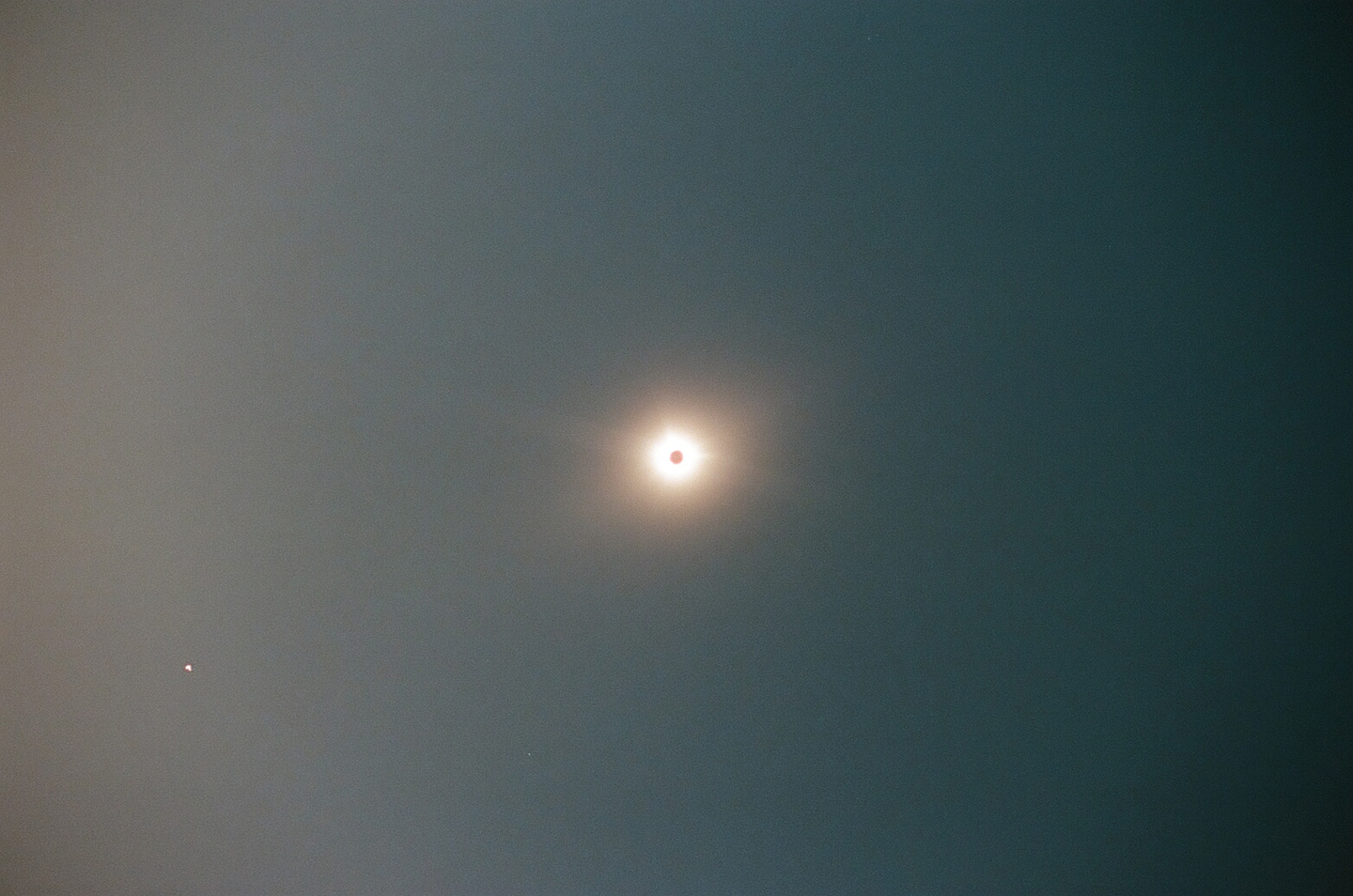
Photo 4. View of the black hole of the Moon’s shadow over the Sun during totality in Houlton, ME.
Photo credit: Zoe Jenkins

Among the SunSpot locations across the path of totality, NASA’s Science Support Office (SSO) staffed events at two of them: in Cleveland, OH and Kerrville, TX.

The Great Lakes Science Center and its two partners – NASA’s Glenn Research Center (GRC) and the Cleveland Orchestra – presented “Total Eclipse Fest 2024,” a three-day celestial celebration at North Coast Harbor in downtown Cleveland beginning April 6 and culminating on the day of the eclipse. The event included free concerts, performances, speakers, and hands-on science activities.

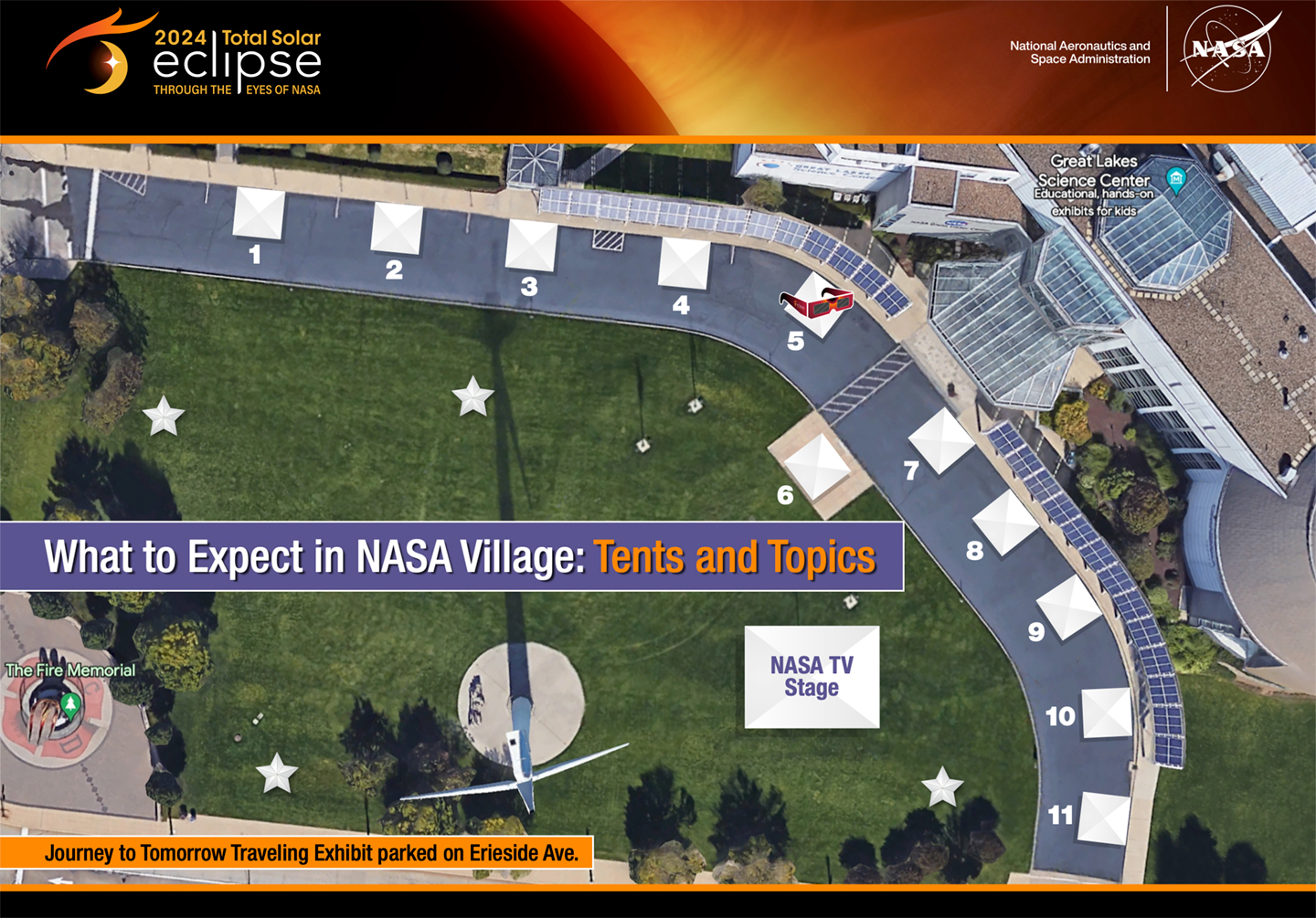
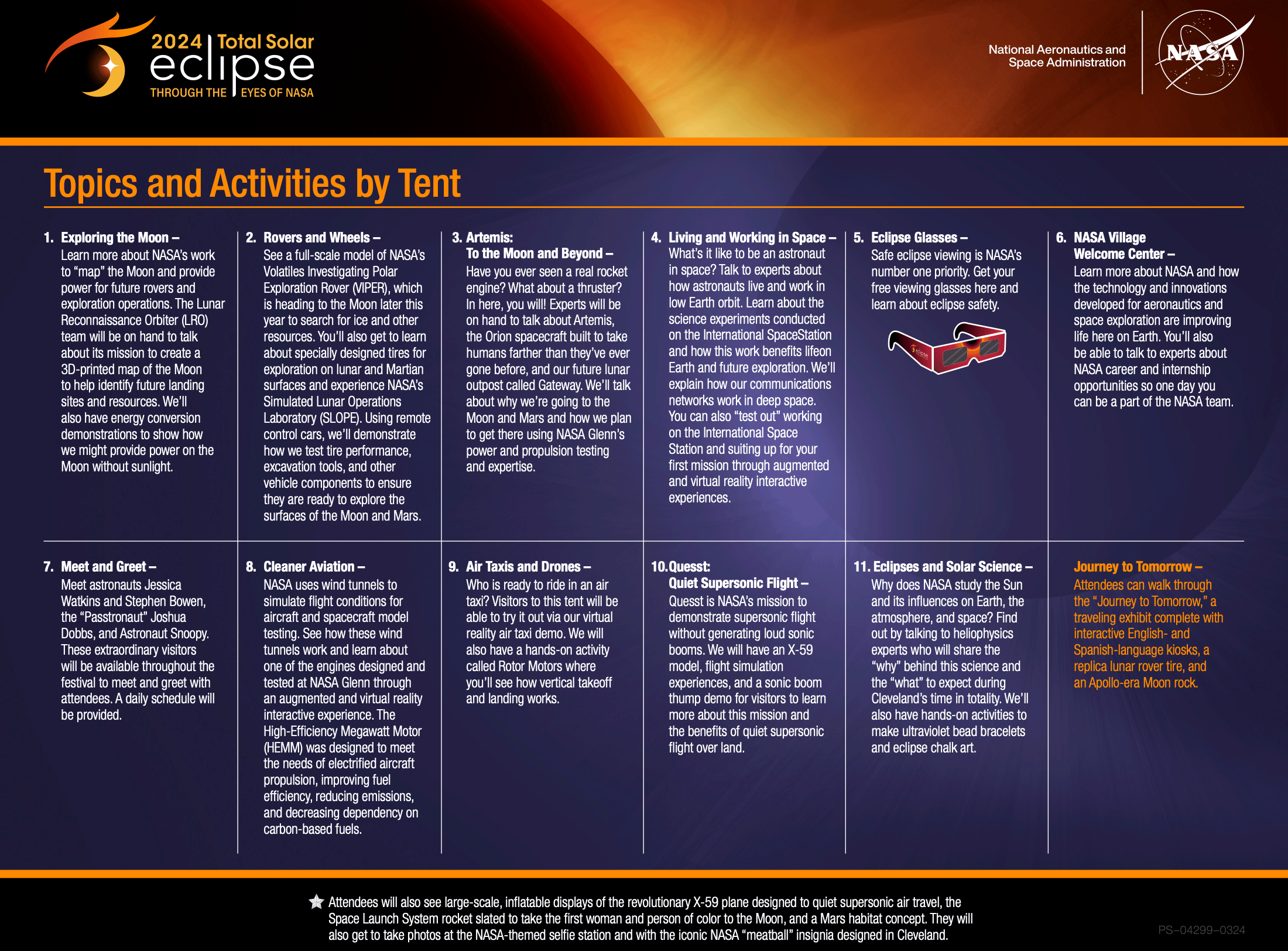
At the heart of the festival was the “NASA Village,” an immersive experience featuring the agency’s major missions and projects aimed at advancing space exploration and revolutionizing air travel. Figure 2 shows the location of each outreach tent in the village, while Figure 3 provides descriptions of each activity. More than 36,000 attendees visited the NASA village over the three-day event.

Exhibits focused on innovations in aeronautics, space, solar, and lunar science, and best practices for ensuring a safe solar eclipse viewing experience. Through virtual and augmented simulations, attendees had the opportunity to take a supersonic flight, walk on Mars, and visit the International Space Station. Attendees of all ages participated in hands-on activities and talked to NASA scientists and engineers about their work and how to join the NASA team. Attendees could also walk through Journey to Tomorrow, a traveling exhibit complete with interactive English and Spanish-language content, and see an Apollo-era Moon rock. Visitors also explored large-scale, inflatable displays of the X-59 plane designed to quiet supersonic air travel, the Space Launch System rocket slated to take the first woman and person of color to the Moon, and a Mars habitat concept. Throughout the NASA Village, attendees could take advantage of several photo opportunities, including iconic NASA cutouts and displays. NASA also hosted astronaut autograph signing sessions, as well as special guest “meet and greets.”

Eclipse figure 2
Figure 2. Map of the “NASA Village” at the Eclipse festival in Cleveland, OH, hosted by GRC. See Figure 3 for activity descriptions.
Figure credit: GRC
Eclipse figure 3
Figure 3. Descriptions of each outreach activity stationed at individual tents within the NASA Village over the three-day festival. See Figure 2 for map.
Figure credit: GRC

A View of the Eclipse from Cleveland

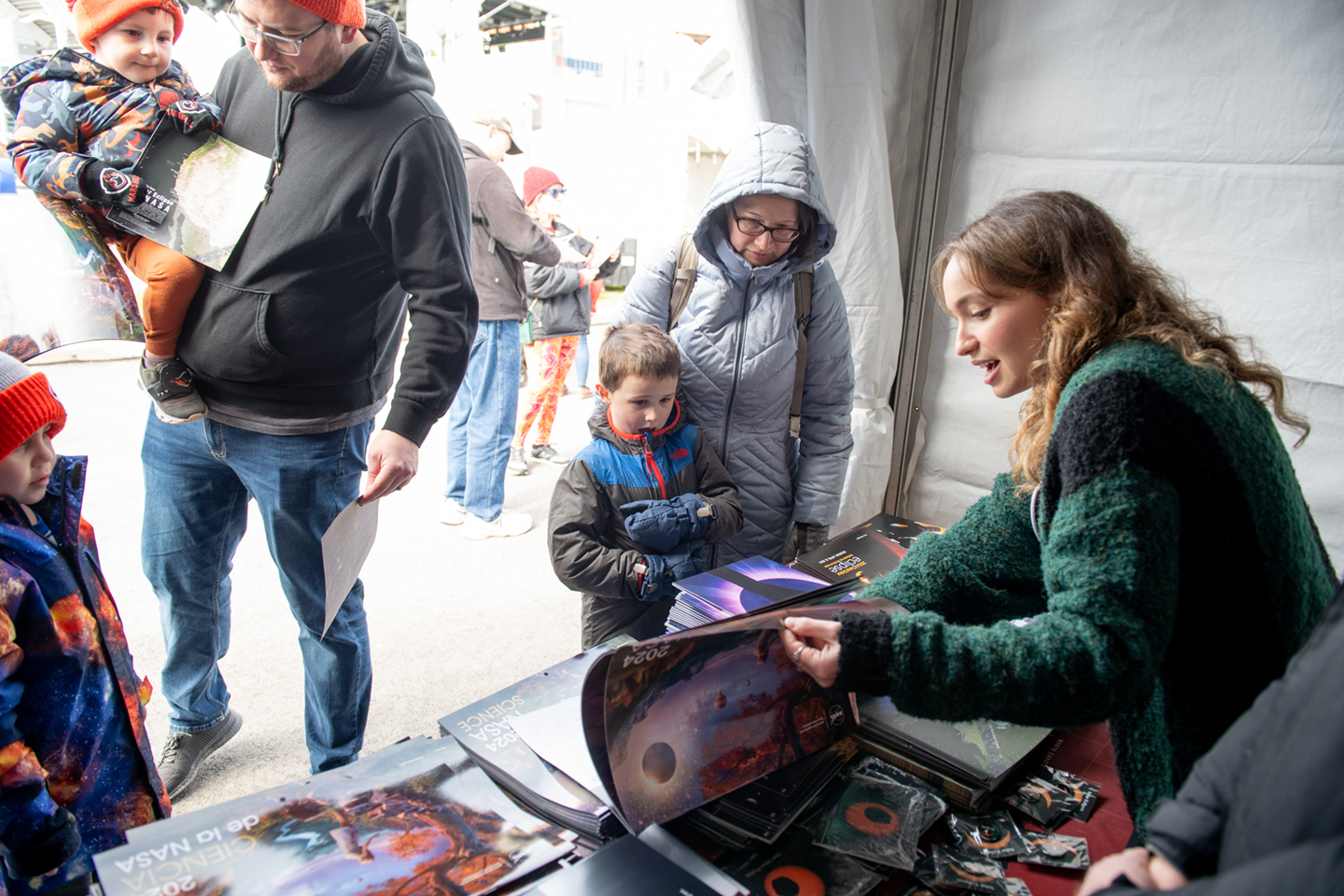
In Cleveland, the eclipse began at 1:59 PM EDT, with totality spanning 3:13–3:17 PM. The eclipse concluded at 4:28 PM. SSO staff supported total eclipse outreach from April 5–9, specifically engaging attendees at the Solar Science tent within the NASA Village and providing information about eclipse safety and heliophysics, and handing out items such as the NASA Science calendar, NASA tote bags, and other outreach materials. SSO also supported a NASA photo booth with eclipse-themed props and took hundreds of souvenir photos for visitors to remember their time at the festival – see Photos 5–9.

Eclipse photo 5
Photo 5. SSO staff member Dalia Kirshenblat [NASA’s Goddard Space Flight Center (GSFC)/Global Science and Technology Inc.(GST)] handed out NASA Science calendars, eclipse glasses, posters, and other NASA outreach materials. The materials informed attendees about eclipse viewing safety and shared NASA science, engaging in topics that explained how eclipses occur.
Photo credit: GRC
Eclipse photo 6
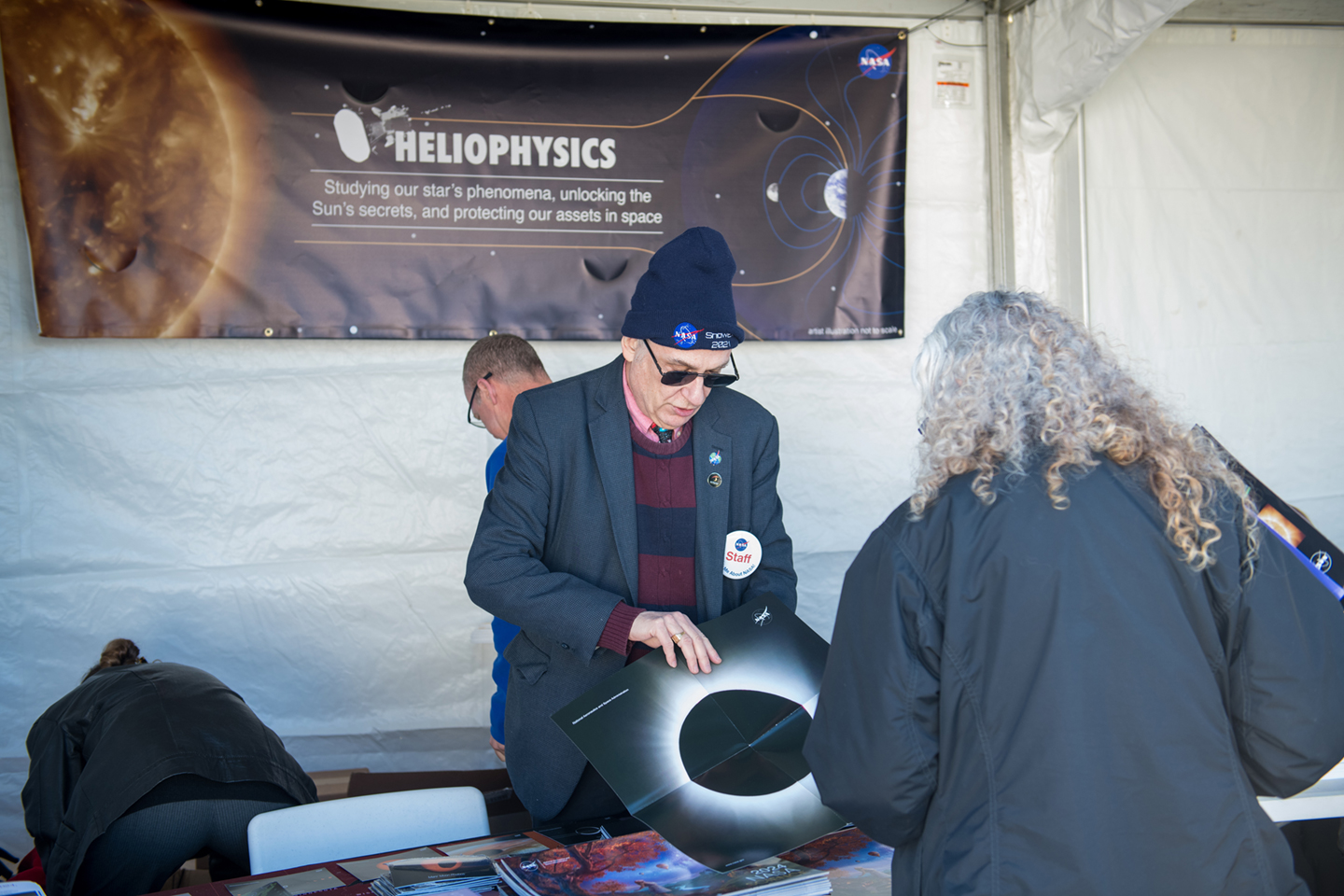
Photo 6. Jack Kaye [NASA HQ—Associate Director for Research, Earth Science Division (ESD)] hands out eclipse posters and other outreach materials to attendees at Eclipse Fest 2024.
Photo credit: GRC
Eclipse photo 7
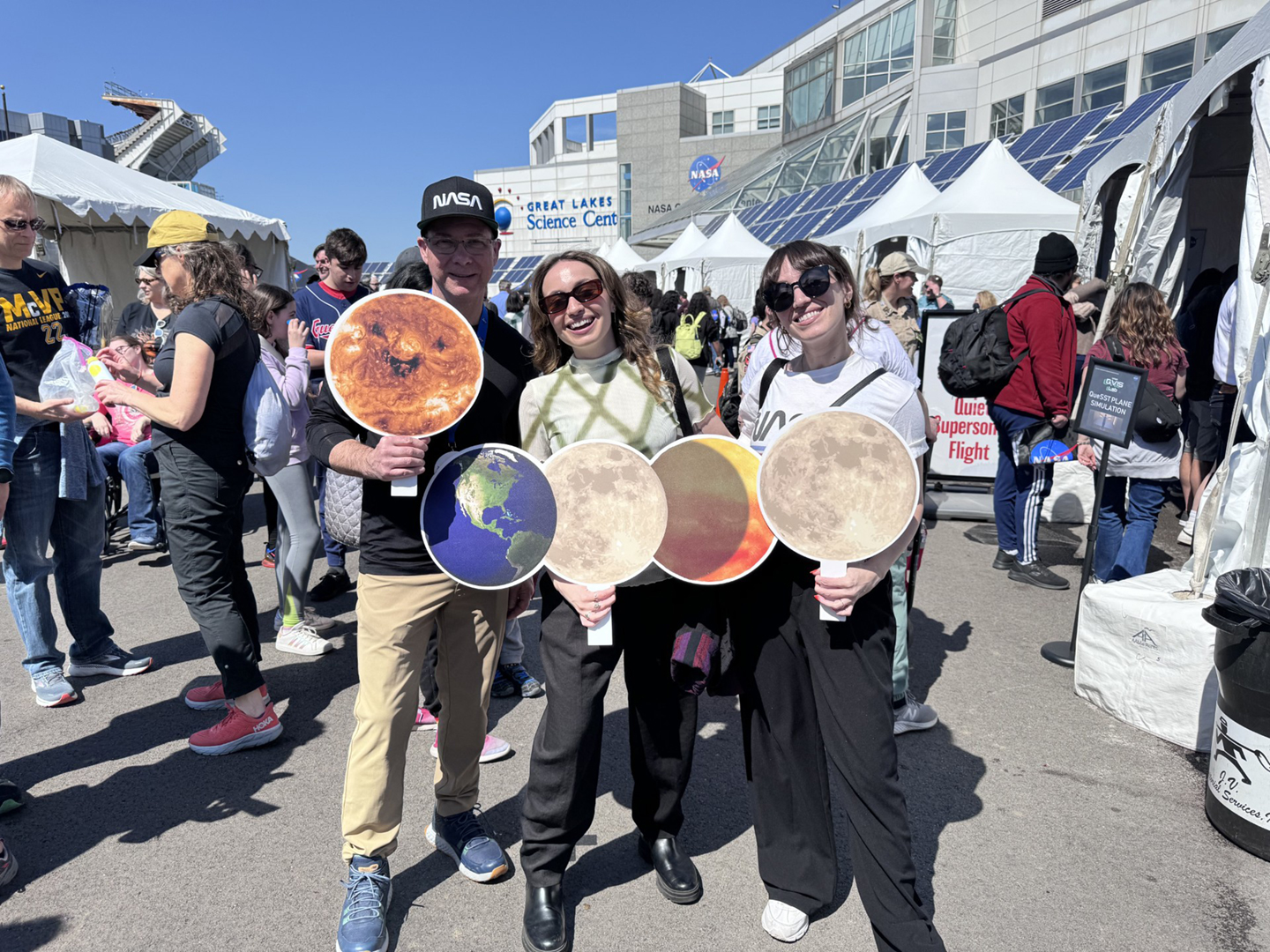
Photo 7. Steve Graham [GSFC/GST], Dalia Kirshenblat, and Danielle Kirshenblat [Space Telescope Science Institute (STScI)] pose with NASA SSO photo booth props at Eclipse Fest 2024. SSO staff took hundreds of pictures of visitors with the photo booth props as keepsakes.
Photo credit: NASA
Eclipse photo 8
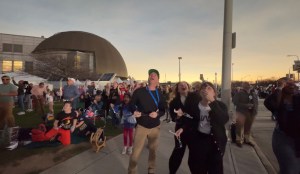
Photo 8. Dalia Kirshenblat and Danielle Kirshenblat watching the eclipse begin in Cleveland, OH, at approximately 2:00 PM EDT.
Photo credit: NASA
Eclipse photo 9
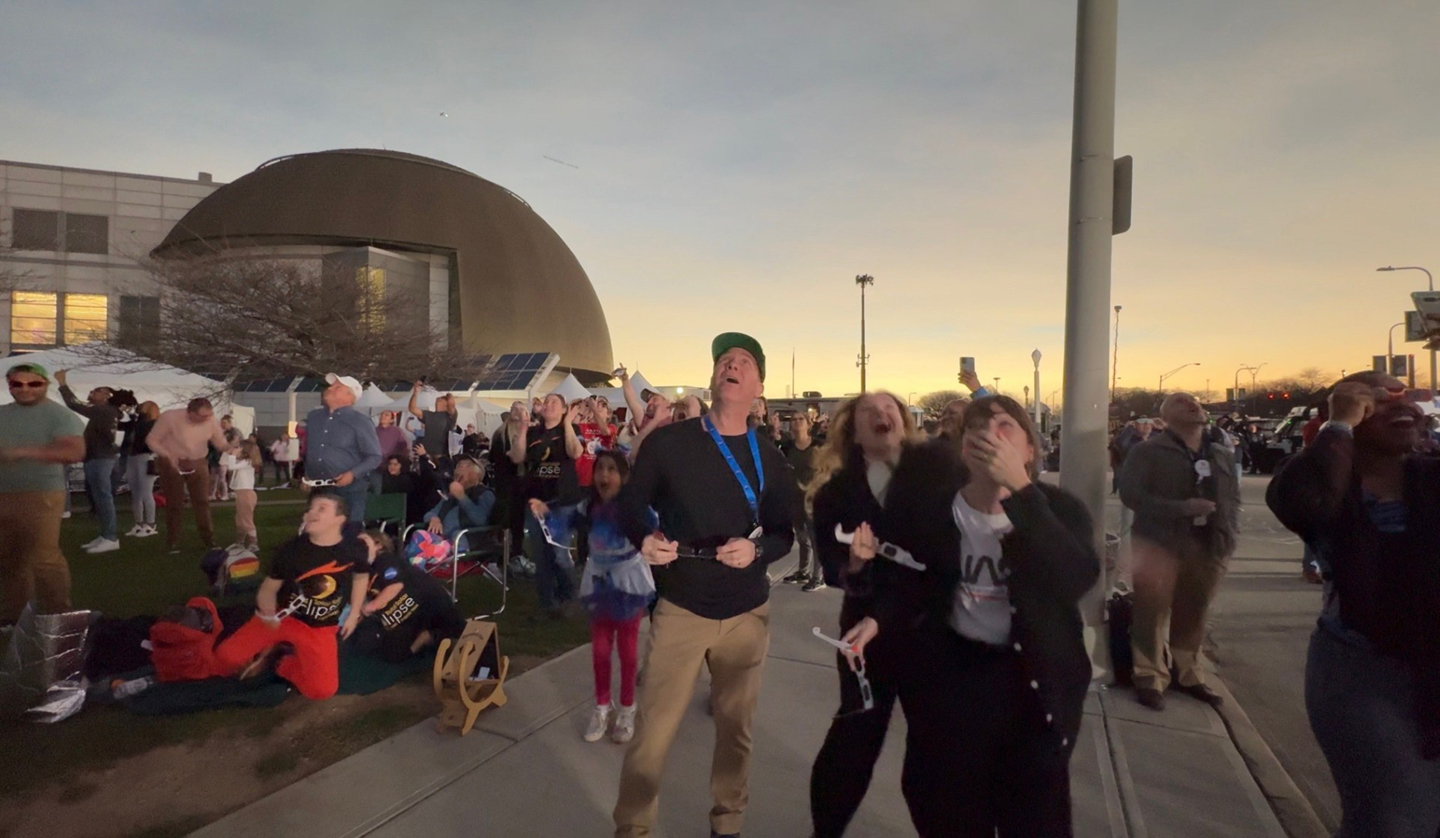
Photo 9. Steve Graham, Dalia Kirshenblat, Danielle Kirshenblat, and other Eclipse Fest attendees gaze at the celestial show unfolding above them as totality begins in Cleveland, OH, at approximately 3:13 PM EDT.
Photo credit: Danielle Kirshenblat

Eclipse Engagement in Texas

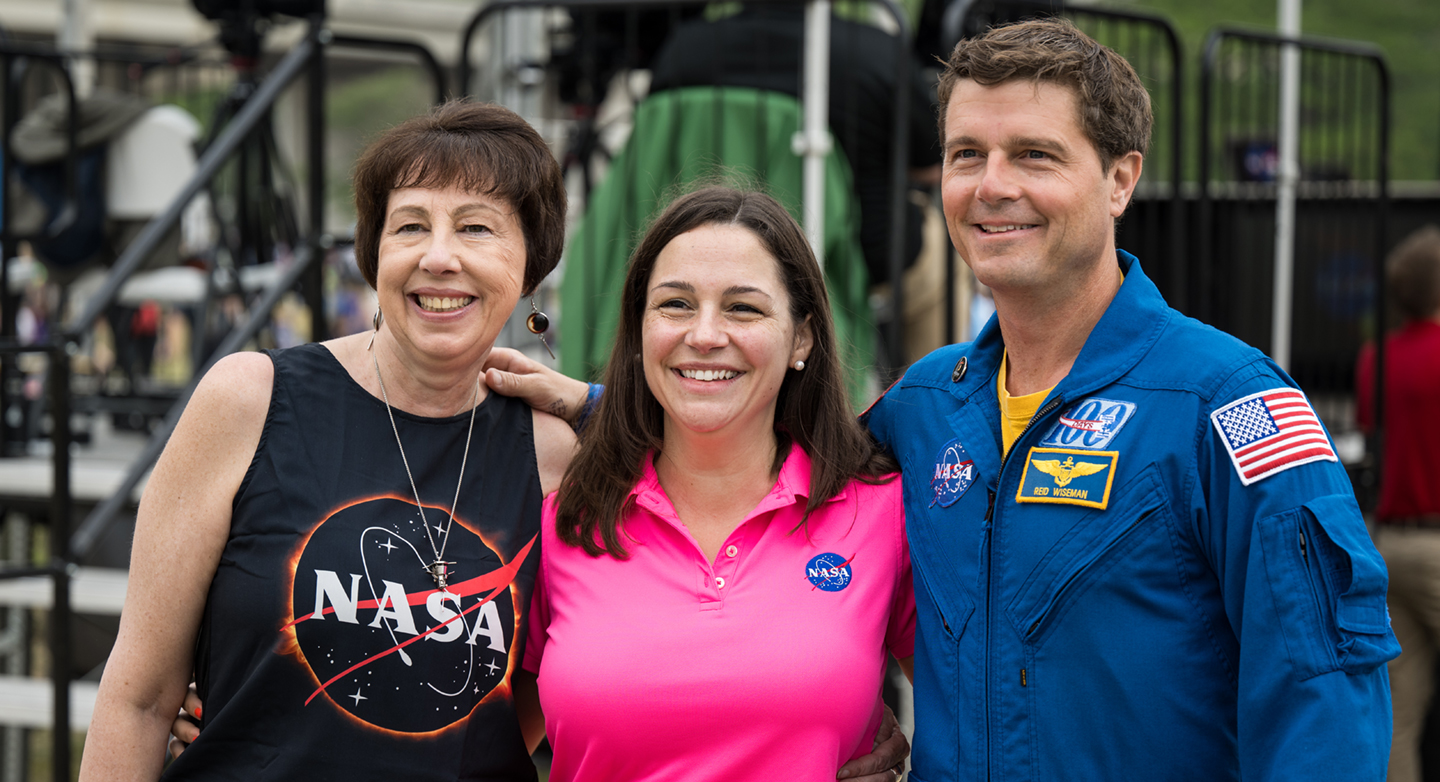
In addition to the Cleveland eclipse festival, SSO staff members supported total eclipse engagement in Kerrville, TX, from April 5–9, including several small events at Cailloux Theatre, Doyle Community Center, Trailhead Garden, and Kerrville-Schreiner Park leading up to the eclipse. (While a bit more remote than Cleveland, Kerville was chosen as a SunSpot location during the total eclipse because it was also in the path of the October 2023 annular eclipse, NASA had outreach activities in Kerville for that eclipse as well). The events culminated on April 8 at Louise Hays Park. NASA’s impact on the community was wide-reaching, engaging approximately 4000 individual interactions with community members and visitors. The feedback was overwhelmingly positive and appreciative. On April 8, SSO provided astronaut handler support for NASA Astronaut Reid Wiseman – who will command the Artemis II Moon mission – during a “photos with an astronaut” session. SSO staff also escorted Wiseman to and from a main stage speaking engagement and the NASA broadcast engagement – see Photos 10–13.

Eclipse photo 10
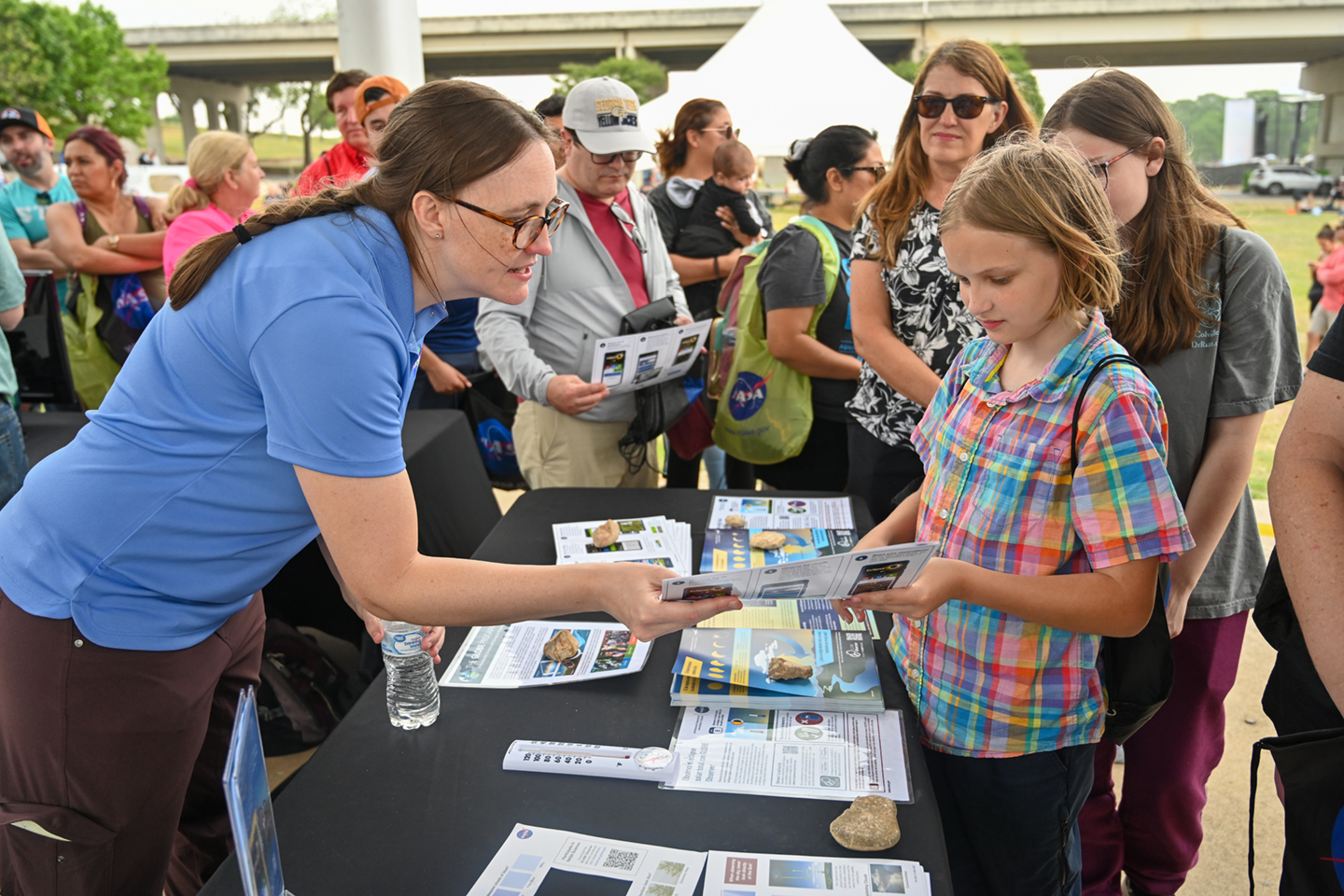
Photo 10. Ellen Gray [GSFC/KBR—Senior Outreach Specialist] engaging attendees in Kerrville, TX with various NASA Science outreach materials.
Photo credit: NASA
Eclipse Photo 11.
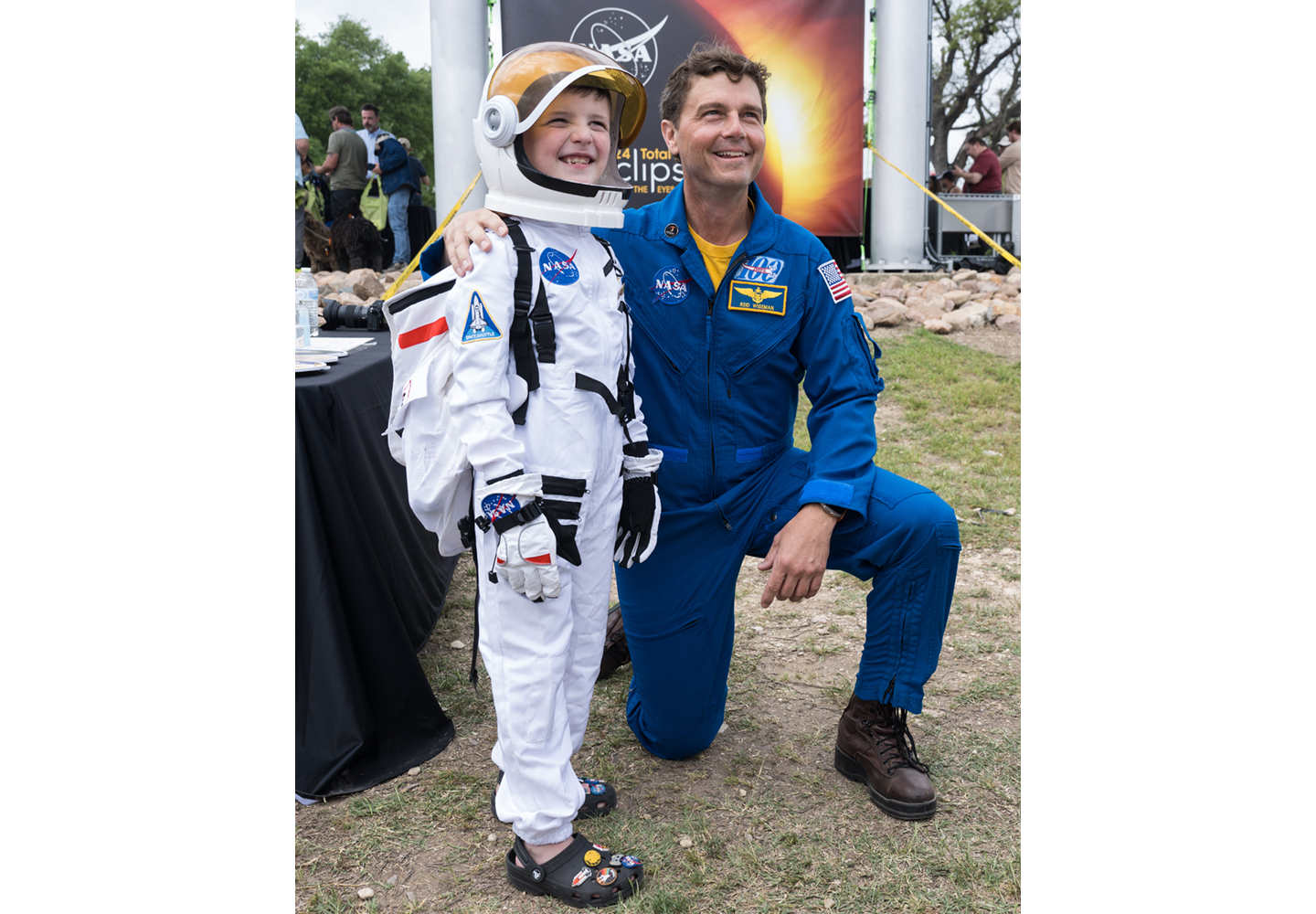
Photo 11. NASA Astronaut Reid Wiseman poses with a potential future astronaut and attendee at the Eclipse event in Kerrville, TX.
Photo credit: NASA
Eclipse Photo 12
Photo 12. Astronaut Reid Wiseman speaks at a NASA broadcast in Kerrville, TX.
Photo credit: NASA
Eclipse Photo 13
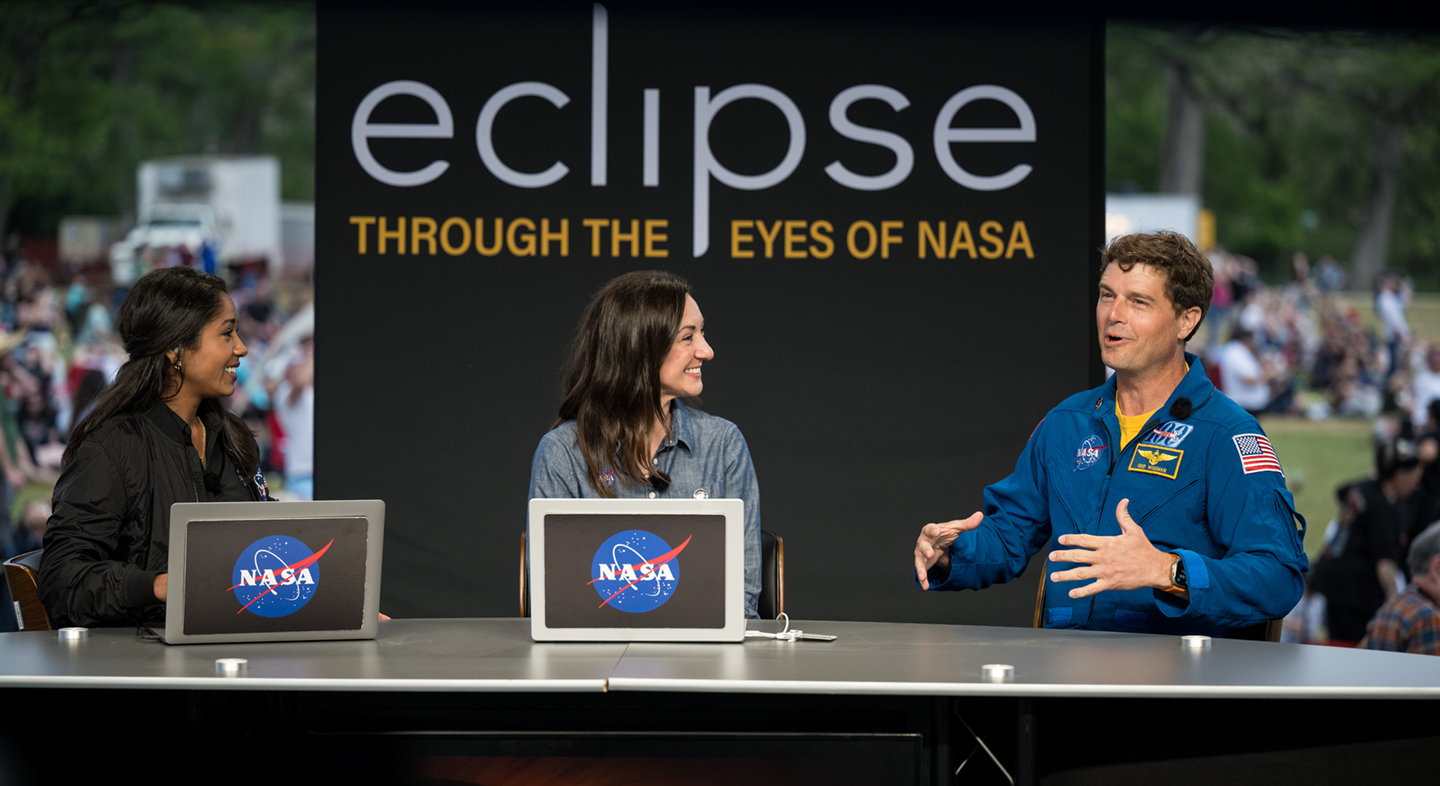
Photo 13. [left to right] Nicola Fox [NASA HQ—Associate Administrator for the Science Mission Directorate (SMD)], Alex Lockwood [NASA HQ—Strategic Engagement Lead], and Astronaut Reid Wiseman.
Photo credit: NASA

NASA Science Engagement Across the Agency

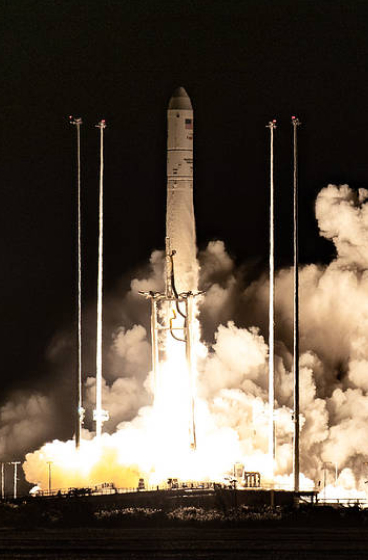
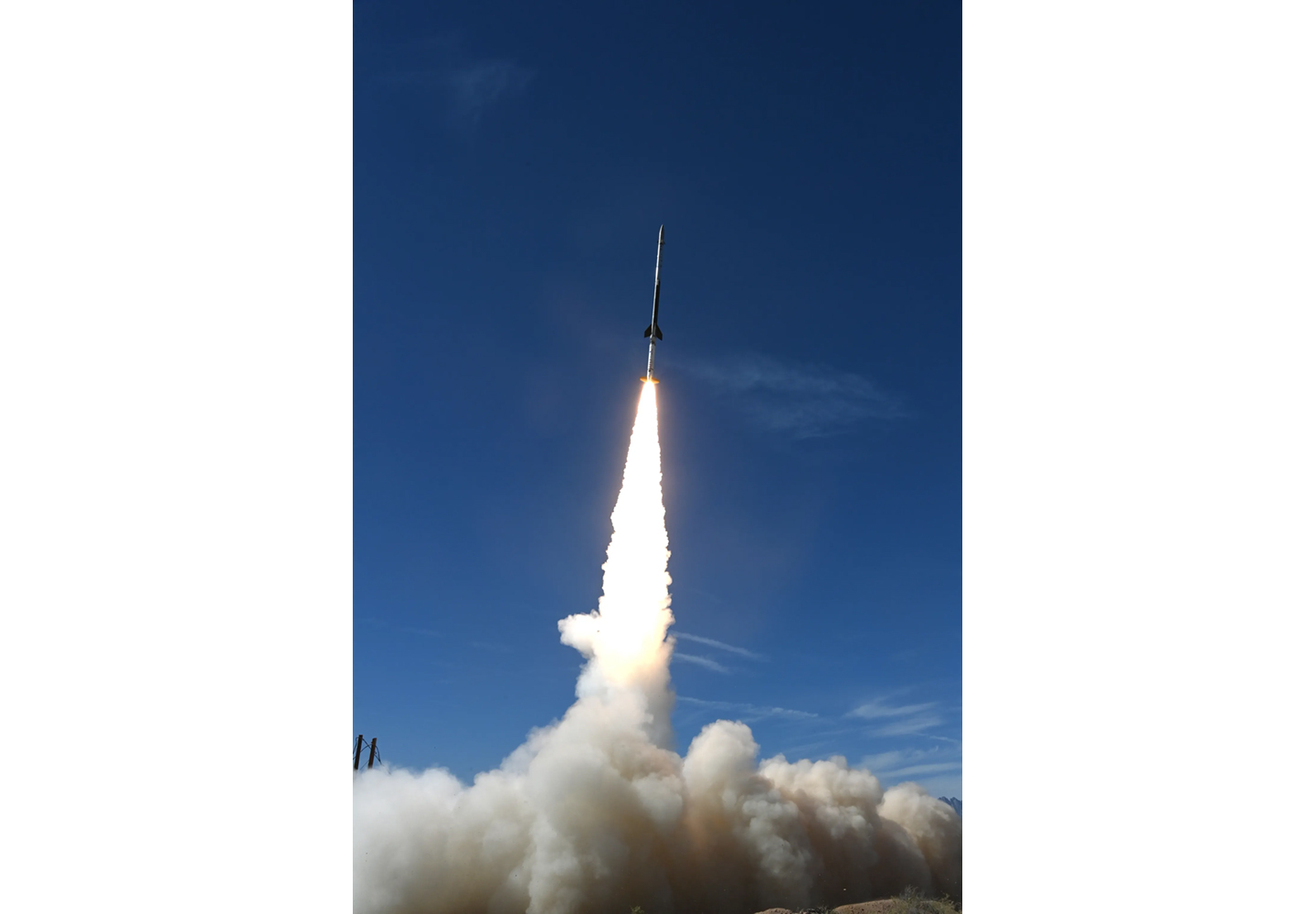
As millions gazed at totality from the ground, NASA was conducting science from the skies. Atmospheric Perturbations around the Eclipse Path (APEP), a NASA sounding rocket mission, launched three rockets from NASA’s Wallops Flight Facility in Virginia to study how the sudden dip in sunlight that occurs during an eclipse affects the upper atmosphere. Each rocket deployed four scientific instruments that measured changes in electric and magnetic fields, density, and temperature – see Photo 14.

Eclipse Photo 14
Photo 14. The Atmospheric Perturbations launched around the Eclipse Period (APEP) sounding rocket during the total eclipse on April. This photo shows the third APEP sounding rocket – launched during the October 2023 annular eclipse – leaving the launchpad.
Photo credit: WSMR Army Photo

As part of the Nationwide Eclipse Ballooning Project, student teams constructed hundreds of balloons and launched them during the eclipse, encouraging students to consider careers in the STEM workforce.

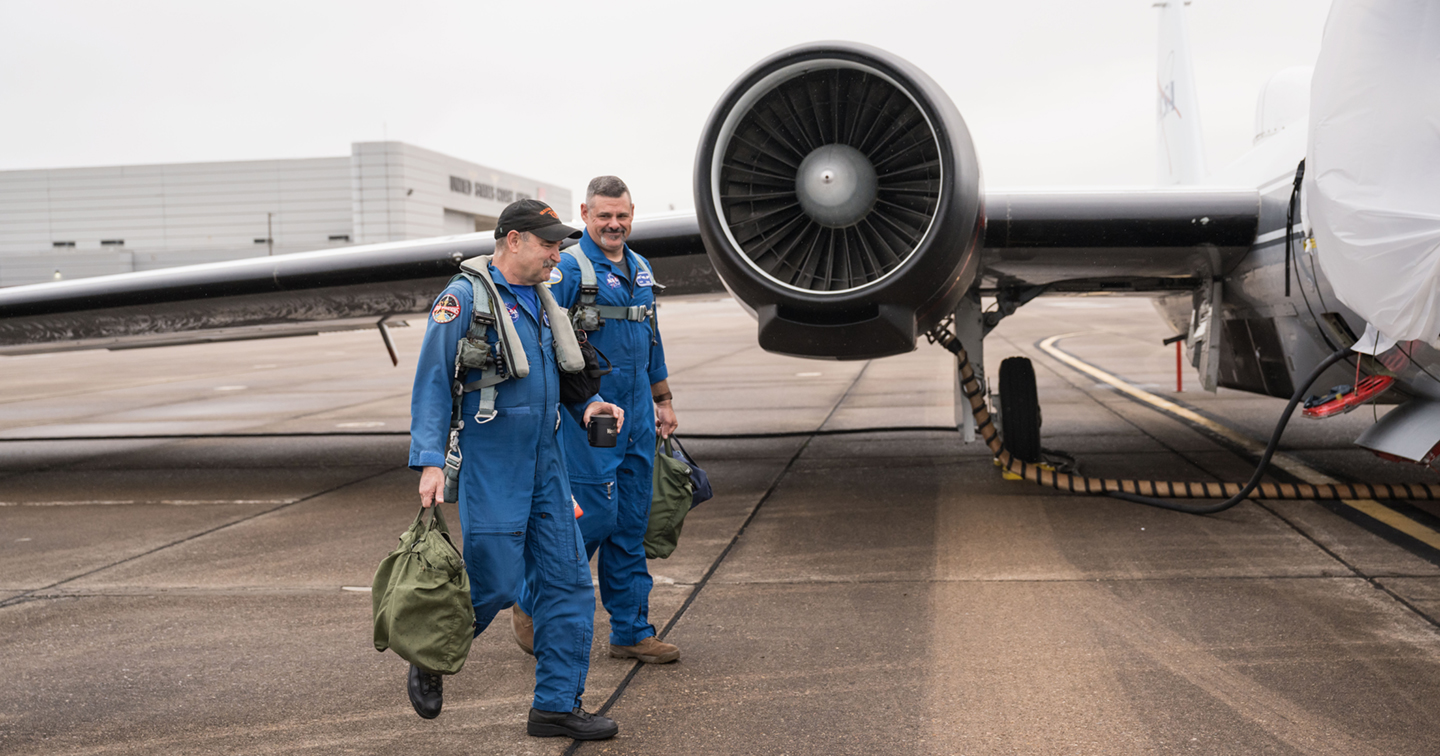
Also, two WB-57 aircraft carried instruments to further extend scientific observations made during the eclipse. By taking images above Earth’s atmosphere, scientists were able to see new details of structures in the middle and lower corona. The observations – taken with a camera that images in infrared and visible light at high resolution and high speed – could improve our understanding of the dust ring around the Sun and help search for asteroids that may orbit near the Sun. The WB-57 flights also carried instruments to learn more about the temperature and chemical composition of the corona and coronal mass ejections – or large bursts of solar material. By flying these instruments on a WB-57, the scientists extended their time in the Moon’s shadow by over two minutes from what could be achieved using ground-based observations. A third experiment used an ionosonde to study the ionosphere – the charged layer of Earth’s upper atmosphere. The device functions like a simple radar, sending out high frequency radio signals and listening for their echo rebounding off the ionosphere. The echoes allow researchers to measure how the ionosphere’s charge changed during the eclipse – see Photo 15.

Eclipse Photo 15
Photo 15. Pilots prepare for the 2024 total solar eclipse experiments on the NASA WB-57 aircraft on April 8, 2024 at Ellington Field in Houston, TX.
Photo credit: NASA/James Blair

The eclipse also provided an opportunity for the public to contribute to the NASA Citizen Science program – a project called Eclipse Soundscapes reached over 900 people during their training programs to prepare for the eclipse. Over 36,000 individual citizen scientists contributed more than 60,000 data submissions across the eclipse path, recording the reactions of wildlife before, during, and after this celestial event.

As part of NASA’s Heliophysics Big Year to celebrate the Sun, NASA played a key role in enabling safe participation as well as working with new-to-NASA audiences. NASA’s Science Mission Directorate ordered and distributed 2.05 million eclipse glasses across the country, with distribution locations including K–12 schools, libraries, minority-serving institutions, community events, museums, partner organizations, underserved communities, science centers, and NASA personnel.

As of April 8, Science Activation reached over 2000 educators across the country through programming designed to prepare educators for the eclipse and provide them with educational resources to train students in STEM. NASA broadcasted a livestream of engagement events on NASA+, the NASA App, NASA.gov, and NASA social media channels. By 4:30 PM EDT, NASA’s websites spiked (e.g., nasa.gov, science.nasa.gov, plus.nasa.gov, and ciencia.nasa.gov) with nearly 28.9 million views and 15.6 million unique visitors. At its peak, 1,458,212 people watched the eclipse broadcast live, experiencing the eclipse together through the eyes of NASA. Total viewership as of 4:30 PM EDT was 13,511,924.

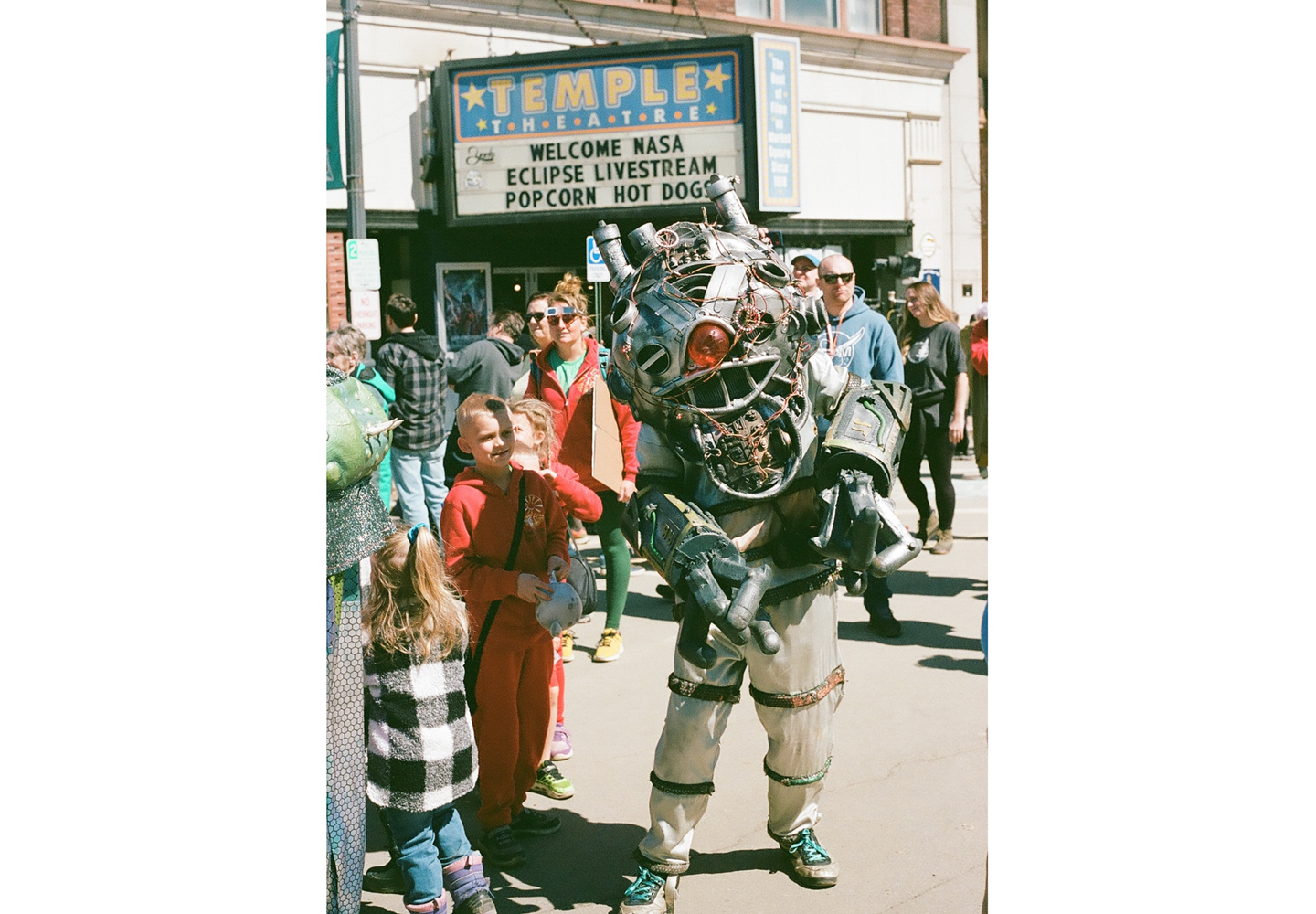
NASA’s Office of Communications Engagement Division organized at least 17 in-person and digital partner interactions, including several Major League Baseball games, Google eclipse safety Doodle and search effect, coverage of NASA on NASDAQ’s screen in Times Square, a solar songs request weekend on Third Rock Radio, and a Snoopy visit to the Cleveland sunspot. Several partners also interacted on social media, including Barbie, Cookie Monster, Elmo, Snoopy, LEGO, and other partner accounts.

Conclusion

The 2024 total eclipse brought joy and awe to millions, inspiring so many to look up, be curious about the natural world around them, and explore the sky. The next total solar eclipse will occur in 2026 and will be visible in Spain, a small area of Portugal, as well as Iceland, Greenland, and Russia. We won’t see another total eclipse in the U.S. until 2044.

Movie. Timelapse of the eclipse’s totality in Cleveland, OH.
Video credit: Danielle Kirshenblat

Dalia Kirshenblat
NASA’s Goddard Space Flight Center/Global Science and Technology, Inc.
dalia.p.zelmankirshenblat@nasa.gov

Share

Details

Last Updated
Aug 22, 2024

Related Terms

Powered by WPeMatico

Get The Details…