NASA Shares Asteroid Bennu Sample in Exchange with JAXA

NASA Shares Asteroid Bennu Sample in Exchange with JAXA

As part of an asteroid sample exchange, NASA has transferred to JAXA (Japan Aerospace Exploration Agency) a portion of the asteroid Bennu sample collected by the agency’s OSIRIS-REx mission. The sample was officially handed over by NASA officials during a ceremony on Aug. 22 at JAXA’s Sagamihara, Japan, campus.

A group of six individuals, consisting of three men and three women, are standing together holding signed documents. The men are on the left and center, wearing business suits, and the women are on the right.
The signature exchange for the Bennu sample transfer took place on Aug. 22, 2024, at JAXA’s (Japan Aerospace Exploration Agency) Institute of Space and Astronautical Science, Sagamihara Campus.
JAXA

This asteroid sample transfer follows the November 2021 exchange where JAXA transferred to NASA a portion of the sample retrieved from asteroid Ryugu by its Hayabusa2 spacecraft. This agreement allows NASA and JAXA to share achievements and promote scientific and technological cooperation on asteroid sample return missions. The scientific goals of the two missions are to understand the origins and histories of primitive, organic-rich asteroids and what role they may have played in the formation of the planets.

“We value our continued collaboration with JAXA on asteroid sample return missions to both increase our science return and reduce risk on these and other missions,” said Kathleen Vander Kaaden, chief scientist for astromaterials curation in the Science Mission Directorate at NASA Headquarters in Washington. “JAXA has extensive curation capabilities, and we look forward to what we will learn from the shared analysis of the OSIRIS-REx samples.”

The Origins, Spectral Interpretation, Resource Identification, and Security-Regolith Explorer, or OSIRIS-REx, spacecraft delivered 4.29 ounces (121.6 grams) of material from Bennu, more than double the mission’s mass requirement, as well as 24 steel Velcro® pads containing dust from the contact with Bennu. As part of the agreement, the Astromaterials Research and Exploration Science Division at NASA’s Johnson Space Center in Houston transferred to JAXA 0.023 ounces (0.66 grams) of the Bennu sample, equaling 0.55% of the total sample mass, and one of the 24 contact pads.

Hayabusa2 collected 0.19 ounces (5.4 grams) of Ryugu between two samples and, in 2021, JAXA provided NASA with 23 millimeter-sized grains plus aggregate sample material from Ryugu, enabling both countries to get the most out of the samples and share the responsibility of sample curation.

Scientists inspect the Bennu sample during its arrival to JAXA’s Institute of Space and Astronautical Science.
JAXA

JAXA’s portion of the Bennu samples will be housed in the newly expanded clean rooms in the extraterrestrial sample curation center on the JAXA Sagamihara campus. The JAXA team received the samples enclosed in non-reactive nitrogen gas and will open them in similarly nitrogen-filled clean chambers, accessed with air-tight gloves. JAXA will now work to create an initial description of the sample, including weight measurements, imaging with both visible light and infrared light microscopes, and infrared spectroscopy. The sample will then be distributed through a competitively selected process for detailed analysis at other research institutes to study the differences and similarities between asteroids Bennu and Ryugu.

“Thank you for safely bringing the precious asteroid samples from Bennu to Earth and then to Japan,” said Tomohiro Usui, Astromaterials Science Research Group Manager, Institute of Space and Astronautical Science, JAXA. “As fellow curators, we understand the tension and responsibility that accompany these tasks. Now, it is our turn at JAXA. We will go ahead with our plans to derive significant scientific outcomes from these valuable samples.”

Asteroids are debris left over from the dawn of the solar system. The Sun and its planets formed from a cloud of dust and gas about 4.6 billion years ago, and asteroids are thought to date back to the first few million years of our solar system’s history. Sample return missions like OSIRIS-REx and Hayabusa2 help provide new data on how the solar system’s evolution unfolded.

Initial analysis of the Bennu samples has revealed dust rich in carbon and nitrogen. Members of the OSIRIS-REx sample analysis team have also found evidence of organic molecules and minerals bearing phosphorous and water, which together could indicate the building blocks essential for life.

Both the Bennu sample and the asteroid Ryugu sample delivered by JAXA’s Hayabusa2 mission appear to have come from an ancient parent object formed beyond the current orbit of Saturn that was broken up and transported into the inner solar system. The differences between these asteroids are emerging as the detailed chemistry is analyzed.

NASA’s Goddard Space Flight Center in Greenbelt, Maryland, provided overall mission management, systems engineering, and the safety and mission assurance for OSIRIS-REx. Dante Lauretta of the University of Arizona, Tucson, is the principal investigator. The university leads the science team and the mission’s science observation planning and data processing. Lockheed Martin Space in Littleton, Colorado, built the spacecraft and provided flight operations. Goddard and KinetX Aerospace were responsible for navigating the OSIRIS-REx spacecraft. Curation for OSIRIS-REx takes place at NASA Johnson. International partnerships on this mission include the OSIRIS-REx Laser Altimeter instrument from CSA (Canadian Space Agency) and asteroid sample science collaboration with JAXA’s Hayabusa2 mission. OSIRIS-REx is the third mission in NASA’s New Frontiers Program, managed by NASA’s Marshall Space Flight Center in Huntsville, Alabama, for the agency’s Science Mission Directorate in Washington.

Find more information about NASA’s OSIRIS-REx mission at:

https://science.nasa.gov/mission/osiris-rex

-end-

News Media Contacts

Wynn Scott
NASA’s Johnson Space Center, Houston
281-910-6835
wynn.b.scott@nasa.gov  

Karen Fox / Alana Johnson
NASA Headquarters, Washington
202-358-1600
karen.c.fox@nasa.gov / alana.r.johnson@nasa.gov

Powered by WPeMatico

Get The Details…
Sumer Loggins
NASA Astronauts Wilmore, Williams’ Space Station Science Highlights

NASA Astronauts Wilmore, Williams’ Space Station Science Highlights

4 min read

Preparations for Next Moonwalk Simulations Underway (and Underwater)

Since the start of International Space Station operations more than two decades ago, crews have lived and worked in microgravity to conduct an array of research that benefits life on Earth and future space exploration missions, and perform operational tasks to keep the state-of-the-art scientific lab in its highest-operating condition.

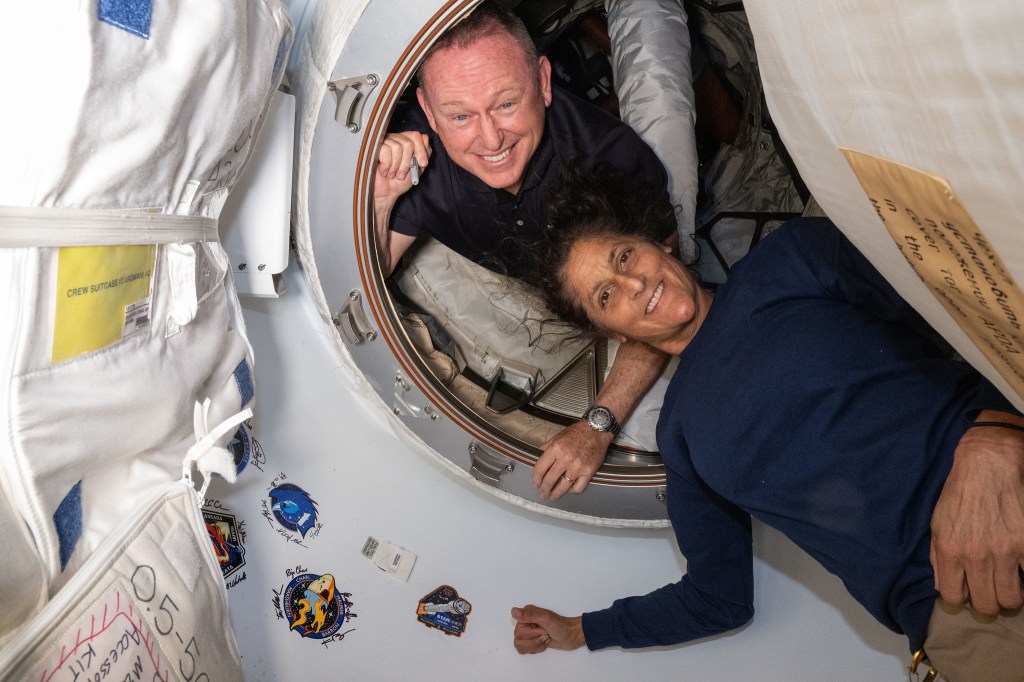
The space station has seen the arrival of more than 270 people. The latest visitors include NASA astronauts Butch Wilmore and Suni Williams, who arrived on June 6 as part of the agency’s Boeing Crew Flight Test.

Both veterans of two previous spaceflights, Wilmore and Williams quickly immersed themselves in station life, living and working in low Earth orbit alongside the Expedition 71 crew. The pair has completed a host of science and operational tasks, including fluid physics research, plant facility maintenance, robotic operations, Earth observations, and more.

Check out some highlights from Wilmore and Williams’ mission below.

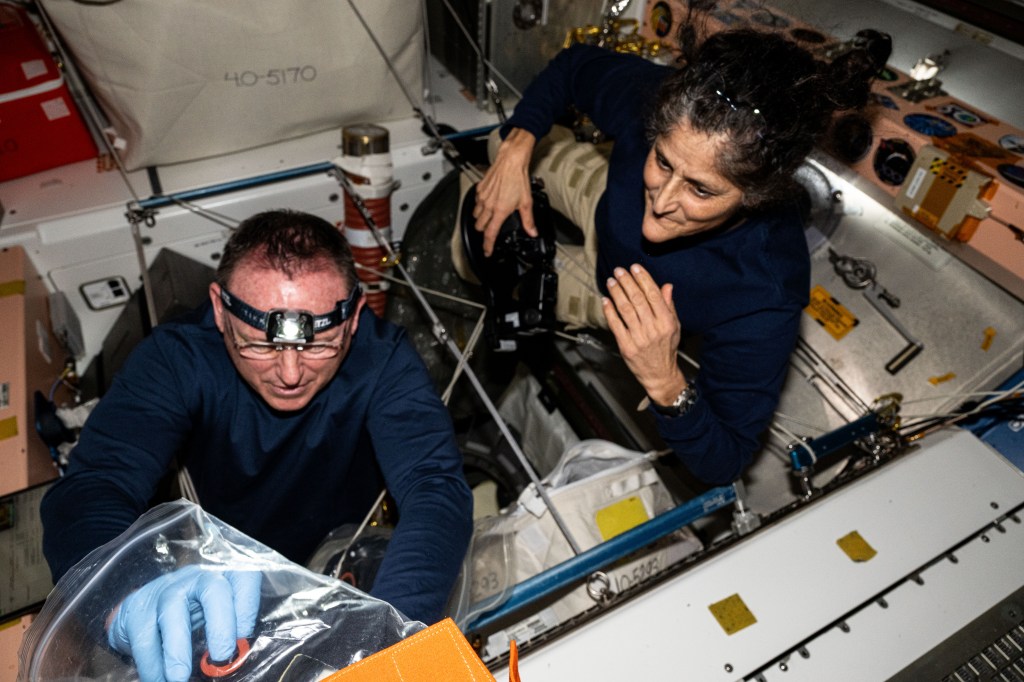
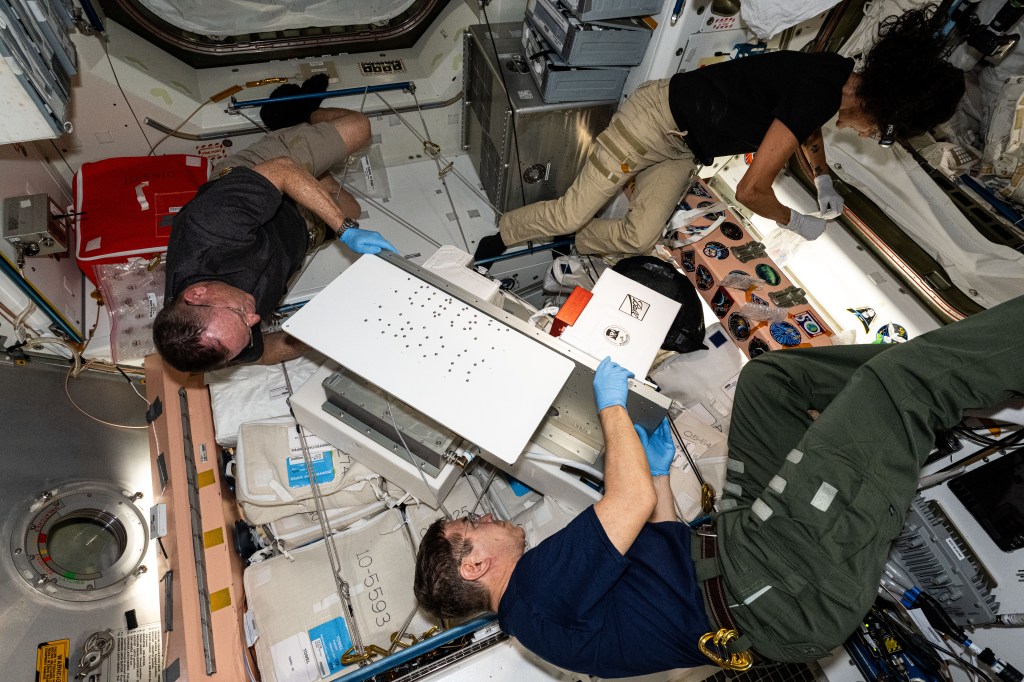
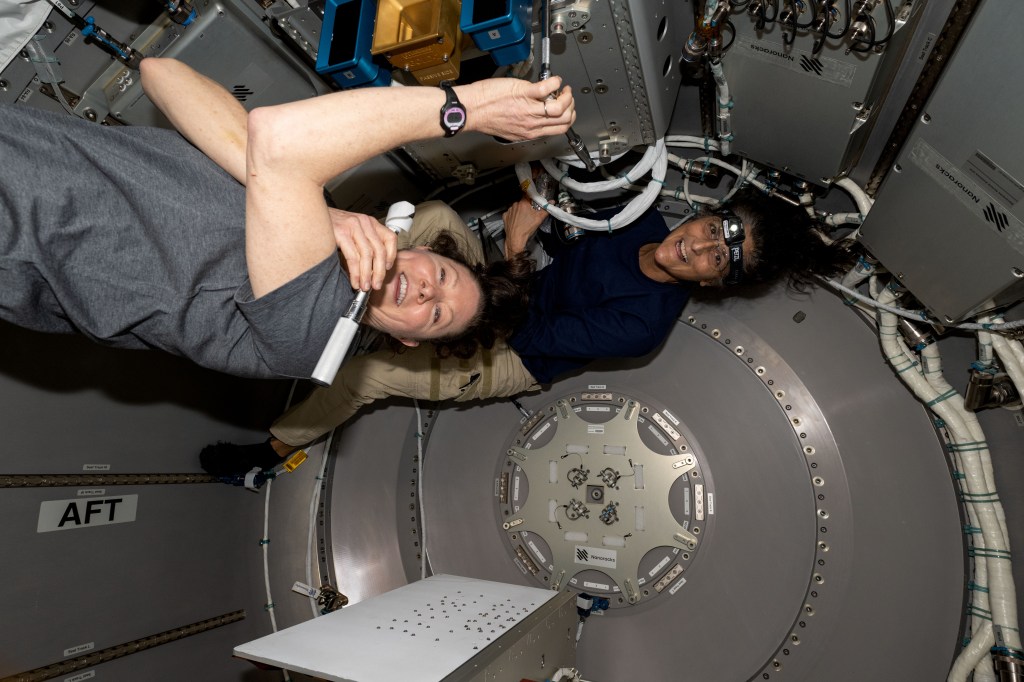
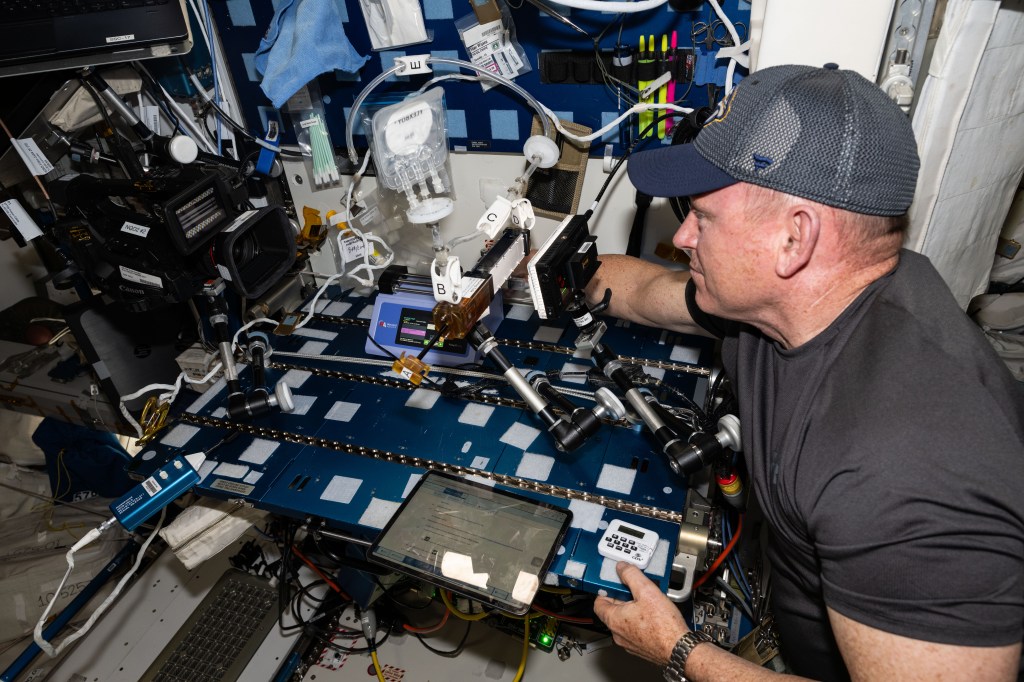
(From left) NASA astronauts Suni Williams and Butch Wilmore perform maintenance work on the Plant Water Management (PWM) system. The duo is investigating how fluid physics, such as surface tension, hydroponics, or air circulation, could overcome the lack of gravity when watering and nourishing plants grown in space. The PWM, located in the station’s Harmony module, uses facilities to promote space agricultural activities on spacecraft and space habitat.
NASA

Providing adequate water and nutrition to plants grown in space is critical as missions expand in low Earth orbit and beyond to the Moon and eventually Mars.

Throughout their stay aboard the orbiting laboratory, Wilmore and Williams have tested how different techniques could benefit crop growth in space through the Plant Water Management investigation.

This investigation uses the physical properties of fluids—surface tension, wetting, and system geometry—to overcome the lack of gravity and provide hydration to plants, which could advance the development of hydroponic systems for use during future space travel.

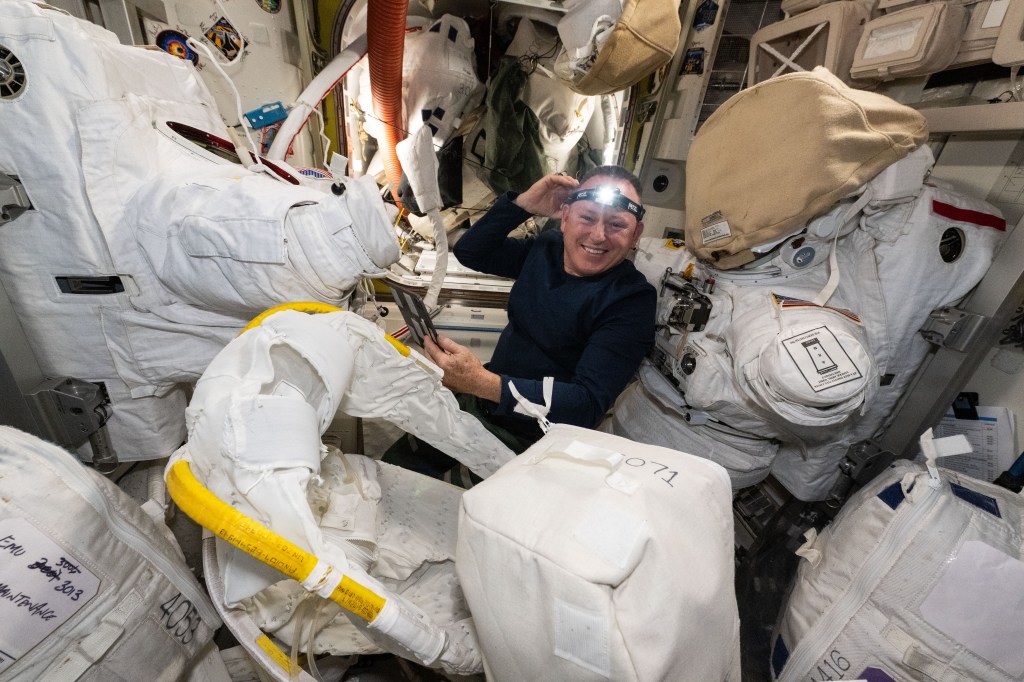
NASA astronaut and Boeing's Crew Flight Test Commander Butch Wilmore installs a light meter inside the Veggie space botany facility to obtain light measurements and adjust the light settings inside the plant research device. Veggie is located aboard the International Space Station's Columbus laboratory module and has grown lettuce, tomatoes, zinnias, and more aboard the orbital outpost.
NASA astronaut Butch Wilmore is pictured installing a light meter inside the Veggie facility to obtain light measurements and adjust the light settings inside the plant research device.
NASA

Another investigation taking a deeper look at growing plants in space is the Vegetable Production System, or Veggie. Crews living aboard the space station have used Veggie to grow fresh produce and even flowers, providing astronauts with nutritious fresh foods, boosting morale, and enhancing well-being.

In preparation for upcoming work with Veggie, Wilmore installed a light meter inside the facility, which will help crew members obtain light measurements and adjust light settings in the future when they practice their green thumb in space.

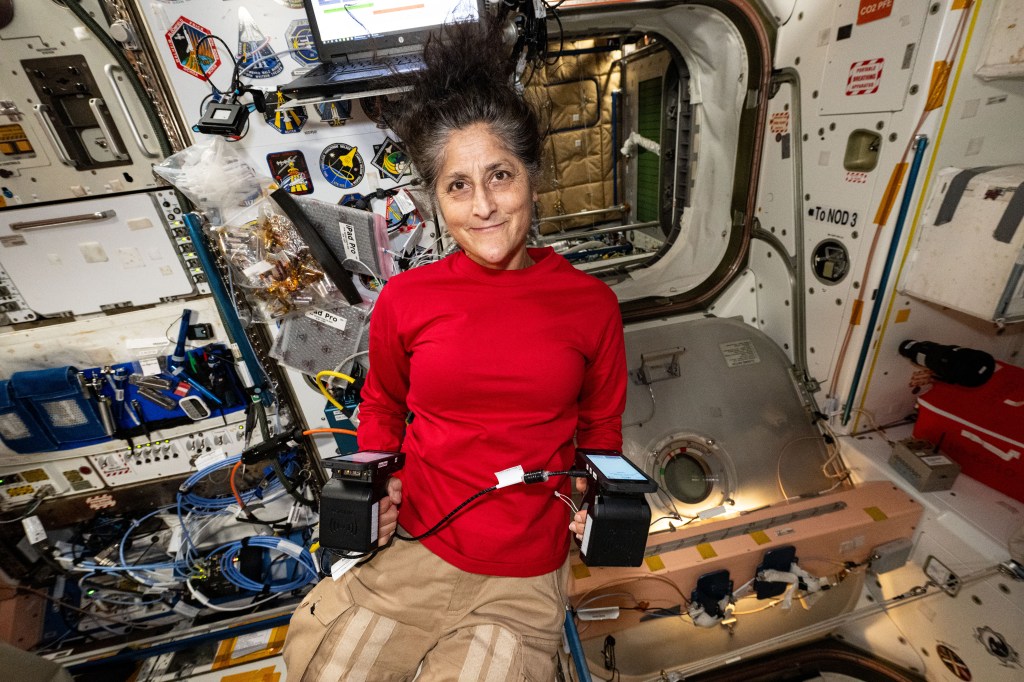
NASA astronaut and Boeing Crew Flight Test Pilot Suni Williams Suni Williams uses a HAM radio and talks to students from Banda Aceh, Indonesia, answering their questions about life in space and other space related subjects aboard the International Space Station.
NASA astronaut Suni Williams speaks into the microphone during a HAM Radio session with students from Banda Aceh, Indonesia.
NASA

For more than two decades, astronauts aboard the space station have connected with students and hobbyists worldwide, sharing details about living and working in microgravity.

In early August, Williams used the Ham Radio to connect with students from Banda Aceh, Indonesia, and answer questions about station research as the orbiting lab passed overhead.  

These space-to-Earth calls inspire younger generations to pursue interests and careers in STEM and provide school communities with opportunities to learn about space technology and communications.

NASA astronaut and Boeing's Crew Flight Test Pilot Suni Williams observes a pair of Astrobee robotic free-flying assistants demonstrating autonomous docking maneuvers inside the International Space Station's Kibo laboratory module. Williams was inside Kibo's logistics module which serves as a storage area that houses materials for experiments, maintenance tools, and crew supplies.
NASA astronaut Suni Williams observes a pair of Astrobee free-flying robots as they demonstrate autonomous docking maneuvers inside the Kibo Laboratory Module.
NASA

Astrobee, a set of three free-flying robots, are often buzzing around the orbiting lab, demonstrating how technology could assist astronauts with various tasks such as routine chores and maintenance.

Throughout the mission, Williams powered up and observed Astrobee operations as ground controllers remotely mapped the interior of the orbiting lab, practiced docking maneuvers, and tested how the robots carry out various tasks.


(From top left) The Strait of Gibraltar separating Spain and Morocco, captured by NASA astronaut Butch Wilmore; Boeing’s Starliner spacecraft is seen docked to the Harmony module’s forward port. This long-duration, night time photo, shows light trails of civilization over the coast of Mumbai, India; Two Patagonian Lakes, Viedma and Argentino, are pictured as the station orbited 272 miles above; Wilmore is photographed inside the cupola while taking pictures of Earth.
(From top left) The Strait of Gibraltar separating Spain and Morocco, captured by NASA astronaut Butch Wilmore; Boeing’s Starliner spacecraft is seen docked to the Harmony module’s forward port. This long-duration, nighttime photo, shows light trails of civilization over the coast of Mumbai, India; (From bottom left) Two Patagonian Lakes, Viedma and Argentino, are pictured as the station orbited 272 miles above; Wilmore is photographed inside the cupola while taking pictures of Earth.
NASA

Since the early days of human spaceflight, astronauts have been photographing Earth from space, capturing the wonder and environmental condition of our home planet.

Orbiting 250 miles above, crew members often spend their free time shooting photos from the cupola, or “window to the world.” The space station’s unique vantage point provides a glimpse at how Earth has changed over time and gives scientists a better look at key data from the perspective of the orbital complex while also improving crews’ mental well-being.

During their mission, the astronaut duo has captured hundreds of photographs of Earth, ranging from auroras, land, sea, orbital sunrises and sunsets, and more.

Wilmore and Williams continue to support daily space station operations as NASA and Boeing evaluate possible return options. For the latest updates on NASA’s commercial crew activities, including the Boeing Crew Flight Test, visit the Commercial Crew Program blog.

For daily space station updates and to learn more about the research being conducted in microgravity, visit the space station blog.

Powered by WPeMatico

Get The Details…
Abby Graf

Preguntas frecuentes: Estado del retorno de la prueba de vuelo tripulado Boeing de la NASA

Preguntas frecuentes: Estado del retorno de la prueba de vuelo tripulado Boeing de la NASA

10 min read

Preparations for Next Moonwalk Simulations Underway (and Underwater)

Read the article in English here.

Los astronautas de la NASA Butch Wilmore y Suni Williams llegaron al laboratorio orbital el 6 de junio a bordo de la nave Boeing Starliner tras despegar el 5 de junio del Complejo de Lanzamiento Espacial-41 de la Estación Espacial de Cabo Cañaveral, en Florida.

Durante el vuelo de Starliner a la estación espacial, los ingenieros observaron que algunos de los propulsores de la nave no funcionaban como se esperaba y también se observaron varias fugas en el sistema de helio de Starliner. Desde entonces, los equipos de ingeniería de la NASA y Boeing han llevado a cabo varias pruebas de los propulsores, así como revisiones exhaustivas de los datos para comprender mejor la nave espacial. Mientras los ingenieros se esfuerzan por resolver los problemas técnicos antes del regreso del Starliner a la Tierra, el dúo de astronautas ha estado trabajando con la tripulación de la Expedición 71, realizando investigaciones científicas y actividades de mantenimiento.

La NASA tiene previsto llevar a cabo dos revisiones: una del junta de control del programa y una revisión del estado de preparación para el vuelo de la agencia, antes de decidir cómo regresará de manera segura a Wilmore y Williams de la estación. La NASA espera tomar una decisión sobre el curso a seguir a finales de agosto.

He aquí algunas preguntas frecuentes sobre su misión.

Boeing's Starliner spacecraft that launched NASA's Crew Flight Test astronauts Butch Wilmore and Suni Williams to the International Space Station is pictured docked to the Harmony module's forward port. This view is from a window on the SpaceX Dragon Endeavour spacecraft docked to the port adjacent to the Starliner.

Sobre la misión y su retraso

¿Qué es la prueba de vuelo tripulado Boeing de la NASA?

La prueba de vuelo tripulado Boeing de la NASA despegó el 5 de junio y es el primer vuelo con astronautas de la nave Starliner a la Estación Espacial Internacional. La prueba de vuelo tiene como objetivo demostrar que el sistema está preparado para misiones de rotación a la estación espacial. La NASA quiere que, además de las naves Soyuz de Roscosmos, haya dos naves estadounidenses capaces de transportar astronautas para garantizar una tripulación permanente a bordo del complejo orbital.

¿Cuáles son los objetivos de la prueba de vuelo tripulado?

Esta prueba de vuelo tiene por objeto demostrar la aptitud del Starliner para ejecutar una misión de rotación de seis meses a la estación espacial. Los objetivos de la prueba de vuelo se desarrollaron para respaldar el proceso de certificación de la NASA y recopilar los datos de rendimiento necesarios para evaluar la preparación antes de los vuelos de larga duración.

¿Por qué la prueba de vuelo tripulado permanecerá más tiempo del previsto a bordo de la estación espacial?

Durante el vuelo de Starliner a la estación espacial, algunos de los propulsores de la nave no funcionaron como se esperaba y se observaron varias fugas en el sistema de helio de Starliner. Aunque la duración inicial de la misión estaba prevista en torno a una semana, no hay prisa por traer de vuelta a casa a la tripulación, por lo que la NASA y Boeing se están tomando un tiempo extra para aprender sobre la nave espacial. Se trata de una lección aprendida del accidente del transbordador espacial Columbia. Nuestros equipos de la NASA y Boeing están estudiando minuciosamente los datos de las pruebas y análisis adicionales en el espacio y en tierra, proporcionando a los gestores de la misión datos para tomar la mejor y más segura decisión sobre cómo y cuándo traer de vuelta a casa a la tripulación.

Si se diera una emergencia en la estación espacial, ¿cómo volverían Butch y Suni a casa?

El Starliner sigue siendo la principal opción para Butch y Suni si se produjera una emergencia y tuvieran que abandonar rápidamente la estación. No existe una necesidad urgente de traerlos a casa, y la NASA está utilizando el tiempo extra para comprender los problemas técnicos de la nave espacial antes de decidir un plan de regreso.

¿Cuánto tiempo podrían permanecer Butch y Suni en la estación espacial si no regresan a bordo de Starliner?

Si la NASA decidiera devolver la nave Starliner sin tripulación, Butch y Suni permanecerían a bordo de la estación hasta finales de febrero de 2025. La NASA replanificaría la misión SpaceX Crew-9, enviando solo dos tripulantes en lugar de cuatro a finales de septiembre. Butch y Suni regresarían a la Tierra tras el incremento programado para Crew-9 a principios del próximo año.

¿Se quedarán Butch y Suni en el espacio hasta 2025?

No se ha tomado ninguna decisión. La NASA sigue evaluando todas las opciones a medida que aprende más sobre el sistema de propulsión de Starliner. Butch y Suni podrían regresar a bordo de Starliner, o podrían volver como parte de la misión SpaceX Crew-9 de la agencia a principios del año que viene.

¿Puede Starliner volar sin astronautas?

Sí, Starliner puede desacoplarse y abandonar la órbita de forma autónoma, si la NASA decide que la nave regrese sin tripulación.

¿Podría la NASA enviar una nave SpaceX Dragon para traer de vuelta a Butch y Suni?

Si la NASA decide que regresen a bordo de una nave SpaceX Dragon, la agencia replanificará su misión SpaceX Crew-9 enviando solo dos tripulantes a finales de septiembre en lugar de cuatro. Butch y Suni regresarían entonces a la Tierra después del incremento regular programado de Crew-9 a principios del próximo año.

¿Por qué necesita la NASA dos sistemas de transporte de tripulación?

El principal objetivo del Programa de Tripulación Comercial de la agencia es contar con dos sistemas distintos de vuelos espaciales tripulados. En caso de que alguno de los sistemas tuviera algún problema, la NASA seguiría teniendo la capacidad de lanzar y traer de vuelta a tripulantes para garantizar la seguridad y que siga habiendo presencia de humanos a bordo de la Estación Espacial Internacional de manera continua.

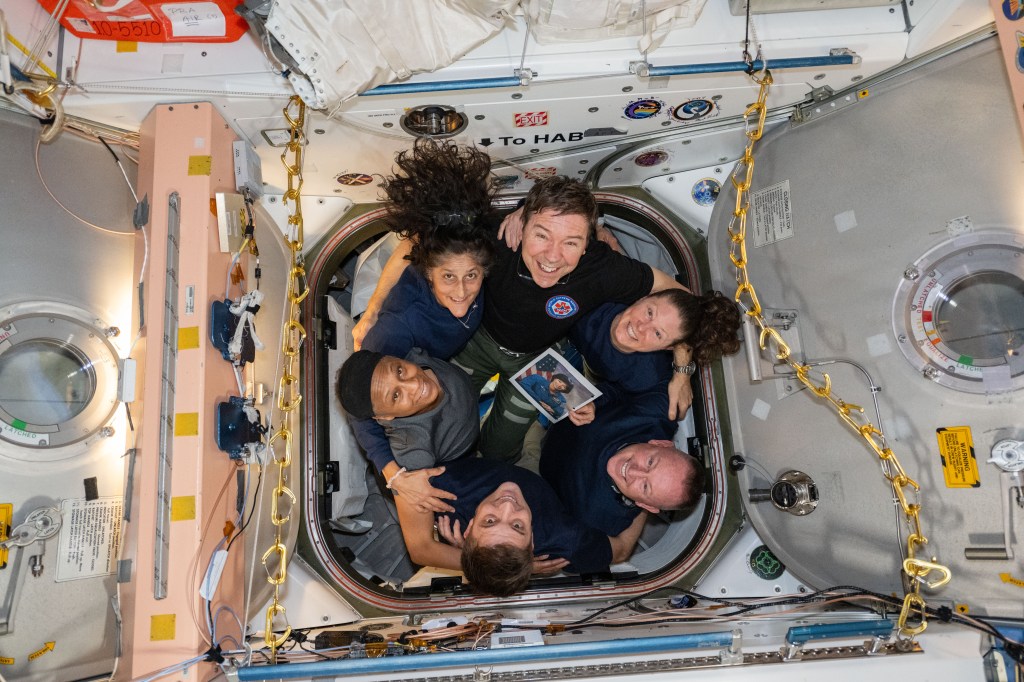
NASA's Boeing Crew Flight Test astronauts Suni Williams and Butch Wilmore (at center) pose with Expedition 71 Flight Engineers (far left) Mike Barratt and Tracy C. Dyson (far right), both NASA astronauts, in their spacesuits aboard the International Space Station's Quest airlock.

Sobre los astronautas

¿Están Butch y Suni atrapados en la estación espacial?

No, Butch y Suni están a salvo a bordo de la estación espacial, trabajando junto a la tripulación de la Expedición 71. También han participado activamente en las pruebas y reuniones técnicas del Starliner. Butch y Suni podrían volver a casa a bordo de la nave Starliner en caso de emergencia. La agencia también dispone de otras opciones de regreso, en caso necesario, tanto para la planificación de contingencias como para el regreso en condiciones normales.

¿Están preparados Suni y Butch para una estancia más larga en la estación?

Butch y Suni ya han realizado dos estancias de larga duración a bordo de la estación. Los astronautas de la NASA se embarcan en misiones plenamente conscientes de los diversos escenarios que podrían materializarse. Esta misión no es diferente, y entendían las posibilidades e incógnitas de este vuelo de prueba, incluyendo la posibilidad de permanecer a bordo de la estación más tiempo del previsto.

¿Cuánto duraría una estancia prolongada de Butch y Suni en comparación con la duración de otras misiones en la estación espacial?

Una estancia típica a bordo de la Estación Espacial Internacional es de unos seis meses, y algunos astronautas de la NASA han permanecido en la estación espacial durante misiones de mayor duración. Las misiones anteriores han proporcionado a la NASA gran cantidad de datos sobre los vuelos espaciales de larga duración y sus efectos en el cuerpo humano, que la agencia aplica a cualquier misión con tripulación.

¿Tienen los astronautas todo lo que necesitan (por ejemplo, comida, ropa, oxígeno, artículos personales, etc.)?

Sí. La Estación Espacial Internacional está bien provista de todo lo que necesita la tripulación, incluidos alimentos, agua, ropa y oxígeno. Además, la NASA y sus socios de la estación espacial lanzan con frecuencia misiones de reabastecimiento al complejo orbital con suministros y carga adicionales.

Recientemente, llegaron a la estación una nave espacial Cygnus de Northrop Grumman que transportaba 3.720 kilogramos (8.200 libras) de alimentos, combustible, suministros y material científico, y una nave espacial de reabastecimiento Progress que transportaba 2.721 kilogramos (6.000 libras) de carga. La NASA tiene previstas misiones adicionales de SpaceX de reabastecimiento durante lo que queda de 2024.

¿Qué están haciendo a bordo de la estación espacial?

La tripulación sigue supervisando los sistemas de vuelo del Starliner y recopilando datos de rendimiento para la certificación de sistemas. La NASA también está aprovechando el tiempo extra de Butch y Suni a bordo del laboratorio orbital, donde han completado varios experimentos científicos, tareas de mantenimiento y han colaborado en los preparativos de las caminatas espaciales. Algunos de los experimentos científicos que han llevado a cabo recientemente incluyen nuevas formas de producir cables de fibra óptica y el cultivo de plantas a bordo del complejo orbital.

¿Pueden hablar con sus familiares y amigos?

Butch y Suni disfrutan de muchas de las comodidades que tenemos aquí en la Tierra. Pueden enviar correos electrónicos, llamar por teléfono y hacer videoconferencias con sus familiares y amigos cuando tienen tiempo libre a bordo de la Estación Espacial Internacional.

iss071e217183 (June 25, 2024) -- As the International Space Station orbited 263 miles above Earth, NASA astronaut Butch Wilmore captured this image of Spain and Morocco. The Strait of Gibraltar separates the two countries and connects the Atlantic Ocean to the Mediterranean Sea.

Sobre el plan de regreso

¿Cuáles son las otras opciones para traer de vuelta a Butch y Suni?

La NASA dispone de dos sistemas estadounidenses de transporte espacial capaces de transportar tripulación a la estación y de vuelta. Aunque no se ha tomado ninguna decisión, la NASA está considerando varias opciones para hacer regresar a Butch y Suni de la estación espacial, incluido su retorno a bordo de la nave Starliner, si se autoriza, o como parte de la misión SpaceX Crew-9 de la agencia en febrero de 2025.

¿Es más seguro traerlos a casa a bordo de una nave Dragon de SpaceX?

Los vuelos de prueba tripulados son intrínsecamente arriesgados y, aunque las misiones de rotación puedan parecer rutinarias, tampoco están exentas de riesgos. Es competencia de la NASA evaluar ese riesgo antes de cada vuelo y determinar si es aceptable para la tripulación.

¿Qué otras medidas está tomando la NASA para traerlos a casa?

La NASA ajustó el lanzamiento de la Tripulación-9 de SpaceX y el regreso de la Tripulación-8 de la agencia, lo que permite más tiempo para finalizar los planes de regreso de Starliner. La NASA también está examinando las asignaciones de tripulación para garantizar que Butch y Suni puedan regresar con Crew-9 si fuera necesario.

Para consultar el blog de la NASA y obtener más información sobre la misión (en inglés), visita: https://www.nasa.gov/commercialcrew

Powered by WPeMatico

Get The Details…
Gary Daines

Hubble Reaches a Lonely Light in the Dark

Hubble Reaches a Lonely Light in the Dark

2 min read

Hubble Reaches a Lonely Light in the Dark

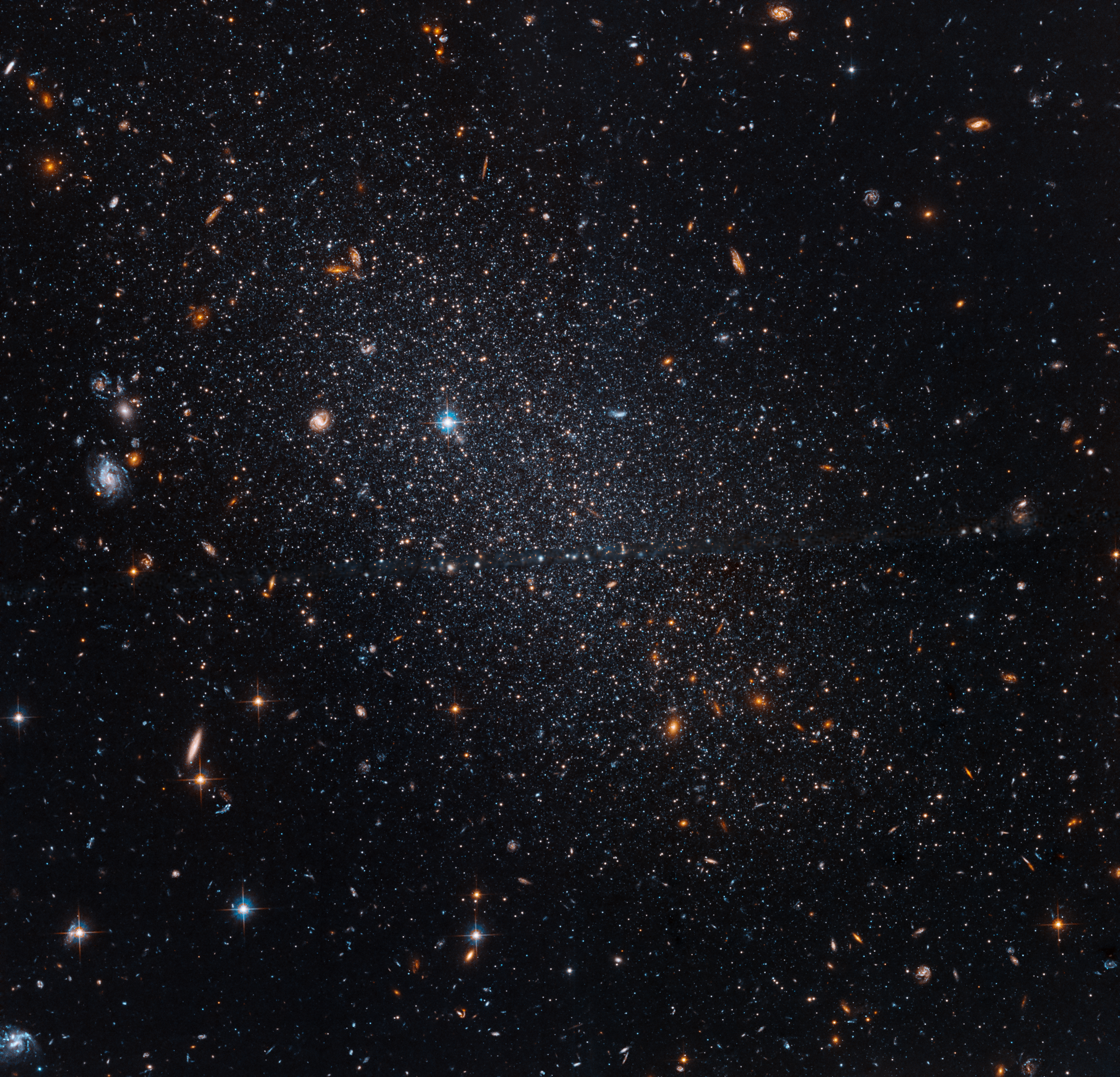
More closely concentrated near the center, several stars shine against black space along with a few distant galaxies.
NASA, ESA, C. Gallart (Instituto de Astrofisica de Canarias), A. del Pino Molina (Centro de Estudios de Fisica del Cosmos de Aragon), and R. van der Marel (Space Telescope Science Institute); Image Processing: Gladys Kober (NASA/Catholic University of America)

A splatter of stars glows faintly at almost 3 million light-years away in this new image from NASA’s Hubble Space Telescope. Known as the Tucana Dwarf for lying in the constellation Tucana, this dwarf galaxy contains a loose bundle of aging stars at the far edge of the Local Group, an aggregation of galaxies including our Milky Way, bound together by gravity. The Tucana Dwarf was discovered in 1990 by R.J. Lavery, the same year Hubble launched.

What makes the Tucana Dwarf distinct from other dwarf galaxies comes in two parts: its classification, and its isolation. As a dwarf spheroidal galaxy, it is much smaller and less luminous than most other dwarf galaxies. Dust is sparse and the stellar population skews towards the older range, giving them a dimmer look. Additionally, the Tucana Dwarf lies about 3.6 million light-years from the Local Group’s center of mass, far from the Milky Way and other galaxies. It is only one of two dwarf spheroidal galaxies in the Local Group to be this remote, making astronomers theorize that a close encounter with a larger galactic neighbor called Andromeda slingshotted it into the distance about 11 billion years ago.

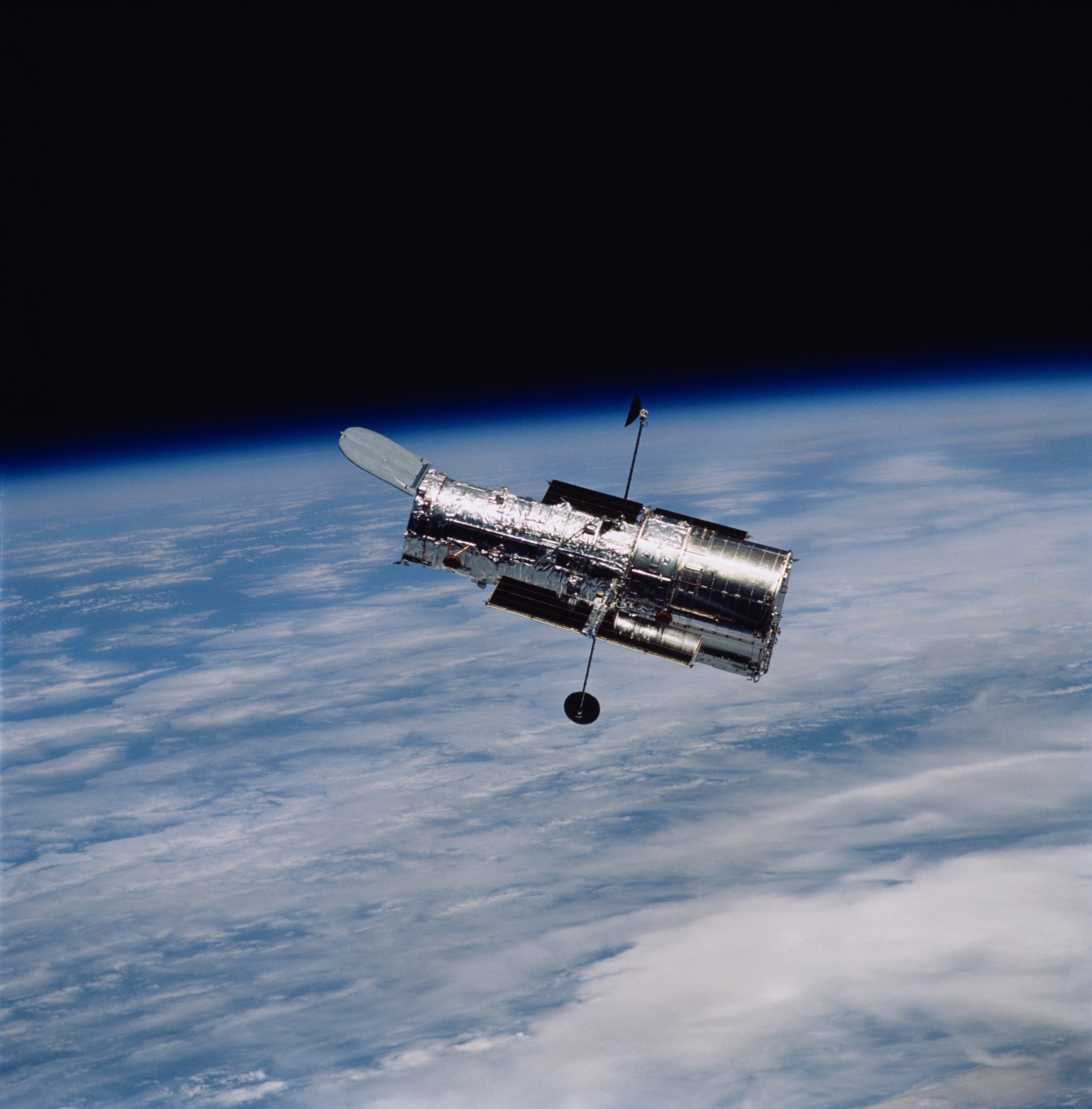
Having such pristine properties enables scientists to use the Tucana Dwarf as a cosmic fossil. Dwarf galaxies could be the early ingredients for larger galaxies, and with older stars residing in such an isolated environment, analyzing them can help trace galaxy formation back to the dawn of time. For that reason, Hubble reached far across the Local Group using the capabilities of the Advanced Camera for Surveys and Wide Field and Planetary Camera 2 to meet this distant, lonely galaxy. Examining its structure, composition, and star formation history sheds light on the epoch of reionization, when the first stars and galaxies arose from the dark billions of years ago.

Explore More

Media Contact:

Claire Andreoli
NASA’s Goddard Space Flight CenterGreenbelt, MD
claire.andreoli@nasa.gov

Share

Details

Last Updated

Aug 23, 2024

Editor
Michelle Belleville

Powered by WPeMatico

Get The Details…

NASA Composite Manufacturing Initiative Gains Two New Members

NASA Composite Manufacturing Initiative Gains Two New Members

2 min read

Preparations for Next Moonwalk Simulations Underway (and Underwater)

Automated fiber placement machine on an industrial robot
An automated fiber placement machine on an industrial robot is seen at Fives Machining Systems Inc. Fives is one of the new partners joining a NASA project that explores ways to speed up the production of composite aircraft.
Fives Machining Systems Inc.

Gulfstream Aerospace Corporation and Fives Machining Systems Inc. have joined 20 other organizations to support NASA’s Hi-Rate Composite Aircraft Manufacturing (HiCAM) project.

The project is addressing industry’s needs to meet growing demand for air travel, replace aging airliners, and secure U.S. competitiveness in the commercial aircraft industry.  

NASA and its partners are collaborating and sharing costs to increase the manufacturing rate for aircraft components made from composite (nonmetallic) materials. Gulfstream and Fives are the newest members in a public-private partnership called the Advanced Composites Consortium

Advanced Composites Consortium

Members of the Consortium have significant and unique expertise in aircraft design, manufacturing, certification, testing, and tool development, with the new members bringing important new insights and capabilities to the team.   

“By partnering with U.S. industry, academia, and regulators, we’ll increase the likelihood of impacting the next generation of transports,” said Richard Young, manager for NASA’s HiCAM project, which oversees the consortium.

The team is currently competing concepts to determine which technologies will have the greatest impact on manufacturing rates. Once the most promising concepts are selected, they’ll be demonstrated at full scale.

The project and Advanced Composites Consortium contribute to NASA’s Sustainable Flight National Partnership by enabling broader use of lightweight composite airframes, which will reduce fuel consumption and carbon emissions, improving air quality and the environment.

 HiCAM is managed under NASA’s Advanced Air Vehicles Program.

Powered by WPeMatico

Get The Details…
Jim Banke