From Houston to the Moon: Johnson’s Thermal Vacuum Chamber Tests Lunar Solar Technology 

From Houston to the Moon: Johnson’s Thermal Vacuum Chamber Tests Lunar Solar Technology 

Imagine designing technology that can survive on the Moon for up to a decade, providing a continuous energy supply. NASA selected three companies to develop such systems, aimed at providing a power source at the Moon’s South Pole for Artemis missions. 

Three companies were awarded contracts in 2022 with plans to test their self-sustaining solar arrays at the Johnson Space Center’s Space Environment Simulation Laboratory (SESL) in Houston, specifically in Chamber A in building 32. The prototypes tested to date have undergone rigorous testing to ensure the technology can withstand the harsh lunar environment and deploy the solar array effectively on the lunar surface. 

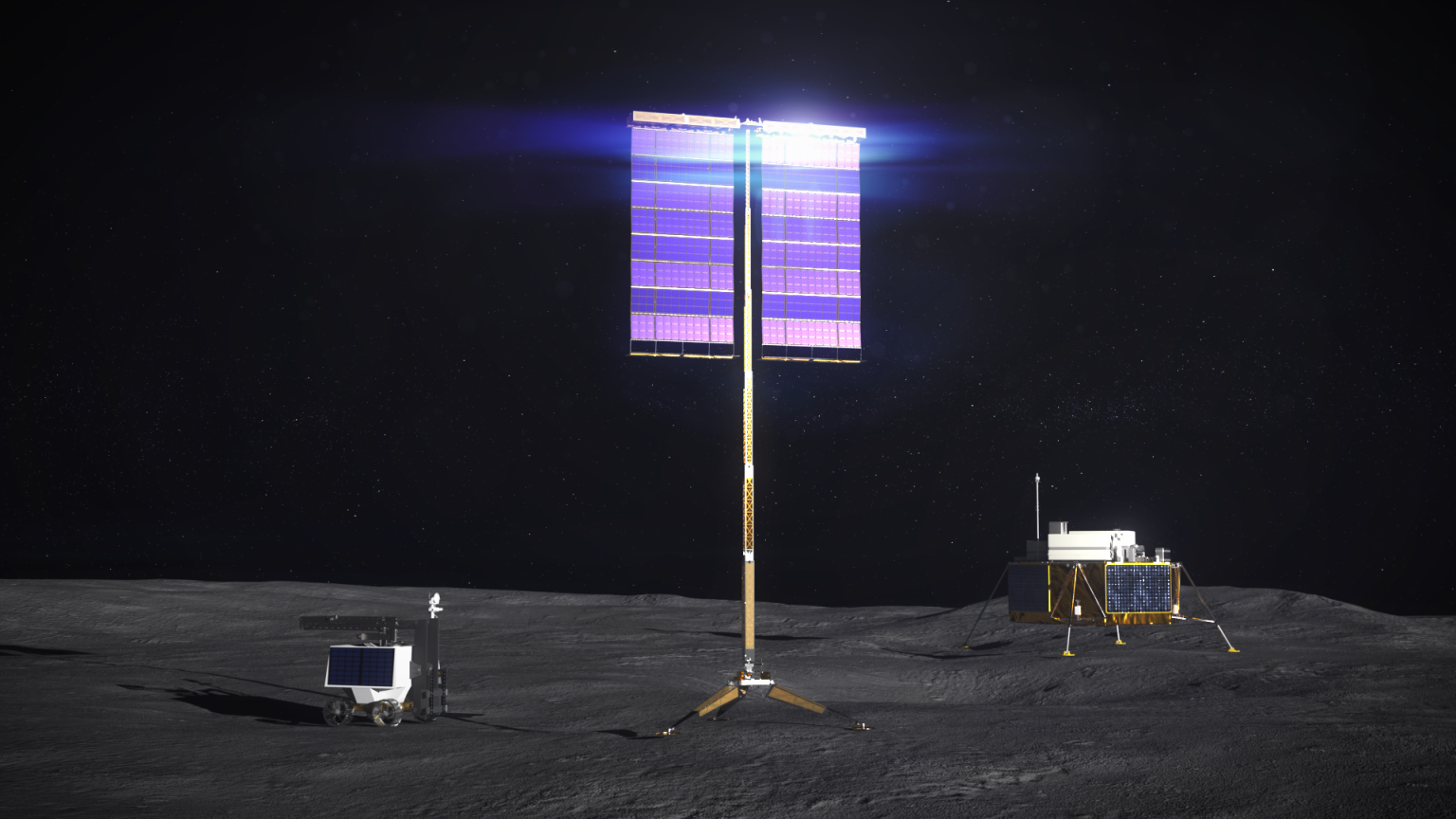
A tall structure inside a testing chamber featuring a vertical mast supporting a large array of solar panels.
The Honeybee Robotics prototype during lunar VSAT (Vertical Solar Array Technology) testing inside Chamber A at NASA’s Johnson Space Center in Houston.
NASA/David DeHoyos
The Astrobotic Technology prototype during lunar VSAT testing inside Chamber A at Johnson Space Center.
NASA/James Blair

In the summer of 2024, both Honeybee Robotics, a Blue Origin company from Altadena, California and Astrobotic Technology from Pittsburgh, Pennsylvania put their solar array concepts to the test in Chamber A. 

Each company has engineered a unique solution to design the arrays to withstand the harsh lunar environment and extreme temperature swings. The data collected in the SESL will support refinement of requirements and the designs for future technological advancements with the goal to deploy at least one of the systems near the Moon’s South Pole. 

The contracts for this initiative are part of NASA’s VSAT (Vertical Solar Array Technology) project, aiming to support the agency’s long-term lunar surface operations. VSAT is under the Space Technology Mission Directorate Game Changing Development program and led by the Langley Research Center in Hampton, Virginia, in collaboration with Glenn Research Center in Cleveland.  

“We foresee the Moon as a hub for manufacturing satellites and hardware, leveraging the energy required to launch from the lunar surface,” said Jim Burgess, VSAT lead systems engineer. “This vision could revolutionize space exploration and industry.” 

Built in 1965, the SESL initially supported the Gemini and Apollo programs but was adapted to conduct testing for other missions like the Space Shuttle Program and Mars rovers, as well as validate the design of the James Webb Space Telescope. Today, it continues to evolve to support future Artemis exploration. 

Johnson’s Front Door initiative aims to solve the challenges of space exploration by opening opportunities to the public and bringing together bold and innovative ideas to explore new destinations. 

“The SESL is just one of the hundreds of unique capabilities that we have here at Johnson,” said Molly Bannon, Johnson’s Innovation and Strategy specialist. “The Front Door provides a clear understanding of all our capabilities and services, the ways in which our partners can access them, and how to contact us. We know that we can go further together with all our partners across the entire space ecosystem if we bring everyone together as the hub of human spaceflight.” 

Chamber A remains as one of the largest thermal vacuum chambers of its kind, with the unique capability to provide extreme deep space temperature conditions down to as low as 20 Kelvin. This allows engineers to gather essential data on how technologies react to the Moon’s severe conditions, particularly during the frigid lunar night where the systems may need to survive for 96 hours in darkness. 

“Testing these prototypes will help ensure more safe and reliable space mission technologies,” said Chuck Taylor, VSAT project manager. “The goal is to create a self-sustaining system that can support lunar exploration and beyond, making our presence on the Moon not just feasible but sustainable.” 

The power generation systems must be self-aware to manage outages and ensure survival on the lunar surface. These systems will need to communicate with habitats and rovers and provide continuous power and recharging as needed. They must also deploy on a curved surface, extend 32 feet high to reach sunlight, and retract for possible relocation.  

“Generating power on the Moon involves numerous lessons and constant learning,” said Taylor. “While this might seem like a technical challenge, it’s an exciting frontier that combines known technologies with innovative solutions to navigate lunar conditions and build a dynamic and robust energy network on the Moon.”

Watch the video below to explore the capabilities and scientific work enabled by the thermal testing conducted in Johnson’s Chamber A facility.

Powered by WPeMatico

Get The Details…
Sumer Loggins

On This Day: Apollo 12 Lands on the Moon

On This Day: Apollo 12 Lands on the Moon

On the Moon, an astronaut in a white spacesuit climbs down a ladder on a lunar module. The lunar module is made of metal with gold and silver foil covering some of its lower half.
NASA

NASA astronaut Alan Bean steps off the lunar module ladder in this photo from Nov. 19, 1969, joining astronaut Charles Conrad Jr. on the Moon in the area called the Ocean of Storms. The two would then complete two spacewalks on the lunar surface, deploying science instruments, collecting geology samples, and inspecting the Surveyor 3 spacecraft, which had landed in the same area. While Bean and Conrad worked on the Moon, astronaut Richard F. Gordon completed science from lunar orbit.

Learn more about Apollo 12’s pinpoint landing on the Moon.

Image credit: NASA

Powered by WPeMatico

Get The Details…
Monika Luabeya

NASA Plans to Assign Missions for Two Future Artemis Cargo Landers

NASA Plans to Assign Missions for Two Future Artemis Cargo Landers

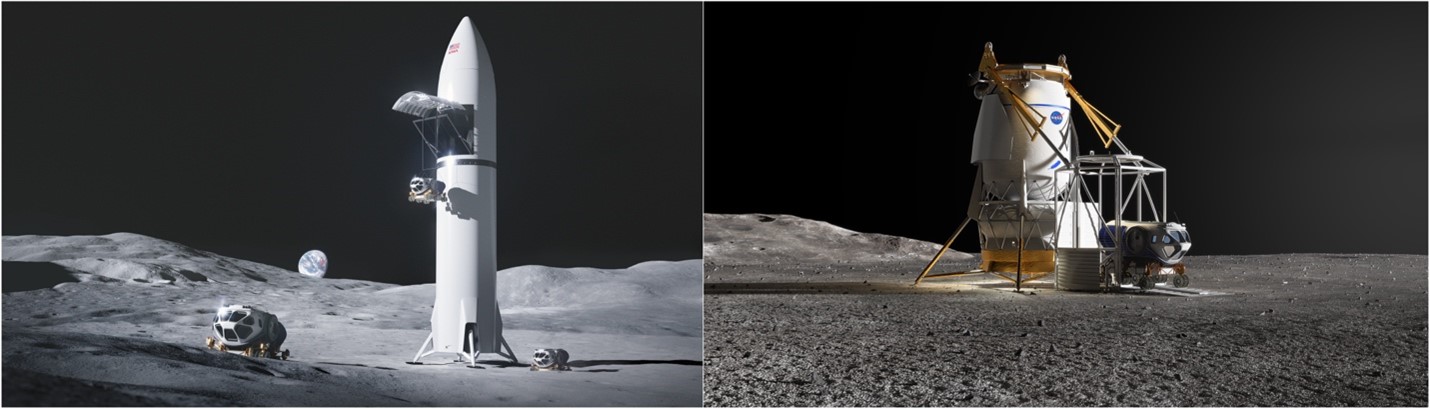
Two artists' concepts of human lunar landing systems on the Moon are shown: SpaceX on the left, which is white, tall, and thinner, with a pointed top, and Blue Origin on the right.
Early conceptual renderings of cargo variants of human lunar landing systems from NASA’s providers SpaceX, left, and Blue Origin, right. The large cargo landers will have the capability to land approximately 26,000 to 33,000 pounds (12-15 metric tons) of large, heavy payload on the lunar surface.
Credit: SpaceX/Blue Origin

NASA, along with its industry and international partners, is preparing for sustained exploration of the lunar surface with the Artemis campaign to advance science and discovery for the benefit of all. As part of that effort, NASA intends to award Blue Origin and SpaceX additional work under their existing contracts to develop landers that will deliver large pieces of equipment and infrastructure to the lunar surface.

NASA expects to assign demonstration missions to current human landing system providers, SpaceX and Blue Origin, to mature designs of their large cargo landers following successful design certification reviews. The assignment of these missions builds on the 2023 request by NASA for the two companies to develop cargo versions of their crewed human landing systems, now in development for Artemis III, Artemis IV, and Artemis V.

“NASA is planning for both crewed missions and future services missions to the Moon beyond Artemis V,” said Stephen D. Creech, assistant deputy associate administrator for technical, Moon to Mars Program Office. “The Artemis campaign is a collaborative effort with international and industry partners. Having two lunar lander providers with different approaches for crew and cargo landing capability provides mission flexibility while ensuring a regular cadence of Moon landings for continued discovery and scientific opportunity.”

NASA plans for at least two delivery missions with large cargo. The agency intends for SpaceX’s Starship cargo lander to deliver a pressurized rover, currently in development by JAXA (Japan Aerospace Exploration Agency), to the lunar surface no earlier than fiscal year 2032 in support of Artemis VII and later missions. The agency expects Blue Origin to deliver a lunar surface habitat no earlier than fiscal year 2033.

Based on current design and development progress for both crew and cargo landers and the Artemis mission schedules for the crew lander versions, NASA assigned a pressurized rover mission for SpaceX and a lunar habitat delivery for Blue Origin,” said Lisa Watson-Morgan, program manager, Human Landing System, at NASA’s Marshall Space Flight Center in Huntsville, Alabama. “These large cargo lander demonstration missions aim to optimize our NASA and industry technical expertise, resources, and funding as we prepare for the future of deep space exploration.”

SpaceX will continue cargo lander development and prepare for the Starship cargo mission under Option B of the NextSTEP Appendix H contract. Blue Origin will conduct its cargo lander work and demonstration mission under NextSTEP Appendix P. NASA expects to issue an initial request for proposals to both companies in early 2025.

With the Artemis campaign, NASA will explore more of the Moon than ever before, learn how to live and work away from home, and prepare for future exploration of Mars. NASA’s SLS (Space Launch System) rocket, exploration ground systems, and Orion spacecraft, along with commercial human landing systems, next-generation spacesuits, Gateway lunar space station, and future rovers are NASA’s foundation for deep space exploration.

For more on NASA’s Human Landing System Program, visit:

https://www.nasa.gov/hls

-end-

James Gannon
Headquarters, Washington
202-358-1600
james.h.gannon@nasa.gov

Corinne Beckinger
Marshall Space Flight Center, Huntsville, Ala.
256-544-0034
corinne.m.beckinger@nasa.gov

Powered by WPeMatico

Get The Details…
Jessica Taveau

Northwestern University Takes Top Honors in BIG Idea Lunar Inflatables Challenge 

Northwestern University Takes Top Honors in BIG Idea Lunar Inflatables Challenge 

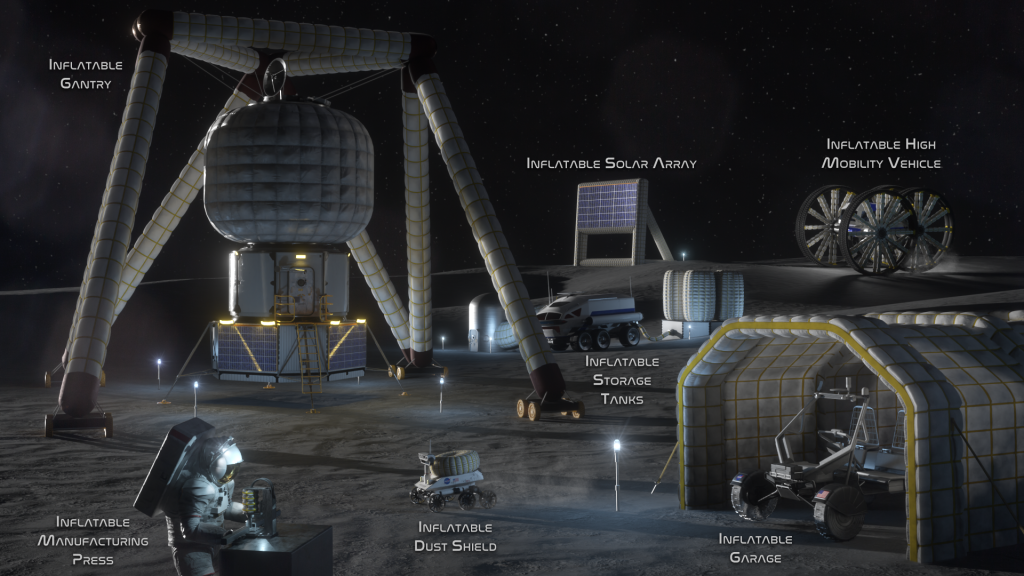
Following eight months of intense research, design, and prototyping, six university teams presented their “Inflatable Systems for Lunar Operations” concepts to a panel of judges at NASA’s 2024 Breakthrough, Innovative and Game-Changing (BIG) Idea Challenge forum. 

The challenge, funded by NASA’s Space Technology Mission Directorate and Office of STEM Engagement, seeks novel ideas from higher education on a new topic each year and supports the agency’s Lunar Surface Innovation Initiative in developing new approaches and innovative technologies to pave the way for successful exploration on the surface of the Moon. This year, teams were asked to develop low Size, Weight, and Power inflatable technologies, structures and systems that could benefit future Artemis missions to the Moon and beyond. 

Taking top honors at this year’s forum receiving the Artemis Award was Northwestern University with National Aerospace Corporation & IMS Engineered Products, with their concept titled METALS: Metallic Expandable Technology for Artemis Lunar Structures. The Artemis Award is given to the team whose concept has the best potential to contribute to and be integrated into an Artemis mission.  

The Northwestern University BIG Idea Challenge team developed METALS, an inflatable metal concept for long-term storage of cryogenic fluid on the Moon. The concept earned the Artemis Award, top honors in NASA’s 2024 BIG Idea Challenge.
Credit: National Institute of Aerospace

The Artemis Award is a generous recognition of the potential impact that our work can have. We hope it can be a critical part of the Artemis Program moving forward. We’re exceptionally grateful to have the opportunity to engage directly with NASA in research for the Artemis Program in such a direct way while we’re still students.” 

Julian Rocher

Julian Rocher

Team co-lead for Northwestern University

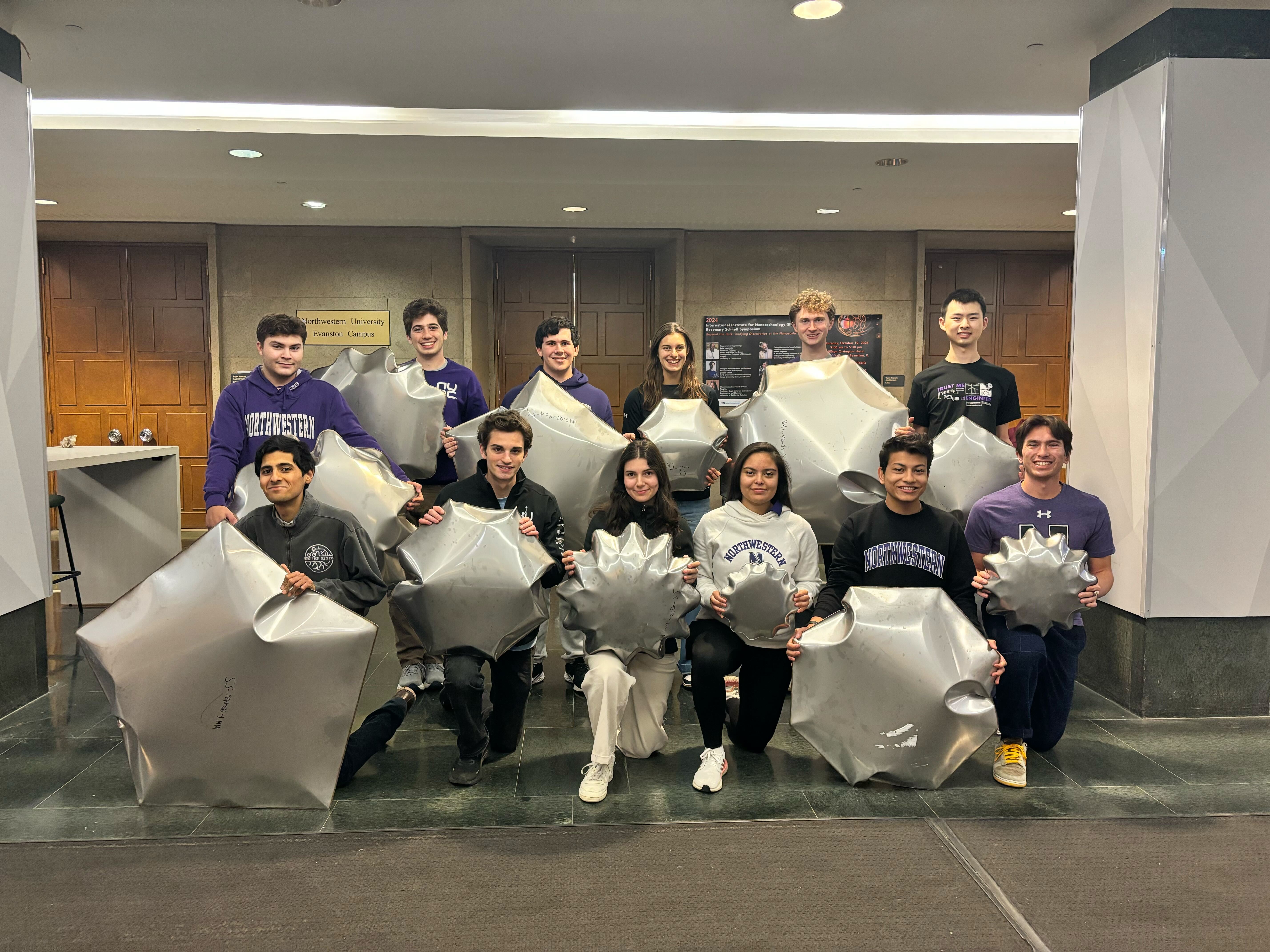
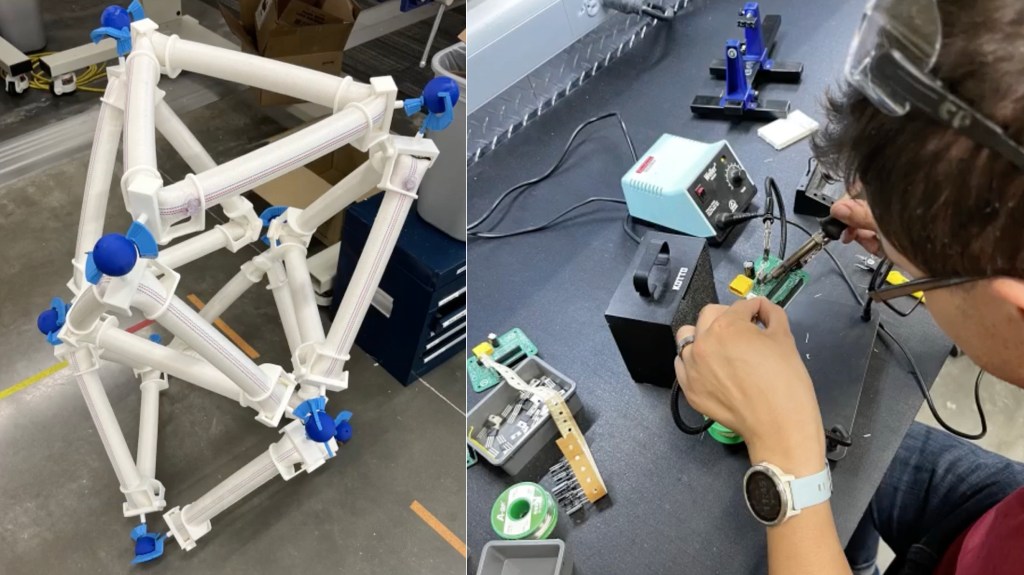
METALS is an inflatable system for long term cryogenic fluid storage on the Moon. Stacked layers of sheet metal are welded along their aligned edges, stacked inside a rocket, and inflated once on the lunar surface. The manufacturing process is scalable, reliable, and simple. Notably, METALS boasts superior performance in the harsh lunar environment, including resistance against radiation, abrasion, micrometeorites, gas permeability, and temperature extremes.

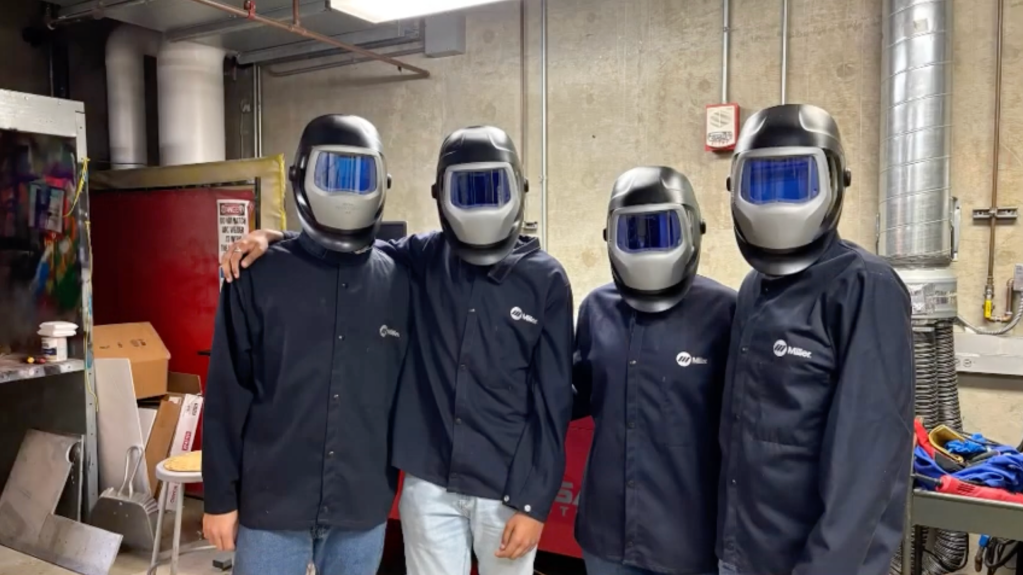
Northwestern University team members pose with lunar inflatable prototypes from their METALS project in NASA’s 2024 BIG Idea Challenge.
Credit: Northwestern University

We learned to ask the right questions, and we learned to question what is the status quo and to go above and beyond and think outside the box. It’s a special mindset for everyone to have on this team… it’s what forces us to innovate.” 

Trevor Abbott

Trevor Abbott

Team co-lead for Northwestern University

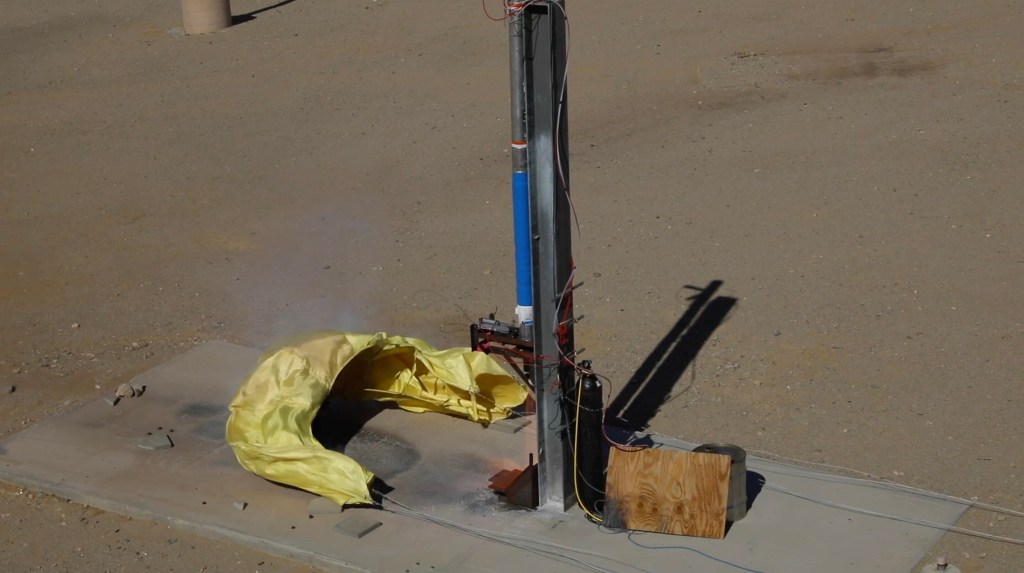
Arizona State University took home the 2024 BIG Idea Challenge Systems Engineering prize for their project, AEGIS: Inflatable Lunar Landing Pad System. The AEGIS system is designed to deflect the exhaust gasses of lunar landers thereby reducing regolith, or Moon dust, disturbances generated during landing. The system is deployed on the lunar surface where it uses 6 anchors in its base to secure itself to the ground. Once inflated to its deployed size of 14 m in diameter, AEGIS provides a reusable precision landing zone for incoming landers.

Arizona State University earned the Systems Engineering prize for their BIG Idea Challenge project: AEGIS: Inflatable Lunar Landing Pad System.
Arizona State University

This year’s forum was held in tandem with the Lunar Surface Innovation Consortium’s (LSIC) Fall Meeting at the University of Nevada, Las Vegas, where students had the opportunity to network with NASA and industry experts, attend LSIC panels and presentations, and participate in the technical poster session. The consortium provides a forum for NASA to communicate technological requirements, needs, and opportunities, and for the community to share with NASA existing capabilities and critical gaps. 

We felt that hosting this year’s BIG Idea Forum in conjunction with the LSIC Fall Meeting would be an exciting opportunity for these incredibly talented students to network with today’s aerospace leaders in government, industry, and academia. Their innovative thinking and novel contributions are critical skills required for the successful development of the technologies that will drive exploration on the Moon and beyond.” 

Niki Werkheiser

Niki Werkheiser

Director of Technology Maturation in NASA’s Space Technology Mission Directorate

In February, teams submitted proposal packages, from which six finalists were selected for funding of up to $150,000 depending on each team’s prototype and budget. The finalists then worked for eight months designing, developing, and demonstrating their concepts. The 2024 BIG Idea program concluded at its annual forum, where teams presented their results and answered questions from judges. Experts from NASA, Johns Hopkins Applied Physics Laboratory, and other aerospace companies evaluated the student concepts based on technical innovation, credibility, management, and the teams’ verification testing. In addition to the presentation, the teams provided a technical paper and poster detailing their proposed inflatable system for lunar operations. 

Year after year, BIG Idea student teams spend countless hours working on tough engineering design challenges. Their dedication and ‘game-changing’ ideas never cease to amaze me. They all have bright futures ahead of them.” 

David Moore

David Moore

Program Director for NASA’s Game Changing Development program

NASA’s Space Technology Mission Directorate sponsors the BIG Idea Challenge through a collaboration between its Game Changing Development program and the agency’s Office of STEM Engagement. It is managed by a partnership between the National Institute of Aerospace and Johns Hopkins Applied Physics Laboratory.   

Team presentations, technical papers, and digital posters are available on the BIG Idea website.       

For full competition details, visit:  https://bigidea.nianet.org/2024-challenge

Powered by WPeMatico

Get The Details…
Stefanie Payne

Super Insulation Requires Super Materials 

Super Insulation Requires Super Materials 

2 min read

Preparations for Next Moonwalk Simulations Underway (and Underwater)

A worker applies ceramic tiles to the space shuttle.
The thermal protection system on the outside of the space shuttle included hundreds of ceramic tiles custom made for the orbiter. These reflected heat off the shuttle’s outside surface during atmospheric re-entry and were an inspiration for the ceramic ingredients in Super Therm.
Credit: NASA

Without proper insulation, sunlight can make buildings feel like ovens. In the late 1980s, Joseph Pritchett aimed to solve this problem by developing a coating for building insulation. He knew of NASA’s experience with thermal testing, particularly with ceramics, which have several uses for the agency. Their heat-resistant properties make them excellent materials for spacecraft reentry shields, and their durability is perfect for airplane components. Pritchett thought by infusing paints with both insulating ceramic compounds and tough, resilient polymers, he could develop an insulation coating with the best features of both. 

Pritchett contacted the materials lab at NASA’s Marshall Space Flight Center in Huntsville, Alabama, through the center’s Technology Transfer Office. The facility had many ways to test heat-resistant materials, and the Marshall engineers and research scientists provided Pritchett with lists of material compounds to test for his insulation coating.  

Super Therm has been applied in several places, including handrails on the Hoover Dam Bypass Bridge over the Colorado River. The selection of its makeup of ceramic and polymeric materials was assisted by NASA scientists.
Credit: Superior Products InternationaI II, LLC

Over a period of six years, Pritchett tested every compound on the lists NASA provided, narrowing down the potential compounds until he found the ideal insulation. Pritchett founded Superior Products International II, Inc. of Shawnee, Kansas, in 1995. His product, dubbed Super Therm, is a composite of both ceramic and polymeric materials. In 2011, when tested by Oak Ridge National Laboratory in Tennessee, Pritchett’s product proved successful in saving energy when cooling homes.

The engineers at Marshall played a pivotal role in Super Therm’s development, as their knowledge was key to finding the right ceramic material. In addition to insulation for buildings, the material has been used in other industrial applications, such as keeping equipment like tanks and pumps cool on oil rigs. Pritchett’s Super Therm is yet another example of how NASA’s Technology Transfer Program within the agency’s Space Technology Mission Directorate drives innovation in commercial industry.  

Share

Details

Last Updated

Nov 19, 2024

Powered by WPeMatico

Get The Details…
Andrew Wagner