NASA Space Station Research Helps Power Moon Science

NASA Space Station Research Helps Power Moon Science

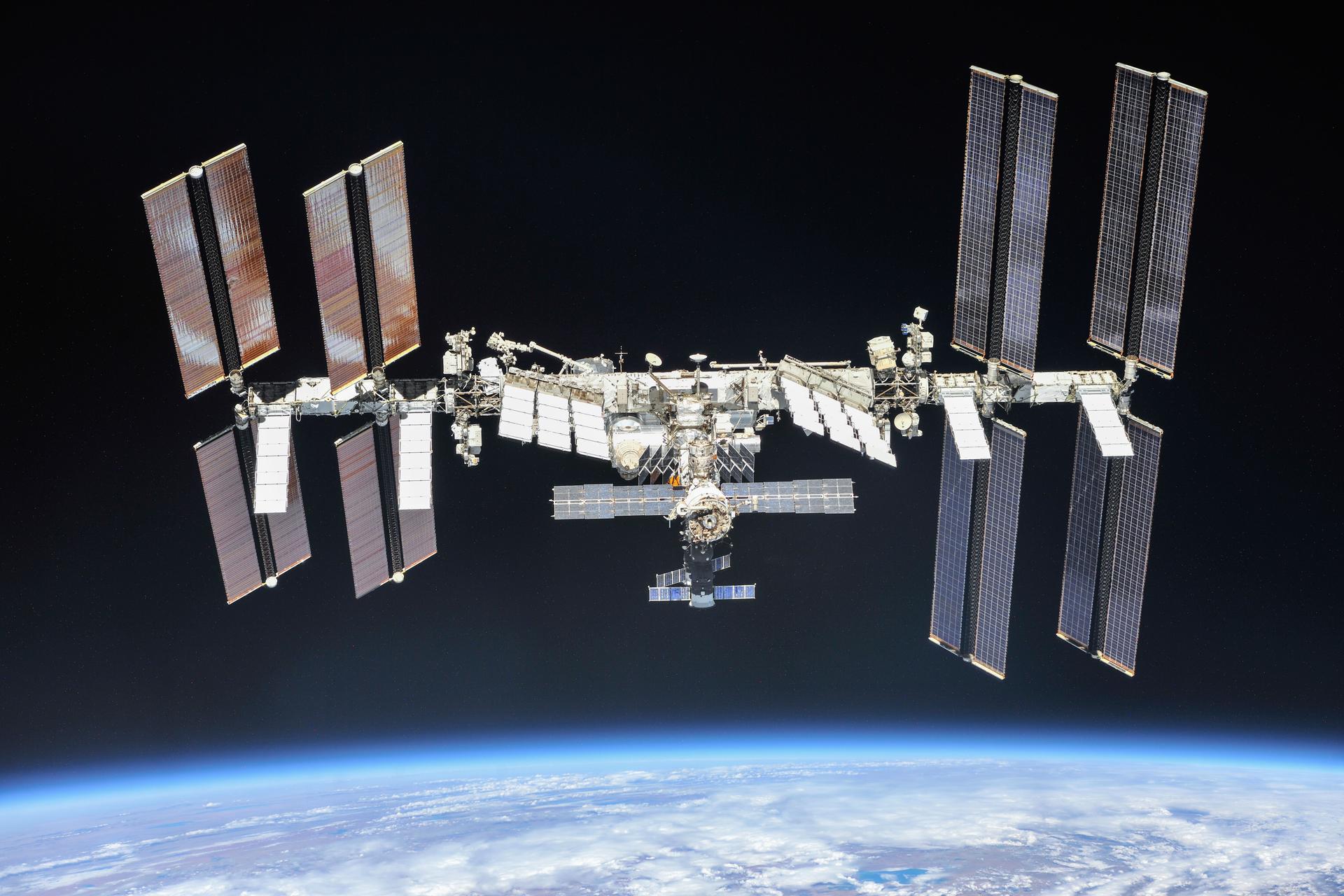
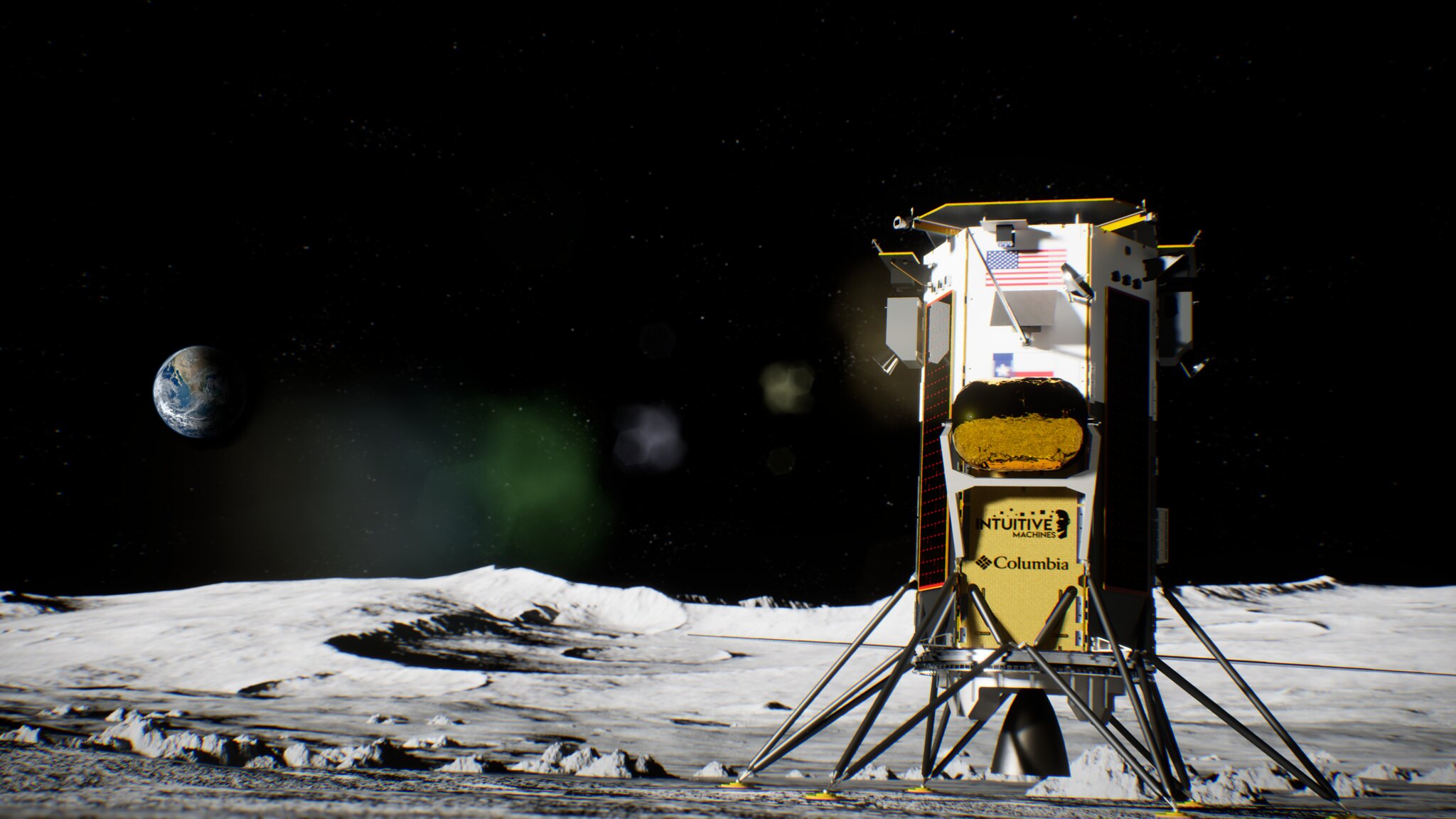
Side-by-side image featuring space telescopes NICER and LEXI. On the left, the NICER telescope is mounted on the International Space Station, with its array of X-ray detectors. Space station solar panels are seen in the background. On the right, an artist's rendering shows the LEXI telescope mounted on Firefly Aerospace's Blue Ghost lunar lander, which is covered in gold-colored insulation and situated on the Moon's surface under the stars.
NICER (left) is shown mounted to the International Space Station, and LEXI (right) is shown attached to the top of Firefly Aerospace’s Blue Ghost in an artist’s rendering.
NASA/Firefly Aerospace

The International Space Station supports a wide range of scientific activities from looking out at our universe to breakthroughs in medical research, and is an active proving ground for technology for future Moon exploration missions and beyond. Firefly Aerospace’s Blue Ghost Mission-1 landed on the Moon on March 2, 2025, kicking off science and technology operations on the surface, including three experiments either tested on or enabled by space station research. These projects are helping scientists study space weather, navigation, and computer performance in space— knowledge crucial for future Moon missions.

One of the experiments, the Lunar Environment Heliospheric X-ray Imager (LEXI), is a small telescope designed to study the Earth’s magnetic environment and its interaction with the solar wind. Like the Neutron star Interior Composition Explorer (NICER) telescope mounted outside of the space station, LEXI observes X-ray sources. LEXI and NICER observed the same X-ray star to calibrate LEXI’s instrument and better analyze the X-rays emitted from Earth’s upper atmosphere, which is LEXI’s primary target. LEXI’s study of the interaction between the solar wind and Earth’s protective magnetosphere could help researchers develop methods to safeguard future space infrastructure and understand how this boundary responds to space weather.

Other researchers sent the Radiation Tolerant Computer System (RadPC) to the Moon to test how computers can recover from radiation-related faults. Before RadPC flew on Blue Ghost, researchers tested a radiation tolerant computer on the space station and developed an algorithm to detect potential hardware faults and prevent critical failures. RadPC aims to demonstrate computer resilience in the Moon’s radiation environment. The computer can gauge its own health in real time, and RadPC can identify a faulty location and repair it in the background as needed. Insights from this investigation could improve computer hardware for future deep-space missions.

In addition, the Lunar Global Navigation Satellite System (GNSS) Receiver Experiment (LuGRE) located on the lunar surface has officially received a GNSS signal at the farthest distance from Earth, the same signals that on Earth are used for navigation on everything from smartphones to airplanes. Aboard the International Space Station, Navigation and Communication Testbed (NAVCOM) has been testing a backup system to Earth’s GNSS using ground stations as an alternative method for lunar navigation where GNSS signals may have limitations. Bridging existing systems with emerging lunar-specific navigation solutions could help shape how spacecraft navigate the Moon on future missions.

The International Space Station serves as an important testbed for research conducted on missions like Blue Ghost and continues to lay the foundation for technologies of the future.

Powered by WPeMatico

Get The Details…
Christian M. Getteau

Embracing the Equinox

Embracing the Equinox

3 Min Read

Embracing the Equinox

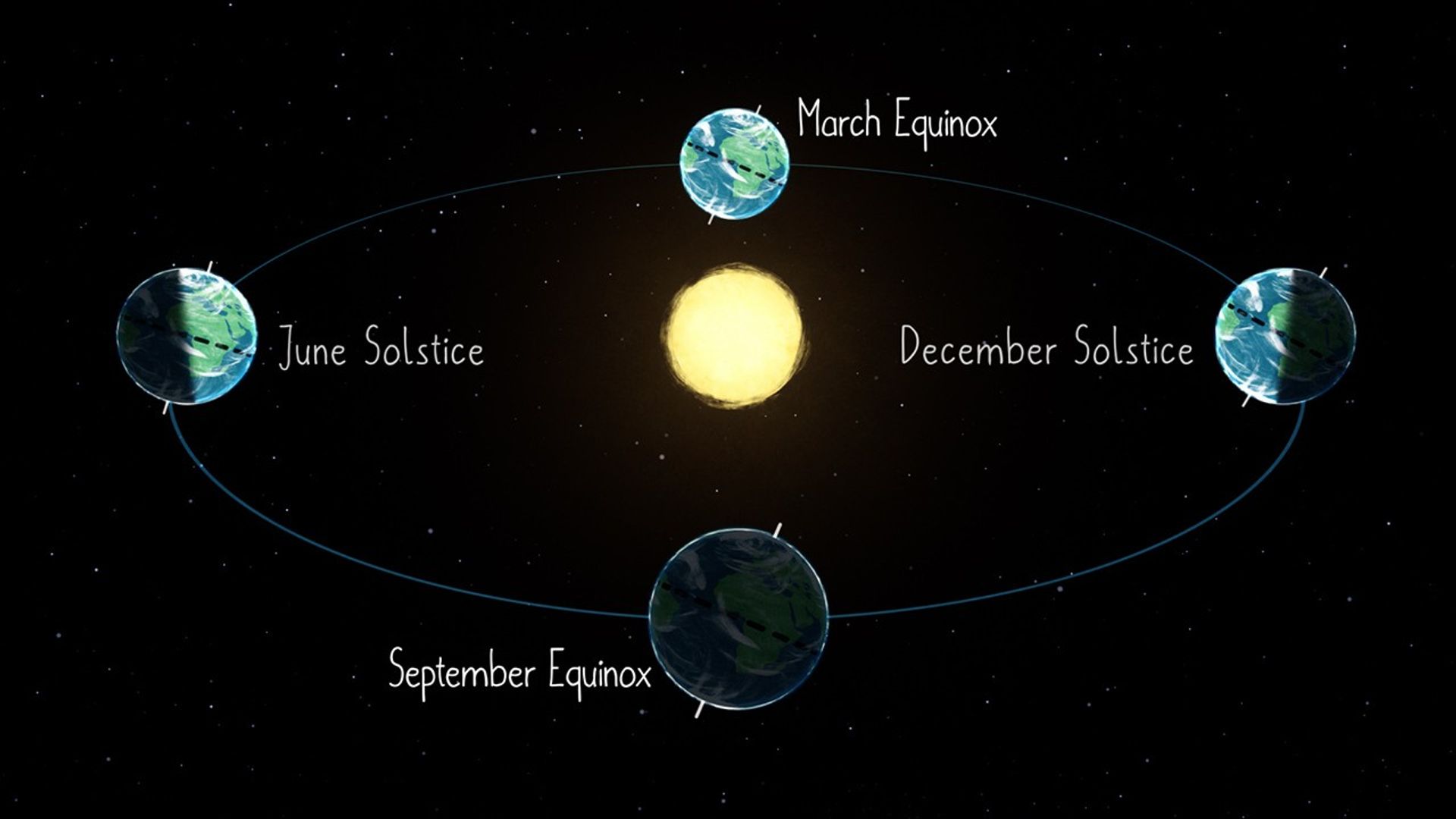
illustration of equinoxes and solstices on Earth in relation to the Sun
Illustration showing how Earth’s tilt leads to the Northern and Southern Hemispheres receiving changing amounts of sunlight over the course of the year. At the equinoxes, neither hemisphere is more tilted toward the Sun, so both hemispheres receive the same amount of sunlight.
Credits:
NASA/JPL-Caltech

Depending on your locale, equinoxes can be seen as harbingers of longer nights and gloomy weather, or promising beacons of nicer temperatures and more sunlight. Observing and predicting equinoxes is one of the earliest skills in humanity’s astronomical toolkit. Many ancient observatories around the world observed equinoxes along with the more pronounced solstices. These days, you don’t need your own observatory to know when an equinox occurs, since you’ll see it marked on your calendar twice a year! The word “equinox” originates from Latin, and translates to equal (equi-) night (-nox). But what exactly is an equinox?

An equinox occurs twice every year, in March and September. In 2025, the equinoxes will occur on March 20, at exactly 09:01 UTC (or 2:01 AM PDT), and again on September 22, at 19:19 UTC (or 11:19 AM PDT). The equinox marks the exact moment when the center of the Sun crosses the plane of our planet’s equator. The day of an equinox, observers at the equator will see the Sun directly overhead at noon. After the March equinox, observers anywhere on Earth will see the Sun’s path in the sky continue its movement further north every day until the June solstice, after which it begins traveling south. The Sun crosses the equatorial plane again during the September equinox, and continues traveling south until the December solstice, when it heads back north once again. This movement is why some refer to the March equinox as the northward equinox, and the September equinox as the southward equinox.

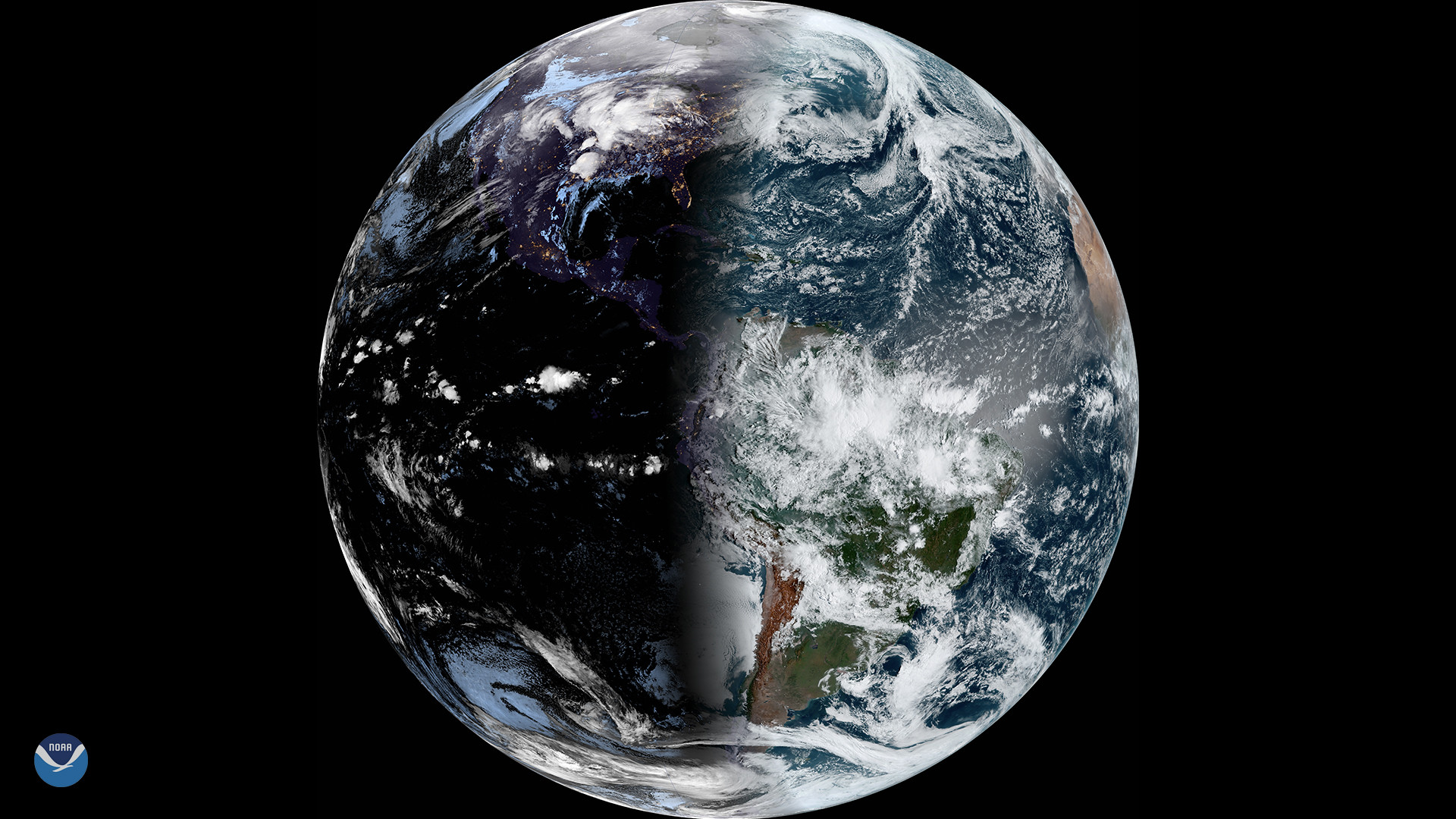
A full disk view of the earth from GOES 16, GOES East on the vernal Equinox.
NOAA/NASA

Our Sun shines equally on both the Northern and Southern Hemispheres during equinoxes, which is why they are the only times of the year when the Earth’s North and South Poles are simultaneously lit by sunlight. Notably, the length of day and night on the equinox aren’t precisely equal; the date for that split depends on your latitude, and may occur a few days earlier or later than the equinox itself. The complicating factors? Our Sun and atmosphere! The Sun itself is a sphere and not a point light source, so its edge is refracted by our atmosphere as it rises and sets, which adds several minutes of light to every day. The Sun doesn’t neatly wink on and off at sunrise and sunset like a light bulb, and so there isn’t a perfect split of day and night on the equinox – but it’s very close.

Equinoxes are associated with the changing seasons. In March, Northern Hemisphere observers welcome the longer, warmer days heralded by their vernal, or spring, equinox, but Southern Hemisphere observers note the shorter days – and longer, cooler nights – signaled by their autumnal, or fall, equinox. Come September, the reverse is true.

Originally posted by Dave Prosper: February 2022

Last Updated by Kat Troche: March 2025

Powered by WPeMatico

Get The Details…

Finalists Selected in NASA Aeronautics Agriculture-Themed Competition 

Finalists Selected in NASA Aeronautics Agriculture-Themed Competition 

3 min read

Preparations for Next Moonwalk Simulations Underway (and Underwater)

Gateways to Blueskies solutions for Agriculture banner.

Eight finalist teams participating in the 2025 NASA Gateways to Blue Skies Competition have been selected to present to a panel of judges their design concepts for aviation solutions that can help the agriculture industry. 

Sponsored by NASA’s Aeronautics Research Mission Directorate, this year’s competition asked teams of university students to research new or improved aviation solutions to support agriculture. The goal of the competition, titled AgAir: Aviation Solutions for Agriculture, is to enhance production, efficiency, sustainability, and resilience to extreme weather. Participants submitted proposals and accompanying videos summarizing their AgAir concepts and describing how they could demonstrate benefits by 2035 or sooner.  

“We continue to see a growing interest in our competition with a tremendous response to this year’s agricultural theme – so many great ideas fueled by the passion of our future workforce,” said Steven Holz, NASA Aeronautics University Innovation assistant project manager and co-chair of the Gateways to Blue Skies judging panel. “We are excited to see how each finalist team fleshes out their original concept in their final papers, infographics, and presentations.” 

The eight finalist teams will each receive stipends to facilitate their participation in the culminating Gateways to Blue Skies Forum, which will be held near NASA’s Armstrong Flight Research Center in Palmdale, California, May 20-21 and livestreamed globally. Finalists will present to a panel of NASA and industry experts, and the winning team will have the opportunity to intern at one of NASA’s aeronautics centers during the coming academic year. 

We continue to see a growing interest in our competition with a tremendous response to this year’s agricultural theme – so many great ideas fueled by the passion of our future workforce.

steven holz

steven holz

NASA Aeronautics University Innovation Assistant Project Manager

The finalists’ projects and their universities are: 

Proactive Resource Efficiency via Coordinated Imaging and Sprayer Execution
Auburn University, in Alabama

Precision Land Analysis and Aerial Nitrogen Treatment
Boston University

Pheromonal Localization Overpopulation Regulation Aircraft
Columbia University, in New York

Sky Shepherd: Autonomous Aerial Cattle Monitoring
Embry-Riddle Aeronautical University in Daytona Beach, Florida

Hog Aerial Mitigation System
Houston Community College, in Texas

Soil Testing and Plant Leaf Extraction Drone
South Dakota State University, in Brookings

RoboBees
University of California, Davis

CattleLog Cattle Management System
University of Tulsa, in Oklahoma

The agriculture industry is essential for providing food, fuel, and fiber to the global population. However, it faces significant challenges. NASA Aeronautics is committed to supporting commercial, industrial, and governmental partners in advancing aviation systems to modernize agricultural capabilities.  

The Gateways to Blue Skies competition is sponsored by NASA’s Aeronautics Research Mission Directorate’s University Innovation Project and is managed by the National Institute of Aerospace. 

More information on the competition is available on the  AgAir: Aviation Solutions for Agriculture competition website. 

Powered by WPeMatico

Get The Details…
Lillian Gipson

NASA Atmospheric Wave-Studying Mission Releases Data from First 3,000 Orbits

NASA Atmospheric Wave-Studying Mission Releases Data from First 3,000 Orbits

4 min read

NASA Atmospheric Wave-Studying Mission Releases Data from First 3,000 Orbits

Following the 3,000th orbit of NASA’s AWE (Atmospheric Waves Experiment) aboard the International Space Station, researchers publicly released the mission’s first trove of scientific data, crucial to investigate how and why subtle changes in Earth’s atmosphere cause disturbances, as well as how these atmospheric disturbances impact technological systems on the ground and in space.

“We’ve released the first 3,000 orbits of data collected by the AWE instrument in space and transmitted back to Earth,” said Ludger Scherliess, principal investigator for the mission and physics professor at Utah State University. “This is a view of atmospheric gravity waves never captured before.”

Available online, the data release contains more than five million individual images of nighttime airglow and atmospheric gravity wave observations collected by the instrument’s four cameras, as well as derived temperature and airglow intensity swaths of the ambient air and the waves.

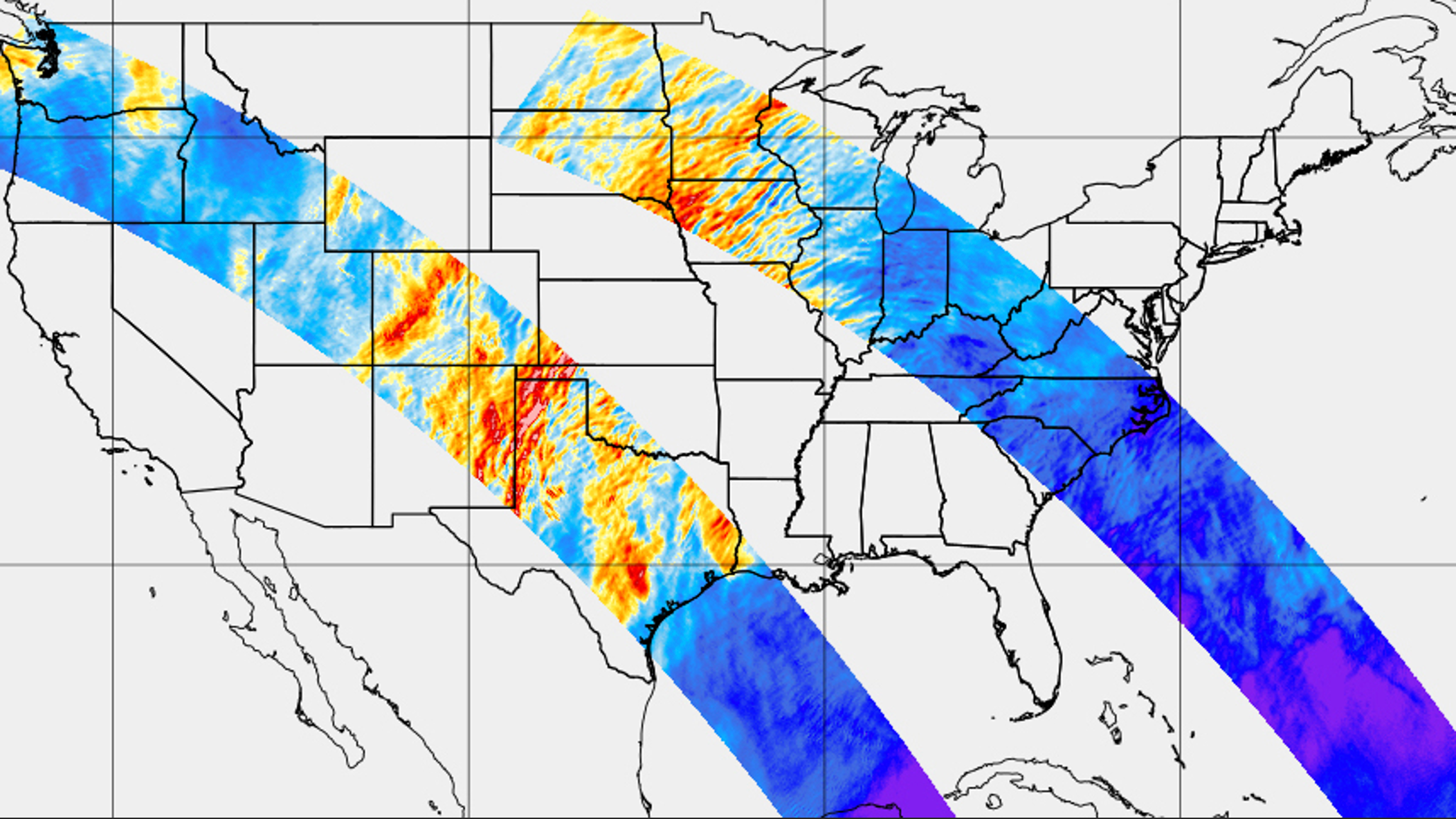
A map of the United States shows satellite data of two weather patterns stretching from the southwest to the northeast. The patterns have varied colors, including blue, yellow, and red, indicating different data intensities in those regions.
This image shows AWE data combined from two of the instrument’s passes over the United States. The red and orange wave-structures show increases in brightness (or radiance) in infrared light produced by airglow in Earth’s atmosphere.
NASA/AWE/Ludger Scherliess

“AWE is providing incredible images and data to further understand what we only first observed less than a decade ago,” said Esayas Shume, AWE program scientist at NASA Headquarters in Washington. “We are thrilled to share this influential data set with the larger scientific community and look forward to what will be discovered.”

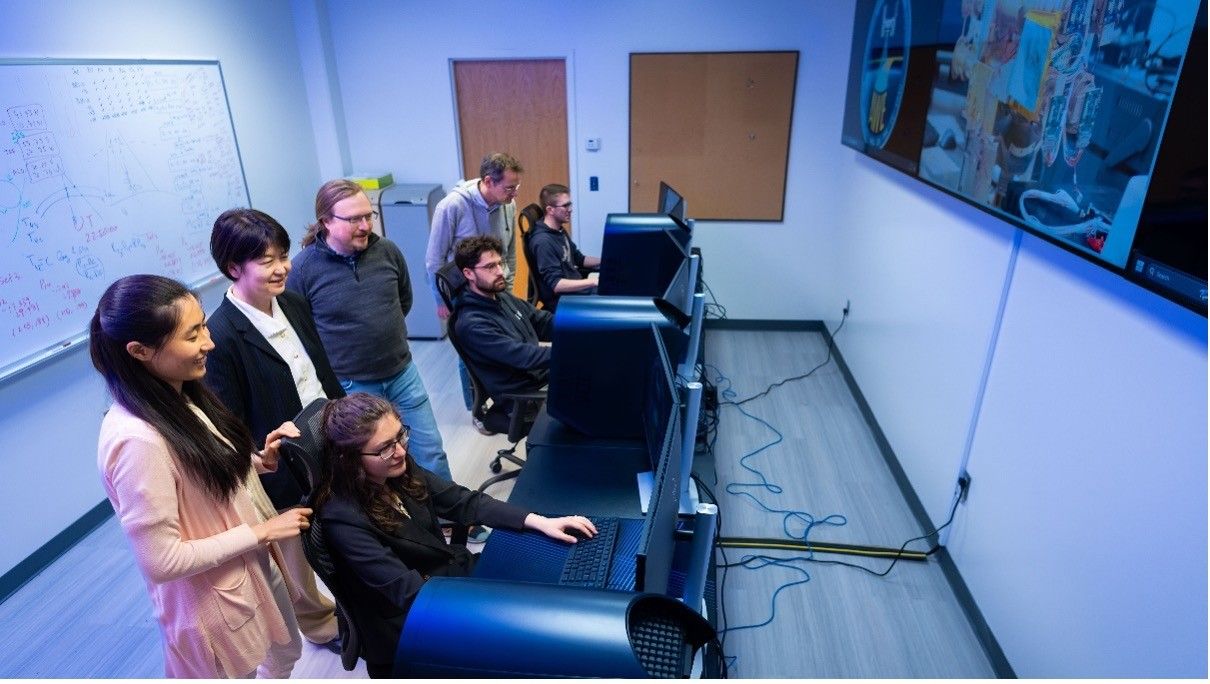
USU physicists in computer lab
Members of the AWE science team gather in the mission control room at Utah State University to view data collected by the mapping instrument mounted on the outside of the International Space Station.
SDL/Allison Bills

Atmospheric gravity waves occur naturally in Earth’s atmosphere and are formed by Earth’s weather and topography. Scientists have studied the enigmatic phenomena for years, but mainly from a few select sites on Earth’s surface.

“With data from AWE, we can now begin near-global measurements and studies of the waves and their energy and momentum on scales from tens to hundreds and even thousands of kilometers,” Scherliess said. “This opens a whole new chapter in this field of research.”  

Data from AWE will also provide insight into how terrestrial and space weather interactions affect satellite communications, and navigation, and tracking.

“We’ve become very dependent on satellites for applications we use every day, including GPS navigation,” Scherliess said. “AWE is an attempt to bring science about atmospheric gravity waves into focus, and to use that information to better predict space weather that can disrupt satellite communications. We will work closely with our collaborators to better understand how these observed gravity waves impact space weather.”

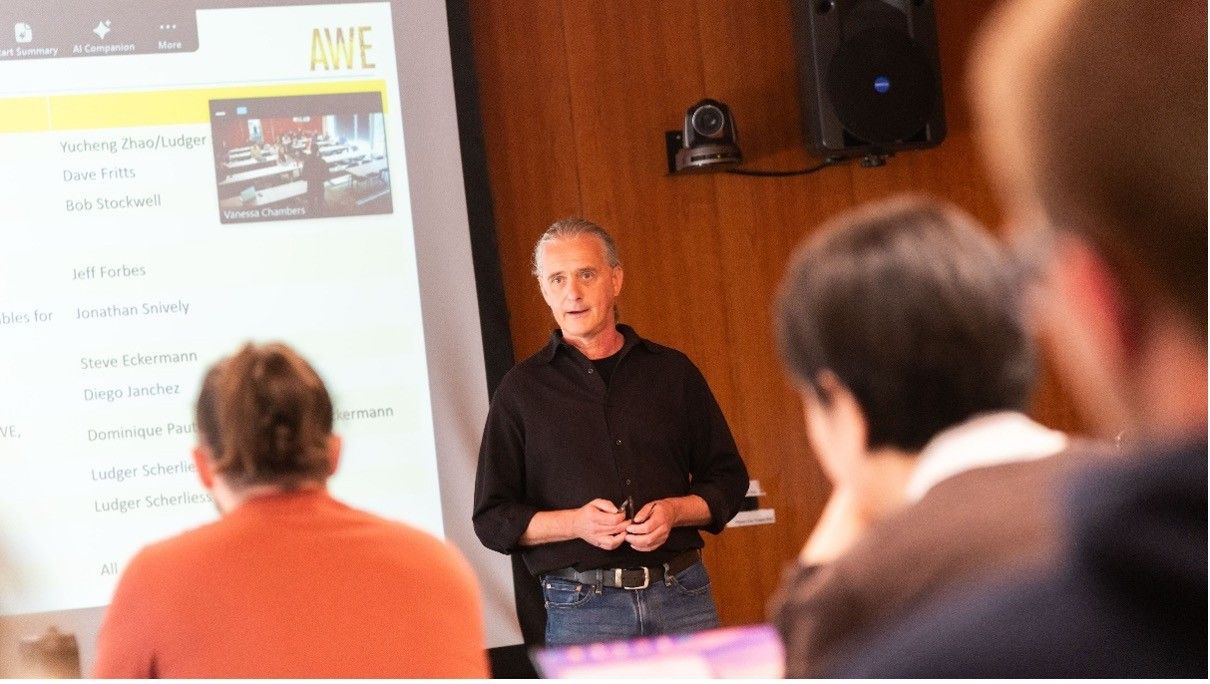
USU physicist Ludger Scherliess
AWE’s principal investigator, Ludger Scherliess, briefs collaborators of initial analysis of early AWE data. Information from the NASA-funded mission is helping scientists better understand how weather on Earth affects weather in space.
SDL/Allison Bills

The tuba-shaped AWE instrument, known as the Advanced Mesospheric Temperature Mapper or AMTM, consists of four identical telescopes. It is mounted to the exterior of the International Space Station, where it has a view of Earth.

As the space station orbits Earth, the AMTM’s telescopes capture 7,000-mile-long swaths of the planet’s surface, recording images of atmospheric gravity waves as they move from the lower atmosphere into space. The AMTM measures and records the brightness of light at specific wavelengths, which can be used to create air and wave temperature maps. These maps can reveal the energy of these waves and how they are moving through the atmosphere.

To analyze the data and make it publicly available, AWE researchers and students at USU developed new software to tackle challenges that had never been encountered before.

“Reflections from clouds and the ground can obscure some of the images, and we want to make sure the data provide clear, precise images of the power transported by the waves,” Scherliess said. “We also need to make sure the images coming from the four separate AWE telescopes on the mapper are aligned correctly. Further, we need to ensure stray light reflections coming off the solar panels of the space station, along with moonlight and city lights, are not masking the observations.”

As the scientists move forward with the mission, they’ll investigate how gravity wave activity changes with seasons around the globe. Scherliess looks forward to seeing how the global science community will use the AWE observations.

“Data collected through this mission provides unprecedented insight into the role of weather on the ground on space weather,” he said.

AWE is led by Utah State University in Logan, Utah, and it is managed by the Explorers Program Office at NASA’s Goddard Space Flight Center in Greenbelt, Maryland. Utah State University’s Space Dynamics Laboratory built the AWE instrument and provides the mission operations center.

By Mary-Ann Muffoletto
Utah State University, Logan, UT

NASA Media Contact: Sarah Frazier

Keep Exploring

Discover More Topics From NASA

Powered by WPeMatico

Get The Details…

Meet the Johnson CLPS Team Supporting NASA’s Lunar Exploration Goals

Meet the Johnson CLPS Team Supporting NASA’s Lunar Exploration Goals

As part of NASA’s Artemis campaign, the Commercial Lunar Payload Services (CLPS) initiative, managed out of Johnson Space Center in Houston, is paving the way for conducting lunar science for the benefit of humanity.

Through CLPS, NASA teams worked closely with commercial companies to develop a new model for space exploration, enabling a sustainable return to the Moon. These commercial missions deliver NASA science and technology to the lunar surface, providing insights into the environment and demonstrating new technologies that will support future astronauts—on the Moon and, eventually, on Mars.

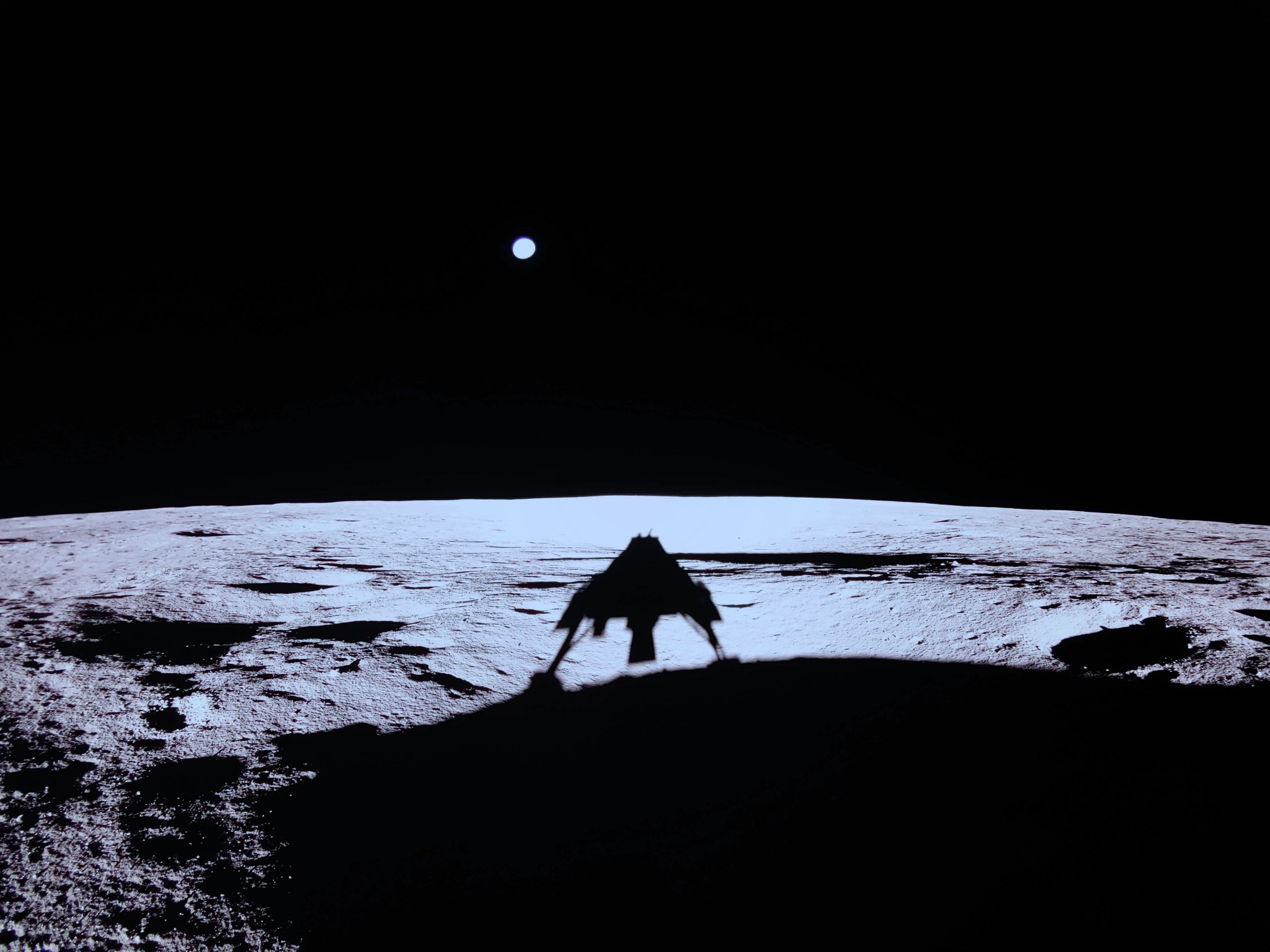
Earth is a small pale circle in the sky in this image taken on the Moon by a camera on @Firefly’s Blue Ghost lunar lander. The Moon’s gray surface sharply contrasts with the blackness of space. The lander’s shadow can be seen on the ground.
Carrying a suite of NASA science and technology, Firefly Aerospace’s Blue Ghost Mission 1 successfully landed at 3:34 a.m. EST on Sunday, March 2, 2025, near a volcanic feature called Mons Latreille within Mare Crisium, a more than 300-mile-wide basin located in the northeast quadrant of the Moon’s near side.
Firefly Aerospace
Intuitive Machines’ IM-2 captured an image March 6, 2025, after landing in a crater from the Moon’s South Pole. The lunar lander is on its side about 820 feet from the intended landing site, Mons Mouton. In the center of the image between the two lander legs is the Polar Resources Ice Mining Experiment 1 suite, which shows the drill deployed.
Credit: Intuitive Machines

2025: A Year of Lunar Firsts

This year has already seen historic milestones. Firefly Aerospace’s Blue Ghost Mission 1 successfully delivered 10 science and technology instruments to the Moon on March 2, 2025. It touched down near a volcanic feature called Mons Latreille within Mare Crisium, a basin over 300 miles wide in the northeast quadrant of the Moon’s near side. Intuitive Machines’ IM-2 Mission, landed near the Moon’s South Pole on March 6, marking the southernmost lunar landing ever achieved.

The lunar deliveries for NASA have collected valuable insights and data to inform the next giant leap in humanity’s return to the Moon, helping scientists address challenges like lunar dust mitigation, resource utilization, and radiation tolerance.

Meet the Johnson employees contributing to lunar innovations that are helping to shape the future of human presence on the Moon.

Mark Dillard: Pioneering Payload Integration

Official NASA portrait of CLPS Payload Integration Manager Mark Dillard.
NASA/James Blair

Mark Dillard, Blue Ghost Mission 1 payload integration manager, has been at the forefront of space exploration for more than 40 years, including 28 years with the International Space Station Program. Beyond ensuring all NASA payloads are integrated onto the lunar landers, he oversees schedules, costs, and technical oversight while fostering strong partnerships with CLPS vendors and NASA science teams.

“I believe NASA is about to enter its next Golden Age,” said Dillard. “The enthusiasm of Firefly’s engineering team is contagious, and it has been a privilege to witness their success.”

Dillard’s career includes five years as NASA’s resident manager in Torino, Italy, where he oversaw the development of International Space Station modules, including three logistics modules, the European Space Agency’s Columbus module, and two space station nodes.

a man dre
Mark Dillard in the clean room with Firefly Aerospace’s Blue Ghost Mission 1 lander behind him.

“Like Apollo, Shuttle, and the International Space Station Programs, Artemis will add the next building block for space exploration,” said Dillard. “The CLPS initiative is a significant building block, aiming to establish reliable and long-term access to the lunar surface.”

Susan Lederer: Guiding Science in Real Time

A woman poses in front of a black background. She is wearing a black top with a black and grey scarf.
Official portrait of CLPS Project Scientist Susan Lederer.
NASA/Bill Stafford

Susan Lederer, IM-2 project scientist, has spent years ensuring all the NASA instruments are fully prepared for lunar operations. She oversees real-time science operations from IM’s Nova Control Center, working to maximize the mission’s scientific return and prepare for the next generation of astronauts to explore the Moon, Mars, and beyond.

“We have done our best with remote data, but the only way to truly understand the Moon—how to drill for resources, how to live on another celestial body—is to go there and do the experiments,” she said. “Now, we get to do that.”

Lederer’s path to CLPS was shaped by a background in space exploration, astrophysics, and planetary science. She has contributed to multiple spacecraft missions, including NASA’s Deep Impact mission, which sent a projectile into Comet Tempel 1, and a separate mission that retrieved a sample from asteroid Itokawa.

On Ascension Island, a remote joint U.S. Air Force and Royal Air Force base, she co-led the construction of a 20,000-pound optical telescope to study space debris. Her work spans collaborations with the Defense Advanced Research Projects Agency, a tenure as a physics professor, and the design of impact experiments at NASA’s Experimental Impact Lab, where she used a vertical gun firing projectiles at speeds exceeding those of sniper rifles to study asteroid and comet collisions.

Lederer has logged hundreds of hours conducting observing runs at professional observatories worldwide, where she refined both her scientific precision and her ability to repair instruments while working alone on remote mountaintops.

As a private pilot and SciComm (the science equivalent of Capsule Communicator) for NASA’s Desert Research and Technology Studies, she honed her mission communication skills. She was also part of an international team that discovered two extrasolar planetary systems—one with a single Earth-sized planet and another with seven—orbiting ultracool red dwarf stars.

Her expertise has uniquely prepared her to oversee real-time science operations for lunar missions in high-intensity environments.

Four people sit in front of a desk with a NASA meatball on it. The background is an image of Earth from Space.
NASA and Intuitive Machines IM-1 lunar lander mission status press briefing. From left to right: Steve Altemus, Intuitive Machines’ chief executive officer and co-founder; Dr. Joel Kearns, NASA’s deputy associate administrator, Exploration, Science Mission Directorate; Dr. Tim Crain, Intuitive Machines’ chief technology officer and co-founder; and CLPS Project Scientist Susan Lederer.
NASA/Robert Markowitz

Lederer emphasizes the importance of both scientific discovery and the practical realities of living and working on another world—a challenge NASA is tackling for the first time in history.

“Honestly, it’s when things don’t go as planned that you learn the most,” she said. “I’m looking forward to the surprises that we get to solve together as a team. That’s our greatest strength—the knowledge and teamwork that make this all happen.”

Lederer credits the success of CLPS lunar deliveries to the dedication of teams working on payloads like Polar Resources Ice Mining Experiment-1 and Lunar Retroreflector Array, as well as peers within NASA’s Science Mission Directorate, Space Technology Mission Directorate, and Intuitive Machines.

“What we do every day in CLPS creates a new world for exploration that is efficient in schedule, cost, and gaining science and technology knowledge in these areas like we’ve never done before,” said Lederer. “It feels very much like being a trailblazer for inspiring future generations of explorers – at least that’s my hope, to keep the next generation inspired and engaged in the wonders of our universe.”

Powered by WPeMatico

Get The Details…
Sumer Loggins