NASA’s Swift Reaches 20th Anniversary in Improved Pointing Mode

NASA’s Swift Reaches 20th Anniversary in Improved Pointing Mode

5 min read

NASA’s Swift Reaches 20th Anniversary in Improved Pointing Mode

After two decades in space, NASA’s Neil Gehrels Swift Observatory is performing better than ever thanks to a new operational strategy implemented earlier this year. The spacecraft has made great scientific strides in the years since scientists dreamed up a new way to explore gamma-ray bursts, the most powerful explosions in the universe.

“The idea for Swift was born during a meeting in a hotel basement in Estes Park, Colorado, in the middle of a conference,” said John Nousek, the Swift mission director at Pennsylvania State University in State College. “A bunch of astrophysicists got together to brainstorm a mission that could help us solve the problem of gamma-ray bursts, which were a very big mystery at the time.”

Watch to learn how NASA’s Neil Gehrels Swift Observatory got its name.
NASA’s Goddard Space Flight Center

Gamma-ray bursts occur all over the sky without warning, with about one a day detected on average. Astronomers generally divide these bursts into two categories. Long bursts produce an initial pulse of gamma rays for two seconds or more and occur when the cores of massive stars collapse to form black holes. Short bursts last less than two seconds and are caused by the mergers of dense objects like neutron stars.

But in 1997, at the time of that basement meeting, the science community disagreed over the origin models for these events. Astronomers needed a satellite that could move quickly to locate them and move to point additional instruments at their positions.

What developed was Swift, which launched Nov. 20, 2004, from Complex 17A at what is now Cape Canaveral Space Force Station in Florida. Originally called the Swift Observatory for its ability to quickly point at cosmic events, the mission team renamed the spacecraft in 2018 after its first principal investigator Neil Gehrels.

Swift uses several methods for orienting and stabilizing itself in space to study gamma-ray bursts.

Sensors that detect the Sun’s location and the direction of Earth’s magnetic field provide the spacecraft with a general sense of its location. Then, a device called a star tracker looks at stars and tells the spacecraft how to maneuver to keep the observatory precisely pointed at the same position during long observations.

Swift uses three spinning gyroscopes, or gyros, to carry out those moves along three axes. The gyros were designed to align at right angles to each other, but once in orbit the mission team discovered they were slightly misaligned. The flight operations team developed a strategy where one of the gyros worked to correct the misalignment while the other two pointed Swift to achieve its science goals.

The team wanted to be ready in case one of the gyros failed, however, so in 2009 they developed a plan to operate Swift using just two.
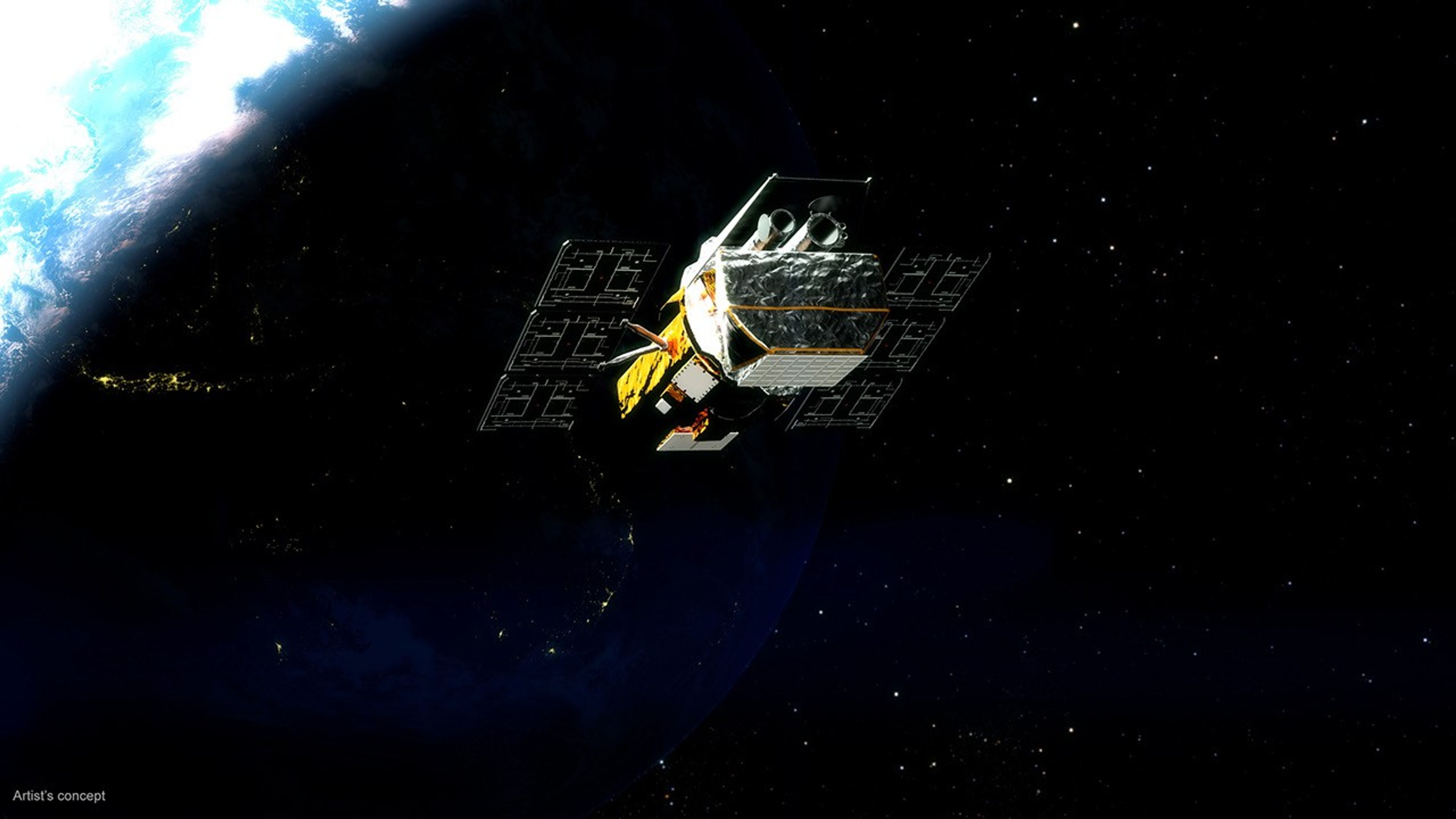
Swift orbits above Earth in this artist's concept.
Swift orbits above Earth in this artist’s concept.
NASA’s Goddard Space Flight Center Conceptual Image Lab

Any change to the way a telescope operates once in space carries risk, however. Since Swift was working well, the team sat on their plan for 15 years.

Then, in July 2023, one of Swift’s gyros began working improperly. Because the telescope couldn’t hold its pointing position accurately, observations got progressively blurrier until the gyro failed entirely in March 2024.

“Because we already had the shift to two gyros planned out, we were able to quickly and thoroughly test the procedure here on the ground before implementing it on the spacecraft,” said Mark Hilliard, Swift’s flight operations team lead at Omitron, Inc. and Penn State. “Actually, scientists have commented that the accuracy of Swift’s pointing is now better than it was since launch, which is really encouraging.”

For the last 20 years, Swift has contributed to groundbreaking results — not only for gamma-ray bursts but also for black holes, stars, comets, and other cosmic objects.

“After all this time, Swift remains a crucial part of NASA’s fleet,” said S. Bradley Cenko, Swift’s principal investigator at NASA’s Goddard Space Flight Center in Greenbelt, Maryland. “The satellite’s abilities have helped pioneer a new era of astrophysics called multimessenger astronomy, which is giving us a more well-rounded view of how the universe works. We’re looking forward to all Swift has left to teach us.”

Swift is a key part of NASA’s strategy to look for fleeting and unpredictable changes in the sky with a variety of telescopes that use different methods of studying the cosmos.

Goddard manages the Swift mission in collaboration with Penn State, the Los Alamos National Laboratory in New Mexico, and Northrop Grumman Space Systems in Dulles, Virginia. Other partners include the University of Leicester and Mullard Space Science Laboratory in the United Kingdom, Brera Observatory in Italy, and the Italian Space Agency.

By Jeanette Kazmierczak
NASA’s Goddard Space Flight Center, Greenbelt, Md.

Media Contact:
Claire Andreoli
301-286-1940
claire.andreoli@nasa.gov
NASA’s Goddard Space Flight Center, Greenbelt, Md.

Share

Details

Last Updated
Nov 20, 2024
Editor
Jeanette Kazmierczak
Location
Goddard Space Flight Center

Powered by WPeMatico

Get The Details…

Gateway Tops Off

Gateway Tops Off

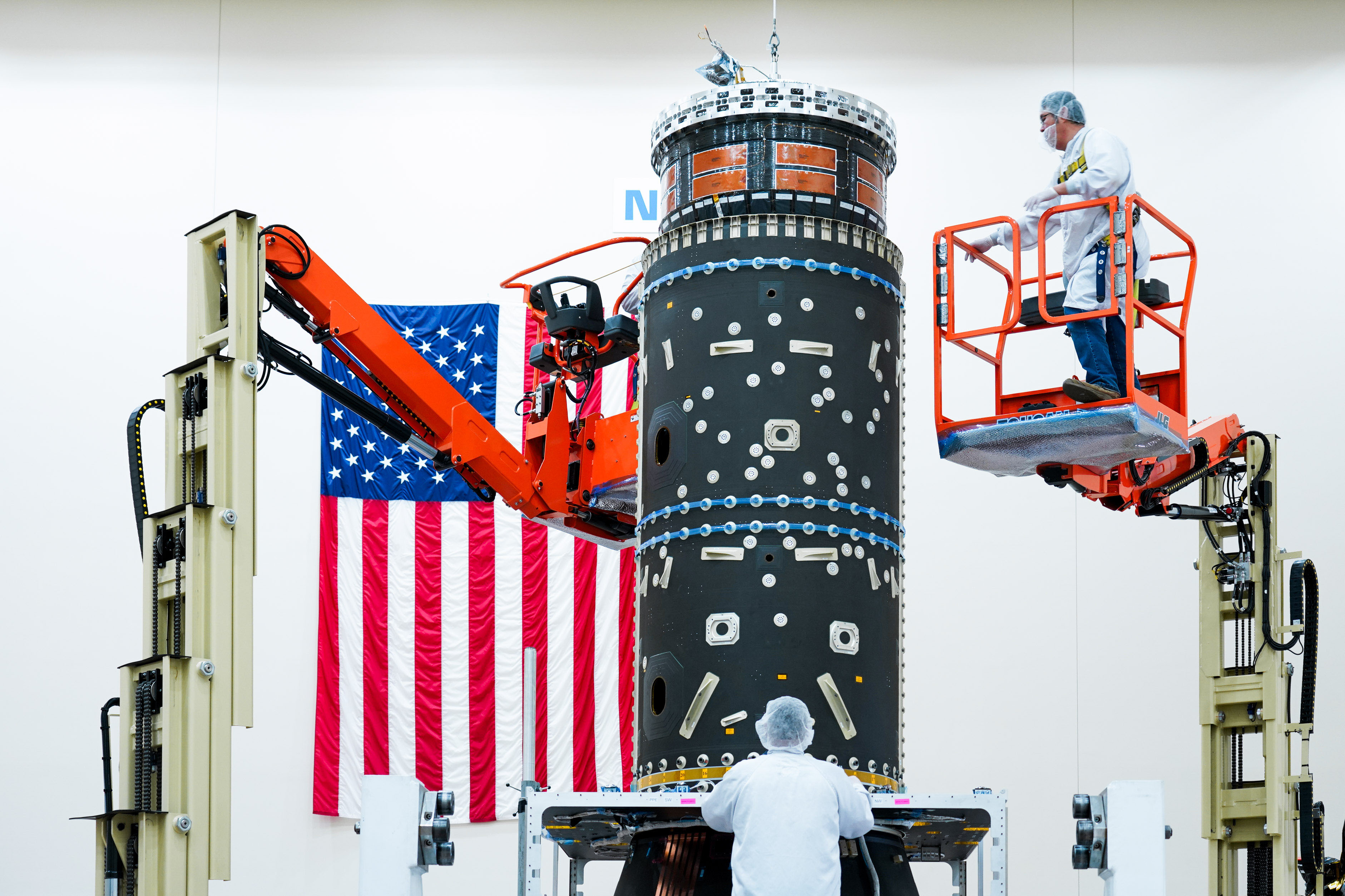
Technicians work on the installation of hardware designed to house Gateway’s xenon fuel tanks, an integral component of its advanced electric propulsion system. The setup is conducted in a cleanroom environment, with one technician on an elevated lift and another standing at the base of the structure. An American flag is displayed prominently in the background.
Technicians carefully install a piece of equipment to house Gateway’s xenon fuel tanks, part of its advanced electric propulsion system.

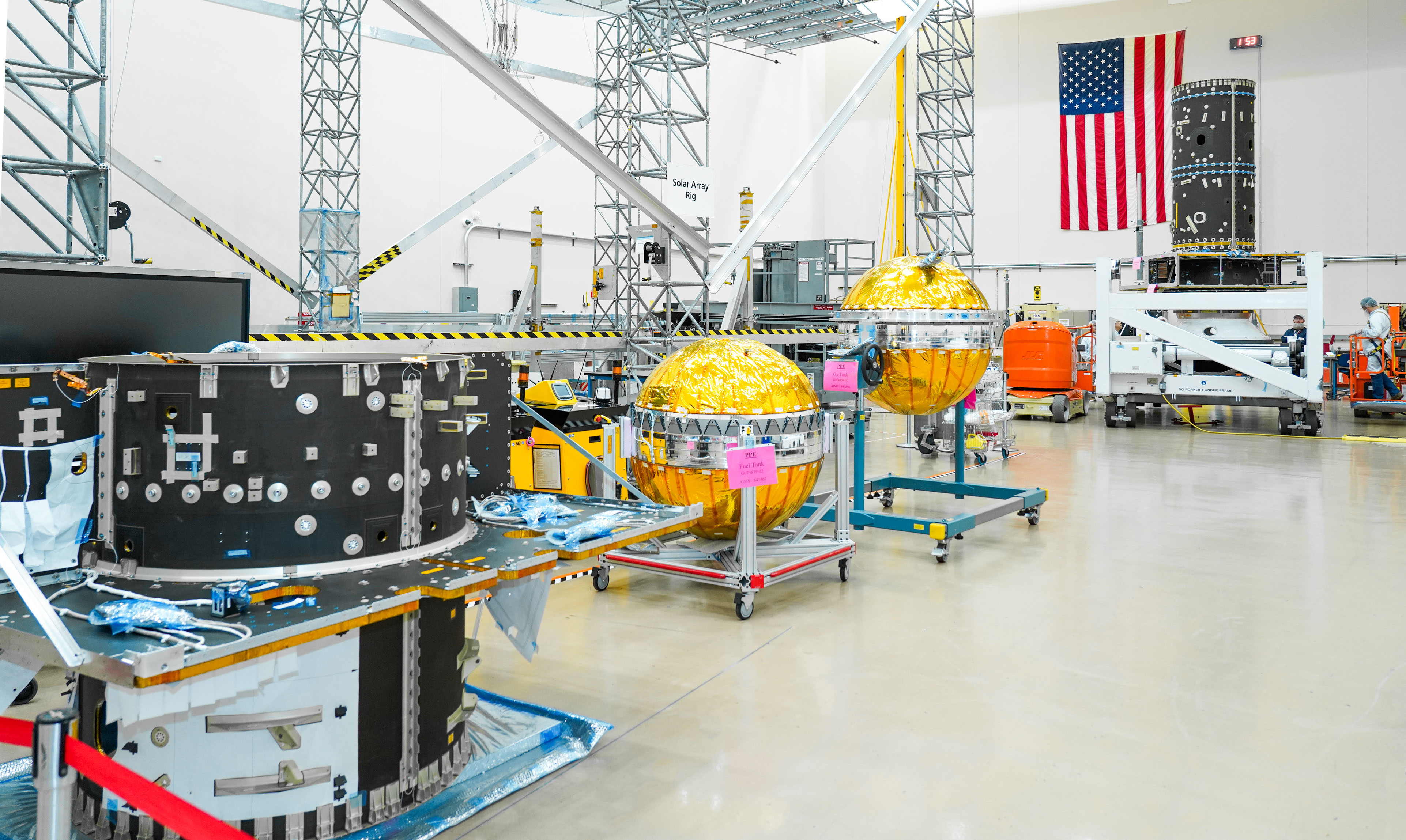
Gateway’s Power and Propulsion Element, which will make the lunar space station the most powerful solar electric spacecraft ever flown, recently received the xenon and liquid fuel tanks for its journey to and around the Moon.

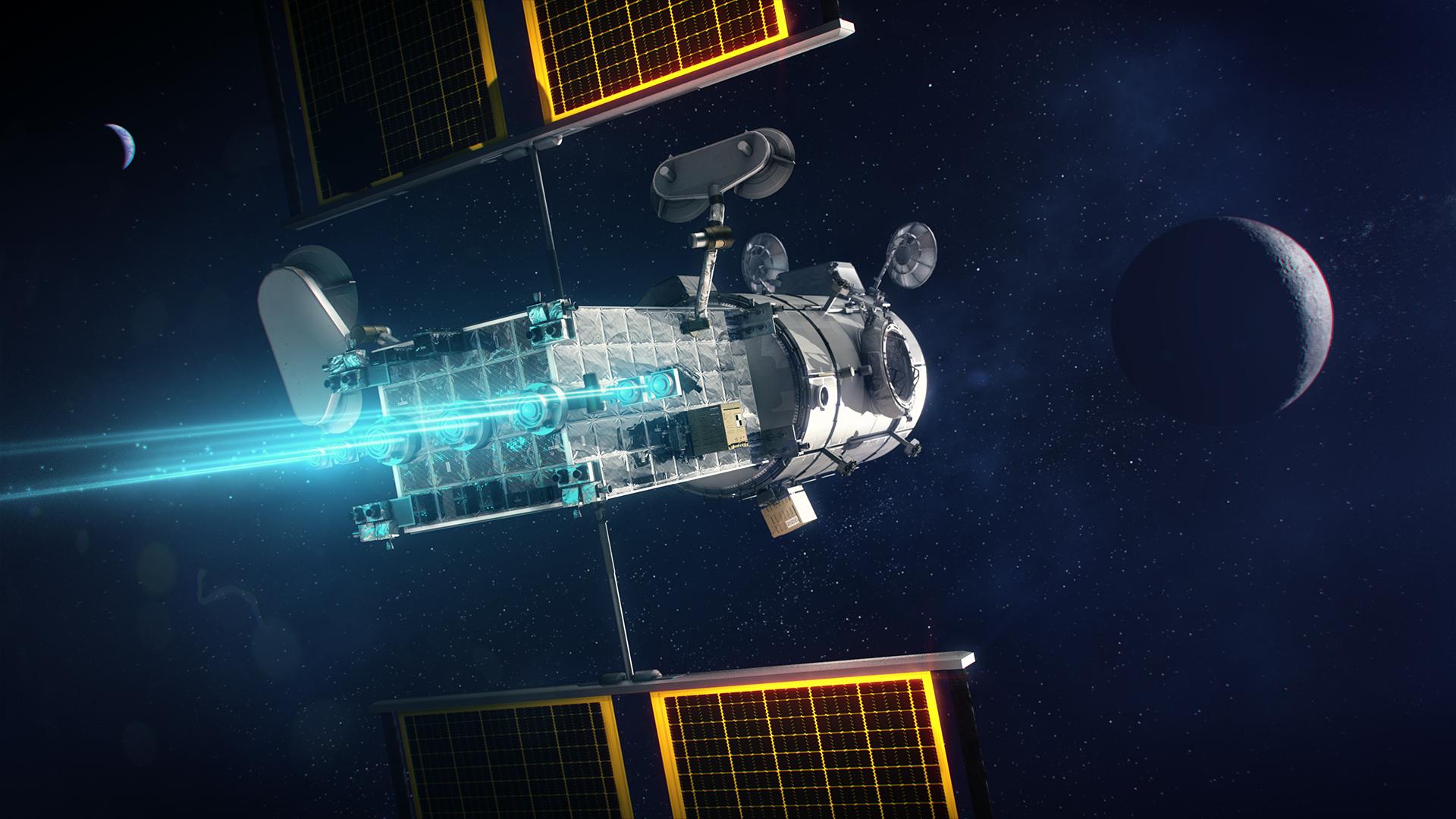
Technicians in Palo Alto, California carefully install a piece of equipment that will house the tanks. Once fully assembled and launched to lunar orbit, the Power and Propulsion Element’s roll-out solar arrays – together about the size of an American football field endzone – will harness the Sun’s energy to energize xenon gas and produce the thrust to get Gateway to the Moon’s orbit where it will await the arrival of its first crew on the Artemis IV mission.

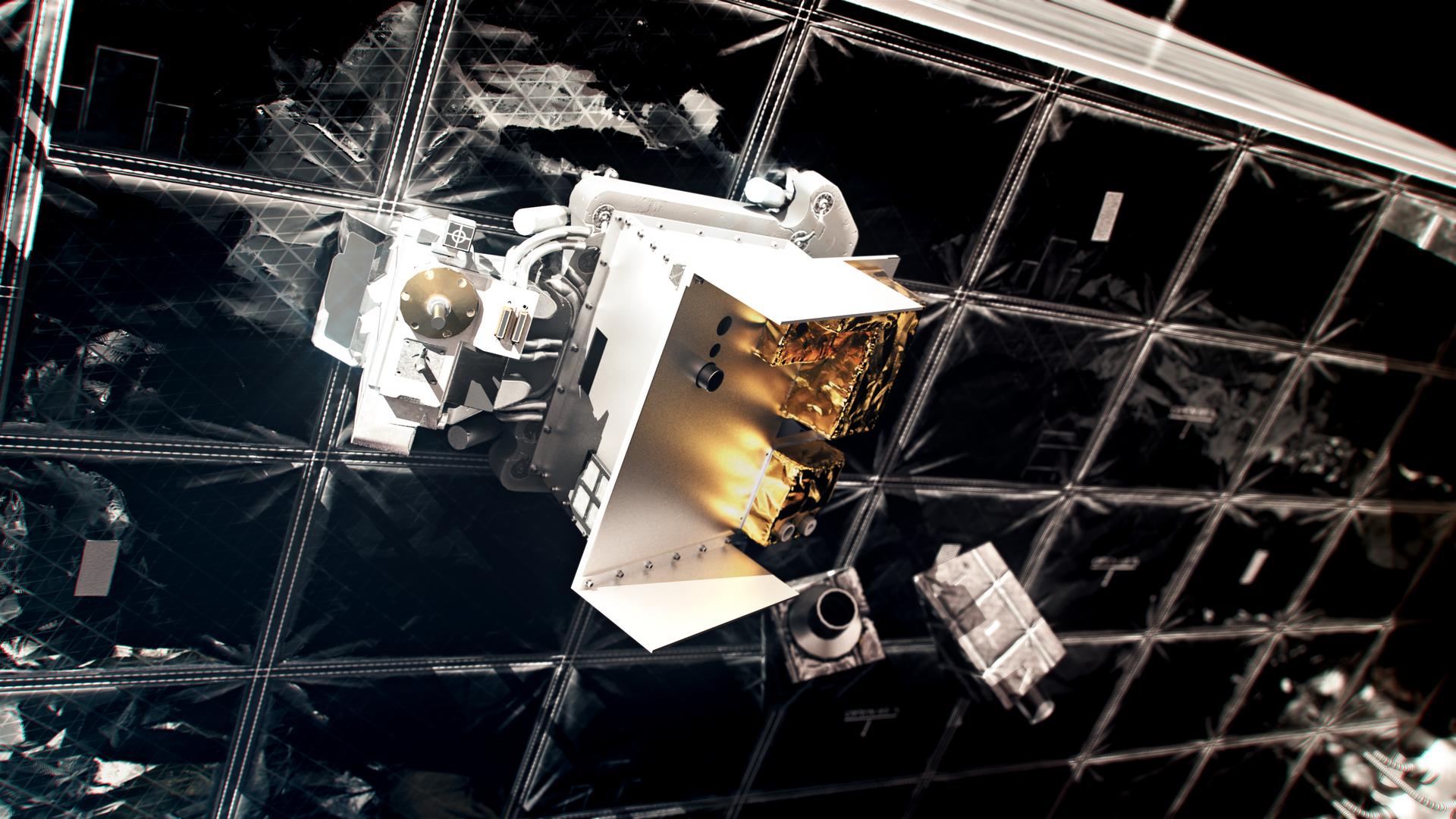
The Power and Propulsion Element will also carry the European Radiation Sensors Array science experiment provided by ESA (European Space Agency) and JAXA (Japan Aerospace Exploration Agency), one of three Gateway science experiments that will study solar and cosmic radiation. The little understood phenomenon is a chief concern for humans and hardware journeying to deep-space destinations like Mars and beyond.

The Power and Propulsion Element is managed out of NASA’s Glenn Research Center in Cleveland, Ohio and built by Maxar Space Systems of Palo Alto, California.

The Power and Propulsion Element (PPE) hardware for the Gateway space station, including its primary structure and gold-coated fuel tanks, is displayed in a cleanroom at Maxar Space Systems in Palo Alto, California. The components are organized for assembly, with an American flag visible in the background.
Hardware for the Gateway space station’s Power and Propulsion element, including its primary structure and fuel tanks ready for assembly, are shown at Maxar Space Systems in Palo Alto, California.
Maxar Space Systems
Artist's rendering of NASA's Gateway space station in its initial configuration, featuring the Habitation and Logistics Outpost (HALO) connected to the Power and Propulsion Element (PPE). The PPE is depicted actively using its Solar Electric Propulsion (SEP) system, with blue plumes of ionized xenon gas streaming from the spacecraft. The Moon and Earth are visible in the distant background, showcasing Gateway's position in deep space.
An artist’s rendering of the Gateway space station’s Power and Propulsion Element.
NASA/Alberto Bertolin
A thruster, part of an advanced electric propulsion system designed for NASA's Gateway space station, emits a focused beam of ionized xenon gas during testing at NASA’s Glenn Research Center. The image captures the thruster in action, highlighting the bright, circular discharge of xenon ions that will propel Gateway in space.
A type of advanced electric propulsion system thruster that will be used on Gateway glows blue as it emits ionized xenon gas during testing at NASA’s Glenn Research Center.
NASA
This artist's concept of the European Radiation Sensors Array (ERSA) shows the instrument suite secured to the external surface of Gateway. ESA (European Space Agency) is developing and managing the ERSA instrument.
An artist’s rendering of European Radiation Sensor Array science experiment that will study both radiation and lunar dust.  
NASA

Powered by WPeMatico

Get The Details…
Dylan Connell

About the Office of the Chief Knowledge Officer (OCKO)

About the Office of the Chief Knowledge Officer (OCKO)

The overarching purpose of the OCKO is to cultivate and sustain a learning culture at Goddard in support of mission success. We have instituted various processes and programs for lessons learned and critical knowledge identification, sharing, and application. The focus of the OCKO is to promote local learning practices that enhances domain-specific expertise within an expanded framework of how NASA works.  The Goddard OCKO provides leadership, coordination and support to center organizations to effectively identify lessons and critical knowledge that can be used to support mission execution.

Mission success at Goddard is driven by many factors including, but not limited to, teamwork, leadership, decision making and risk-informed prioritization of lessons. The OCKO has developed many technical case studies that touch on broad organizational issues, project implementation, technology and engineering development, procurement and contract management challenges, and other topics that contribute to mission success. Our learning programs and knowledge sharing activities are designed to transfer the experiences, technical wisdom and values embedded in our policies, procedures and processes.

The OCKO, whether through formal dissenting opinion processes, pause-and-learn exercises, or project reflective learning sessions, encourages our workforce to speak up in support of mission success. We promote a healthy culture where project teams discuss major events, milestones and reviews to ascertain “what happened and why it happened,” how to sustain strengths, and how to improve on weaknesses to enable collective discovery of contextual lessons for institutional learning.

As the Chief Knowledge Officer (CKO) of the NASA Goddard Space Flight Center, it is my sincere desire to help assure that Goddard operates as a learning organization to enhance the likelihood of mission success.

moses adoko signature

Moses Adoko, Chief Knowledge Officer 

Powered by WPeMatico

Get The Details…
Alysha Bayens

Space Biology, Student Robotics Top Day as Cargo Craft Departs

Space Biology, Student Robotics Top Day as Cargo Craft Departs

Nov. 19, 2024: International Space Station Configuration. Five spaceships are parked at the space station including the SpaceX Dragon Freedom, the SpaceX Dragon cargo spacecraft, the Northrop Grumman Cygnus resupply ship, the Soyuz MS-26 crew ship, and the Progress 89 resupply ship.

Space biology to improve health and robotics to promote education were the primary research topics aboard the International Space Station on Tuesday. The Expedition 72 crew members also saw the departure of a cargo craft as another one prepares for launch.

NASA Flight Engineer Don Pettit continued nourishing research samples and servicing an artificial gravity-generating incubator housing the samples inside the Kibo laboratory module. Pettit will process the samples during the week inside Kibo’s Life Science Glovebox helping researchers prevent space-caused immune system dysfunction and protect astronaut health.

NASA Flight Engineer Nick Hague reviewed the biology study’s operations and will soon assist Pettit as they process the samples. Hague also unpacked health accessories from the SpaceX Dragon cargo craft resupplying medical kits inside the space station. He later joined Pettit troubleshooting cargo-securing hardware located inside Dragon.

Commander Suni Williams collected station water samples for microbial analysis at the beginning of her shift. Then with assistance from Flight Engineer Butch Wilmore she serviced engineered bacteria and yeast samples for a biomanufacturing study and installed the specimens in cold stowage and a variable gravity simulator for later examination.

Wilmore also activated an Astrobee robotic free-flyer and tested its operation inside Kibo supporting a robotics competition to choose student-written algorithms that control the device. Wilmore worked in conjunction with engineers on the ground monitoring the Astrobee’s flight trajectory and its gesture recognition software. The Astrobee-Zero Robotics contest is meant to inspire students from around the world to pursue STEM and space-related careers.

The trash-packed Progress 88 cargo craft ended its resupply mission today undocking from the orbital outpost at 7:53 a.m. EST after six-months docked to the Poisk module. The Progress 88 descended into Earth’s atmosphere just over three hours later for a fiery, but safe destruction above the South Pacific Ocean.

Roscosmos Flight Engineers Alexey Ovchinin and Ivan Vagner deactivated computer and video monitoring gear after the Progress 88’s departure. Flight Engineer Aleksandr Gorbunov spent his day on orbital plumbing and cleaning duties throughout the station’s Roscosmos segment.

The Progress 90 resupply ship now stands at its launch pad at the Baikonur Cosmodrome in Kazakhstan counting down to a lift off 7:22 a.m. on Thursday. It will dock to the vacated Poisk module at 9:35 a.m. on Saturday loaded with about 5,500 pounds of cargo.


Learn more about station activities by following the space station blog@space_station and @ISS_Research on X, as well as the ISS Facebook and ISS Instagram accounts.

Get the latest from NASA delivered every week. Subscribe here: www.nasa.gov/subscribe

Powered by WPeMatico

Get The Details…

Mark Garcia

Space Station Raises Orbit Avoiding Orbital Debris

Space Station Raises Orbit Avoiding Orbital Debris

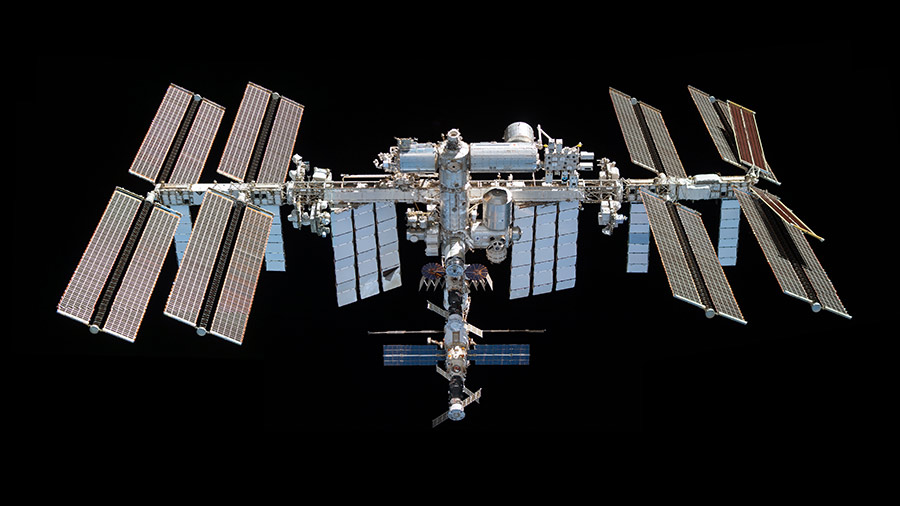
This mosaic depicts the space station pictured from the SpaceX Dragon crew spacecraft on Nov. 8, 2021.

The Progress 89 thrusters were fired at 2:09 p.m. CST today for 5 minutes, 31 seconds, to raise the orbit of the International Space Station to provide an extra margin of distance from a piece of orbital debris from a defunct defense meteorological satellite that broke up in 2015. The Pre-determined Debris Avoidance Maneuver (PDAM) was conducted in coordination with NASA, Roscosmos and the other space station partners.

Without the maneuver, ballistics officials estimated that the fragment could have come within around 2 ½ miles of the station.

The maneuver had no impact on station operations and will not affect Thursday’s scheduled launch of the Progress 90 cargo craft from the Baikonur Cosmodrome in Kazakhstan.


Learn more about station activities by following the space station blog@space_station and @ISS_Research on X, as well as the ISS Facebook and ISS Instagram accounts.

Get the latest from NASA delivered every week. Subscribe here: www.nasa.gov/subscribe

Powered by WPeMatico

Get The Details…

Mark Garcia