June’s Night Sky Notes: Seasons of the Solar System

June’s Night Sky Notes: Seasons of the Solar System

2 Min Read

June’s Night Sky Notes: Seasons of the Solar System

Two views of the planet Uranus appear side-by-side for comparison. At the top, left corner of the left image is a two-line label. The top line reads Uranus November 9, 2014. The bottoms line reads HST WFC3/UVIS. At the top, left corner of the right image is the label November 9, 2022. At the left, bottom corner of each image is a small, horizontal, white line. In both panels, over this line is the value 25,400 miles. Below the line is the value 40,800 kilometers. At the top, right corner of the right image are three, colored labels representing the color filters used to make these pictures. Located on three separate lines, these are F467M in blue, F547M in green, and F485M in red. On the bottom, right corner of the right image are compass arrows showing north toward the top and east toward the left.
Credits:
NASA

by Kat Troche of the Astronomical Society of the Pacific

Here on Earth, we undergo a changing of seasons every three months. But what about the rest of the Solar System? What does a sunny day on Mars look like? How long would a winter on Neptune be? Let’s take a tour of some other planets and ask ourselves what seasons might look like there.

Martian Autumn

Although Mars and Earth have nearly identical axial tilts, a year on Mars lasts 687 Earth days (nearly 2 Earth years) due to its average distance of 142 million miles from the Sun, making it late autumn on the red planet. This distance and a thin atmosphere make it less than perfect sweater weather. A recent weather report from Gale Crater boasted a high of -18 degrees Fahrenheit for the week of May 20, 2025.

A diagram of Mars' orbit around the Sun, labeled with seasons for both hemispheres (Northern Spring/Southern Autumn, Northern Winter/Southern Summer, etc.). Key points like perihelion (closest to Sun) and aphelion (farthest from Sun) are marked, illustrating how seasons align with orbital position.
Credit: NASA/JPL-Caltech

Seven Years of Summer

Saturn has a 27-degree tilt, very similar to the 25-degree tilt of Mars and the 23-degree tilt of Earth. But that is where the similarities end. With a 29-year orbit, a single season on the ringed planet lasts seven years. While we can’t experience a Saturnian season, we can observe a ring plane crossing here on Earth instead. The most recent plane crossing took place in March 2025, allowing us to see Saturn’s rings ‘disappear’ from view.

A Lifetime of Spring

Springtime on Neptune: Increased Brightness Shows Seasonal Change
NASA Hubble Space Telescope observations in August 2002 show that Neptune’s brightness has increased significantly since 1996. The rise is due to an increase in the amount of clouds observed in the planet’s southern hemisphere. These increases may be due to seasonal changes caused by a variation in solar heating. Because Neptune’s rotation axis is inclined 29 degrees to its orbital plane, it is subject to seasonal solar heating during its 164.8-year orbit of the Sun. This seasonal variation is 900 times smaller than experienced by Earth because Neptune is much farther from the Sun. The rate of seasonal change also is much slower because Neptune takes 165 years to orbit the Sun. So, springtime in the southern hemisphere will last for several decades! Remarkably, this is evidence that Neptune is responding to the weak radiation from the Sun. These images were taken in visible and near-infrared light by Hubble’s Wide Field and Planetary Camera 2.
Credit: NASA, L. Sromovsky, and P. Fry (University of Wisconsin-Madison)

Even further away from the Sun, each season on Neptune lasts over 40 years. Although changes are slower and less dramatic than on Earth, scientists have observed seasonal activity in Neptune’s atmosphere. These images were taken between 1996 and 2002 with the Hubble Space Telescope, with brightness in the southern hemisphere indicating seasonal change.

As we welcome summer here on Earth, you can build a Suntrack model that helps demonstrate the path the Sun takes through the sky during the seasons. You can find even more fun activities and resources like this model on NASA’s Wavelength and Energy activity. 

Powered by WPeMatico
Get The Details…

Sol 4553: Back to the Boxwork!

Sol 4553: Back to the Boxwork!

2 min read

Sol 4553: Back to the Boxwork!

A grayscale photograph of Martian terrain in front of the Curiosity rover shows very bumpy, uneven ground with large, polygonal sections of rock on the surface separated by gouges in the soil. The bumpy area and a smoother patch just beyond that all appear shiny. The bottom of the frame shows parts of the rover, running from the middle left edge to the lower right corner of the image, including part of its robotic arm which carries a nameplate imprinted with “Curiosity” outlined in white, all-capital letters, and to the right of that a line drawing of the rover.
NASA’s Mars rover Curiosity acquired this image of its workspace in the “boxwork” terrain area, showing resistant, ridge-like features where it will investigate the targets dubbed “Sisquoc River” and “Palo Verde Mountains.” Curiosity acquired the image using its Left Navigation Camera on May 27, 2025 — Sol 4552, or Martian day 4,552 of the Mars Science Laboratory mission — at 08:38:12 UTC.
NASA/JPL-Caltech

Written by Lucy Thompson, Planetary Geologist at University of New Brunswick

Earth planning date: Tuesday, May 27, 2005

We return to planning today after a successful long weekend and about 42 meters of drive distance (about 138 feet). We planned four sols of activities on Friday to keep Curiosity busy, while the U.S.-based science team and engineers took time off yesterday for the Memorial Day holiday. As we got to admire the new workspace and drive direction view in front of the rover this morning, I realized that we have now driven about 35 kilometers (about 22 miles) and climbed more than 850 meters (2,789 feet) in elevation since landing nearly 13 years ago, and we continue to do exciting science on Mars, having recently driven onto new terrain. 

The so-called boxwork structures are a series of resistant ridges observed both from orbit and in long-distance rover imaging (see Ashley’s blog here). Not only are the ridges of interest (do they indicate enhanced fluid-flow and cementation?), but the outcrop expression in general changed after we drove over a shallow trough onto the rocks that host the ridges.

This plan will continue characterization of the interesting boxwork terrain. We had an example of a more resistant, ridge-like feature in our workspace today (see accompanying image). The composition of the ridge will be investigated using ChemCam (target “Sisquoc River”) and APXS (target “Palo Verde Mountains”), with accompanying Mastcam and MAHLI images. We will also acquire Mastcam imaging of a trough-like feature surrounding a bedrock slab, as part of our ongoing documentation of such structures, as well as of an apparent resistant boxwork ridge in the distance (“Lake Cachuma”). And a first for our mission, we are planning the longest-distance ChemCam remote imaging mosaic that we will have acquired — 91 kilometers (almost 57 miles) away! The intent is to compare the long-distance view from the ground with HiRISE orbital images in an attempt to create a 3D view. We also managed to squeeze in a Navcam large dust-devil survey before the planned 24-meter drive (about 79 feet). Once we arrive at our new location, MARDI will take an image of the terrain beneath the rover.

The plan is rounded out with the standard REMS, DAN and RAD activities.

Share

Details

Last Updated
May 29, 2025

Related Terms

Powered by WPeMatico
Get The Details…

A Dust Devil Photobombs Perseverance!

A Dust Devil Photobombs Perseverance!

3 min read

A Dust Devil Photobombs Perseverance!

NASA’s Perseverance rover takes a selfie on the surface of Mars with a faint dust devil swirling in the background.
Perseverance self portrait, acquired by the WATSON camera on Sol 1500 on Mars. The Bell Island borehole where the rover acquired a sample is visible in the workspace in front of the rover.
NASA/JPL-Caltech/MSSS

Written by Athanasios Klidaras, Ph.D. candidate at Purdue University, and Megan Kennedy Wu, Senior Mission Operations Specialist at Malin Space Science Systems

To celebrate her 1,500th Martian day (“Sol”) exploring the red planet, the Perseverance rover used its robotic arm to take a selfie of the rover and the surrounding landscape. But when team members reviewed the photo, they were surprised to find that Perseverance had been photobombed!  

As the rover sat at the “Pine Pond” workspace, located on the outer rim of Jezero crater, which it has been exploring for the past several months, the Wide Angle Topographic Sensor for Operations and eNgineering (WATSON) camera on the end of its arm was used to acquire a 59-image mosaic of the rover. This is the fifth “selfie” that Perseverance has acquired since landing on Mars in 2021. The rover’s robotic arm is not visible in the self portrait because — just like a selfie you would take with your own cellphone camera — rover operators make sure not to have the arm get “in the way” of the body of the rover. This is even easier to do on Mars because Perseverance needs to take 59 different images at slightly different arm positions to build up the selfie, and the elbow of the robotic arm is kept out of the way while the images are acquired. You can find more details about the Sol 1500 selfie here, and this YouTube video shows how the rover arm moves when these activities take place. 

While snapping away, Perseverance was photobombed by a dust devil in the distance! These are relatively common phenomena both on Mars and in Earth’s desert regions, and form from rising and rotating columns of warm air, which gives the appearance of a dust tornado. Just like many other weather patterns, there is a peak “season” for dust-devil activity, and Jezero crater is in the peak of that season now (late northern spring).  The one seen in the selfie is fairly large, about 100 meters, or 328 feet, across. While Perseverance regularly monitors the horizon for dust-devil activity with Navcam movies, this is the first time the WATSON camera on the end of the robotic arm has ever captured an image of a dust devil! 

The dark hole in front of the rover, surrounded by gray rock powder created during the drilling process, shows the location of Perseverance’s 26th sample. Nicknamed “Bell Island” after an island near Newfoundland, Canada, this rock sample contains small spherules, thought to have formed by volcanic eruptions or impacts early in Martian history. Later, this ancient rock was uplifted during the impact that formed Jezero crater. Now that the rover has successfully acquired the spherule sample the science team was searching for, Perseverance is leaving the area to explore new rock exposures. Last week, the rover arrived at an exposure of light-toned bedrock called “Copper Cove,” and the science team was interested to determine if this unit underlies or overlies the rock sequence explored earlier. After performing an abrasion to get a closer look at the chemistry and textures, the rover drove south to scout out more sites along the outer edge of the Jezero crater rim.    

Share

Details

Last Updated
May 29, 2025

Related Terms

Powered by WPeMatico
Get The Details…

Crew Works on Spacesuits, Life Support as Human Research Continues

Crew Works on Spacesuits, Life Support as Human Research Continues

NASA astronaut and Expedition 73 Flight Engineer Nichole Ayers replaces components on an experimental carbon dioxide removal device. Also called the Thermal Amine Scrubber, the advanced life support mechanism is testing a new method that removes carbon dioxide from the station’s atmosphere and recovers water for oxygen generation.
NASA astronaut Nichole Ayers replaces components on an experimental carbon dioxide removal device, called the Thermal Amine Scrubber. The advanced life support mechanism is testing a new method that removes carbon dioxide from the station’s atmosphere and recovers water for oxygen generation.
NASA

Spacesuit and life support maintenance were the main focus on Thursday while the Expedition 73 still had time set aside for space biology research aboard the International Space Station.

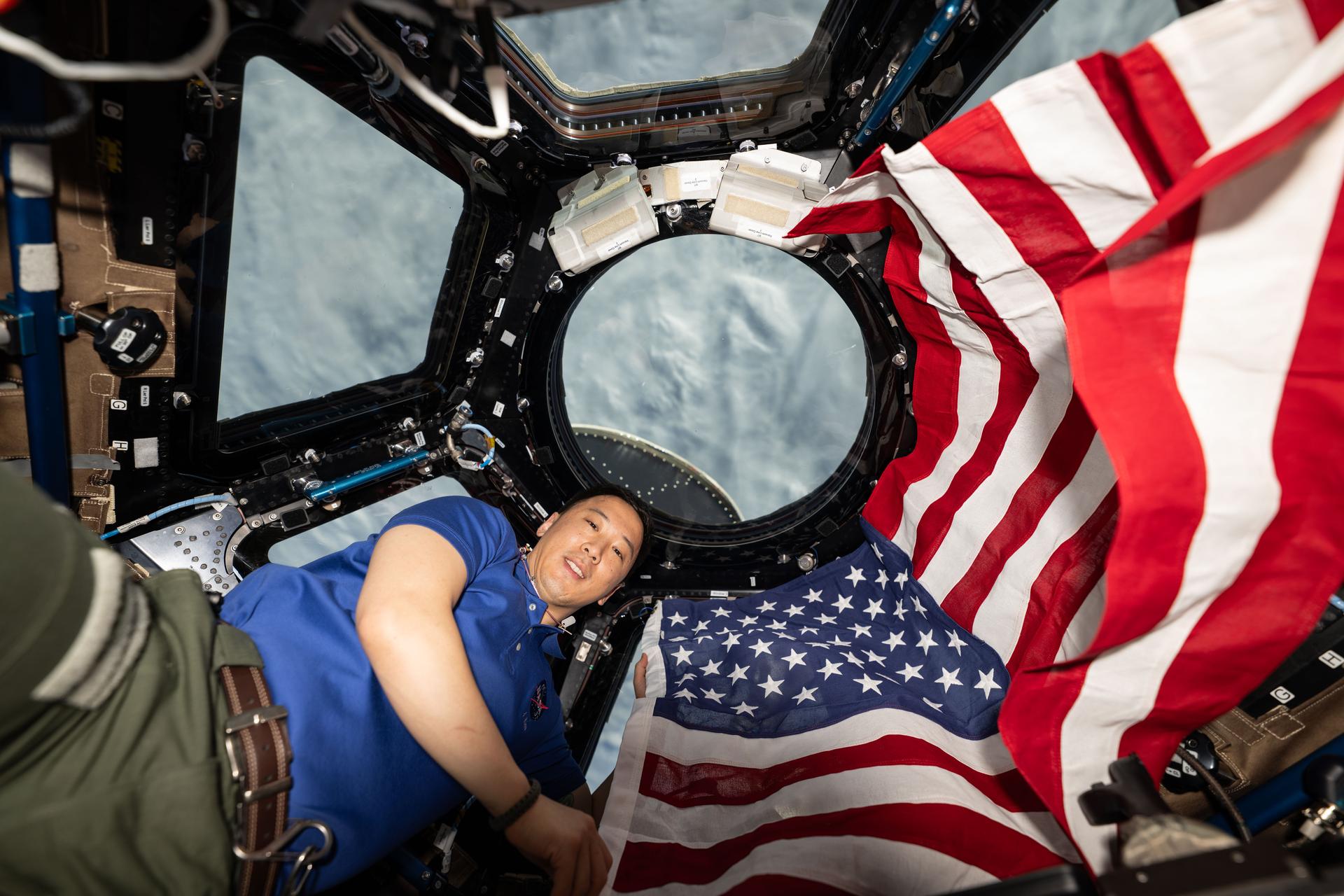
NASA Flight Engineers Jonny Kim and Anne McClain partnered together throughout Thursday servicing a pair of spacesuits in the Quest airlock. The duo took turns scrubbing cooling loops, installing components that clean suits, and checking out the suits’ radio gear. The pair wrapped up the suit maintenance at the end of the day uninstalling the cleaning gear and stowing the equipment in Quest.

Before the spacesuit work, Kim began his day collecting his blood and urine samples for processing, cold stowage, and later analysis as part of the CIPHER suite of 14 human research investigations. Next, he took a cognition test, also a part of CIPHER, measuring his mental adaptation to living in space. McClain powered up the KERMIT fluorescence microscope and installed a test sample slide so ground controllers could remotely checkout the operations of the state-of-the-art imaging device.

NASA Flight Engineer Nichole Ayers spent her shift inside the Destiny laboratory module replacing and cleaning components on the oxygen generation system. She also swapped out an advanced hydrogen sensor being tested for its ability last longer than previous sensors in the oxygen generator.

Station Commander Takuya Onishi kicked off his day swabbing his body and stowing the samples in a science freezer for later analysis. Onishi then set up a 3D imaging microscope, also known as the Extant Life Volumetric Imaging System, or ELVIS, in the Kibo laboratory module to view samples of deep-sea bacteria. The advanced imaging device could be used to monitor water quality, detect potentially infectious organisms, and study liquid mixtures and microorganisms in space and on Earth.

Three-time space station visitor Sergey Ryzhikov of Roscosmos worked on a pair of different experiments exploring physics and biology. He first synced up hardware that measures neutron radiation from sources such as solar flares and how it impacts crew members. Next, he attached sensors to his arm and hands and measured his blood pressure to understand how microgravity affects blood flow to the extremities.

Roscosmos Flight Engineer Alexey Zubritskiy wrapped up an Earth observation session stowing imaging hardware and downlinking photographs of landmarks across the Pacific Ocean. Cosmonaut Kirill Peskov spent his shift inside the Nauka science module replacing orbital plumbing gear and cleaning ventilation hardware.

Learn more about station activities by following the space station blog, @space_station and @ISS_Research on X, as well as the ISS Facebook and ISS Instagram accounts.

Get the latest from NASA delivered every week. Subscribe here.

Powered by WPeMatico
Get The Details…

Mark A. Garcia

NASA Tech Gives Treadmill Users a ‘Boost’  

NASA Tech Gives Treadmill Users a ‘Boost’  

2 min read

Preparations for Next Moonwalk Simulations Underway (and Underwater)

A man runs on a high tech treadmill, a large bubble-like structure surrounds his lower body
Boost Treadmills cofounder Sean Whalen runs on the Boost 2. The treadmill uses air pressure to counter gravity, making running possible for people with injuries and other conditions.
Credit: Boost Treadmills LLC

The antigravity treadmill, which has benefits in space and on Earth, was pioneered by Robert Whalen at NASA’s Ames Research Center in Silicon Valley, California, in the 1980s and ’90s. 

Whalen built a system that placed a pressurized bulb over the user’s upper body, creating downward pressure that could simulate gravity for astronauts running on a treadmill in space. With support from Ames, he prototyped a treadmill in his garage that reversed the concept, with the bubble enclosing the user from the waist down to create lift. He thought the system could help patients rehabilitate.  

Years later, his son recalled the prototype in the garage and turned it into the AlterG concept. The AlterG treadmill, which uses air pressure to take weight off the user, had proven popular with professional sports teams and rehabilitation clinics, but Whalen and his friends wanted to make it affordable enough for home use, so they founded Boost Treadmills in 2017.  

Now Boost, based in Palo Alto, California, has cut the price of an antigravity treadmill by almost two thirds. In 2022, the company released the Boost 2, which is quieter and more energy-efficient than its predecessor, among other improvements. The Boost 2 has roughly tripled sales to individuals, progressing on the company’s goal of moving into the home.  

Offloading weight during exercise is a clear solution for patients whose injuries prevent them from walking or running at their full weight, but Boost says it can be equally valuable for people with long-term mobility impairments, such as obesity or arthritis.  

Advanced through NASA, the antigravity treadmill is one of many space-inspired technologies benefitting life on Earth.  

Share

Details

Last Updated

May 29, 2025

Powered by WPeMatico

Get The Details…
Andrew Wagner