c-FIRST Team Sets Sights on Future Fire-observing Satellite Constellations

c-FIRST Team Sets Sights on Future Fire-observing Satellite Constellations

Two NASA-developed technologies are key components of a new high-resolution sensor for observing wildfires: High Operating Temperature Barrier Infrared Detector (HOT-BIRD), developed with support from NASA’s Earth Science Technology Office (ESTO), and a cutting-edge Digital Readout Integrated Circuit (DROIC), developed with funding from NASA’s Small Business Innovation Research (SBIR) program.

complex metal device with various protruding tubes and wires sits on a metallic work surface
NASA’s c-FIRST instrument could provide high resolution data from a compact space-based platform in under an hour, making it easier for wildfire managers to detect and monitor active burns.
Credit: NASA/JPL

A novel space-based sensor for observing wildfires could allow first responders to monitor burns at a global scale, paving the way for future small satellite (SmallSat) constellations dedicated entirely to fire management and prevention.

Developed with support from NASA’s Earth Science Technology Office (ESTO), the “Compact Fire Infrared Radiance Spectral Tracker” (c-FIRST) is a small, mid-wave infrared sensor that collects thermal radiation data across five spectral bands. Most traditional space-based sensors dedicated to observing fires have long revisit times, observing a scene just once over days or even weeks. The compact c-FIRST sensor could be employed in a SmallSat constellation that could observe a scene multiple times a day, providing first responders data with high spatial resolution in under an hour.

In addition, c-FIRST’s dynamic spectral range covers the entire temperature profile of terrestrial wild fires, making it easier for first-responders to detect everything from smoldering, low-intensity fires to flaming, high intensity fires.

“Wildfires are becoming more frequent, and not only in California. It’s a worldwide problem, and it generates tons of by-products that create very unhealthy conditions for humans,” said Sarath Gunapala, who is an Engineering Fellow at NASA’s Jet Propulsion Laboratory (JPL) and serves as Principal Investigator for c-FIRST.

The need for space-based assets dedicated to wildfire management is severe. During the Palisade and Eaton Fires earlier this year, strong winds kept critical observation aircraft from taking to the skies, making it difficult for firefighters to monitor and track massive burns.

Space-based sensors with high revisit rates and high spatial resolution would give firefighters and first responders a constant source of eye-in-the-sky data.

“Ground-based assets don’t have far-away vision. They can only see a local area. And airborne assets, they can’t fly all the time. A small constellation of CubeSats could give you that constant coverage,” said Gunapala.

c-FIRST leverages decades of sensor development at JPL to achieve its compact size and high performance. In particular, the quarter-sized High Operating Temperature Barrier Infrared Detector (HOT-BIRD), a compact infrared detector also developed at JPL with ESTO support, keeps c-FIRST small, eliminating the need for bulky cryocooler subsystems that add mass to traditional infrared sensors.

With HOT-BIRD alone, c-FIRST could gather high-resolution images and quantitative retrievals of targets between 300°K (about 80°F) to 1000°K (about 1300°F). But when paired with a state-of-the-art Digital Readout Integrated Circuit (DROIC), c-FIRST can observe targets greater than 1600°K (about 2400°F).

Developed by Copious Imaging LLC. and JPL with funding from NASA’s Small Business Innovation Research (SBIR) program, this DROIC features an in-pixel digital counter to reduce saturation, allowing c-FIRST to capture reliable infrared data across a broader spectral range.

Artifical intelligence (AI) will also play a role in c-FIRST’s success. Gunapala plans to leverage AI in an onboard smart controller that parses collected data for evidence of hot spots or active burns. This data will be prioritized for downlinking, keeping first responders one step ahead of potential wildfires.

“We wanted it to be simple, small, low cost, low power, low weight, and low volume, so that it’s ideal for a small satellite constellation,” said Gunapala.

Gunapala and his team had a unique opportunity to test c-FIRST after the Palisade and Eaton Fires in California. Flying their instrument aboard NASA’s B-200 Super King Air, the scientists identified lingering hot spots in the Palisades and Eaton Canyon area five days after the initial burn had been contained.

Now, the team is eyeing a path to low Earth orbit. Gunapala explained that their current prototype employs a standard desktop computer that isn’t suited for the rigors of space, and they’re working to incorporate a radiation-tolerant computer into their instrument design.

But this successful test over Los Angeles demonstrates c-FIRST is fit for fire detection and science applications. As wildfires become increasingly common and more destructive, Gunapala hopes that this tool will help first responders combat nascent wildfires before they become catastrophes.

“To fight these things, you need to detect them when they’re very small,” said Gunapala.

A publication about c-FIRST appeared in the journal “Society of Photo-Optical Instrumentation Engineers” (SPIE) in March, 2023.

For additional details, see the entry for this project on NASA TechPort.

To learn more about emerging technologies for Earth science, visit ESTO’s open solicitations page.

Project Lead:  Sarath Gunapala, NASA Jet Propulsion Laboratory (JPL)

Sponsoring Organization: NASA ESTO

Powered by WPeMatico

Get The Details…

Hubble Filters a Barred Spiral

Hubble Filters a Barred Spiral

2 min read

Hubble Filters a Barred Spiral

A spiral galaxy. It has several arms that appear mixed together, yet it has an overall oval shape. The center of the galaxy glows brightly. There are bright pink patches and filaments of dark red dust spread across the galaxy’s center.
This NASA/ESA Hubble Space Telescope image features the barred spiral galaxy NGC 1385.
ESA/Hubble & NASA, R. Chandar, J. Lee and the PHANGS-HST team

This NASA/ESA Hubble Space Telescope image features a luminous tangle of stars and dust called the barred spiral galaxy NGC 1385, located about 30 million light-years away. Hubble released an earlier image of NGC 1385, but the two images are notably different. This more recent image has far more pinkish-red and umber shades, whereas cool blues dominate the earlier image. This chromatic variation is not just a creative choice, but also a technical one, that represents the different number and types of filters used to collect the data that comprises the respective images.


NGC 1385, released in 2021
NGC 1385, released in 2023

This jewel-bright image from the nasa/esa hubble space telescope shows ngc 1385, a spiral galaxy 68 million light-years from earth, which lies in the constellation fornax.

A spiral galaxy. It has several arms that appear mixed together, yet it has an overall oval shape. The center of the galaxy glows brightly. There are bright pink patches and filaments of dark red dust spread across the galaxy’s center.
This NASA/ESA Hubble Space Telescope image features a luminous tangle of stars and dust called the barred spiral galaxy NGC 1385, located about 30 million light-years away. Hubble released an earlier image of NGC 1385, but the two images are notably different. This more recent image has far more pinkish-red and umber shades, whereas cool blues dominate the earlier image. This chromatic variation is not just a creative choice, but also a technical one, that represents the different number and types of filters used to collect the data that comprises the respective images.Like all telescopes used in scientific research, Hubble holds a range of filters. These highly specialized filters are pieces of physical hardware that allow a range of wavelengths (broadband filters) or very specific wavelengths (narrowband filters) of light to enter the telescope. This allows astronomers to look for specific features in the object. The data can tell us what elements are present, the temperature, and pressure of the object. The ability to probe extremely specific parts of the electromagnetic spectrum is very useful to astronomers. It helps them better understand the physical processes and environments of the objects they study.
ESA/Hubble & NASA, R. Chandar, J. Lee and the PHANGS-HST team

This jewel-bright image from the nasa/esa hubble space telescope shows ngc 1385, a spiral galaxy 68 million light-years from earth, which lies in the constellation fornax.
A spiral galaxy. It has several arms that appear mixed together, yet it has an overall oval shape. The center of the galaxy glows brightly. There are bright pink patches and filaments of dark red dust spread across the galaxy’s center.
This NASA/ESA Hubble Space Telescope image features a luminous tangle of stars and dust called the barred spiral galaxy NGC 1385, located about 30 million light-years away. Hubble released an earlier image of NGC 1385, but the two images are notably different. This more recent image has far more pinkish-red and umber shades, whereas cool blues dominate the earlier image. This chromatic variation is not just a creative choice, but also a technical one, that represents the different number and types of filters used to collect the data that comprises the respective images.Like all telescopes used in scientific research, Hubble holds a range of filters. These highly specialized filters are pieces of physical hardware that allow a range of wavelengths (broadband filters) or very specific wavelengths (narrowband filters) of light to enter the telescope. This allows astronomers to look for specific features in the object. The data can tell us what elements are present, the temperature, and pressure of the object. The ability to probe extremely specific parts of the electromagnetic spectrum is very useful to astronomers. It helps them better understand the physical processes and environments of the objects they study.
ESA/Hubble & NASA, R. Chandar, J. Lee and the PHANGS-HST team

NGC 1385, released in 2021

NGC 1385, released in 2023

Before and After

Two views of NGC 1385


These two views of NGC 1385 illustrate how Hubble’s filters allow astronomers to see specific features in this barred spiral galaxy. The earlier (left) image shows areas where hot, young, blue stars dominate. The more recent (right) image features pinkish-red, dusty areas where stars are forming.

Like all telescopes used in scientific research, Hubble holds a range of filters. These highly specialized filters are pieces of physical hardware that allow a range of wavelengths (broadband filters) or very specific wavelengths (narrowband filters) of light to enter the telescope. This allows astronomers to look for specific features in the object. The data can tell us what elements are present, the temperature, and pressure of the object. The ability to probe extremely specific parts of the electromagnetic spectrum is very useful to astronomers. It helps them better understand the physical processes and environments of the objects they study.

Text Credit: ESA/Hubble

Media Contact:

Claire Andreoli (claire.andreoli@nasa.gov)
NASA’s Goddard Space Flight CenterGreenbelt, MD

Powered by WPeMatico

Get The Details…

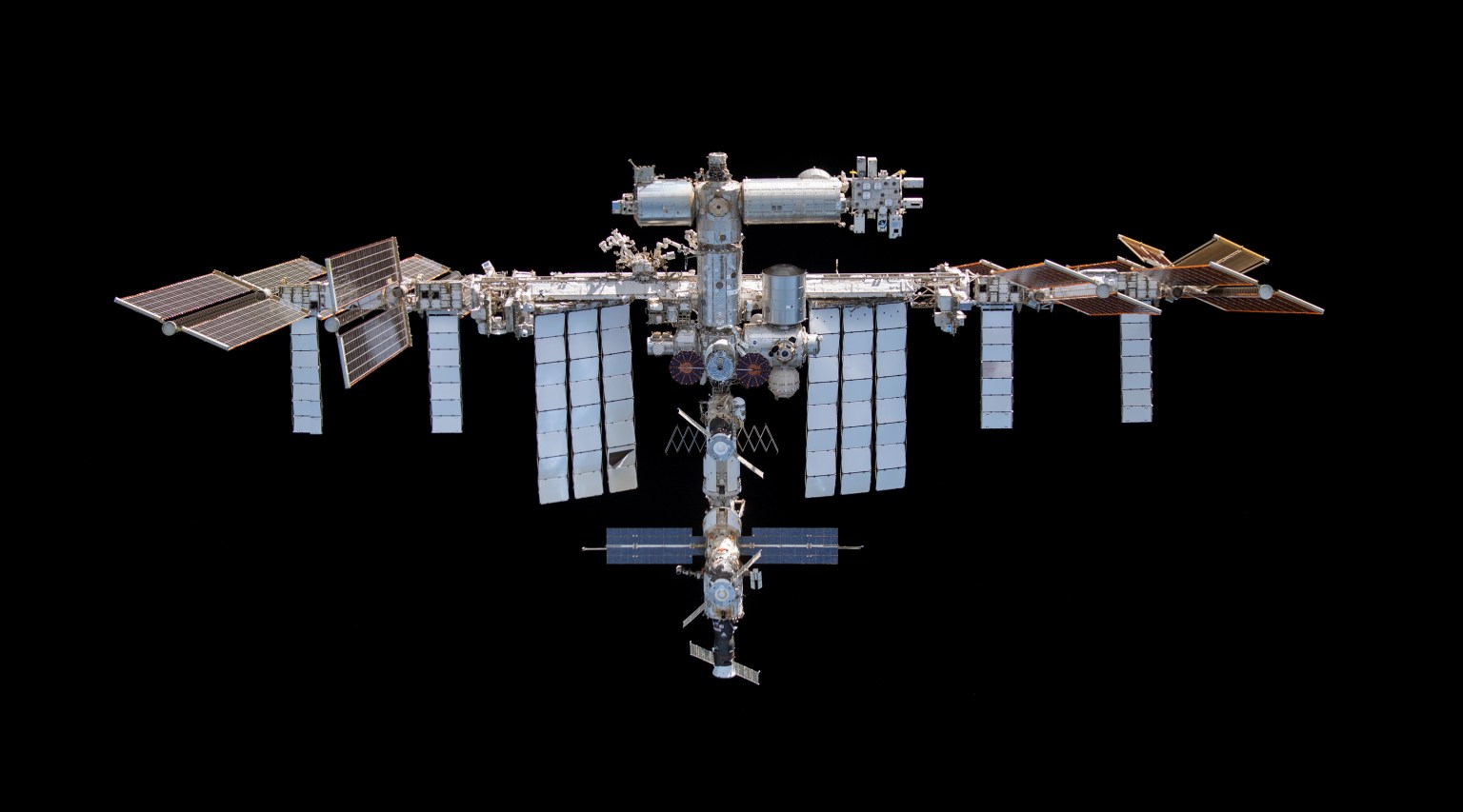
Crew Preps for Fourth Axiom Private Mission, Keeps up Human Research

Crew Preps for Fourth Axiom Private Mission, Keeps up Human Research

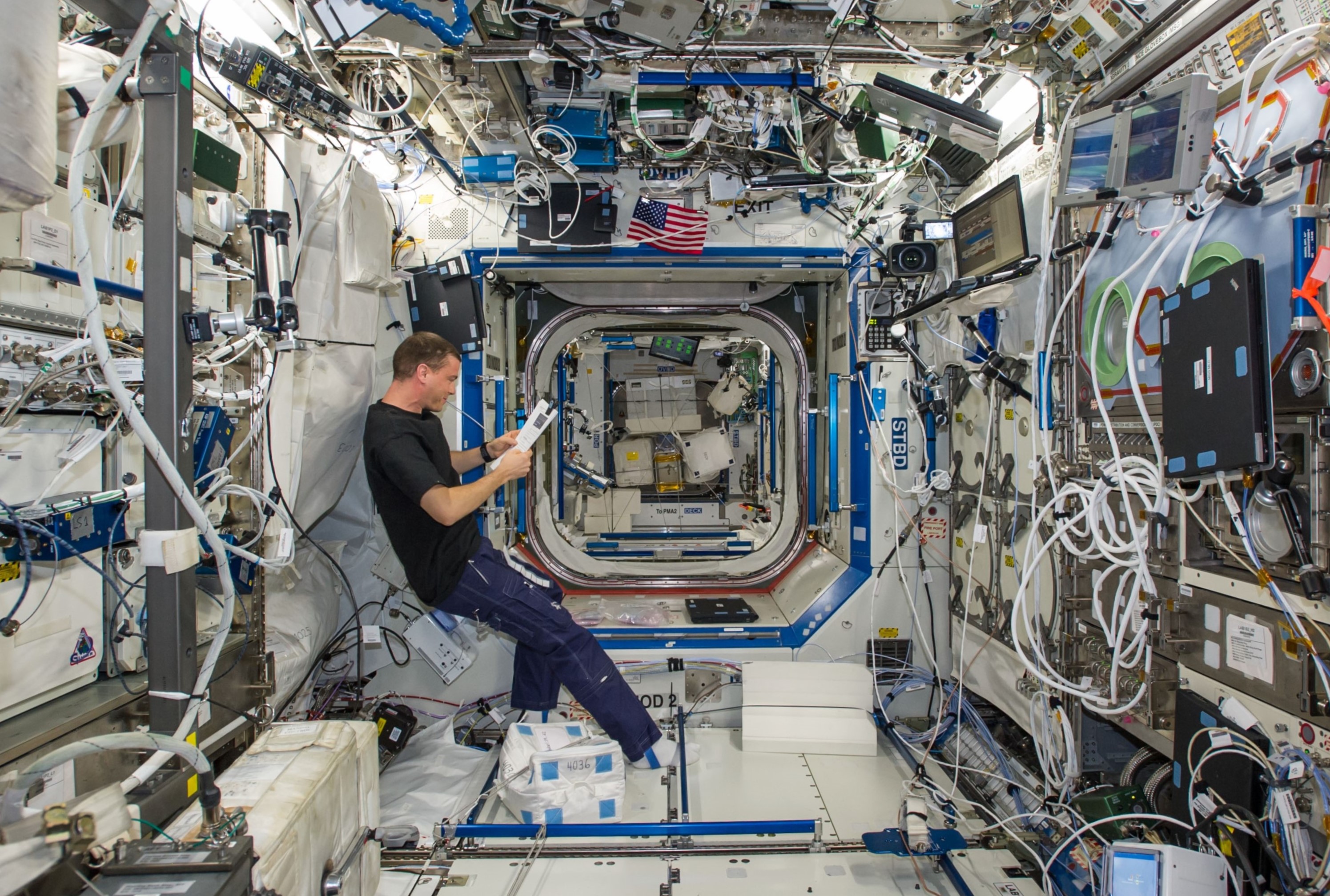
NASA astronaut and Expedition 73 Flight Engineer Jonny Kim works inside the SpaceX Dragon cargo spacecraft completing cargo operations before it undocked from the International Space Station's Harmony module several hours later.
NASA astronaut Jonny Kim works inside the SpaceX Dragon cargo spacecraft completing cargo operations before it undocked from the International Space Station’s Harmony module on May 23, 2025.
NASA

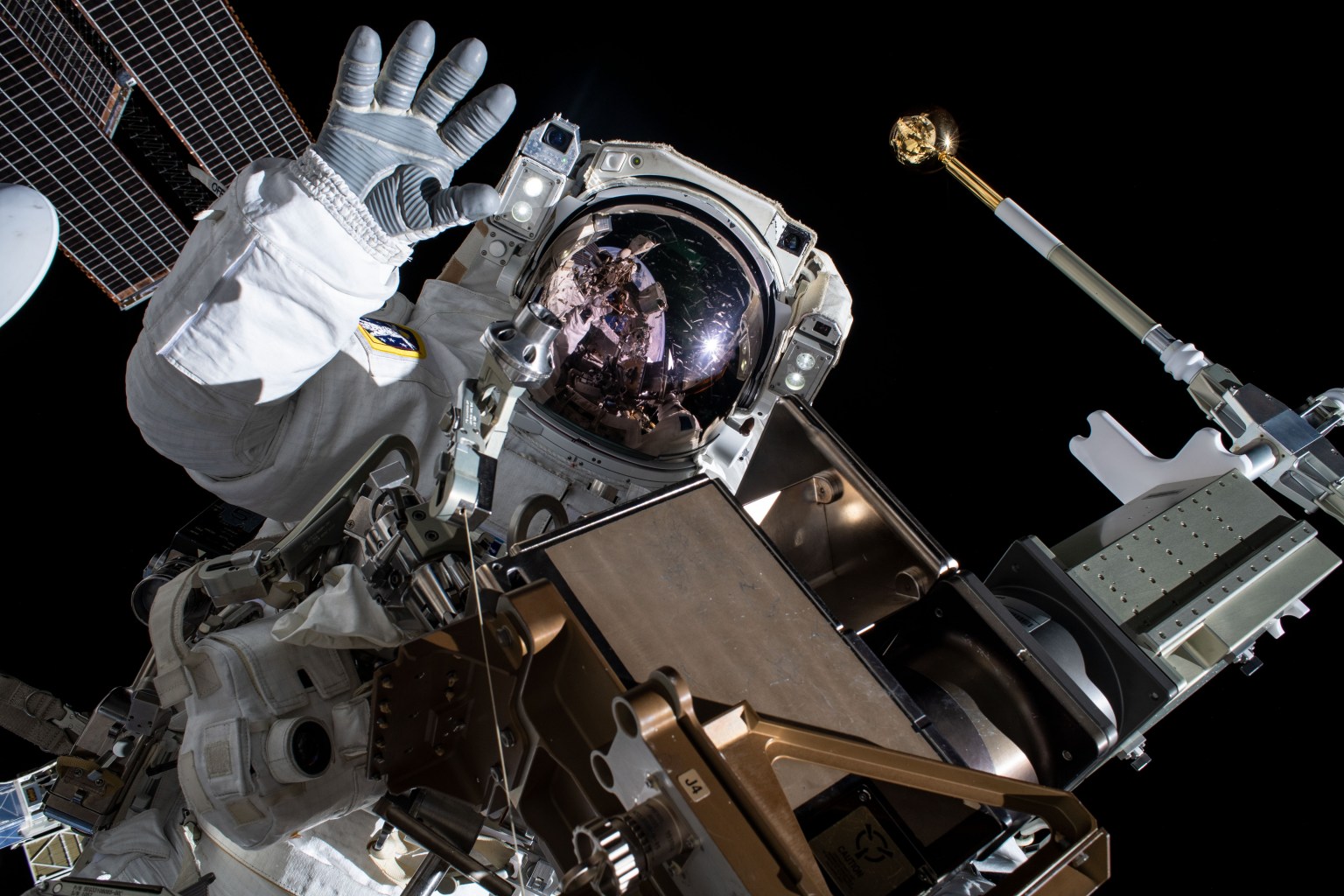
The Expedition 73 crew members are turning their attention to the upcoming fourth private mission from Axiom Space. While the International Space Station crewmates prepare for the Ax-4 quartet’s arrival aboard a SpaceX Dragon they also continued studying how their bodies are adapting to weightlessness in the midst of ongoing lab maintenance duties.

Axiom Mission-4 (Ax-4) is preparing for its launch to the orbital outpost this month carrying experienced astronaut Peggy Whitson as commander and three first-time space flyers including Pilot Shubhanshu Shukla from India and Mission Specialists Sławosz Uzanański-Wiśniewksi from Poland and Tibor Kapu from Hungary to the orbital outpost. NASA Flight Engineers Anne McClain and Nichole Ayers spent a portion of their shift on Monday reviewing procedures they will use from inside the space station when the Ax-4 crew aboard the Dragon approaches the space station to begin a two-week space research mission.

Earlier during her shift, McClain opened up the Destiny laboratory module’s Combustion Integrated Rack and replaced experiment samples and research components inside the sealed chamber that allows exploration of how fuels and flames behave in weightlessness. Ayers relocated and inspected hardware that monitors airborne particles in the station’s atmosphere then staged hardware that will soon be stowed inside BEAM, or the Bigelow Expandable Activity Module.

NASA Flight Engineer Jonny Kim began a 48-hour session wearing a biomedical vest and headband being tested for their ability to comfortably measure a crew member’s health data during daily activities. Next, he wrapped up his shift stowing bags and cleaning up packing materials following the departure of the SpaceX Dragon cargo craft on May 23.

Station Commander Takuya Onishi of JAXA (Japan Aerospace Exploration Agency) worked on standard human research duties Monday collecting his blood, saliva, and urine samples for stowage in a science freezer and later analysis. He also swapped a memory card inside radio frequency identification hardware, downloaded station acoustic data, and serviced the water storage system.

Veteran cosmonaut Sergey Ryzhikov assisted fellow Roscosmos Flight Engineer Alexey Zubritskiy who wore virtual reality glasses for an investigation of how a crew member’s sense of balance and visual tracking adjust to microgravity. Cosmonaut Kirill Peskov pointed a camera outside a window on the orbital outpost’s Roscosmos segment and photographed landmarks including the Amazon delta, the Volga River delta, the Aral Sea, and more.

Learn more about station activities by following the space station blog, @space_station and @ISS_Research on X, as well as the ISS Facebook and ISS Instagram accounts.

Get the latest from NASA delivered every week. Subscribe here.

Powered by WPeMatico

Get The Details…

Mark A. Garcia

A Star Like No Other

A Star Like No Other

This composite image shows a dramatically colorful scene. There are green, blue, and orange gas clouds at top left and a large, wispy, a supernova remnant which appears as a red oval ring at lower right. The oddly-behaving star sits inside that oval ring; a tiny purple speck (with a white circle around it) in a sea of colorful specks. In this composite image, X-rays from Chandra (blue) have been combined with infrared data from NASA’s Spitzer Space Telescope (cyan, light blue, teal and orange), and radio from LOFAR (red).
Scientists have discovered a star behaving like no other seen before, giving fresh clues about the origin of a new class of mysterious objects.
X-ray: NASA/CXC/ICRAR, Curtin Univ./Z. Wang et al.; Infrared: NASA/JPL/CalTech/IPAC; Radio: SARAO/MeerKAT; Image processing: NASA/CXC/SAO/N. Wolk

An unusual star (circled in white at right) behaving like no other seen before and its surroundings are featured in this composite image released on May 28, 2025. A team of astronomers combined data from NASA’s Chandra X-ray Observatory and the Square Kilometer Array Pathfinder (ASKAP) radio telescope on Wajarri Country in Australia to study the discovered object, known as ASKAP J1832−0911 (ASKAP J1832 for short).

ASKAP J1832 belongs to a class of objects called “long period radio transients” discovered in 2022 that vary in radio wave intensity in a regular way over tens of minutes. This is thousands of times longer than the length of the repeated variations seen in pulsars, which are rapidly spinning neutron stars that have repeated variations multiple times a second. ASKAP J1832 cycles in radio wave intensity every 44 minutes, placing it into this category of long period radio transients. Using Chandra, the team discovered that ASKAP J1832 is also regularly varying in X-rays every 44 minutes. This is the first time that such an X-ray signal has been found in a long period radio transient.

Image credit: X-ray: NASA/CXC/ICRAR, Curtin Univ./Z. Wang et al.; Infrared: NASA/JPL/CalTech/IPAC; Radio: SARAO/MeerKAT; Image processing: NASA/CXC/SAO/N. Wolk

Powered by WPeMatico

Get The Details…
Monika Luabeya

What’s Up: June 2025 Skywatching Tips from NASA

What’s Up: June 2025 Skywatching Tips from NASA

Planets, Solstice, and the Galaxy

Venus and Saturn separate, while Mars hangs out in the evening. Plus the June solstice, and dark skies reveal our home galaxy in all of its glory.

Skywatching Highlights

All Month – Planet Visibility:

  • Venus: Rises about 2 hours before the Sun in June, and shines very brightly, low in the eastern sky, in the morning all month.
  • Mars: Visible in the west for a couple of hours after sunset all month. Drops lower in the sky as June continues, and passes very close to Regulus in the constellation Leo on June 16 and 17. (They will be about half a degree apart, or the width of the full moon.) 
  • Jupiter: Visible quite low in the west after sunset for the first week of June, then lost in the Sun’s glare after. Will re-appear in July in the morning sky.
  • Mercury: Becomes visible low in the west about 30 to 45 minutes after sunset in the last week and a half of June.
  • Saturn: Rises around 3 a.m. in early June, and around 1 a.m. by the end of the month. Begins the month near Venus in the dawn sky, but rapidly pulls away, rising higher as June goes on.

Daily Highlights:

June 19 – Moon & Saturn – The third-quarter moon appears right next Saturn this morning in the hours before dawn. The pair rise in the east together around 1:30 a.m.

June 22 – Moon & Venus – Venus rises this morning next to a slender and elegant crescent moon. Look for them in the east between about 3 a.m. and sunrise.

June 20 – June Solstice – The June solstice is on June 20 for U.S. time zones (June 21 UTC). The Northern Hemisphere’s tilt toward the Sun is greatest on this day. This means the Sun travels its longest, highest arc across the sky all year for those north of the equator.

June 16 & 17 – Mars & Regulus – Mars passes quite close to the bright bluish-white star Regulus, known as the “heart” of the lion constellation, Leo. They will appear about as far apart as the width of the full moon, and should be an excellent sight in binoculars or a small telescope.

June 21-30 – Mercury becomes visible – For those with a clear view to the western horizon, Mercury becomes visible for a brief period each evening at the end of June. Look for it quite low in the sky starting 30 to 45 minutes after the Sun sets.

All month – Mars: The Red Planet can be observed for a couple of hours after dark all month. It is noticeably dimmer than it appeared in early May, as Earth speeds away in its orbit, putting greater distance between the two worlds.

All month – Milky Way core: The bright central bulge of our home galaxy, the Milky Way, is visible all night in June, continuing through August. It is best observed from dark sky locations far from bright city lights, and appears as a faint, cloud-like band arching across the sky toward the south.

Transcript

What’s Up for June? Mars grazes the lion’s heart, a connection to ancient times, and the galaxy in all its glory.

June Planet Observing

Starting with planet observing for this month, find Saturn and Venus in the eastern sky during the couple of hours before dawn each morning throughout the month. Saturn rapidly climbs higher in the sky each day as the month goes on. You’ll find the third quarter moon next to Saturn on the 19th, and a crescent moon next to Venus on the 22nd. 

An illustrated sky chart shows a view of the western sky 45 minutes after sunset. The scene features a dark twilight background with faint stars and labeled compass directions:
Sky chart showing Mercury with the crescent Moon following sunset in late June, 2025.
NASA/JPL-Caltech

Mercury pops up toward the end of the month. Look for it quite low in the west, just as the glow of sunset is fading. It’s highest and most visible on the 27th.

Mars is still visible in the couple of hours after sunset toward the west, though it’s noticeably fainter than it was in early May. Over several days in mid-June, Mars passes quite close to Regulus, the bright star at the heart of the constellation Leo, the lion. Have a peek on the 16th and 17th with binoculars or a small telescope to see them as close as the width of the full moon.

An illustrated sky chart shows a view of the western evening sky after dark. The scene features a nighttime background with faint stars. Near center is the constellation Leo, with its stars connected by thin lines. Mars and bright star Regulus appear very close together in the bottom corner of Leo.
Sky chart showing Mars close to Regulus in the evening sky on June 16, 2025.
NASA/JPL-Caltech

Milky Way Core Season

June means that Milky Way “Core Season” is here. This is the time of year when the Milky Way is visible as a faint band of hazy light arching across the sky all night. You just need to be under dark skies away from bright city lights to see it. What you’re looking at is the bright central core of our home galaxy, seen edge-on, from our position within the galaxy’s disk. 

Long-exposure photos make the Milky Way’s bright stars and dark dust clouds even clearer. And while our eyes see it in visible light, NASA telescopes observe the galaxy across the spectrum — peering through dust to help us better understand our origins.

However you observe it, getting out under the Milky Way in June is a truly remarkable way to connect with the cosmos.

June Solstice

June brings the summer solstice for those north of the equator, which is the winter solstice for those south of the equator. In the Northern Hemisphere, this is when the Sun is above the horizon longer than any other day, making it the longest day of the year. The situation is reversed for the Southern Hemisphere, where it’s the shortest day of the year. 

Illustration from a NASA animation showing the tilt of Earth’s axis in June (Northern Hemisphere summer) with respect to the Sun, the planet’s orbit, and the North Star, Polaris.
NASA’s Goddard Space Flight Center

Earth’s tilted rotation is the culprit. The tilt is always in the same direction, with the North Pole always pointing toward Polaris, the North Star. And since that tilt stays the same, year round, when we’re on one side of the Sun in winter, the north part of the planet is tilted away from the Sun. But six months later, the planet moves halfway around its annual path, carrying us to the opposite side of Earth’s orbit, and the northern part of the planet now finds itself tilted toward the Sun. The June solstice is when this tilt is at its maximum. This is summertime for the north, bringing long days, lots more sunlight, and warmer temperatures.

The June solstice marks a precise moment in Earth’s orbit – a consistent astronomical signpost that humans have observed for millennia. Ancient structures from Stonehenge to Chichén Itzá were built, in part, to align with the solstices, demonstrating how important these celestial events were to many cultures. 

So whether you’re experiencing long summer days in the northern hemisphere or the brief daylight hours of winter in the south, find a quiet spot to watch the sunset on this special day and you’ll be participating in one of humanity’s oldest astronomical traditions, connecting you to observers across thousands of years of human history.

Here are the phases of the Moon for June.

The main phases of the Moon are illustrated in a horizontal row, with the first quarter moon on June 3, full moon on June 11, third quarter on June 17, and the new moon on June 25, 2025.
The phases of the Moon for June 2025.

You can stay up to date on all of NASA’s missions exploring the solar system and beyond at NASA Science. I’m Preston Dyches from NASA’s Jet Propulsion Laboratory, and that’s What’s Up for this month.

Keep Exploring

Discover More Topics From NASA

Powered by WPeMatico

Get The Details…