Apocalypse When? Hubble Casts Doubt on Certainty of Galactic Collision

Apocalypse When? Hubble Casts Doubt on Certainty of Galactic Collision

5 Min Read

Apocalypse When? Hubble Casts Doubt on Certainty of Galactic Collision

Hubble Interacting Galaxy NGC 520
This NASA Hubble Space Telescope image of NGC 520 offers one example of possible encounter scenarios between our Milky Way and the Andromeda galaxy. NGC 520 is the product of a collision between two disk galaxies that started 300 million years ago.
Credits:
NASA, ESA, the Hubble Heritage (STScI/AURA)-ESA/Hubble Collaboration, and B. Whitmore (STScI)

As far back as 1912, astronomers realized that the Andromeda galaxy — then thought to be only a nebula — was headed our way. A century later, astronomers using NASA’s Hubble Space Telescope were able to measure the sideways motion of Andromeda and found it was so negligible that an eventual head-on collision with the Milky Way seemed almost certain.

A smashup between our own galaxy and Andromeda would trigger a firestorm of star birth, supernovae, and maybe toss our Sun into a different orbit. Simulations had suggested it was as inevitable as, in the words of Benjamin Franklin, “death and taxes.”

But now a new study using data from Hubble and the European Space Agency’s (ESA) Gaia space telescope says “not so fast.” Researchers combining observations from the two space observatories re-examined the long-held prediction of a Milky Way – Andromeda collision, and found it is far less inevitable than astronomers had previously suspected. 

“We have the most comprehensive study of this problem today that actually folds in all the observational uncertainties,” said Till Sawala, astronomer at the University of Helsinki in Finland and lead author of the study, which appears today in the journal Nature Astronomy.

His team includes researchers at Durham University, United Kingdom; the University of Toulouse, France; and the University of Western Australia. They found that there is approximately a 50-50 chance of the two galaxies colliding within the next 10 billion years. They based this conclusion on computer simulations using the latest observational data.

A three-panel image, two at the top and one stretched across the bottom. At the top of the image is the title u201cThree Future Scenarios for Milky Way and Andromeda Encounter.u201d This title is extended over all three panels. In the top left panel, two spiral galaxies are widely separated against the black background of space. Beneath these galaxies are the words u201cGalaxies bypass at 1 million light-year separation.u201d In the top right panel, two face-on spiral galaxies are close together. Their spiral arms appear stretched toward each other. At the bottom of this panel are the words u201cAt 500,000 light-years, dark matter provides friction that brings galaxies to a close encounter.u201d In the bottom panel, two spiral galaxies have collided, resulting in a broad X-shaped patch of milky white. Mottled clouds of dark brown dust are superimposed. At the bottom of this panel are the words u201cA 100,000 light-year separation leads to a collision.u201d
These galaxy images illustrate three possible encounter scenarios between our Milky Way and the neighboring Andromeda galaxy. Top left: Galaxies M81 and M82. Top right: NGC 6786, a pair of interacting galaxies. Bottom: NGC 520, two merging galaxies.
Science: NASA, ESA, STScI, DSS, Till Sawala (University of Helsinki); Image Processing: Joseph DePasquale (STScI)

Sawala emphasized that predicting the long-term future of galaxy interactions is highly uncertain, but the new findings challenge the previous consensus and suggest the fate of the Milky Way remains an open question.

“Even using the latest and most precise observational data available, the future of the Local Group of several dozen galaxies is uncertain. Intriguingly, we find an almost equal probability for the widely publicized merger scenario, or, conversely, an alternative one where the Milky Way and Andromeda survive unscathed,” said Sawala.

The collision of the two galaxies had seemed much more likely in 2012, when astronomers Roeland van der Marel and Tony Sohn of the Space Telescope Science Institute in Baltimore, Maryland published a detailed analysis of Hubble observations over a five-to-seven-year period, indicating a direct impact in no more than 5 billion years. 

“It’s somewhat ironic that, despite the addition of more precise Hubble data taken in recent years, we are now less certain about the outcome of a potential collision. That’s because of the more complex analysis and because we consider a more complete system. But the only way to get to a new prediction about the eventual fate of the Milky Way will be with even better data,” said Sawala.

100,000 Crash-Dummy Simulations

Astronomers considered 22 different variables that could affect the potential collision between our galaxy and our neighbor, and ran 100,000 simulations called Monte Carlo simulations stretching to 10 billion years into the future. 

“Because there are so many variables that each have their errors, that accumulates to rather large uncertainty about the outcome, leading to the conclusion that the chance of a direct collision is only 50% within the next 10 billion years,” said Sawala.

“The Milky Way and Andromeda alone would remain in the same plane as they orbit each other, but this doesn’t mean they need to crash. They could still go past each other,” said Sawala. 

Researchers also considered the effects of the orbits of Andromeda’s large satellite galaxy, M33, and a satellite galaxy of the Milky Way called the Large Magellanic Cloud (LMC).  

“The extra mass of Andromeda’s satellite galaxy M33 pulls the Milky Way a little bit more towards it. However, we also show that the LMC pulls the Milky Way off the orbital plane and away from Andromeda. It doesn’t mean that the LMC will save us from that merger, but it makes it a bit less likely,” said Sawala. 

In about half of the simulations, the two main galaxies fly past each other separated by around half a million light-years or less (five times the Milky Way’s diameter). They move outward but then come back and eventually merge in the far future. The gradual decay of the orbit is caused by a process called dynamical friction between the vast dark-matter halos that surround each galaxy at the beginning.

In most of the other cases, the galaxies don’t even come close enough for dynamical friction to work effectively. In this case, the two galaxies can continue their orbital waltz for a very long time.

The new result also still leaves a small chance of around 2% for a head-on collision between the galaxies in only 4 to 5 billion years. Considering that the warming Sun makes Earth uninhabitable in roughly 1 billion years, and the Sun itself will likely burn out in 5 billion years, a collision with Andromeda is the least of our cosmic worries. 

The Hubble Space Telescope has been operating for over three decades and continues to make ground-breaking discoveries that shape our fundamental understanding of the universe. Hubble is a project of international cooperation between NASA and ESA (European Space Agency). NASA’s Goddard Space Flight Center in Greenbelt, Maryland, manages the telescope and mission operations. Lockheed Martin Space, based in Denver, also supports mission operations at Goddard. The Space Telescope Science Institute in Baltimore, which is operated by the Association of Universities for Research in Astronomy, conducts Hubble science operations for NASA.

Explore More

Share

Details

Last Updated
Jun 02, 2025
Editor
Andrea Gianopoulos
Contact
Media

Claire Andreoli
NASA’s Goddard Space Flight Center
Greenbelt, Maryland
claire.andreoli@nasa.gov

Ray Villard
Space Telescope Science Institute
Baltimore, Maryland

Powered by WPeMatico

Get The Details…

Week Ends with Vein Scans, Brain Research, and 3D Microscope Test

Week Ends with Vein Scans, Brain Research, and 3D Microscope Test

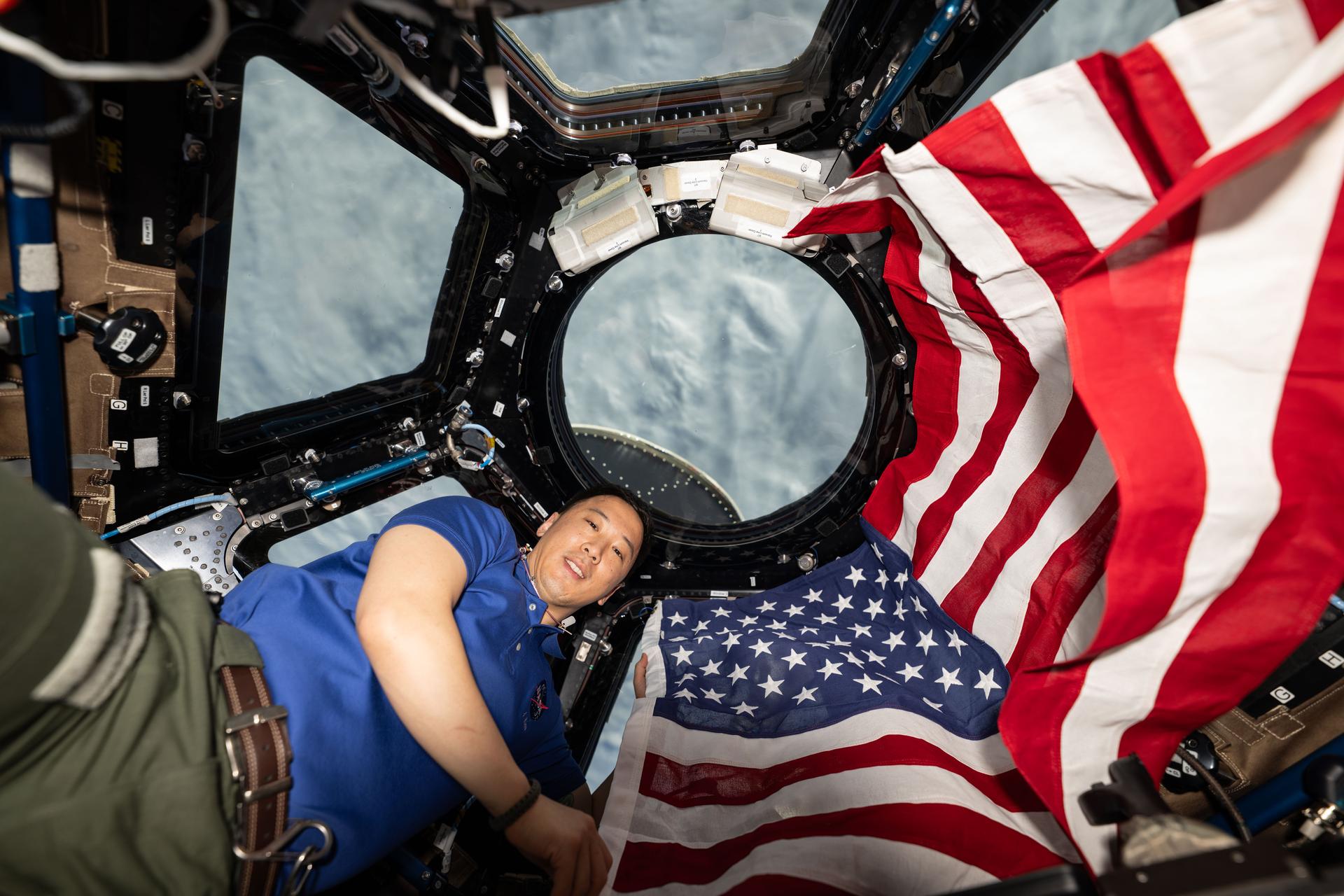
The International Space Station was soaring 259 miles above central Mexico with a faint atmospheric glow crowning Earth's horizon at approximately 2:58 a.m. local time when this photograph was taken. The city lights of Mexico City, the nation's capital and largest city with a population of 9.21 million, and its surrounding suburbs dominate the nightscape.
The International Space Station soars above central Mexico with a faint atmospheric glow crowning Earth’s horizon. The city lights of Mexico City, the nation’s capital and largest city with a population of 9.21 million, and its surrounding suburbs dominate the nightscape.
NASA

Vein scans and hearing checks were the main human research activities aboard the International Space Station on Friday ensuring the Expedition 73 crew remains healthy. The orbital residents also tested a 3D microscope and kept up the maintenance of the orbital outpost at the end of the week.

NASA Flight Engineer Jonny Kim activated the Ultrasound 2 device inside the Columbus laboratory module and scanned the neck, shoulder, and leg veins of Roscosmos cosmonauts Sergey Ryzhikov and Alexey Zubritskiy. Afterward, station Commander Takuya Onishi of JAXA (Japan Aerospace Exploration Agency) took control of the biomedical activities and scanned the veins of Kim. Doctors on the ground monitored the downlinked ultrasound imagery in real time gaining insight into the condition of the crew’s cardiovascular system in microgravity.

Kim also took turns with Ryzhikov and Zubritskiy and participated in a computerized hearing exam with remote support from doctors on the ground. Space station systems run continuously at different volumes and researchers are studying how the orbiting lab’s acoustic environment affects a crew member’s hearing.

NASA Flight Engineer Nichole Ayers worked on a pair of different studies on Friday, first looking at how blood flows from the brain to the heart then demonstrating the operation of an advanced biology microscope. Ayers began the day attaching sensors to her neck and chest measuring the volume of blood flowing back and forth. Scientists are using the data to test a tool that can check an astronaut’s cardiovascular health in different gravity environments. Next, Ayers treated samples of deep-sea bacteria that will be viewed inside a holographic, fluorescence imaging microscope. Known as the Extant Life Volumetric Imaging System, or ELVIS, the specialized 3D imaging device could be used to monitor water quality, detect potentially infectious organisms, and study liquid mixtures and microorganisms in space and on Earth.

NASA Flight Engineer Anne McClain spent her day on lab maintenance. She began her shift monitoring the airflow between the modules of the station’s U.S. segment ensuring the operability of the ventilation system. Next, she verified the functionality of computer tablets that will be used once the private crew of Axiom Mission-4 arrives at the station in June. At the end of her shift, McClain downloaded data collected from wearable radiation detectors, documented her meals for the day, and swapped drying agents inside a science freezer.

Before his vein scans, Ryzhikov, a three-time station resident, tested communication systems in the Zvezda service module then charged Soyuz spacecraft phone batteries. Zubritskiy inspected the Zarya module’s power supply system with an infrared camera as part of troubleshooting procedures. Roscosmos Flight Engineer Kirill Peskov turned off ultraviolet atmospheric observation gear after an overnight imaging session then inventoried medical hardware in the station’s Roscosmos segment.

Learn more about station activities by following the space station blog, @space_station and @ISS_Research on X, as well as the ISS Facebook and ISS Instagram accounts.

Get the latest from NASA delivered every week. Subscribe here.

Powered by WPeMatico

Get The Details…

Mark A. Garcia

Sols 4554–4555: Let’s Try That One Again…

Sols 4554–4555: Let’s Try That One Again…

2 min read

Sols 4554–4555: Let’s Try That One Again…

A grayscale wide-angle view of the Martian surface (creating an exaggerated, curved horizon) shows very rough terrain in front of the Curiosity rover. Light gray, gravel-covered rocks extend to the horizon, separated by gouges in some areas. Reaching down from the top of the frame is Curiosity’s robotic arm, with the turret at its end holding science instruments reaching toward the ground. The rover’s shadow, including its body and robotic arm, darkens the bottom third of the image.
NASA’s Mars rover Curiosity acquired this image using its Front Hazard Avoidance Camera (Front Hazcam) on May 28, 2025 — Sol 4553, or Martian day 4,553 of the Mars Science Laboratory mission — at 04:48:55 UTC.
NASA/JPL-Caltech

Written by Abigail Fraeman, Planetary Geologist at NASA’s Jet Propulsion Laboratory

Earth planning date: Wednesday, May 28, 2025

We came in early this morning and learned that part of Tuesday’s plan didn’t execute on Mars due to a temporary issue with the arm. We collected APXS data on the target “Palo Verde Mountains,” but were not able to take the corresponding MAHLI images or drive away. So it was a straightforward decision for the planning team today to pick up where we left off yesterday, giving ourselves a second chance to collect the MAHLI observation and then complete the same 29.5-meter drive to the west (about 97 feet) that we had planned on Tuesday.

 We love making lemonade from lemons when things don’t go exactly as expected in rover tactical planning, and today was no exception. Since we’re sticking around for a little bit longer, the science team decided to collect additional mosaics of impressive nearby features, including a 15×2 Mastcam mosaic of the “Mishe Mokwa” hill and an 11×2 Mastcam mosaic of fractures near “Lake Cachuma.” We’re also having another go at taking the epically long, long-distance RMI mosaic of a crater 91 kilometers away from Curiosity (almost 57 miles) that we planned yesterday, and we’re playing around with the focus settings to see if we can get a sharper image. 

The team also had time for a second RMI mosaic of our very well-imaged “Texoli” butte, and a ChemCam LIBS observation on a target named “Santa Monica Bay,” which is just above the “Sisquoc River” target we observed yesterday on the bumpy rock in our workspace. As usual, we will also continue to monitor the environment around us with REMS, RAD, Navcam, and Mastcam observations.

Share

Details

Last Updated
May 30, 2025

Related Terms

Powered by WPeMatico

Get The Details…

NASA’s SpaceX Demo-2 Launch Fifth Anniversary

NASA’s SpaceX Demo-2 Launch Fifth Anniversary

President Donald Trump walks onstage. Behind him is a white SpaceX Dragon crew spacecraft. It has a large rectangular window with two round windows on either side. The SpaceX, Dragon, and NASA logos can be seen on the spacecraft. In the background, the bottom of the United States flag (red and white stripes) are just visible at top, while the majority of the backdrop has small white lights, and another NASA "meatball" logo.
NASA/Bill Ingalls

President Donald Trump walks onstage to speak to a crowd at NASA’s Kennedy Space Center in Florida, following the launch of NASA’s SpaceX Demo-2 mission on May 30, 2020. The mission was the first crewed launch of the SpaceX Crew Dragon spacecraft and Falcon 9 rocket to the International Space Station as part of the agency’s Commercial Crew Program. This marked the first time American astronauts launched on an American rocket from American soil to low-Earth orbit since the conclusion of the Space Shuttle Program in 2011.

Image credit: NASA/Bill Ingalls

Powered by WPeMatico

Get The Details…
Monika Luabeya

Hubble Spies Paired Pinwheel on Its Own

Hubble Spies Paired Pinwheel on Its Own

2 min read

Hubble Spies Paired Pinwheel on Its Own

A spiral galaxy seen face-on. Across its center, a broad bar of blazing stars shines. A glowing spiral arm extends from each end of this bar, both making almost a full turn through the galaxy’s disk before fading out. The arms contain sparkling blue stars, pink spots of star formation, and dark threads of dust that follow both spiral arms into and across the central bar. A foreground star sits atop the galaxy.
This NASA Hubble Space Telescope image features the beautiful barred spiral galaxy NGC 3507
ESA/Hubble & NASA, D. Thilker

A single member of a galaxy pair takes centerstage in this NASA/ESA Hubble Space Telescope image. This beautiful spiral galaxy is NGC 3507, which is situated about 46 million light-years away in the constellation Leo (the Lion). NGC 3507’s classification is a barred spiral because the galaxy’s sweeping spiral arms emerge from the ends of a central bar of stars rather than the central core of the galaxy.

Though pictured solo here, NGC 3507 actually travels the universe with a galactic partner named NGC 3501 that is located outside the frame. While NGC 3507 is a quintessential galactic pinwheel, its partner resembles a streak of quicksilver across the sky. Despite looking completely different, both are spiral galaxies, simply seen from different angles.

For galaxies that are just a few tens of millions of light-years away, like NGC 3507 and NGC 3501, features like spiral arms, dusty gas clouds, and brilliant star clusters are on full display. More distant galaxies appear less detailed. See if you can spot any faraway galaxies in this image: they tend to be orange or yellow and can be anywhere from circular and starlike to narrow and elongated, with hints of spiral arms. Astronomers use instruments called spectrometers to split the light from these distant galaxies to study the nature of these objects in the early universe.

In addition to these far-flung companions, a much nearer object joins NGC 3507. The object is marked by four spikes of light: a star within the Milky Way, a mere 436 light-years away from Earth.

Text Credit: ESA/Hubble

Media Contact:

Claire Andreoli (claire.andreoli@nasa.gov)
NASA’s Goddard Space Flight CenterGreenbelt, MD

Powered by WPeMatico

Get The Details…