Crew Packs Dragon for Thursday Departure, Keeps Up Human Research

Crew Packs Dragon for Thursday Departure, Keeps Up Human Research
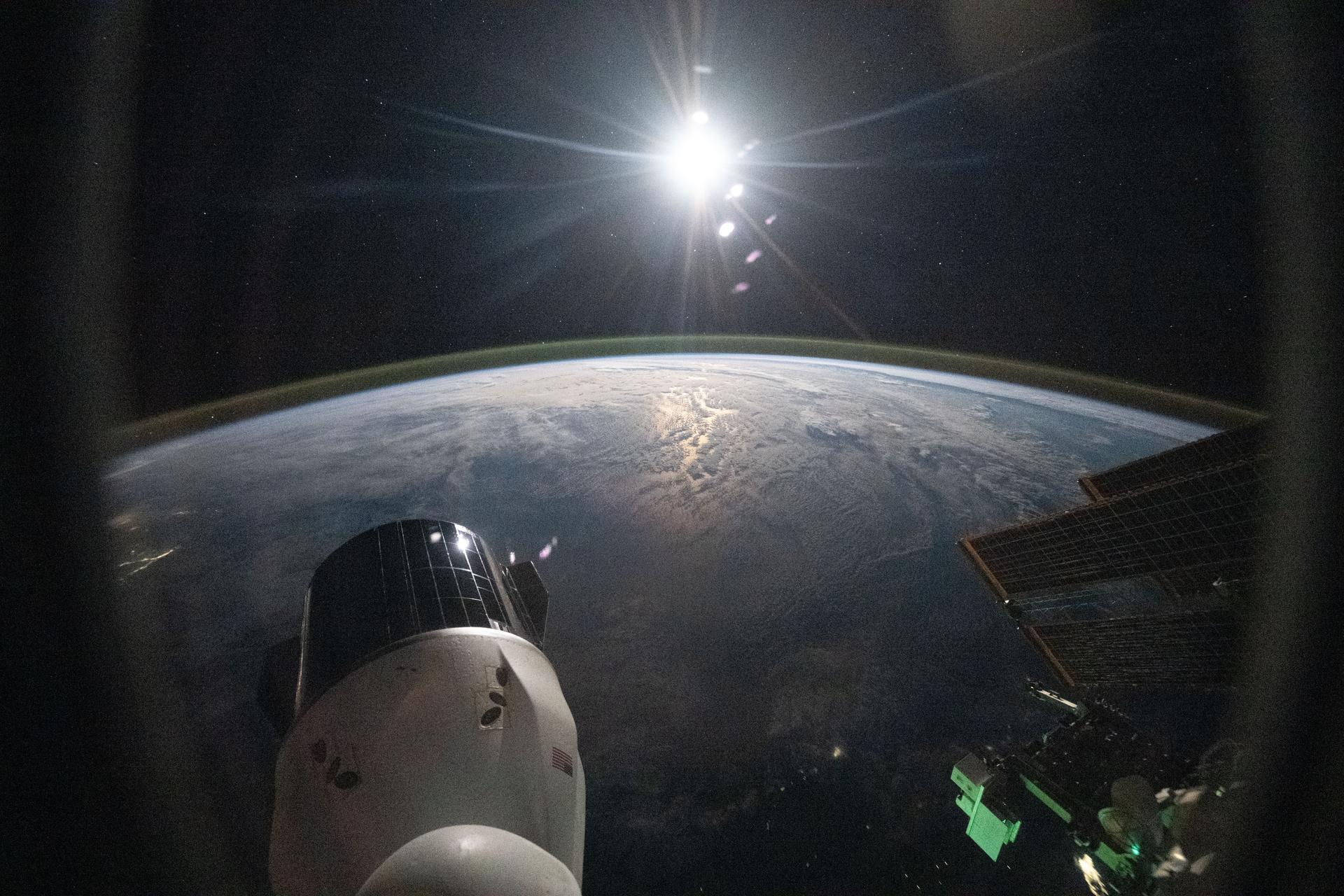
The sun begins setting above Earth's atmospheric glow blanketing a cloudy Atlantic Ocean. The International Space Station was orbiting 260 miles above the Earth off the coast of Florida when this photograph was taken. In the foreground, are a SpaceX Dragon spacecraft (lower left) and a set of the orbital outpost's solar arrays (right).
The sun begins setting above Earth’s atmospheric glow blanketing a cloudy Atlantic Ocean. In the foreground, are a SpaceX Dragon spacecraft (lower left) and a set of the orbital outpost’s solar arrays (right).
JAXA/Kimiya Yui

The Expedition 74 crew will finalize the packing of a SpaceX Dragon spacecraft as it nears its departure later this week. Science operations were still underway aboard the International Space Station on Tuesday as the orbital residents explored how living and working in weightlessness is affecting their bodies.

NASA and SpaceX have scheduled Dragon to undock from the Harmony module’s forward port at 12:05 p.m. EST on Thursday. Live streaming coverage begins at 11:45 a.m. on NASA+, Amazon Prime, and the agency’s YouTube channel. Learn how to watch NASA content on a variety of online platforms, including social media.

Dragon will be returning numerous science experiments completed aboard the orbital outpost for retrieval and analysis on Earth. Packed inside the spacecraft will be samples of materials exposed to the harsh environment of space, flat liquid crystal films, stem cells programmed to become cardiac and brain cells, and more. Results from the investigations may lead to advanced Earth and space technologies and improved human health. Dragon’s parachute-assisted splashdown off the coast of California a half-a-day later will not be broadcast.

NASA Flight Engineers Chris Williams and Jessica Meir transferred portable science freezers containing numerous research samples, including stem cells and microbes, into Dragon on Tuesday. The duo also partnered with Flight Engineer Sophie Adenot of ESA (European Space Agency) continuing to load and secure station hardware inside Dragon for the ride back to Earth. Adenot also collected her saliva samples for immunological analysis then continued familiarizing herself with living and working aboard the space station.

NASA Flight Engineer Jack Hathaway began his shift inside the Kibo laboratory module servicing the small satellite orbital deployer that is regularly placed outside the orbital outpost to eject CubeSats into Earth orbit for public, private, and educational research. Hathaway then joined Meir at the end of their shift and continued studying station systems and procedures such as using exercise gear, handling safety equipment, and performing medical procedures.

Station Commander Sergey Kud-Sverchkov and Flight Engineer Sergei Mikaev, both Roscosmos cosmonauts, worked together on a pair of human research experiments on Tuesday. Kud-Sverchkov and Sergei Mikaev took turns wearing chest electrodes and arm, wrist, and thumb cuffs measuring their cardiac activity and blood pressure. Doctors are assessing microgravity’s effect on blood flow regulation, clot prevention, and inflammation responses. The duo also wore virtual reality goggles and responded to visual and audio signals to test a crew member’s sense of balance and orientation in space.

Roscosmos Flight Engineer Andrey Fedyaev kicked off his shift wearing an acoustic sensor attached to his neck that recorded his rapid exhalation to understand how microgravity affects his breathing. Next, Fedyaev set up a space physics experiment and used molecular beams to explore semiconductor growth in microgravity. Results may lead to advanced electronics systems and scientific instruments for spacecraft and satellites. At the end of his shift, Fedyaev installed Earth observation gear for an automated overnight photography session to capture ground targets in a variety of wavelengths.

Learn more about station activities by following the space station blog, @space_station on X, as well as the ISS Facebook and ISS Instagram accounts.

Get the latest from NASA delivered every week. Subscribe here.

Powered by WPeMatico

Get The Details…

Mark A. Garcia

Curiosity Blog, Sols 4812-4819: Back Into the Hollows

Curiosity Blog, Sols 4812-4819: Back Into the Hollows

2 min read

Curiosity Blog, Sols 4812-4819: Back Into the Hollows

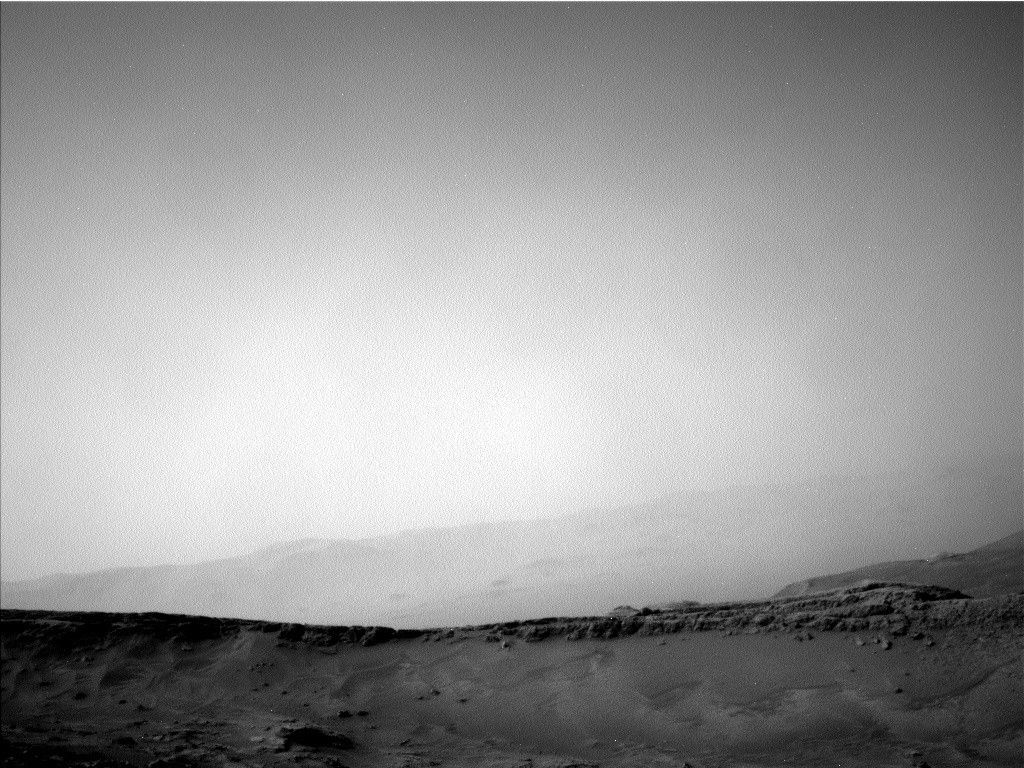
A grayscale landscape photo from the Martian surface shows a dark gray band of sandy terrain in the foreground, filling the bottom quarter of the frame, topped by a jagged, rocky ridge along its right half. Beyond that is a more distant area in very light gray, creating a horizon line from the lower third of the left side of the image, upward toward the center-right edge. This area and the sky above is very hazy, as if clouded by a dust storm.
NASA’s Mars rover Curiosity acquired this Navcam image looking out towards the northern rim of Gale Crater. Compared to just a few months ago, the view is much hazier, reflecting the higher amount of atmospheric dust that is typical of this time of year. Curiosity captured the image using its Left Navigation Camera on Feb.19 — Sol 4813, or Martian day 4,813 of the Mars Science Laboratory mission — at 12:15:50 UTC.
NASA/JPL-Caltech

Written by Diana Hayes, Graduate student at York University, Toronto

Earth planning date: Friday, Feb. 20, 2026

This has been a pretty routine week for Curiosity. As was mentioned last week, we’re now in the final phase of the boxwork exploration campaign. We’re currently making our way toward the eastern contact of the boxwork formation with the surrounding geology, which we plan to drive along before turning our attention to the southern contact. That will likely be our last opportunity to directly interrogate the boxwork area before we continue our adventure up the slopes of Mount Sharp.

Along the way, we’ve been performing our usual investigations of the geology that we encounter at our parking locations. As always, this includes contact science on bedrock targets close to the rover, ChemCam LIBS observations of targets slightly further afield, and a number of ChemCam RMI and Mastcam mosaics. These mosaics include observations deeper into the “Tapiche” hollow where we’re parked and the “Los Flamencos” ridge to its south, which we plan on investigating closer in the coming week.

Mars continues to move deeper into its dusty season, so the environmental science group filled this week’s plan with a typical assortment of atmospheric monitoring activities to track dust devils and the amount of dust in the atmosphere, as well as several Navcam cloud movies. So far this dusty season the atmosphere over Gale Crater appears to be behaving much like it does most years, with no signs of imminent dust storms. It’s now been almost eight years (four Mars years) since the last time that a global dust storm swept across the planet, so we’re keeping a close eye on the possibility of another one occurring this year.

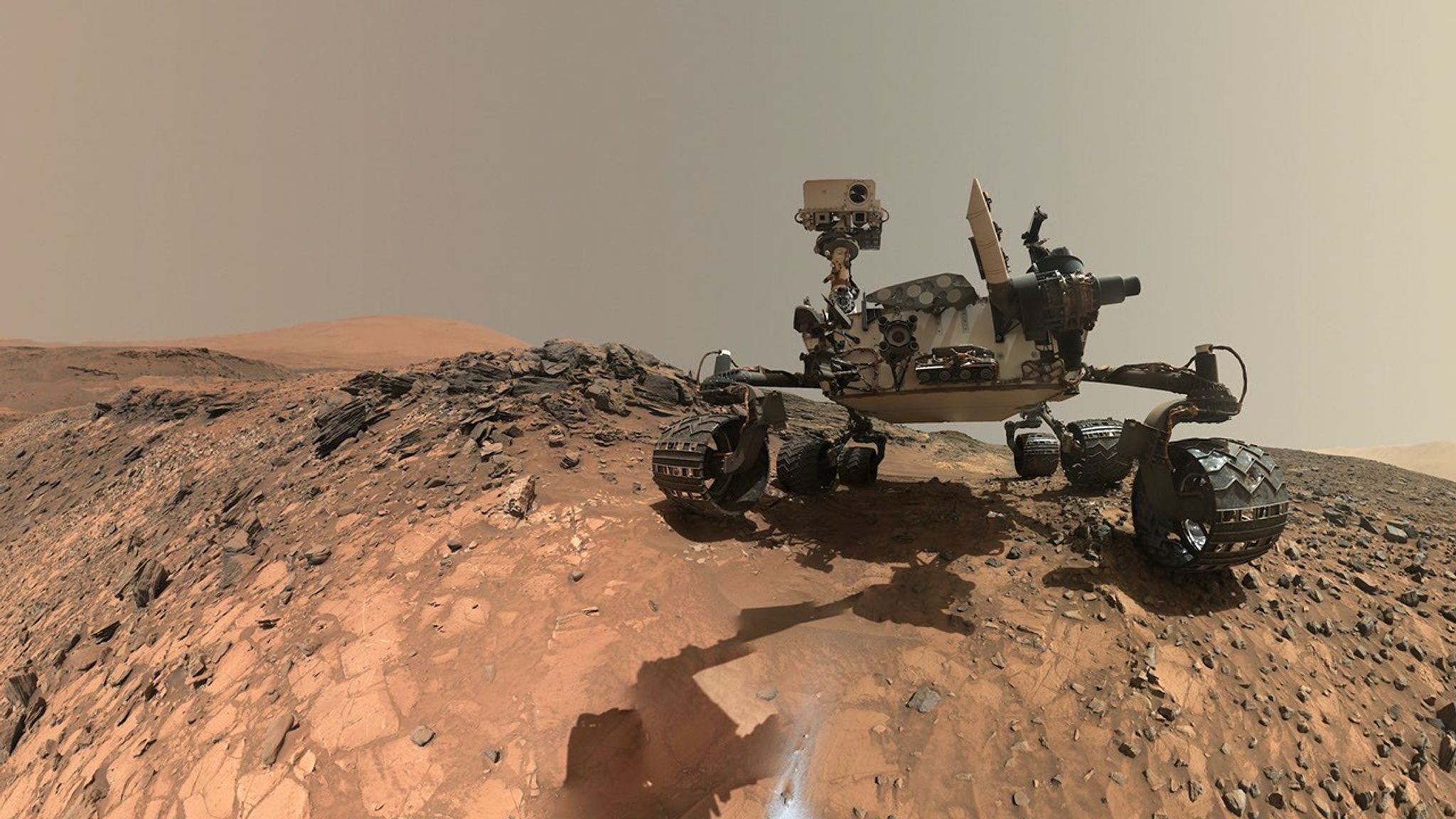
A rover sits on the hilly, orange Martian surface beneath a flat grey sky, surrounded by chunks of rock.
NASA’s Curiosity rover at the base of Mount Sharp
NASA/JPL-Caltech/MSSS

Share

Details

Last Updated
Feb 24, 2026

Related Terms

Powered by WPeMatico

Get The Details…

New Volunteer Data from 143 Observatories Unveils the 2024 Total Solar Eclipse

New Volunteer Data from 143 Observatories Unveils the 2024 Total Solar Eclipse

2 min read

New Volunteer Data from 143 Observatories Unveils the 2024 Total Solar Eclipse

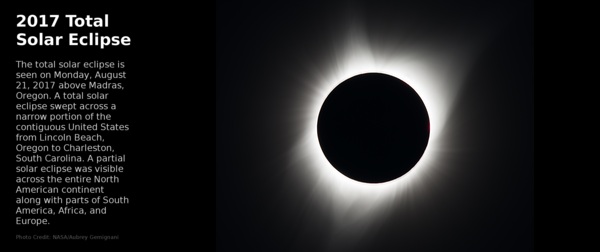
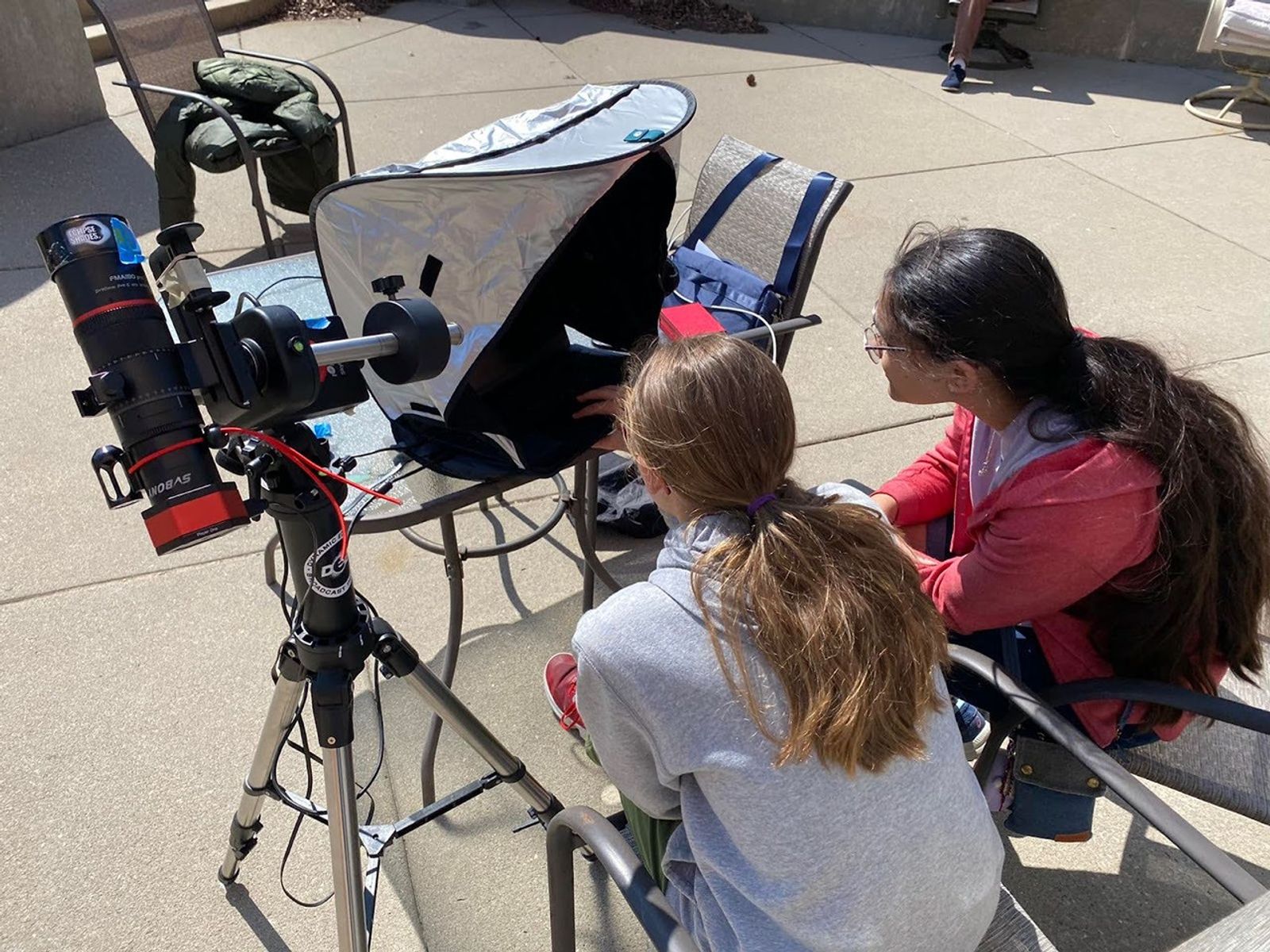
On April 8, 2024, volunteers participating in NASA’s Eclipse Megamovie citizen science project all around the United States hurried to photograph the solar eclipse with the latest, greatest equipment, capturing groundbreaking images of the Sun’s corona.

Now, the Eclipse Megamovie team has released the remarkable new dataset that resulted from this effort — the first-ever, white-light eclipse dataset with calibration frames, spanning more than a cumulative hour and a half of observations of the solar corona. This data, which includes 52,469 total photographs uploaded by project volunteers, is now live: https://eclipsemegamovie.org/database. The data include contributions from 143 unique, mobile, volunteer-led “observatories” – people with cameras charged with taking precise images of the eclipse, taking extra steps to allow the painstaking calibration required to reveal how the corona evolves from one person’s view to the next. Researchers around the world can now use these observations to identify solar jets leaving the Sun’s surface and study how solar plumes grow and develop. The public can also peruse and download all of this data, which is highly accessible and searchable by observatory name and location.

“Thank you for all you do and have done for us,” said Eclipse Megamovie volunteer Jessi McKenna. “Everyone in the group has been amazingly supportive of each other. And those who are running things are always so obviously appreciative of everyone who has contributed to the project.” 

The files include data at three different levels of processing, from raw (level 1) data to calibrated (level 3) data, in a format called FITS, or Flexible Image Transport System. It is the standard astronomical data format used by NASA and the International Astronomical Union. Of the 143 unique observatories involved, 28 observatories had clear skies, sufficient calibration frames, and enough unique exposure times to create calibrated level 3 images.

The Eclipse Megamovie team at Sonoma State University and the University of California, Berkeley and collaborators at NASA’s Goddard Space Flight Center began working together long before the eclipse to construct this database, together with EdEon STEM (Science, Technology, Engineering, & Mathematics) Learning programmer Troy Wilson. But crucially, Eclipse Megamovie 2024 was made possible because of hundreds of volunteers who journeyed into the path of the April 8, 2024 total solar eclipse with their cameras, patience, and curiosity.

Black and white photograph of 2024 total solar eclipse. Black circle in the middle surrounded by white sun beams
Photograph taken during the April 8th, 2024, total solar eclipse uploaded by EM2024 volunteer Franz Zabroky G. This picture has been aligned and processed and is available in the new database. https://eclipsemegamovie.org/database.
Franz Zabroky G.

Share

Details

Last Updated
Feb 24, 2026

Related Terms

Powered by WPeMatico

Get The Details…

Webb Maps Uranus’ Upper Atmosphere

Webb Maps Uranus’ Upper Atmosphere

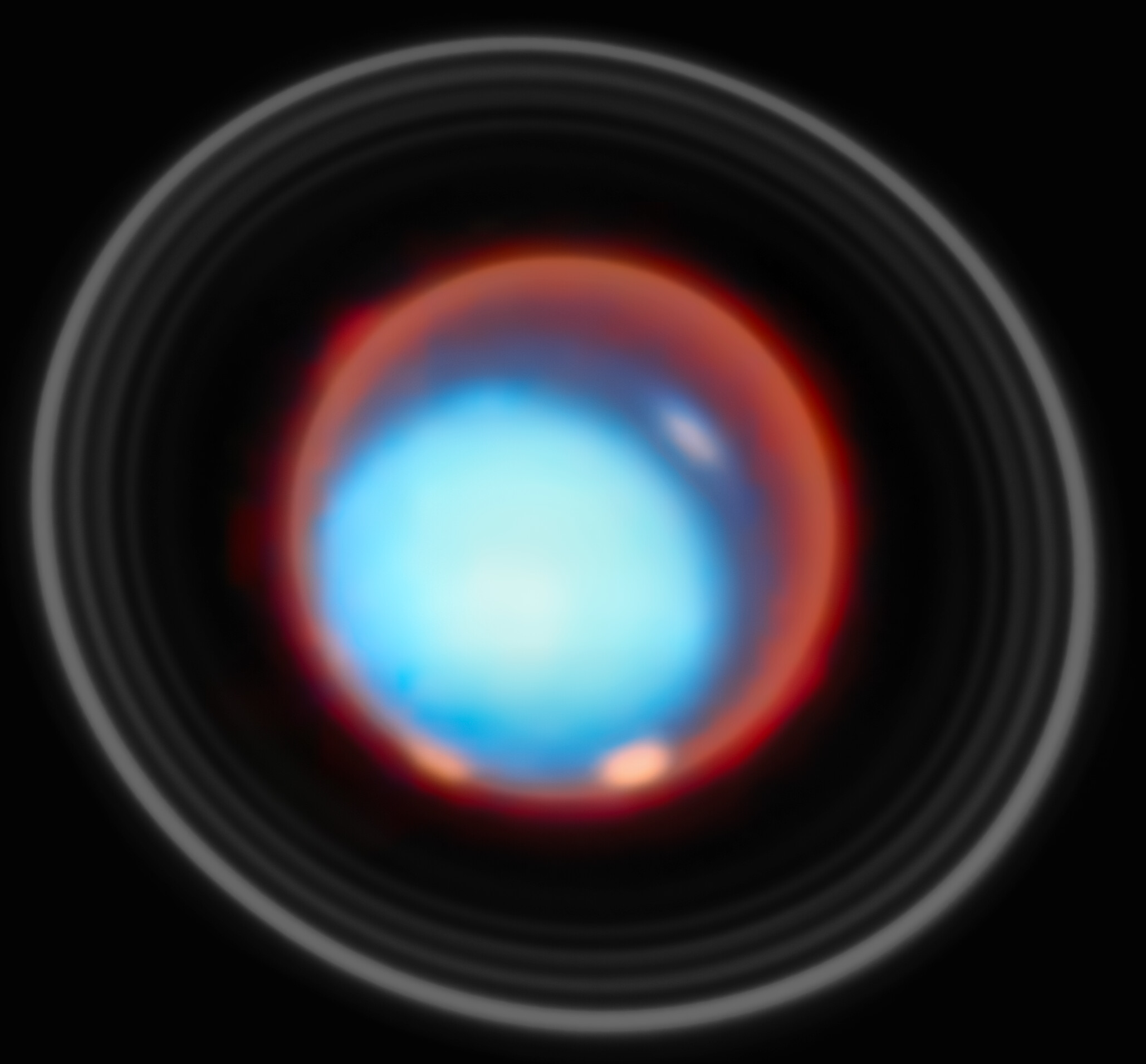
This image shows the planet Uranus set against the blackness of space. The planet appears as a smooth, bright cyan disc at the center, its atmosphere reveals soft, hazy tones of blue. Surrounding the planet is a vivid reddish glow, forming a diffuse halo that contrasts strongly with the cool blue of the planetary disc. Encircling Uranus are several thin, concentric rings, visible as pale gray arcs. Subtle variations in brightness can be seen across the planet’s face, with slightly brighter patches near the limb, hinting at atmospheric structure.
ESA/Webb, NASA, CSA, STScI, P. Tiranti, H. Melin, M. Zamani (ESA/Webb)

NASA’s James Webb Space Telescope provided the first vertical view of Uranus’s ionosphere in this image released on Feb. 19, 2026, revealing auroras shaped by its tilted magnetic field.

Getting a look at the structure of the region where the atmosphere interacts strongly with the planet’s magnetic field is giving us the most detailed portrait yet of where its auroras form, how the magnetic field influences them, and also data on how Uranus’s atmosphere has continued to cool since the 1990s.

Uranus has the strangest magnetosphere in the Solar System. It is tilted and offset from the planet’s rotation axis (and this planet already rolls around the Sun nearly on its side), which means auroras move across the surface in complex ways. Better understanding Uranus will give us insight into ice-giant planets and help us better characterize giant planets outside our Solar System.

Read more about this image.

Image credit: ESA/Webb, NASA, CSA, STScI, P. Tiranti, H. Melin, M. Zamani (ESA/Webb)

Powered by WPeMatico

Get The Details…
Monika Luabeya

Technology Originally Developed for Space Missions Now Integral to Everyday Life

Technology Originally Developed for Space Missions Now Integral to Everyday Life

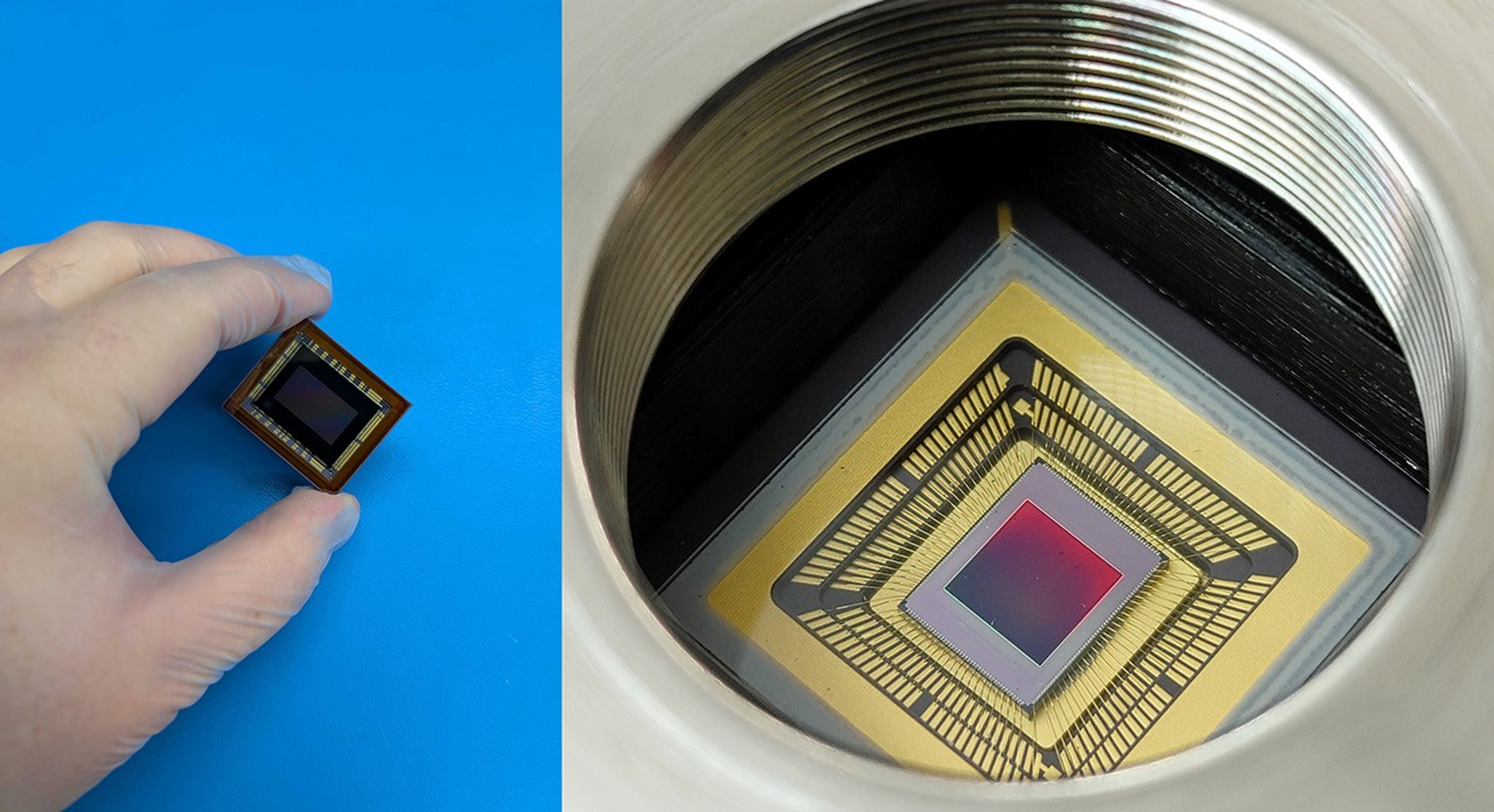
Groundbreaking “camera-on-a-chip” technology that was originally developed at NASA’s Jet Propulsion Laboratory (JPL) for use in space missions is currently employed in billions of devices like cell phones that are used daily by people worldwide.

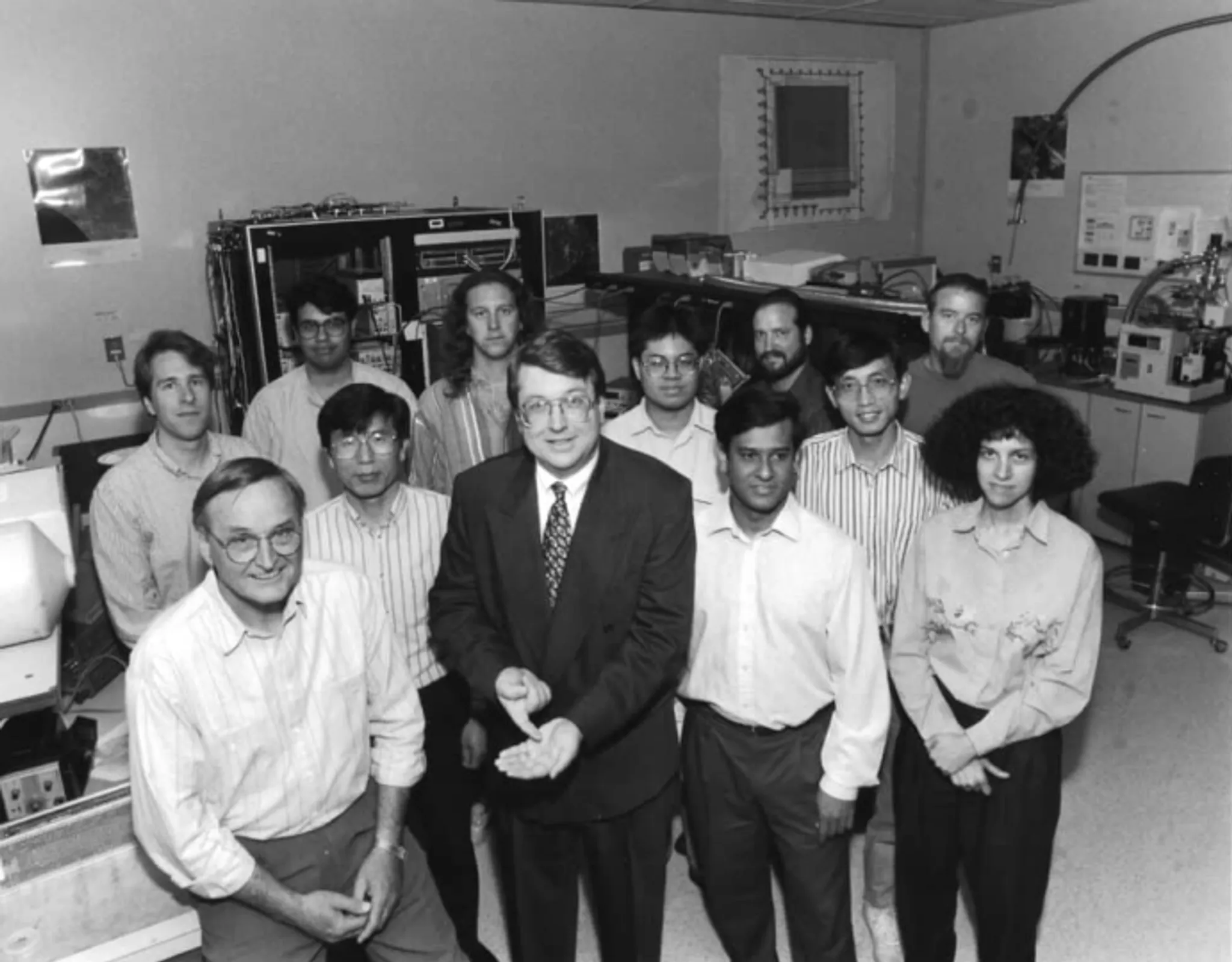
A group of people standing in a lab surrounded by technical equipment.
Eric Fossum (in the center of the front row) and the team that invented the CMOS image sensor on site at NASA’s Jet Propulsion Laboratory.
Courtesy NASA/JPL-Caltech

In the 1980s, sensors used to produce high-quality images for space science (including the amazing images from NASA’s Hubble Space Telescope) and other applications employed charge coupled device (CCD) technology. Dr. Eric Fossum was originally hired at JPL in 1990 to advance CCD technology for use in interplanetary space missions, but he ended up advancing another technology called complementary metal-oxide semiconductor (CMOS) technology for that purpose and much more. While at JPL, Fossum took advantage of a technique commonly used for CCDs and applied it to CMOS sensors to develop the first CMOS active pixel image sensor. This development began a chain of events that led to the present use of CMOS technology not only in space science missions, but also in billions of cameras in smartphones, webcams, automobiles, and medical devices used worldwide.

A new technology emerges…

In 1990, CCDs were the primary technology used to generate high-quality images. CCD sensors consist of arrays of pixels that convert light into electric charges. The charge from each pixel is transferred step-by-step to an output amplifier at the corner of the sensor and converted to a voltage that represents the brightness of the light received at the corresponding pixel. The data from all the pixels is then aggregated to generate an image. While CCD cameras can produce very high-quality images that are suitable for scientific use, they require a lot of power and an efficient charge transfer process to be effective.

CMOS sensors, on the other hand, have signal amplifiers within each pixel and signals can be read directly from each pixel instead of being transferred long distances to an amplifier for conversion. CMOS sensors therefore require less voltage to operate than CCDs and issues with the charge transfer process such as radiation susceptibility are greatly reduced. Although CMOS sensors existed in the 1990s, they produced too much noise to produce high-quality images required for science applications.

To reduce the signal noise typical of CMOS sensors at that time, Fossum applied a technique that was often used in CCD devices. This technique—called “intra-pixel charge transfer with correlated double sampling”—enables a double measurement of a pixel’s voltage without and with the light-generated charge. Subtracting the values of these two samples enables noise to be suppressed, improving the signal-to-noise ratio.

The next steps

Soon several companies signed Technology Cooperation Agreements with JPL and partnered with Fossum and his colleagues to develop the promising new technology. In 1995, Fossum and co-worker Dr. Sabrina Kemeny licensed the technology from CalTech and founded a company called Photobit to develop CMOS sensors. In 1996, Fossum left JPL to work at Photobit full time. The Photobit, team further refined the CMOS technology to get it closer to CCD capabilities, reduce power requirements, and make manufacturing cheaper.

Shortly thereafter, CMOS cameras started to be used in webcams, “pill cams” (small, swallowable devices that incorporate a tiny camera to take thousands of high-resolution images of the digestive tract), and other applications. In 2001 Photobit was acquired by Micron Technology, a larger company that devoted even more resources to development of CMOS technology. With the subsequent explosion of the cell phone industry, by 2013 more than a billion CMOS sensors were manufactured each year, and today that number has grown to about seven billion per year.

Where are these sensors now?

The CMOS technology Dr. Fossum originally developed has not only enabled space science, it has been infused into devices we depend on every day, dramatically and positively transforming many aspects of our lives. Virtually all digital still and video cameras, including those on cell phones, employ them. In addition, CMOS technology is used in automotive electronics, webcams, sports cameras, industrial equipment, security cameras including doorbells, and cinematography cameras, and for medical and dental imaging, among many other applications.

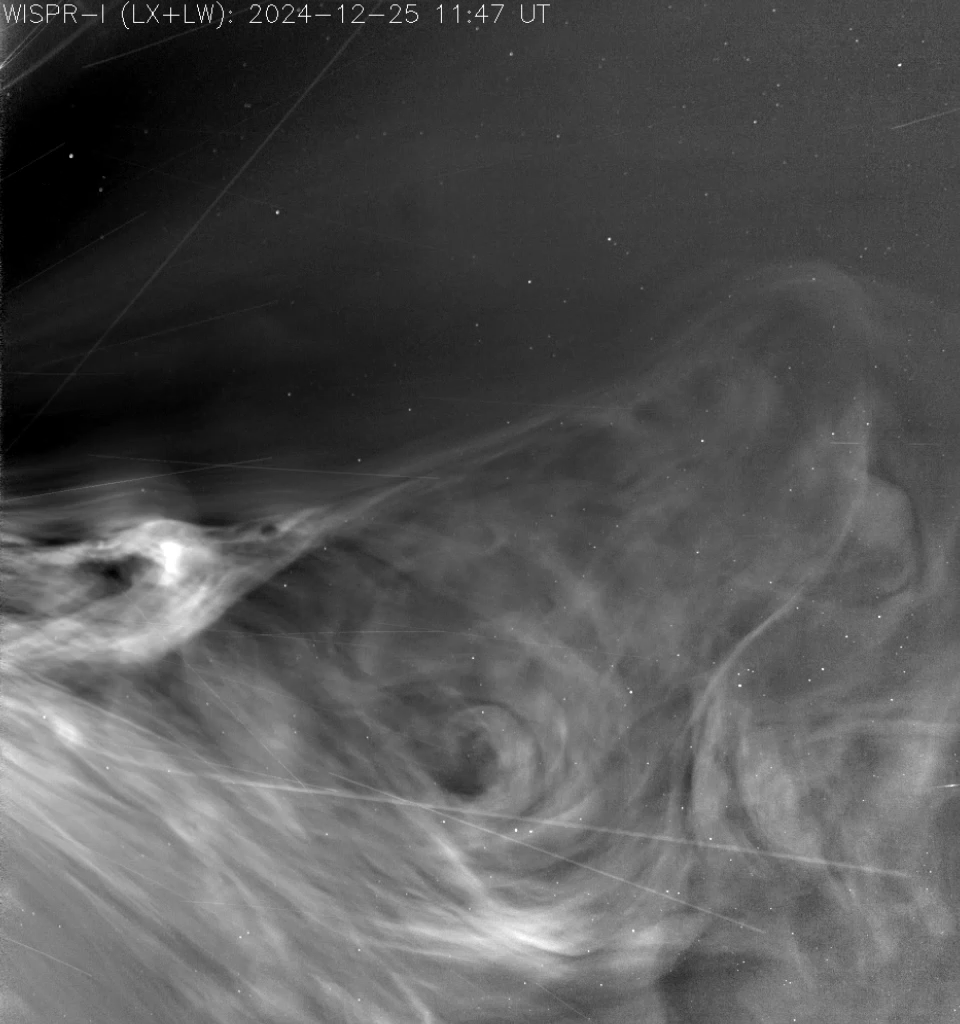
Image of solar wind racing out from the Sun’s outer atmosphere, looking like smoke on a black background.
A frame from a video made from images taken by the Wide-Field Imager for Solar Probe (WISPR) instrument (which employs CMOS technology) onboard NASA’s Parker Solar Probe. This image was captured during the mission’s record-breaking flyby of the Sun on Dec. 25, 2024, and shows the solar wind racing out from the Sun’s outer atmosphere, the corona.
Credit: NASA/Johns Hopkins APL/Naval Research Lab

In addition to dominating the commercial and consumer market, CMOS imagers have been used as engineering cameras to enable the entry, descent, and landing of NASA’s Perseverance Mars rover, in the camera onboard the OCO-3 (Orbiting Carbon Observatory-3) mission that monitors the distribution of carbon dioxide on Earth, and as scientific imagers on NASA’s Parker Solar Probe mission that is revolutionizing our understanding of the Sun. CMOS imagers are on their way to Jupiter’s moon, Europa, on the agency’s Europa Clipper mission, and a delta-doped ultraviolet version with tailored response is under development for use on the upcoming UVEX (UltraViolet EXplorer) mission that will provide insight into how galaxies and stars evolve.

CMOS imagers are routinely used in monitoring the launch and deployment of CubeSats and SmallSats. They were recently used to monitor the deployment of Pandora, a small satellite that will characterize exoplanet atmospheres and their host stars; BLACKCAT (the Black Hole Coded Aperture Telescope), a small X-ray telescope; and the SPARCS (Star-Planet Activity Research CubeSat) mission designed to monitor and characterize the stellar flares of low-mass stars in ultraviolet to provide context for the habitability of exoplanets in their system. NASA is also developing descendants of this technology for use in missions that will search for life beyond Earth like its Habitable Worlds Observatory.

In recognition of the impact this CMOS technology has had, the National Academy of Engineering (NAE) has named Dr. Fossum the recipient of the 2026 Charles Stark Draper Prize for Engineering “for innovation, development, and commercialization of the complementary metal-oxide semiconductor (CMOS) active pixel image sensor ‘camera-on-a-chip.’” The NAE bestows this award biennially to honor an engineer “whose accomplishment has significantly impacted society by improving the quality of life, providing the ability to live freely and comfortably, and/or permitting the access to information.”

Sponsoring Organizations: The original efforts at JPL to develop this CMOS technology were funded by JPL and NASA.

Share

Details

Last Updated
Feb 24, 2026

Powered by WPeMatico

Get The Details…