Crew Tackles Cardiac Research, Cargo Ops, and Spacesuit Checks

Crew Tackles Cardiac Research, Cargo Ops, and Spacesuit Checks

A vivid red and green aurora crowns Earth’s horizon over the southern Indian Ocean in this photo from the International Space Station as it orbited 270 miles above. At top left, a lit window reveals the docked SpaceX Dragon crew spacecraft docked to the orbital outpost's forward port on the Harmony module, set against a starry sky captured with long-exposure, low-light settings.
A vivid red and green aurora crowns Earth’s horizon over the southern Indian Ocean in this photo from the International Space Station as it orbited 270 miles above.
NASA

Heart and blood pressure studies led the research schedule for the Expedition 73 crew on Wednesday informing scientists how the cardiovascular system adapts to weightlessness. The International Space Station residents are also gearing up for the next SpaceX Dragon cargo mission and cleaning spacesuits for potential spacewalks later this year.

A suite of 14 human research investigations, also known as CIPHER, has been underway aboard the orbital lab for several years providing doctors continual insights into an astronaut’s health in space. The growing database of knowledge helps crew members train for long-duration missions, maintain their fitness in orbit, and prepare for the return to Earth’s gravity.

NASA Flight Engineers Mike Fincke and Zena Cardman began their shift in the Columbus laboratory module with blood pressure checks and artery scans for the cardiac research portion of the CIPHER investigation. Fincke led the CIPHER biomedical operations first measuring Cardman’s blood pressure then scanning her arteries with the Ultrasound 2 device. Doctors on the ground monitored the activities in real time to learn about the unique cardiovascular risks astronauts face when living and working in space.

Afterward, Fincke reviewed the upcoming Dragon resupply mission due to visit the orbital outpost next week. The four-time space station visitor examined the areas where the new cargo will be stowed and studied the tools he will use to monitor Dragon’s approach and rendezvous. Cardman joined NASA Flight Engineer Jonny Kim and assisted him as he serviced components on a pair of spacesuits in the Quest airlock throughout his shift. Kim also spent some time Wednesday reviewing Dragon’s cargo operations.

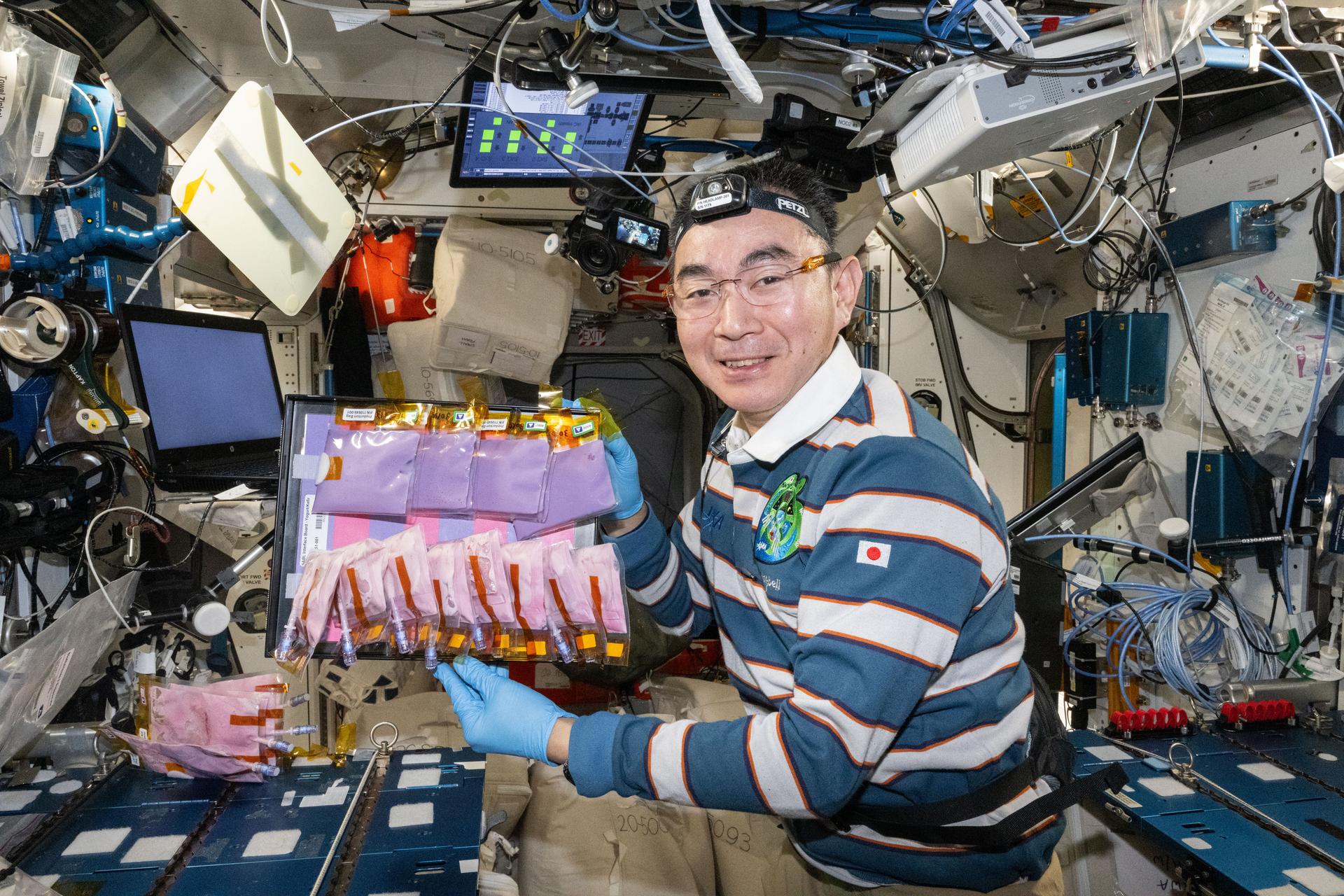
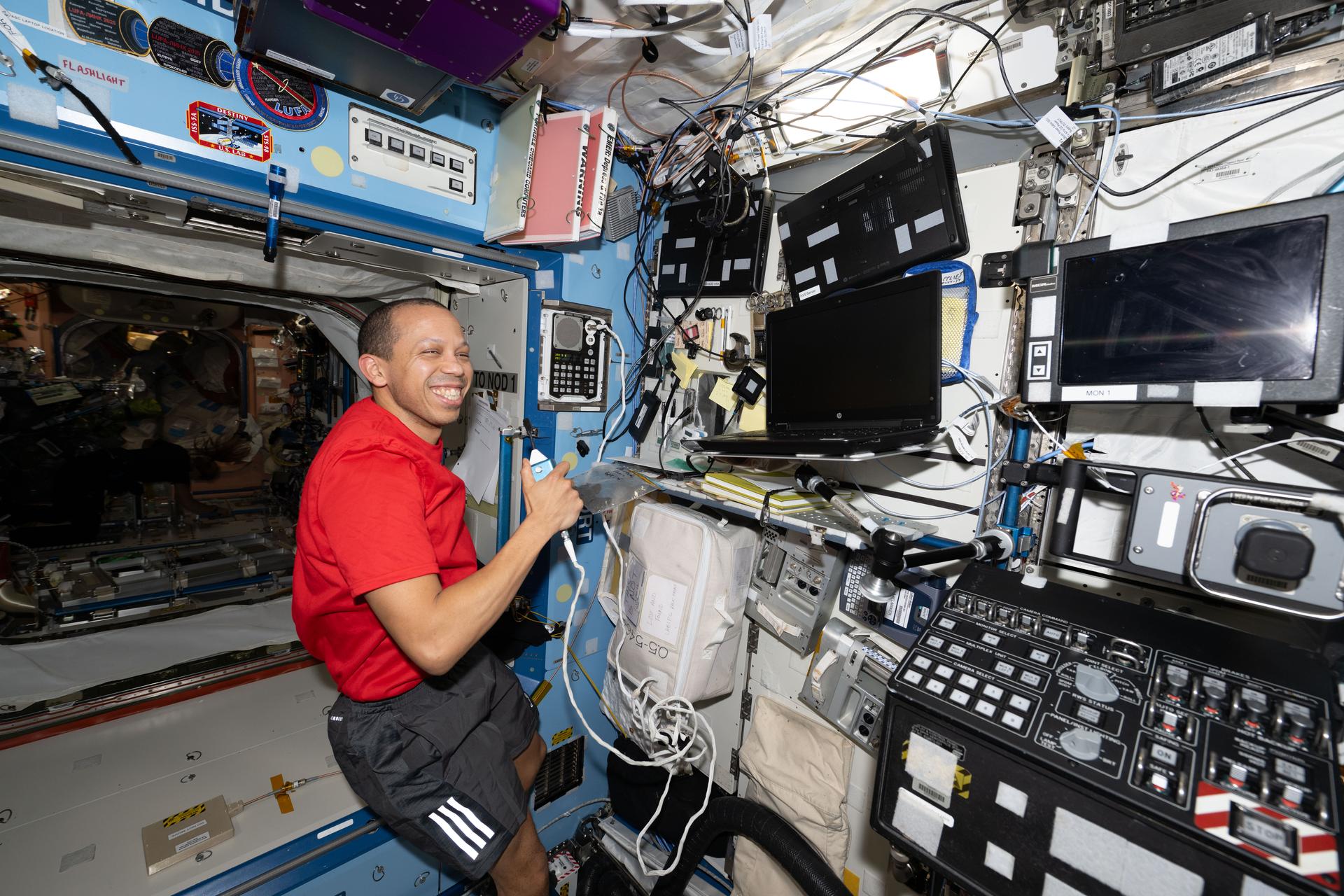
Flight Engineer Kimiya Yui of JAXA (Japan Aerospace Exploration Agency), who is on his second spaceflight, juggled an array of science and maintenance duties throughout his shift on Wednesday. During the first half of his day he configured a robot camera for a ground operations test and collected airflow measurements in the pressurized mating adapter where the SpaceX Dragon crew spacecraft is docked to on the Harmony module. After lunch, Yui replaced a pair of air quality sensors in the Destiny laboratory module then set up and wore the sensors that would measure the blood flow in his brain as he slept overnight.

Station Commander Sergey Ryzhikov and Flight Engineer Alexey Zubritsky, both Roscosmos cosmonauts, continued their cardiac research on Wednesday splitting their day on a pair of human research experiments. The duo first attached electrodes to their chests for an electrocardiogram that recorded the heart’s electrical activity to detect potential space-caused heart issues. Afterward, Ryzhikov and Zubritsky replaced the electrodes with sensors on their hands, fingers, feet, and toes and measured how blood flows in the tiny vessels, or microcirculatory system.

Roscosmos Oleg Platonov spent the first half of his shift downlinking Earth imagery of North and South America and replacing life support gear inside the Nauka science module. Next, he spent the rest of his day getting up to speed with station systems and conducting a regularly scheduled hearing test.

Learn more about station activities by following the space station blog, @space_station on X, as well as the ISS Facebook and ISS Instagram accounts.

Get the latest from NASA delivered every week. Subscribe here.

Powered by WPeMatico

Get The Details…

Mark A. Garcia

The NASA RASC-AL 2026 Competition

The NASA RASC-AL 2026 Competition

An artist's rendition of an astronaut on an extraterrestrial surface, facing forwards and holding a rock in front of them as lights from the spacesuit illuminate the object in hand. The words
National Institute of Aerospace

NASA is calling on the next generation of collegiate innovators to imagine bold new concepts pushing the boundaries of human exploration on the Moon, Mars, and beyond through the 2026 NASA Revolutionary Aerospace Systems Concepts – Academic Linkage (RASC-AL) competition. The RASC-AL challenge fuels innovation for aerospace systems concepts, analogs, and technology prototyping by bridging gaps through university engagement with NASA and industry. The competition is seeking U.S.-based undergraduate and graduate-level teams and their faculty advisors to develop new concepts to improve our ability to operate on the Moon and Mars. This year’s themes range from developing systems and technologies to support exploration of the lunar surface, to enhancing humanity’s ability to operate and return data from the surface of Mars.  

Award: $112,000 in total prizes

Open Date: August 13, 2025

Close Date: February 23, 2026

For more information, visit:  https://rascal.nianet.org/

Powered by WPeMatico

Get The Details…
Sarah Douglas

NASA Seeks Moon and Mars Innovations Through University Challenge

NASA Seeks Moon and Mars Innovations Through University Challenge

An artist's rendition of an astronaut on an extraterrestrial surface, facing forwards and holding a rock in front of them as lights from the spacesuit illuminate the object in hand. The words
National Institute of Aerospace

NASA is calling on the next generation of collegiate innovators to imagine bold new concepts l pushing the boundaries of human exploration on the Moon, Mars, and beyond through the agency’s 2026 NASA Revolutionary Aerospace Systems Concepts – Academic Linkage (RASC-AL) competition.  

The RASC-AL challenge fuels innovation for aerospace systems concepts, analogs, and technology prototyping by bridging gaps through university engagement with NASA and industry. The competition is seeking U.S.-based undergraduate and graduate-level teams and their faculty advisors to develop new concepts to improve our ability to operate on the Moon and Mars. This year’s themes range from developing systems and technologies to support exploration of the lunar surface, to enhancing humanity’s ability to operate and return data from the surface of Mars.  

“This competition is a unique opportunity for university students to play a role in the future of space innovation,” said Dan Mazanek, assistant branch head of NASA’s Exploration Space Mission Analysis Branch at NASA’s Langley Research Center in Hampton Virginia. “The RASC-AL challenge fuels creativity and empowers students to explore what’s possible. We’re excited for another year of RASC-AL and fresh ideas coming our way.”  

Interested and eligible teams are invited to propose groundbreaking solutions and systems approaches that redefine how humans live and explore in deep space with relation to one of the following themes:  

  • Communications, Positioning, Navigation, and Timing Architectures for Mars Surface Operations 
  • Lunar Surface Power and Power Management and Distribution Architectures  
  • Lunar Sample Return Concept 
  • Lunar Technology Demonstrations Leveraging Common Infrastructure  

Teams should express their intent to participate by submitting a non-binding notice of intent by Monday Oct. 13. Teams who submit a notice will be invited to a question-and-answer session with NASA subject matter experts on Monday Oct. 27.  

The proposals, due Monday Feb. 23, 2026, are required to be seven-to-nine pages with an accompanying two-to-three-minute video. Proposals should demonstrate innovative solutions with original engineering and analysis in response to one of the four 2026 RASC-AL themes. Each team’s response should address novel and robust technologies, capabilities, and operational models that support expanding human’s ability to thrive beyond Earth. 

Based on review of the team proposal and video submissions, in March, up to 14 teams will be selected to advance to the final phase of the competition – writing a technical paper, creating a technical poster, and presenting their concepts to a panel of NASA and industry experts in a competitive design review at the 2026 RASC-AL Forum in Cocoa Beach, Florida, beginning Monday June 1, 2026. 

“The RASC-AL challenge enables students to think like NASA engineers—and in doing so, they often become the engineers who will carry NASA forward,” said Dr. Christopher Jones, RASC-AL program sponsor and Chief Technologist for the Systems Analysis and Concepts Directorate at NASA Langley. “The concepts they develop for this year’s competition will help inform our future strategies.”  

Each finalist team will receive a $7,000 stipend to facilitate their full participation in the 2026 RASC-AL competition, and the top two overall winning teams will each be awarded an additional $7,000 cash prize as well as an invitation to attend and present their concept at an aerospace conference later in 2026. 

The 2026 NASA RASC-AL competition is administered by the National Institute of Aerospace on behalf of NASA. The RASC-AL competition is sponsored by the agency’s Strategy and Architecture Office in the Exploration Systems Development Mission Directorate at NASA Headquarters, the Space Technology Mission Directorate (STMD), and the Systems Analysis and Concepts Directorate at NASA Langley. The NASA Tournament Lab, part of the Prizes, Challenges, and Crowdsourcing Program in STMD, manages the challenge. 

For more information about the RASC-AL competition, including eligibility and submission guidelines, visit: https://rascal.nianet.org/

Powered by WPeMatico

Get The Details…
Sarah Douglas

Compton J. Tucker Retires from NASA and is Named NAS Fellow

Compton J. Tucker Retires from NASA and is Named NAS Fellow

Dr. Compton J. Tucker – a senior researcher at NASA’s Goddard Space Flight Center (GSFC) – joins 149 newly elected members to the National Academy of Sciences (NAS) – see Photo. NAS is one of the highest honors in American science. Compton gave a virtual presentation at GSFC on July 21, 2025, in which he showed highlights from his 50 years of research and reflected on the honor of being selected as an NAS fellow. He admitted that he was surprised upon learning of his election in April 2025 – despite his prestigious career.

Tucker photo 1
Photo 1. Compton Tucker uses satellites to address global environmental challenges.
Photo credit: Colorado State University

In some ways this award brings Compton’s career full circle. He first came to GSFC as a NAS postdoc in 1975 after having earned his Bachelor’s of Science degree at Colorado State University (CSU) in 1969. He followed with his Master’s of Science degree and Ph.D. from CSU’s College of Forestry in 1973 and 1975 respectively. Two years later, he joined NASA as a civil servant. After a prestigious 48 years of public service, Compton has decided to retire in March 2025.

Compton is a well-known pioneer in the field of satellite-based environmental analysis, using data from various U.S. Geological Survey–NASA Landsat missions and from the National Oceanographic and Atmospheric Administration’s (NOAA) Advanced Very High Resolution Radiometer (AVHRR) instrument, the prototype of which launched aboard the Television Infrared Observation Satellite–N (TIROS-N) in 1978, with launches continuing on NOAA and European polar orbiting satellites throughout the next 40 years. The last two AVHRR instruments, which launched on the European Organisation for the Exploitation of Meteorological Satellites’ (EUMETSAT) Meteorological Operational satellites (METOP–B and -C) in 2012 and 2018 respectively, are still operational today.

Tucker photo 2
Photo 2. Earth scientist Compton Tucker, who has studied remote sensing of vegetation at NASA Goddard for 50 years, has been elected to the National Academy of Sciences.
Photo credit: Compton Tucker

In his GSFC presentation, Compton described how, in the course of doing their research, he and his colleague(s) realized the original plans for AVHRR resulted in Channel 1 and 2 overlapping one another. In short, he explained that his input helped persuade NOAA management to change the design for Channel 1 of AVHRR – beginning with NOAA-7. It is fair to say that this change had a lasting impact, with 16 more AVHRR instruments (with slight modifications over time) launched over the next four decades.

Compton’s research has focused on global photosynthesis on land (e.g., grass-dominated savannas), determined land cover (i.e., forest fragmentation, deforestation, and forest condition), monitored droughts and food security, and evaluated ecologically coupled disease outbreaks. From 2005 to 2010, he was the co-chair of two Interagency Working Groups for Observations and Land Use and Land Cover Change. Compton was active in NASA’s Space Archaeology Program, participating in ground-based radar and magnetic surveys in Turkey, particularly at Troy, the Granicus River Valley, and Gordion. Over the course of his 50-year career, he has authored or co-authored more than 400 scholarly articles that have appeared in scientific journals – and in his presentation he hinted that more might be in store after retirement.

Compton has received numerous scientific awards and honors. He was elected to a fellow of the American Geophysical Union in 2009 and to the American Association for the Advancement of Science in 2015. He received the Senior Executive Service Presidential Rank Award for Meritorious Service (2017), the Vega Medal from the Swedish Society of Anthropology and Geography (2014), the Galathea Medal from the Royal Danish Geographical Society (2004), the William T. Pecora Award from the U.S. Geological Survey (1997), the Michael Collins Trophy for Current Achievement from the National Air and Space Museum (1993), the Henry Shaw Medal from the Missouri Botanical Garden (1992), and the Exceptional Scientific Achievement Medal from NASA (1987).

Compton enjoyed sharing his knowledge with the next generation of scientists. He served as an adjunct professor at the University of Maryland (1994–2024) and a consulting scholar at the University of Pennsylvania Museum of Archeology and Anthropology (2005–2024).

Congratulations to Compton on earning this prestigious – and well-earned – recognition from NAS. Best wishes to him in whatever is next on his journey.

Black Separator Line

The National Academy of Sciences is a private, nonprofit institution that was established under a congressional charter signed by President Abraham Lincoln in 1863. It recognizes achievement in science by election to membership, and – with the National Academy of Engineering and the National Academy of Medicine – provides science, engineering, and health policy advice to the federal government and other organizations.

Black Separator Line

Powered by WPeMatico

Get The Details…

Alligator Goes for a Swim

Alligator Goes for a Swim

An alligator swims through green and brown water. It is facing left and we can see the side of its face. A small wave of water marks where its front left leg is moving.
NASA/Bill White

An alligator moves through a brackish waterway at NASA’s Kennedy Space Center in Florida in this May 8, 2017, photo. The center shares space with the Merritt Island National Wildlife Refuge. More than 330 native and migratory bird species, 25 mammals, 117 fishes and 65 amphibians and reptiles call NASA Kennedy and the wildlife refuge home. The refuge is also home to over 1,000 known plant species.

Image credit: NASA/Bill White

Powered by WPeMatico

Get The Details…
Monika Luabeya