Station Crew Tracks Changes to Eyes, Brain, and Blood in Space

Station Crew Tracks Changes to Eyes, Brain, and Blood in Space

NASA astronaut and Expedition 73 Flight Engineer Jonny Kim stows research samples inside a cryogenic storage unit for installation inside a science freezer for preservation inside the International Space Station's Destiny laboratory module. Offically called the Minus Eighty-Degree Laboratory Freezer for ISS, or MELFI, the ultra-cold storage unit enables space biology research by preserving biological samples for analysis including blood, saliva, urine, microbes, and more.
NASA astronaut Jonny Kim stores research samples like blood, saliva, and microbes inside an ultra-cold science freezer to keep them preserved for future analysis.
NASA

More human research was underway aboard the International Space Station on Tuesday as the Expedition 73 crew explored how working in space affects the eyes, brain, circulatory system, and more. Quantum physics hardware and spacesuit maintenance rounded out the schedule for the seven orbital residents.

NASA Flight Engineers Mike Fincke and Zena Cardman joined each other in the Columbus laboratory module for an eye exam helping doctors identify potential space-caused changes to eye anatomy and function. Fincke, with assistance from specialists on the ground, operated medical gear that sent signals to electrodes attached to Cardman’s forehead and around her eyes. The test, one part of the CIPHER suite of 14 human research investigations, measures how the retina responds to light providing insights into an astronaut’s visual adaptation to microgravity.

NASA Flight Engineer Jonny Kim participated in a secondary portion of the CIPHER investigation taking a test to monitor how his sense of balance, direction, and memory is adjusting to weightlessness. He first collected and processed his blood and urine samples for analysis as is standard procedure for the CIPHER study. Afterward, Kim opened up spatial cognition software on a laptop computer and took a series of tests helping doctors track changes to brain function in space. Results may help researchers design advanced tools such as brain scans, thinking tests, and task simulations to monitor and protect cognition during long-duration space missions.

Kim and Cardman also worked together inside the Quest airlock and swapped components on a pair of spacesuits preparing for potential spacewalks planned for later this year.

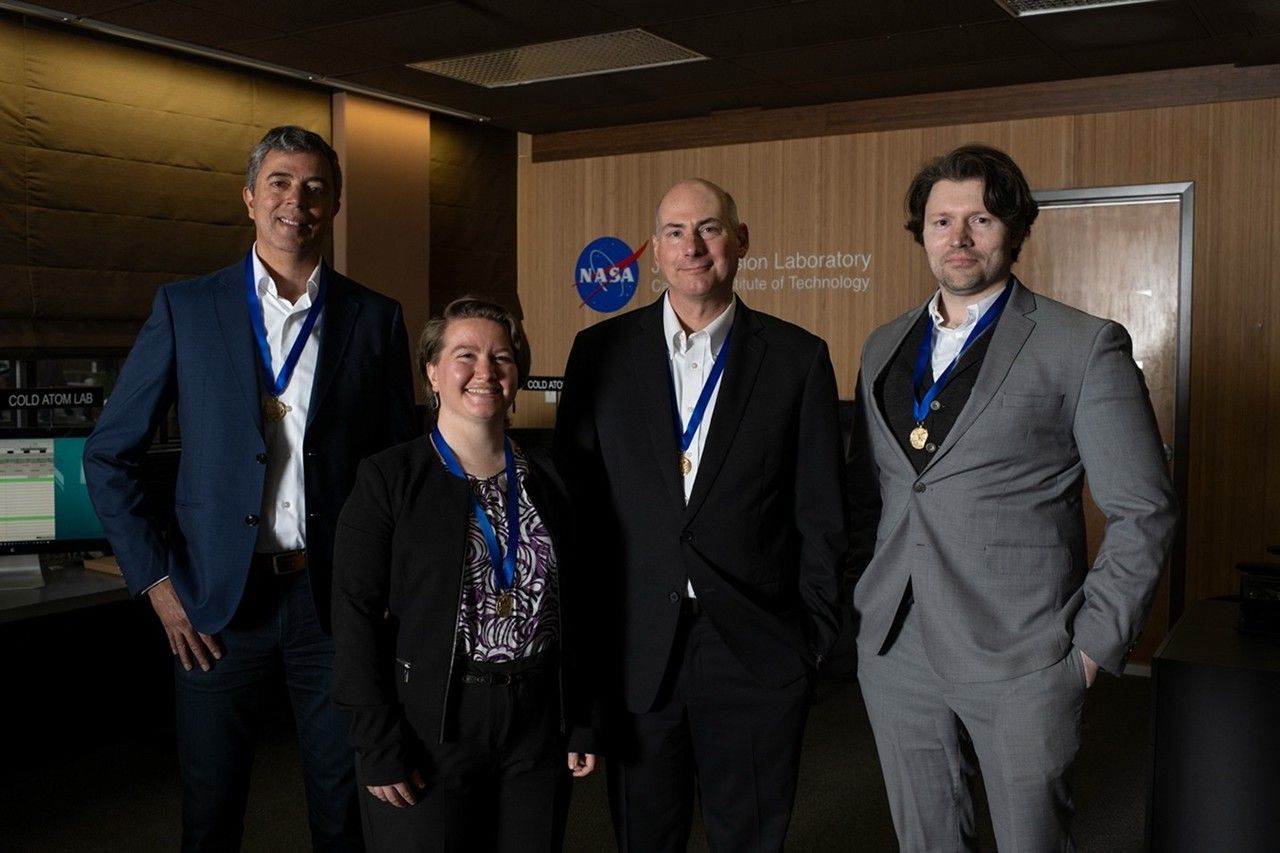
JAXA (Japan Aerospace Exploration Agency) Flight Engineer Kimiya Yui, who is on his second space station mission, opened up the Cold Atom Lab in the Destiny laboratory module and replaced computer components inside the physics device. The research facility chills atoms below the average temperature of the universe allowing scientists to observe atomic wave functions and quantum characteristics unachievable on Earth.

Roscosmos cosmonauts Sergey Ryzhikov and Alexey Zubritsky continued studying the microcirculatory system wearing sensors measuring how blood flows to the tiny vessels in a crew member’s hands, fingers, feet, and toes. The data will help doctors refine methods and develop tools to understand how weightlessness affects blood circulation and keep crews healthy during long-duration space missions.

Ryzhikov earlier joined new Flight Engineer Oleg Platonov and swabbed surfaces throughout the station’s Roscosmos segment collecting microbe samples for analysis. The samples were placed in petri dishes for incubation and later analysis to characterize the microbial environment of the orbital outpost for the protection of the crew and its hardware. Platonov also partnered with Zubritsky taking turns wearing an acoustic sensor on their necks measuring the volume as they rapidly exhaled for an ongoing respiratory study.

Learn more about station activities by following the space station blog, @space_station on X, as well as the ISS Facebook and ISS Instagram accounts.

Get the latest from NASA delivered every week. Subscribe here.

Powered by WPeMatico

Get The Details…

Mark A. Garcia

Veins, Vessels Fill Station Research Schedule after Crew Returns to Earth

Veins, Vessels Fill Station Research Schedule after Crew Returns to Earth

From left, JAXA (Japan Aerospace Exploration Agency) astronauts Takuya Onishi and Kimiya Yui, Expedition 73 Commander and Flight Engineer respectively, are pictured during crew familiarization activities inside the International Space Station's Kibo laboratory module.
From left, JAXA astronauts Takuya Onishi and Kimiya Yui are pictured on Aug. 2, 2025, during crew familiarization activities inside the International Space Station’s Kibo laboratory module.
NASA

Expedition 73, with its four newest crewmates, kicked off the week exploring how living in space affects the circulatory system and exercise. Meanwhile, the four crew members from NASA’s SpaceX Crew-10 mission are back on Earth and getting used to gravity after five months aboard the International Space Station.

Flight Engineers Zena Cardman from NASA and Oleg Platonov joined each other on Monday for Ultrasound 2 scans of their neck, shoulder, and leg veins looking for signs of space-caused blood clots. Afterward, NASA astronaut Mike Fincke and JAXA (Japan Aerospace Exploration Agency) astronaut Kimiya Yui took part in the vein scans that are scheduled for the crew throughout a mission. The quartet has been on the space station for over week since arriving on Aug. 2 aboard the SpaceX Dragon as NASA’s SpaceX Crew-11 mission. Doctors will be monitoring the crew’s health for the duration of its stay in space adding to the growing space medical knowledge potentially leading to advanced treatments for a variety of ailments in space and on Earth.

Cardman also worked out on the advanced resistive exercise device as specialists on the ground monitored taking note of her cardiorespiratory fitness, muscle strength, and fitness in microgravity. NASA Flight Engineer Jonny Kim took part in another portion of the same experiment, the CIPHER suite of 14 human research investigations, and collected his blood and urine samples for processing, stowage, and later analysis. CIPHER is a study that looks at how space travel affects astronauts’ bodies and minds during short and long missions. By comparing results from different mission lengths, scientists can better prepare for future trips to places like Mars and help keep astronauts healthy.

Station Commander Sergey Ryzhikov and Flight Engineer Alexey Zubritsky, both from Roscosmos, partnered together on Monday and examined how blood flows to the tiny vessels, known as the microcirculatory system, in a crew member’s hands, fingers, feet, and toes. Researchers will study the data to understand how weightlessness affects blood circulation and keep crews healthy during long-duration space missions.

Four Crew-10 members are back on Earth following a splashdown in the Pacific Ocean on Aug. 9 aboard the SpaceX Dragon spacecraft completing their five-month stay aboard the orbital outpost. The Commercial Crew quartet returned to NASA’s Johnson Space Center later that day to begin several weeks of rehabilitation activities to help their bodies readjust to Earth’s gravity. Astronauts Anne McClain of NASA and Takuya Onishi of JAXA both completed their second spaceflight. NASA astronaut Nichole Ayers and Roscosmos cosmonaut Kirill Peskov both wrapped up their first mission aboard the orbital laboratory.

Learn more about station activities by following the space station blog, @space_station on X, as well as the ISS Facebook and ISS Instagram accounts.

Get the latest from NASA delivered every week. Subscribe here.

Powered by WPeMatico

Get The Details…

Mark A. Garcia

NASA Invites Media to View Artemis II Orion Stage Adapter at Marshall

NASA Invites Media to View Artemis II Orion Stage Adapter at Marshall

2 min read

Preparations for Next Moonwalk Simulations Underway (and Underwater)

The Artemis II Orion stage adapter, built at NASA’s Marshall Space Flight Center in Huntsville, Alabama.
NASA

Media are invited to NASA’s Marshall Space Flight Center in Huntsville, Alabama, at 2 p.m. CDT Thursday, Aug. 14 to view the final piece of space flight hardware for the agency’s SLS (Space Launch System) rocket for the Artemis II mission before it is delivered to NASA’s Kennedy Space Center in Florida. All other elements of the SLS rocket for Artemis II are stacked on mobile launcher 1 in the Vehicle Assembly Building at Kennedy. Artemis II, NASA’s first mission with crew aboard the SLS rocket and Orion spacecraft, is currently scheduled for a 10-day trip around the Moon no later than April 2026.

The Orion stage adapter, built by NASA Marshall, connects the SLS rocket’s interim cryogenic propulsion stage to NASA’s Orion spacecraft. The small ring structure is the topmost portion of the SLS rocket. The adapter will also carry small payloads, called CubeSats, to deep space.

Media will have the opportunity to capture images and video and speak to subject matter experts. Along with viewing the adapter for Artemis II, media will be able to see the Orion stage adapter for the Artemis III mission, the first lunar landing at the Moon’s South Pole.

This event is open to U.S. media, who must confirm their attendance by 12 p.m. CDT Wednesday, Aug. 13, with Jonathan Deal in Marshall’s Office of Communications at jonathan.e.deal@nasa.gov. Media must also report by 1:30 p.m. Thursday, Aug.14 to the Redstone Arsenal Joint Visitor Control Center Gate 9 parking lot, located at the Interstate 565 interchange at Research Park Boulevard, to be escorted to the event.

Through Artemis, NASA will send astronauts to explore the Moon for scientific discovery, economic benefits, and build the foundation for the first crewed missions to Mars.

For more on SLS, visit: 

https://www.nasa.gov/humans-in-space/space-launch-system

Jonathan Deal
Marshall Space Flight Center, Huntsville, Ala. 
256.631.9126
jonathan.e.deal@nasa.gov

Share

Details

Last Updated

Aug 11, 2025

Editor
Beth Ridgeway

Powered by WPeMatico

Get The Details…
Beth Ridgeway

NASA Awards Second Human Health, Performance Contract

NASA Awards Second Human Health, Performance Contract

The letters NASA on a blue circle with red and white detail, all surrounded by a black background
Credit: NASA

NASA has selected KBR Wyle Services, LLC of Fulton, Maryland, to provide services to the Human Health and Performance Directorate at the agency’s Johnson Space Center in Houston, which focuses on astronaut health, occupational health, and research that could help mitigate health risks for future human spaceflight missions.

The Human Health and Performance Contract 2 is a follow-on single-award indefinite-delivery/indefinite-quantity contract that begins its five-year period of performance on Nov. 1, with two possible option periods that could extend it through 2035. The total estimated value of the base period plus the optional periods is $3.6 billion. Leidos, Inc. of Reston, Virginia, is a subcontractor.

The contract will acquire support services for several programs, primarily at NASA Johnson. This includes the Human Research Program, International Space Station Program, Commercial Crew Program, Artemis campaign, and more. Services include ensuring crew health, safety, and performance; providing occupational health services; and conducting research into mitigating risks to the health, safety, and performance of future spaceflight crews.

The Human Health and Performance Directorate leads the global spaceflight community in protecting astronaut health and enabling human mission performance. Its vision focuses on humans living, working, and thriving in space, on the Moon and on to Mars, and its mission is to lead the global spaceflight community in protecting astronaut health and enabling human mission performance.

For more information about NASA and agency programs, visit:

https://www.nasa.gov

–end–

Tiernan Doyle
Headquarters, Washington
202-358-1600
tiernan.doyle@nasa.gov

Victoria Segovia
Johnson Space Center, Houston
281-483-5111
victoria.segovia@nasa.gov

Share

Details

Last Updated

Aug 11, 2025

Powered by WPeMatico

Get The Details…
Tiernan P. Doyle

NASA Explores Industry Possibilities to Raise Swift Mission’s Orbit

NASA Explores Industry Possibilities to Raise Swift Mission’s Orbit

Against the blackness of space, a boxy, metallic spacecraft dominates the frame. Two "wings" of solar panels stick out from its sides. Below is the bright, cloudy limb of Earth.
This artist’s concept shows NASA’s Neil Gehrels Swift Observatory orbiting above Earth.
Credit: NASA’s Goddard Space Flight Center/Chris Smith (KBRwyle)

To drive the development of key space-based capabilities for the United States, NASA is exploring an opportunity to demonstrate technology to raise a spacecraft’s orbit to a higher altitude. Two American companies – Cambrian Works of Reston, Virginia, and Katalyst Space Technologies of Flagstaff, Arizona – will develop concept design studies for a possible orbit boost for the agency’s Neil Gehrels Swift Observatory.

Since its launch in 2004, NASA’s Swift mission has led the agency’s fleet of space telescopes in investigating changes in the high-energy universe. The spacecraft’s low Earth orbit has been decaying gradually, which happens to most satellites over time. Because of recent increases in the Sun’s activity, however, Swift is experiencing additional atmospheric drag, speeding up its orbital decay. This lowering orbit presents an opportunity for NASA to advance a U.S. industry capability, while potentially extending the science lifetime of the Swift mission. The concept studies will help determine whether extending Swift’s critical scientific capabilities would be more cost-effective than replacing those capabilities with a new observatory.

“NASA Science is committed to leveraging commercial technologies to find innovative, cost-effective ways to open new capabilities for the future of the American space sector,” said Nicky Fox, associate administrator, Science Mission Directorate, NASA Headquarters in Washington. “To maintain Swift’s role in our portfolio, NASA Science is uniquely positioned to conduct a rare in-space technology demonstration to raise the satellite’s orbit and solidify American leadership in spacecraft servicing.”

The concept studies are being developed under Phase III awards through NASA’s Small Business Innovation Research (SBIR) Program, managed by the agency’s Space Technology Mission Directorate, to American small businesses from a pool of existing participants. This approach allows NASA to rapidly explore affordable possibilities to boost Swift on a shorter development timeline than would otherwise be possible, given the rapid rate at which Swift’s orbit is decaying.

At this time NASA does not have plans for an orbit boost mission and could still allow the spacecraft to reenter Earth’s atmosphere, as many satellites do at the end of their lifetimes. NASA is studying a potential Swift boost to support innovation in the American space industry, while gaining a better understanding of the available options, the technical feasibility, and the risks involved.

NASA will also work with Starfish Space of Seattle, Washington, to analyze the potential of performing a Swift boost using an asset under development on an existing Phase III SBIR award. Starfish is currently developing the Small Spacecraft Propulsion and Inspection Capability (SSPICY) demonstration for NASA, with the primary objective of inspecting multiple U.S.-owned defunct satellites in low Earth orbit.

“Our SBIR portfolio exists for circumstances like this – where investments in America’s space industry provide NASA and our partners an opportunity to develop mutually beneficial capabilities,” said Clayton Turner, associate administrator, Space Technology Mission Directorate, NASA Headquarters. “Whether we choose to implement the technologies in this circumstance, understanding how to boost a spacecraft’s orbit could prove valuable for future applications.”

Swift was designed to observe gamma-ray bursts, the universe’s most powerful explosions, and provide information for other NASA and partner telescopes to follow up on these events. Its fast and flexible observations have been instrumental in advancing how scientists study transient events to understand how the universe works. For more than two decades, Swift has led NASA’s missions in providing new insights on these events, together broadening our understanding of everything from exploding stars, stellar flares, and eruptions in active galaxies, to comets and asteroids in our own solar system and high-energy lightning events on Earth.

As neutron stars collide, some of the debris blasts away in particle jets moving at nearly the speed of light, producing a brief burst of gamma rays
As neutron stars collide, some of the debris blasts away in particle jets moving at nearly the speed of light, producing a brief burst of gamma rays.
NASA’s Goddard Space Flight Center/CI Lab

“Over its extremely productive lifetime, Swift has been a key player in NASA’s network of space telescopes – directing our fleet to ensure we keep a watchful eye on changes in the universe, both far off and close to home,” said Shawn Domagal-Goldman, acting director, Astrophysics Division, NASA Headquarters. “Now, this long-lived science mission is presenting us with a new opportunity: partnering with U.S. industry to rapidly explore efficient, state-of-the-art solutions that could extend Swift’s transformative work and advance private spacecraft servicing.”

Cambrian and Katalyst have each been awarded $150,000 under Phase III SBIR contracts for concept design studies. The NASA SBIR program is part of America’s Seed Fund, the nation’s largest source of early-stage, non-dilutive funding for innovative technologies. Through this program, entrepreneurs, startups, and small businesses with less than 500 employees can receive funding and non-monetary support to build, mature, and commercialize their technologies, advancing NASA missions and helping solve important problems facing our country.

NASA’s Goddard Space Flight Center in Greenbelt, Maryland, manages the Swift mission in collaboration with Penn State, the Los Alamos National Laboratory in New Mexico, and Northrop Grumman Space Systems in Dulles, Virginia. Other partners include the UK Space Agency, University of Leicester and Mullard Space Science Laboratory in the United Kingdom, Brera Observatory in Italy, and the Italian Space Agency. To learn more about the Swift mission, visit:

https://www.nasa.gov/swift

-end-

Alise Fisher / Jasmine Hopkins
Headquarters, Washington
202-358-2546 / 321-432-4624
alise.m.fisher@nasa.gov / jasmine.s.hopkins@nasa.gov

Powered by WPeMatico

Get The Details…
Elizabeth R. Landau