How NASA Is Homing in From Space on Ocean Debris

How NASA Is Homing in From Space on Ocean Debris

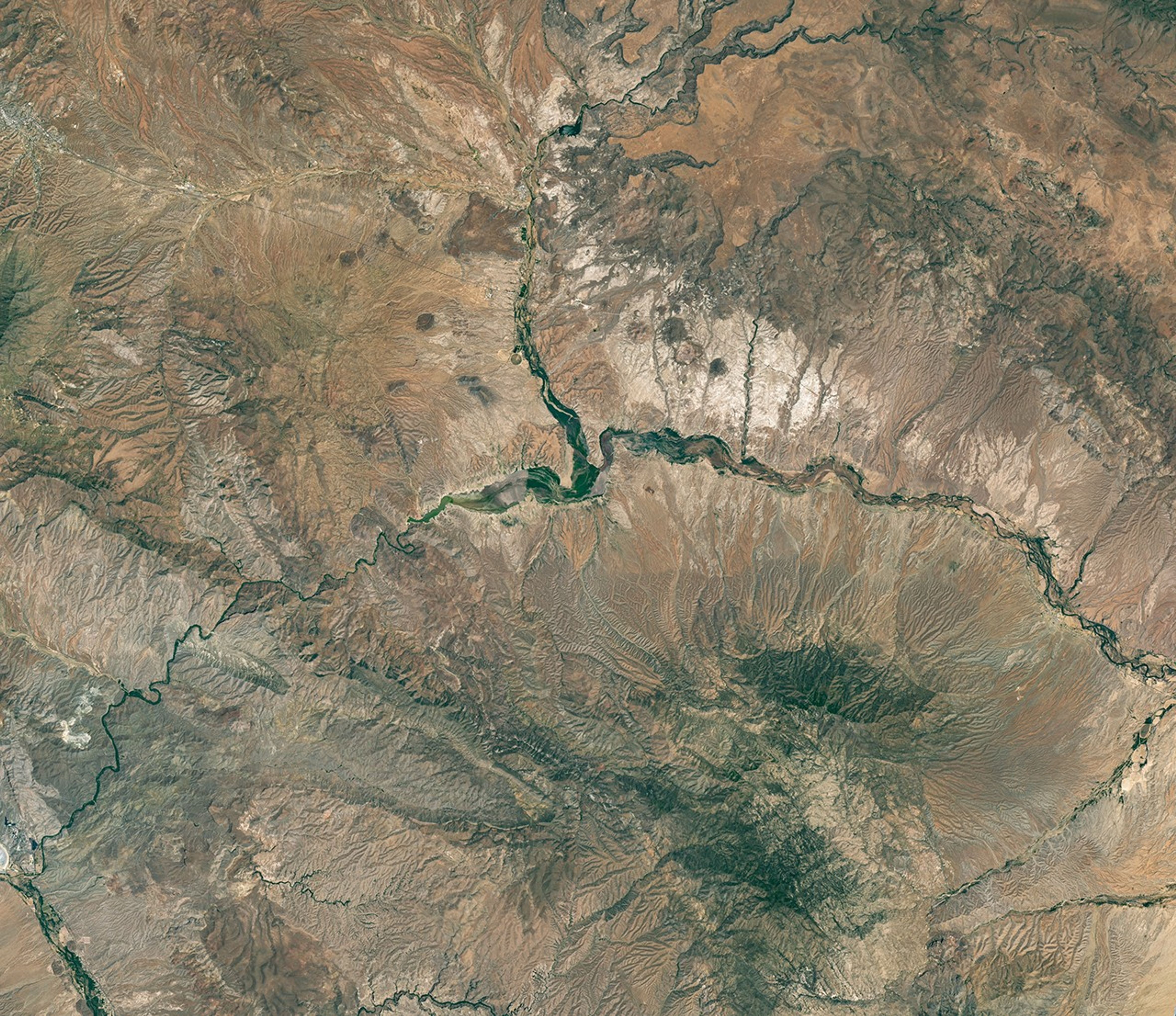
Detergent bottles and other litter can travel thousands of miles across the ocean before washing up on the remote Island of Kaho’olawe in Hawaii. JPL remote-sensing technology recently showed that it can spot plastic pollution on land, but doing so in the sea presents challenges.
NOAA

Space-based technology could help track plastic and other flotsam by its ‘fingerprints.’

In late 2025, scientists reported that, for the first time, they were able to detect concentrations of plastic pollution on land using NASA’s Earth Surface Mineral Dust Source Investigation (EMIT) sensor aboard the International Space Station. The technology has inspired marine researchers to see whether it could also help track debris in our waters.

Before future generations of sensors like EMIT can be called upon to detect ocean litter, scientists need to know what to look for. Working with collaborators, NASA intern Ashley Ohall has built a newly published reference library containing nearly 25,000 molecular “fingerprints” from all manner of flotsam and jetsam, including rope, tires, metal, bubble wrap, buoys, and bottle caps. Given the overwhelming presence of plastic in marine debris, the library includes some 19 types of polymer.

NASA’s EMIT, shown in the red circle, was launched to the International Space Station in 2022 to map minerals. Its data is now advancing fields from agriculture to water science.
NASA

Most of the estimated 8 million tons or more of plastic that enter the ocean every year comes from land, so mapping pollution hot spots near coastlines could be a first step toward reducing what ends up on beaches and washed out to sea. That’s exactly what NASA’s sensor showed it could do, though detecting plastic wasn’t its first mission. Launched in 2022, EMIT maps minerals across desert regions to help determine how the dust can heat or cool the atmosphere.

But the instrument has proved itself incredibly nimble. From its perch on the space station, it can identify hundreds of compounds on Earth via the unique spectral patterns they make in reflected sunlight. The technology behind EMIT, called imaging spectroscopy, was pioneered at NASA’s Jet Propulsion Laboratory in Southern California and is used on missions throughout the solar system. One of EMIT’s cousins discovered lunar water in 2009, and another is set to return to the Moon to help future astronauts identify scientifically valuable areas to sample.

Marine scientist Ashley Ohall checked out aircraft at NASA’s Langley Research Center in Hampton, Virginia, during her recent internship with the agency in which she led the creation of a spectral library containing nearly 25,000 molecular “fingerprints” from all manner of debris.
Kelsey Bisson

The same technology has now shown that it can find plastic compounds in landfills and large-scale structures like greenhouses, said JPL’s David Thompson, who coauthored the 2025 study. However, detecting plastic once it enters the ocean is more challenging: Seawater absorbs infrared light, masking many of plastic’s prominent spectral features.

Litter library

That’s where the work of Ohall and her collaborators comes in. Their open-source library compiles the work of many researchers over the years who’ve analyzed marine debris using handheld instruments in laboratories. Standardizing the various datasets into one searchable repository is crucial because different kinds of debris have slightly different spectra based on material, color, and condition. Weathered water bottles, for example, “look” different than washed-up hurricane detritus. Once the patterns are known, detection algorithms can be developed.

Carried by ocean currents, debris can travel thousands of miles from the source, so a better understanding of where it is and where it’s headed could be a boon for public health and coastal tourism, said Ohall, a Florida native who recently graduated from the University of Georgia.

“My biggest hope is that people see remote sensing as an important and useful tool for marine debris monitoring,” Ohall said. “Just because it hasn’t been done yet doesn’t mean it can’t be done.”

Planet-scale challenge

Conventional methods for quantifying plastic in the ocean — including dragging nets through garbage patches — can’t sample the millions of tons that flow in. With NASA’s support, scientists are learning more about the ability of existing sensors as well as what’s still needed to spot marine debris. Teams are also training AI tools to sift through satellite imagery.

It remains a planet-scale endeavor, said Kelsey Bisson, a program manager at NASA Headquarters in Washington. The groundwork being done by Ohall and other scientists brings us a step closer to leveraging a powerful technology flying in air and space today.

“Humans have a visceral connection to the ocean and its health,” Bisson said. “Detecting marine debris is the kind of incredible challenge that NASA can help solve.”

To learn more about EMIT, visit:

https://earth.jpl.nasa.gov/emit/

Media Contacts

Andrew Wang / Andrew Good
Jet Propulsion Laboratory, Pasadena, Calif.
626-379-6874 / 818-393-2433
andrew.wang@jpl.nasa.gov / andrew.c.good@jpl.nasa.gov

Written by Sally Younger

2026-003

Powered by WPeMatico

Get The Details…
Naomi Hartono

NASA Reveals New Details About Dark Matter’s Influence on Universe

NASA Reveals New Details About Dark Matter’s Influence on Universe

Containing nearly 800,000 galaxies, this image from NASA’s James Webb Space Telescope is overlaid with a map of dark matter, represented in blue. Researchers used Webb data to find the invisible substance via its gravitational influence on regular matter.
NASA/STScI/J. DePasquale/A. Pagan

With the Webb telescope’s unprecedented sensitivity, scientists are learning more about dark matter’s influence on stars, galaxies, and even planets like Earth.

Scientists using data from NASA’s James Webb Space Telescope have made one of the most detailed, high-resolution maps of dark matter ever produced. It shows how the invisible, ghostly material overlaps and intertwines with “regular” matter, the stuff that makes up stars, galaxies, and everything we can see.

Published Monday, Jan. 26, in Nature Astronomy, the map builds on previous research to provide additional confirmation and new details about how dark matter has shaped the universe on the largest scales — galaxy clusters millions of light-years across — that ultimately give rise to galaxies, stars, and planets like Earth.

“This is the largest dark matter map we’ve made with Webb, and it’s twice as sharp as any dark matter map made by other observatories,” said Diana Scognamiglio, lead author of the paper and an astrophysicist at NASA’s Jet Propulsion Laboratory in Southern California. “Previously, we were looking at a blurry picture of dark matter. Now we’re seeing the invisible scaffolding of the universe in stunning detail, thanks to Webb’s incredible resolution.”

Dark matter doesn’t emit, reflect, absorb, or even block light, and it passes through regular matter like a ghost. But it does interact with the universe through gravity, something the map shows with a new level of clarity. Evidence for this interaction lies in the degree of overlap between dark matter and regular matter. According to the paper’s authors, Webb’s observations confirm that this close alignment can’t be a coincidence but, rather, is due to dark matter’s gravity pulling regular matter toward it throughout cosmic history.

“Wherever we see a big cluster of thousands of galaxies, we also see an equally massive amount of dark matter in the same place. And when we see a thin string of regular matter connecting two of those clusters, we see a string of dark matter as well,” said Richard Massey, an astrophysicist at Durham University in the United Kingdom and a coauthor of the new study. “It’s not just that they have the same shapes. This map shows us that dark matter and regular matter have always been in the same place. They grew up together.”

Closer look

Found in the constellation Sextans, the area covered by the new map is a section of sky about 2.5 times larger than the full Moon. A global community of scientists have observed this region with at least 15 ground- and space-based telescopes for the Cosmic Evolution Survey (COSMOS). Their goal: to precisely measure the location of regular matter here and then compare it to the location of dark matter. The first dark matter map of the area was made in 2007 using data from NASA’s Hubble Space Telescope, a project led by Massey and JPL astrophysicist Jason Rhodes, a coauthor of the paper.

Webb peered at this region for a total of about 255 hours and identified nearly 800,000 galaxies, some of which were detected for the first time. Scognamiglio and her colleagues then looked for dark matter by observing how its mass curves space itself, which in turn bends the light traveling to Earth from distant galaxies. When observed by researchers, it’s as if the light of those galaxies has passed through a warped windowpane.

The Webb map contains about 10 times more galaxies than maps of the area made by ground-based observatories and twice as many as Hubble’s. It reveals new clumps of dark matter and captures a higher-resolution view of the areas previously seen by Hubble.

To refine measurements of the distance to many galaxies for the map, the team used Webb’s Mid-Infrared Instrument (MIRI), designed and managed through launch by JPL, along with other space- and ground-based telescopes. The wavelengths that MIRI detects also make it adept at detecting galaxies obscured by cosmic dust clouds.

Why it matters

When the universe began, regular matter and dark matter were probably sparsely distributed. Scientists think dark matter began to clump together first and that those dark matter clumps then pulled together regular matter, creating regions with enough material for stars and galaxies to begin to form.

In this way, dark matter determined the large-scale distribution of galaxies in the universe. And by prompting galaxy and star formation to begin earlier than they would have otherwise, dark matter’s influence also played a role in creating the conditions for planets to eventually form. That’s because the first generations of stars were responsible for turning hydrogen and helium — which made up the vast majority of atoms in the early universe — into the rich array of elements that now compose planets like Earth. In other words, dark matter provided more time for complex planets to form.

“This map provides stronger evidence that without dark matter, we might not have the elements in our galaxy that allowed life to appear,” said Rhodes. “Dark matter is not something we encounter in our everyday life on Earth, or even in our solar system, but it has definitely influenced us.”

Scognamiglio and some of her coauthors will also map dark matter with NASA’s upcoming Nancy Grace Roman Space Telescope over an area 4,400 times bigger than the COSMOS region. Roman’s primary science goals include learning more about dark matter’s fundamental properties and how they may or may not have changed over cosmic history. But Roman’s maps won’t beat Webb’s spatial resolution. More detailed looks at dark matter will be possible only with a next-generation telescope like the Habitable Worlds Observatory, NASA’s next astrophysics flagship concept.

More about Webb

The James Webb Space Telescope is solving mysteries in our solar system, looking beyond to distant worlds around other stars, and probing the mysterious structures and origins of our universe and our place in it. Webb is an international program led by NASA with its partners, ESA (European Space Agency) and CSA (Canadian Space Agency).

To learn more about Webb, visit:

https://science.nasa.gov/webb

Media Contacts

Calla Cofield / Ian O’Neill
Jet Propulsion Laboratory, Pasadena, Calif.
626-808-2469 / 818-354-2649
calla.e.cofield@jpl.nasa.gov / ian.j.oneill@jpl.nasa.gov

2026-002

Powered by WPeMatico

Get The Details…
Naomi Hartono

NASA Sets Briefings for SpaceX Crew-12 Mission to Space Station

NASA Sets Briefings for SpaceX Crew-12 Mission to Space Station

Four a
NASA’s SpaceX Crew-12 crew, from left to right, is NASA astronauts Jessica Meir and Jack Hathaway, ESA (European Space Agency) astronaut Sophie Adenot, and Roscosmos cosmonaut Andrey Fedyaev.
Credit: SpaceX

NASA and its partners will discuss the upcoming crew rotation to the International Space Station during a pair of news conferences on Friday, Jan. 30, from the agency’s Johnson Space Center in Houston.

At 11 a.m. EST, mission leadership will discuss final launch and mission preparations in a news conference that will stream on the agency’s YouTube channel.

Next, the crew of NASA’s SpaceX Crew-12 mission will participate in a virtual news conference from NASA Johnson crew quarters at 1 p.m., also on the agency’s YouTube channel. Individual streams for each of the events will be available on that page. This is the final media opportunity with Crew-12 before they travel to NASA’s Kennedy Space Center in Florida for launch.

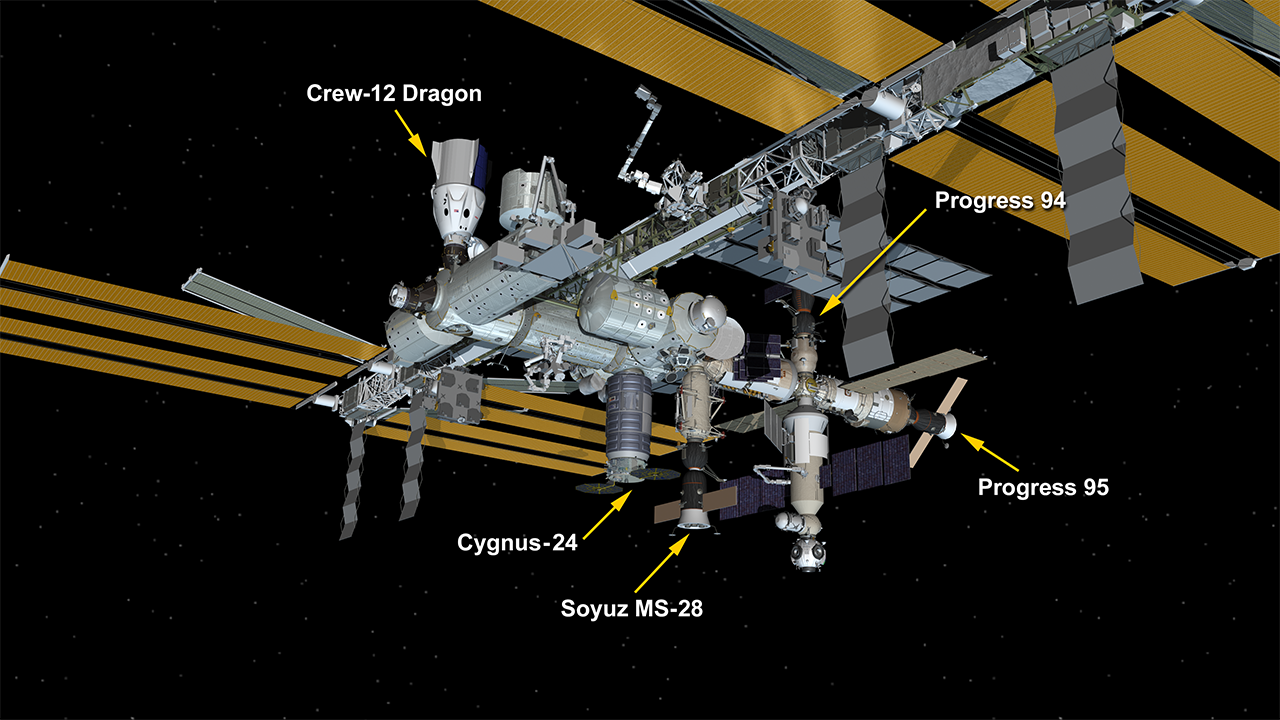
Crew-12 will carry NASA astronauts Jessica Meir and Jack Hathaway, ESA (European Space Agency) astronaut Sophie Adenot, and Roscosmos cosmonaut Andrey Fedyaev to the orbiting laboratory. The crew will launch aboard a SpaceX Dragon spacecraft on the company’s Falcon 9 rocket from Space Launch Complex 40 at Cape Canaveral Space Force Station in Florida. The agency is working with SpaceX and its international partners to review options to advance the launch of Crew-12 from its original target date of Sunday, Feb. 15.

United States-based media interested in attending in person must contact the NASA Johnson newsroom no later than 5 p.m. CST on Thursday, Jan. 29, at 281-483-5111 or jsccommu@mail.nasa.gov.

Media wishing to join the news conferences by phone must contact the Johnson newsroom by 9:45 a.m. on the day of the event. A copy of NASA’s media accreditation policy is available online.

Briefing participants are as follows (all times Eastern and subject to change based on real-time operations):

11 a.m.: Mission Overview News Conference

  • Ken Bowersox, associate administrator, NASA’s Space Operations Mission Directorate
  • Steve Stich, manager, Commercial Crew Program, NASA Kennedy
  • Dana Weigel, manager, International Space Station Program, NASA Johnson
  • Andreas Mogensen, Human Exploration Group Leader, ESA
  • SpaceX representative

1 p.m.: Crew News Conference

  • Jessica Meir, Crew-12 commander, NASA
  • Jack Hathaway, Crew-12 pilot, NASA
  • Sophie Adenot, Crew-12 mission specialist, ESA
  • Andrey Fedyaev, Crew-12 mission specialist, Roscosmos

This will be the second flight to the space station for Meir, who was selected as a NASA astronaut in 2013. The Caribou, Maine, native earned a bachelor’s degree in biology from Brown University, a master’s degree in space studies from the International Space University, and a doctorate in marine biology from Scripps Institution of Oceanography in San Diego. On her first spaceflight, Meir spent 205 days as a flight engineer during Expedition 61/62, and she completed the first three all-woman spacewalks with fellow NASA astronaut Christina Koch, totaling 21 hours and 44 minutes outside of the station. Since then, she has served in various roles, including assistant to the chief astronaut for commercial crew (SpaceX), deputy for the Flight Integration Division, and assistant to the chief astronaut for the human landing system.

A commander in the United States Navy, Hathaway was selected as part of the 2021 astronaut candidate class. This will be Hathaway’s first spaceflight. The South Windsor, Connecticut, native holds a bachelor’s degree in physics and history from the U.S. Naval Academy and master’s degrees in flight dynamics from Cranfield University and national security and strategic studies from the U.S. Naval War College, respectively. Hathaway also is a graduate of the Empire Test Pilot’s School, Fixed Wing Class 70 in 2011. At the time of his selection, Hathaway was deployed aboard the USS Truman, serving as Strike Fighter Squadron 81’s prospective executive officer. He has accumulated more than 2,500 flight hours in 30 different aircraft, including more than 500 carrier arrested landings and 39 combat missions.

The Crew-12 mission will be Adenot’s first spaceflight. Before her selection as an ESA astronaut in 2022, Adenot earned a degree in engineering from ISAE-SUPAERO in Toulouse, France, specializing in spacecraft and aircraft flight dynamics. She also earned a master’s degree in human factors engineering at Massachusetts Institute of Technology in Cambridge. After earning her master’s degree, she became a helicopter cockpit design engineer at Airbus Helicopters and later served as a search and rescue pilot at Cazaux Air Base from 2008 to 2012. She then joined the High Authority Transport Squadron in Villacoublay, France, and served as a formation flight leader and mission captain from 2012 to 2017. Between 2019 and 2022, Adenot worked as a helicopter experimental test pilot in Cazaux Flight Test Center with DGA (Direction Générale de l’Armement – the French Defence Procurement Agency). She has logged more than 3,000 hours flying 22 different helicopters.

This will be Fedyaev’s second long-duration stay aboard the orbiting laboratory. He graduated from the Krasnodar Military Aviation Institute in 2004, specializing in aircraft operations and air traffic organization, and earned qualifications as a pilot engineer. Prior to his selection as a cosmonaut, he served as deputy commander of an Ilyushin-38 aircraft unit in the Kamchatka Region, logging more than 600 flight hours and achieving the rank of second-class military pilot. Fedyaev was selected for the Gagarin Research and Test Cosmonaut Training Center Cosmonaut Corps in 2012 and has served as a test cosmonaut since 2014. In 2023, he flew to the space station as a mission specialist during NASA’s SpaceX Crew-6 mission, spending 186 days in orbit, as an Expedition 69 flight engineer. For his achievements, Fedyaev was awarded the title Hero of the Russian Federation and received the Yuri Gagarin Medal.

For more information about the mission, visit:

https://www.nasa.gov/commercialcrew

-end-

Joshua Finch / Jimi Russell
Headquarters, Washington
202-358-1100
joshua.a.finch@nasa.gov / james.j.russell@nasa.gov

Sandra Jones / Joseph Zakrzewski
Johnson Space Center, Houston
281-483-5111
sandra.p.jones@nasa.gov / joseph.a.zakrzewski@nasa.gov

Share

Details

Last Updated

Jan 23, 2026

Editor
Jessica Taveau

Powered by WPeMatico

Get The Details…
Jessica Taveau
Crew Studies Cardiac Research, Artificial Intelligence as Dragon Boosts Station’s Orbit

Crew Studies Cardiac Research, Artificial Intelligence as Dragon Boosts Station’s Orbit

This photograph, taken from a window aboard the SpaceX Dragon crew spacecraft, shows the SpaceX Dragon cargo spacecraft with southern Florida visible below as the International Space Station orbited 260 miles above the Gulf of America.
This photograph shows the SpaceX Dragon with southern Florida visible below as the International Space Station orbited 260 miles above Earth.
NASA

Cardiac research and artificial intelligence were the main science topics for the Expedition 74 crew on Friday. The International Space Station also received an orbital boost when the SpaceX Dragon spacecraft fired its engines at the end of the week.

NASA Flight Engineer Chris Williams started his shift inside the Columbus laboratory module setting up the Ultrasound 2 device and attaching electrodes to his chest. Next he scanned his neck, chest, and leg vessels with the Ultrasound 2 with assistance from doctors on the ground as the electrodes measured his heart’s electrical activity. Afterward, Williams jogged on the COLBERT treadmill while wearing a heart monitor then worked out on the advanced resistive exercise device as his movements were tracked. Doctors will use the biomedical data to understand how living and working in space long-term affects the cardiovascular system.

Roscosmos cosmonauts Sergey Kud-Sverchkov and Sergei Mikaev joined each other in the Zvezda service module and studied using artificial intelligence to boost crew efficiency aboard the orbital outpost. The duo tested AI-assisted tools to convert speech-to-text and improve data handling and communications between the crew and ground controllers. Researchers seek to use the new technology to speed up and increase the accuracy of crew documentation benefitting operations aboard spacecraft.

Kud-Sverchkov also serviced the Elektron oxygen generator inside Zvezda, collected air samples from the station’s Roscosmos segment for analysis, and cleaned ventilation fans inside the Soyuz MS-28 spacecraft. Mikaev deactivated physics research gear that enables observations of crystallization, plasma behavior, and radiation effects then inventoried computer and electronics gear to wrap his work shift.

On Friday, Jan. 23, SpaceX’s Dragon fired its thrusters for 26 minutes, 11 seconds, boosting the International Space Station’s orbit.

The two Draco engines, which are located in the spacecraft’s trunk and use an independent propellant system, increased the station’s altitude by 3.1 miles at apogee, or highest point of station’s orbit, and 2.3 miles at perigee, or lowest point of station’s orbit, placing the station in an orbit of 269 x 255 miles. 

This Dragon spacecraft, which is supporting SpaceX’s 33rd commercial resupply mission for NASA, arrived at the orbital complex on Aug. 25 and previously performed five reboosts of the station on Sept. 3, Sept. 26, and Oct. 14, Nov. 7, and Dec. 29. This is the final planned reboost for this Dragon spacecraft before it returns to Earth with critical research and cargo and splashes down off the coast of California.

Learn more about station activities by following the space station blog, @space_station on X, as well as the ISS Facebook and ISS Instagram accounts.

Get the latest from NASA delivered every week. Subscribe here.

Powered by WPeMatico

Get The Details…

Mark A. Garcia

NASA Awards Global Modeling, Assimilation Support Contract

NASA Awards Global Modeling, Assimilation Support Contract

The letters NASA on a blue circle with red and white detail, all surrounded by a black background
Credit: NASA

NASA has selected ADNET Systems, Inc. of Bethesda, Maryland, to provide global modeling and data assimilation support at the agency’s Goddard Space Flight Center in Greenbelt, Maryland.

The Global Modeling and Assimilation Support contract is a single-award, cost-plus-fixed-fee, indefinite-delivery/indefinite-quantity contract with a maximum ordering value of approximately $84 million with a five-year period of performance beginning March 15, 2026.

Under this contract, the contractor will be responsible for supporting and maintaining NASA Goddard’s Global Modeling and Assimilation Office’s Goddard Earth Observing System (GEOS) model and data assimilation system. Tasks include supporting the development and validation of individual model components within GEOS and the development and integration of external components like sea and land-ice models within the modeling and assimilation system.

For information about NASA and other agency programs, visit:

https://www.nasa.gov

-end-

Tiernan Doyle
Headquarters, Washington
202-358-1600
tiernan.doyle@nasa.gov

Rob Garner
Goddard Space Flight Center, Greenbelt, Md.
301-286-5687
rob.garner@nasa.gov

Powered by WPeMatico

Get The Details…
Tiernan P. Doyle