An Apollo 8 Christmas Dinner Surprise: Turkey and Gravy Make Space History

An Apollo 8 Christmas Dinner Surprise: Turkey and Gravy Make Space History

6 min read

Preparations for Next Moonwalk Simulations Underway (and Underwater)

On Christmas Day in 1968, the three-man Apollo 8 crew of Frank Borman, Jim Lovell, and Bill Anders found a surprise in their food locker: a specially packed Christmas dinner wrapped in foil and decorated with red and green ribbons. Something as simple as a “home-cooked meal,” or as close as NASA could get for a spaceflight at the time, greatly improved the crew’s morale and appetite. More importantly, the meal marked a turning point in space food history.
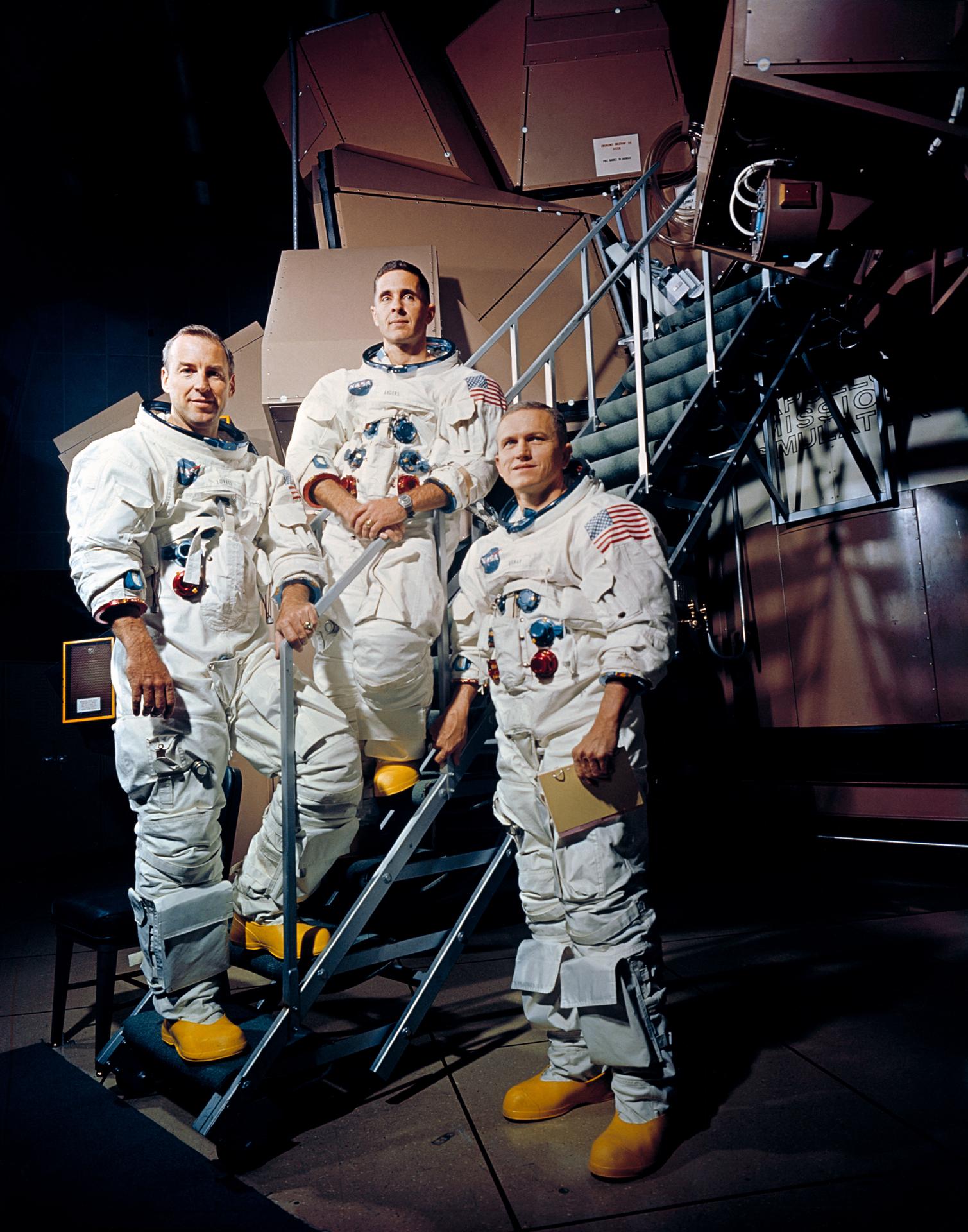
Portrait of the Apollo 8 crew
The prime crew of the Apollo 8 lunar orbit mission pose for a portrait next to the Apollo Mission Simulator at the Kennedy Space Center (KSC). Left to right, they are James A. Lovell Jr., command module pilot; William A. Anders, lunar module pilot; and Frank Borman, commander.
NASA

On their way to the Moon, the Apollo 8 crew was not very hungry. Food scientist Malcolm Smith later documented just how little the crew ate. Borman ate the least of the three, eating only 881 calories on day two, which concerned flight surgeon Chuck Berry. Most of the food, Borman later explained, was “unappetizing.” The crew ate few of the compressed, bite-sized items, and when they rehydrated their meals, the food took on the flavor of their wrappings instead of the actual food in the container. “If that doesn’t sound like a rousing endorsement, it isn’t,” he told viewers watching the Apollo 8 crew in space ahead of their surprise meal. As Anders demonstrated to the television audience how the astronauts prepared a meal and ate in space, Borman announced his wish, that folks back on Earth would “have better Christmas dinners” than the one the flight crew would be consuming that day.1

If that doesn’t sound like a rousing endorsement, it isn’t.
Frank Borman

Frank Borman

Apollo 8 Astronaut

Over the 1960s, there were many complaints about the food from astronauts and others working at the Manned Spacecraft Center (now NASA’s Johnson Space Center). After evaluating the food that the Apollo 8 crew would be consuming onboard their upcoming flight, Apollo 9 astronaut Jim McDivitt penciled a note to the food lab about his in-flight preferences. Using the back of the Apollo 8 crew menu, he directed them to decrease the number of compressed bite-sized items “to a bare minimum” and to include more meat and potato items. “I get awfully hungry,” he wrote, “and I’m afraid I’m going to starve to death on that menu.”2

In 1969, Rita Rapp, a physiologist who led the Apollo Food System team, asked Donald Arabian, head of the Mission Evaluation Room, to evaluate a four-day food supply used for the Apollo missions. Arabian identified himself as someone who “would eat almost anything. … you might say [I am] somewhat of a human garbage can.” But even he found the food lacked the flavor, aroma, appearance, texture, and taste he was accustomed to. At the end of his four-day assessment he concluded that “the pleasures of eating were lost to the point where interest in eating was essentially curtailed.”3
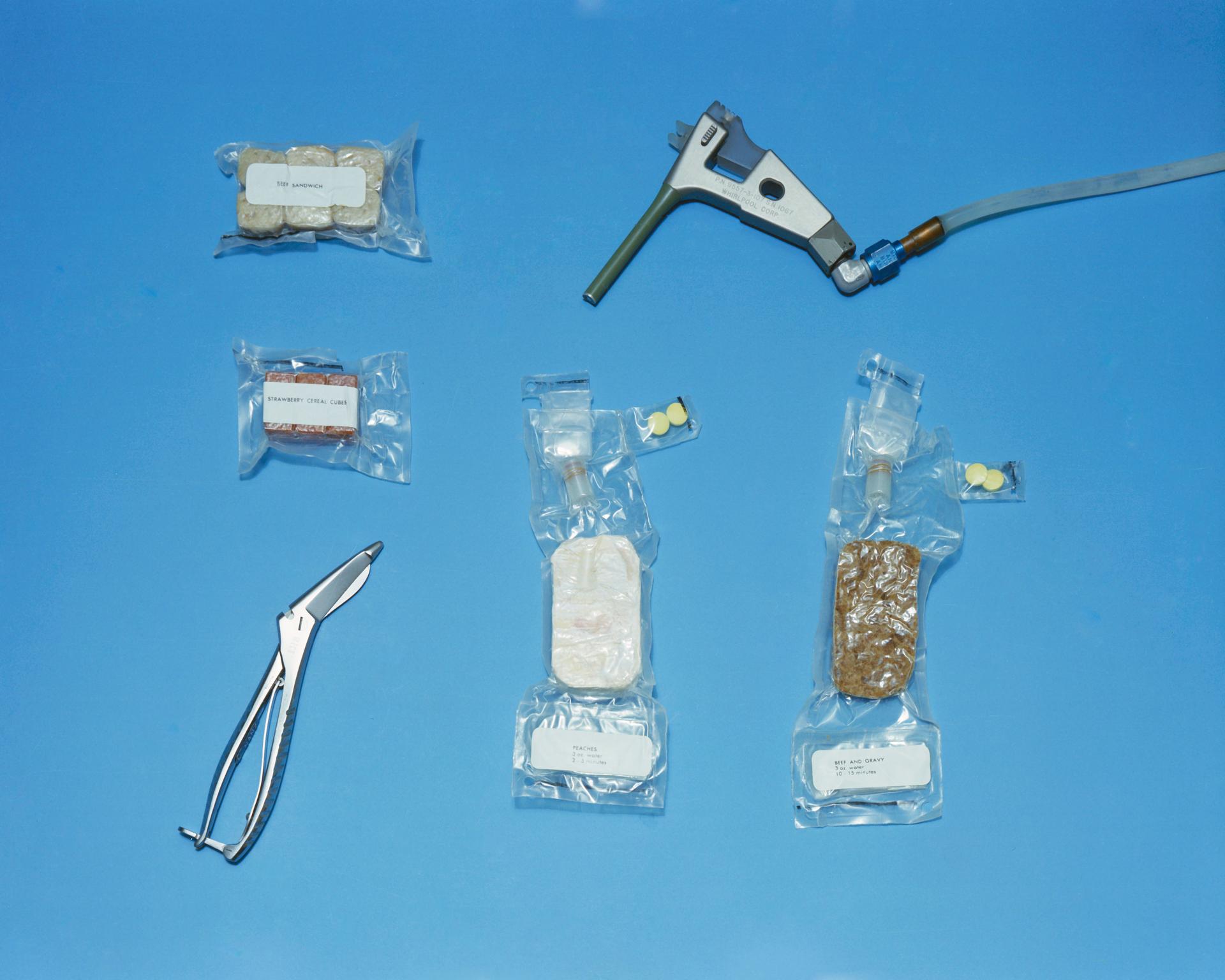
An array of food items and related implements used on the Gemini-Titan 4 mission
Food used on the Gemini-Titan IV flight. Packages include beef sandwich cubes, strawberry cereal cubes, dehydrated peaches, and dehydrated beef and gravy. A water gun on the Gemini spacecraft is used to reconstitute the dehydrated food and scissors are used to open the packaging.
NASA

Apollo 8 commander Frank Borman concurred with Arabian’s assessment of the Apollo food. The one item Borman enjoyed? It was the contents of the Christmas meal wrapped in ribbons: turkey and gravy. The Christmas dinner was so delicious that the crew contacted Houston to inform them of their good fortune. “It appears that we did a great injustice to the food people,” Lovell told capsule communicator (CAPCOM) Mike Collins. “Just after our TV show, Santa Claus brought us a TV dinner each; it was delicious. Turkey and gravy, cranberry sauce, grape punch; [it was] outstanding.” In response, Collins expressed delight in hearing the good news but shared that the flight control team was not as lucky. Instead, they were “eating cold coffee and baloney sandwiches.”4
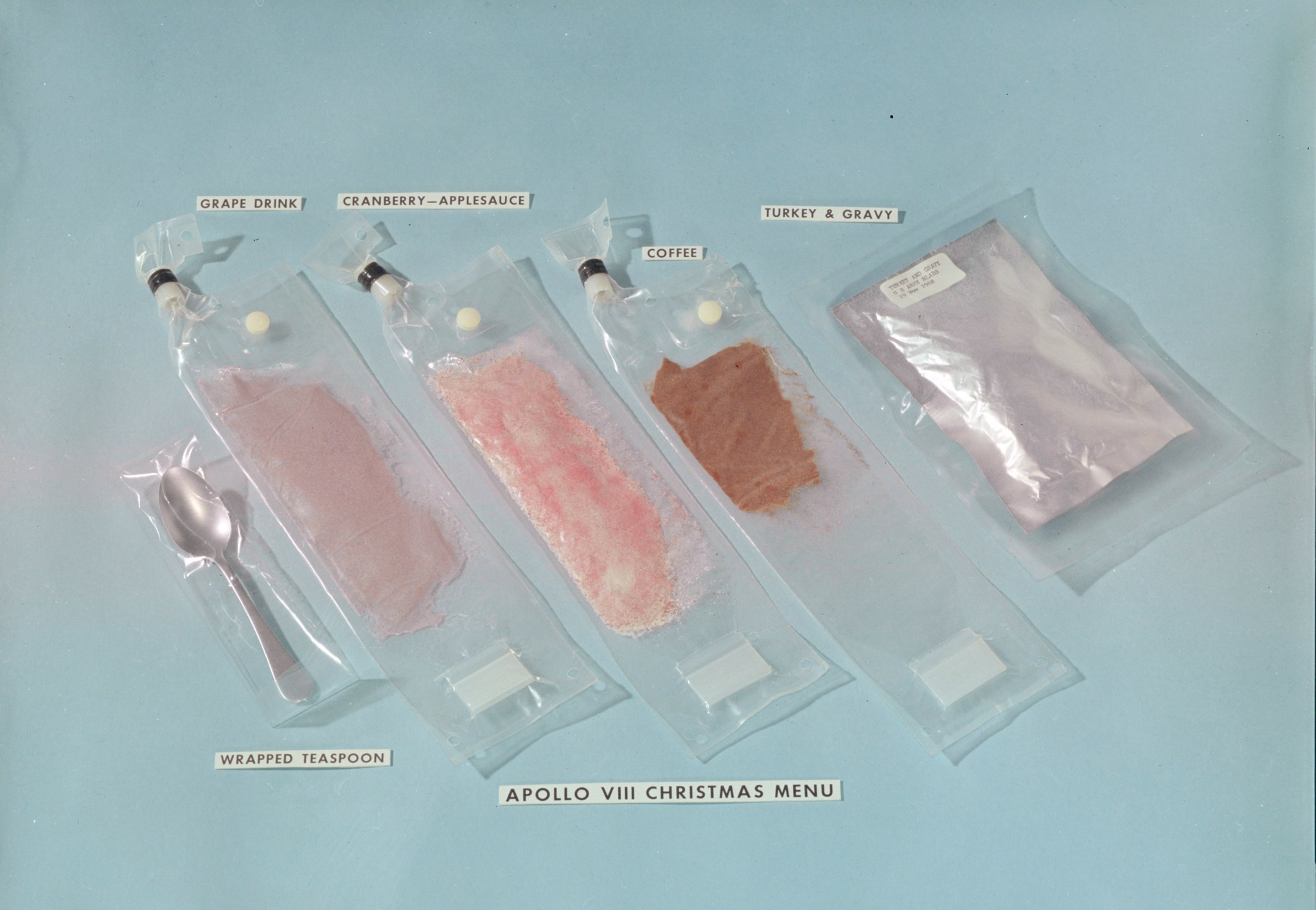
4 packets of food and a spoon wrapped in plastic that were served to the Apollo 8 crew for Christmas
The Apollo 8 Christmas menu included dehydrated grape drink, cranberry-applesauce, and coffee, as well as a wetpack containing turkey and gravy.
U.S. Natick Soldier Systems Center Photographic Collection

The Apollo 8 meal was a “breakthrough.” Until that mission, the food choices for Apollo crews were limited to freeze dried foods that required water to be added before they could be consumed, and ready-to-eat compressed foods formed into cubes. Most space food was highly processed. On this mission NASA introduced the “wetpack”: a thermostabilized package of turkey and gravy that retained its normal water content and could be eaten with a spoon. Astronauts had consumed thermostabilized pureed food on the Project Mercury missions in the early 1960s, but never chunks of meat like turkey. For the Project Gemini and Apollo 7 spaceflights, astronauts used their fingers to pop bite-sized cubes of food into their mouths and zero-G feeder tubes to consume rehydrated food. The inclusion of the wetpack for the Apollo 8 crew was years in the making. The U.S. Army Natick Labs in Massachusetts developed the packaging, and the U.S. Air Force conducted numerous parabolic flights to test eating from the package with a spoon.5

Smith called the meal a real “morale booster.” He noted several reasons for its appeal: the new packaging allowed the astronauts to see and smell the turkey and gravy; the meat’s texture and flavor were not altered by adding water from the spacecraft or the rehydration process; and finally, the crew did not have to go through the process of adding water, kneading the package, and then waiting to consume their meal. Smith concluded that the Christmas dinner demonstrated “the importance of the methods of presentation and serving of food.” Eating from a spoon instead of the zero-G feeder improved the inflight feeding experience, mimicking the way people eat on Earth: using utensils, not squirting pureed food out of a pouch into their mouths. Using a spoon also simplified eating and meal preparation. NASA added more wetpacks onboard Apollo 9, and the crew experimented eating other foods, including a rehydrated meal item, with the spoon.6
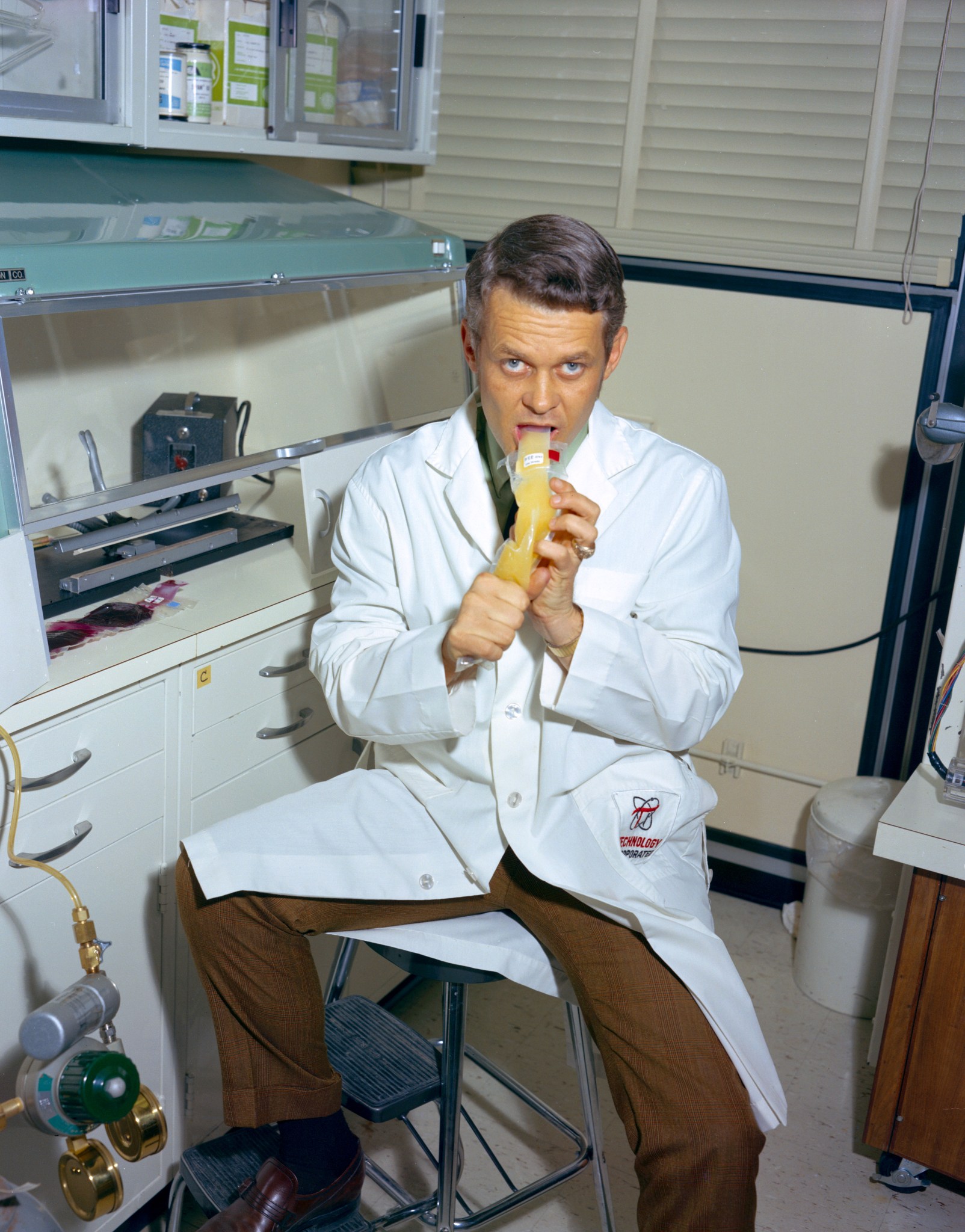
Photo of Malcolm Smith squirting a clear plastic pouch of orange food into his mouth while sitting on a stool.
Malcolm Smith demonstrates eating space food.
NASA

Food was one of the few creature comforts the crew had on the Apollo 8 flight, and this meal demonstrated the psychological importance of being able to smell, taste, and see the turkey prior to consuming their meal, something that was lacking in the first four days of the flight. Seeing appetizing food triggers hunger and encourages eating. In other words, if food looks and smells good, then it must taste good. Little things like this improvement to the Apollo Food System made a huge difference to the crews who simply wanted some of the same eating experiences in orbit and on the Moon that they enjoyed on Earth.

Footnotes

[1] Apollo 8 Mission Commentary, Dec. 25, 1968, p. 543, https://historycollection.jsc.nasa.gov/JSCHistoryPortal/history/mission_trans/AS08_PAO.PDF; Apollo 8 Technical Debriefing, Jan. 2, 1969, 078-15, Apollo Series, University of Houston-Clear Lake, Houston, Texas (hereafter UHCL); Malcolm C. Smith to Director of Medical Research and Operations, “Nutrient consumption on Apollo VII and VIII,” Jan. 13, 1969, Rita Rapp Papers, Box 1, UHCL.

[2] Jim McDivitt food evaluation form, n.d., Box 17, Rapp Papers, UHCL.   

[3] Donald Arabian to Rapp, “Evaluation of four-day food supply,” May 8, 1969, Box 17, Rapp Papers, UHCL.

[4] Apollo 8 Mission Commentary, Dec. 25, 1968, p. 545.

[5] Malcolm Smith, “The Apollo Food Program,” in Aerospace Food Technology, NASA SP-202 (Washington, DC: 1970), pp. 5–8; Whirlpool Corporation, “Space Food Systems: Mercury through Apollo,” Dec. 1970, Box 9, Rapp Papers, UHCL.

[6] Smith, “The Apollo Food Program,” pp. 7–8; Smith to the Record, “Christmas Dinner for Apollo VIII,” Jan. 10, 1969, Box 1, Rapp Papers, UHCL; Smith et al, “Apollo Food Technology,” in Biomedical Results of Apollo, NASA SP-368 (Washington, DC: NASA, 1975), p. 456.

About the Author
Jennifer Ross-Nazzal

Jennifer Ross-Nazzal

NASA Human Spaceflight Historian

Jennifer Ross-Nazzal is the NASA Human Spaceflight Historian. She is the author of Winning the West for Women: The Life of Suffragist Emma Smith DeVoe and Making Space for Women: Stories from Trailblazing Women of NASA’s Johnson Space Center.

Share

Details

Last Updated

Dec 21, 2023

Editor
Michele Ostovar

Powered by WPeMatico

Get The Details…
Jennifer Ross-Nazzal

Dragon Undocks, Scientific Cargo Headed Back to Earth

Dragon Undocks, Scientific Cargo Headed Back to Earth

A SpaceX Dragon cargo spacecraft is seen departing the station after undocking from the Harmony module at 4:05 p.m. EST Thursday, Dec. 21. Credit: NASA TV

Following commands from ground controllers at SpaceX in Hawthorne, California, Dragon undocked at 5:05 p.m. EST from the forward port of the station’s Harmony module. At the time of undocking the station was flying at an altitude about 260 miles southwest of Chile.

After re-entering Earth’s atmosphere, the spacecraft will make a parachute-assisted splashdown off the coast of Florida on Friday, Dec. 22. NASA will not broadcast the splashdown, but updates will be posted on the agency’s space station blog.

Dragon arrived at the space station Nov. 11 as SpaceX’s 29th commercial resupply services mission for NASA, delivering about 6,500 pounds of research investigations, crew supplies, and station hardware. It was launched Nov. 9 on a SpaceX Falcon 9 rocket from Launch Complex 39A at Kennedy.


Learn more about station activities by following the space station blog, @space_station and @ISS_Research on X, as well as the ISS Facebook and ISS Instagram accounts.

Get weekly video highlights at: https://roundupreads.jsc.nasa.gov/videoupdate/

Get the latest from NASA delivered every week. Subscribe here: www.nasa.gov/subscribe

Powered by WPeMatico

Get The Details…

Abby Graf

NASA Flies Drones Autonomously for Air Taxi Research

NASA Flies Drones Autonomously for Air Taxi Research

3 min read

Preparations for Next Moonwalk Simulations Underway (and Underwater)

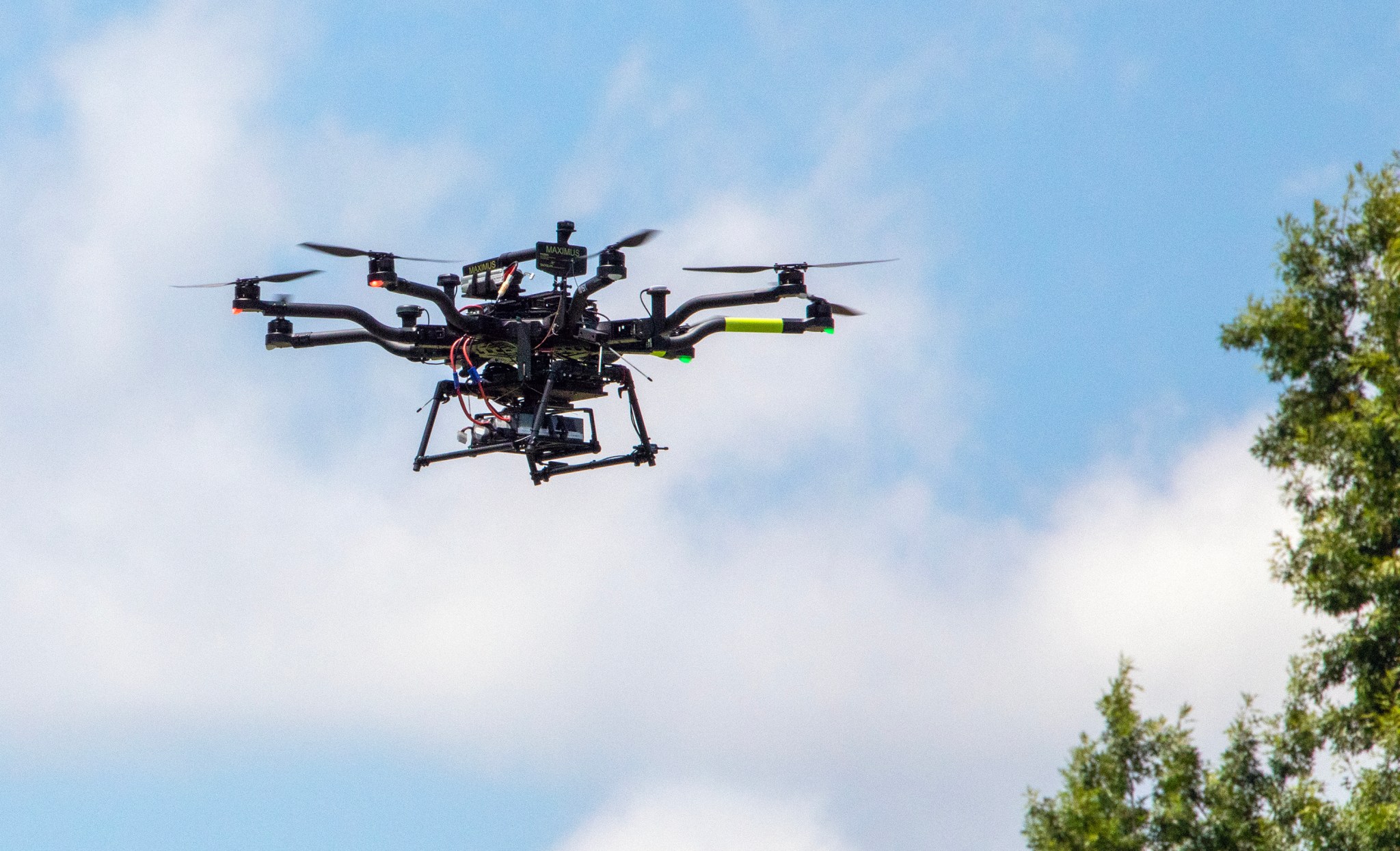
A small, black drone with multiple helicopter-like blades hovers over some trees during a bright, partly cloudy day in Virginia.
An Alta-8 small Unmanned Aircraft System testbed vehicle flies above NASA’s Langley Research Center in Hampton, Virginia. Flying beyond visual line of sight from observers on the ground required special approval from the Federal Aviation Administration and NASA.
NASA / Bowman

Researchers at NASA’s Langley Research Center in Hampton, Virginia recently flew multiple drones beyond visual line of sight with no visual observer. The drones successfully flew around obstacles and each other during takeoff, along a planned route, and upon landing, all autonomously without a pilot controlling the flight. This test marks an important step towards advancing self-flying capabilities for air taxis.

“Flying the vehicles beyond visual line of sight, where neither the vehicle nor the airspace is monitored using direct human observation, demonstrates years of research into automation and safety systems, and required specific approval from the Federal Aviation Administration and NASA to complete,” said Lou Glaab, branch head for the aeronautics systems engineering branch at NASA Langley.

It is safer and more cost effective to test self-flying technology meant for larger, passenger carrying air taxis on smaller drones to observe how they avoid each other and other obstacles.

NASA also is testing elements of automation technology using helicopters. These stand-in aircraft help NASA mature the autonomy well before self-flying air taxis are integrated into the skies.

“When you have multiple vehicles, all coming and going from a vertiport that is located adjacent to an airport or deep within a community, we have to ensure the automation technologies of these vehicles are capable of safely handling a high volume of air traffic in a busy area,” said Glaab.

Building upon past tests, the team successfully performed multiple flights using purchased ALTA 8 Uncrewed Aircraft Systems, also known as drones, with no visual observer and flew the drones beyond visual line of sight, referred to as “NOVO-BVLOS” flights.

The software loaded onto the small drones performed airspace communications, flight path management, avoidance with other vehicles, and more skills needed to operate in a busy airspace. This is imperative for what is envisioned with Advanced Air Mobility (AAM), where drones and air taxis will be operating at the same time on a routine basis.

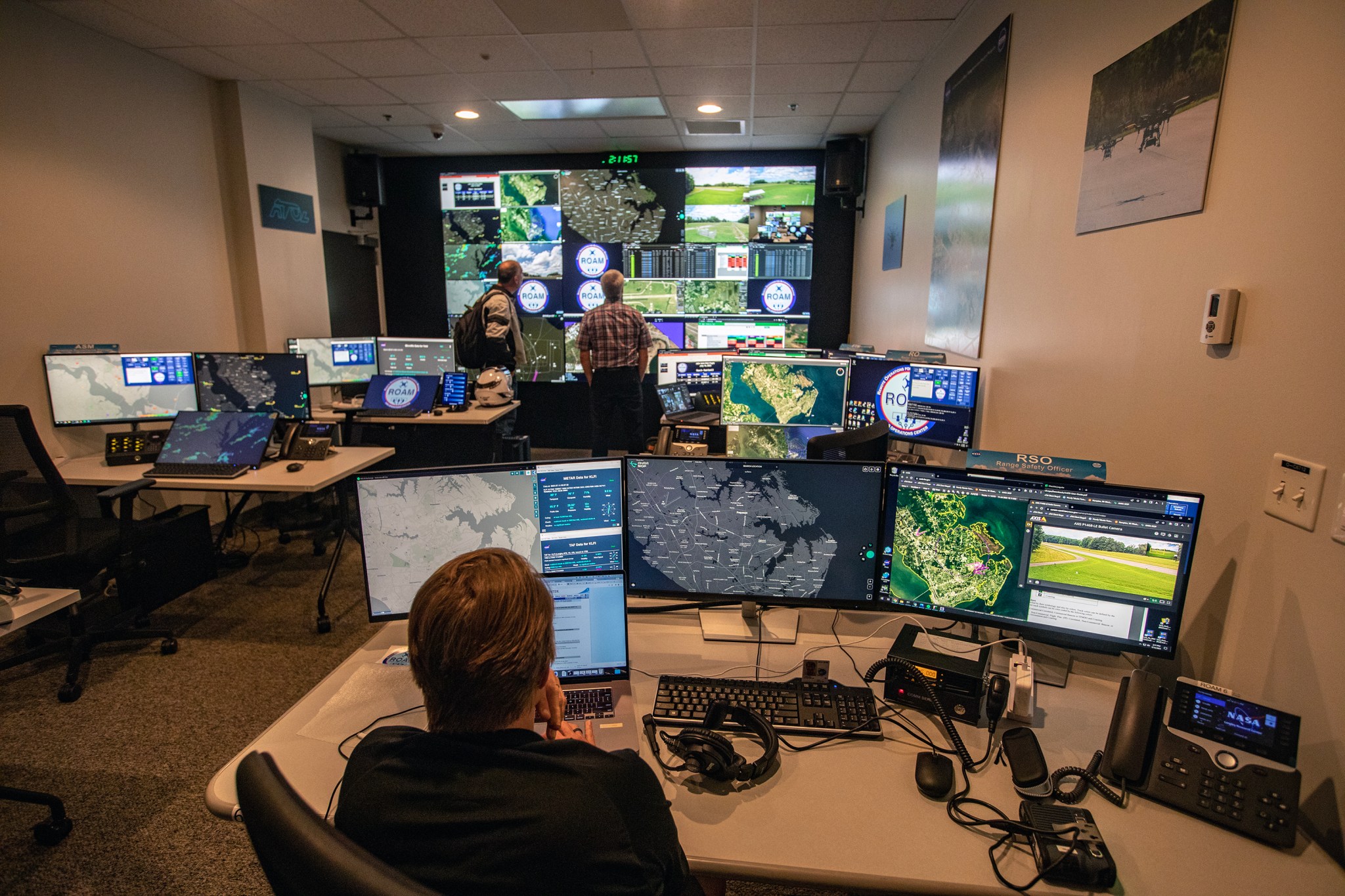
The flight tests were observed from NASA Langley’s Remote Operations for Autonomous Missions control center while the drones took off and landed at the City Environment for Testing Autonomous Integrated Navigation test range.

A room full of computer screens on tables and a far wall are watched by researchers monitoring the flight of small drones.
NASA researchers monitor the flight of an autonomous vehicle from the Remote Operations for Autonomous Missions UAS Operations Center at NASA’s Langley Research Center in Hampton, Virginia. the center facilitates “beyond visual line of sight” flight operations of small uncrewed aircraft system vehicles, also known as drones.
NASA / David Bowman

NASA will transfer the new technology created during this project to the public to ensure industry manufacturers can access the software while designing their vehicles.

“NASA’s ability to transfer these technologies will significantly benefit the industry,” said Jake Schaefer, flight operations lead for the project. “By conducting flight tests within the national airspace, in close proximity to airports and an urban environment, we are table to test technologies and procedures in a controlled but relevant environment for future AAM vehicles.”

One of these technologies was ICAROURS, which stands for NASA’s Integrated Configurable Architecture for Reliable Operations of Unmanned Systems. This software provides an autonomous detect-and-avoid function and is part of the overall system to maintain “well clear” from other air traffic.

Another technology used was NASA’s Safe2Ditch system, which allows the vehicle to observe the ground below and make an autonomous decision on the safest place to land in the event of an in-flight emergency.

NASA’s AAM mission has multiple projects contributing to various research areas. This project, called the High Density Vertiplex, was specifically focused on testing and evaluating where these future vehicles will take off and land at high frequency, called vertiports, or vertiplexes, for multiple vertiports near each other, and the technology advancements needed to make this successful.

Share

Details

Last Updated

Dec 21, 2023

Editor
Jim Banke
Contact
Location
Langley Research Center

Powered by WPeMatico

Get The Details…
Jim Banke

Live Coverage Underway of SpaceX Dragon Cargo Spacecraft Departure

Live Coverage Underway of SpaceX Dragon Cargo Spacecraft Departure

Thrusters on the SpaceX Dragon cargo spacecraft fire automatically while adjusting the vehicle's slow, methodical approach toward the International Space Station for a docking to the Harmony module's forward port.
Thrusters on the SpaceX Dragon cargo spacecraft fire automatically while adjusting the vehicle’s slow, methodical approach toward the International Space Station for a docking to the Harmony module’s forward port.

Live coverage of the departure of SpaceX’s Dragon cargo spacecraft from the International Space Station is underway on NASA Television, the agency’s website, and the NASA app.

Following commands from ground controllers at SpaceX in Hawthorne, California, Dragon will undock at 5:05 p.m. EST from the forward port of the station’s Harmony module and fire its thrusters to move a safe distance away from the station.

After re-entering Earth’s atmosphere, the spacecraft will make a parachute-assisted splashdown off the coast of Florida on Friday, Dec. 22. NASA will not broadcast the splashdown, but updates will be posted on the agency’s space station blog.


Watch Dragon undock live on the NASA+ streaming service via the web or the NASA app. Docking coverage also will air live on NASA Television, YouTube, and on the agency’s website. Learn how to stream NASA TV through a variety of platforms including social media.

Learn more about station activities by following the space station blog, @space_station and @ISS_Research on X, as well as the ISS Facebook and ISS Instagram accounts.

Get weekly video highlights at: https://roundupreads.jsc.nasa.gov/videoupdate/

Get the latest from NASA delivered every week. Subscribe here: www.nasa.gov/subscribe

Powered by WPeMatico

Get The Details…

Abby Graf

Dragon, Cygnus Cargo Missions Nearing End This Week

Dragon, Cygnus Cargo Missions Nearing End This Week

A SpaceX Dragon cargo spacecraft (left) approaches the station on Nov. 11. The Cygnus resupply ship (right) awaits a robotic capture on Aug. 4.

A SpaceX Dragon cargo spacecraft is targeting its undocking from the International Space Station for 5:05 p.m. EST today. The Expedition 70 crew finished packing Dragon on Wednesday with a variety of research samples and lab hardware for retrieval and analysis on Earth.

The orbital residents now turn their attention to the departure of a second U.S. resupply ship set for 8:05 a.m. on Friday. Northrop Grumman’s Cygnus space freighter was grappled with the Canadarm2 robotic arm and will soon be detached from the Unity module’s Earth-facing port before being released into Earth orbit completing a four-and-a-half month stay at the orbiting lab. Cygnus will stay in space until early January when it will enter the atmosphere above the Pacific Ocean for a fiery, but safe demise.

NASA, Axiom Space, and SpaceX teams now are targeting no earlier than Wednesday, Jan. 17, to launch Axiom Mission-3 to the space station from Kennedy Space Center’s Launch Complex 39A due to recent unfavorable weather conditions and changes in SpaceX’s launch manifest.

Astronauts Jasmin Moghbeli and Satoshi Furukawa completed preparations for Cygnus’ departure today closing the hatch and configuring the vehicle to end its mission. NASA’s Moghbeli earlier installed the SAFFIRE-VI experiment inside Cygnus that will be remotely activated to explore spacecraft fire safety. Furukawa from JAXA (Japan Aerospace Exploration Agency) ensured the disposable cargo was securely strapped inside the departing spacecraft.

Science and maintenance activities were still ongoing throughout Thursday advancing knowledge and keeping the orbital outpost in tip-top shape. Scientists use the microgravity environment to discover new phenomena impossible to observe in Earth’s gravity.

NASA Flight Engineer Loral O’Hara opened up the Combustion Integrated Rack and configured research components supporting an experiment that is observing how fuel temperatures affect material flammability. Results from the study may improve fire safety techniques on Earth and in space. Commander Andreas Mogensen of ESA (European Space Agency) activated a series of coding studies to interest students in science, swapped out optical fiber samples for a manufacturing experiment, then replaced filters in the Advanced Plant Habitat for a new space botany investigation.

Working in the orbital lab’s Roscosmos segment, veteran cosmonaut Oleg Kononenko once again tested the 3D printing of tools and supplies in weightlessness then set up an Earth atmosphere monitoring experiment. Flight Engineer Konstantin Borisov installed a secondary atmospheric study that is observing Earth’s nighttime environment in near-ultraviolet wavelengths. Flight Engineer Nikolai Chub attached sensors to his chest monitoring how his heart is adapting to the lack of gravity.


Learn more about station activities by following the space station blog@space_station and @ISS_Research on X, as well as the ISS Facebook and ISS Instagram accounts.

Get weekly video highlights at: https://roundupreads.jsc.nasa.gov/videoupdate/

Get the latest from NASA delivered every week. Subscribe here: www.nasa.gov/subscribe

Powered by WPeMatico

Get The Details…

Mark Garcia