A Look Through Time with NASA’s Lead Photographer for the James Webb Space Telescope

A Look Through Time with NASA’s Lead Photographer for the James Webb Space Telescope

2 Min Read

A Look Through Time with NASA’s Lead Photographer for the James Webb Space Telescope

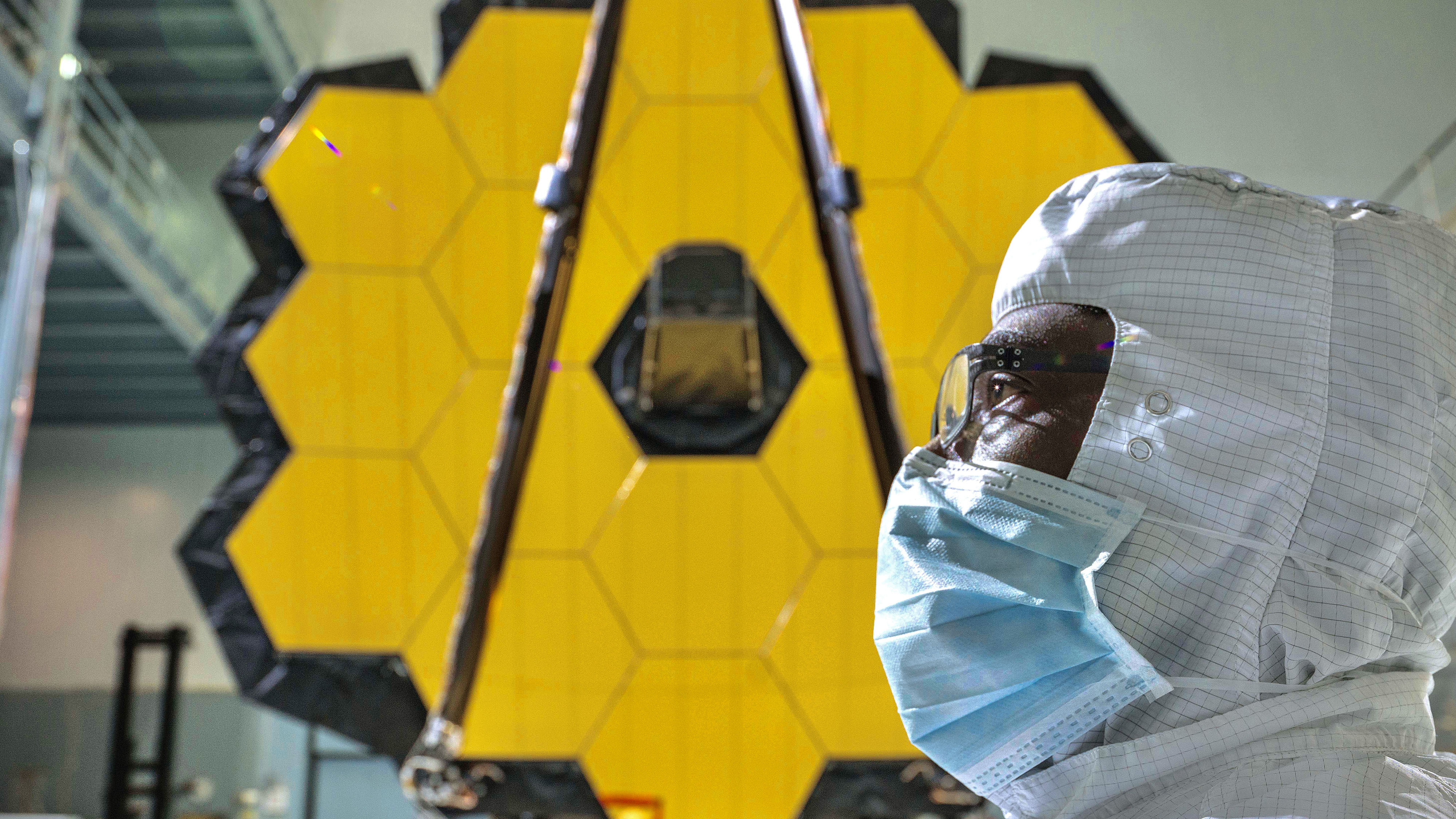
This self portrait of Chris Gunn, standing in front of NASA’s James Webb Space Telescope from inside the Goddard Space Flight Center cleanroom, was captured November 10, 2016.

Credits:
NASA/Chris Gunn

Nearly two years ago in the early morning hours of Dec. 25, NASA’s James Webb Space Telescope successfully took flight from the jungle-encircled ELA-3 launch complex at Europe’s Spaceport near Kourou, French Guiana. Following a successful deployment in space, and the precise alignment of the telescope’s mirrors and instruments, Webb began science operations nearly six months after liftoff. As the two-year anniversary of the launch aboard ESA’s (European Space Agency) Ariane 5 rocket approaches, Webb’s lead photographer Chris Gunn has remastered a selection of his favorite images from his career, including one previously unreleased image. 

The opportunity to be the visual spokesperson for a mission of this magnitude was the experience of a lifetime

Chris GUNN

Chris GUNN

NASA/GSFC Lead Photographer for Webb Telescope


Since the fall of 2009, Gunn has routinely worked through holidays and weekends, and has spent much of these years on the road, ensuring that the Webb telescope’s progress is visually chronicled and shared with the world. As the various parts and components of Webb began to be assembled and tested throughout the country, Gunn and his camera followed along, capturing the historic development of NASA’s premier space telescope. Though Gunn’s images display the complex nature of the telescope aesthetically, these images also serve as critical engineering bookmarks that the team routinely relied on to document that Webb’s construction was sound before launch.   

Following the launch of Webb, Gunn is now chronicling NASA’s next flagship space telescope, the Nancy Grace Roman Space Telescope.

All images below, credit NASA/Chris Gunn.  

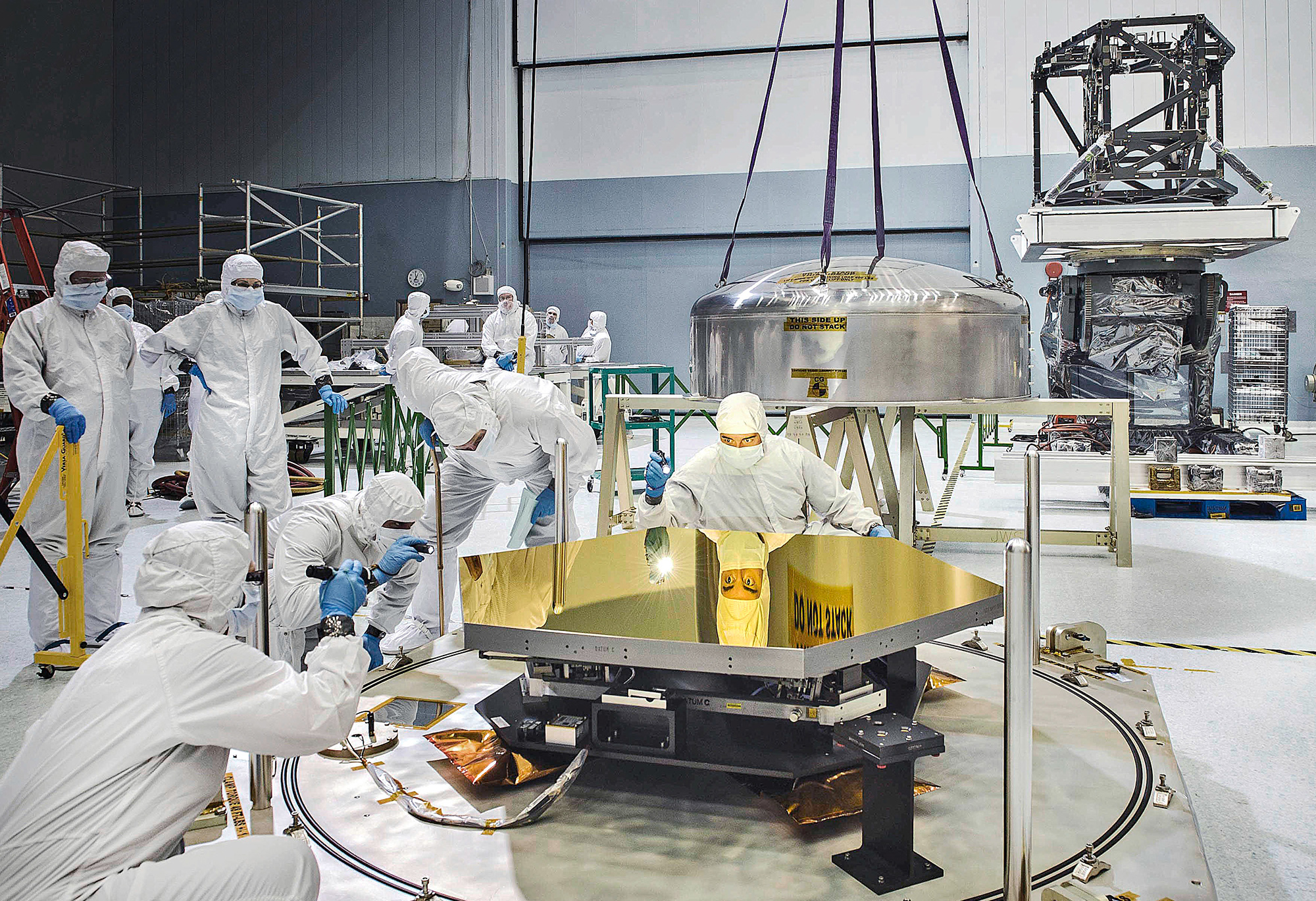
A diverse group of people in white cleanroom suits carefully inspect a single golden faced, hexagonal mirror from the James Webb Space Telescope. Many faces all stare intently, some using flashlights, to examine the mirror surface. Reflected on the surface is the face and intense eye contact from one engineer, and the bright reflection of his flashlight shining directly at the viewer. Behind this engineer, a stainless-steel lens cap used to safely transport the mirror, nearly the size of a human body, rests on scaffolding, still attached by ropes to the crane that lifted it off the mirror moments before. In the background, gray and light blue walls lay behind several other components of Webb scattered around the cleanroom floor. To the right of the frame, a structure made of long overlapping black struts that appear like scaffolding sits on top of a lift table that is meant to safely move the structure up and down.
On Nov. 6, 2012, engineers and technicians inspected one of the first of Webb’s 18 hexagonal mirrors to arrive at NASA’s Goddard Space Flight Center in Greenbelt, Maryland.
NASA/Chris Gunn

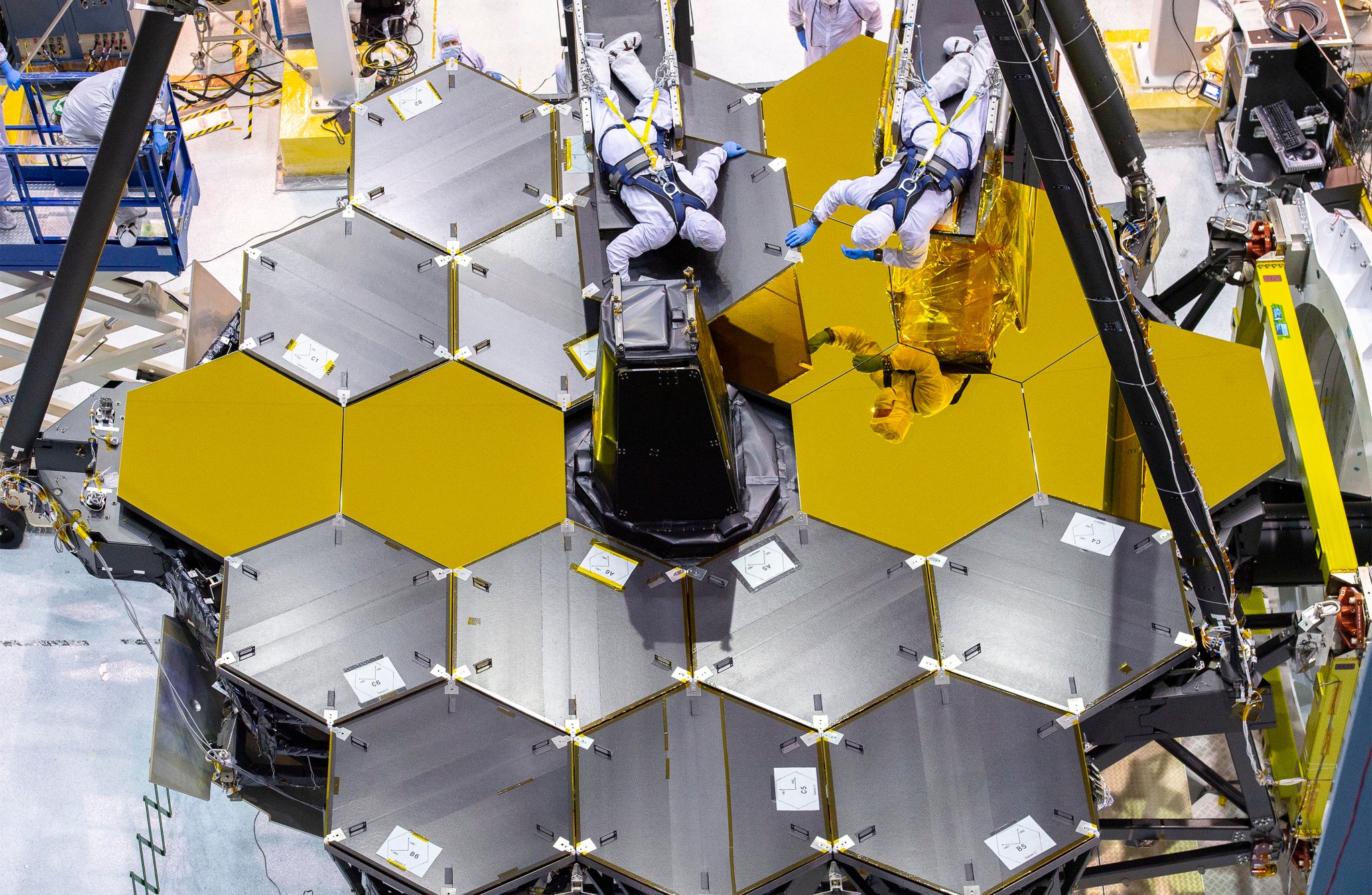
The covers being removed from the hexagonal gold mirrors of the James Webb Space Telescope. Two people in cleanroom “bunny” suits lay on diving boards over the mirror, which lays face pointed up, very carefully removing the covers one at a time. In this photo 6 covers have been removed, revealing the golden mirrors beneath. These are the 4 center line mirrors and two in the 4 and 5 o’clock positions. The two workers each hold part of another cover as they remove it. The worker on the right is reflected in the mirrors. Each of the black covers has a white sign on it noting which mirror segment it is. Each segment has a unique designation including A, B, or C and 1, 2, 3, 4, 5, or 6 depending on its prescription and location.
Inside a clean room at NASA’s Goddard Space Flight Center, on the afternoon of April 25, 2016, the James Webb Space Telescope primary mirrors were uncovered in preparation for installation of its scientific instruments.
NASA/Chris Gunn

Traveling alongside Webb as it grew and evolved, and to be able to add my signature to each photograph captured, was of course an honor, but also an immense challenge. With each image, I wanted to express the awe that I felt seeing Webb integrated right before my eyes, knowing that it was destined to shed new light on the mysteries of the cosmos.

CHRIS GUNN

CHRIS GUNN

NASA/GSFC Lead Photographer for Webb Telescope

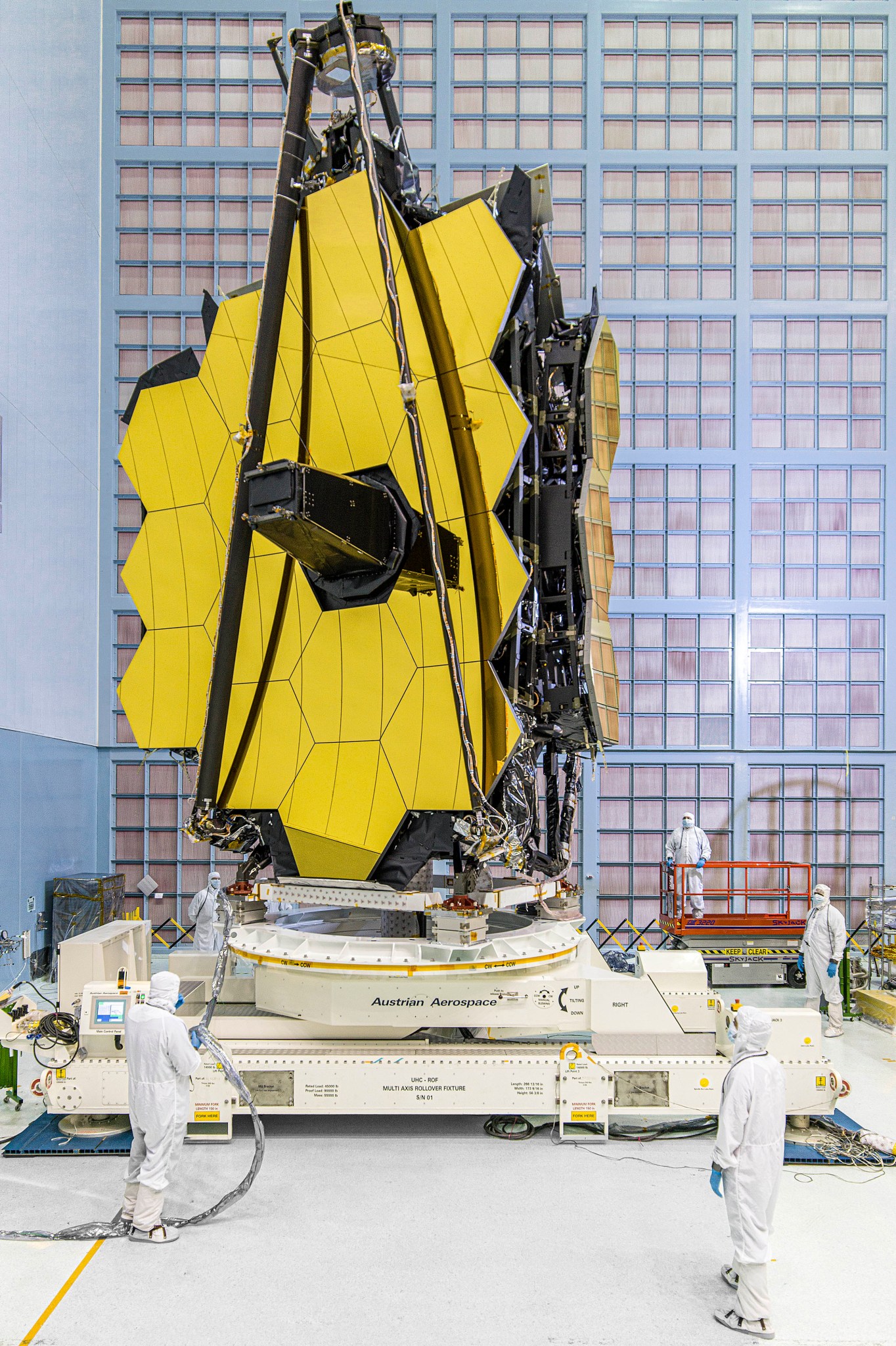
The James Webb Space Telescope mirrors upright on a white stand in the NASA Goddard cleanroom. The 3 mirrors on the right “wing” are folding back like a leaf on a drop-leaf table. The telescope has 18 golden hexagonal segments. The secondary mirror support structure, made of three thin black lines, is folded and the secondary mirror sits atop this folded tripod. There are 5 people in white cleanroom suits supervising the folding maneuver. One of them is on a red lift at the back right. There is a wall of HEPA filters behind the telescope.
NASA’s James Webb Space Telescope is shown with one of its two “wings” folded. Each wing holds three of its primary mirror segments. During this operation in the clean room at NASA Goddard, the telescope was also rotated in preparation for the folding back of the other wing. When Webb launched, both wings were stowed in this position, which enabled the mirror to fit into the launch vehicle. This image was captured July 17, 2016.
NASA/Chris Gunn

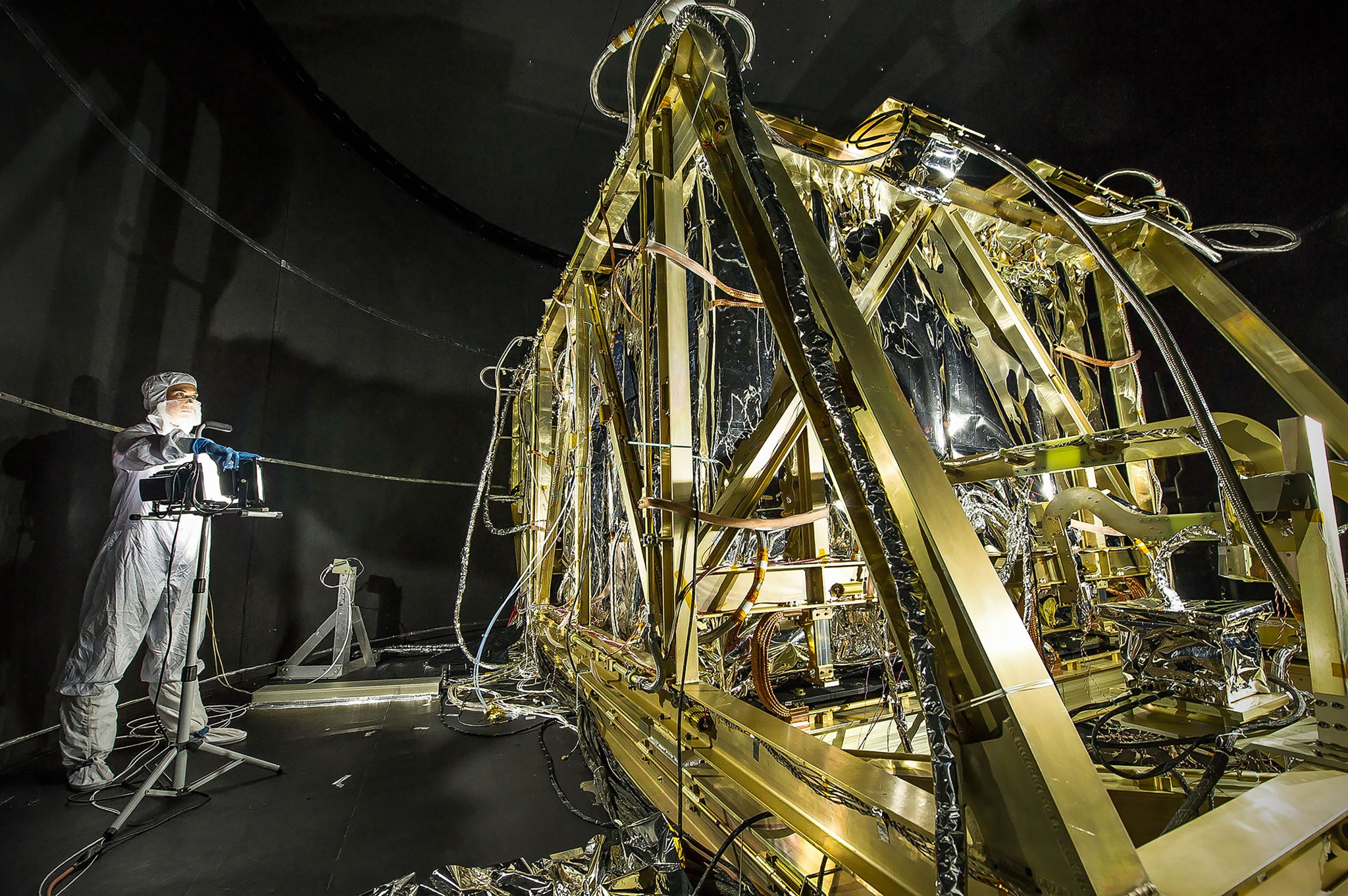
The silvery James Webb Space Telescope instrument module is enclosed in a metallic gold-colored structure. NASA photographer Desiree Stover stands to the left, holding some equipment and facing the hardware. She is wearing a white cleanroom suit. She and the hardware are inside a round, black chamber, which is inside Goddard’s large thermal vacuum chamber where the instrument is tested at its extremely cold operating temperatures.
Dressed in a clean room suit, NASA photographer Desiree Stover shines a light on the Space Environment Simulator’s integration frame inside the thermal vacuum chamber at NASA’s Goddard Space Flight Center in Greenbelt, Md. This image was captured Aug. 29, 2013.
NASA/Chris Gunn

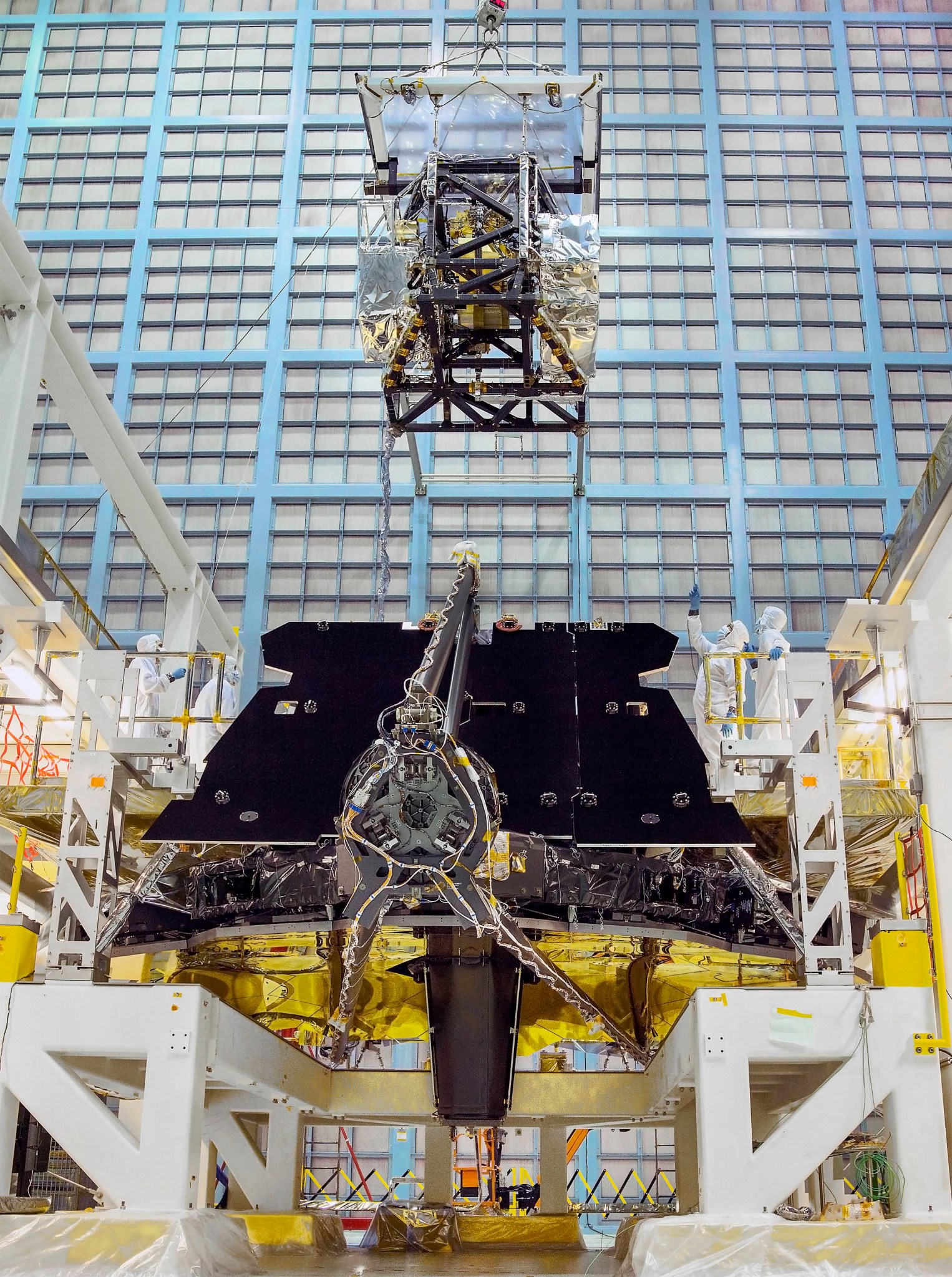
Webb’s instrument module is integrated onto the back of the telescope, right behind the mirrors. The telescope is facedown on a white stand, with the golden mirrors facing down. The secondary mirror support structure is folded over the mirrors, with the round back of the secondary mirrors facing the camera. Behind it is a black radiator panel. The instrument module is being lowered by a crane. The 4 science instruments are visible through the module structure. In the background is a wall of HEPA filters that help keep the NASA Goddard cleanroom clean.
On May 19, 2016, inside a massive clean room at NASA’s Goddard Space Flight Center, Webb’s Integrated Science Instrument Module was lowered into the Optical Telescope Element.
NASA/Chris Gunn

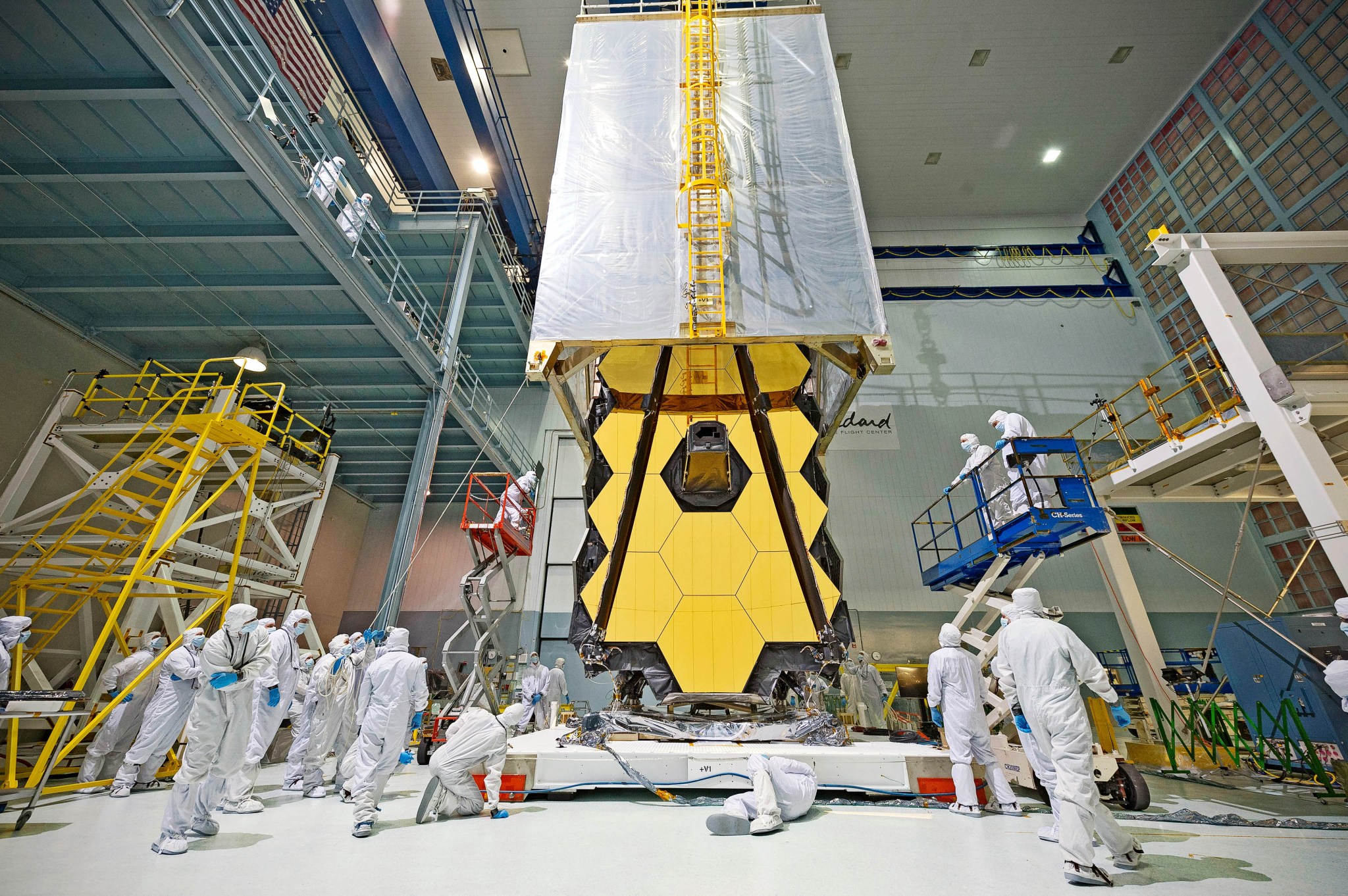
The Webb telescope mirrors are shown in the NASA Goddard cleanroom, with a clean tent, which looks like a giant rectangle made of clear plastic tarp, half over the mirrors. A crane is lowering it down. The mirrors are gold hexagons. The three on each side wing are folded back like a drop leaf table. The telescope is being prepped for vibration testing. For testing, it has to be removed from the cleanroom, so the tent will protect it while it is being tested. There are multiple people in white cleanroom suits that cover them from head to toe and protect the cleanroom from hair and skin cells and contaminants on clothes. Two of the people are on a blue lift to the right of the telescope, and one on a red and silver left to the left, inspecting the work. There is a yellow ladder at far left. There are various white support structures. The wall at far right is covered in HEPA filters. The very large cleanroom door is directly behind the telescope.
Taken on Nov. 16, 2016, inside NASA Goddard’s largest clean room Webb’s Optical Telescope Element and Integrated Science Instrument Module – together called “OTIS” – are shrouded with a “clean tent” as the team prepared for Webb’s first vibration testing, which took place just outside the clean room.
NASA/Chris Gunn

To capture Webb in its true beauty, I employed the use of specialized lighting rigs, often setting up lights early before the start of work. Johnson Space Center’s Chamber A was an especially tough subject to shoot once Webb was inside. It required remote lights that had to be adjusted perfectly before I boarded a boom lift to make the photograph from seven stories up. It was all worth it, everyone’s hard work – just look at how well our starship is performing

Chris Gunn

Chris Gunn

NASA/GSFC Lead Photographer for Webb Telescope

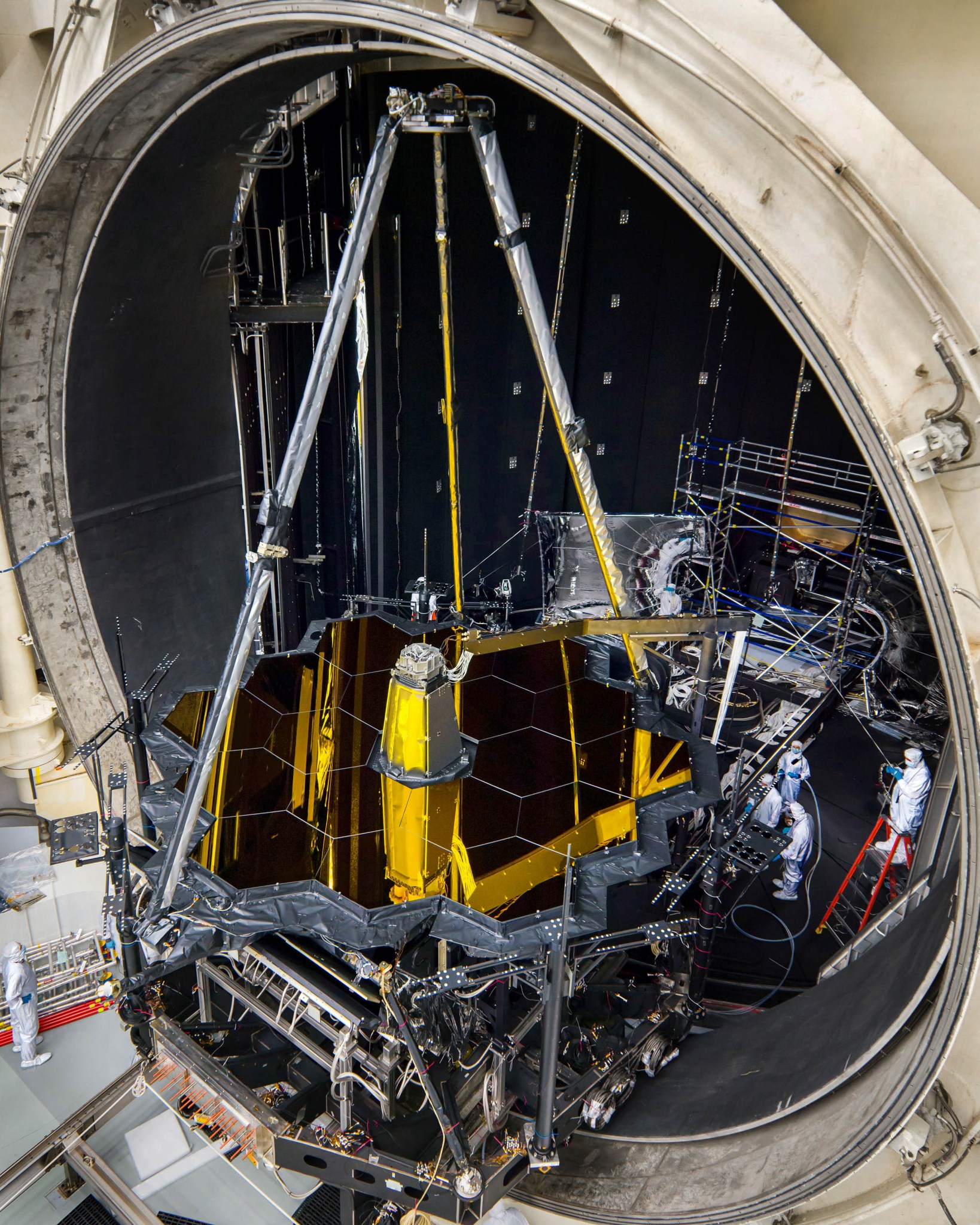
The Webb telescope enters the giant Chamber A thermal vacuum chamber at NASA Johnson. At this point, Webb consists of mirrors and instruments but has not yet been mated with the sunshield or spacecraft bus. Webb is on its back, golden hexagonal mirrors face up. The secondary mirror support structure is extended like a tripod above the primary mirrors. The telescope lies on black and silver support equipment. It is half in the giant mouth of the cavernous test chamber. The chamber is filled with test equipment and people in cleanroom suits. One of them stands on top of a red ladder.
On June 20, 2017, Webb’s Optical Telescope Element and science instruments were loaded into the historic thermal vacuum testing facility known as “Chamber A” at NASA’s Johnson Space Center in Houston.
NASA/Chris Gunn

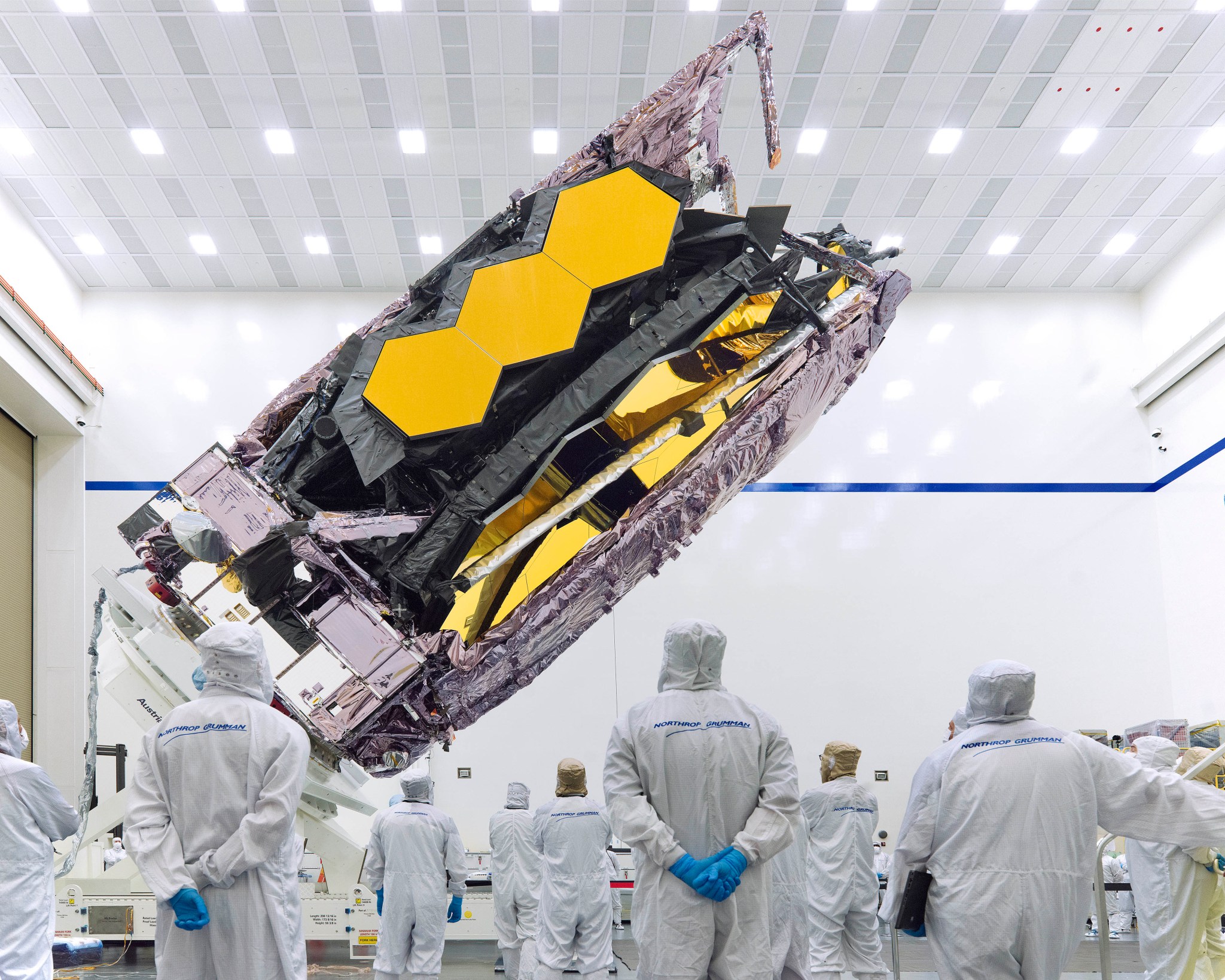
Several cleanroom technicians stand and watch as the Webb telescope, in its folded configuration, is being lifted and horizontally tilted towards the right side. When folded, Webb’s purple, metallic pallets surround its hexagonal, gold-coated mirror segments, making a long rectangle shape. The technicians wear blue gloves and white contamination-control suits that have the blue Northrop Grumman logo on the back. This image was taken in the Northrop Grumman cleanroom, which features a blue line running across its bright white walls.
On Sept. 16, 2021, Webb was ready to be shipped to the launch site in French Guiana. Before Webb could be lifted into its shipping container, engineers and technicians at Northrop Grumman in Redondo Beach, California, performed this first horizontal tilt of the fully assembled observatory.
NASA/Chris Gunn
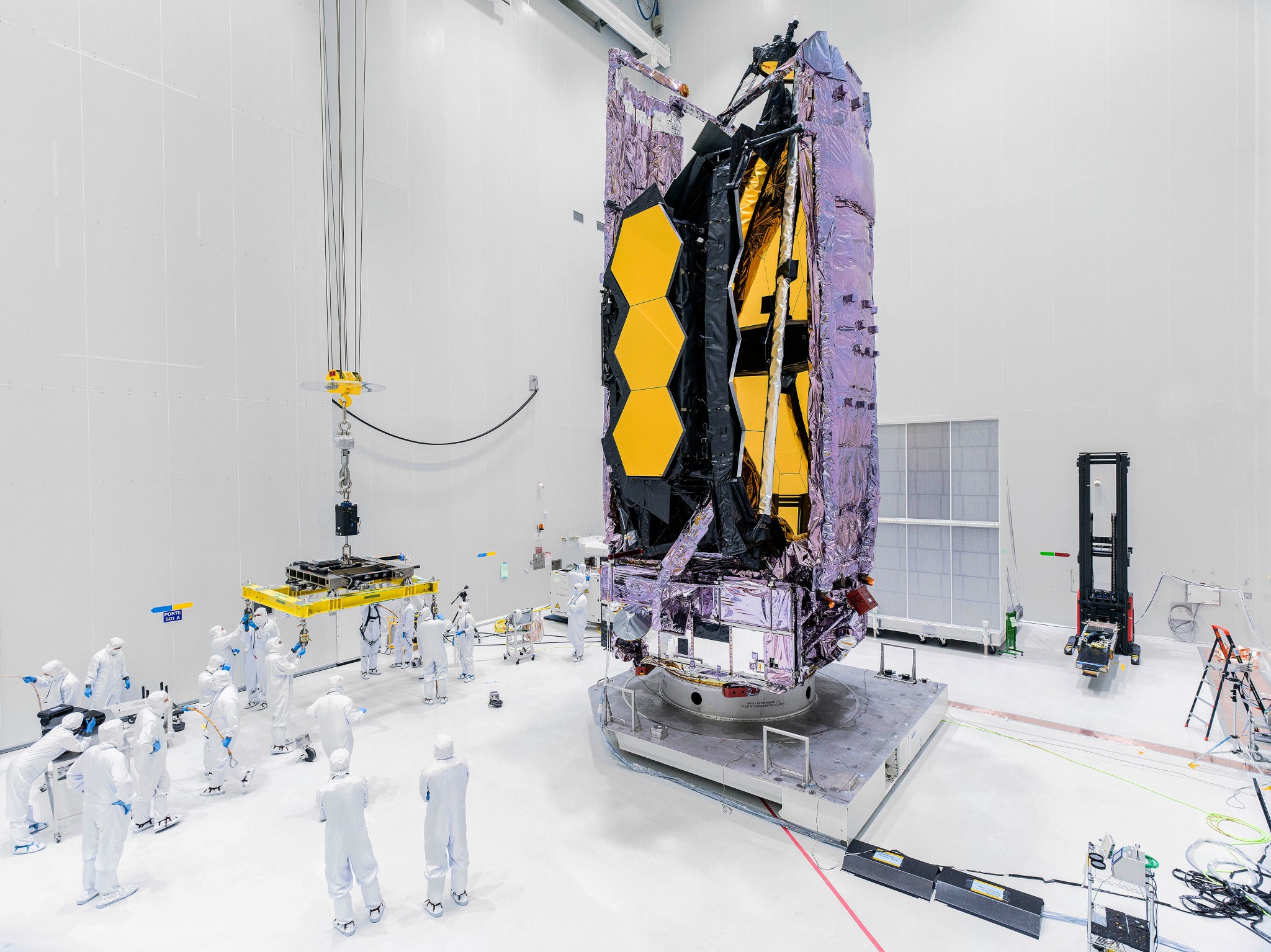
Image taken in a cleanroom at Europe’s Spaceport in Kourou, French Guiana. Dozens of cleanroom technicians, wearing white contamination-control suits and blue gloves, stand towards the left side of this image. On the right side is the Webb telescope in its folded configuration. Its purple sunshield pallets enclose its hexagonal, gold-colored mirror segments. Other hardware, wires, and equipment are located around the cleanroom, which features bright white walls.
This never-before-seen image shows engineers and technicians disassembling ground hardware after completing one of the final lifts of the Webb observatory, before being placed atop ESA’s (European Space Agency) Ariane 5 rocket in French Guiana. This image was taken Nov. 11, 2021.
NASA/Chris Gunn

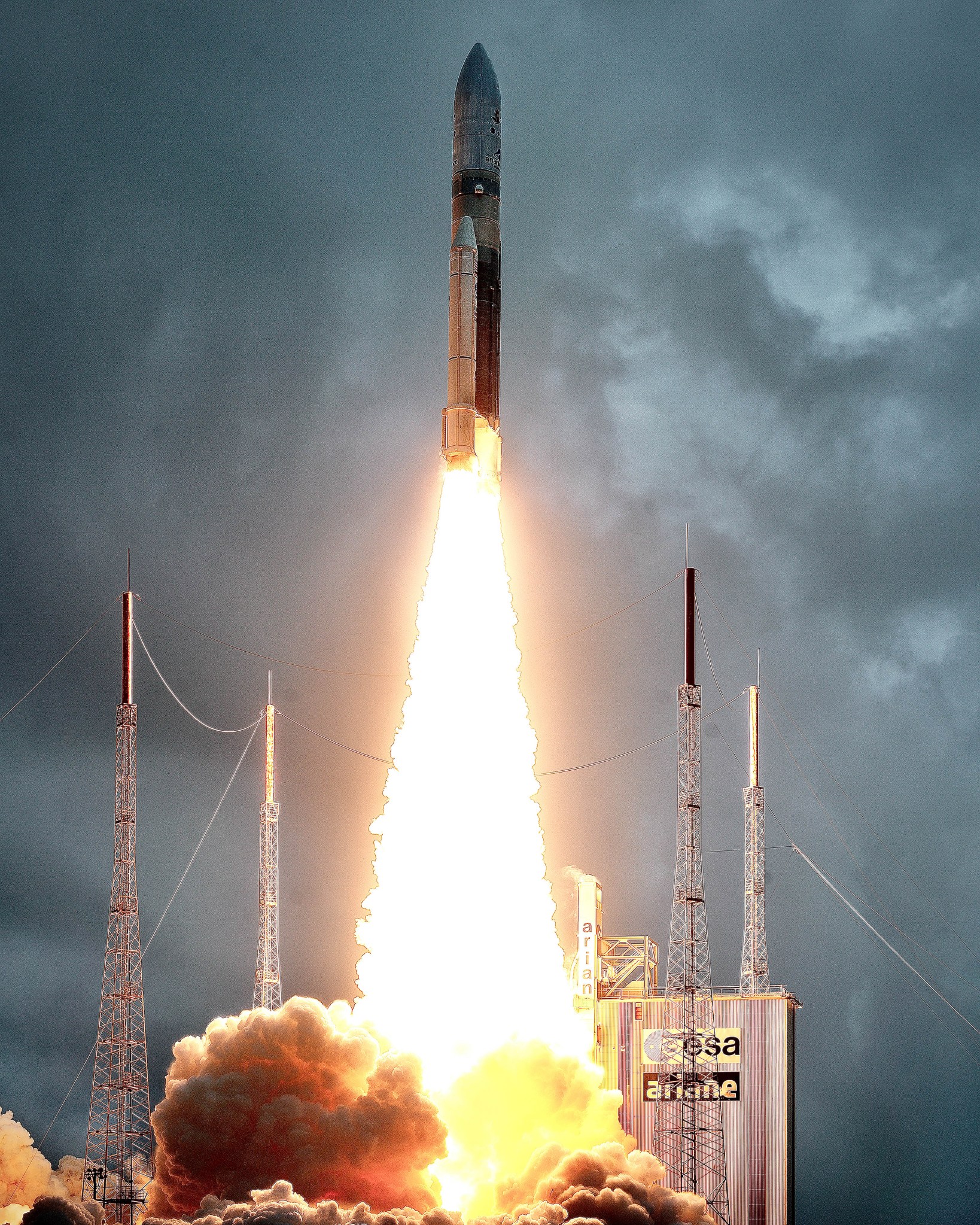
Webb’s Ariane 5 rocket launches from Europe’s Spaceport in Kourou, French Guiana. A glowing, white-yellow stream of gas and fire is streaming from the rocket towards the ground below. The ground is covered with puffy clouds of pink-orange gas. In the background, lit up by the launch, is a building that is emblazoned with dark blue European Space Agency (ESA) and Ariane logos. The sky is a dark blue-gray and largely cloudy.
“Liftoff – from a tropical rainforest to the edge of time itself, James Webb begins a voyage back to the birth of the universe.” Arianespace’s Ariane 5 rocket launched with NASA’s James Webb Space Telescope aboard, Dec. 25, 2021, from the ELA-3 Launch Zone of Europe’s Spaceport at the Guiana Space Centre in Kourou, French Guiana.
NASA/Chris Gunn

The James Webb Space Telescope is the world’s premier space science observatory. Webb is solving mysteries in our solar system, looking beyond to distant worlds around other stars, and probing the mysterious structures and origins of our universe and our place in it. Webb is an international program led by NASA with its partners, ESA (European Space Agency) and the Canadian Space Agency.

Downloads

Right click the images in this article to open a version in a new tab/window that can be zoomed or saved.

Media Contacts

Thaddeus Cesari Thaddeus.cesari@nasa.gov, Laura Betzlaura.e.betz@nasa.gov, Rob Gutrorob.gutro@nasa.gov
NASA’s  Goddard Space Flight Center, Greenbelt, Md.

Related Information

Webb Observatory

More Webb News

More Webb Images

Webb Mission Page

Share

Details

Last Updated

Dec 22, 2023

Editor

Stephen Sabia

Powered by WPeMatico

Get The Details…

Meet the Infrared Telescopes That Paved the Way for NASA’s Webb

Meet the Infrared Telescopes That Paved the Way for NASA’s Webb

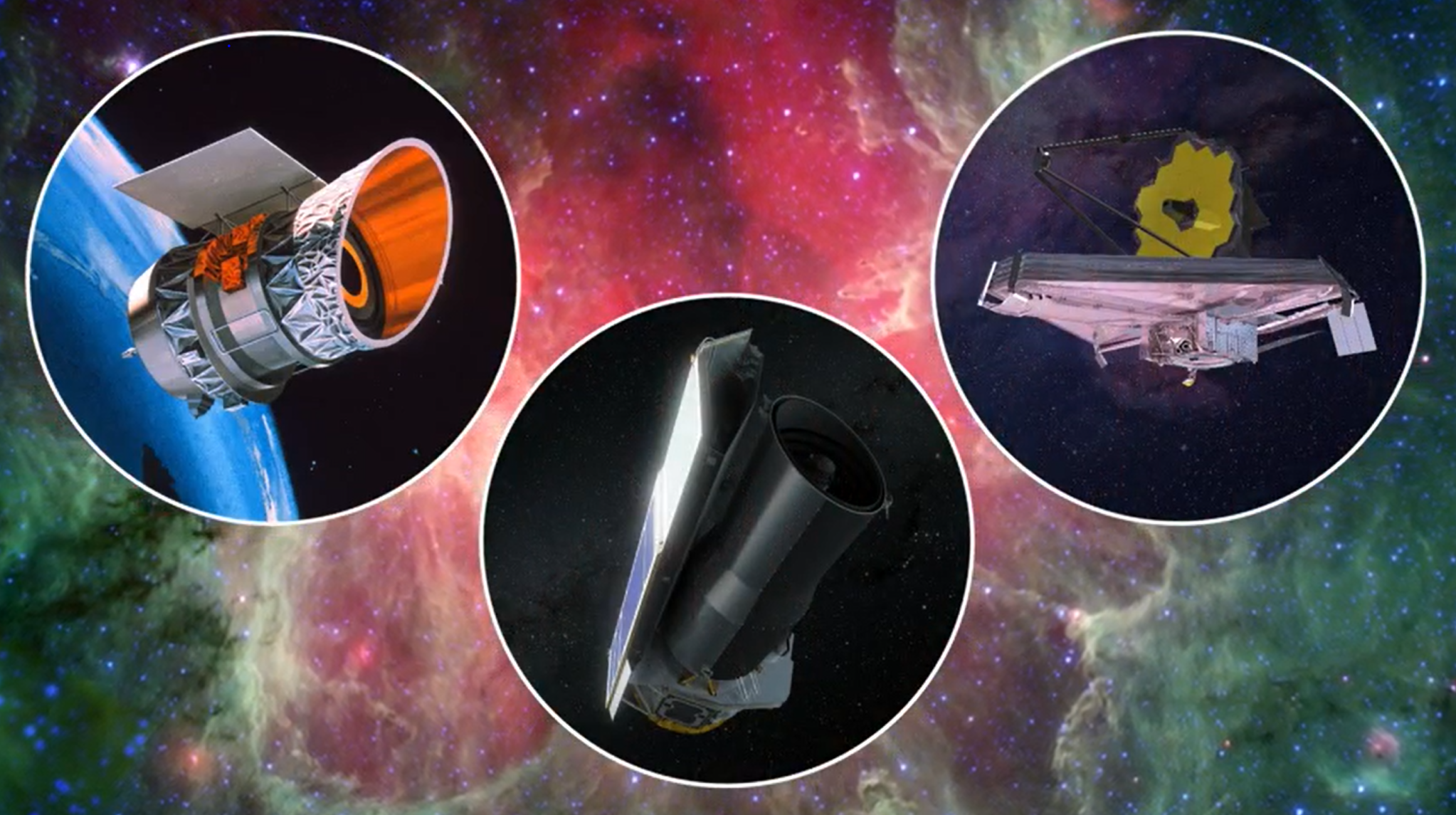
Scientists have been studying the universe with infrared space telescopes for 40 years, including these NASA missions, from left: the Infrared Astronomical Satellite (IRAS), launched in 1983; the Spitzer Space Telescope, launched in 2003; and the James Webb Space Telescope, launched in 2021.
NASA/JPL-Caltech

The Webb telescope has opened a new window onto the universe, but it builds on missions going back 40 years, including Spitzer and the Infrared Astronomical Satellite.

On Dec. 25, NASA will celebrate the two-year launch anniversary of the James Webb Space Telescope – the largest and most powerful space observatory in history. The clarity of its images has inspired the world, and scientists are just beginning to explore the scientific bounty it is returning.

Webb’s success builds on four decades of space telescopes that also detect infrared light (which is invisible to the naked eye) – in particular the work of two retired NASA telescopes with big anniversaries this past year: January marked the 40th year since the launch of the Infrared Astronomical Satellite (IRAS), while August marked the 20th launch anniversary of the Spitzer Space Telescope.

NASA’s James Webb Space Telescope builds on four decades of work by space telescopes that also detect infrared light, in particular two other retired NASA telescopes: the Infrared Astronomical Satellite (IRAS) and the Spitzer Space Telescope. Credit: NASA/JPL-Caltech

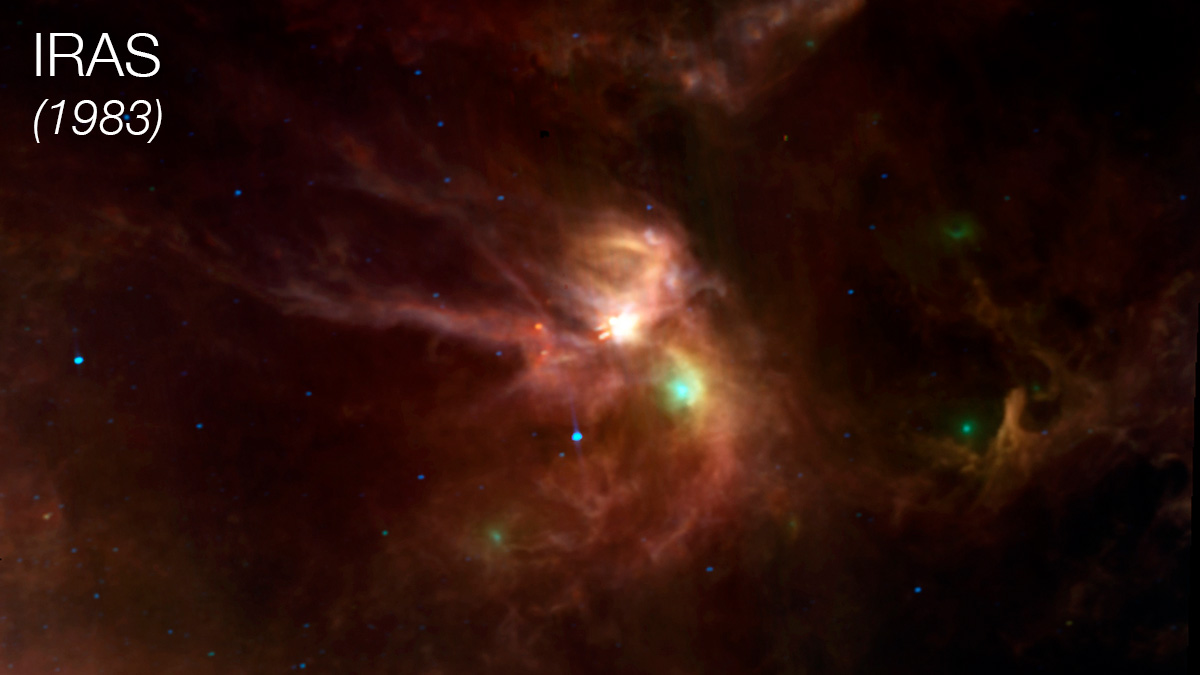
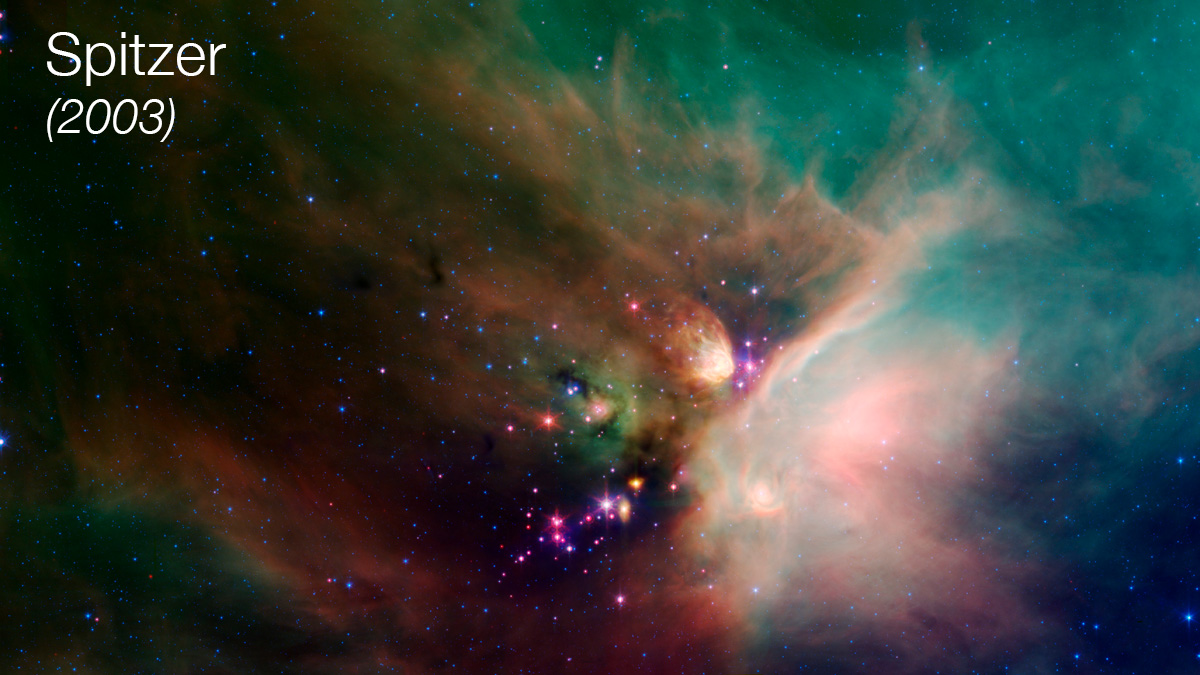
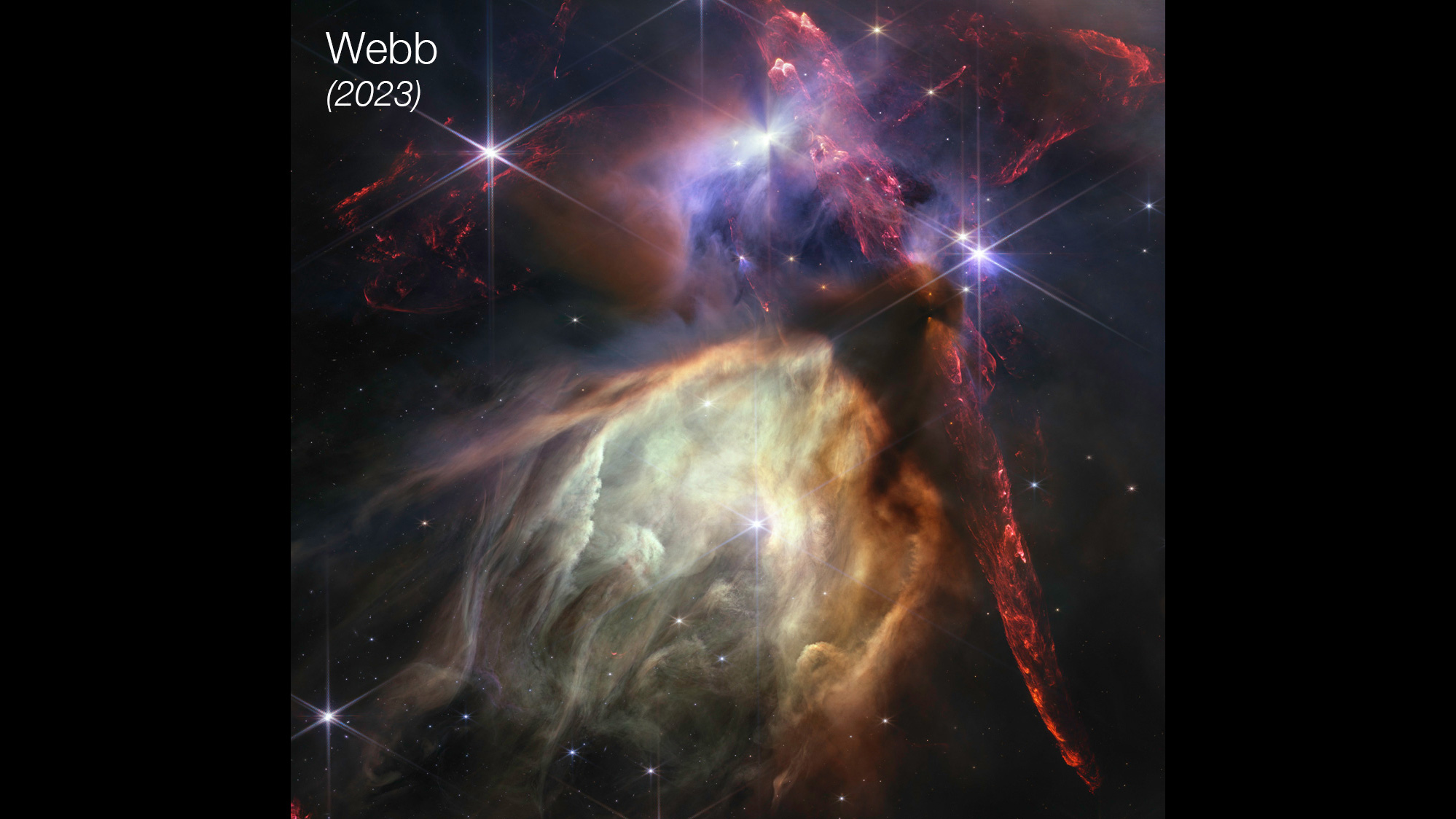
This heritage shines through in NASA’s images of Rho Ophiuchi, one of the closest star-forming regions to Earth. IRAS was the first infrared telescope ever launched into Earth orbit, above the atmosphere that blocks most infrared wavelengths. Rho Ophiuchi’s thick clouds of gas and dust block visible light, but IRAS’ infrared vision made it the first observatory to be able to pierce those layers to reveal newborn stars nestled deep inside.

Twenty years later, Spitzer’s multiple infrared detectors helped astronomers assign more specific ages to many of the stars in the region, providing insights about how young stars throughout the universe evolve. Webb’s even more detailed infrared view shows jets bursting from young stars, as well as disks of material around them – the makings of future planetary systems.

Another example is Fomalhaut, a star surrounded by a disk of debris similar to our asteroid belt. Forty years ago, the disk was one of IRAS’ major discoveries because it also strongly suggested the presence of at least one planet, at a time when no planets had yet been found outside the solar system. Subsequent observations by Spitzer showed the disk had two sections – a cold, outer region and a warm, inner region – and revealed more evidence of the presence of planets.

Many other telescopes, including NASA’s Hubble Space Telescope, have since studied Fomalhaut, and earlier this year, images from Webb gave scientists their clearest view of the disk structure yet. It revealed two previously unseen rings of rock and gas in the inner disk. Combining the work of generations of telescopes is bringing the story of Fomalhaut into sharp relief.

Visionary Infrared Astronomy Survey

When IRAS launched in 1983, scientists weren’t sure what the mission would reveal. They couldn’t predict that infrared would eventually be used in almost every area of astronomy, including studies of the evolution of galaxies, the life cycle of stars, the source of pervasive cosmic dust, the atmospheres of exoplanets, the movements of asteroids and other near-Earth objects, and even the nature of one of the biggest cosmological mysteries in history, dark energy.

IRAS set the stage for the European-led Infrared Space Observatory (ISO) and the Herschel Space Observatory; the Japanese-led AKARI satellite; NASA’s Wide-Field Infrared Survey Explorer (WISE), and the agency’s airborne SOFIA (Stratospheric Observatory for Infrared Astronomy), as well as many balloon-lofted observatories.

“Infrared light is essential for understanding where we came from and how we got here, on both the biggest and smallest astrophysical scales,” said Michael Werner, an astrophysicist at NASA’s Jet Propulsion Laboratory in Southern California. Werner, who specializes in infrared observations, served as project scientist for Spitzer. “We use infrared to look back in space and time, to help us understand how the modern universe came to be. And infrared enables us to study the formation and evolution of stars and planets, which tells us about the history of our own solar system.”

On to Spitzer

If IRAS was a pathfinding mission, Spitzer was designed to dive deep into the infrared universe. Many of Webb’s planetary targets in its first year had already been studied with Spitzer, which pursued a broad range of science goals, thanks to its wide field of view and relatively high resolution. During its 16-year mission, Spitzer uncovered new wonders from the edge of the universe (including some of the most distant galaxies ever observed at the time) to our own solar system (such as a new ring around Saturn). Researchers were also surprised to find that the telescope was a perfect tool for studying exoplanets (planets beyond our solar system), something they hadn’t expected when building it.

“With any telescope, you’re not just taking data for the sake of it; you’re asking a particular question or a series of questions,” said Sean Carey, a former manager for the Spitzer Science Center at IPAC, a data and science processing center at Caltech. “The questions we’re able to ask with Webb are much more complex and varied because of the knowledge we acquired with telescopes like Spitzer and IRAS.”

For example, Carey said, “We studied exoplanets with Spitzer and Hubble, and we figured out what you can do with an infrared telescope in that field, what types of planets are most interesting, and what you can learn about them. So when Webb launched, we jumped into exoplanet studies right from the get-go.”

Webb, too, is paving the way for future infrared missions. NASA’s upcoming SPHEREx (Spectro-Photometer for the History of the Universe, Epoch of Reionization and Ices Explorer) mission as well as the agency’s next flagship observatory, the Nancy Grace Roman Space Telescope, will continue to explore the universe in infrared.

More About the Missions

IRAS was a joint project of NASA, the Netherlands Agency for Aerospace Programmes, and the United Kingdom’s Science and Engineering Research Council. The mission was managed for NASA by JPL. Caltech in Pasadena manages JPL for NASA.

For more information about IRAS, visit:

https://www.jpl.nasa.gov/missions/infrared-astronomical-satellite-iras

JPL managed the Spitzer Space Telescope mission for NASA’s Science Mission Directorate in Washington until the mission was retired in January 2020. Science operations were conducted at the Spitzer Science Center at Caltech. Spacecraft operations were based at Lockheed Martin Space in Littleton, Colorado. Data are archived at the Infrared Science Archive operated by IPAC at Caltech.

For more information about Spitzer, visit:

https://www.nasa.gov/spitzer

The James Webb Space Telescope is the world’s premier space science observatory. Webb is solving mysteries in our solar system, looking beyond to distant worlds around other stars, and probing the mysterious structures and origins of our universe and our place in it. Webb is an international program led by NASA with its partners, ESA (European Space Agency) and CSA (Canadian Space Agency).

For more information about Webb, visit:

https://www.nasa.gov/webb

News Media Contact

Calla Cofield
Jet Propulsion Laboratory, Pasadena, Calif.
626-808-2469
calla.e.cofield@jpl.nasa.gov

2023-186

Powered by WPeMatico

Get The Details…
Naomi Hartono

Celebrating the Holiday Season in Space

Celebrating the Holiday Season in Space

The Christmas, Hanukkah, and New Year holidays are joyful events typically spent with family and friends. Astronauts and cosmonauts who find themselves in space during the holidays have found their own unique way to celebrate the occasions. In the early years of the space program, holidays spent in space occurred infrequently, most notably the flight of Apollo 8 around the Moon during Christmas 1968, making them more memorable. As missions became longer and more frequent, holidays in space became more common occasions. For the past 23 years, holidays spent aboard the International Space Station have become annual, if not entirely routine, events.
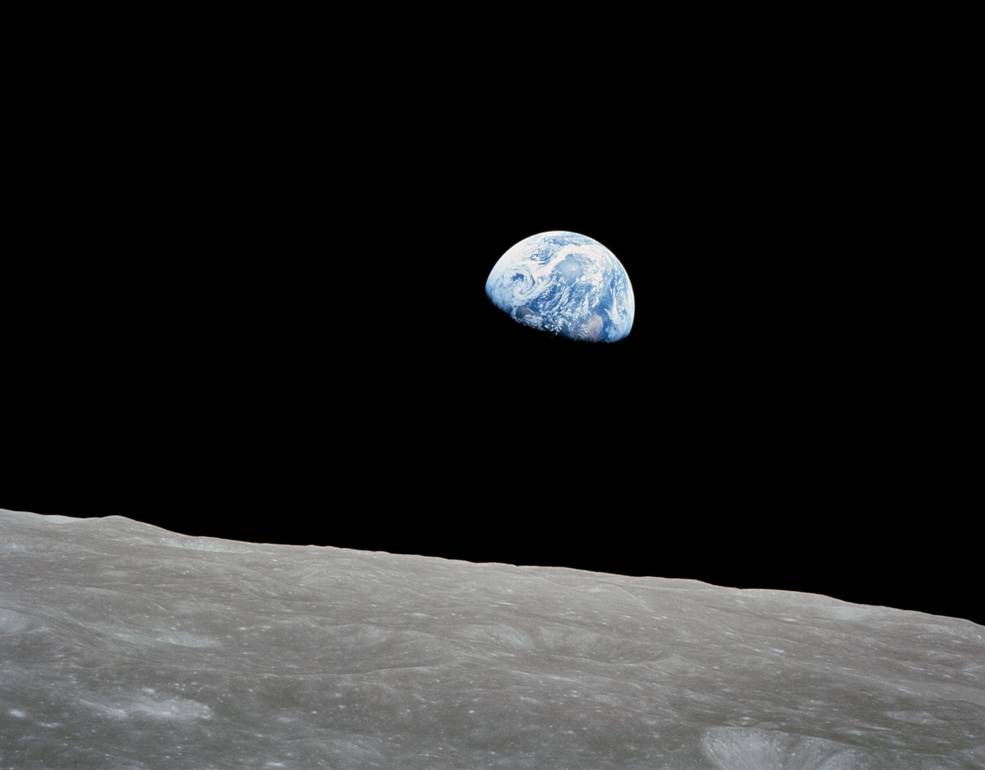
apollo_8_earthrise_1968 holidays_in_space_2021_2_apollo_8_video_screen_shot
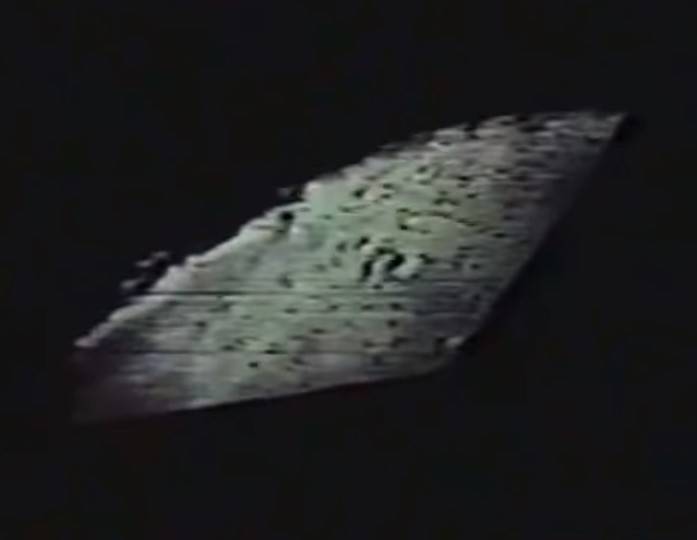
Left: The famous Earthrise photograph, taken by the Apollo 8 crew in lunar orbit. Right: Video of the Apollo 8 crew of Frank Borman, James A. Lovell, and William A. Anders reading from The Book of Genesis.

As the first crew to spend Christmas in space, Apollo 8 astronauts Frank Borman, James A. Lovell, and William A. Anders, celebrated the holiday while circling the Moon in December 1968, the first humans to leave Earth orbit. They immortalized the event on Christmas Eve by taking turns reading the opening verses from the Bible’s Book of Genesis as they broadcast scenes of the Moon gliding by below. An estimated one billion people in 64 countries tuned in to their Christmas Eve broadcast. As they left lunar orbit, Lovell radioed back to Earth, where Christmas Eve had already turned to Christmas Day, “Please be informed there is a Santa Claus!”
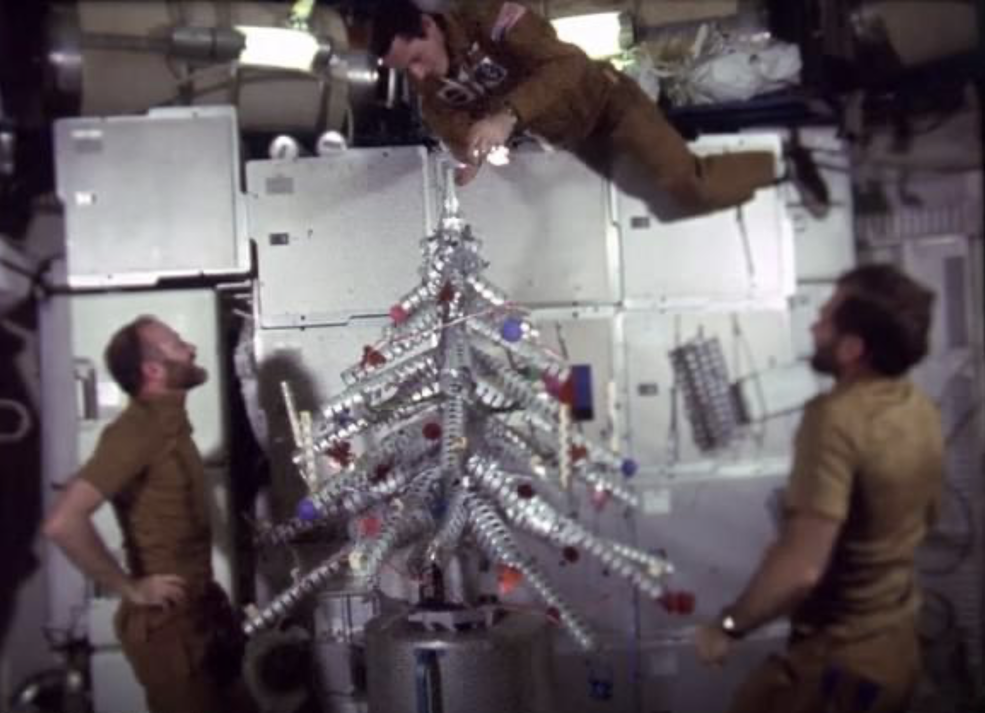
holidays_in_space_2022 holidays_in_space_2022
Left: Skylab 4 astronauts Gerald P. Carr, left, Edward G. Gibson, and William R. Pogue trim their homemade Christmas tree in December 1973. Right: Carr, Gibson, and Pogue hung their stockings aboard Skylab.

During their 84-day record-setting mission aboard the Skylab space station in 1973 and 1974, Skylab 4 astronauts Gerald P. Carr, William R. Pogue, and Edward G. Gibson celebrated Thanksgiving, Christmas, and New Year’s in space – the first crew to spend Thanksgiving and New Year’s in orbit. They built a homemade Christmas tree from leftover food containers, used colored decals as decorations, and topped it with a cardboard cutout in the shape of a comet. Carr and Pogue spent seven hours on a Christmas Day spacewalk to change out film canisters and observe the passing Comet Kohoutek. Once back inside the station, they enjoyed a Christmas dinner complete with fruitcake, talked to their families, and opened presents. They even had orbital visitors of sorts, as Soviet cosmonauts Pyotr I. Klimuk and Valentin V. Lebedev orbited the planet aboard Soyuz 13 between Dec. 18 and 26, marking the first time that astronauts and cosmonauts were in space at the same time. Different orbits precluded any direct contact between the two crews.


soyuz_26_grechko_romanenko_new_year_message_1978 soyuz_26_grechko_romanenko_toasting_1978
Aboard Salyut-6, Georgi M. Grechko, left, and Yuri V. Romanenko, toast to celebrate the new year in space, the first Russian cosmonauts to do so. Image credits: Courtesy of Roscosmos.

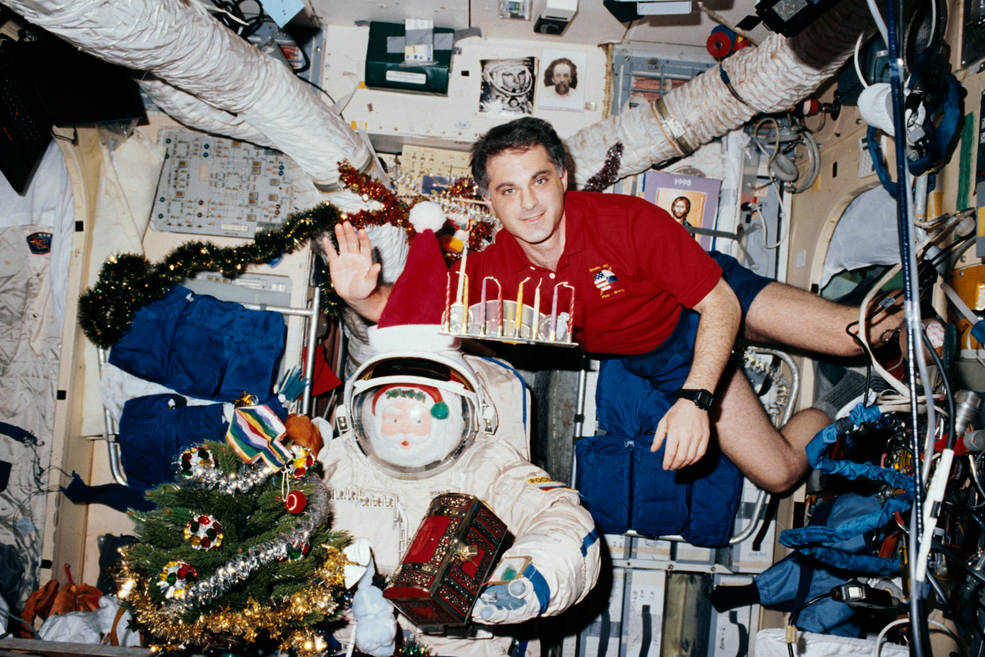
In the more secular Soviet era, the New Year’s holiday had more significance than the Jan. 7 observance of Orthodox Christmas. The first cosmonauts to ring in a new year in orbit were Yuri V. Romanenko and Georgi M. Grechko, during their record-setting 96-day mission in 1977 and 1978, aboard the Salyut-6 space station. They toasted the new year during a TV broadcast with the ground. The exact nature of the beverage consumed for the occasion has not been passed down to posterity.
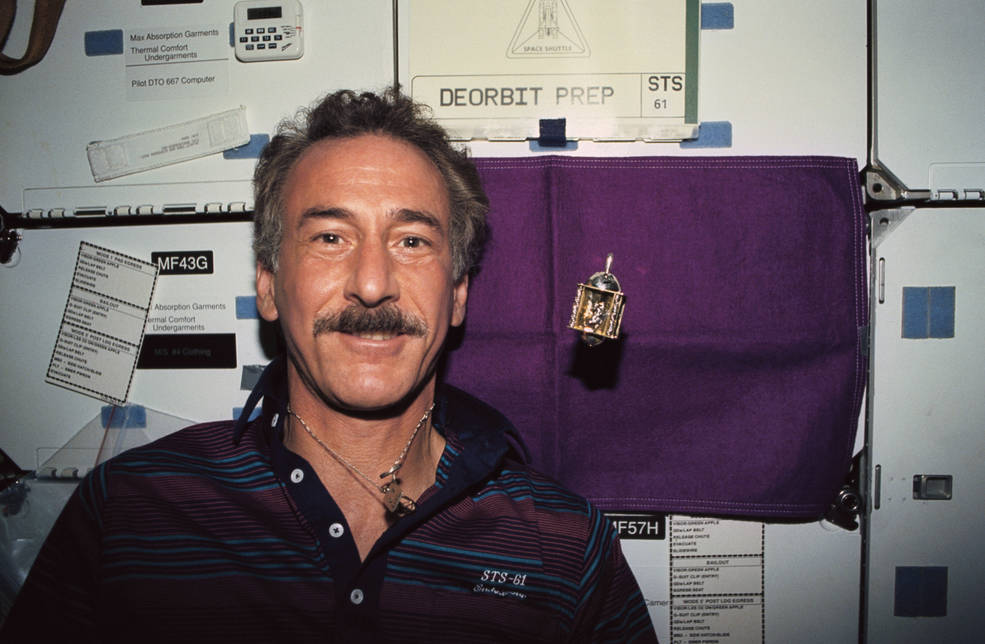
sts_61_hoffman_w_dreidel hoffman_hanukkah_video_screenshot
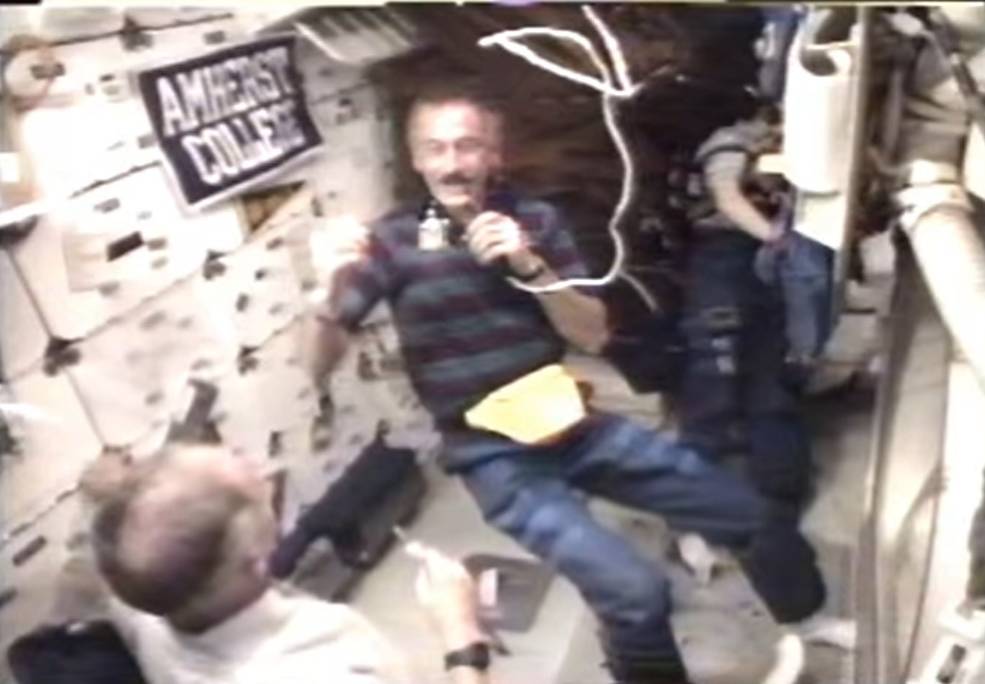
Left: STS-61 mission specialist Jeffrey A. Hoffman with a dreidel during Hanukkah in December 1993. Right: Video of Hoffman describing how he celebrated Hanukkah aboard space shuttle Endeavour.

The eight-day Jewish holiday of Hanukkah, also known as the Festival of Lights, celebrates the recapture of Jerusalem and rededication of the Second Temple in 164 B.C.E. It occurs in the month of Kislev in the Hebrew lunar calendar, which can fall between late November to late December in the Gregorian calendar. NASA astronaut Jeffrey A. Hoffman celebrated the first Hanukkah in space during the STS-61 Hubble Space Telescope first servicing mission in 1993. Hanukkah that year began on the evening of Dec. 9, after Hoffman completed his third spacewalk of the mission. He celebrated with a traveling menorah, unlit of course, and by spinning a dreidel.
sts_103_christmas_1999
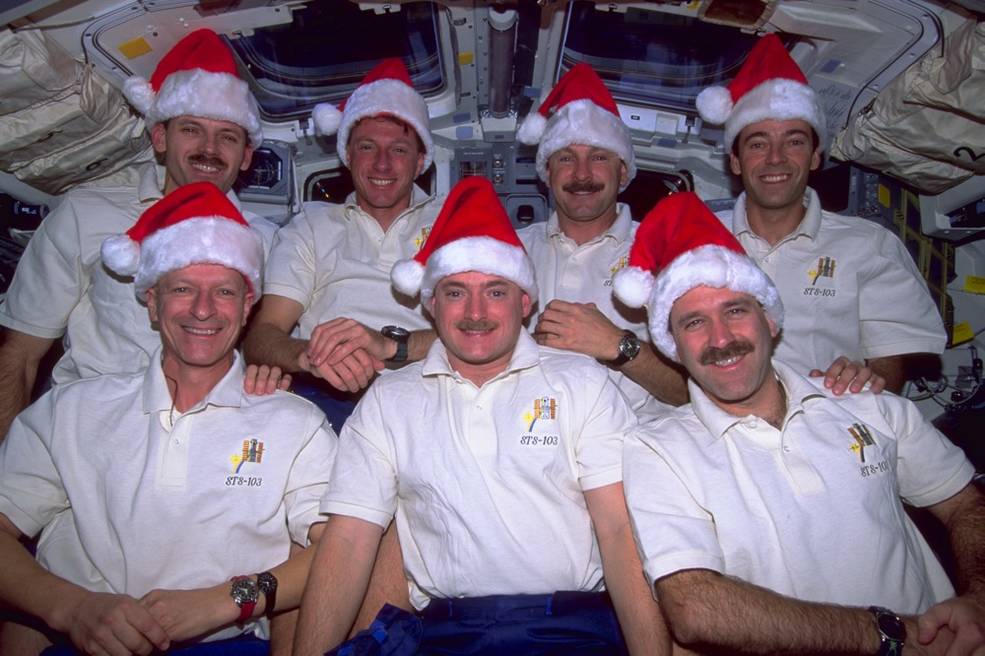
The STS-103 crew show off their Santa hats on the flight deck of space shuttle Discovery in 1999.

The crew of another Hubble Space Telescope repair mission, STS-103, celebrated the first space shuttle Christmas in 1999 aboard Discovery. For Christmas dinner, Curtis L. Brown, Scott J. Kelly, Steven L. Smith, Jean-François A. Clervoy of the European Space Agency (ESA), John M. Grunsfeld, C. Michael Foale, and Claude Nicollier of ESA enjoyed duck foie gras on Mexican tortillas, cassoulet, and salted pork with lentils. Smith and Grunsfeld completed repairs on the telescope during a Christmas Eve spacewalk.
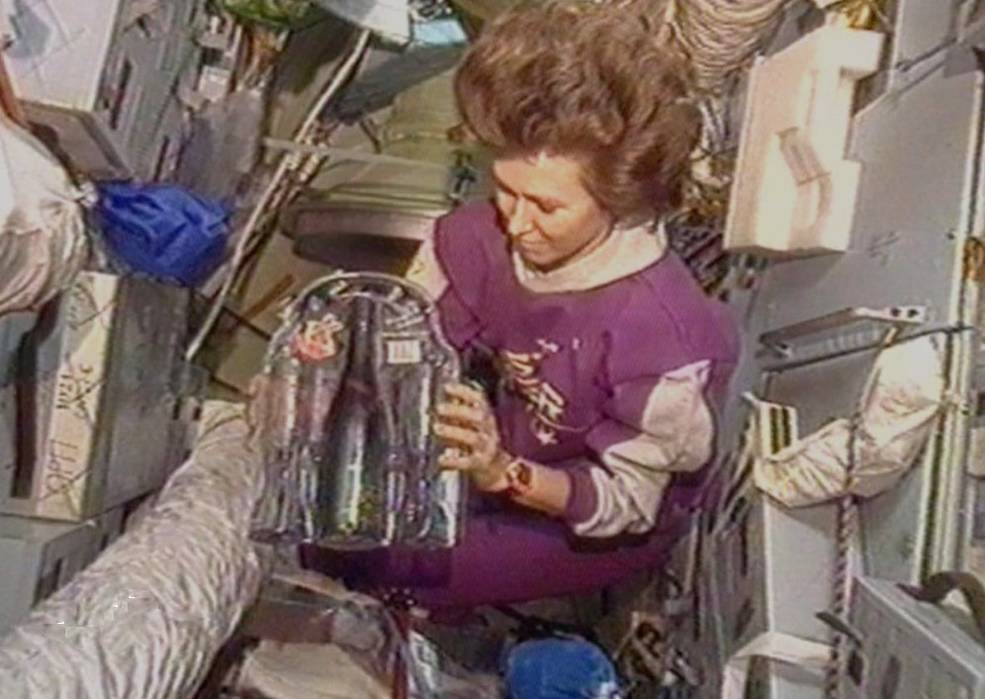

mir_17_new_years_kondakova_with_freixenet_champagne kondakova_champagne_screen_shot
Left: Roscosmos cosmonaut and Mir Expedition 17 flight engineer Elena V. Kondakova with a bottle of champagne to celebrate New Year’s Eve 1994. Right: Video of Kondakova demonstrating the behavior of champagne in weightlessness aboard Mir. Image credits: Courtesy of Roscosmos.

Between 1987 and 1998, 12 Mir expedition crews spent their holidays aboard the ever-expanding orbital outpost. Two of the crews included NASA astronauts, John E. Blaha and David A. Wolf, aboard the Russian space station as part of the Shuttle-Mir Program.  

mir_22_christmas_blaha_1996 mir_24_nasa_6_wolf_w_menorah_1997
Left: Video of Mir Expedition 22 flight engineer and NASA astronaut John E. Blaha’s 1996 Christmas message from Mir. Right: Mir Expedition 24 flight engineer and NASA astronaut David A. Wolf with his menorah and dreidel to celebrate Hanukkah in 1997. 
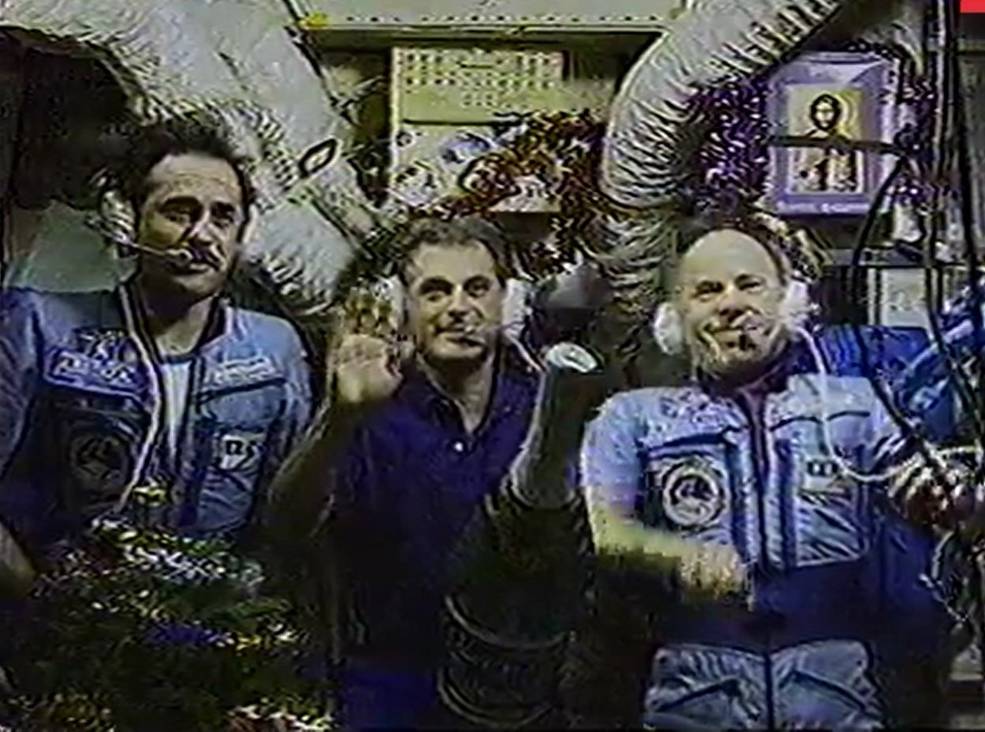
mir_24_new_years_eve_message_1997 mir_26_new_years_eve_1998
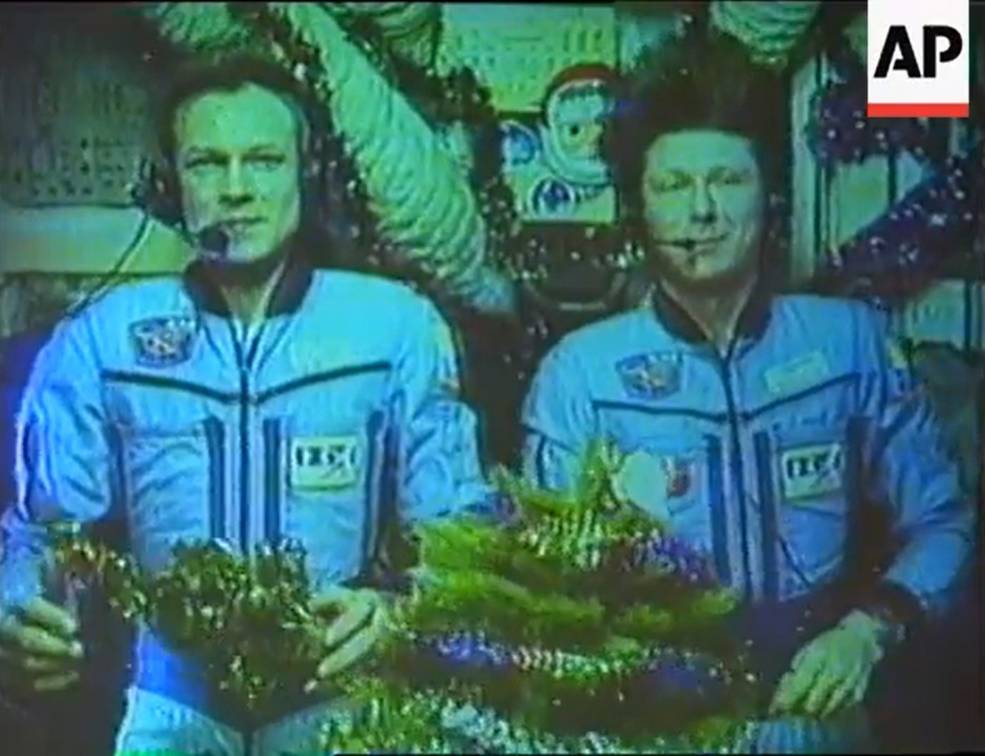
The last two New Year’s Eve messages from Mir. Left: Mir 24 crew of Pavel V. Vinogradov, left, NASA astronaut David A. Wolf, and Anatoli Y. Solovyev in 1997. Right: Mir 26 crew of Sergei V. Avdeyev, left, and Gennadi I. Padalka in 1998. It was the third time Avdeyev rang in the new year in space. Image credits: Courtesy of Roscosmos.

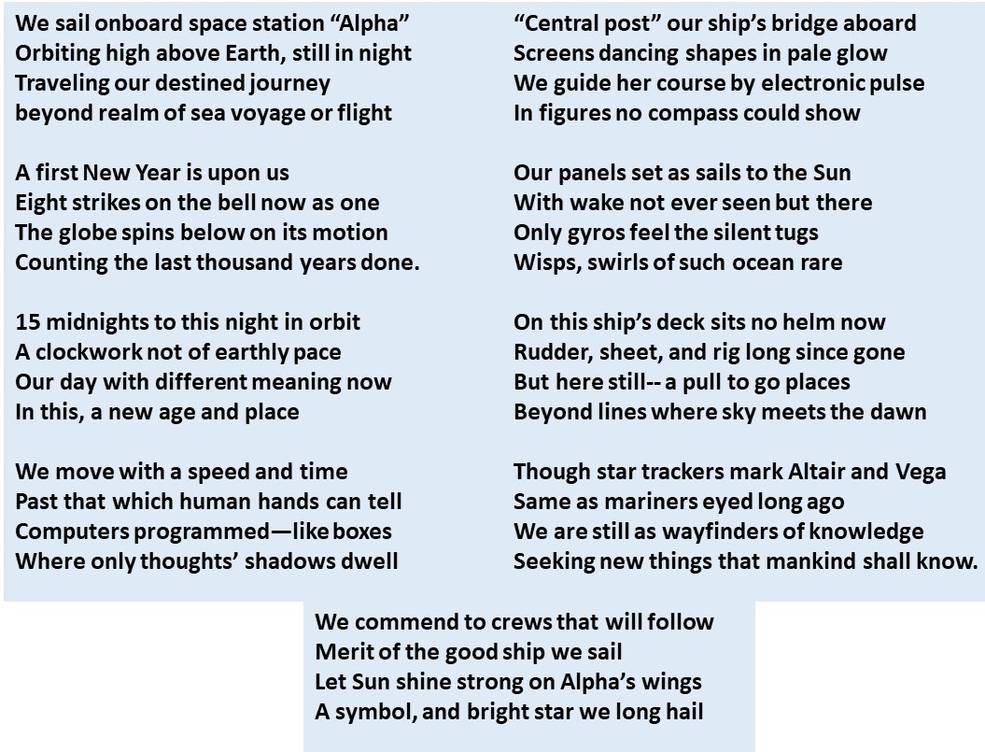
The arrival of Expedition 1 crew members William M. Shepherd of NASA and Yuri P. Gidzenko and Sergei K. Krikalev of Roscosmos aboard the International Space Station on Nov. 2, 2000, marked the beginning of a permanent human presence in space. The first to celebrate Christmas and ring in the new year aboard the fledgling orbiting laboratory, they began a tradition of reading a goodwill message to people back on Earth. Shepherd honored a naval tradition of writing a poem as the first entry of the new year in the ship’s log.
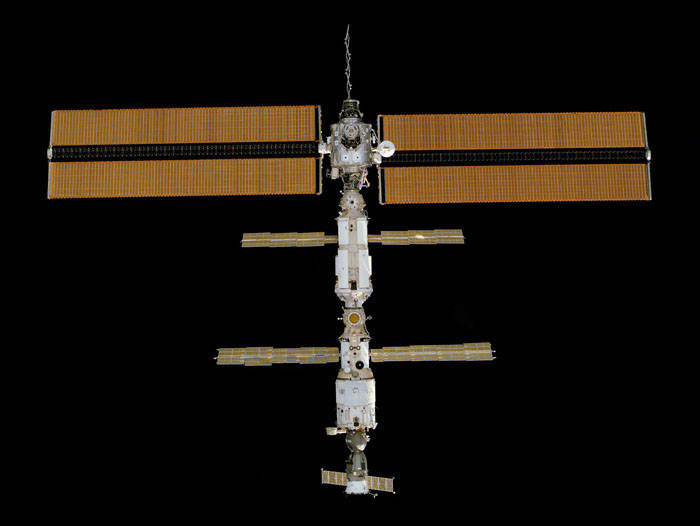
exp_1_christmas_message_2000_still_from_video sts_97_iss_during_departure
Left: Video of Expedition 1 crew members Yuri P. Gidzenko of Roscosmos, left, NASA astronaut William M. Shepherd, and Sergei K. Krikalev of Roscosmos reading their Christmas message in December 2000 – this marked Krikalev’s third holiday season spent in orbit, the first two spent aboard Mir in 1988 and 1991. Right: The space station as it appeared in December 2000.
exp_1_new_year_poem_by_shep
Expedition 1 commander NASA astronaut William M. Shepherd’s poem, written for the New Year’s Day 2001 entry in the space station’s log, in keeping with naval tradition.
christmas_on_iss_screen_shot exp_61_christmas_message_screen_shot
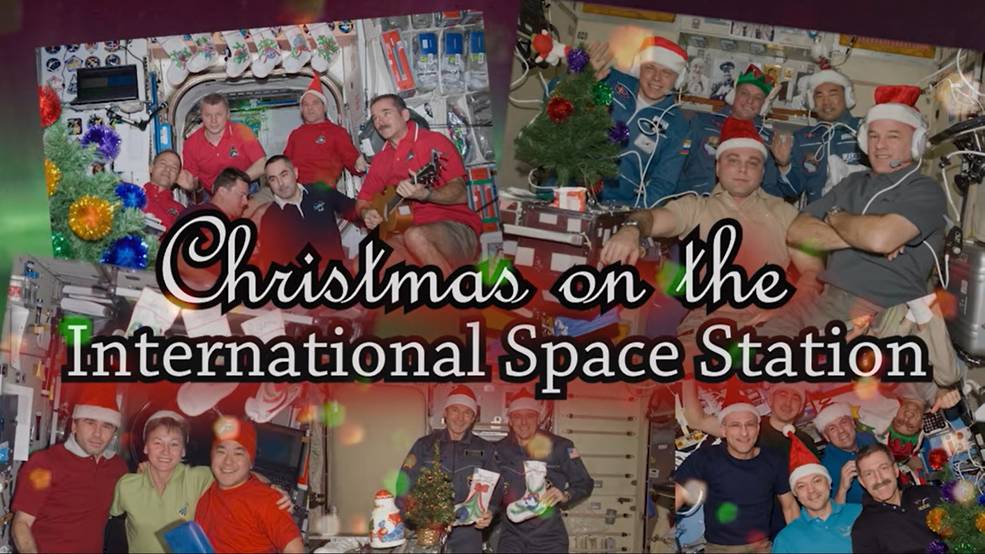
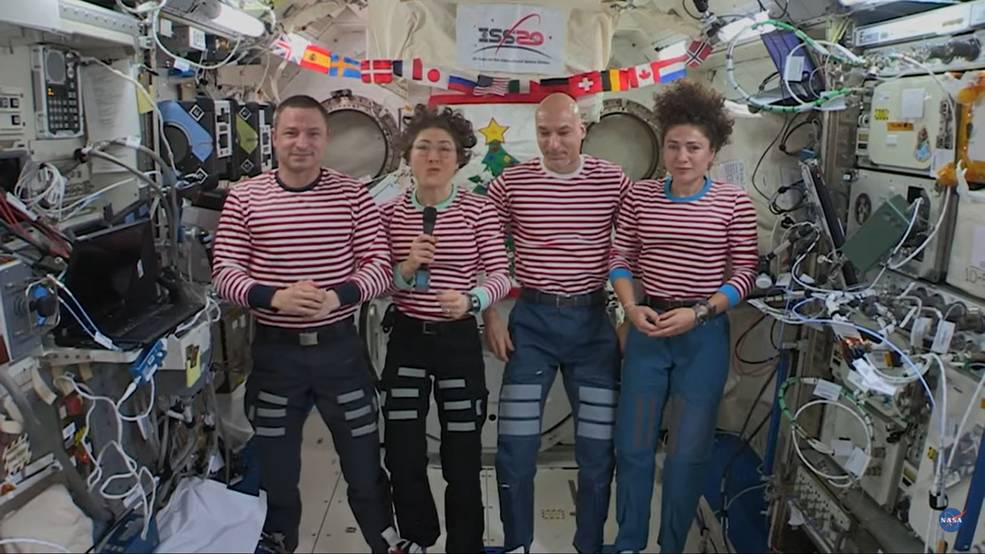
Left: A brief video selection of how some expedition crews celebrated Christmas aboard the space station. Right: From 2019, the Christmas message from the Expedition 61 crew members.

Enjoy the following selection of photographs and videos of international crews as they celebrated Hanukkah and Christmas, and rang in the new year over the past 22 years aboard the space station.
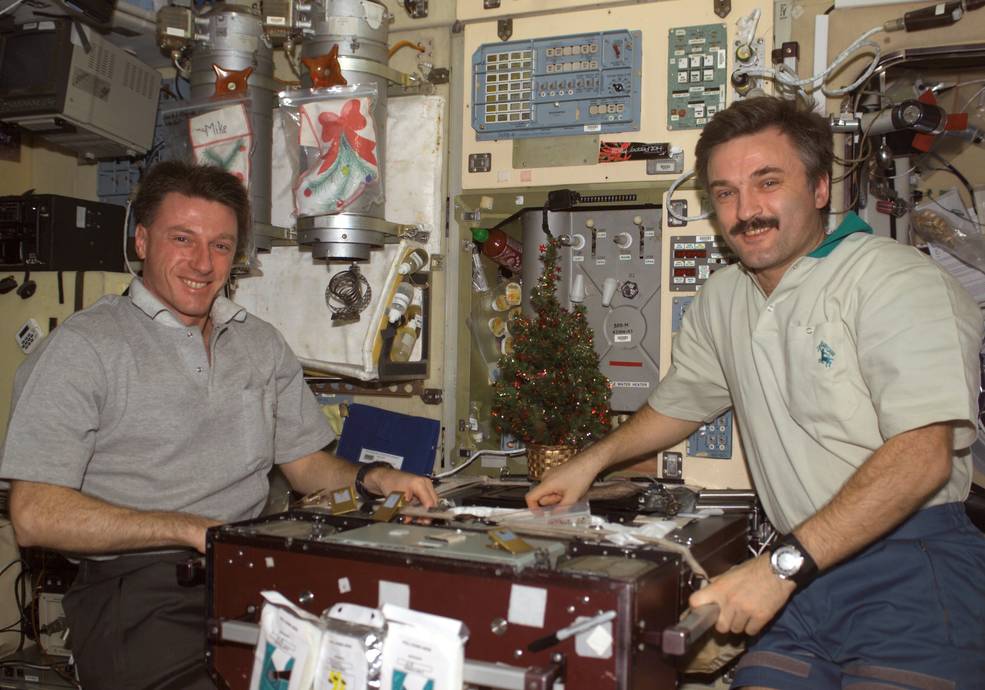
exp_4_christmas_2001 exp_8_christmas_2003 exp_10_happy_new_year_2004
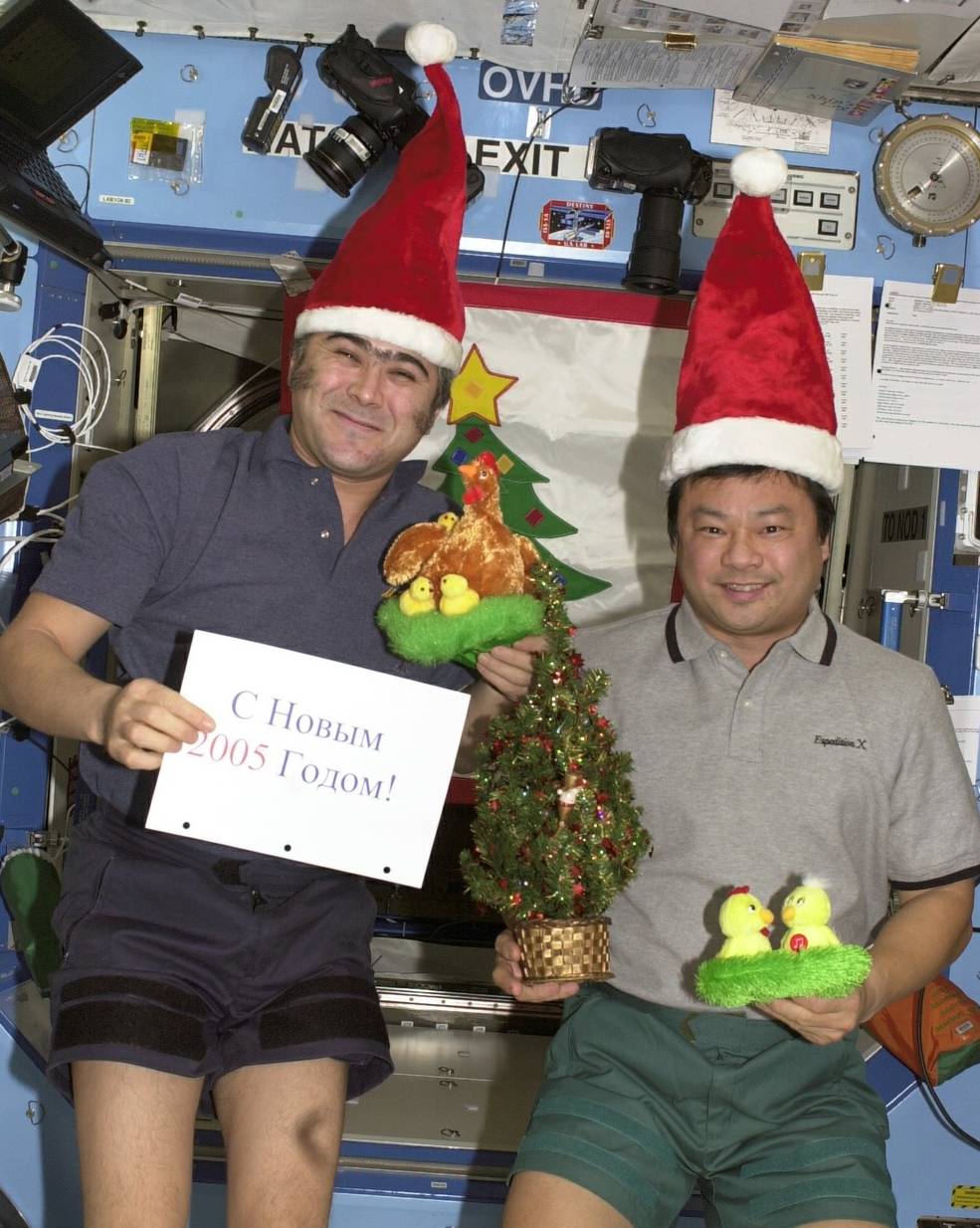
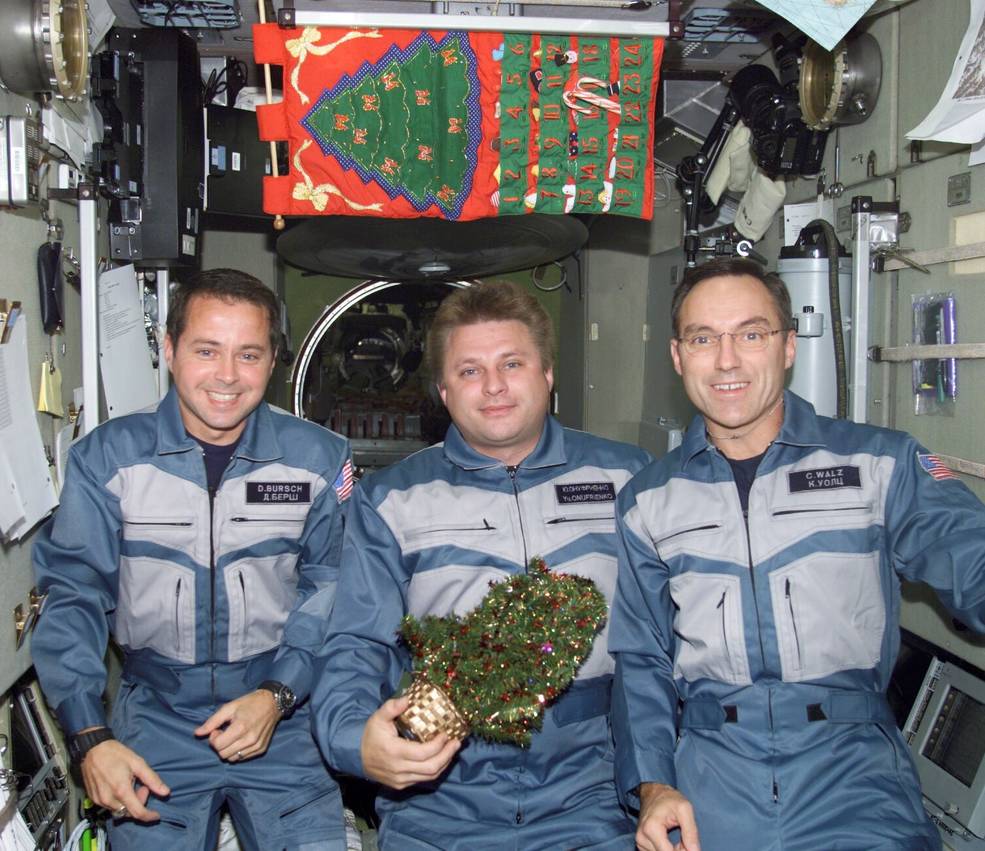
Left: The Expedition 4 crew of Daniel W. Bursch of NASA, left, Yuri I. Onufriyenko of Roscosmos, and Carl E. Walz of NASA poses for its Christmas photo in 2001. Middle: NASA astronaut C. Michael Foale, left, and Aleksandr Y. Kaleri of Roscosmos of Expedition 8 celebrate Christmas in 2003. Right: The Expedition 10 crew of Salizhan S. Sharipov of Roscosmos, left, and NASA astronaut Leroy Chiao festooned for New Year’s Eve 2004.
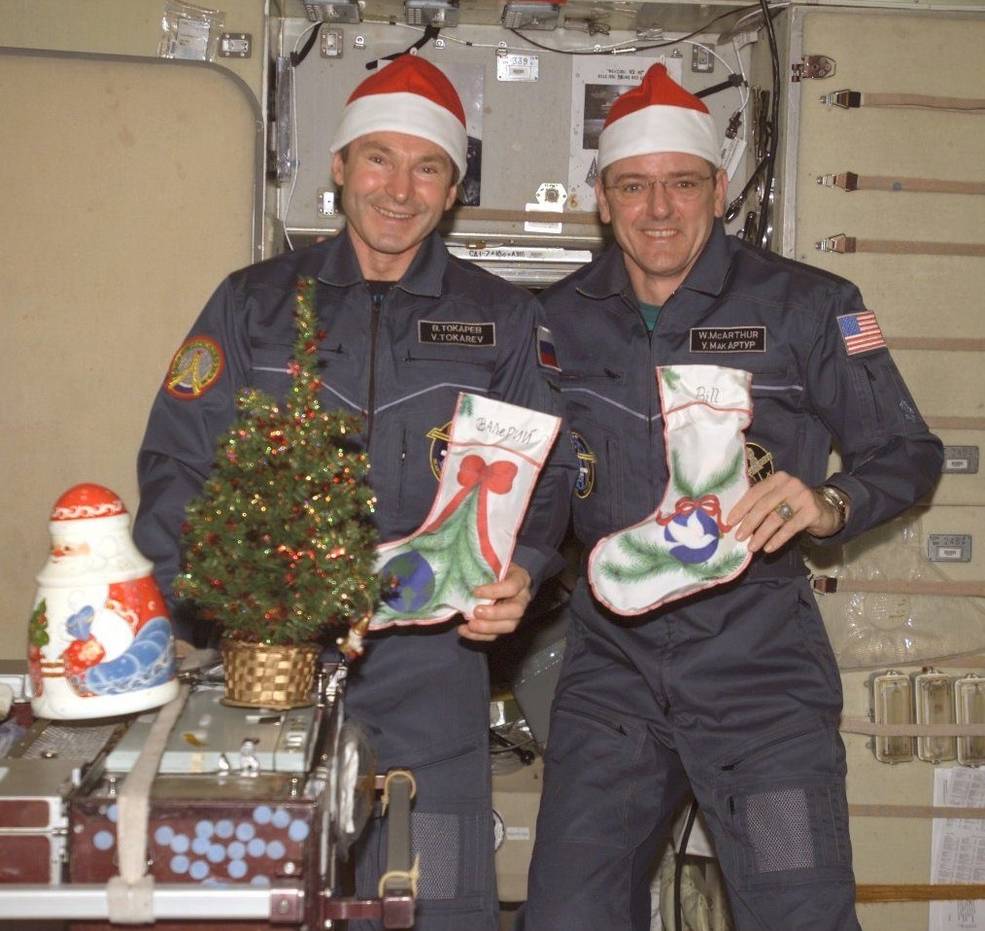
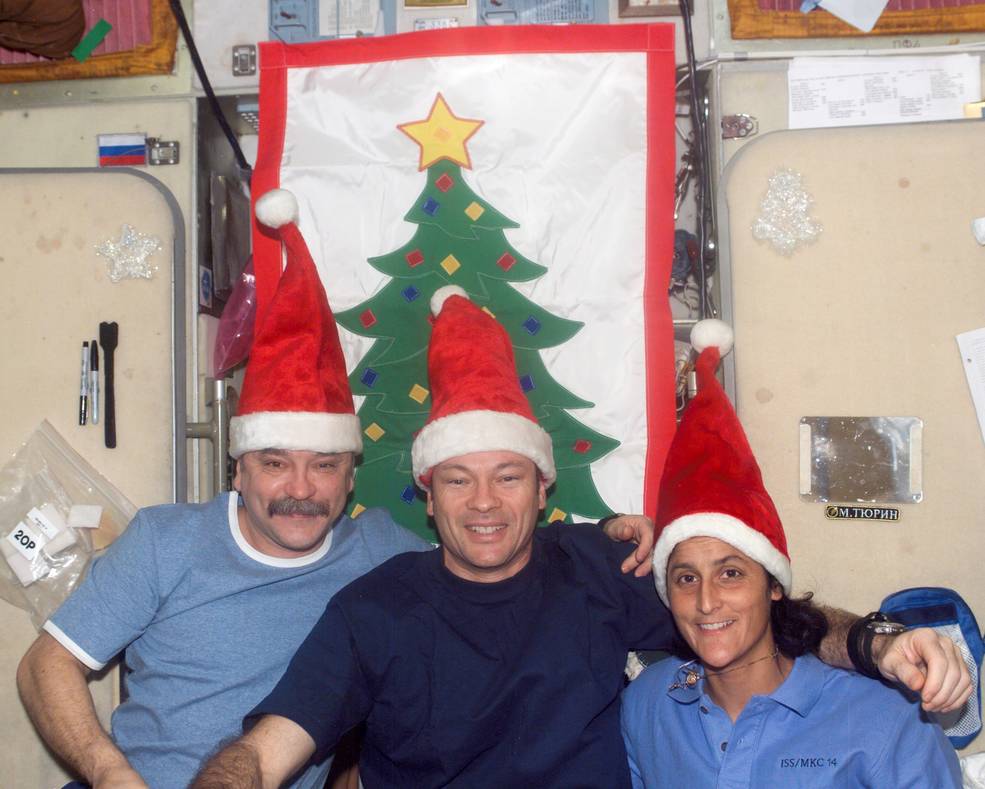
exp_12_christmas_2005 exp_14_christmas_2005 exp_16_christmas_2007
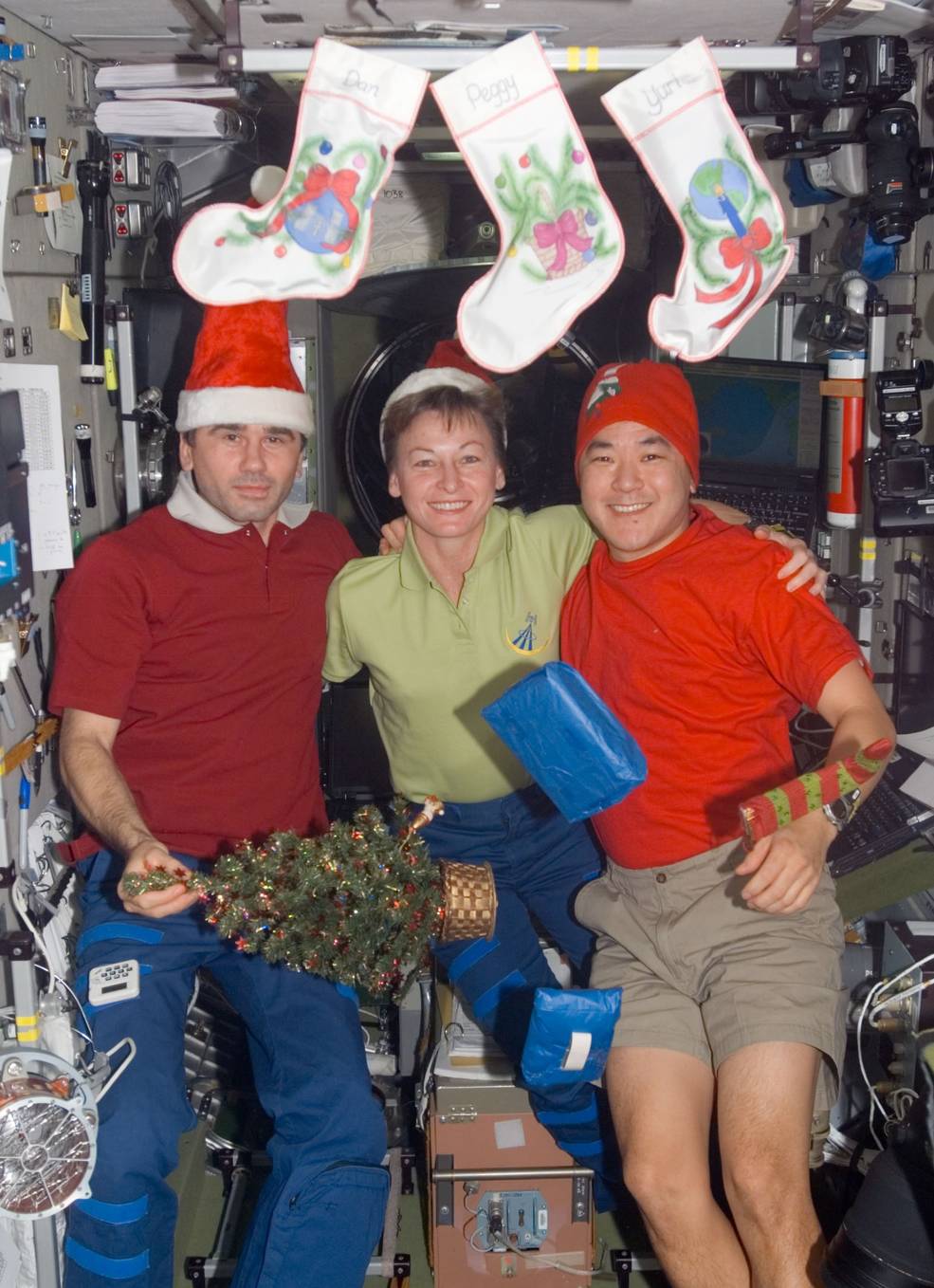
Left: Valeri I. Tokarev of Roscosmos, left, and NASA astronaut William S. McArthur of Expedition 12 pose with Christmas stockings in 2005. Middle: The Expedition 14 crew of Mikhail V. Tyurin of Roscosmos, left, and NASA astronauts Michael E. Lopez-Alegria and Sunita L. Williams pose wearing Santa hats for Christmas 2006. Right: The Expedition 16 crew of Yuri I. Malenchenko of Roscosmos, left, and NASA astronauts Peggy A. Whitson and Daniel M. Tani, with Christmas stockings and presents in 2007.
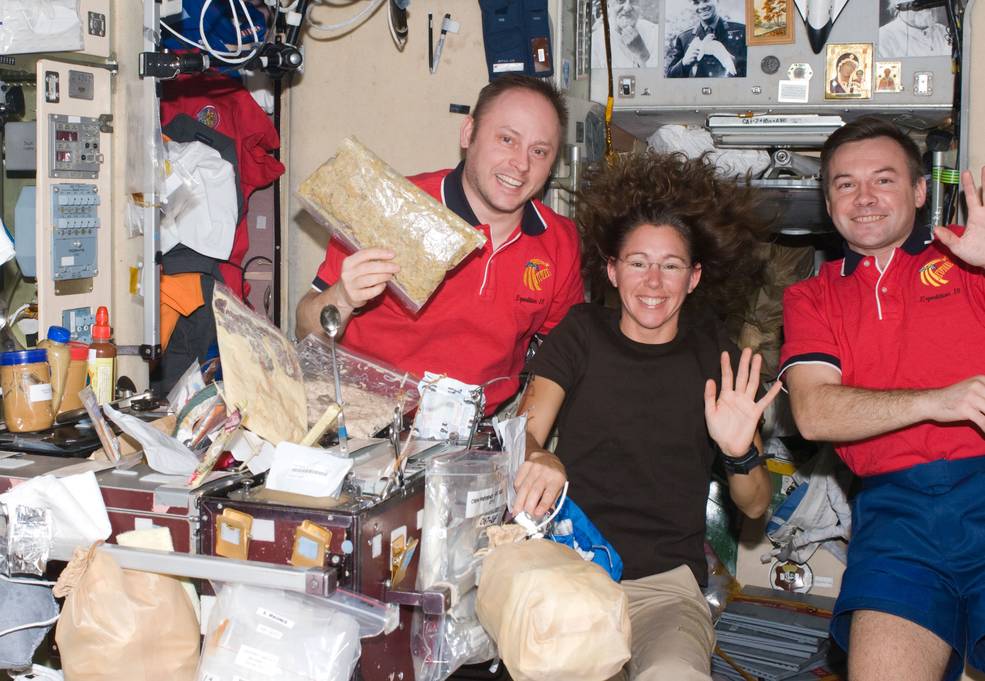
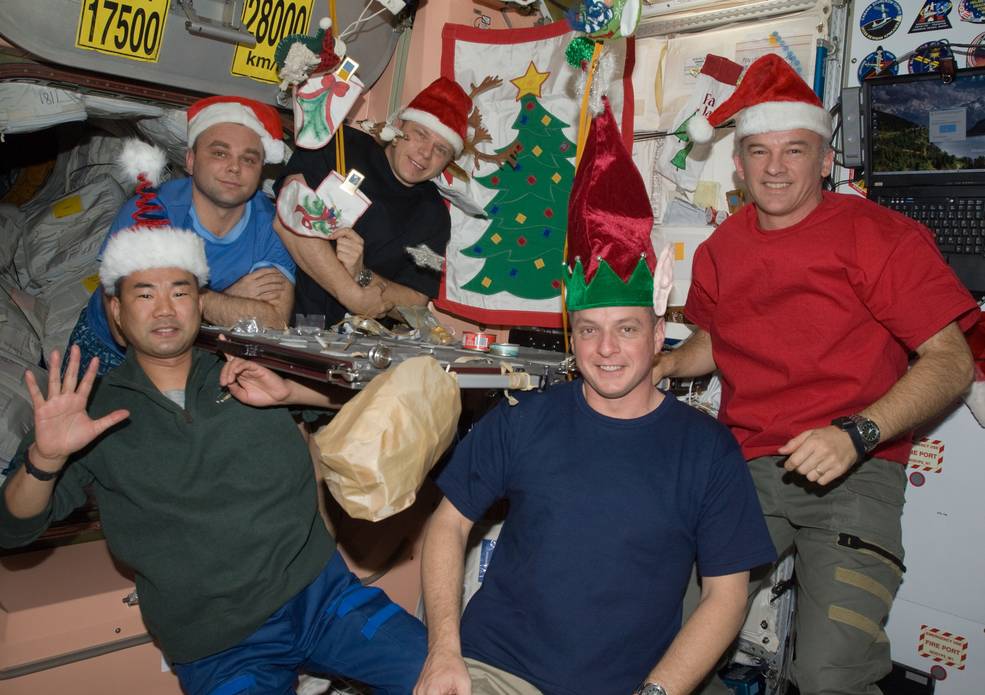
exp_18_christmas_meal_2008 exp_22_christmas_2009 exp_26_new_years_eve_2010
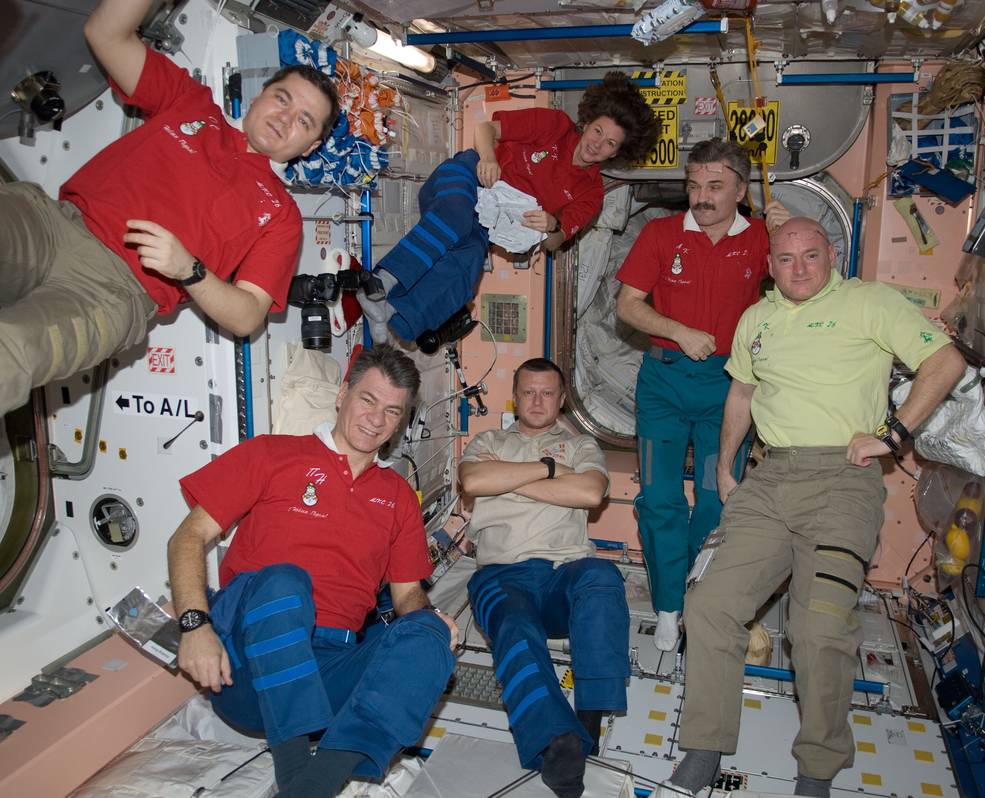
Left: The Expedition 18 crew of E. Michael Fincke, left, and Sandra H. Magnus of NASA, and Yuri V. Lonchakov of Roscosmos enjoys its Christmas dinner in 2008. Middle: The five-member Expedition 22 crew of Soichi Noguchi of the Japan Aerospace Exploration Agency, left, Maksim V. Surayev and Oleg V. Kotov of Roscosmos, and Timothy J. Creamer and Jeffrey N. Williams of NASA around the Christmas dinner table in 2009. Right: The Expedition 26 crew of Oleg I. Skripochka of Roscosmos, left, Paolo A. Nespoli of the European Space Agency, Dmitri Y. Kondratyev of Roscosmos, Catherine G. “Cady” Coleman of NASA, Aleksandr Y. Kaleri of Roscosmos, and NASA’s Scott J. Kelly celebrates New Year’s Eve 2010. This marked Kaleri’s third holiday season spent in space.
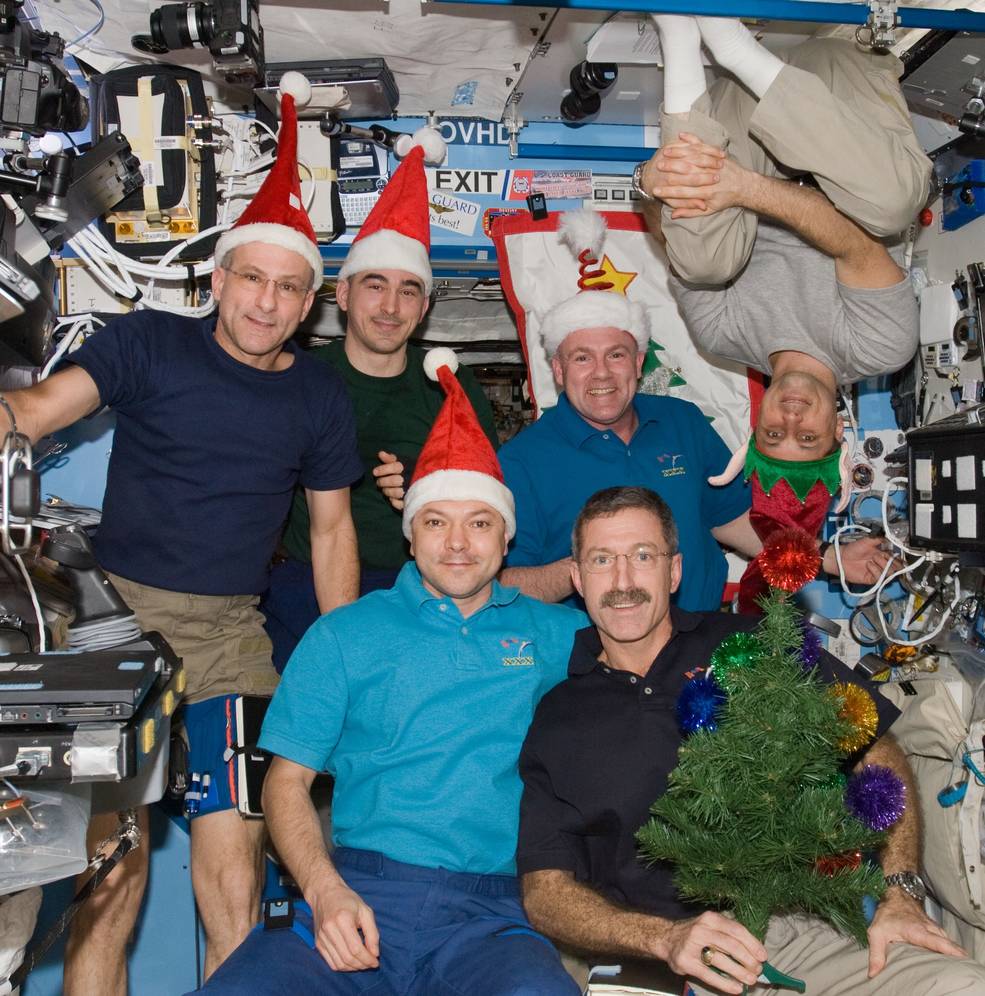
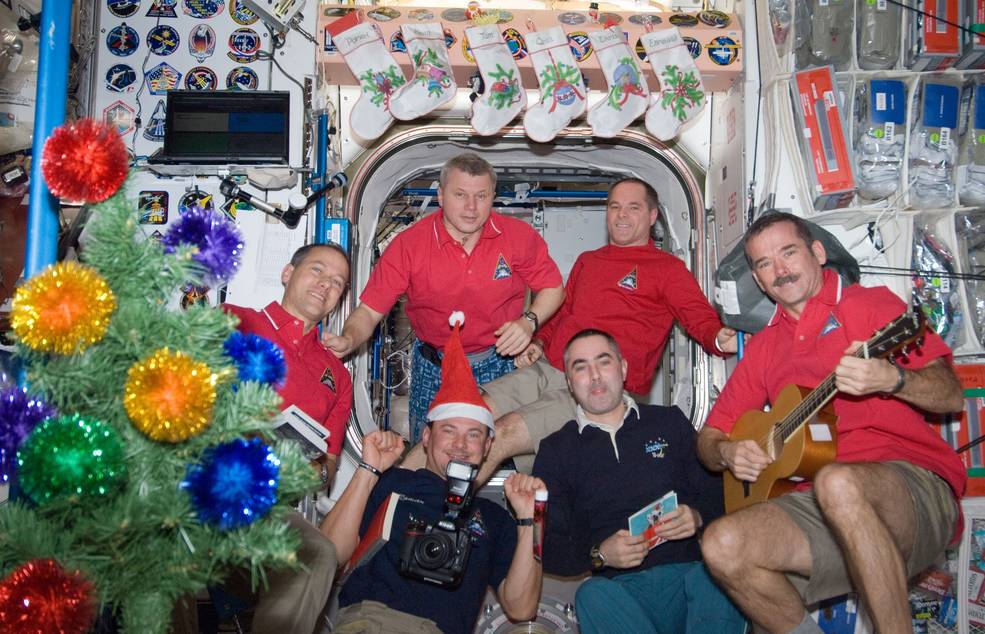
exp_30_crew_with_santa_claus_hats exp_34_christmas exp_42
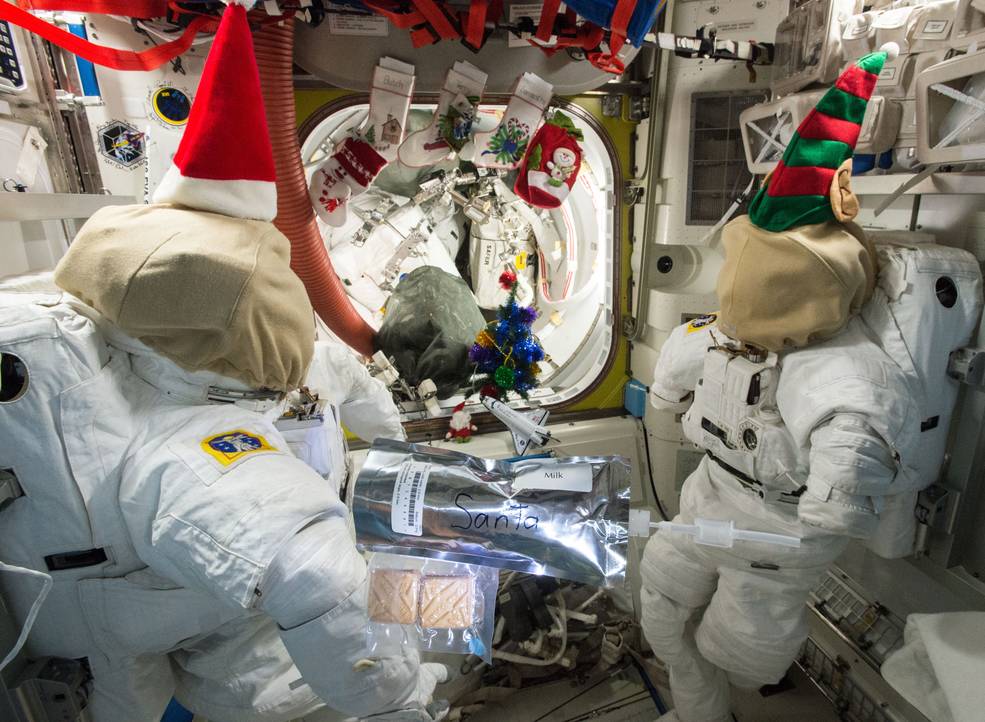
Left: The Expedition 30 crew of NASA astronaut Donald R. Pettit, left, Anatoli A. Ivanishin and Oleg D. Kononenko of Roscosmos, André Kuipers of the European Space Agency, NASA’s Daniel C. Burbank, and Anton N. Shkaplerov of Roscosmos pose for their Christmas photo in 2011. Middle: Christmas 2012 photograph of Expedition 34 crew members of NASA astronaut Thomas H. Marshburn, left, Roman Y. Romanenko, Oleg V. Novitski, and Yevgeni I. Tarelkin of Roscosmos, Kevin A. Ford of NASA, and Chris A. Hadfield of the Canadian Space Agency. Right: For Christmas in 2013, the Expedition 42 crew left milk and cookies for Santa and hung their stockings using the Joint Airlock as a makeshift chimney.
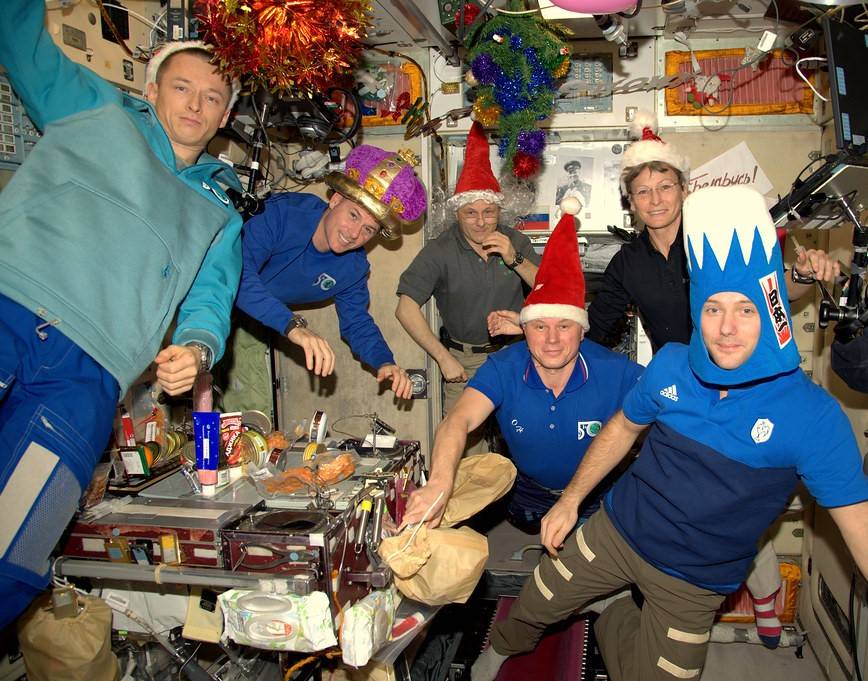
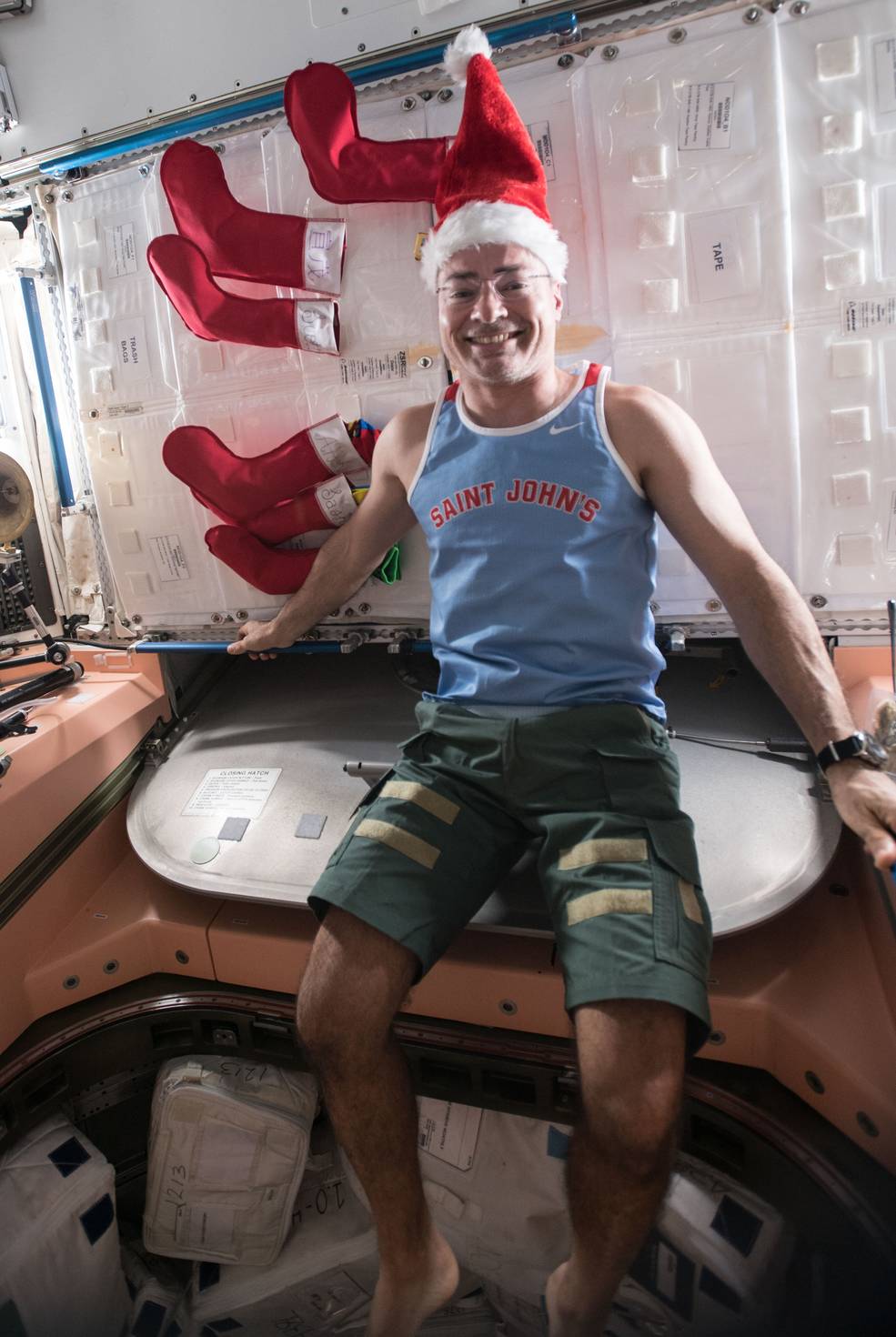
exp_50_new_years_eve_2016 exp_54_vande_hei_elf_on_a_shelf_2017 exp_58_christmas_2018
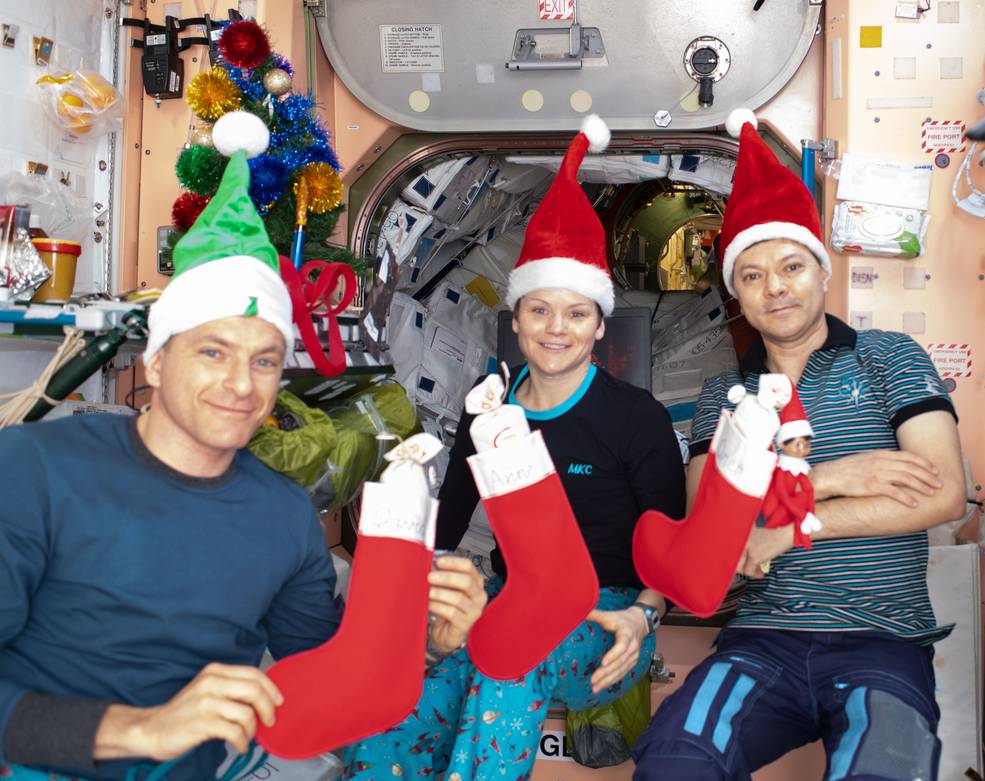
Left: Expedition 50 crew members Sergei N. Ryzhikov of Roscosmos, left, R. Shane Kimbrough of NASA, Andrei I. Borisenko and Oleg V. Novitski of Roscosmos, Peggy A. Whitson of NASA, and Thomas G. Pesquet of the European Space Agency celebrate New Year’s Eve in style in 2016. Middle: Expedition 54 crew member Mark T. Vande Hei of NASA strikes a pose as an Elf on the Shelf for Christmas 2017. Right: The Expedition 58 crew of David Saint-Jacques of the Canadian Space Agency, left, Anne C. McClain of NASA, and Oleg D. Kononenko of Roscosmos inspect their Christmas stockings for presents in 2018.
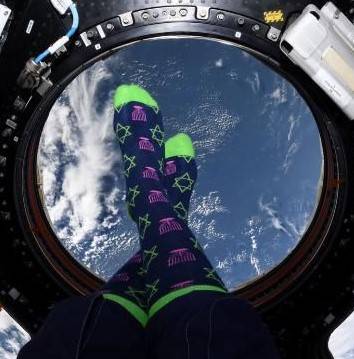
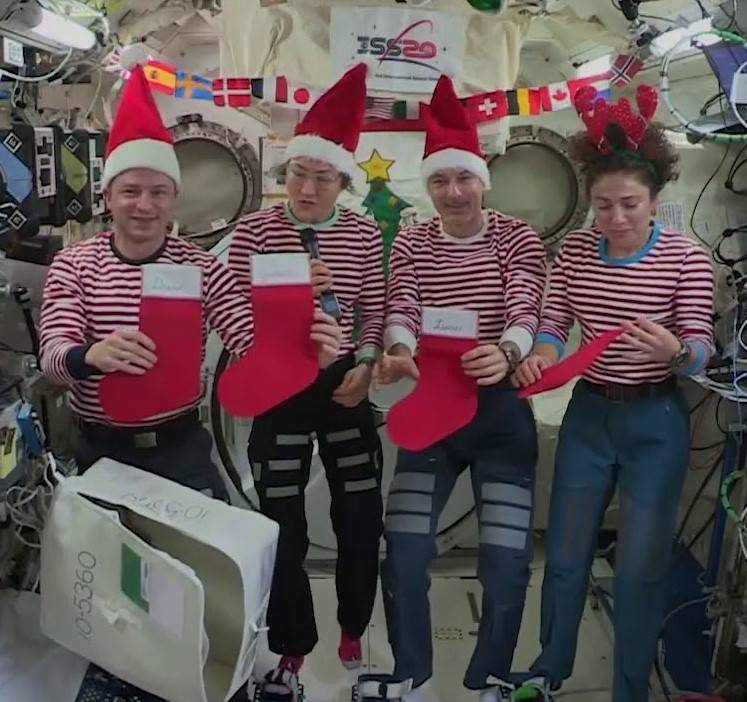
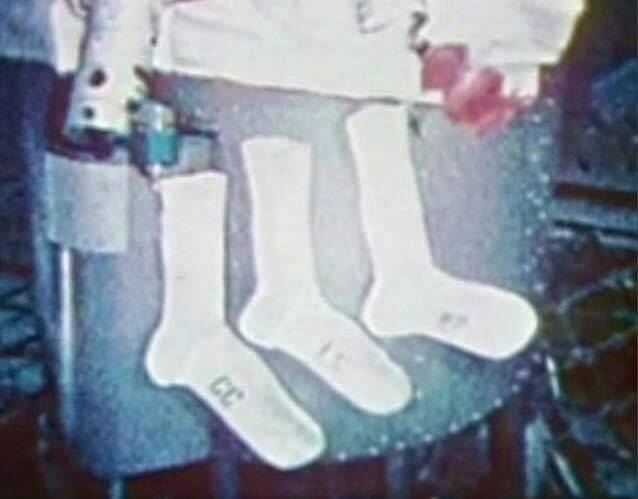
exp_61_meir_hanukkah_socks_2019 exp_61_christmas_message_2019 exp_61_new_years_eve_2019
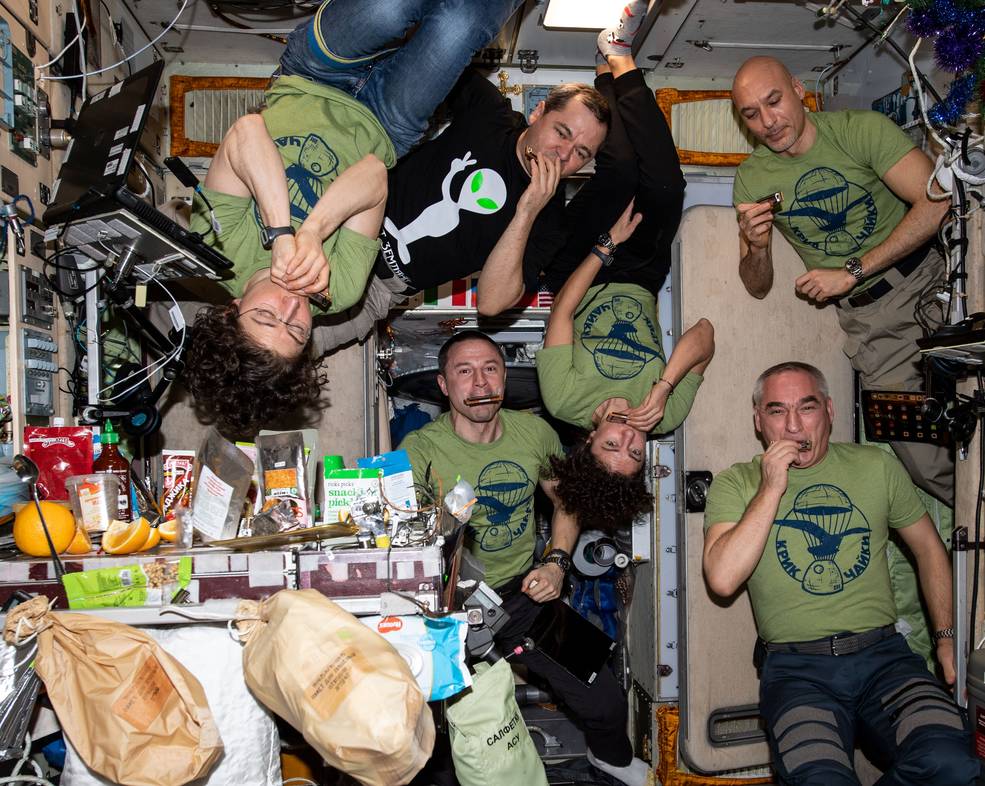
Three scenes from the 2019 holiday season aboard the space station. Left: Expedition 61 flight engineer Jessica U. Meir of NASA shows off her Hanukkah-themed socks in the Cupola. Middle: Expedition 61 crew members Andrew R. Morgan, left, and Christina H. Koch of NASA, Luca S. Parmitano of the European Space Agency, and Meir share their Christmas messages. Right: Expedition 61 crew members Koch, left, Morgan, Oleg I. Skripochka of Roscosmos, Meir, Aleksandr A. Skvortsov of Roscosmos, and Parmitano ring in the new year with harmonicas.
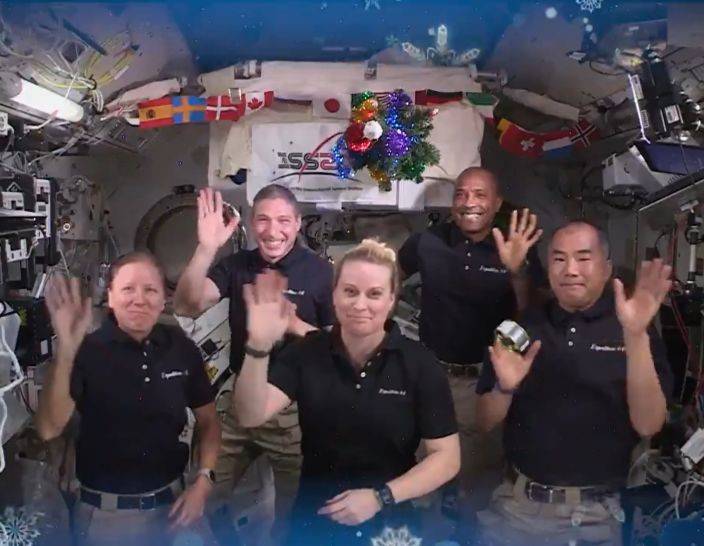
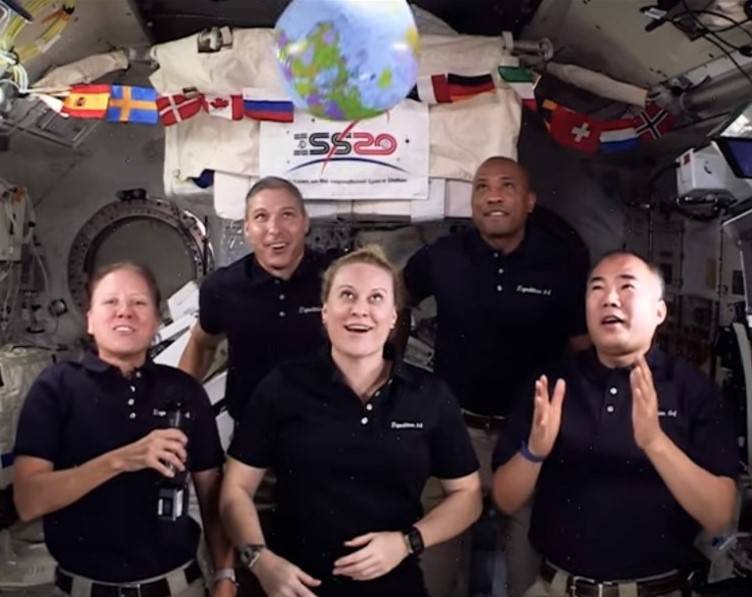
holidays_in_space_2021_39_exp_64_holiday_greeting_dec_2020 holidays_in_space_2021_40_exp_64_new_year_message holidays_in_space_2021_41_exp_64_new_years_celebration
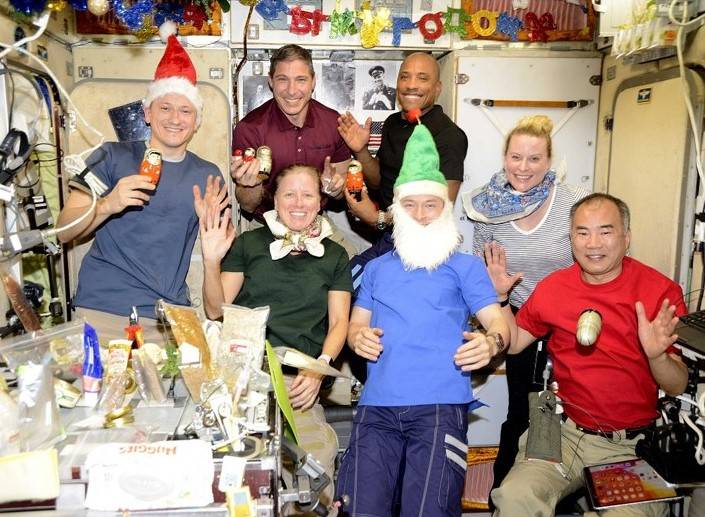
Three scenes from the 2020 holiday season aboard the space station. Left: Expedition 64 NASA astronauts Shannon Walker, left, Michael S. Hopkins, Kathleen H. Rubins, and Victor J. Glover and Soichi Noguchi of the Japan Aerospace Exploration Agency (JAXA) record Christmas greetings. Middle: Walker, left, Hopkins, Rubins, Glover, and Noguchi use an inflatable Earth globe as a substitute for the Times Square New Year’s Eve ball “drop” aboard the space station. Right: Expedition 64 crew members Sergei V. Kud-Sverchkov of Roscosmos, left, Hopkins, Walker, Sergei N. Ryzhikov of Roscosmos, Glover, Rubins, and Noguchi welcome in 2021 aboard the space station.
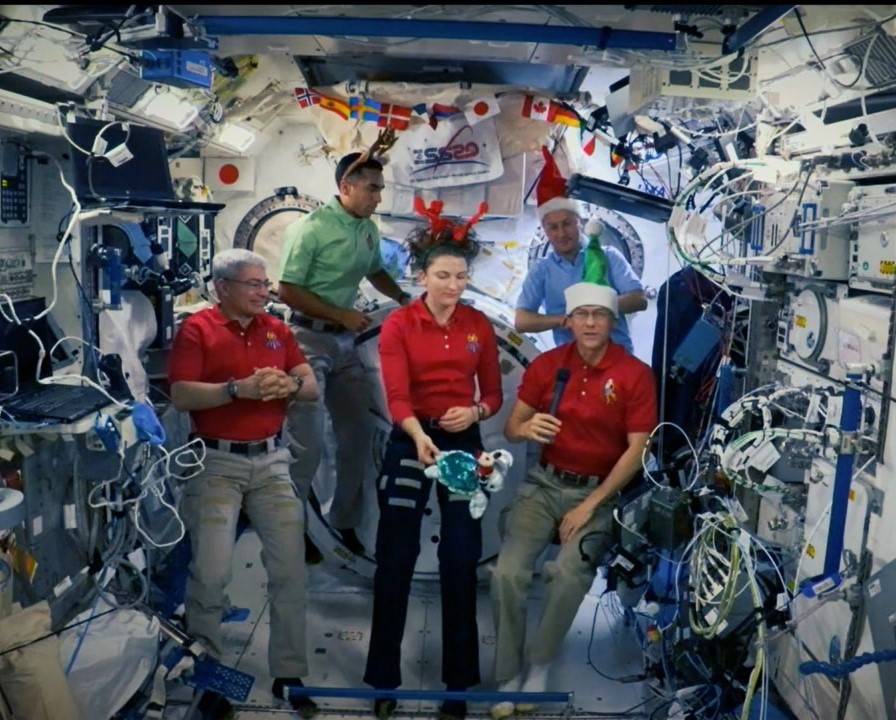
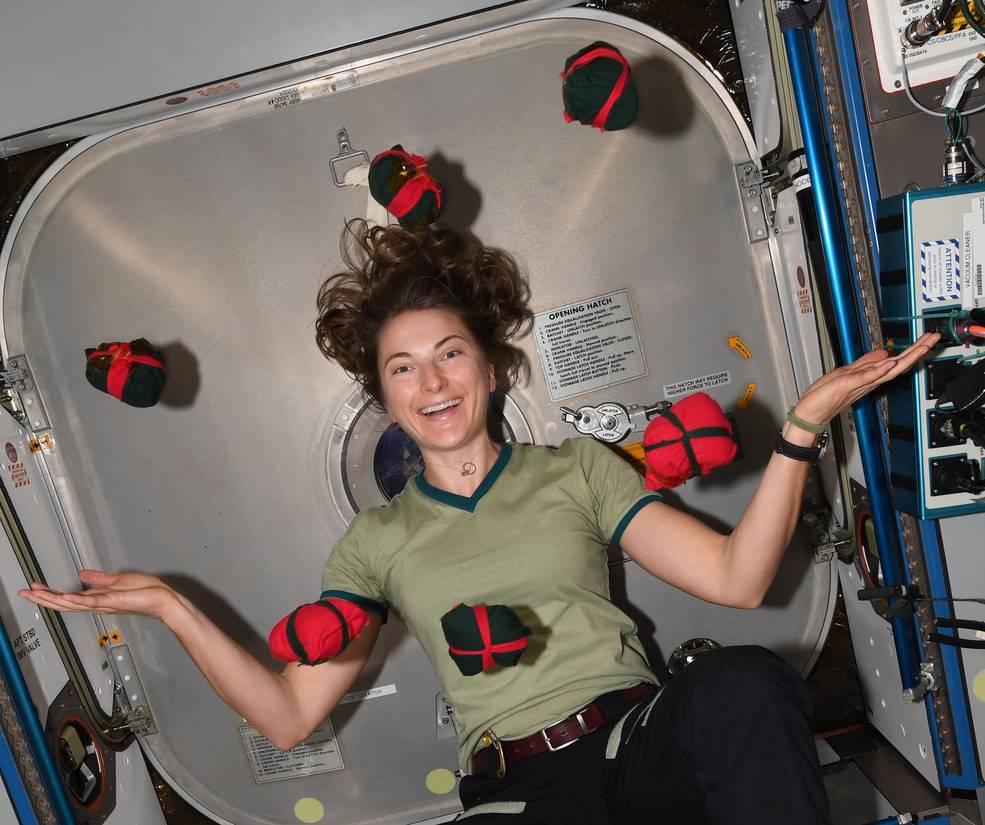
holidays_in_space_2021_42_exp_66_holiday_message_dec_2021 holidays_in_space_2021_43_exp_66_barron_w_presents_dec_2021
Left: During Expedition 66 in 2021, NASA astronauts Mark T. Vande Hei, left, Raja J. Chari, Kayla S. Barron, and Thomas H. Marshburn, and Matthias J. Maurer of the European Space Agency in a still from a video in which they share their thoughts about the holiday season. Right: Barron showing off the presents she wrapped for her six crewmates.

“It is a privilege to have the perspective of seeing so many countries,” said Expedition 66 Commander NASA astronaut Thomas H. Marshburn in a video sharing his thoughts about spending the New Year in space. “We can go from one side [of Earth] to another in just a few minutes and it truly gives us a feeling of unification for all human beings around the world.” “We get to see the sunrise many times a day, so thinking about the fact that people are waking up to a New Year each time we see that sunrise is pretty cool,” added NASA astronaut Raja J. Chari. In a social media post, ESA astronaut Matthias J. Maurer wrote about their New Year’s Eve dinner, and included a time lapse video of the festive meal.
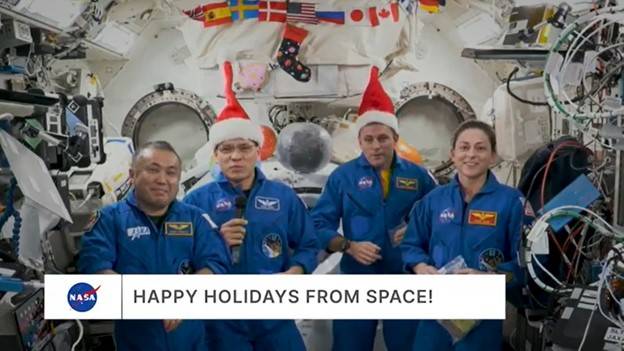
happy_holidays_from_space_2022 Expedition 68 crew members wear holiday garb
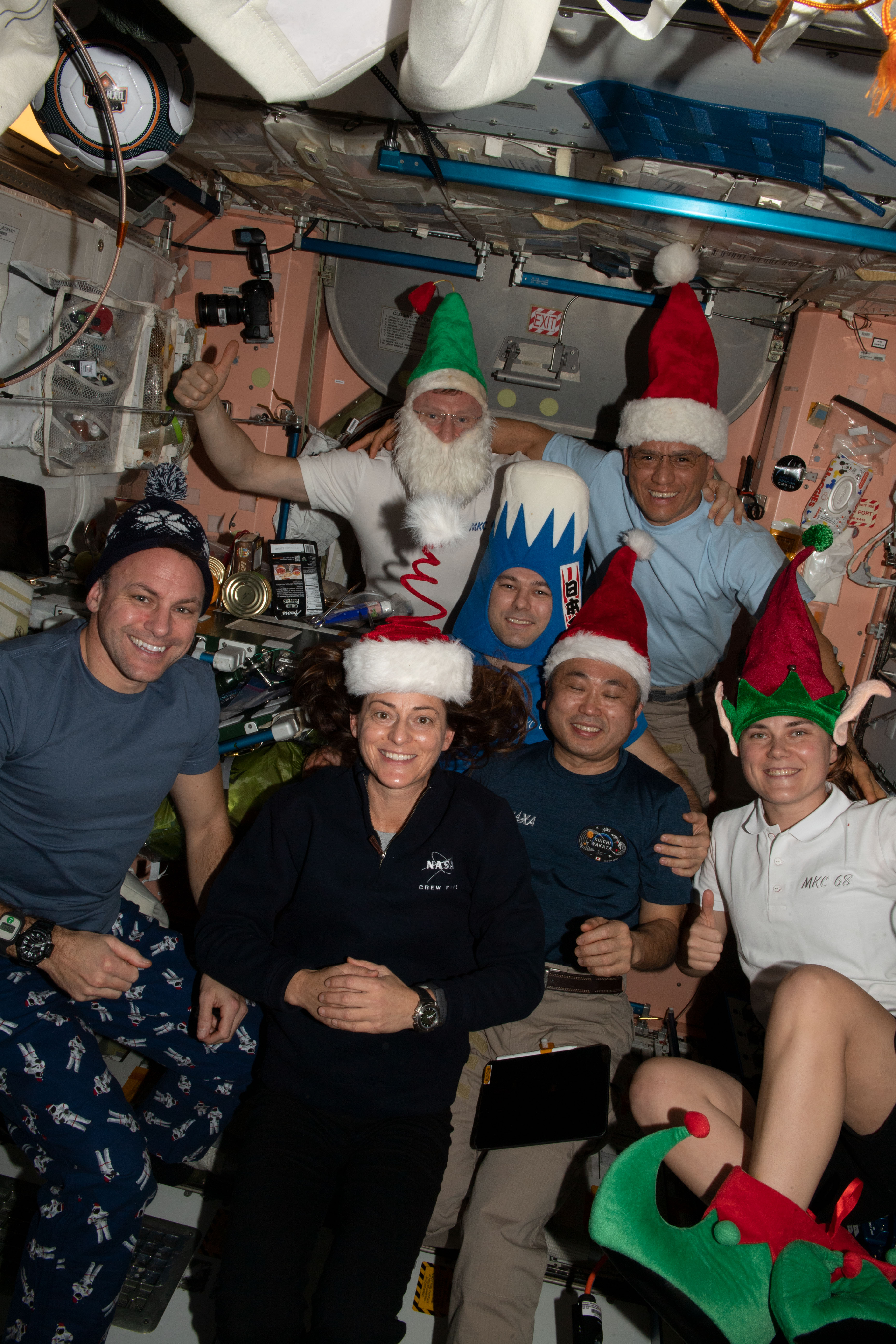
Left: Expedition 68 crew members Koichi Wakata of the Japan Aerospace Exploration Agency, left, and NASA astronauts Francisco C. “Frank” Rubio, Josh A. Cassada, and Nicole A. Mann record a holiday greeting from the space station. Right: Expedition 68 crew members wear holiday garb.

In 2022, Expedition 68 crew members NASA astronauts Nicole A. Mann, Josh A. Cassada, and Francisco C. “Frank” Rubio, and JAXA astronaut Koichi Wakata recorded a holiday message for everyone on the ground. They shared some of their personal traditions for the holidays and provided a glimpse of how they spend the holidays aboard the space station. 
Expedition 70 NASA astronaut Jasmin Moghbeli’s felt menorah and dreidel that she used to celebrate Hanukkah
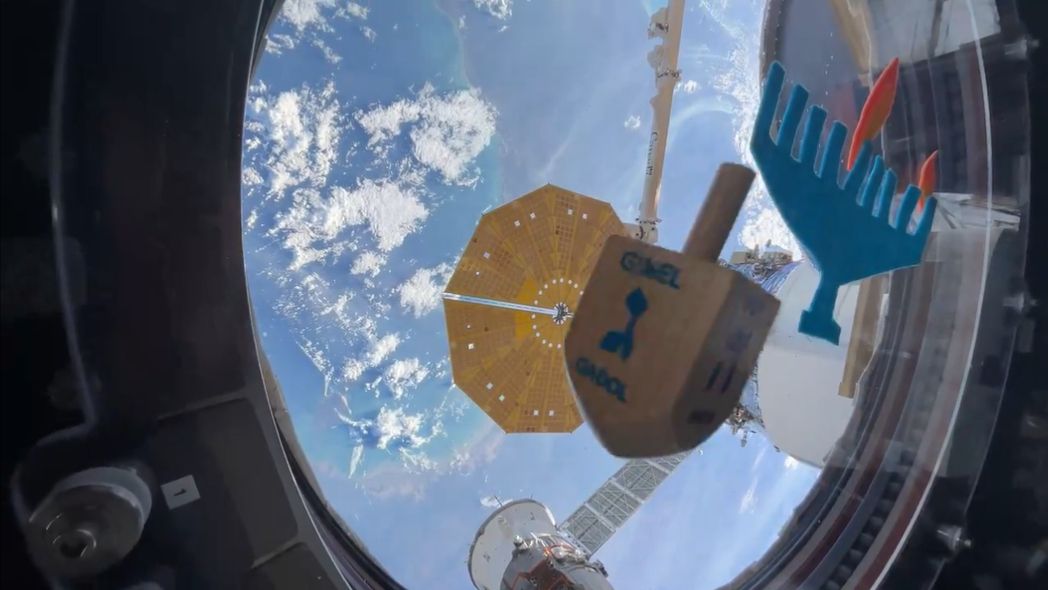
Expedition 70 NASA astronaut Jasmin Moghbeli’s felt menorah and dreidel that she used to celebrate Hanukkah.

Expedition 70 flight engineer NASA astronaut Jasmin Moghbeli’s husband and two little girls made a felt menorah for her to celebrate Hanukkah during her mission. Since astronauts can’t light real candles aboard the space station, Moghbeli pinned felt “lights” for each night of the eight-day holiday. A dreidel spun in weightlessness will continue spinning until it comes in contact with another object, but can’t land on any of its four faces. 

tiangong_space_station_astronauts_livestream shenzhou_13_lunar_new_year_welcoming_year_of_the_tiger_jan_30_2022
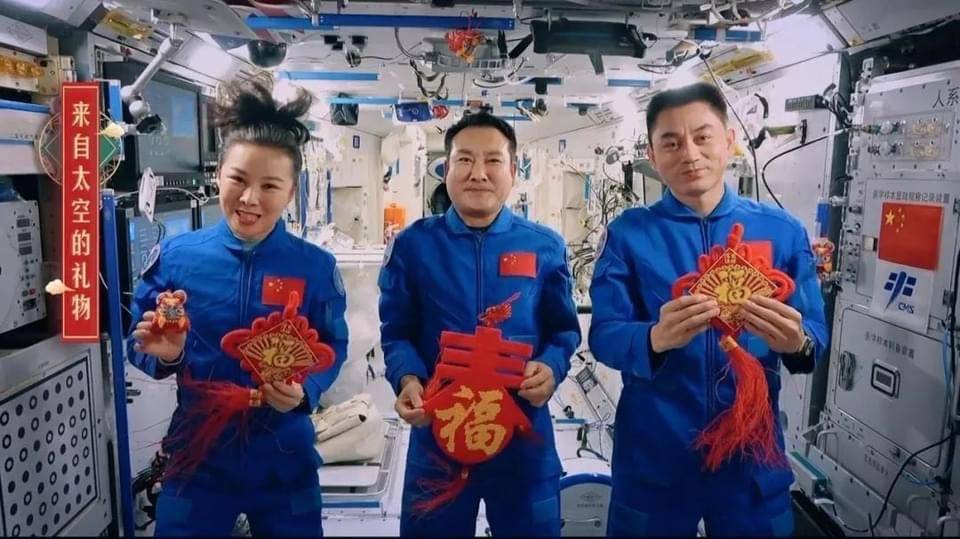
Left: To celebrate New Year’s Day 2022, Shenzhou 13 astronauts Ye Guangfu, left, Zhai Zhigang, and Wang Yaping aboard the China Space Station Tiangong hold a live video call. Right: Wang, left, Zhai, and Ye celebrate the Chinese New Year of the Tiger aboard Tiangong.

On Jan. 1, 2022, for the first time Chinese astronauts celebrated a New Year in space. The Shenzhou 13 crew of Zhai Zhigang, Wang Yaping, and Ye Guangfu arrived aboard the China Space Station Tiangong on Oct. 15, 2021, for a six-month mission. On New Year’s Day 2022, they hosted a live video call and interacted with college students at venues in Beijing, Hong Kong, and Macao. For the Feb. 1 start of the Chinese New Year of the Tiger, they decorated the space station and sent best wishes to people on the ground for a happy and prosperous new year.

In January 2023, Shenzhou 15 astronauts Fei Junlong, left, Deng Qingming, and Zhang Lu send New Year’s greetings to Earth from the Tiangong China Space Station.

We hope you enjoyed these stories, photographs, and videos from holiday celebrations in space. This year, a record-tying 10 people from five nations will celebrate the holidays and ring in the new year while serving aboard two space stations – the International Space Station and the Tiangong China Space Station. We wish them all and everyone here on Earth the very best during the holiday season and hope that 2024 will indeed be a Happy New Year!

Powered by WPeMatico

Get The Details…
Kelli Mars

Robotic Arm Releases Cygnus from Station

Robotic Arm Releases Cygnus from Station

The Cygnus space freighter is poised for release from the grip of the Canadarm2 robotic arm ending a four-and-a-half month space station cargo mission. Credit: NASA TV

At 8:06 a.m. EST, Northrop Grumman Cygnus spacecraft was released from the Canadarm2 robotic arm which earlier detached Cygnus from the Earth-facing port of the International Space Station’s Unity module. At the time of release, the station was flying about 260 miles over the Atlantic Ocean.

The Cygnus spacecraft successfully departed the space station more than four months after arriving at the microgravity laboratory to deliver about 8,200 pounds of supplies, scientific investigations, commercial products, hardware, and other cargo for NASA and its international partners.

Following a deorbit engine firing in early January, Cygnus will begin a planned destructive re-entry, in which the spacecraft – filled with trash packed by the station crew – will safely burn up in Earth’s atmosphere.

Cygnus arrived at the space station Aug. 4, following a launch on Northrop Grumman’s Antares rocket from NASA’s Wallops Flight Facility on Wallops Island, Virginia. It was the company’s 19th commercial resupply services mission to the space station for NASA. Northrop Grumman named the spacecraft after the late NASA astronaut Laurel Clark.


Learn more about station activities by following the space station blog@space_station and @ISS_Research on X, as well as the ISS Facebook and ISS Instagram accounts.

Get weekly video highlights at: https://roundupreads.jsc.nasa.gov/videoupdate/

Get the latest from NASA delivered every week. Subscribe here: www.nasa.gov/subscribe

Powered by WPeMatico

Get The Details…

Mark Garcia

NASA Asteroid Sampling Mission Renamed OSIRIS-APEX for New Journey

NASA Asteroid Sampling Mission Renamed OSIRIS-APEX for New Journey

5 min read

Preparations for Next Moonwalk Simulations Underway (and Underwater)

At the end of a long-haul road trip, it might be time to kick up your feet and rest awhile – especially if it was a seven-year, 4 billion-mile journey to bring Earth a sample of asteroid Bennu. But OSIRIS-REx (Origins, Spectral Interpretation, Resource Identification and Security – Regolith Explorer), the NASA mission that accomplished this feat in September, is already well on its way (with a new name) to explore a new destination.

When OSIRIS-REx left Bennu in May 2021 with a sample aboard, its instruments were in great condition, and it still had a quarter of its fuel left. So instead of shutting down the spacecraft after it delivered the sample, the team proposed to dispatch it on a bonus mission to asteroid Apophis, with an expected arrival in April 2029. NASA agreed, and OSIRIS-APEX (Origins, Spectral Interpretation, Resource Identification, and Security – Apophis Explorer) was born.

A Rare Opportunity at Apophis

After considering several destinations (including Venus and various comets), NASA chose to send the spacecraft to Apophis, an “S-type” asteroid made of silicate materials and nickel-iron – a fair bit different than the carbon-rich, “C-type” Bennu.

The intrigue of Apophis is its exceptionally close approach of our planet on April 13, 2029. Although Apophis will not hit Earth during this encounter or in the foreseeable future, the pass in 2029 will bring the asteroid within 20,000 miles (32,000 kilometers) of the surface – closer than some satellites, and close enough that it could be visible to the naked eye in the Eastern Hemisphere.

Scientists estimate that asteroids of Apophis’ size, about 367 yards across (about 340 meters), come this close to Earth only once every 7,500 years.

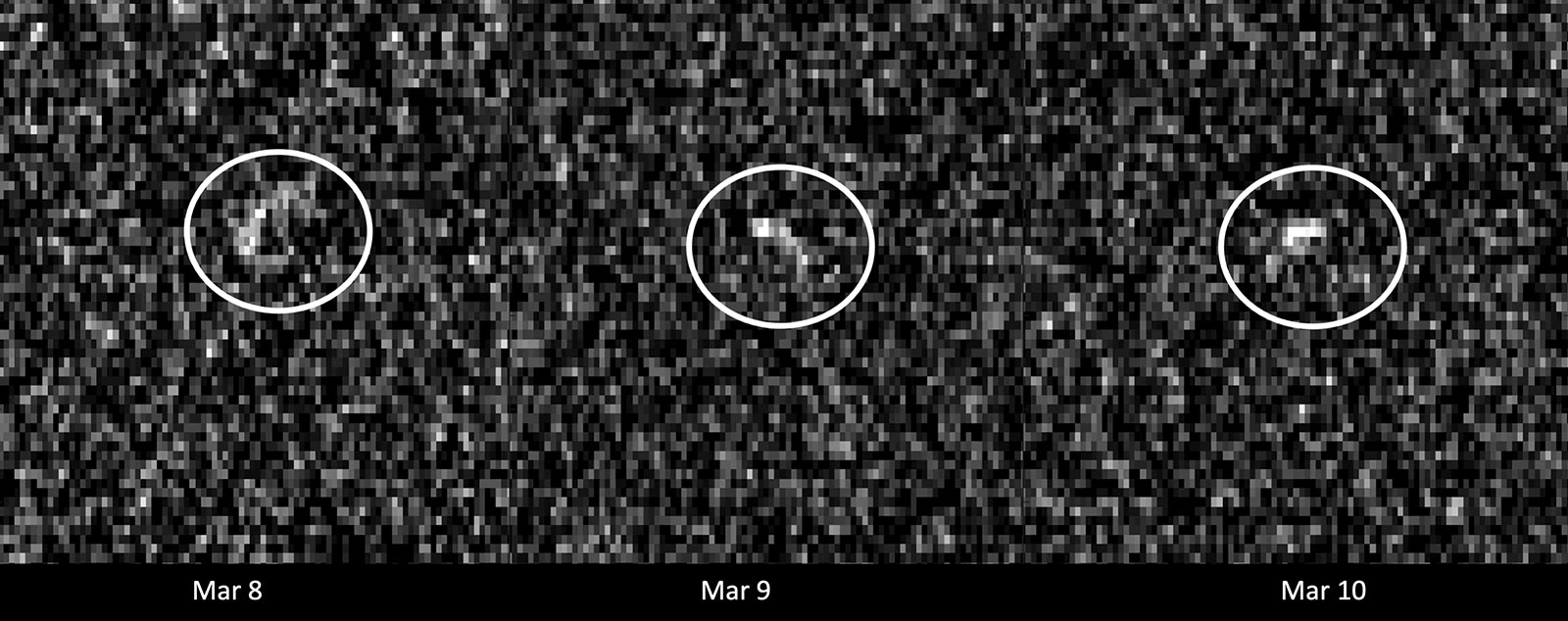
three grayscale, pixelated images of asteroid Apophis (circled) taken with radar
These images of asteroid Apophis were recorded in March 2021 by radio antennas at the Deep Space Network’s Goldstone complex in California and the Green Bank Telescope in West Virginia. The asteroid was 10.6 million miles (17 million kilometers) away, and each pixel has a resolution of 127 feet (38.75 meters).
Credit: NASA/JPL-Caltech and NSF/AUI/GBO

“OSIRIS-APEX will study Apophis immediately after such a pass, allowing us to see how its surface changes by interacting with Earth’s gravity,” said Amy Simon, the mission’s project scientist based at NASA’s Goddard Space Flight Center in Greenbelt, Maryland.

Apophis’ close encounter with Earth will change the asteroid’s orbit and the length of its 30.6-hour day. The encounter also may cause quakes and landslides on the asteroid’s surface that could churn up material and uncover what lies beneath.

“The close approach is a great natural experiment,” said Dani Mendoza DellaGiustina, principal investigator for OSIRIS-APEX at the University of Arizona in Tucson. “We know that tidal forces and the accumulation of rubble pile material are foundational processes that could play a role in planet formation. They could inform how we got from debris in the early solar system to full-blown planets.”

Apophis represents more than just the opportunity to learn more about how solar systems and planets form: As it happens, most of the known potentially hazardous asteroids (those whose orbits come within 4.6 million miles of Earth) are also S-types. What the team learns about Apophis can inform planetary defense research, a top priority for NASA.

OSIRIS-APEX: Travel Itinerary

By April 2, 2029 – around two weeks before Apophis’ close encounter with Earth –  OSIRIS-APEX’s cameras will begin taking images of the asteroid as the spacecraft catches up to it. Apophis will also be closely observed by Earth-based telescopes during this time. But in the hours after the close encounter, Apophis will appear too near the Sun in the sky to be observed by ground-based optical telescopes. This means any changes triggered by the close encounter will be best detected by the spacecraft.

This animation depicts the orbital trajectory of asteroid 99942 Apophis as it zooms safely past Earth on April 13, 2029. Earth’s gravity will slightly deflect the trajectory as the 1,100-foot-wide (340-meter-wide) near-Earth object comes within 20,000 miles (32,000 kilometers) of our planet’s surface. The motion has been sped up 2,000 times.
Credit: NASA/JPL-Caltech

OSIRIS-APEX will arrive at the asteroid on April 13, 2029, and operate in its proximity for about the next 18 months. In addition to studying changes to Apophis caused by its Earth encounter, the spacecraft will conduct many of the same investigations OSIRIS-REx did at Bennu, including using its instrument suite of imagers, spectrometers, and a laser altimeter to closely map the surface and analyze its chemical makeup.

As an encore, OSIRIS-APEX will reprise one of OSIRIS-REx’s most impressive acts (minus sample collection), dipping within 16 feet of the asteroid’s surface and firing its thrusters downward. This maneuver will stir up surface rocks and dust to give scientists a peek at the material that lies below.

Although the rendezvous with Apophis is more than five years away, the next milestone on its journey is the first of six close Sun passes. Those near approaches, along with three gravity assists from Earth, will put OSIRIS-APEX on course to reach Apophis in April 2029.

What OSIRIS-APEX will discover about Apophis remains to be seen, but if the mission’s previous incarnation is any indication, surprising science lies ahead. “We learned a lot at Bennu, but now we’re armed with even more questions for our next target,” Simon said.

NASA’s Goddard Space Flight Center provides overall mission management, systems engineering, and the safety and mission assurance for OSIRIS-APEX. Dani Mendoza DellaGiustina of the University of Arizona, Tucson, is the principal investigator. The university leads the science team and the mission’s science observation planning and data processing. Lockheed Martin Space in Littleton, Colorado, built the spacecraft and provides flight operations. Goddard and KinetX Aerospace are responsible for navigating the OSIRIS-APEX spacecraft. International partnerships on this mission include the spacecraft’s laser altimeter instrument from CSA (the Canadian Space Agency) and science collaboration with JAXA’s (the Japan Aerospace Exploration Agency) Hayabusa2 mission. OSIRIS-APEX (previously named OSIRIS-REx) is the third mission in NASA’s New Frontiers Program, managed by NASA’s Marshall Space Flight Center in Huntsville, Alabama, for the agency’s Science Mission Directorate in Washington.

By Lonnie Shekhtman and Rob Garner
NASA’s Goddard Space Flight Center, Greenbelt, Md.

Share

Details

Last Updated

Dec 22, 2023

Editor
Rob Garner
Contact
Rob Garner
Location
Goddard Space Flight Center

Powered by WPeMatico

Get The Details…
Rob Garner