The Iconic Photos from STS-41B: Documenting the First Untethered Spacewalk

The Iconic Photos from STS-41B: Documenting the First Untethered Spacewalk
4 Min Read

The Iconic Photos from STS-41B: Documenting the First Untethered Spacewalk

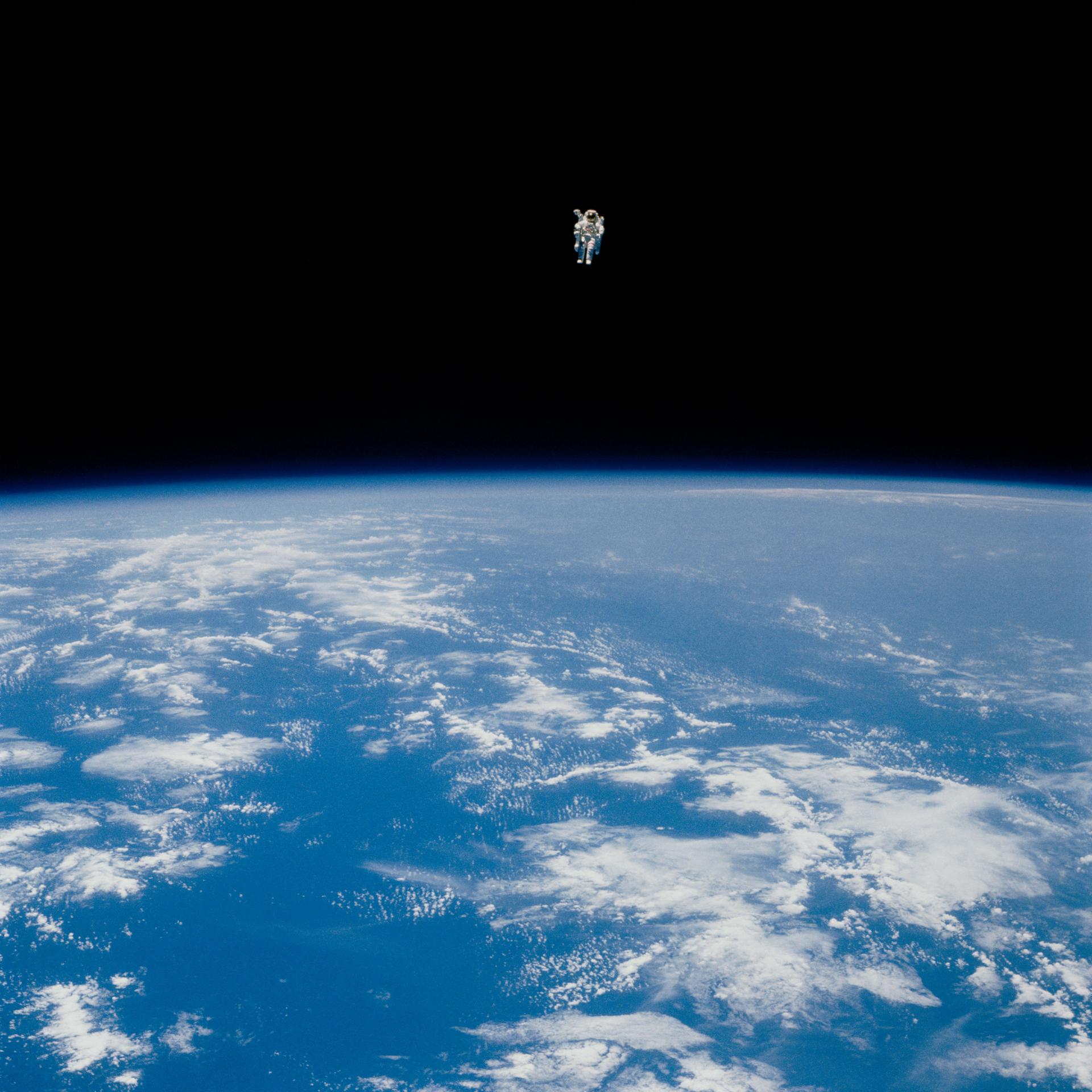
Astronaut Bruce McCandless II, STS-41B mission specialist, reaches his maximum distance from space shuttle Challenger before returning to the spacecraft using the Manned Maneuvering Unit (MMU).

Credits:
NASA

As astronaut Bruce McCandless II flew the Manned Maneuvering Unit (MMU) out of the space shuttle Challenger’s payload bay for the first time on February 7, 1984, many in the agency were fearful about the use of a self-propelled and untethered backpack in space.  (Previous spacewalkers remained connected to the vehicle with tethers. This jet-pack allowed crews to move outside of the cargo bay and perform activities away from the safety of the spacecraft.) He remembered trying to ease the tension for his wife and the flight controllers in Mission Control, saying something similar to Neil Armstrong’s declaration as he first stepped on the Moon in 1969. “It may have been one small step for Neil,” he proclaimed, “but it’s a heck of a big leap for me.”

It may have been one small step for Neil, but it’s a heck of a big leap for me.
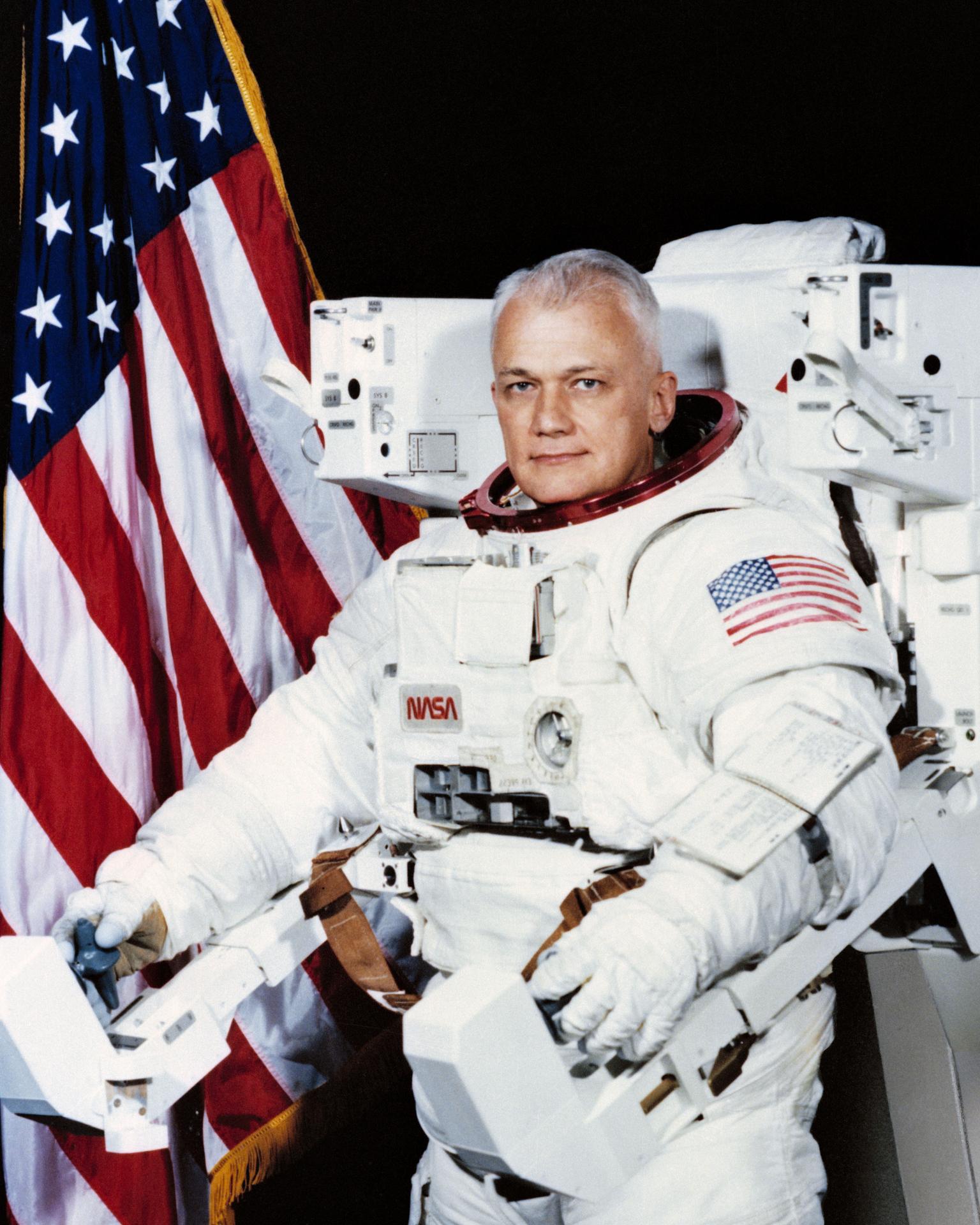
Bruce McCandless II

Bruce McCandless II

NASA Astronaut

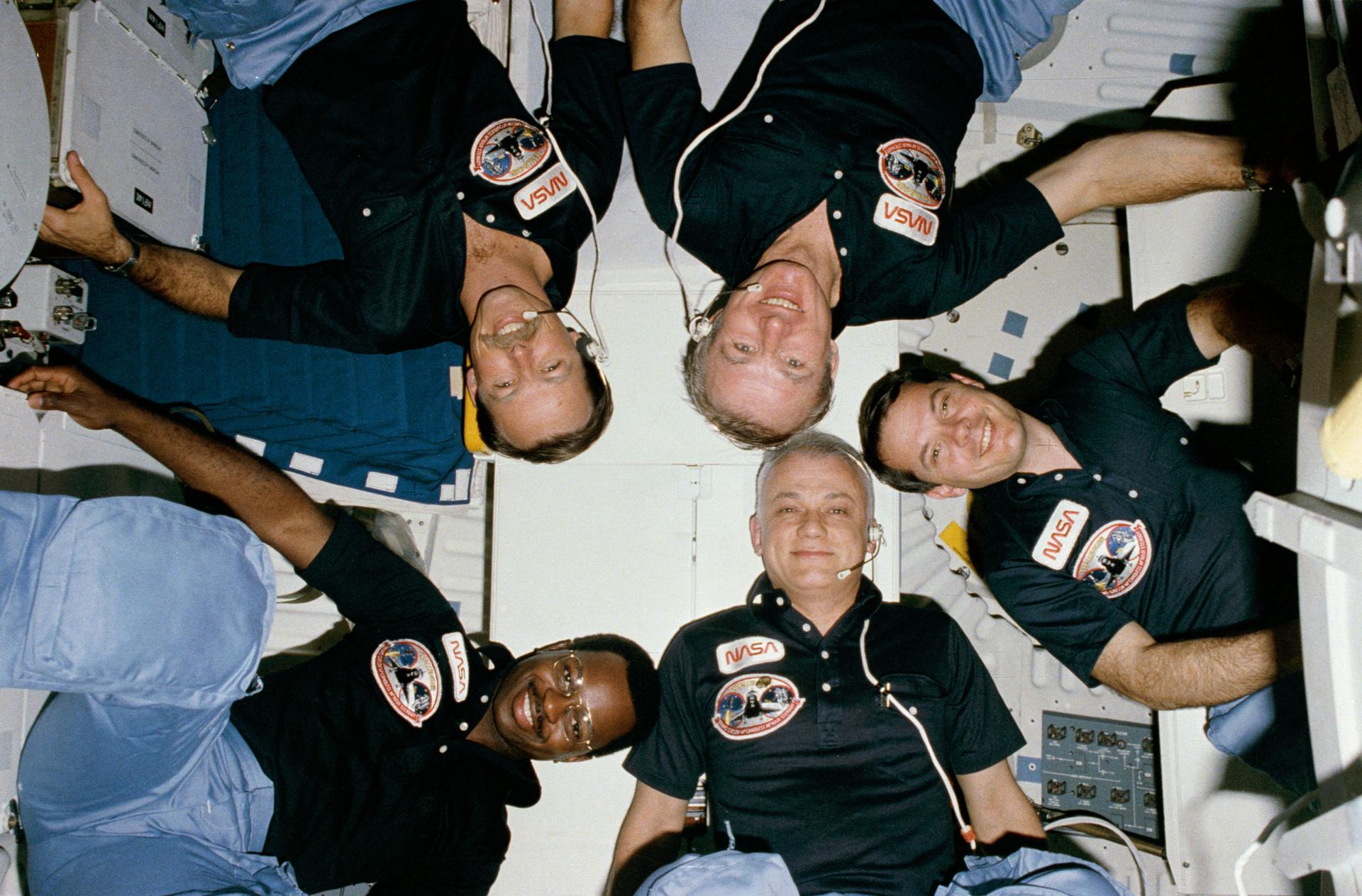
The 5-man crew of STS-41B take a group photo on the space shuttle
The crew of STS-41B take an informal portrait on the mid-deck of the Earth-orbiting Challenger. Counter clockwise from the top right are astronauts Vance D. Brand commander; Robert L. “Hoot” Gibson, pilot; and Dr. Ronald E. McNair, Bruce McCandless II, and Robert L. Stewart, all mission specialists.
NASA

The MMU was the highlight of the STS-41B mission as demonstrated by the stunning mission photographs that graced the cover of Aviation Week & Space Technology, not once, not twice, but three times.  

“Hoot” Gibson, the flight’s pilot, shot the photograph featured on the February 20, 1984, issue of the magazine from the crew cabin. Gibson remembered he was the only one on the crew that “had absolutely nothing to do” as McCandless made his way out into space, so he picked up a Hasselblad camera and began documenting the events. When he first looked through the camera’s viewfinder, he could not believe what an incredible sight it was to see McCandless untethered, floating above the Earth. Gibson wanted to capture what he was seeing and remembered how meticulous he was. For each photograph he took three light meter readings and checked the focus four times. In the crew’s photography training he learned that an off-kilter horizon looked wrong and was not pleasing to the eye. That presented a slight problem because Challenger was at a 28.5-degree inclination, so he “tilted the camera to put the horizon level in the pictures.”
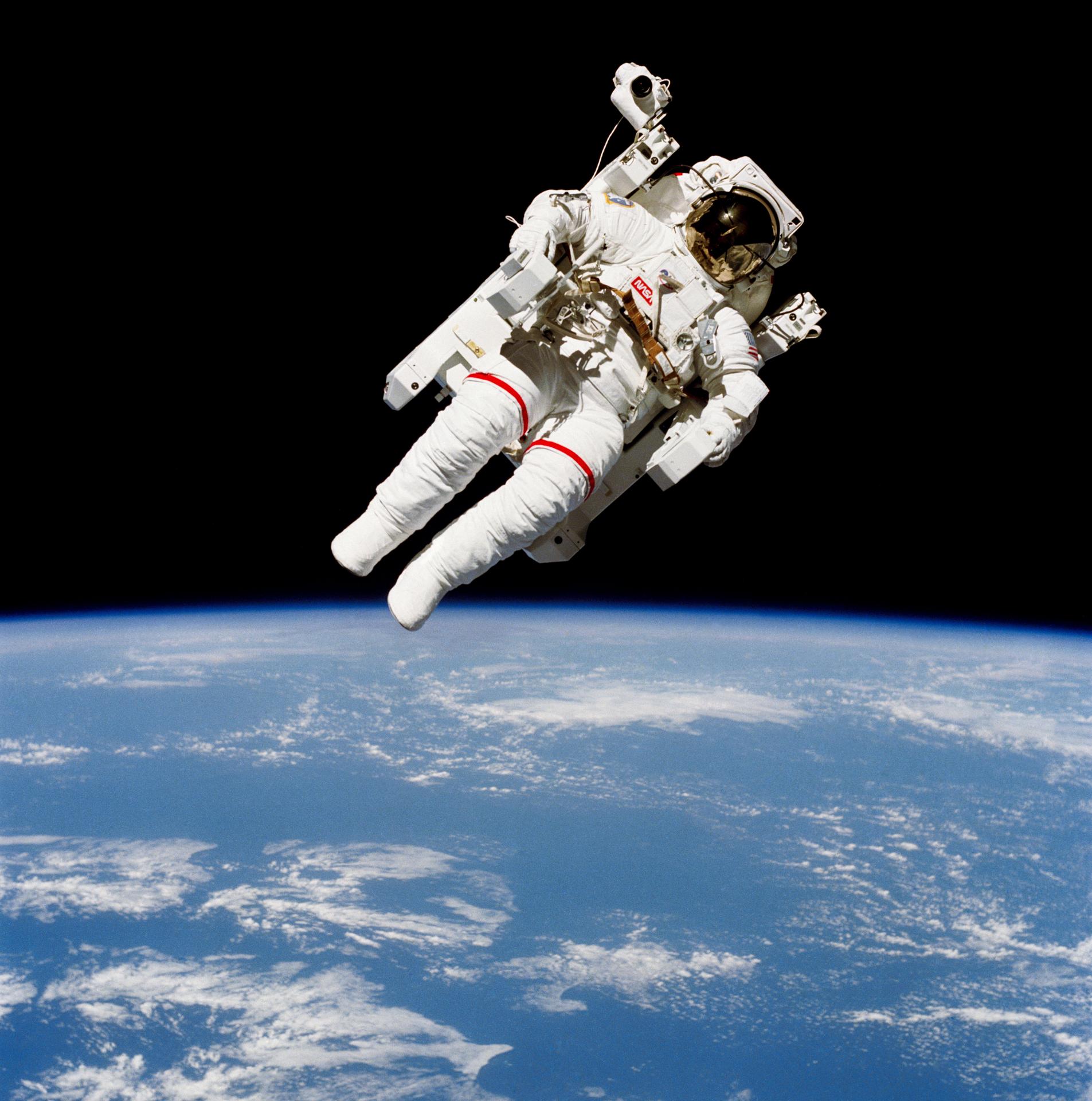
An astronaut floats in space untethered with Earth far below
Astronaut Bruce McCandless II is a few meters away from the cabin of the Earth-orbiting space shuttle Challenger in this iconic photo taken by Hoot Gibson, which was featured on the February 20, 1984 issue of Aviation Week & Space Technology.
NASA

The result was one of NASA’s most iconic and requested images. McCandless called the photograph “beautiful, partly because the sun is shining directly on me.” His son, Bruce McCandless III, said his father “appears to be glowing.” Because the sun was in his eyes, he closed the helmet visor, which made it difficult to identify who exactly was inside the spacesuit. “My anonymity means people can imagine themselves doing the same thing,” he said. And, he added, “at visitor centres [sic], they often have life-sized cardboard versions with the visor cut out, so people can peep through.” Perhaps more importantly, as expressed by United States Senator John McCain, the photo “inspired generations of Americans to believe that there is no limit to the human potential.”

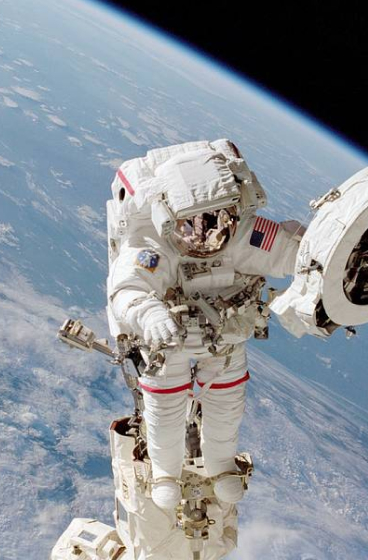
A second, but less recognized image, appeared on the cover of Aviation Week & Space Technology the following week: February 27, 1984. Also taken by Gibson, the image featured McCandless on the Manipulator Foot Restraint or “cherry picker” device at end of the Remote Manipulator System (RMS). The restraint was a platform where spacewalkers could work outside the vehicle but remain anchored at the end of the RMS to repair a satellite or other activities. STS-41B marked the first test of the new apparatus. Gibson explained how he chose to capture McCandless on the device. “What I did was I shifted the camera so that he wasn’t right in the center of the picture. I put him on the edge and the orbiter’s rudder on the other edge of the picture. That made a really cool photo.”
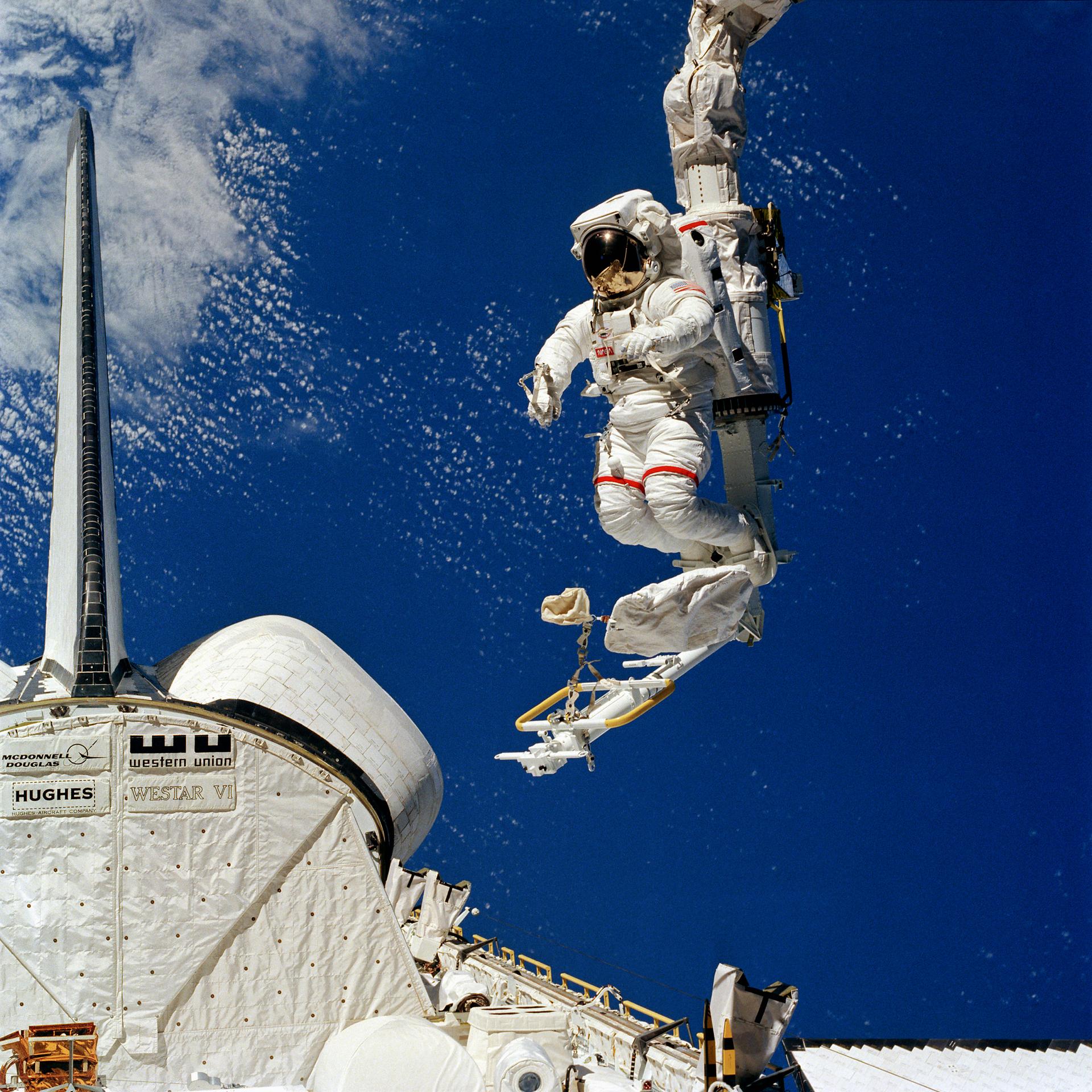
The feet of Bruce McCandless II are anchored in the Mobile Foot Restraint (MFR) and moved around by the Remote Manipulator System (RMS). The aft portion of the Challenger, to which the RMS is connected, is seen in lower left corner.
NASA

A third image from the mission appeared on the March 12, 1984, cover of the magazine. The photograph, taken by a fixed camera on McCandless’s helmet, captured Challenger in its entirety, which included the payload bay with the Shuttle Pallet Satellite and a glimpse of astronaut Robert Stewart standing just beneath the spacecraft’s RMS.
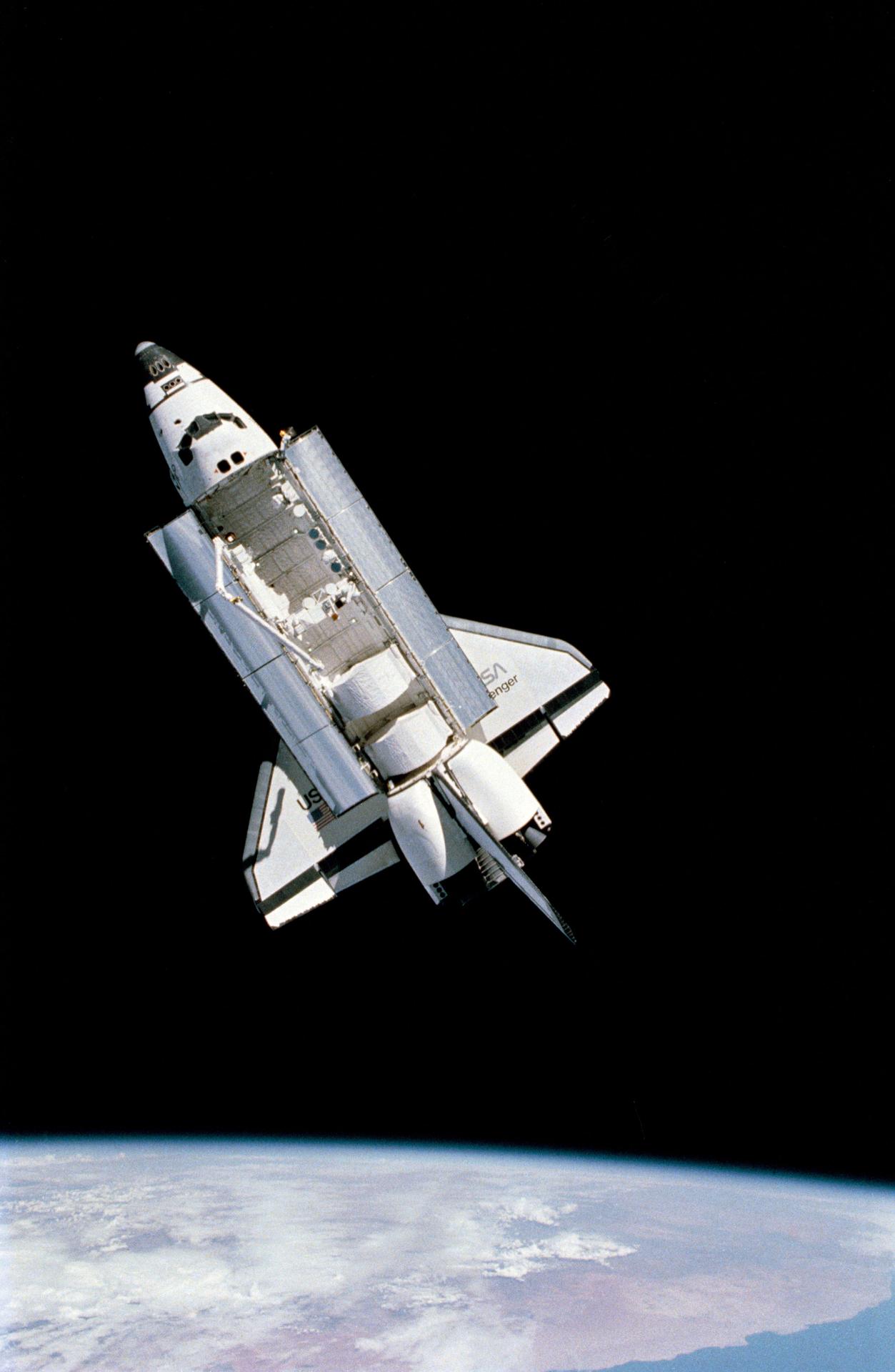
This photo of Challenger was the third from the STS-41B mission to be featured on the cover of Aviation Week & Space Technology.
NASA

These photographs from STS-41B, from the tenth flight of the space shuttle, illustrate just how engaging and exciting shuttle missions were. While flying in space became more routine in the 1980s, no one, not even the crew, “appreciated how spectacular” the first MMU flight “was going to be.” The STS-41B photos demonstrated that human spaceflight remained just as captivating, breathtaking, and inspiring as it had always been.

About the Author

Jennifer Ross-Nazzal

Jennifer Ross-Nazzal

NASA Human Spaceflight Historian

Jennifer Ross-Nazzal is the NASA Human Spaceflight Historian. She is the author of Winning the West for Women: The Life of Suffragist Emma Smith DeVoe and Making Space for Women: Stories from Trailblazing Women of NASA’s Johnson Space Center.

Share

Details

Last Updated

Feb 02, 2024

Powered by WPeMatico

Get The Details…
Jennifer Ross-Nazzal
Meet the Creators, Part 3: NASA’s 2024 Total Solar Eclipse Posters

Meet the Creators, Part 3: NASA’s 2024 Total Solar Eclipse Posters

3 min read

Meet the Creators, Part 3: NASA’s 2024 Total Solar Eclipse Posters

A total solar eclipse is a captivating experience – evoking feelings of awe and wonder that are sometimes best expressed through art.

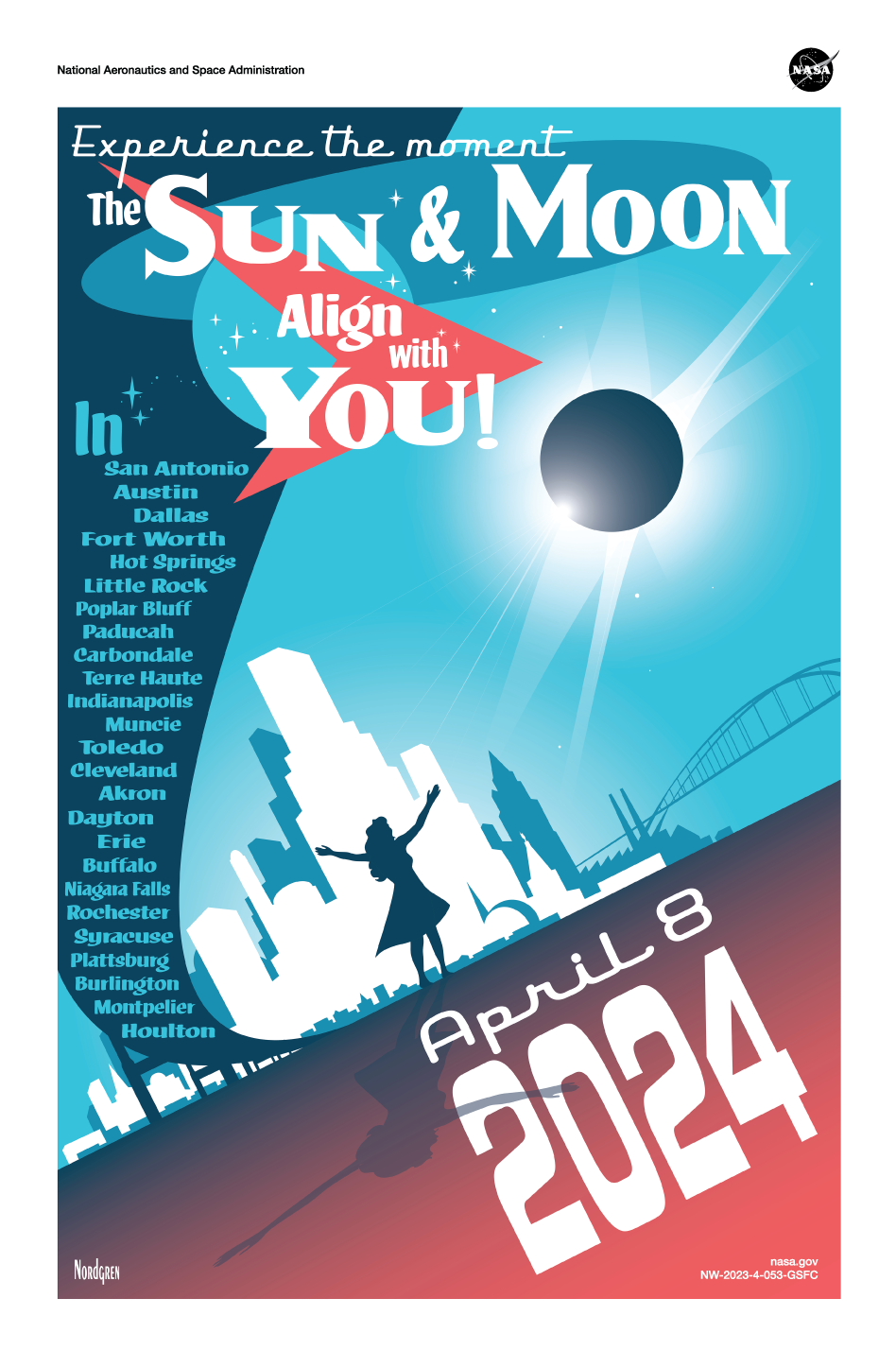
Inspired by the upcoming total solar eclipse of April 8, 2024, artists Tyler Nordgren and Kristen Perrin have designed two posters for NASA that present the magic of the eclipse in unique ways.

Tyler Nordgren

An illustrative poster shows the silhouette of a person with outstretched arms standing in front of a city skyline and looking up at a total solar eclipse in the sky. The top of the poster says “Experience the moment” and “The Sun & Moon Align with You!” The bottom of the poster has the date “April 8, 2024.” Along the left side, the word “In” appears above a list of 25 U.S. cities. The name “Nordgren” appears in the lower left corner.
Download the poster here.
NASA/Tyler Nordgren

In “The Sun and Moon Align with You” poster for NASA, Nordgren – who is a professional astronomer as well as an artist – said that his goal was to capture the experience that can be had by millions of people in cities across the United States in April, while reflecting on the last total solar eclipse that crossed the country in August 2017.

“For 2017, the total solar eclipse passed over so many national parks and natural landscapes with very few cities in the path. So I created a poster modeled after the 1930s ‘See America’ national parks posters produced by the Works Progress Administration to educate Americans about the parks. I figured I was doing the same thing. Now, seven years later in 2024, this time the total solar eclipse is passing over major metropolitan areas. Over 30 million people will be living directly in the path of totality – that’s almost three times the total in 2017. So I wanted to make a poster that emphasized what it would be like to see it in one of these cities.

“The poster shows a figure standing before a representative skyline where I used elements of different cities (like certain buildings and bridges) all across the path of totality. Along the underpass that sweeps overhead of our central figure are the names of major cities from every state along totality. It truly is stunning how many people in so many cities will get to see this. 

“Think about being in a sports or concert stadium when the crowd erupts in joy all at once. Now imagine, not just a stadium, but every single person in an entire city all at once at the instant the Sun goes black. This will be a day people will remember and talk about with awe for the rest of their lives. I hope I captured some small part of that.”

Kristen Perrin

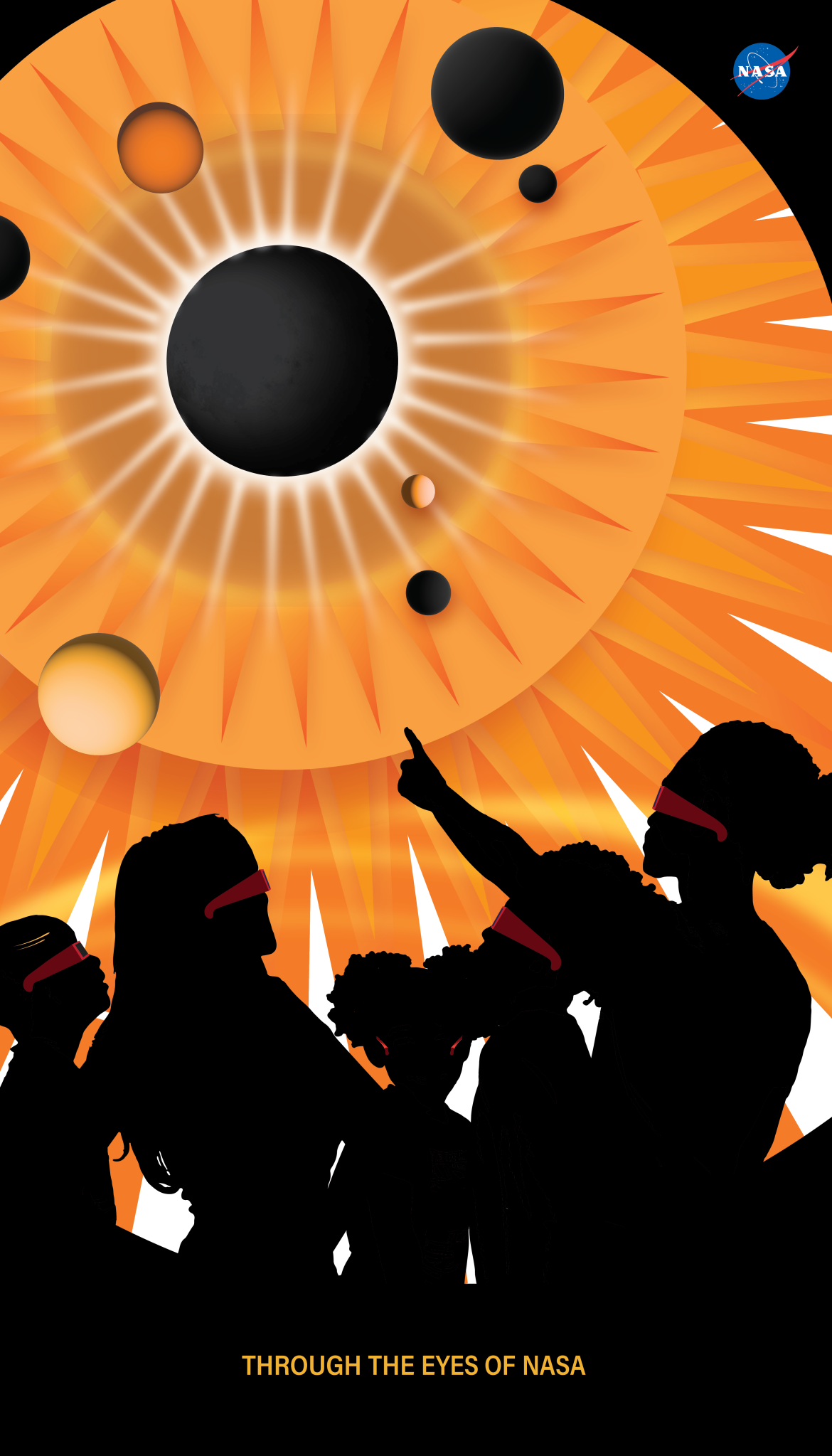
An illustrative poster shows the black silhouettes of five people of different heights wearing red eclipse glasses and looking at a total solar eclipse. One person points toward the eclipse. The eclipse is represented as a black disk surrounded by concentric circles of yellow and orange with white, orange, and red rays. Several spheres appear around the eclipse. At the bottom are the words “Through the eyes of NASA” and the NASA logo appears in the upper right.
Download the poster here.
NASA/Kristen Perrin

For her “Through the Eyes of NASA” poster, Perrin – who is an African American woman, mother of four, and the Senior Multimedia and Graphic Specialist on the NASA Heliophysics communications team – said she wanted to show that the eclipse is an experience for everyone.

“Designing the poster to commemorate the total solar eclipse happening on April 8 was an honor. I wanted to highlight the event using people that represented all demographics. This was done so that the eclipse could be recognized as an event for ALL. Using the spherical elements to represent the Moon and some of the planets within our solar system encouraged the overall visual to help the audience see where the eclipse takes place and understand, by the coloring, what would happen. The look of the skyline from the audience point of view was also designed to resemble an eye. This visual honed in on the tagline ‘Through the eyes of NASA’.”

To learn more about these artists and other eclipse posters they’ve created, read Meet the Creators of NASA’s Newest Eclipse Art.

by Vanessa Thomas
NASA’s Goddard Space Flight Center, Greenbelt, Md.

Share

Details

Last Updated
Feb 02, 2024

Powered by WPeMatico

Get The Details…

California, Massachusetts Students to Hear from NASA, ESA Astronauts

California, Massachusetts Students to Hear from NASA, ESA Astronauts

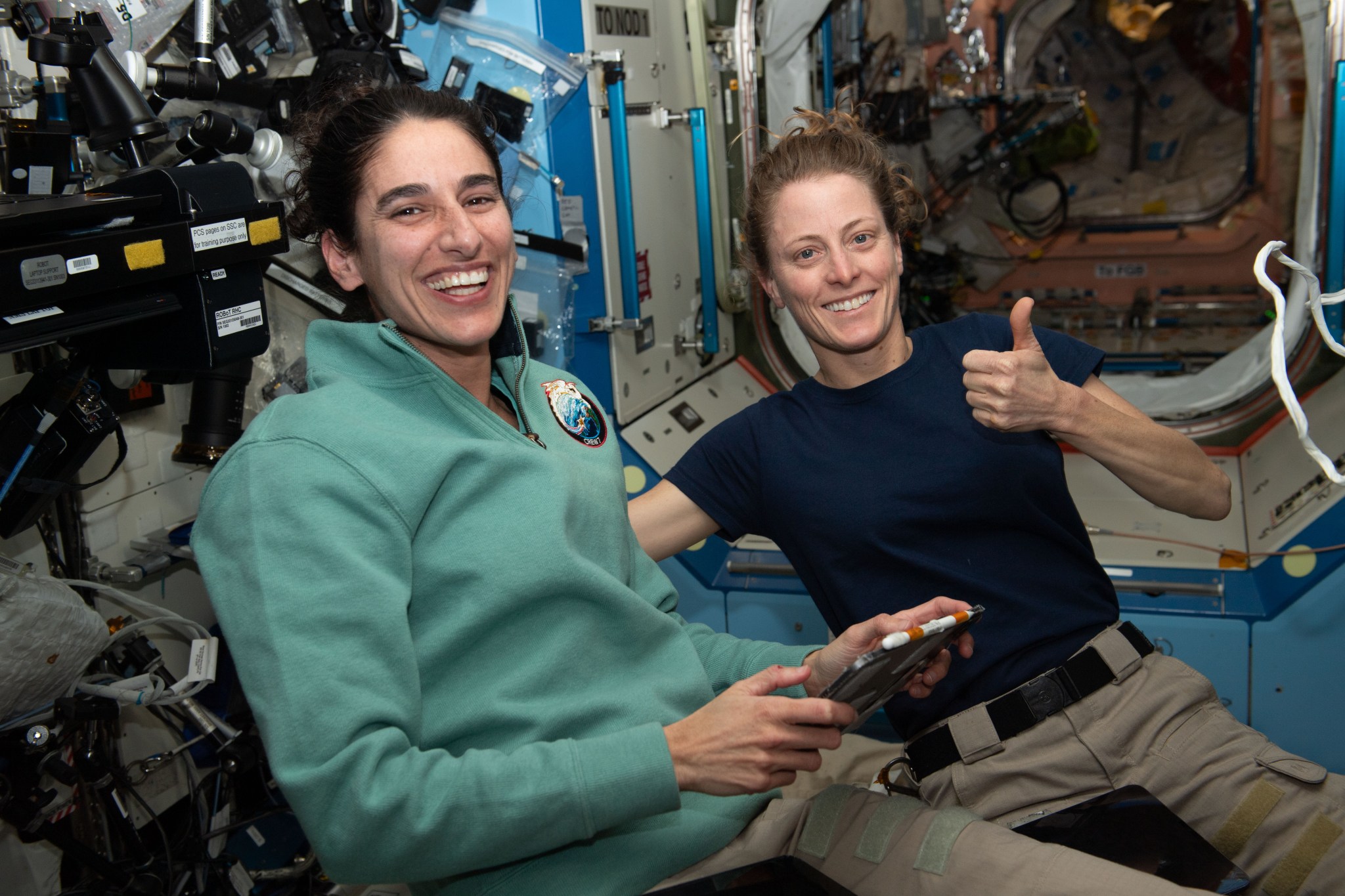
NASA astronauts and Expedition 70 Flight Engineers Jasmin Moghbeli, left, and Loral O’Hara in the Destiny laboratory celebrate the successful docking of a SpaceX Dragon cargo spacecraft to the International Space Station.
NASA

Students from California and Massachusetts will have separate opportunities next week to hear from NASA astronauts aboard the International Space Station.

The two Earth-to-space calls will air live Monday, Feb. 5, and Friday, Feb. 9, on NASA+ and agency’s website. Learn how to stream NASA TV through a variety of platforms including social media.

At 12:15 p.m. EST Feb. 5, NASA astronauts Loral O’Hara and Jasmin Moghbeli will answer prerecorded questions from students at Emblem Academy in Santa Clarita, California, a public transitional kindergarten through sixth-grade school. In preparation for the event, students and their families will participate in an engineering family night where they will participate in STEM design challenges related to the science, technology, engineering, and mathematics conducted on the space station.

Coverage on NASA+ will be live at:

https://go.nasa.gov/4bj0k5Q

Media interested in covering the event must  RSVP no later than 5 p.m. Friday, Feb. 2, to Katie Demsher at kdemsher@saugususd.org or 661-294-5315.

At 10:40 a.m. Feb. 9, O’Hara and ESA (European Space Agency) astronaut Andreas Mogensen will answer prerecorded questions from students at Central Tree Middle, part of the Wachusett Regional School District in Massachusetts. The day of the event, 13 schools from five cities will watch live from their classrooms.

Coverage on NASA+ will be live at:

https://go.nasa.gov/42uPAxm

Media interested in covering the event must RSVP no later than 5 p.m. Thursday, Feb. 8, to Dave Cornacchioli at david_cornacchioli@wrsd.net or 508-886-0073.

For more than 23 years, astronauts have continuously lived and worked aboard the space station, testing technologies, performing science, and developing the skills needed to explore farther from Earth. Astronauts living in space aboard the orbiting laboratory communicate with NASA’s Mission Control Center in Houston 24 hours a day through the Space Communications and Navigation (SCaN) Near Space Network.

Important research and technology investigations taking place aboard the International Space Station benefits people on Earth and lays the groundwork for future exploration. As part of Artemis, NASA will send astronauts to the Moon to prepare for future human exploration of Mars. Inspiring the next generation of explorers – the Artemis Generation – ensures America will continue to lead in space exploration and discovery.

See videos and lesson plans highlighting research on the space station at:

https://www.nasa.gov/stemonstation

-end-

Katherine Brown
Headquarters, Washington
202-358-1288
katherine.m.brown@nasa.gov

Sandra Jones 
Johnson Space Center, Houston
281-483-5111
sandra.p.jones@nasa.gov

Powered by WPeMatico

Get The Details…
Roxana Bardan

NASA Sets Coverage for Axiom Mission 3 Departure from Space Station

NASA Sets Coverage for Axiom Mission 3 Departure from Space Station

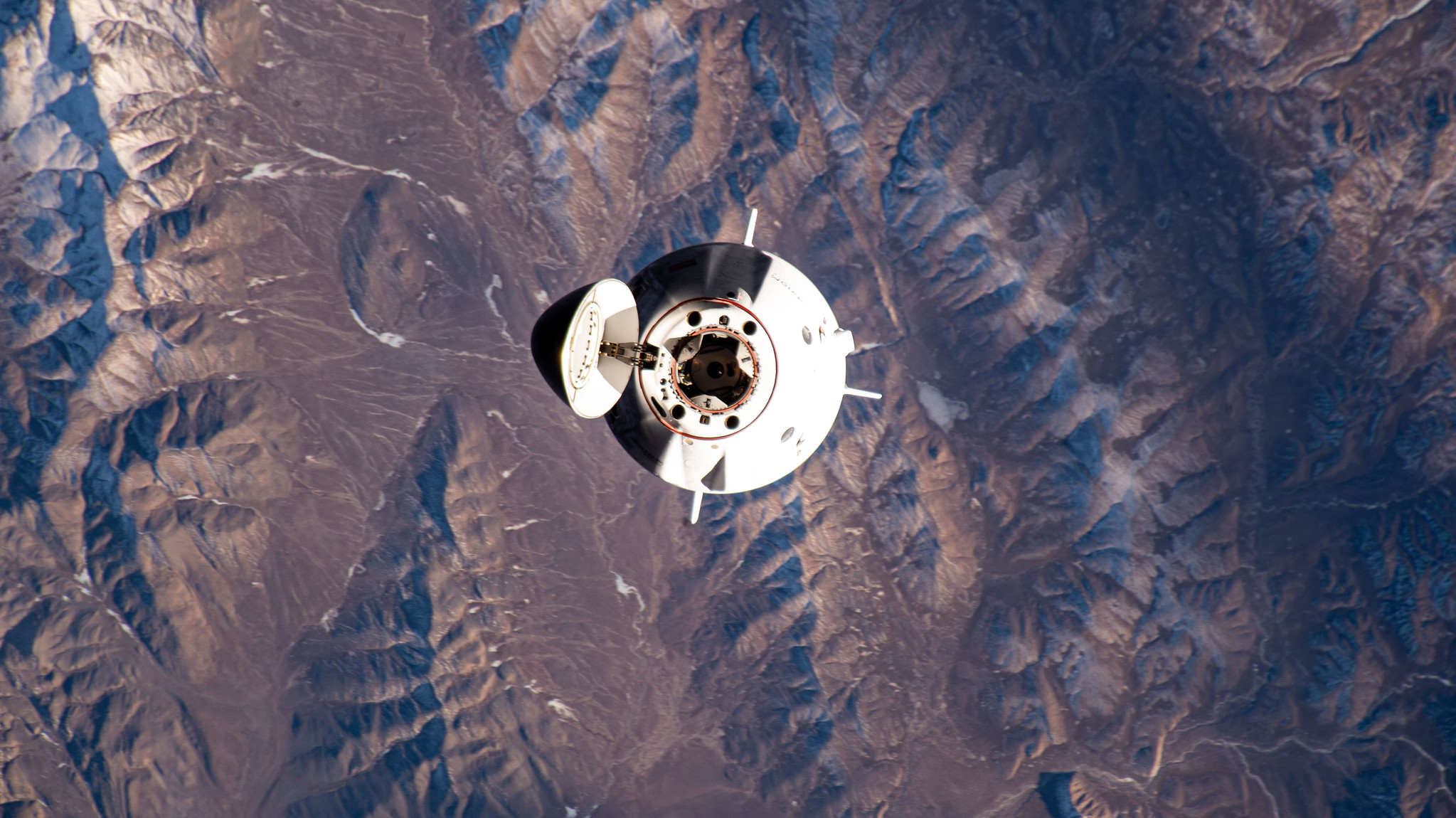
The SpaceX Dragon Freedom spacecraft carrying the four-member Axiom Mission 3 (Ax-3) crew is pictured approaching the International Space Station 260 miles above China north of the Himalayas.

NASA will provide live coverage of the undocking and departure of the Axiom Mission 3 (Ax-3) private astronaut flight from the International Space Station before the crew returns to Earth. 

The four-member astronaut crew is scheduled to undock no earlier than 6:05 a.m. EST Saturday, Feb. 3, from the space-facing port of the station’s Harmony module in a SpaceX Dragon spacecraft to begin the journey home and splashdown off the coast of Florida. 

NASA will provide live coverage of space station joint operations with Axiom Space and SpaceX. Coverage of hatch-closure preparations will begin at 4 a.m. NASA coverage of undocking will resume at 5:45 a.m. 

Coverage will be available on NASA+, NASA Television, the NASA app, YouTube, and the agency’s website. Learn how to stream NASA TV through a variety of platforms including social media. 

The four private astronauts, Michael López-Alegría, Walter Villadei, Marcus Wandt, and Alper Gezeravci, will complete about two weeks in space at the conclusion of their mission. The Axiom crew, along with Expedition 70, highlighted their stay aboard the space station during farewell remarks on Friday in advance of their undocking. 

Their SpaceX Dragon will return to Earth with more than 550 pounds of cargo, including NASA hardware and data from more than 30 different experiments the crew conducted during their mission. Splashdown is expected about 7 p.m. 

Ax-3, the third all-private astronaut mission to the International Space Station, successfully lifted off from NASA’s Kennedy Space Center in Florida Jan. 18. 

NASA’s undocking and departure coverage for Ax-3 is as follows (all times Eastern and subject to change based on operations): 

Saturday, Feb. 3 

4 a.m. – NASA coverage begins for 4:15 a.m. hatch closure 

5:45 a.m. – NASA coverage continues for 6:05 a.m. undocking 

NASA’s coverage ends approximately 30 minutes after undocking when space station joint operations with Axiom Space and SpaceX mission teams conclude. Axiom Space will resume coverage of Dragon’s re-entry and splashdown on the company’s website

The Ax-3 mission is part of NASA’s effort to foster a commercial market in low Earth orbit and continue a new era of space exploration that enables more people and organizations to fly multiple mission objectives. This partnership expands the arc of human spaceflight and opens access to low Earth orbit and the International Space Station to more people, science, and commercial opportunities. 

Learn more about how NASA is supporting a space economy in low Earth orbit: 

https://www.nasa.gov/humans-in-space/commercial-space/

-end- 

Julian Coltre
Headquarters, Washington
202-358-1100
julian.n.coltre@nasa.gov

Rebecca Turkington
Johnson Space Center, Houston
281-483-5111
rebecca.turkington@nasa.gov

Powered by WPeMatico

Get The Details…
Abbey A. Donaldson

Orbital Outpost Prepares for Departure of Ax-3 Astronauts

Orbital Outpost Prepares for Departure of Ax-3 Astronauts

The 11 crew members representing the Expedition 70 and Axiom Space 3 crews gather for a farewell ceremony calling down to mission controllers on Earth. Credit: NASA TV
The 11 crew members representing the Expedition 70 (red shirts) and Axiom Space 3 (dark blue suits) crews gather for a farewell ceremony calling down to mission controllers on Earth. Credit: NASA TV

The Expedition 70 and Axiom Mission 3 (Ax-3) crews called down to Mission Control on Friday for a farewell ceremony as the four private astronauts target their departure for Saturday morning. The orbital residents aboard the International Space Station worked just half-a-day packing the SpaceX Dragon Freedom spacecraft before going to bed early to get ready for the spacecraft’s undocking.

The Ax-3 private astronauts are in their final day aboard the orbital outpost following two weeks of science and educational activities. The foursome, led by Commander Michael López-Alegría, is currently targeted to undock inside Dragon from the Harmony module’s forward port at 6:05 a.m. EST on Saturday. López-Alegría, along with Pilot Walter Villadei and Mission Specialists Alper Gezeravcı and Marcus Wandt, will then parachute inside Dragon to the splashdown site where support personnel from Axiom Space and SpaceX await their arrival. Mission managers will receive a final weather report before giving the Ax-3 quartet the final go for a splashdown off the coast of Florida.

Space station Commander Andreas Mogensen from ESA (European Space Agency) helped the Ax-3 crewmates wrap up their mission activities helping reconfigure the orbital lab for standard crew operations. NASA Flight Engineers Jasmin Moghbeli and Loral O’Hara joined in and retrieved station emergency gear from Dragon and stowed science hardware inside the returning spacecraft.

Earlier, O’Hara partnered with astronaut Satoshi Furukawa from JAXA (Japan Aerospace Exploration Agency) and transferred research samples from the newly arrived Cygnus cargo craft into science freezers aboard the station. Furukawa later swapped out research hardware that supports botany and biology experiments with a minimum of astronaut intervention inside the Columbus laboratory module.

Cosmonauts Oleg Kononenko and Nikolai Chub packed the Progress 85 resupply ship, docked to the Zvezda service module’s rear port, with trash and discarded items before it ends its cargo mission and undocks later this month. Flight Engineer Konstantin Borisov spent his shift configuring a variety of experiment hardware. Borisov serviced a camera that observes Earth’s atmosphere in ultraviolet wavelengths, charged hardware that documents crew interactions with mission controllers from around the world, then deactivated medical gear that continuously monitors a crew member’s blood pressure.


Learn more about station activities by following the space station blog@space_station and @ISS_Research on X, as well as the ISS Facebook and ISS Instagram accounts.

Get weekly video highlights at: https://roundupreads.jsc.nasa.gov/videoupdate/

Get the latest from NASA delivered every week. Subscribe here: www.nasa.gov/subscribe

Powered by WPeMatico

Get The Details…

Mark Garcia