What is Dark Energy? Inside our accelerating, expanding Universe

What is Dark Energy? Inside our accelerating, expanding Universe

11 min read

What is Dark Energy? Inside our accelerating, expanding Universe

Some 13.8 billion years ago, the universe began with a rapid expansion we call the big bang. After this initial expansion, which lasted a fraction of a second, gravity started to slow the universe down. But the cosmos wouldn’t stay this way. Nine billion years after the universe began, its expansion started to speed up, driven by an unknown force that scientists have named dark energy.

But what exactly is dark energy?

The short answer is: We don’t know. But we do know that it exists, it’s making the universe expand at an accelerating rate, and approximately 68.3 to 70% of the universe is dark energy.
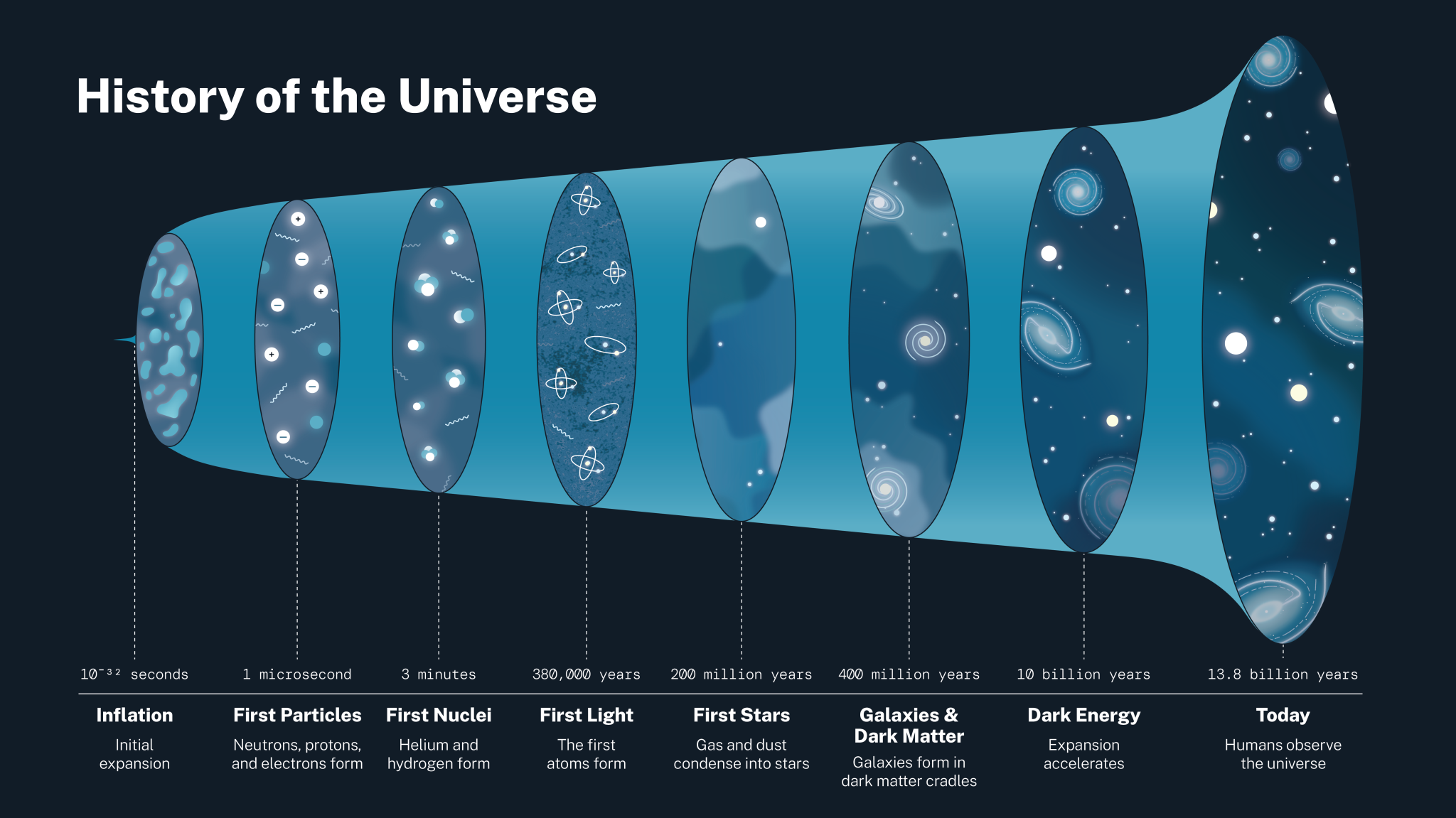
The history of the universe is outlined in this infographic.
NASA

A Brief History

It All Started With Cepheids

Dark energy wasn’t discovered until the late 1990s. But its origin in scientific study stretches all the way back to 1912 when American astronomer Henrietta Swan Leavitt made an important discovery using Cepheid variables, a class of stars whose brightness fluctuates with a regularity that depends on the star’s brightness.

All Cepheid stars with a certain period (a Cepheid’s period is the time it takes to go from bright, to dim, and bright again) have the same absolute magnitude, or luminosity – the amount of light they put out. Leavitt measured these stars and proved that there is a relationship between their regular period of brightness and luminosity. Leavitt’s findings made it possible for astronomers to use a star’s period and luminosity to measure the distances between us and Cepheid stars in far-off galaxies (and our own Milky Way).

Around this same time in history, astronomer Vesto Slipher observed spiral galaxies using his telescope’s spectrograph, a device that splits light into the colors that make it up, much like the way a prism splits light into a rainbow. He used the spectrograph, a relatively recent invention at the time, to see the different wavelengths of light coming from the galaxies in different spectral lines. With his observations, Silpher was the first astronomer to observe how quickly the galaxy was moving away from us, called redshift, in distant galaxies. These observations would prove to be critical for many future scientific breakthroughs, including the discovery of dark energy.

Redshift is a term used when astronomical objects are moving away from us and the light coming from those objects stretches out. Light behaves like a wave, and red light has the longest wavelength. So, the light coming from objects moving away from us has a longer wavelength, stretching to the “red end” of the electromagnetic.

Discovering an Expanding Universe

The discovery of galactic redshift, the period-luminosity relation of Cepheid variables, and a newfound ability to gauge a star or galaxy’s distance eventually played a role in astronomers observing that galaxies were getting farther away from us over time, which showed how the universe was expanding. In the years that followed, different scientists around the world started to put the pieces of an expanding universe together.

In 1922, Russian scientist and mathematician Alexander Friedmann published a paper detailing multiple possibilities for the history of the universe. The paper, which was based on Albert Einstein’s theory of general relativity published in 1917, included the possibility that the universe is expanding.

In 1927, Belgian astronomer Georges Lemaître, who is said to have been unaware of Friedmann’s work, published a paper also factoring in Einstein’s theory of general relativity. And, while Einstein stated in his theory that the universe was static, Lemaître showed how the equations in Einstein’s theory actually support the idea that the universe is not static but, in fact, is actually expanding.

Astronomer Edwin Hubble confirmed that the universe was expanding in 1929 using observations made by his associate, astronomer Milton Humason. Humason measured the redshift of spiral galaxies. Hubble and Humason then studied Cepheid stars in those galaxies, using the stars to determine the distance of their galaxies (or nebulae, as they called them). They compared the distances of these galaxies to their redshift and tracked how the farther away an object is, the bigger its redshift and the faster it is moving away from us. The pair found that objects like galaxies are moving away from Earth faster the farther away they are, at upwards of hundreds of thousands of miles per second – an observation now known as Hubble’s Law, or the Hubble- Lemaître law. The universe, they confirmed, is really expanding.
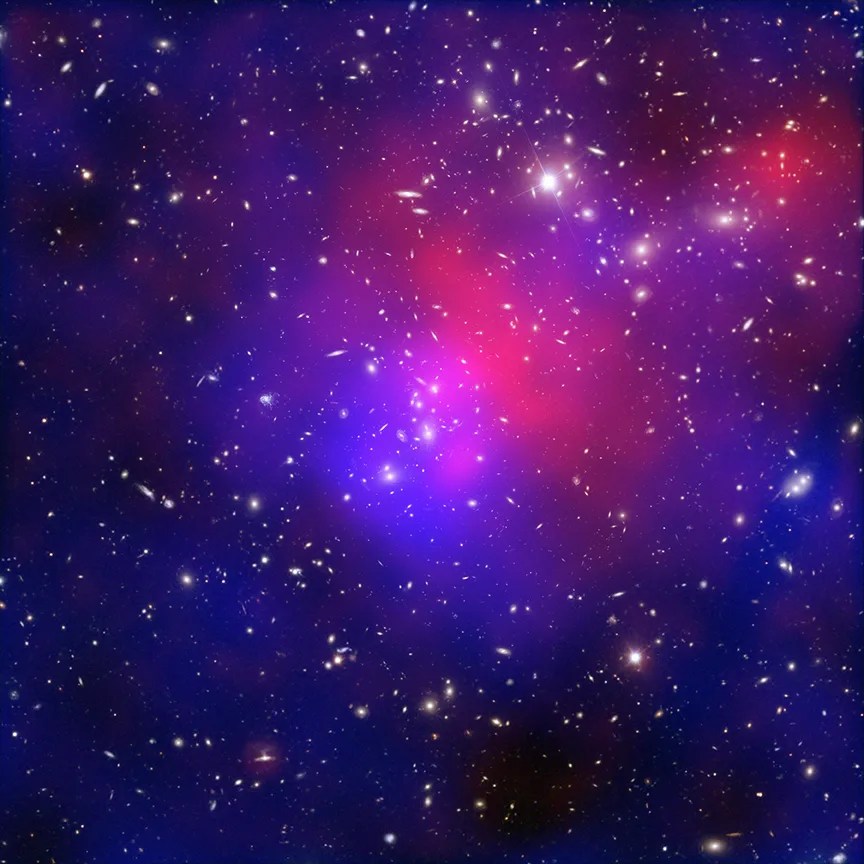
Abell 2744: Pandora's Cluster Revealed
This composite image features one of the most complicated and dramatic collisions between galaxy clusters ever seen. Known officially as Abell 2744, this system has been dubbed Pandora’s Cluster because of the wide variety of different structures found. Data from Chandra (red) show gas with temperatures of millions of degrees. In blue is a map showing the total mass concentration (mostly dark matter) based on data from the Hubble Space Telescope, the Very Large Telescope (VLT), and the Subaru telescope. Optical data from HST and VLT also show the constituent galaxies of the clusters. Astronomers think at least four galaxy clusters coming from a variety of directions are involved with this collision.

Expansion is Speeding Up, Supernovae Show

Scientists previously thought that the universe’s expansion would likely be slowed down by gravity over time, an expectation backed by Einstein’s theory of general relativity. But in 1998, everything changed when two different teams of astronomers observing far-off supernovae noticed that (at a certain redshift) the stellar explosions were dimmer than expected. These groups were led by astronomers Adam Riess, Saul Perlmutter, and Brian Schmidt. This trio won the 2011 Nobel Prize in Physics for this work.

While dim supernovae might not seem like a major find, these astronomers were looking at Type 1a supernovae, which are known to have a certain level of luminosity. So they knew that there must be another factor making these objects appear dimmer. Scientists can determine distance (and speed) using an objects’ brightness, and dimmer objects are typically farther away (though surrounding dust and other factors can cause an object to dim).

This led the scientists to conclude that these supernovae were just much farther away than they expected by looking at their redshifts.

Using the objects’ brightness, the researchers determined the distance of these supernovae. And using the spectrum, they were able to figure out the objects’ redshift and, therefore, how fast they were moving away from us. They found that the supernovae were not as close as expected, meaning they had traveled farther away from us faster than ancitipated. These observations led scientists to ultimately conclude that the universe itself must be expanding faster over time.

While other possible explanations for these observations have been explored, astronomers studying even more distant supernovae or other cosmic phenomena in more recent years continued to gather evidence and build support for the idea that the universe is expanding faster over time, a phenomenon now called cosmic acceleration. 

But, as scientists built up a case for cosmic acceleration, they also asked: Why? What could be driving the universe to stretch out faster over time?

Enter dark energy.

What Exactly is Dark Energy?

Right now, dark energy is just the name that astronomers gave to the mysterious “something” that is causing the universe to expand at an accelerated rate.

Dark energy has been described by some as having the effect of a negative pressure that is pushing space outward. However, we don’t know if dark energy has the effect of any type of force at all. There are many ideas floating around about what dark energy could possibly be. Here are four leading explanations for dark energy. Keep in mind that it’s possible it’s something else entirely.

Vacuum Energy:

Some scientists think that dark energy is a fundamental, ever-present background energy in space known as vacuum energy, which could be equal to the cosmological constant, a mathematical term in the equations of Einstein’s theory of general relativity. Originally, the constant existed to counterbalance gravity, resulting in a static universe. But when Hubble confirmed that the universe was actually expanding, Einstein removed the constant, calling it “my biggest blunder,” according to physicist George Gamow.

But when it was later discovered that the universe’s expansion was actually accelerating, some scientists suggested that there might actually be a non-zero value to the previously-discredited cosmological constant. They suggested that this additional force would be necessary to accelerate the expansion of the universe. This theorized that this mystery component could be attributed to something called “vacuum energy,” which is a theoretical background energy permeating all of space.

Space is never exactly empty. According to quantum field theory, there are virtual particles, or pairs of particles and antiparticles. It’s thought that these virtual particles cancel each other out almost as soon as they crop up in the universe, and that this act of popping in and out of existence could be made possible by “vacuum energy” that fills the cosmos and pushes space outward.

While this theory has been a popular topic of discussion, scientists investigating this option have calculated how much vacuum energy there should theoretically be in space. They showed that there should either be so much vacuum energy that, at the very beginning, the universe would have expanded outwards so quickly and with so much force that no stars or galaxies could have formed, or… there should be absolutely none. This means that the amount of vacuum energy in the cosmos must be much smaller than it is in these predictions. However, this discrepancy has yet to be solved and has even earned the moniker “the cosmological constant problem.”

Quintessence:

Some scientists think that dark energy could be a type of energy fluid or field that fills space, behaves in an opposite way to normal matter, and can vary in its amount and distribution throughout both time and space. This hypothesized version of dark energy has been nicknamed quintessence after the theoretical fifth element discussed by ancient Greek philosophers.

It’s even been suggested by some scientists that quintessence could be some combination of dark energy and dark matter, though the two are currently considered completely separate from one another. While the two are both major mysteries to scientists, dark matter is thought to make up about 85% of all matter in the universe.

Space Wrinkles:

Some scientists think that dark energy could be a sort of defect in the fabric of the universe itself; defects like cosmic strings, which are hypothetical one-dimensional “wrinkles” thought to have formed in the early universe. 

A Flaw in General Relativity:

Some scientists think that dark energy isn’t something physical that we can discover. Rather, they think there could be an issue with general relativity and Einstein’s theory of gravity and how it works on the scale of the observable universe. Within this explanation, scientists think that it’s possible to modify our understanding of gravity in a way that explains observations of the universe made without the need for dark energy. Einstein actually proposed such an idea in 1919 called unimodular gravity, a modified version of general relativity that scientists today think wouldn’t require dark energy to make sense of the universe.

The Future

Dark energy is one of the great mysteries of the universe. For decades, scientists have theorized about our expanding universe. Now, for the first time ever, we have tools powerful enough to put these theories to the test and really investigate the big question: “what is dark energy?”

NASA plays a critical role in the ESA (European Space Agency) mission Euclid (launched in 2023), which will make a 3D map of the universe to see how matter has been pulled apart by dark energy over time. This map will include observations of billions of galaxies found up to 10 billion light-years from Earth.

NASA’s Nancy Grace Roman Space Telescope, set to launch by May 2027, is designed to investigate dark energy, among many other science topics, and will also create a 3D dark matter map. Roman’s resolution will be as sharp as NASA’s Hubble Space Telescope’s, but with a field of view 100 times larger, allowing it to capture more expansive images of the universe. This will allow scientists to map how matter is structured and spread across the universe and explore how dark energy behaves and has changed over time. Roman will also conduct an additional survey to detect Type Ia supernovae

In addition to NASA’s missions and efforts, the Vera C. Rubin Observatory, supported by a large collaboration that includes the U.S. National Science Foundation, which is currently under construction in Chile, is also poised to support our growing understanding of dark energy. The ground-based observatory is expected to be operational in 2025.

The combined efforts of Euclid, Roman, and Rubin will usher in a new “golden age” of cosmology, in which scientists will collect more detailed information than ever about the great mysteries of dark energy.

Additionally, NASA’s James Webb Space Telescope (launched in 2021), the world’s most powerful and largest space telescope, aims to make contributions to several areas of research, and will contribute to studies of dark energy.

NASA’s SPHEREx (the Spectro-Photometer for the History of the Universe, Epoch of Reionization, and Ices Explorer) mission, scheduled to launch no later than April 2025, aims to investigate the origins of the universe. Scientists expect that the data collected with SPHEREx, which will survey the entire sky in near-infrared light, including over 450 million galaxies, could help to further our understanding of dark energy.

NASA also supports a citizen science project called Dark Energy Explorers, which enables anyone in the world, even those who have no scientific training, to help in the search for dark energy answers.

*A brief note*

Lastly, to clarify, dark energy is not the same as dark matter. Their main similarity is that we don’t yet know what they are!

By Chelsea Gohd
NASA’s Jet Propulsion Laboratory

Keep Exploring

Discover More Topics From NASA

Powered by WPeMatico

Get The Details…

Ax-3 Nears Departure as Station Crew Picks Up Research

Ax-3 Nears Departure as Station Crew Picks Up Research

Four Expedition 70 astronauts pose for a fun portrait inside their crew quarters aboard the International Space Station's Harmony module.
Four Expedition 70 astronauts pose for a fun portrait inside their crew quarters aboard the International Space Station’s Harmony module.

Four private astronauts comprising the Axiom Mission 3 (Ax-3) crew continue to target Tuesday for their departure from the International Space Station and return to Earth. In the meantime, the seven Expedition 70 crew members are continuing their schedule of advanced microgravity research and orbital lab maintenance.

Ax-3 Commander Michael López-Alegría readied the SpaceX Dragon Freedom spacecraft for its undocking scheduled for no earlier than 9:05 a.m. EST on Tuesday. The veteran astronaut transferred emergency gear from Dragon into the station then stowed completed science experiments and their samples inside science freezers aboard the commercial spacecraft. NASA Flight Engineer Jasmin Moghbeli assisted with the emergency hardware transfers stowing masks, gloves, sensors, and medical kits, back inside the station. Station Commander Andreas Mogensen from ESA (European Space Agency) also helped the Ax-3 crew as they cleaned up inside the station and prepared for the return to Earth.

Mission managers continue to evaluate weather at the potential splashdown sites off the coast of Florida. The hatch closing and undocking will be broadcast live on the NASA+ streaming service, NASA TV, the NASA app, YouTube, and the agency’s website. Learn how to stream NASA TV through a variety of platforms, including social media.

The rest of the Ax-3 crew, including Pilot Walter Villadei and Mission Specialists Alper Gezeravcı and Marcus Wandt, also packed Dragon with return cargo such as personal items, computer and electronics gear, and more science experiments. The private crew is spending the rest of the day exercising, videotaping crew activities, and looking at the Earth below from the cupola.

Science continued aboard the orbital outpost on Monday as the Expedition 70 crew explored an array of life science topics including how weightlessness affects immunity and botany. The orbital residents also worked inside a pair of cargo spaceships and maintained critical life support systems.

NASA Flight Engineers Loral O’Hara and Moghbeli took turns unpacking some of the several tons of cargo packed inside the Northrop Grumman Cygnus space freighter. The pair later helped the Ax-3 crew stow science experiments and computer gear inside Dragon. Flight Engineer Satoshi Furukawa from JAXA (Japan Aerospace Exploration Agency) also assisted with the Cygnus cargo work then set up hardware to explore how plant-microbe interactions are affected in microgravity. Mogensen spent his morning processing his blood and saliva samples for an investigation exploring how a crew member’s immunity system changes during a space mission.

Roscosmos Flight Engineers Oleg Kononenko and Nikolai Chub partnered together and tested the communications system inside the Progress 85 resupply ship before it departs the station next week. Kononenko then worked on cargo and fluid transfers inside the Progress 85. Chub moved into the Poisk module for computer maintenance. Flight Engineer Konstantin Borisov worked on hardware supporting a pair of Earth observation studies, inventoried ventilation hardware, and serviced orbital plumbing components.


Learn more about station activities by following the space station blog@space_station and @ISS_Research on X, as well as the ISS Facebook and ISS Instagram accounts.

Get weekly video highlights at: https://roundupreads.jsc.nasa.gov/videoupdate/

Get the latest from NASA delivered every week. Subscribe here: www.nasa.gov/subscribe

Powered by WPeMatico

Get The Details…

Mark Garcia

What’s Made in a Thunderstorm and Faster Than Lightning? Gamma Rays!

What’s Made in a Thunderstorm and Faster Than Lightning? Gamma Rays!

3 min read

What’s Made in a Thunderstorm and Faster Than Lightning? Gamma Rays!

A flash of lightning. A roll of thunder. These are normal stormy sights and sounds. But sometimes, up above the clouds, stranger things happen. Our Fermi Gamma-ray Space Telescope has spotted bursts of gamma rays – some of the highest-energy forms of light in the universe – coming from thunderstorms. Gamma rays are usually found coming from objects with crazy extreme physics like neutron stars and black holes. So why is Fermi seeing them come from thunderstorms?

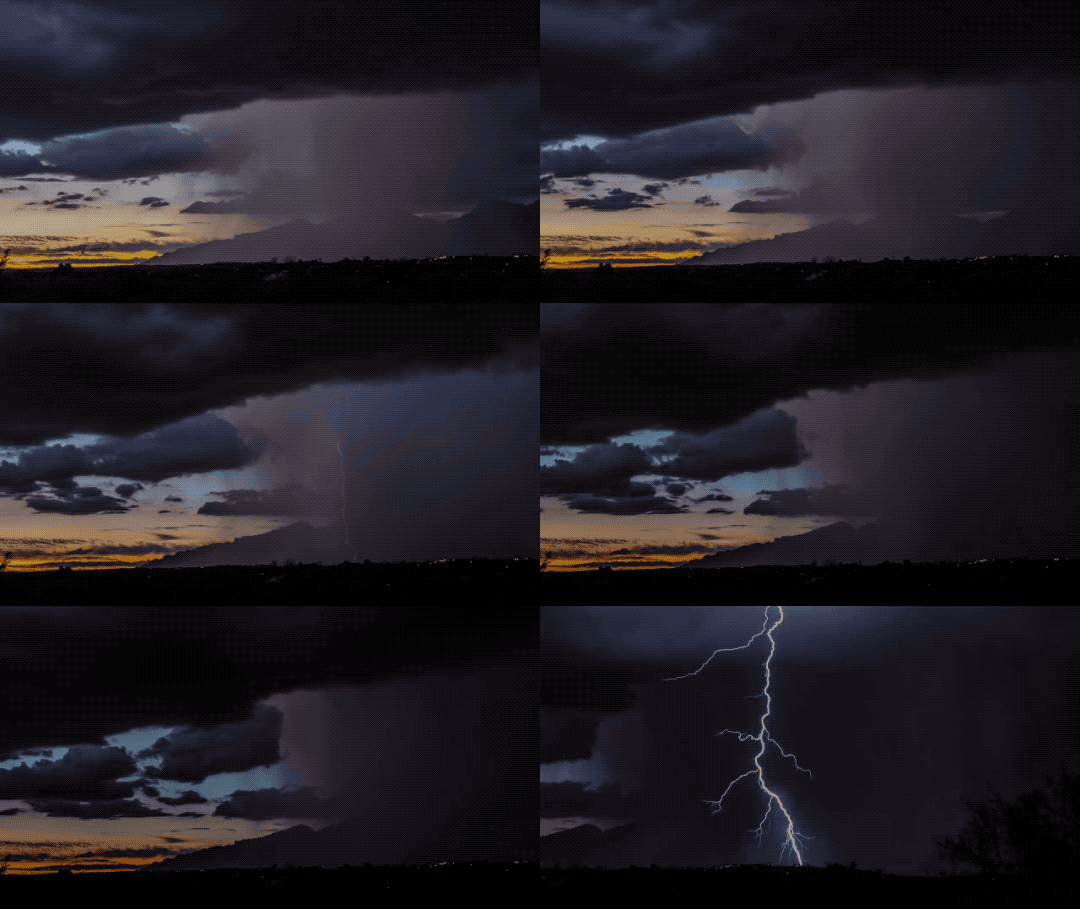
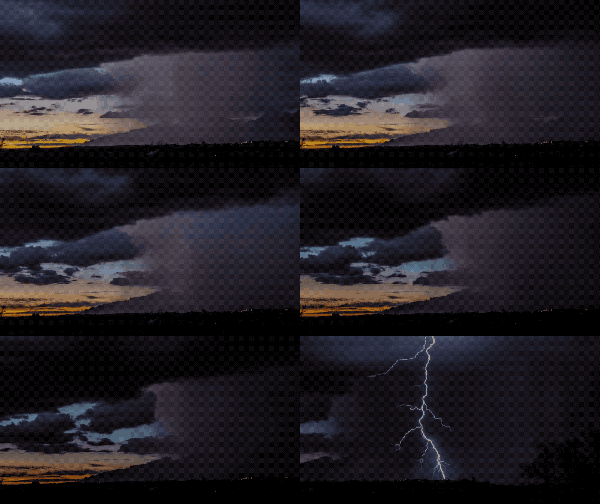
This animated GIF shows clouds moving across a dusky sky. The clouds on the right side have a gray haze extending down to the bottom of the image, where there is rain. Flashes of lightning, stretching from the cloud to the ground, light up the screen periodically.
About a thousand times a day, thunderstorms fire off fleeting bursts of some of the highest-energy light naturally found on Earth. These events, called terrestrial gamma-ray flashes, last less than a millisecond and produce gamma rays with tens of millions of times the energy of visible light.
NASA’s Goddard Space Flight Center

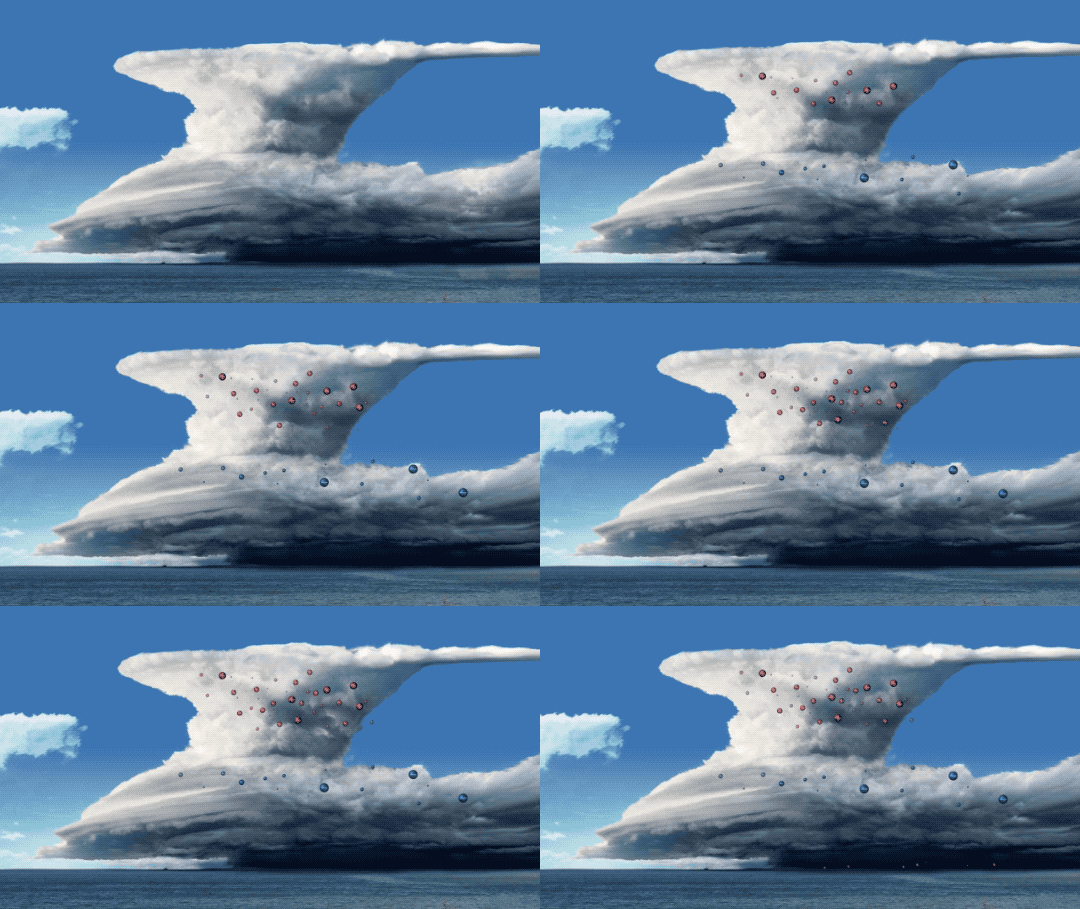
Thunderstorms form when warm, damp air near the ground starts to rise and encounters colder air. As the warm air rises, moisture condenses into water droplets. The upward-moving water droplets bump into downward-moving ice crystals, stripping off electrons and creating a static charge in the cloud.

This animated GIF shows charge accumulating in a cloud. The cloud looms over a landscape. The bottom part of the cloud stretches nearly all the way across the image. On the left edge of the cloud, a thin portion juts upward and spreads out, looking almost like the neck of a bird with a stumpy beak on one side and a long plume on the other. During the animation, blue dots appear in the bottom part of the cloud, representing negative charges. Red dots appear in the upper part, representing positive charges.
Updrafts and downdrafts within thunderstorms force rain, snow and ice to collide and acquire an electrical charge, which can cause lightning. Under just the right conditions, the fast-moving electrons can create a terrestrial gamma-ray flash.
NASA’s Goddard Space Flight Center

The top of the storm becomes positively charged, and the bottom becomes negatively charged, like two ends of a battery. Eventually the opposite charges build enough to overcome the insulating properties of the surrounding air – and zap! You get lightning.

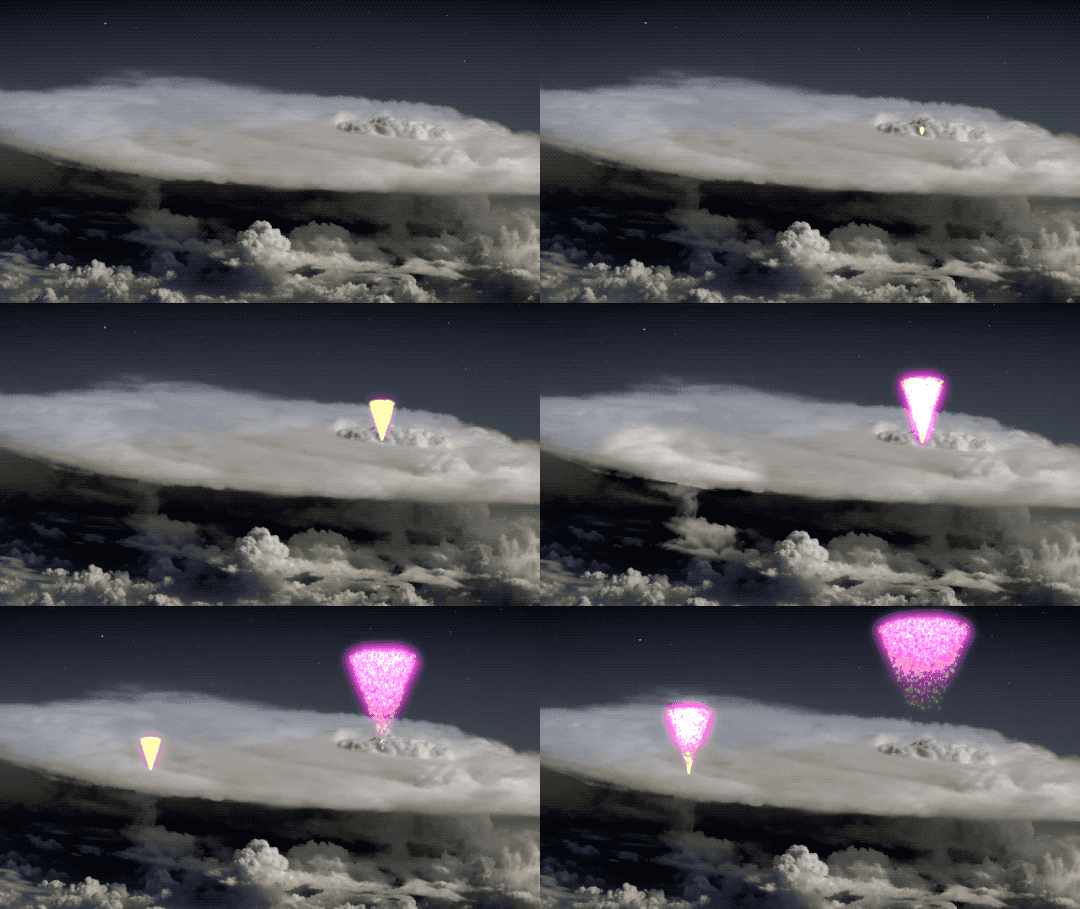
An oval cloud dominates the center of this animation, with smaller, puffier clouds below and around it. A flash of light, signaling a lightning strike, appears below the right side of the cloud, and a cone of particles erupts from the top of the cloud. The cone starts small with just yellow particle, but as it expands upward, the yellow gives way to magenta. Then a flash occurs on the left side of the cloud, and another cone with similar colors lifts away from that site.
This illustration shows electrons accelerating upwards from a thunderhead.
NASA’s Goddard Space Flight Center

Scientists suspect that lightning reconfigures the cloud’s electrical field. In some cases, this allows electrons to rush toward the upper part of the storm at nearly the speed of light. That makes thunderstorms the most powerful natural particle accelerators on Earth!

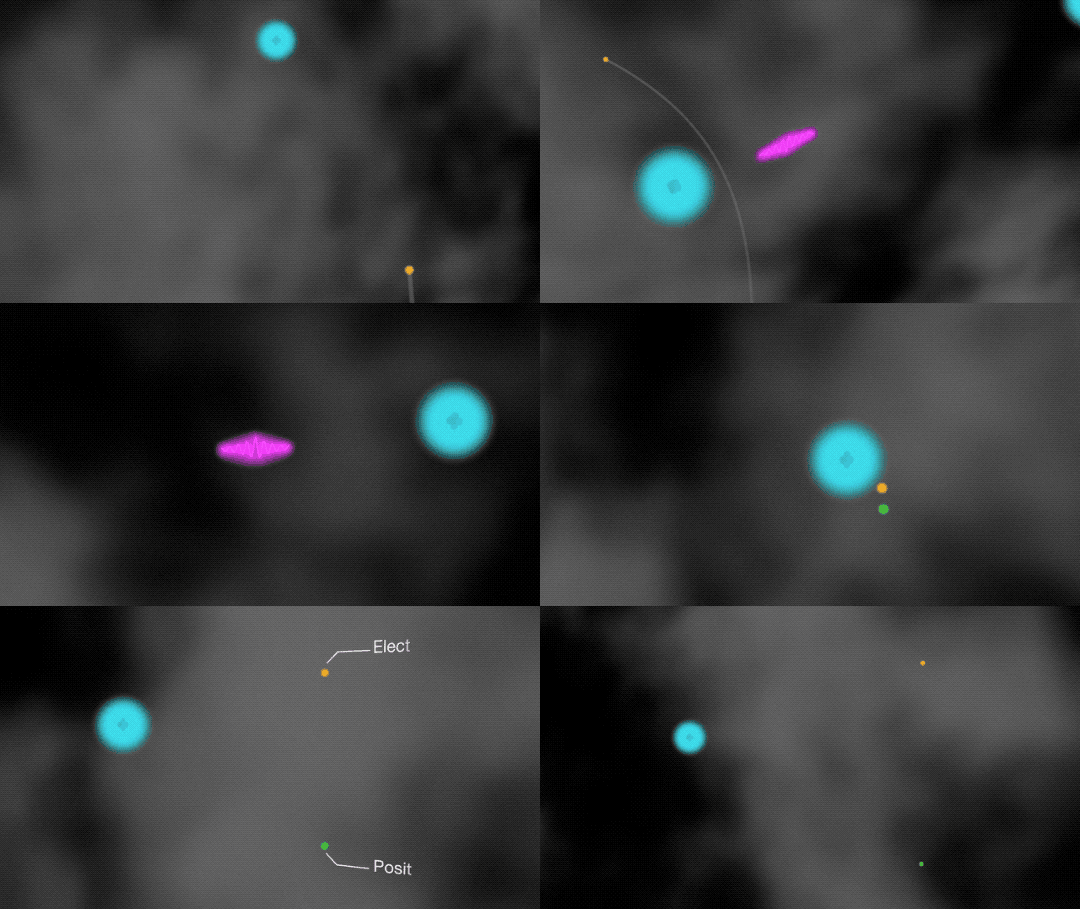
This animation shows processes where gamma rays can be created and destroyed in interactions with matter. The background is a cloudy haze, representing a sub-atomic scene. The animation opens with a large blue circle representing an atom moving across the screen. A small electron, shown as a yellow dot, arcs across the screen, just grazing the atom. In the process a gamma ray is produced, which is represented by a magenta squiggle. The gamma ray moves across the screen and runs into another blue circle, representing another atom. The gamma ray disappears, and two particles appear, a yellow dot representing an electron, and a green dot representing a positron.
Interactions with matter can produce gamma rays and vice versa, as shown here in this illustration. High-energy electrons traveling close to the speed of light can be deflected by passing near an atom or molecule, producing a gamma ray. And a gamma ray passing through the electron shell of an atom transforms into two particles: an electron and a positron.
NASA’s Goddard Space Flight Center

When those electrons run into air molecules, they emit a terrestrial gamma-ray flash, which means that thunderstorms are creating some of the highest energy forms of light in the universe. But that’s not all – thunderstorms can also produce antimatter! Yep, you read that correctly! Sometimes, a gamma ray will run into an atom and produce an electron and a positron, which is an electron’s antimatter opposite!

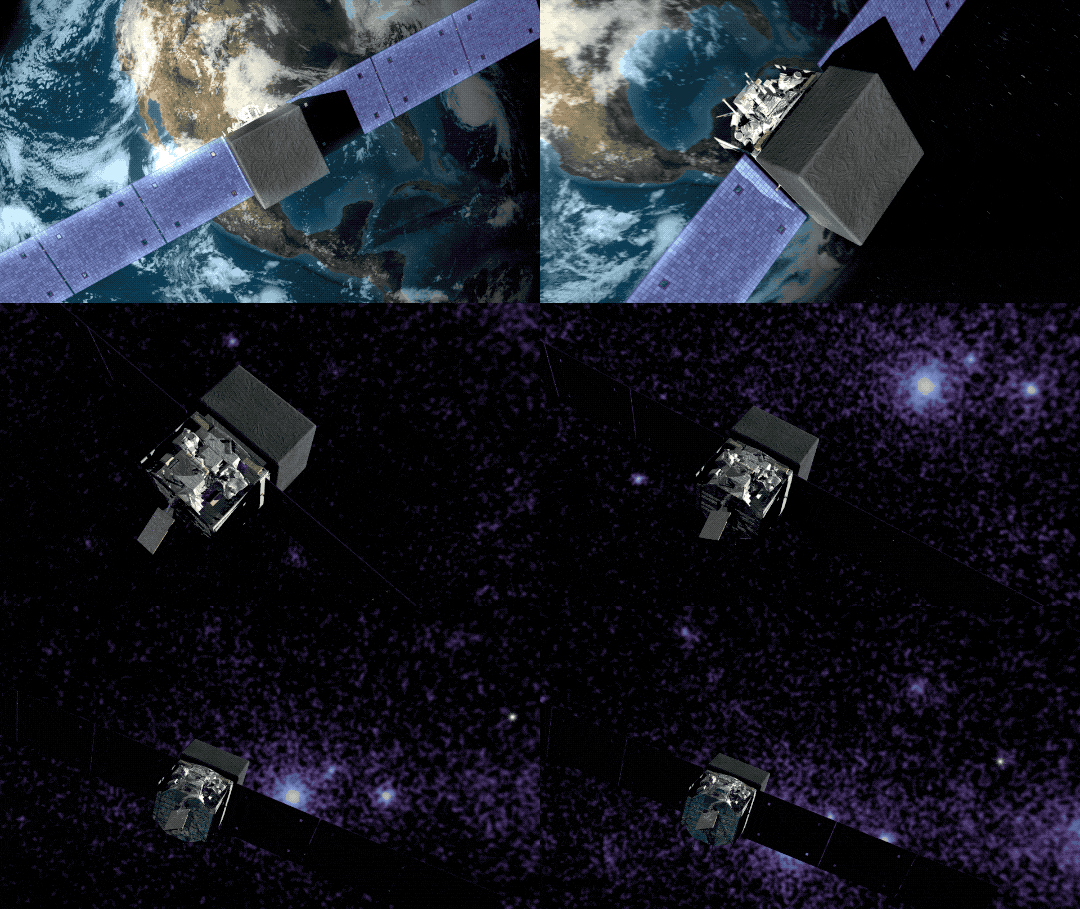
Animation of the Fermi Gamma-ray Space Telescope. The satellite features a large black box structure with white instruments underneath. Two long solar arrays extend from opposite sides, just under the black box.
NASA’s Fermi Gamma-ray Space Telescope, illustrated here, scans the entire sky every three hours as it orbits Earth.
NASA’s Goddard Space Flight Center Conceptual Image Lab

Fermi can spot terrestrial gamma-ray flashes within 500 miles (800 kilometers) of the location directly below the spacecraft. It does this using an instrument called the Gamma-ray Burst Monitor which is primarily used to watch for spectacular flashes of gamma rays coming from the universe.

This animated GIF shows a map of the world stretched out to show all the continents in a rectangular layout. Magenta spots show up, indicating where Fermi has detected terrestrial gamma-ray flashes. The spots are concentrated on either side of the equator, which is where Fermi can detect them.
Visualization of ten years of Fermi observations of terrestrial gamma-ray flashes.
NASA’s Goddard Space Flight Center

There are an estimated 1,800 thunderstorms occurring on Earth at any given moment. Over its first 10 years in space, Fermi spotted about 5,000 terrestrial gamma-ray flashes. But scientists estimate that there are 1,000 of these flashes every day – we’re just seeing the ones that are within 500 miles of Fermi’s regular orbits, which don’t cover the U.S. or Europe.

The map above shows all the flashes Fermi saw between 2008 and 2018. (Notice there’s a blob missing over the lower part of South America. That’s the South Atlantic Anomaly, a portion of the sky where radiation affects spacecraft and causes data glitches.)

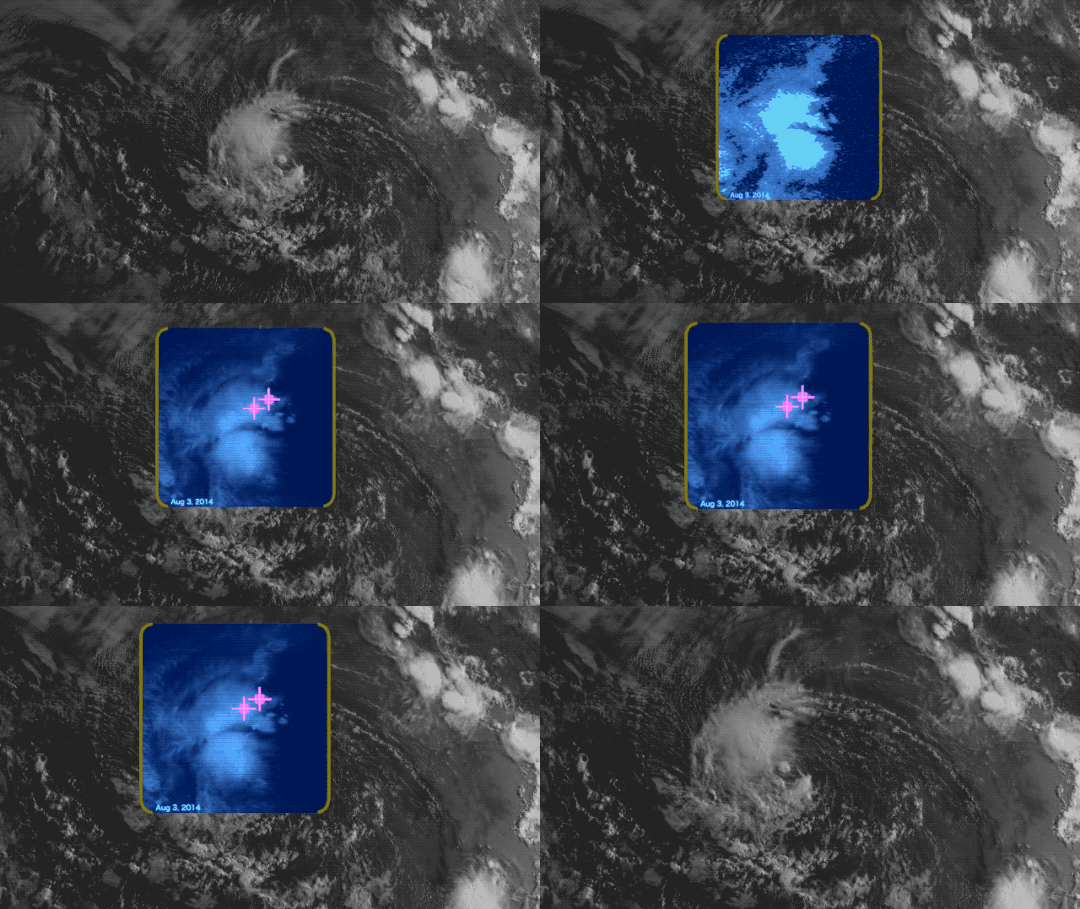
This animation pans in on satellite imagery of the swirl of clouds that was forming into Hurricane Julio. The image is a grayish-blue color with wisps of clouds. In the center is an oval with a faint cloud ring surrounding it and heavy cloud cover on the left side of the oval. An inset square pops up showing one region and marking two spots in purple to show where terrestrial gamma-ray flashes were observed. The inset is dated Aug 2, 2014.
Storm clouds produce some of the highest-energy light naturally made on Earth: terrestrial gamma-ray flashes. The tropical disturbance that would later become Hurricane Julio in 2014 produced four flashes within 100 minutes, with a fifth the next day.
NASA’s Goddard Space Flight Center

Fermi has also spotted terrestrial gamma-ray flashes coming from individual tropical weather systems. In 2014 Tropical Storm Julio produced four flashes in just 100 minutes!

Keep Exploring

Discover More Topics From NASA

Powered by WPeMatico

Get The Details…

When Dead Stars Collide!

When Dead Stars Collide!

4 min read

When Dead Stars Collide!

Gravity has been making waves — literally. In October 2017, the Nobel Prize in Physics was awarded for the first direct detection of gravitational waves two years earlier. Also in that month, astronomers announced a huge advance in the field of gravitational waves: For the first time, they had observed light and gravitational waves from the same source. Let’s look at what happened.

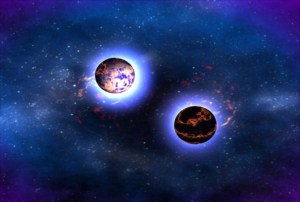
Two glowing stars with red and black surfaces sit in the middle of a starfield.
Two neutron stars are on the verge of colliding in this illustration.
NASA’s Goddard Space Flight Center

There was a pair of orbiting neutron stars in a galaxy (called NGC 4993). Neutron stars are the crushed leftover cores of massive stars (stars more than 8 times the mass of our sun) that long ago exploded as supernovae. There are many such pairs of binaries in this galaxy, and in all the galaxies we can see, but something special was about to happen to this particular pair.

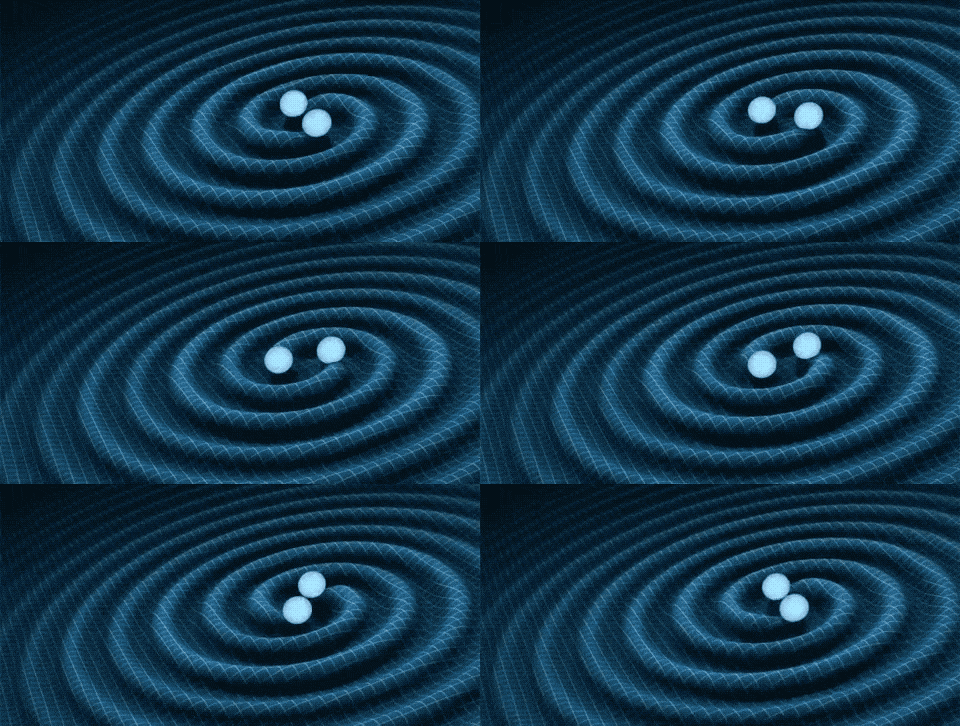
Two blue spheres circle each other on a grid representing space-time. As the spheres orbit, ripples propagate outward along the grid, representing gravitational waves.
An animation of gravitational wave propagation.
R. Hurt/Caltech/JPL

Each time these neutron stars orbited, they would lose a teeny bit of gravitational energy to gravitational waves. Gravitational waves are disturbances in space-time — the very fabric of the universe — that travel at the speed of light. The waves are emitted by any mass that is changing speed or direction, like this pair of orbiting neutron stars. However, the gravitational waves are very faint unless the neutron stars are very close and orbiting around each other very fast.

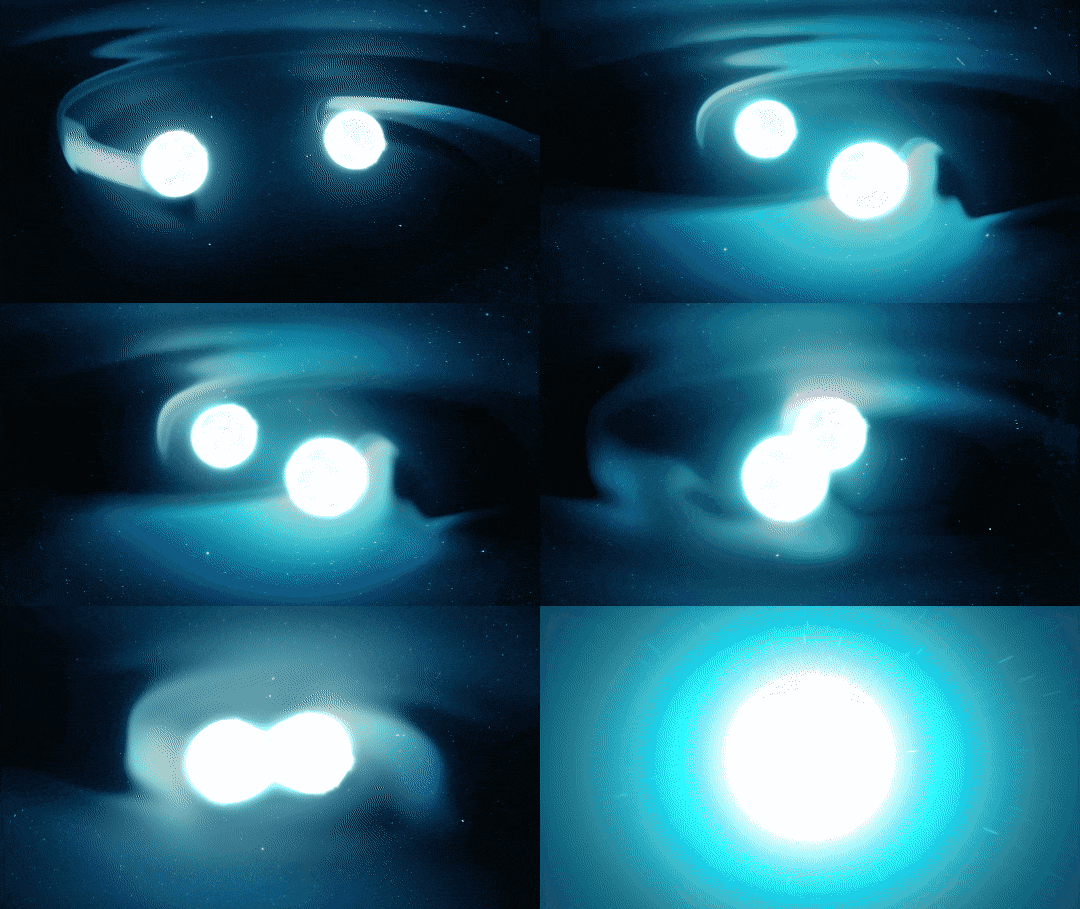
Two bright spheres orbit each other, and pale arcs of blue, representing gravitational waves, ripple away from the spheres. The spheres get closer with each orbit, and as they do they distort, turning into teardrop shapes, with the points pointing toward the center. Then they touch and finally merge in a bright, white explosion.
Doomed neutron stars whirl toward their demise in this illustration. Gravitational waves (pale arcs) bleed away orbital energy, causing the stars to move closer together and merge.
NASA’s Goddard Space Flight Center/Conceptual Image Lab

The teeny energy loss caused the two neutron stars to get a teeny bit closer to each other and orbit a teeny bit faster. After hundreds of millions of years, all those teeny bits added up, and the neutron stars were very close. So close that … BOOM! … they collided. And we witnessed it on Earth on August 17, 2017.

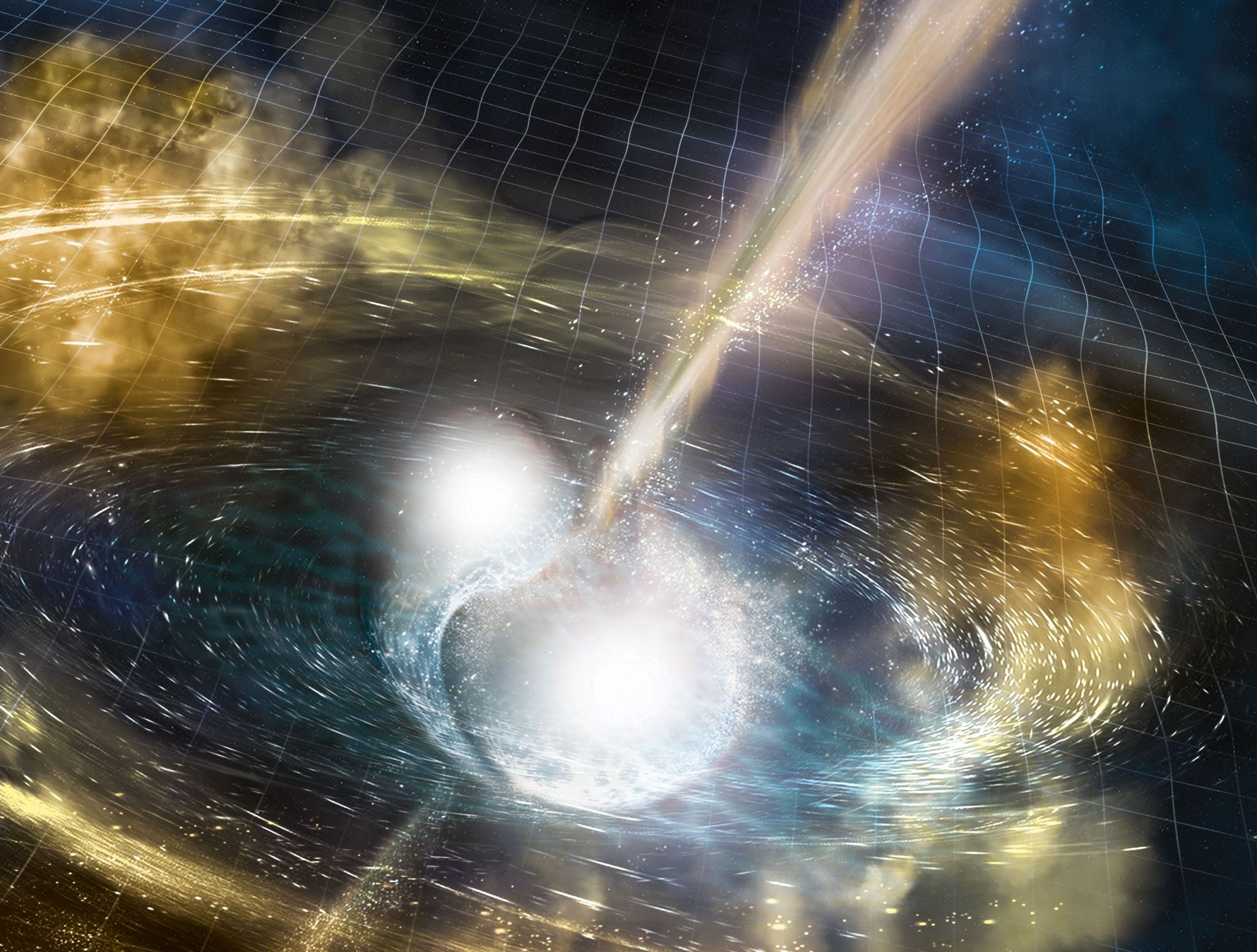
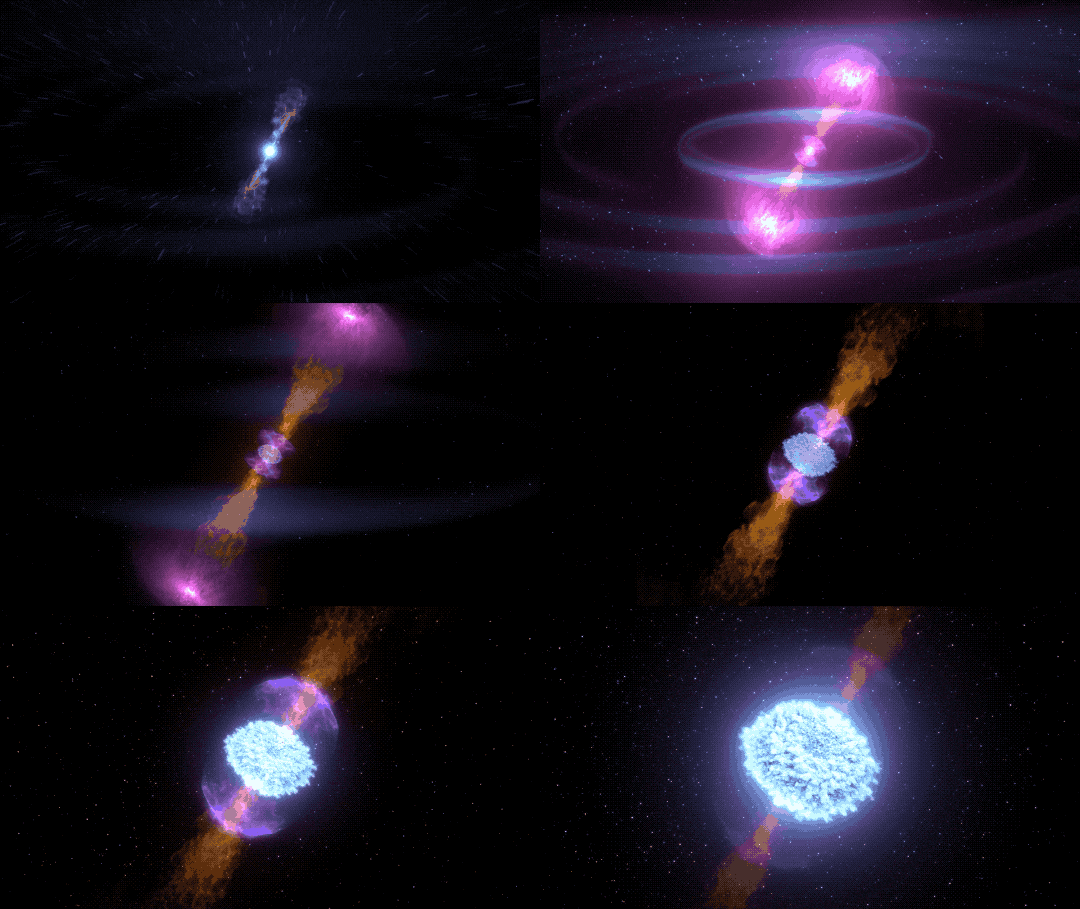
At the center of this illustration is a bright region of light that looks like two balls that haven’t quite merged into one. Two rays of white and orange light emanate from that central collision, one up and to the right, the other down and to the left, though you can’t see the one to the left quite as well because there is also a disk of swirling material blocking the view. There is also a faint grid across the entire image, representing space-time. Ripples in the grid can be seen at the edges of the image, showing gravitational waves that had been emitted by the merger.
Illustration of two merging neutron stars. The rippling space-time grid represents gravitational waves that travel out from the collision. Narrow beams show the burst of gamma rays that are shot out just seconds after the gravitational waves. The swirling clouds of material are ejected from the merging stars.
National Science Foundation/LIGO/A. Simonnet (Sonoma State Univ.)

A couple of very cool things happened in that collision, and we expect they happen in all such neutron-star collisions. Just before the neutron stars collided, the gravitational waves were strong enough and at just the right frequency that the National Science Foundation’s Laser Interferometer Gravitational-Wave Observatory (LIGO) and European Gravitational Observatory’s Virgo could detect them. Just after the collision, those waves quickly faded out because there are no longer two things orbiting around each other!

LIGO and Virgo are ground-based detectors waiting for gravitational waves to pass through their facilities on Earth. When it is active, it can detect them from almost anywhere in space.

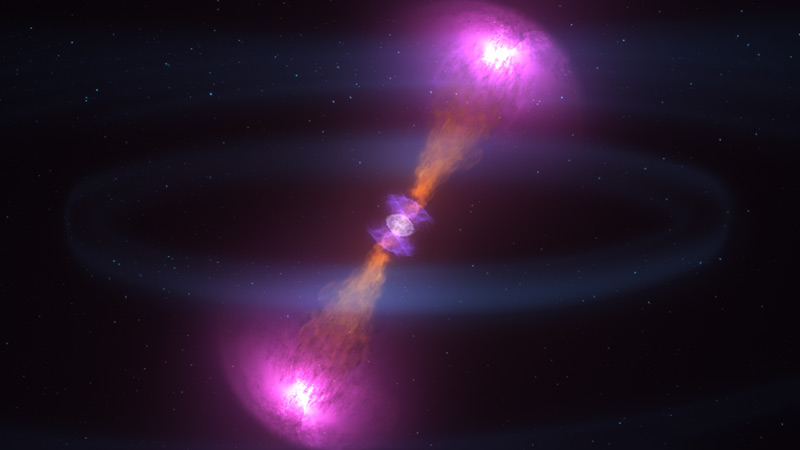
This animation of a gamma-ray burst shows two jets of material that look like two orange cones connected by their points and facing in opposite directions, one opening up and to the right of the center, the other opening down and to the left. The ends of the cones have bright magenta light, which represent an expanding shock wave. At the center is a wrapped-candy-shaped blue structure lined up with the jets which represents the kilonova, the neutron-rich debris of the explosion.
This illustration shows a snapshot of a gamma-ray burst caused by the merger of two neutron stars. Powerful jets (orange) emerge and plow into their surroundings, causing shock waves (pink). Just emerging at the center is the kilonova, the neutron-rich debris of the explosion (blue) powered by the decay of newly forged radioactive elements.
NASA’s Goddard Space Flight Center/Conceptual Image Lab

The other thing that happened was what we call a gamma-ray burst. When they get very close, the neutron stars break apart and create a spectacular, but short, explosion. For a couple of seconds, our Fermi satellite saw gamma rays from that explosion. Fermi’s Gamma-ray Burst Monitor is one of our eyes on the sky, looking out for such bursts of gamma rays that scientists want to catch as soon as they’re happening.

And those gamma rays came just 1.7 seconds after the gravitational wave signal. The galaxy this occurred in is 130 million light-years away, so the light and gravitational waves were traveling for 130 million years before we detected them.

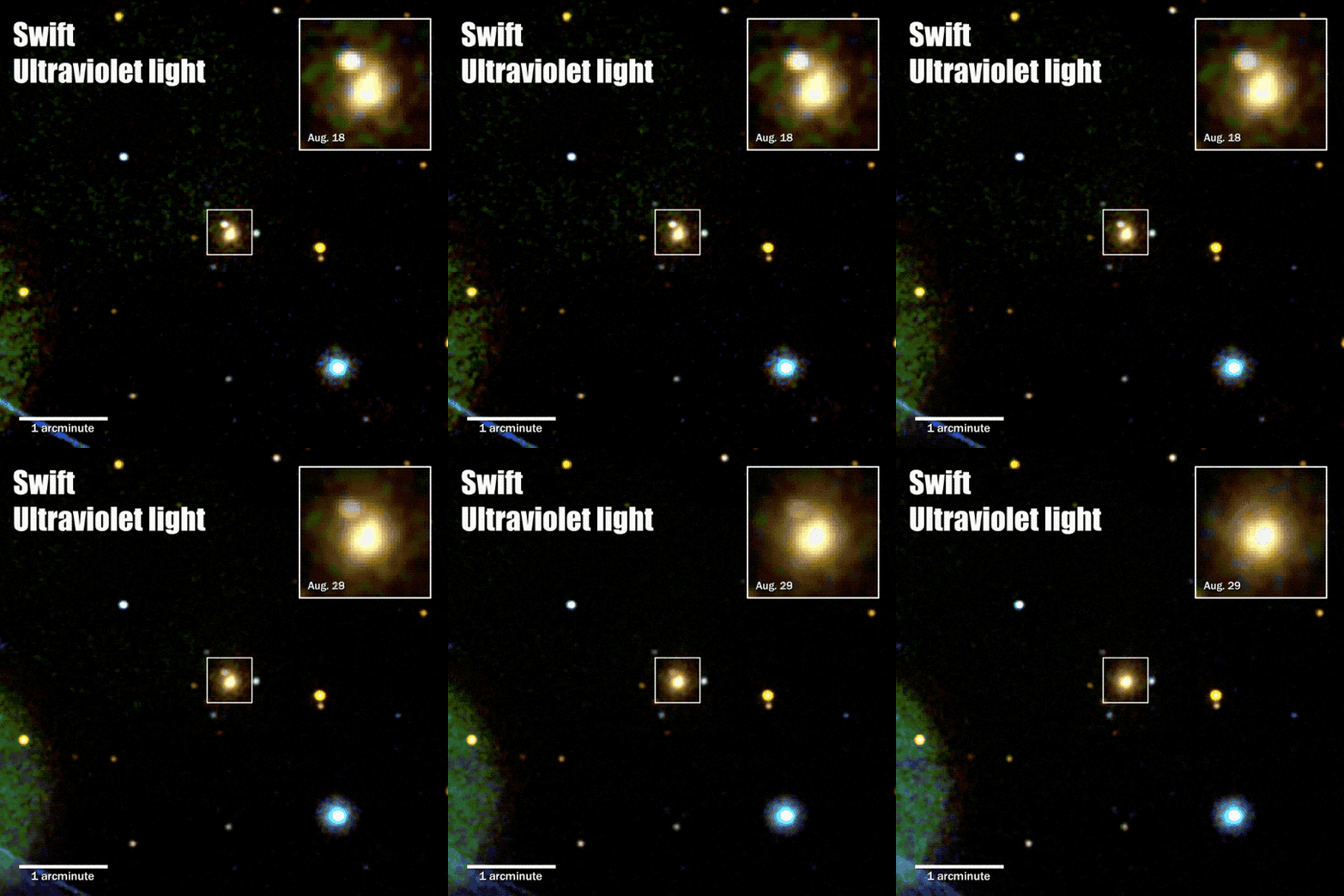
This animation GIF has text “Swift Ultraviolet light,” and shows the UV light Swift detected on August 18 and 29, fading between the two. The image shows the sky, black with several small circles of light. On August 18, the central source appears as a small yellow blob with a second white ball just to the side of it. On August 29, the white ball has disappeared, leaving just the larger yellow source.
NASA’s Neil Gehrels Swift Observatory imaged the kilonova produced by merging neutron stars in the galaxy NGC 4993 (box) on Aug. 18, 2017, about 15 hours after gravitational waves and the gamma-ray burst were detected. Inset: Magnified views of the galaxy.
NASA/Swift

After that initial burst of gamma rays, the debris from the explosion continued to glow, fading as it expanded outward. Our Swift, Hubble, Chandra, and Spitzer telescopes, along with a number of ground-based observatories, were poised to look at this afterglow from the explosion in ultraviolet, optical, X-ray, and infrared light. Such coordination between satellites is something that we’ve been doing with our international partners for decades, so we catch events like this one as quickly as possible and in as many wavelengths as possible.

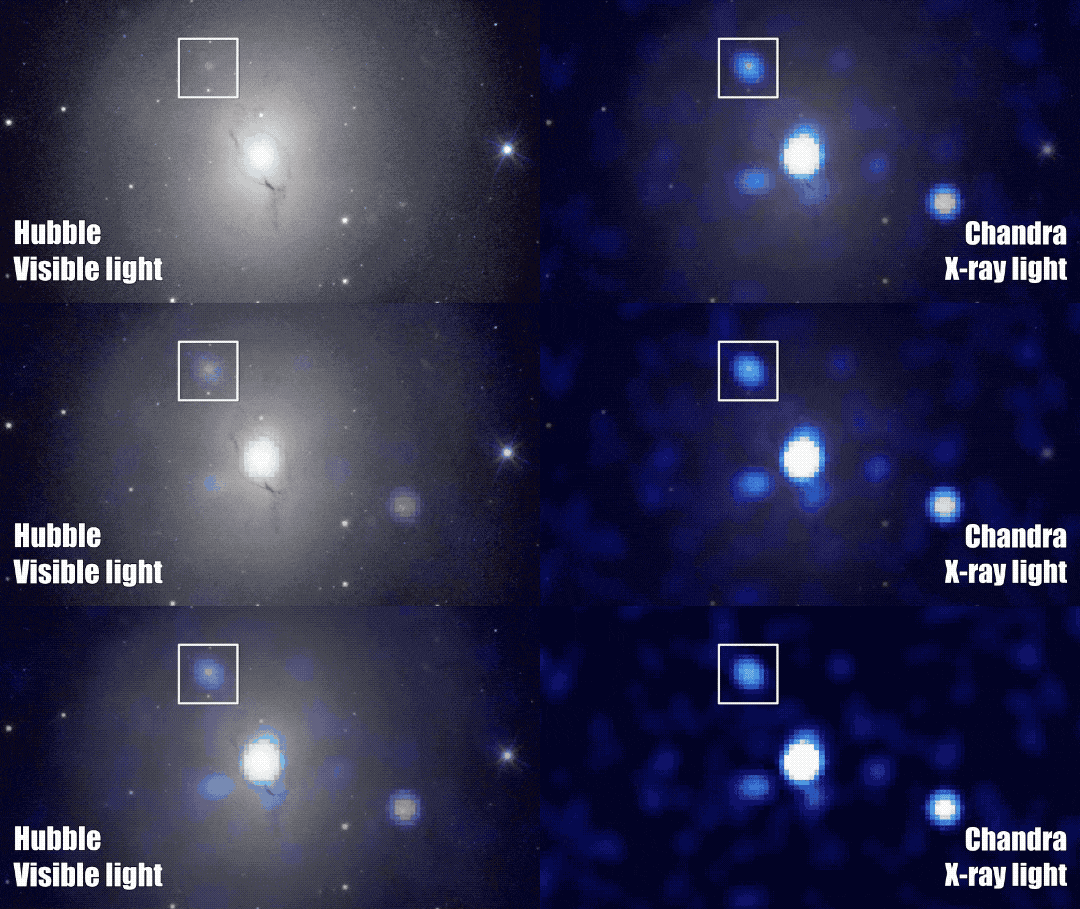
This animated GIF shows the region of the sky where the gravitational waves and gamma-ray burst were detected as seen by Hubble in visible light and Chandra in X-ray light, fading between the two. In visible light, there is a bright oval-shaped galaxy that takes up most of the image with a bright, white center region that fades into gray clouds around it. The site of the gamma-ray burst is outlined in a box, and shows a dim source in visible light about half way between the center of the galaxy and its edge. In X-ray light, the galaxy’s center and a couple of other sources appear as dots encircled in blue. The galaxy itself does not show up in X-rays. The site of the gamma-ray burst is a bright blue source.
The kilonova associated with GW170817 (box) was observed by NASA’s Hubble Space Telescope and Chandra X-ray Observatory. Hubble detected optical and infrared light from the hot expanding debris. Nine days later, Chandra detected the X-ray afterglow emitted by the jet directed toward Earth after it had spread into our line of sight.
NASA/CXC/E. Troja

Astronomers have thought that neutron star mergers were the cause of one type of gamma-ray burst — a short gamma-ray burst, like the one they observed on August 17. It wasn’t until we could combine the data from our satellites with the information from LIGO/Virgo that we could confirm this directly.

When this animation opens, there are concentric rings of pale blue the expand away and off the screen. At the center is a bright ball of light with two narrow cones of orange, fiery-looking material extend in opposing directions, tilted just to the right. During the first few seconds, there are magenta flashes of light that seem to be pushed along with the ends of the orange cones. The central ball expands into a puffy, electric blue cloud. The sequence represents the events that happened after two neutron stars merged, exploding in a gamma-ray burst.
This animation captures phenomena observed over the course of nine days following the neutron star merger known as GW170817, detected on Aug. 17, 2017. They include gravitational waves (pale arcs), a near-light-speed jet that produced gamma rays (magenta), expanding debris from a kilonova that produced ultraviolet (violet), optical and infrared (blue-white to red) emission, and, once the jet directed toward us expanded into our view from Earth, X-rays (blue).
NASA’s Goddard Space Flight Center/Conceptual Image Lab

That event began a new chapter in astronomy. For centuries, light was the only way we could learn about our universe. Now, we’ve opened up a whole new window into the study of neutron stars and black holes. This means we can see things we could not detect before.

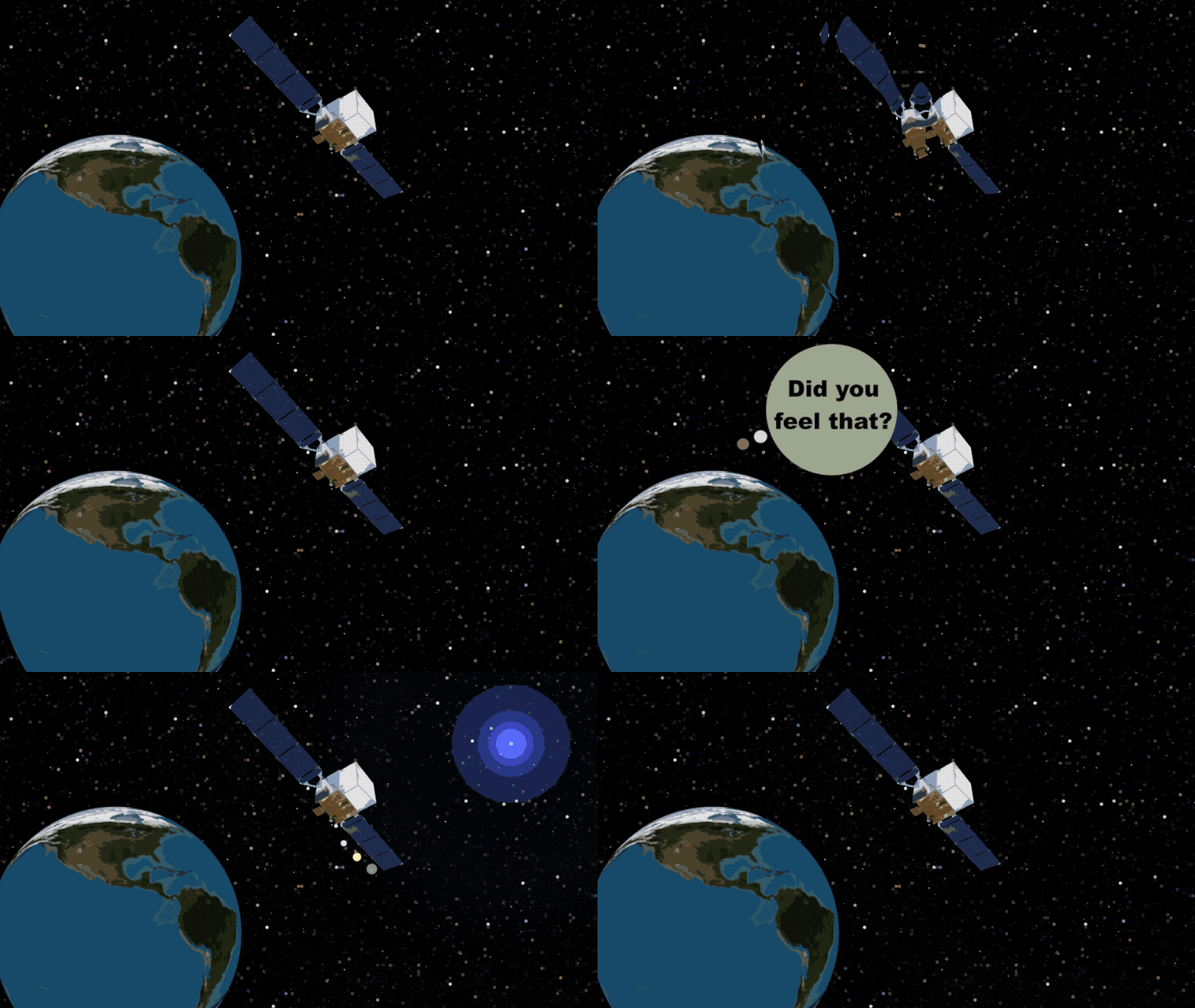
This animated GIF shows a fun animation of what happened on Aug. 17, 2017. The scene shows Earth on the left side with a cartoon depiction of the Fermi satellite near the center. The image appears to ripple, starting from a dot on the upper right of the image. A speech bubble raises from two site on Earth that says, “Did you hear that?” Then, 1.7 seconds after the ripple, a magenta “blast” of light appears where the ripple originated, and the Fermi telescope has a speech bubble that says, “I sure saw it!”
On Aug. 17, gravitational waves from merging neutron stars reached Earth. Just 1.7 seconds after that, NASA’s Fermi saw a gamma-ray burst from the same event. Now that astronomers can combined what we can “see” (light) and what we can “hear” (gravitational waves) from the same event, our ability to understand these extreme cosmic phenomena is greatly enhanced.
NASA’s Goddard Space Flight Center

The first LIGO detection was of a pair of merging black holes. Mergers like that may be happening as often as once a month across the universe, but they do not produce much light because there’s little to nothing left around the black hole to emit light. In that case, gravitational waves were the only way to detect the merger.

The neutron star merger, though, has plenty of material to emit light. By combining different kinds of light with gravitational waves, we are learning how matter behaves in the most extreme environments. We are learning more about how the gravitational wave information fits with what we already know from light — and in the process we’re solving some long-standing mysteries!

Keep Exploring

Discover More Topics From NASA

Powered by WPeMatico
Get The Details…

NASA Administrator Announces New Marshall Space Flight Center Director

NASA Administrator Announces New Marshall Space Flight Center Director

Official portrait of Joseph Pelfrey, director, NASA’s Marshall Space Flight Center in Huntsville, Alabama.
NASA

NASA Administrator Bill Nelson on Monday named Joseph Pelfrey director of the agency’s Marshall Space Flight Center in Huntsville, Alabama, effective immediately. Pelfrey has served as acting center director since July 2023.

“Joseph is a respected leader who shares the passion for innovation and exploration at NASA Marshall. As center director, he will lead the entire Marshall workforce, which includes a world-renowned team of scientists, engineers, and technologists who have a hand in nearly every NASA mission,” said Nelson. “I am confident that under Joseph’s leadership, Marshall will continue to make critical advancements supporting Artemis and Moon to Mars that will benefit all humanity.” 

NASA Marshall is one of the agency’s largest field centers, and manages NASA’s Michoud Assembly Facility in New Orleans, where some of the largest elements of the SLS (Space Launch System) rocket and Orion spacecraft for the Artemis campaign are manufactured. The center also is responsible for the oversight and execution of an approximately $5 billion portfolio comprised of human spaceflight, science, and technology development efforts. Its workforce consists of nearly 7,000 employees, both civil servants and contractors. 

“Marshall is renowned for its expertise in exploration and scientific discovery, and I am honored and humbled to be chosen to lead the center into the future,” said Pelfrey. “We will continue to shape the future of human space exploration by leading SLS and human landing system development for Artemis and leveraging our capabilities to make critical advancements in human landing and cargo systems, habitation and transportation systems, advanced manufacturing, mission operations, and cutting-edge science and technology missions.”

Prior to joining NASA, Pelfrey worked in industry, supporting development of space station payload hardware. He began his NASA career as an aerospace engineer in the Science and Mission Systems Office, going on to serve in various leadership roles within the International Space Station Program, the Marshall Engineering Directorate and the SLS Spacecraft/Payload Integration and Evolution Office. He also served as manager for the Commercial Orbital Transportation Services Project at Marshall and the Exploration and Space Transportation Development Office in the Flight Programs and Partnerships Office.

Appointed to the Senior Executive Service in 2016, Pelfrey served as the associate director for operations in Engineering, later becoming deputy manager and subsequently manager for Marshall’s Human Exploration Development and Operations Office. He was appointed as Marshall’s deputy center director in April 2022.

Pelfrey received a bachelor’s degree in Aerospace Engineering from Auburn University in 2000.

Learn more about Pelfrey in his biography online at:

https://www.nasa.gov/people/joseph-pelfrey/

-end-

Faith McKie / Cheryl Warner 
Headquarters, Washington 
202-358-1600 
faith.d.mckie@nasa.gov / cheryl.m.warner@nasa.gov  

Lance Davis
Marshall Space Flight Center, Huntsville, Ala.
256-640-9065 
lance.d.davis@nasa.gov    

Share

Details

Last Updated

Feb 05, 2024

Powered by WPeMatico
Get The Details…
Roxana Bardan