Crew Working Life Science, Looks Ahead to Upcoming Spacewalks

Crew Working Life Science, Looks Ahead to Upcoming Spacewalks
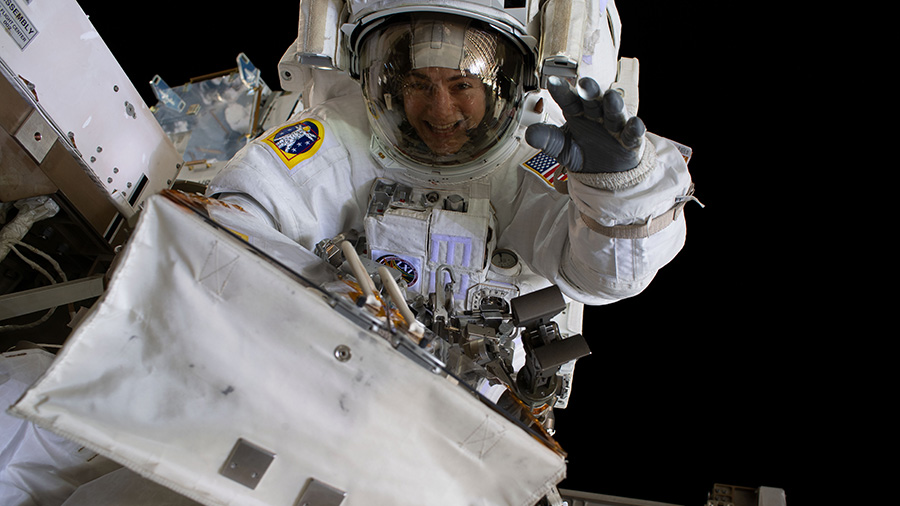
Astronaut Jessica Meir waves during a spacewalk
Astronaut Jessica Meir waves during a spacewalk with fellow astronaut Christina Koch (out of frame) on Oct. 18, 2019.

Human research and space biology filled the lab schedule aboard the International Space Station today. The Expedition 61 crewmembers are also ramping up for a trio of spacewalks set to begin next week.

NASA Flight Engineer Jessica Meir and Commander Luca Parmitano of ESA (European Space Agency) started Thursday collecting their blood samples. The duo spun the samples in a centrifuge and stowed them in a science freezer for later analysis. The astronauts also joined cosmonaut Alexander Skvortsov for a series of eye checks throughout the day.

Skvortsov also partnered up with cosmonaut Oleg Skripochka for cardiac research. After some Russian lab maintenance work, the pair also filmed educational activities to promote spaceflight for audiences on Earth.

Parmitano later tested how living in microgravity influences an astronaut’s perception of time. At the end of the workday, the ESA commander serviced a research incubator located in the Unity module.

Flight Engineer Andrew Morgan is setting up a mouse habitat in Japan’s Kibo laboratory module. The research facility is part of the Cell Biology Experiment Facility and enables the observation of rodents, which have a physiology similar to humans, in different gravity conditions.

Meir and fellow NASA astronaut Christina Koch are getting ready for two of three spacewalks planned for this month. The spacewalkers will work outside the station on Jan. 15 and 20 to replace older batteries with newer, more powerful batteries on the orbiting lab’s Port-6 truss structure. Morgan and Parmitano are targeting a third spacewalk on Jan. 25 to finish repairing the station’s cosmic particle detector, the Alpha Magnetic Spectrometer.

Get The Details…

Mark Garcia

Powered by WPeMatico

Spacewalk Preps Underway Amidst Space Research

Spacewalk Preps Underway Amidst Space Research

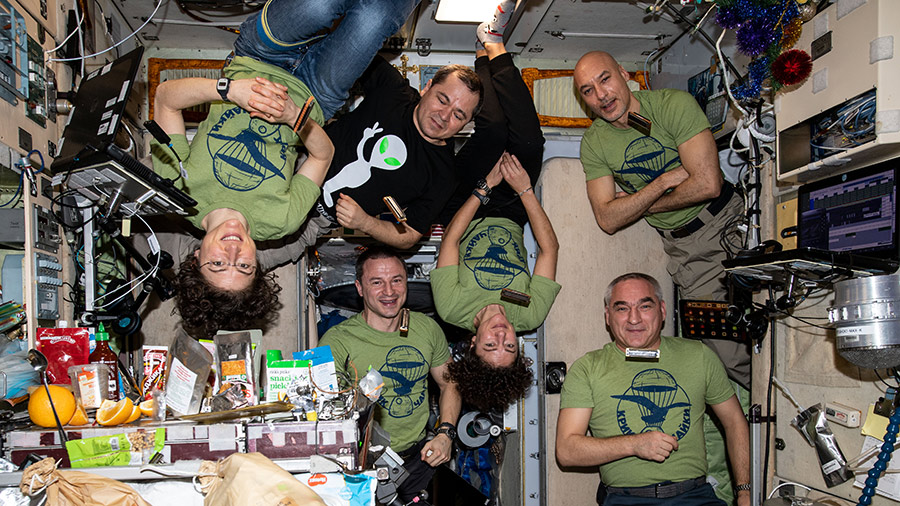
The Expedition 61 crew gathered together for a New Year's Eve meal
The Expedition 61 crew gathers together for a meal. Clockwise from top left are, Christina Koch, Oleg Skripochka, Luca Parmitano, Alexander Skvortsov, Jessica Meir and Andrew Morgan.

The Expedition 61 crew is gearing up for the first three spacewalks of 2020 set for this month. Meanwhile, the International Space Station is bustling with an array of microgravity research activities today.

NASA astronauts Jessica Meir and Christina Koch will conduct the first two spacewalks scheduled for Jan. 15 and Jan. 20. The duo will finish replacing older nickel-hydrogen batteries with new lithium-ion batteries on the station’s Port-6 truss structure. They spent Wednesday reviewing spacewalk procedures and inspecting spacesuit tethers.

The next spacewalk would be Jan. 25 following the successful battery replacements. NASA astronaut Andrew Morgan and Commander Luca Parmitano of ESA (European Space Agency) will finish the repair work they started in November on the station’s cosmic particle detector, the Alpha Magnetic Spectrometer.

In the midst of the spacewalk preparations, the lab residents kept up the ongoing space science to improve life for humans on and off Earth.

Morgan began the day installing botany research gear inside Japan’s Cell Biology Experiment Facility before transferring resupply racks to the Cygnus space freighter. Parmitano conducted a vision test then cleaned up Rodent Research hardware that housed mice that were returned to Earth aboard the SpaceX Dragon cargo craft.

Cosmonauts Alexander Skvortsov and Oleg Skripochka split their time on Russian science and maintenance tasks. The duo partnered together for a study exploring piloting methods under a variety of gravity conditions. Skvortsov then measured the station’s radiation environment as Skripochka replaced fuel bottles for combustion research.

Get The Details…

Mark Garcia

Powered by WPeMatico

Dragon Splashes Down in Pacific Returning Science and Cargo

Dragon Splashes Down in Pacific Returning Science and Cargo

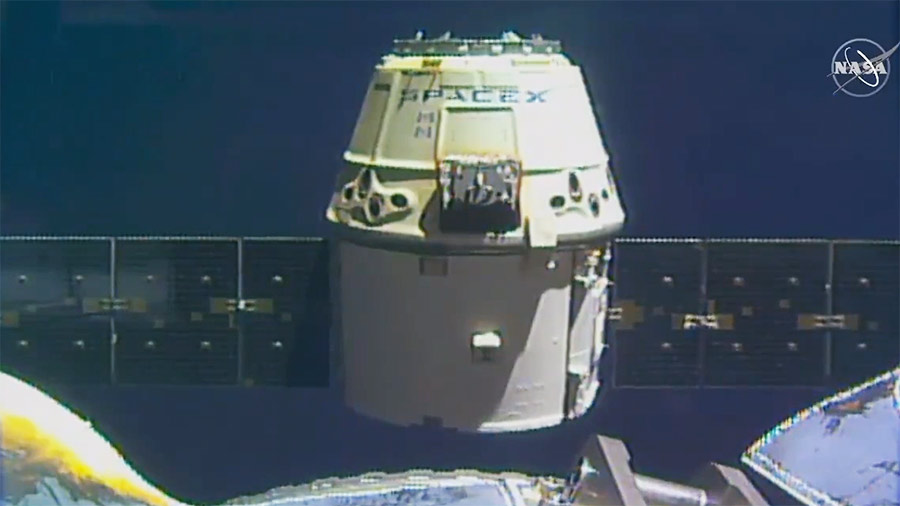
The SpaceX Dragon separates from the International Space Station
A camera on the tip of the Canadarm2 robotic arm views the SpaceX Dragon as it separates from the International Space Station.

The SpaceX Dragon spacecraft splashed down at 10:42 a.m. in the Pacific Ocean about 271 miles southwest of Long Beach, California, marking the end of the company’s 19th contracted cargo resupply mission to the International Space Station for NASA.

A key component being returned aboard Dragon is a faulty battery charge-discharge unit (BCDU), which failed to activate following the Oct. 11 installation of new lithium-ion batteries on the space station’s truss. The BCDU was removed and replaced during a spacewalk Oct. 18 by Expedition 61 flight engineers Christina Koch and Jessica Meir of NASA. The unit are being returned to teams on Earth for an evaluation and repair.

Dragon launched on the SpaceX Falcon 9 rocket Dec. 5 from Space Launch Complex 40 at Cape Canaveral Air Force Station in Florida, and arrived at the station two days later with almost 3,400 pounds of science, supplies and cargo.

Learn more about station activities by following the space station blog, @space_station and @ISS_Research on Twitter as well as the ISS Facebook and ISS Instagram accounts.

Get The Details…

Mark Garcia

Powered by WPeMatico

Dragon Released from Station Carrying Science for Earth-Analysis

Dragon Released from Station Carrying Science for Earth-Analysis

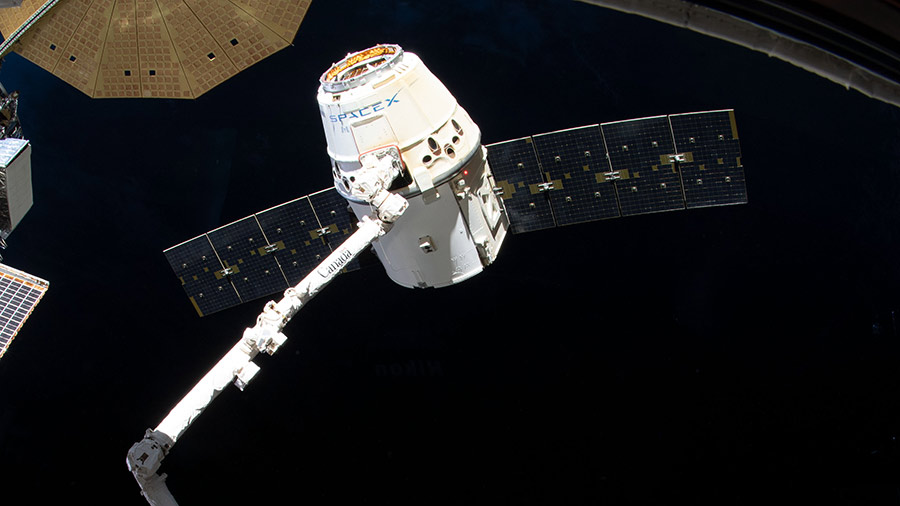
The SpaceX Dragon cargo craft is pictured moments before its release
The SpaceX Dragon cargo craft is pictured moments before its release from the Canadarm2 robotic arm on June 3, 2019.

The SpaceX Dragon cargo spacecraft released from the International Space Station at 5:05 a.m. EST after flight controllers in Houston delivered remote commands to the station’s Canadarm2 robotic arm. Expedition 61 Station Commander Luca Parmitano of ESA (European Space Agency) will back up the ground controllers and monitor Dragon’s systems as it departs the orbital laboratory.

Next up, Dragon will fire its thrusters to move a safe distance from the station, then execute a deorbit burn as it heads for a parachute-assisted splashdown around 10:41 a.m. in the Pacific Ocean southwest of Long Beach, California. The splashdown will not air on NASA TV.

Some of the scientific investigations Dragon will return to Earth include:

 Tiny Radiation Resistors

Rotifer-B1 examines the effects of spaceflight on tiny aquatic animals, called rotifers, which are found in freshwater ecosystems and soil and are highly resistant to radiation on Earth. The investigation specifically looks at the metabolism and genome of the rotifer Adineta vaga to determine whether they have similar adaptation mechanisms in microgravity.

 Mice in Space

Rodent Research-19 examines myostatin and activin, molecular signaling pathways that influence muscle degradation, as possible targets for preventing muscle and bone loss during spaceflight and enhancing recovery following return to Earth. This study also could support the development of therapies for a wide range of conditions that cause muscle and bone loss on Earth.

 Finding the Perfect Solution

On Earth, our bodies deal with low-level radiation through a naturally occurring protein that helps our body safely process it. The Growth of Large, Perfect Protein Crystals for Neutron Crystallography (Perfect Crystals) study, aims to help scientists find a way to deal with the problem of radiation during long-duration spaceflight missions using the same protein that is already at work in our bodies.

 Convection and Crystallization in Microgravity

The Polymer Convection study examines the effects of gravity on formation and crystallization of Broadband Angular Selective Material (BASM), an optical material with the ability to control the reflection and absorption of light. BASM has applications in polymer packaging, optical films, solar power and electronic displays.

These are just a few of the hundreds of investigations providing opportunities for U.S. government agencies, private industry, and academic and research institutions to conduct microgravity research that leads to new technologies, medical treatments and products that improve life on Earth. Conducting science aboard the orbiting laboratory will help us learn how to keep astronauts healthy during long-duration space travel and demonstrate technologies for future human and robotic exploration beyond low-Earth orbit to the Moon and Mars.

Learn more about station activities by following the space station blog, @space_station and @ISS_Research on Twitter as well as the ISS Facebook and ISS Instagram accounts.

Get The Details…

Mark Garcia

Powered by WPeMatico

Live Now on NASA TV Dragon Prepares for Station Departure

Live Now on NASA TV Dragon Prepares for Station Departure

The SpaceX Dragon cargo craft is pictured moments before its release
The SpaceX Dragon cargo craft is pictured moments before its release from the Canadarm2 robotic arm on June 3, 2019.

NASA Television coverage is underway for departure of the SpaceX Dragon spacecraft from the International Space Station. The spacecraft is scheduled for release at approximately 5:03 a.m. EST today.

Dragon will be released from the Earth-facing port of the Harmony module after flight controllers at mission control in Houston deliver remote commands to the station’s Canadarm2 robotic arm. Expedition 61 Station Commander Luca Parmitano of ESA (European Space Agency) will back up the ground controllers and monitor Dragon’s systems as it departs the orbital laboratory.

After firing its thrusters to move a safe distance away from the station, Dragon will execute a deorbit burn to leave orbit, as it heads for a parachute-assisted splashdown in the Pacific Ocean, 202 miles southwest of Long Beach, California, at approximately 10:41 a.m. (7:41 p.m. PST). There will be no live coverage of deorbit burn or splashdown.

A key component being returned aboard Dragon is a faulty battery charge-discharge unit (BCDU), which failed to activate following the Oct. 11 installation of new lithium-ion batteries on the space station’s truss. The BCDU was removed and replaced during a spacewalk Oct. 18 by Expedition 61 flight engineers Christina Koch and Jessica Meir of NASA. The unit will be returned to teams on Earth for an evaluation and repair.

Dragon launched on the SpaceX Falcon 9 rocket Dec. 5 from Space Launch Complex 40 at Cape Canaveral Air Force Station in Florida, and arrived at the station two days later with almost 3,400 pounds of science, supplies and cargo on SpaceX’s 19th commercial resupply mission to the station for NASA.

Learn more about station activities by following the space station blog@space_station and @ISS_Research on Twitter as well as the ISS Facebook and ISS Instagram accounts.

Get The Details…

Mark Garcia

Powered by WPeMatico