Robotics, Cargo Mission and Photography Keep Station Crew Busy

Robotics, Cargo Mission and Photography Keep Station Crew Busy

63 Commander Chris Cassidy sets up an Astrobee robotic assistant
63 Commander Chris Cassidy sets up an Astrobee robotic assistant, one of a trio of cube-shaped, free-flying robots, for a test of its mobility and vision system.

NASA’s International Space Station commander configured robotic assistants today while continuing to get ready for next week’s U.S. cargo craft departure. The two Expedition 63 Flight Engineers from Roscosmos explored advanced space photography techniques and inventoried electronics gear.

Three-time space visitor Chris Cassidy is readying a trio of cube-shaped, free-flying robotic assistants for upcoming operations. The NASA astronaut and Navy captain swapped batteries in the advanced devices being tested for their ability to autonomously navigate the station and service small payloads. The program dubbed Astrobee is researching the potential of small robots to perform routine duties and monitor activities freeing up crew time for critical science.

A U.S. space freighter will leave the station Monday after nearly three months attached to the Unity module. Northrop Grumman’s Cygnus resupply ship will be released from the grips of the Canadarm2 robotic arm at noon EDT on Monday completing its cargo mission.

Not only is Cygnus being packed with trash, but Cassidy prepared it for secondary missions to research space fires and deploy a set of CubeSats. Once Cygnus reaches a safe distance from the orbital lab, a small satellite deployer configuring on its hatch will eject a pair of nanosatellites. The shoe box-sized research satellites will research ways to improve space communication techniques and GPS mapping systems.

Over in the Russian segment, cosmonauts Anatoly Ivanishin and Ivan Vagner concentrated on their set of tasks to maintain station operations. Ivanishin, who is on his third station mission, started his day with Vagner studying techniques to accurately detect and locate landmarks to improve Earth observations.

Ivanishin then spent the rest of the day servicing Russian life support gear and communications systems. First-time station resident Vagner inventoried electrical gear and checked network connections throughout the station’s five Russian modules.

Get The Details…

Mark Garcia

Powered by WPeMatico

Station Trio Works Spacesuits, Science as SpaceX Readies Crew Launch

Station Trio Works Spacesuits, Science as SpaceX Readies Crew Launch

The three-member Expedition 63 crew aboard the International Space Station
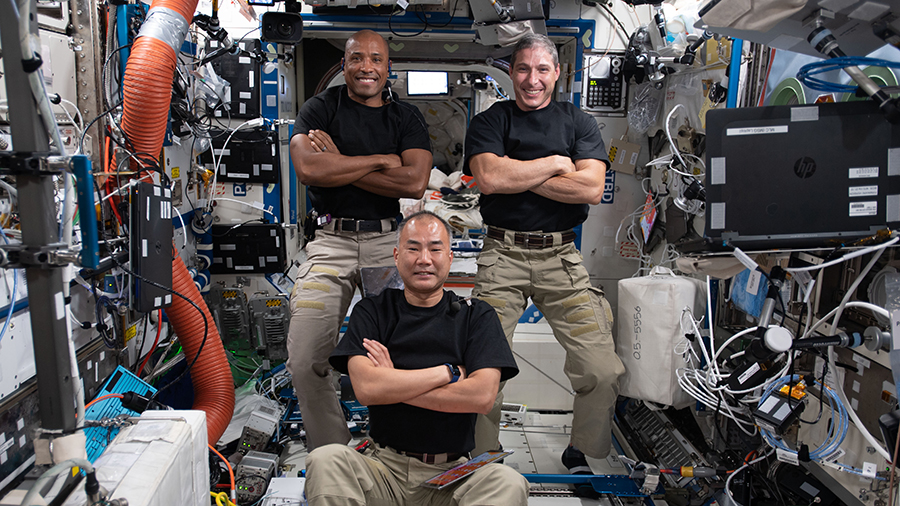
The three-member Expedition 63 crew aboard the International Space Station with (from left) NASA astronaut and Commander Chris Cassidy and Roscosmos cosmonauts and Flight Engineers Anatoly Ivanishin and Ivan Vagner.

Spacesuits, photo inspections and pilot studies kept the Expedition 63 crew busy aboard the International Space Station today. Meanwhile, the Commercial Crew Program is getting ready to launch its first crewed mission.

Commander Chris Cassidy of NASA spent most of Tuesday inside the Quest airlock where spacewalks in U.S. spacesuits are staged. The veteran space visitor serviced the spacesuits today replacing components and cleaning cooling loops. NASA is planning a series of spacewalks later this year to upgrade power and science systems on the orbiting lab.

Flight Engineer Anatoly Ivanishin of Roscosmos, a veteran of two previous station missions, spent his morning photographing the interior condition of the Zarya and Pirs modules. Russian mission controllers will inspect the photos to determine areas necessary for repair as well locations for the installation of future science experiments.

First-time space station resident Ivan Vagner began his day exploring ways crews might pilot spacecraft and robotic rovers on future planetary missions. In the afternoon, the Roscosmos cosmonaut moved on and serviced a variety of communications and life support gear.

Back on Earth, the SpaceX Crew Dragon spacecraft is being processed at the Cape Canaveral Air Force Station in Florida. NASA astronauts Bob Behnken and Doug Hurley will be the first crew since 2011 to launch aboard an American spacecraft.

The duo will be inside the Crew Dragon atop the Falcon 9 rocket when it lifts off May 27 for a 19-hour trip to the space station. The experienced NASA astronauts will join the Expedition 63 crew for several weeks to ramp up science activities aboard the orbiting lab.

Get The Details…

Mark Garcia

Powered by WPeMatico

Cygnus Readied for Departure, Crew Trains for Medical Emergency

Cygnus Readied for Departure, Crew Trains for Medical Emergency

April 25, 2020: International Space Station Configuration.
Four spaceships are attached at the space station including the U.S. Northrop Grumman Cygnus cargo craft and Russia’s Progress 74 and 75 resupply ships and Soyuz MS-16 crew ship.

A U.S. cargo craft is one week away from completing its mission at the International Space Station. Meanwhile, the three-member Expedition 63 crew focused its attention today on emergency training and orbital maintenance.

On Monday May 11, the Cygnus space freighter from Northrop Grumman will complete its mission attached to the station’s Unity module. Cygnus will serve a dual purpose after its departure as it takes out the trash and deploys a set of CubeSats for a variety of space research.

Commander Chris Cassidy is setting up a small satellite deployer, called the SlingShot, that will be installed on the hatch of Cygnus before its departure. The tiny satellites will test space communication technologies and advanced GPS mapping techniques.

Cassidy then joined Roscosmos Flight Engineers Anatoly Ivanishin and Ivan Vagner for an emergency drill after lunchtime. The trio practiced CPR techniques necessary in microgravity. The crewmates also reviewed medical hardware, communication and coordination in the event of a medical emergency aboard the orbiting lab.

Ivanishin started Monday morning photographing the interior of the station’s Russian segment to document spaces that could support new research gear and areas that may require repairs. Vagner explored ways to prevent science experiments or degraded station hardware from potentially contaminating the cabin atmosphere.

Get The Details…

Mark Garcia

Powered by WPeMatico

Expedition 63 Explores Free-Flying Robots and Heart Research

Expedition 63 Explores Free-Flying Robots and Heart Research

Expedition 63 Commander Chris Cassidy works on the Fluids Integrated Rack
Expedition 63 Commander Chris Cassidy works on the Fluids Integrated Rack (FIR) replacing components in the research device that studies the behavior of fluids in microgravity.

Free-flying robots and heart research filled the science schedule aboard the International Space Station today. The Expedition 63 crew also managed cargo activities in a pair of resupply ships and cleaned biology research gear.

Astrobee is a robotics investigation that explores the ability of a trio of cube-shaped, free-flying robots to assist crews aboard the station. Commander Chris Cassidy set up one of the autonomous robotic assistants in the afternoon for a test of its mobility and vision system. Astrobee could perform routine lab chores giving astronauts more time to conduct critical space research.

Cassidy also finalized the cleaning of a mouse habitat that housed rodents monitored for changes to their genetic expression due to microgravity. The mice have since returned to Earth aboard the last SpaceX Dragon cargo mission on April 7.

Living and working in space impacts the human body and scientists are exploring measures to ensure astronauts adapt successfully to weightlessness. How heart performance changes in space is fundamental to keeping crews healthy during long-term missions.

Cosmonauts Anatoly Ivanishin and Ivan Vagner continued a long-running Russian heart study today that utilizes the Lower Body Negative Pressure Suit. The investigation examines how the heart behaves as the specialized spacesuit prevents blood from pooling in a crewmember’s head reducing head and eye pressure.

The Russian duo then spent the afternoon transferring cargo to and from the Progress 74 and 75 space freighters. Ivanishin packed trash and old gear in the 74P which is due to complete its mission in July. Vagner unloaded new gear and supplies from the 75P which just arrived on April 25.

Get The Details…

Mark Garcia

Powered by WPeMatico

Spacesuit Work and Heart Research Fill Crew Day

Spacesuit Work and Heart Research Fill Crew Day

Expedition 63 Commander Chris Cassidy works in the Combustion Integrated Rack
Expedition 63 Commander Chris Cassidy works in the Combustion Integrated Rack, a research device that enables safe fuel, flame and soot studies in microgravity.

The three-member Expedition 63 crew aboard the International Space Station focused its attention on spacesuits and cardiac research today. The orbital residents also serviced science hardware and life support gear.

Commander Chris Cassidy worked on a pair of U.S. spacesuits in the Quest airlock today cleaning cooling loops, replacing components and checking for leaks. NASA is planning a series of spacewalks later this year to upgrade power and science systems on the orbiting lab.

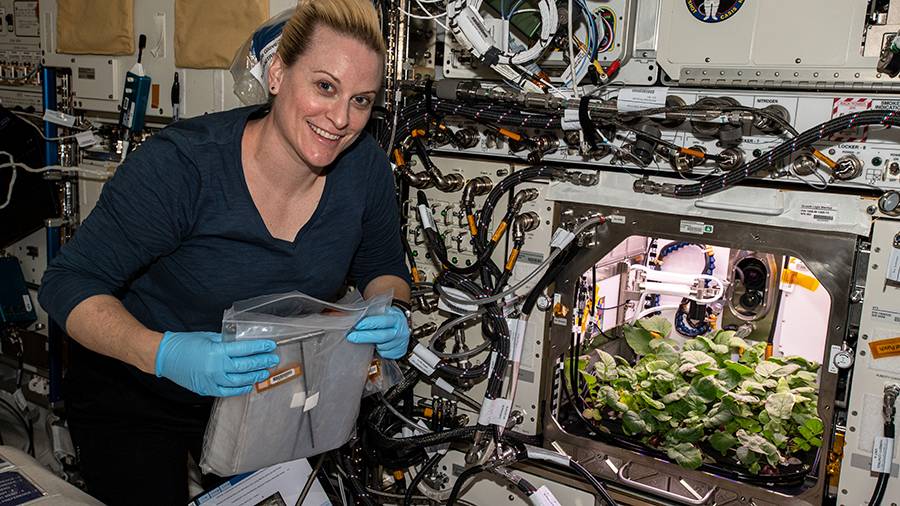
Cassidy, who last served in 2013 as an Expedition 36 flight engineer, also cleaned the Veggie PONDS botany research hardware after growing lettuce and mizuna greens in the Columbus lab module. Next, he swapped batteries in the Astrobee robotic assistant then set up audio software for a hearing assessment.

Roscosmos Flight Engineers Anatoly Ivanishin and Ivan Vagner worked in the morning on a long-running study to understand how the human heart adapts to microgravity. The duo then split up for Earth observation studies and life support maintenance.

Get The Details…

Mark Garcia

Powered by WPeMatico