NASA, Space Station Partners Approve Next Axiom Private Mission Crew
NASA and its international partners have approved the crew for Axiom Space’s second private astronaut mission to the International Space Station, Axiom Mission 2 (Ax-2).
Axiom Space’s Director of Human Spaceflight and former NASA astronaut Peggy Whitson will command the privately funded mission. Aviator John Shoffner of Knoxville, Tennessee, will serve as pilot. The two mission specialists will be announced later.
Spacewalkers (from left) Koichi Wakata and Nicole Mann are pictured installing hardware on the space station preparing the orbiting lab for its next roll-out solar array. Credit: NASA TV
NASA astronaut Nicole Mann and Japan Aerospace Exploration Agency (JAXA) astronaut Koichi Wakata concluded their spacewalk at 3:35 p.m. EST after 7 hours and 21 minutes.
Mann and Wakata completed work left over from a previous spacewalk for a platform on which a set of International Space Station Roll-Out Solar Arrays (iROSAs) for the station’s 1B power channel will be installed later this year, as well as most of the work to install a similar mounting platform for a set of iROSAs for the 1A power channel. Due to time constraints, plans to bolt a final strut for the second platform were deferred until a future spacewalk. There is no impact to station operations.
The installation is part of a series of spacewalks to augment the International Space Station’s power channels with new iROSAs. Four iROSAs have been installed so far, and two more will be mounted to the platforms installed during this spacewalk in the future.
It was the 258th spacewalk in support of space station assembly, upgrades, and maintenance, the first spacewalk of 2023, and the first spacewalk for both astronauts.
Mann and Wakata are in the midst of a planned six-month science mission living and working aboard the microgravity laboratory to advance scientific knowledge and demonstrate new technologies for future human and robotic exploration missions, including lunar missions through NASA’s Artemis program.
Astronauts Begin Spacewalk to Prep for Station Power Upgrades
Expedition 68 Flight Engineer and NASA astronaut Josh Cassada prepares a roll-out solar array for deployment during a spacewalk on Dec. 22, 2022.
NASA astronaut Nicole Mann and Japan Aerospace Exploration Agency (JAXA) astronaut Koichi Wakata began a spacewalk at 8:14 a.m. EST to complete the installation of two mounting platforms as part of planned solar array augmentation on the starboard side of the space station’s truss. The duo will complete the installation of a mounting platform on the 1B power channel that was started during a previous spacewalk, and begin installing a mounting platform on the 1A power channel.
The installation is part of a series of spacewalks to augment the International Space Station’s power channels with new International Space Station Roll-Out Solar Arrays (iROSAs). Four iROSAs have been installed so far, and two more will be mounted to the platforms installed during this spacewalk in the future.
Mann, designated as extravehicular crew member 2 (EV 2), is wearing an unmarked suit. Wakata, designated as extravehicular crew member 1 (EV 1), is wearing a suit with red stripes. Coverage of the spacewalk continues on NASA Television, the NASA app, and the agency’s website.
Crew Ready for Spacewalk and Conducts Biology, Physics Research
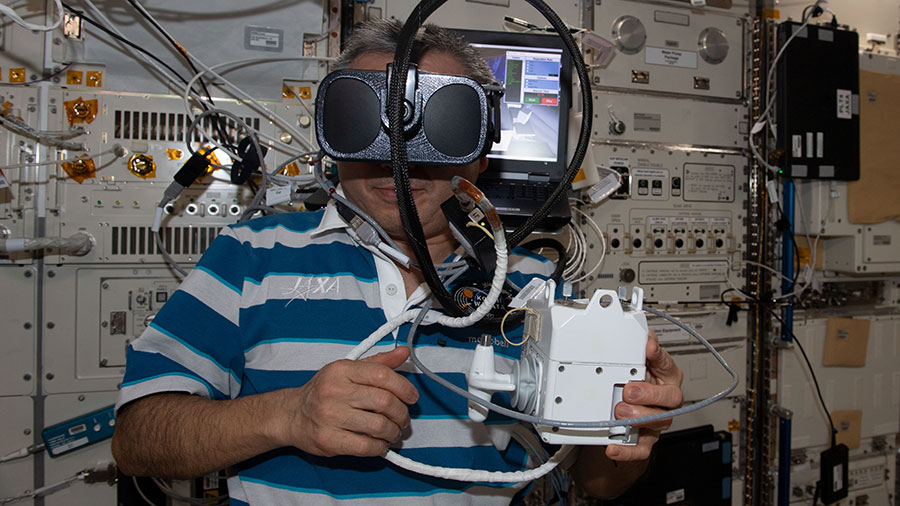
Astronaut Koichi Wakata wears virtual reality goggles aboard the space station while training for a spacewalk.
The first spacewalk of 2023 will begin on Friday to continue upgrading the International Space Station’s power generation system. The Expedition 68 crew members finalized preparations today for the excursion while continuing advanced space research and orbital lab maintenance.
Astronauts Koichi Wakata of the Japan Aerospace Exploration Agency (JAXA) and Nicole Mann of NASA are due to spend about six-and-a-half hours working outside the station during a spacewalk on Friday. The two flight engineers will turn the batteries on inside their Extravehicular Mobility Units (EMUs), or spacesuits, at 8:15 a.m. EST signifying the start of a six-and-a-half hour spacewalk. The duo will work on the far end of the station’s starboard truss structure in their EMUs and install a modification kit enabling the future installation of a roll-out solar array. NASA TV, on the agency’s app and website, will begin its live spacewalk coverage at 7 a.m.
Wakata and Mann were joined on Thursday by NASA Flight Engineer Frank Rubio for final spacewalk preparations. The two spacewalkers along with Rubio staged tools and hardware inside the Quest airlock during the morning. The trio then spent the afternoon reviewing spacewalk steps and procedures before readying the two spacesuits for operations.
The orbiting lab’s three cosmonauts kept up their schedule of ongoing microgravity research and lab upkeep on Thursday. Commander Sergey Prokopyev packed the ISS Progress 81 resupply ship with trash and discarded gear before more conducting more tests on a 3-D printer monitoring the device for excessive noise. Flight Engineer Dmitri Petelin spent all day Thursday servicing life support hardware and electronics gear. Flight Engineer Anna Kikina began her day with a hearing assessment then checked radiation detectors before finally studying future spacecraft and robotic piloting techniques on a computer.
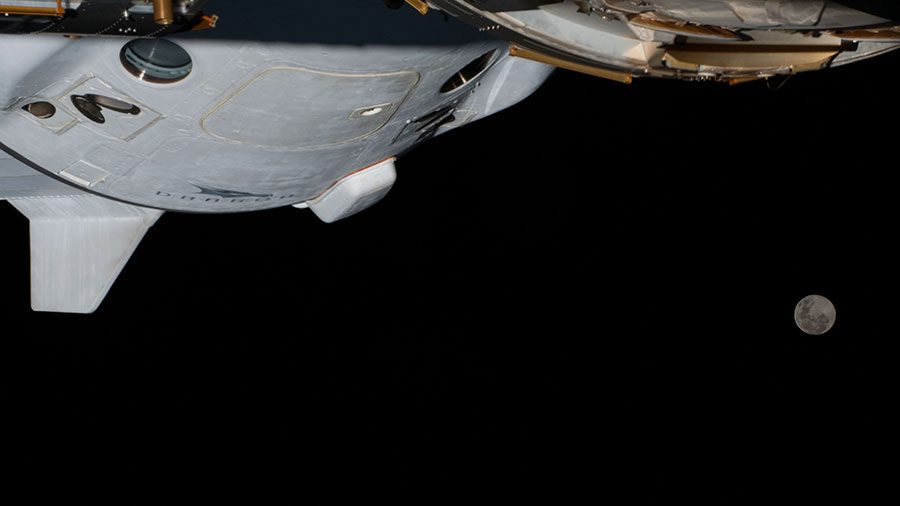
The Full Moon is pictured behind the SpaceX Dragon Endurance crew ship while the space station was orbiting above southern Brazil.
On Jan. 17, NASA Flight Engineer Josh Cassada, with assistance from NASA Flight Engineer Nicole Mann, worked inside the SpaceX Dragon Endurance crew ship collecting tools and readying the spacecraft for a seat liner move. The seat liner move, completed today, Jan. 18, ensures NASA Flight Engineer Frank Rubio will be able to return to Earth in the unlikely event of an emergency evacuation from the International Space Station. Rubio originally launched to the station with cosmonauts Sergey Prokopyev and Dmitri Petelin aboard the Soyuz MS-22 crew ship on Sept. 21, 2022. The change allows for increased crew protection by reducing the heat load inside the MS-22 spacecraft for Prokopyev and Petelin in case of an emergency return to Earth.



 NASA and its international partners have approved the crew for Axiom Space’s second private astronaut mission to the International Space Station, Axiom Mission 2 (Ax-2).