Astronauts Begin Spacewalk to Continue Power System Upgrades
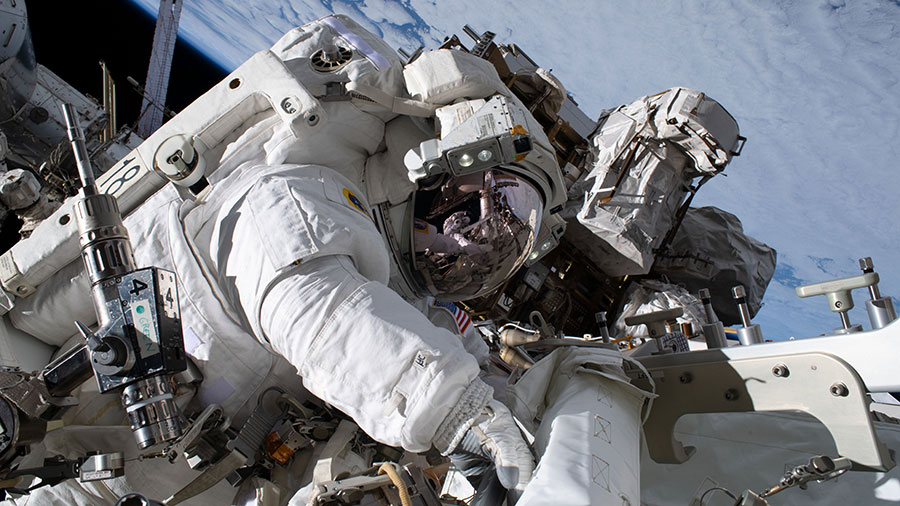
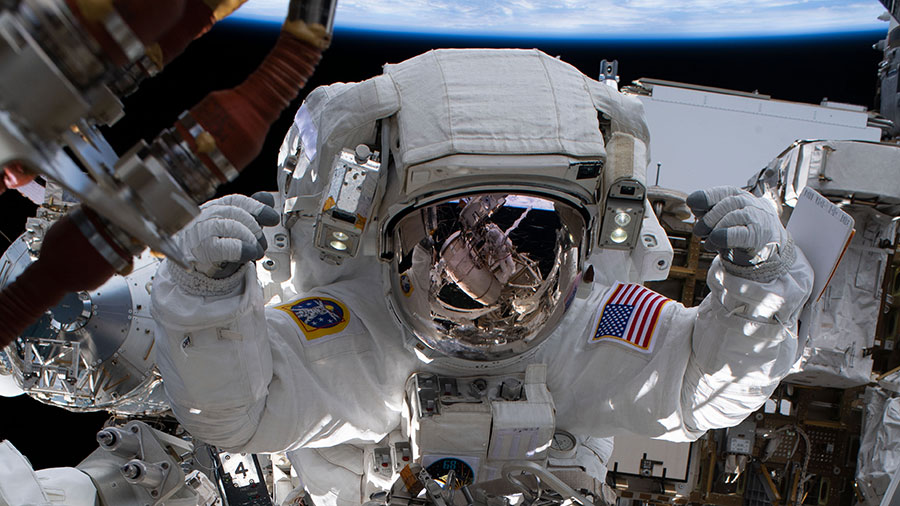
Astronaut Nicole Mann is pictured during her first spacewalk on Jan. 20, 2023, upgrading the space station’s power generation system.
NASA astronaut Nicole Mann and Japan Aerospace Exploration Agency (JAXA) astronaut Koichi Wakata began a spacewalk at 7:45 a.m. EST, approximately 30 minutes ahead of schedule, to complete the construction of a mounting platform on the 1A power channel that was started during a spacewalk on Jan. 20, relocate and install an articulating portable foot restraint from the P6 truss for future spacewalk tasks, and if time permits, complete cable routing on the 1B power channel.
The installation is part of a series of spacewalks to augment the station’s power channels with new International Space Station Roll-Out Solar Arrays (iROSAs). Four iROSAs have been installed so far, and two additional arrays will be mounted to the installed platforms during future spacewalks following their arrival later this year on SpaceX’s 28th commercial resupply services mission for NASA.
Mann, designated extravehicular crew member 1, is wearing a suit with red stripes. Wakata, designated extravehicular crew member 2, is wearing an unmarked suit. The spacewalk is the second for both Mann and Wakata.
Coverage of the spacewalk continues on NASA Television, the NASA app, and the agency’s website.
NASA TV is Live as Astronauts Prep for Spacewalk to Continue Power System Upgrades
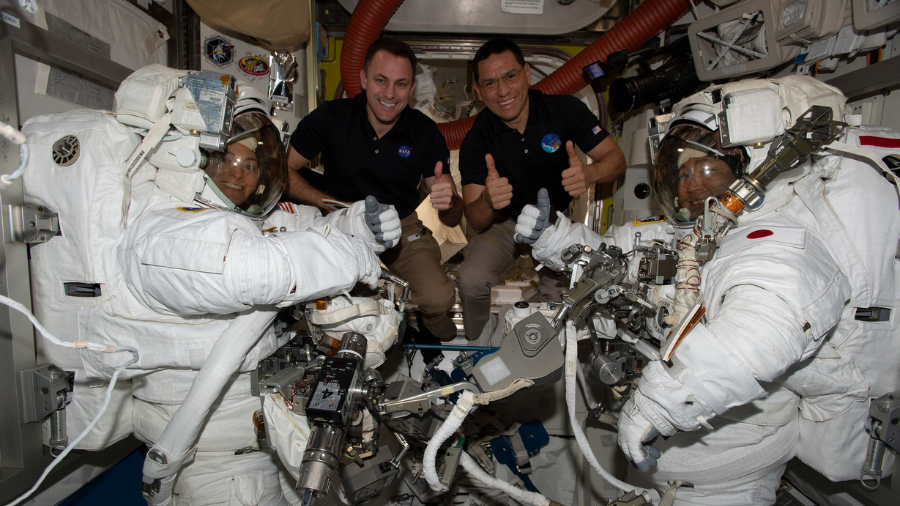
Expedition 68 Flight Engineers (middle left to right) Josh Cassada and Frank Rubio, both from NASA, pose with astronauts (far left and right) Nicole Mann from NASA and Koichi Wakata of the Japan Aerospace Exploration Agency (JAXA) in their Extravehicular Mobility Units (EMUs), or spacesuits, as they prep for a spacewalk on Jan. 20, 2022.
NASA Television coverage of today’s spacewalk with NASA astronaut Nicole Mann and Japan Aerospace Exploration Agency (JAXA) astronaut Koichi Wakata is now underway and is also available on the NASA app and the agency’s website.
The two Expedition 68 crew members are preparing to exit the International Space Station‘s Quest airlock for a spacewalk expected to begin at about 8:15 a.m. EST and last up to seven hours.
Mann and Wakata will work to complete the construction of a mounting platform on the 1A power channel as part of a planned solar array augmentation on the starboard side of the station’s truss.
The duo will complete the installation of the mounting platform that was started during a spacewalk on Jan. 20, relocate and install an articulating portable foot restraint from the P6 truss for future spacewalk tasks, and if time permits, complete cable routing on the 1B power channel.
The installation is part of a series of spacewalks to augment the station’s power channels with new International Space Station Roll-Out Solar Arrays (iROSAs). Four iROSAs have been installed so far, and two additional arrays will be mounted to the installed platforms during future spacewalks following their arrival later this year on SpaceX’s 28th commercial resupply services mission for NASA.
Mann will serve as extravehicular crew member 1 and will wear a suit with red stripes. Wakata will serve as extravehicular crew member 2 and will wear an unmarked suit. The spacewalk will be the second for both Mann and Wakata.
Station is GO for Thursday Spacewalk as Space Research Keeps Up
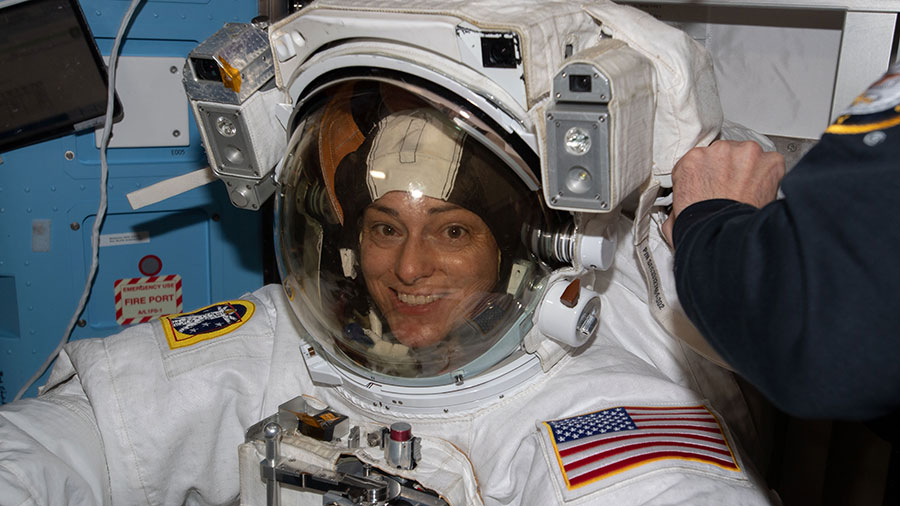
Astronaut Nicole Mann is pictured in her spacesuit after completing a spacewalk to modify the station’s power generation system on Jan. 20.
Mission managers have given the “go” for two astronauts to exit the International Space Station on Thursday and conduct a seven-hour spacewalk. While the spacewalk preparations were under way, the rest of the Expedition 68 crew kept up its ongoing schedule of human research, botany, and physics experiments.
Flight Engineers Nicole Mann of NASA and Koichi Wakata of the Japan Aerospace Exploration Agency (JAXA) will set their Extravehicular Mobility Units (EMUs), or spacesuits, to battery power at 8:15 a.m. EST on Thursday. After their EMUs are set to battery power, the astronauts’ spacewalk officially begins and they will exit the Quest airlock into the vacuum of space and maneuver to the starboard truss structure. Once they arrive at the Starboard-4 truss, they will complete a modification kit installation job they began on Jan. 20 to prepare the station for its next roll-out solar array.
Mann and Wakata started Wednesday readying their spacesuits and its components inside Quest. Afterward, NASA Flight Engineer Frank Rubio joined the duo and began organizing spacewalking tools and hardware before a final procedures review and a conference with specialists on the ground. Roscosmos Flight Engineer Anna Kikina also handed the spacewalking astronauts dosimeters, or radiation detectors, to attach to their spacesuits. NASA TV, on the agency’s app and website, will begin its live spacewalk coverage at 6:45 a.m. on Thursday.
Rubio began his day with NASA Flight Engineer Josh Cassada collecting and processing blood samples for spinning in a centrifuge, stowage in a science freezer, and later analysis. The pair then split up configuring advanced research hardware and an ultra-high resolution video camera. Cassada relocated two TangoLab facilities from a research rack in the Destiny laboratory module to a research rack in the Columbus laboratory module. The TangoLab cube modules enable a variety of space research from microbiology to chemistry. Cassada also watered tomato plants growing for the Veg-05 space botany study. Rubio installed the Sphere Camera-1 inside Destiny to evaluate its ultra-high resolution capabilities that may assist future space travelers with vehicle inspections, as well as Earth and space observations.
Commander Sergey Prokopyev continued testing a 3-D printer checking its performance while being controlled from a computer. Roscosmos Flight Engineer Dmitri Petelin worked throughout the day packing the ISS Progress 82 resupply ship with trash and discarded gear before replacing air filters inside the Zvezda service module. Kikina, after handing over radiation detectors in the morning, worked inside the Nauka multipurpose laboratory module testing operations with the European robotic arm.
Crew Readies Spacewalk Tools While Continuing Advanced Science
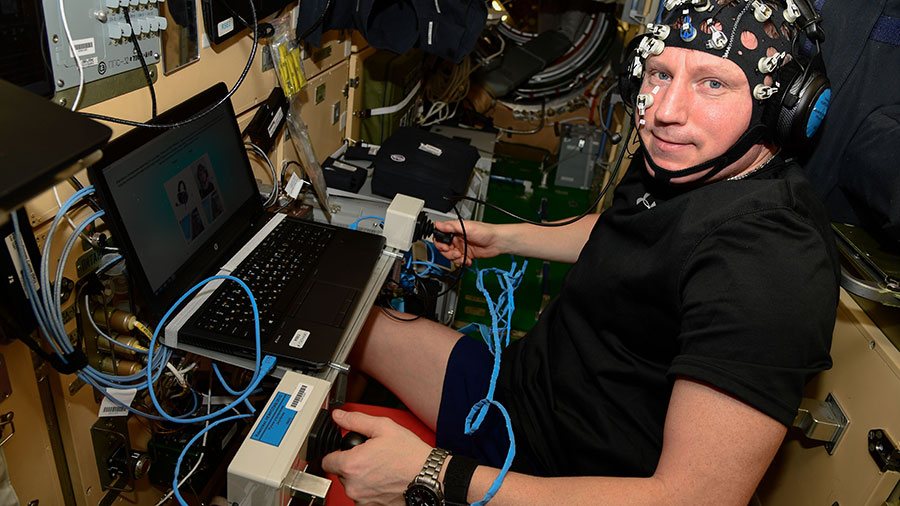
Commander Sergey Prokopyev wears a head cap with sensors and practices potential piloting techniques for futuristic planetary missions.
Two Expedition 68 astronauts continue gearing up for a spacewalk scheduled for Thursday at the International Space Station. The orbital residents also kept up a host of research activities as they serviced science gear, studied human research, and explored future technologies.
The next spacewalk is scheduled to begin at 8:15 a.m. EST on Thursday to continue upgrading the space station’s power generation system. Flight Engineers Nicole Mann of NASA and Koichi Wakata of the Japan Aerospace Exploration Agency (JAXA) will spend about seven hours in the vacuum of space completing the hardware installation job that they began on Jan. 20 during their first spacewalk. NASA TV, on the agency’s app and website, will begin live spacewalk coverage at 6:45 a.m.
Mann and Wakata started Tuesday morning organizing their tools, tethers, and other spacewalking components inside the Quest airlock ahead of Thursday’s excursion. Afterward, the duo split up as Mann worked in the Columbus laboratory module and cleaned up the BioLab facility that enables research into microbes, cells, tissue cultures, and small invertebrates. Wakata later took a robotics test on a computer measuring his performance, behavior, and cognition while living in space.
NASA Flight Engineers Josh Cassada and Frank Rubio worked throughout the day maintaining physics and biology hardware. Cassada installed the BioFabrication Facility in the Columbus lab that will be used to investigate manufacturing human organs in microgravity. Rubio worked in the Kibo laboratory module cleaning up the Life Science Glovebox following several days of advanced bone healing studies last week.
Two cosmonauts took turns today studying how future space crews might pilot spacecraft or robots on potential planetary missions. Roscosmos Commander Sergey Prokopyev and Flight Engineer Anna Kikina both wore a helmet with electrodes attached and simulated piloting techniques, such as docking a spaceship or commanding a robot on a planetary surface, on a computer.
Flight Engineer Dmitri Petelin spent his morning investigating fluids exposed to magnetic and electric fields in microgravity. During the afternoon, he moved on to orbital lab maintenance and worked on an oxygen generator before servicing water and drainage valves.
The remotely-controlled Canadarm2 robotic arm jettisoned flight support equipment during the day that was delivered aboard the SpaceX Dragon cargo ship on Nov. 27, 2022, toward Earth’s atmosphere. The flight hardware secured a pair of roll-out solar arrays inside Dragon’s trunk during its ascent to orbit and rendezvous with the space station. The jettisoned support equipment drifted safely away from the station and will eventually harmlessly burn up in the atmosphere with no chance for recontacting the space station.
Crew Gets Ready for Thursday Spacewalk, Keeps Up Space Research
Astronaut Nicole Mann is pictured during her first spacewalk on Jan. 20, 2023, to prepare the orbiting lab for its next roll-out solar array.
The Expedition 68 crew kicked off Monday preparing for a spacewalk to upgrade the International Space Station’s power generation system on Thursday. The orbital residents also researched a variety of space phenomena and packed a cargo craft ahead of its upcoming departure.
Astronauts Nicole Mann of NASA and Koichi Wakata of the Japan Aerospace Exploration Agency (JAXA) began their day reviewing procedures for a spacewalk set to begin at 8:15 a.m. EST on Thursday. The duo will spend about seven hours completing the installation of hardware to ready the space station for its next roll-out solar array on the starboard truss structure. This will be their second spacewalk together and they will finish the external installation job they began on Jan. 20.
NASA Flight Engineers Josh Cassada and Frank Rubio joined Mann and Wakata during Monday afternoon for a conference with spacewalk specialists on the ground at Mission Control in Houston. Cassada and Rubio will assist the spacewalkers in and out of their Extravehicular Mobility Units (EMUs), or spacesuits, and monitor the excursion from inside the orbiting lab.
Commander Sergey Prokopyev is packing the ISS Progress 81 cargo craft with trash ahead of its departure on Feb. 6 after nearly eight-and-a-half months docked to the Zvezda service module. A new cargo craft will replenish the Expedition 68 crew and dock on Feb. 11 to the same port vacated by the Progress 81.
Roscosmos Flight Engineers Dmitri Petelin and Anna Kikina spent Monday on human research activities and a station photography session. Petelin wore a helmet packed with sensors measuring his reactions as he simulated spacecraft and robotic piloting techniques on a computer for future planetary missions. Kikina first photographed the external condition of the Nauka and Zvezda modules before moving on and studying ways to improve communications with international crews and ground controllers.