Expedition 71 Prepares to Welcome Boeing’s Starliner Crew

Expedition 71 Prepares to Welcome Boeing’s Starliner Crew

Boeing's Starliner spacecraft sits atop the United Launch Alliance Atlas V rocket at Cape Canaveral Space Force Station in Florida.
Boeing’s Starliner spacecraft sits atop the United Launch Alliance Atlas V rocket at Cape Canaveral Space Force Station in Florida.

It was a light duty day aboard the International Space Station for four Expedition 71 astronauts as they await the launch and arrival of Boeing’s Crew Flight Test. The orbital outpost’s three cosmonauts had their day full as they kept up lab maintenance and researched a variety of microgravity phenomena.

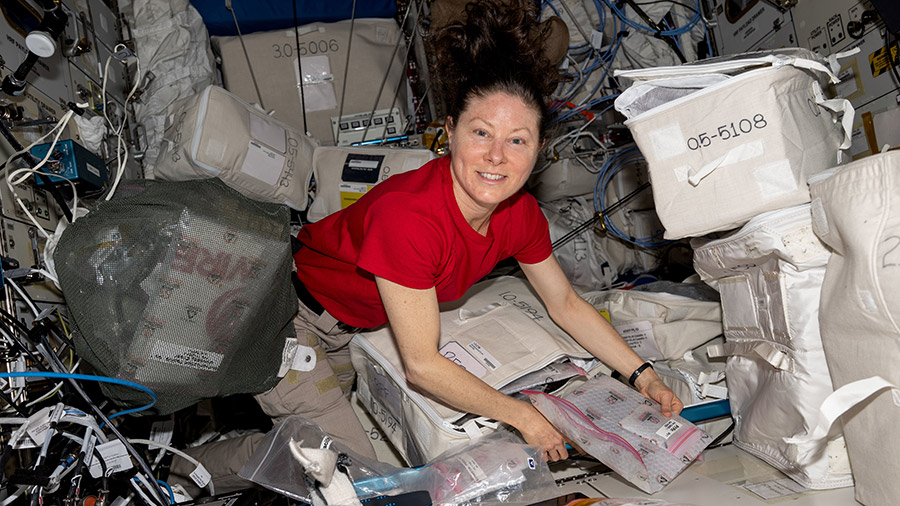
NASA Flight Engineers Tracy C. Dyson and Mike Barratt kicked off Monday morning with a series of biomedical tests to help doctors understand how living in space affects the human body. Dyson first collected her saliva samples then stowed them in a science freezer for later analysis. Afterward, she drew her blood then processed those samples with assistance from Barratt before spinning them in a centrifuge then stowing them in a science freezer.

Next, Barratt joined NASA Flight Engineer Matthew Dominick and set up in-ear sensors that will monitor an astronaut’s sleep patterns in space. Researchers will record the data and compare it to a crew member’s sleep patterns on Earth before and after a space mission. The Sleep in Orbit investigation will help doctors learn how sleep differs on and off the Earth and promote an astronaut’s cognitive well-being.

All three astronauts then joined NASA Flight Engineer Jeanette Epps, who had the entire day off, and relaxed the rest of their shift while also conducting in their daily exercise sessions.

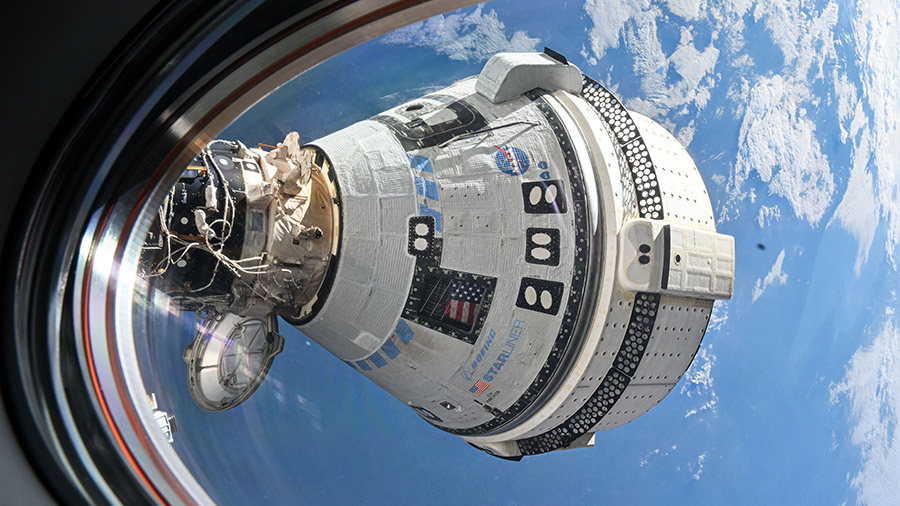
The quartet will work half-a-day on Tuesday then go to bed early and get a good night’s sleep before the arrival of Boeing’s Starliner spacecraft carrying NASA astronauts Butch Wilmore and Suni Williams. The Commercial Crew duo is scheduled to launch aboard Starliner atop United Launch Alliance’s Atlas V rocket at 10:34 p.m. EDT today from Florida. Starliner is due to dock to the orbital lab’s forward port on the Harmony module at 12:46 a.m. on Wednesday. Watch live on the NASA+ streaming service via the web or the NASA app. Mission coverage also will air live on NASA Television,  YouTube, and on the agency’s website. Learn how to stream NASA TV through a variety of platforms including social media.

Roscosmos’ three cosmonauts Oleg Kononenko, Nikolai Chub, and Alexander Grebenkin had a full day on Monday tending to ongoing research and ensuring the upkeep of the space station. Kononenko spent his shift servicing life support gear and science hardware. Chub cleaned airducts in the Nauka science module then photographed the condition of windows in the Zvezda service module. Grebenkin worked throughout the day on orbital plumbing duties and computer maintenance while also studying how international crews and controllers con improve communications.


Learn more about station activities by following the space station blog@space_station and @ISS_Research on X, as well as the ISS Facebook and ISS Instagram accounts.

Get weekly video highlights at: https://roundupreads.jsc.nasa.gov/videoupdate/

Get the latest from NASA delivered every week. Subscribe here: www.nasa.gov/subscribe

Powered by WPeMatico

Get The Details…

Mark Garcia

Weather 95% ‘Go’ for NASA’s Boeing Crew Flight Test

Weather 95% ‘Go’ for NASA’s Boeing Crew Flight Test

NASA astronauts Butch Wilmore and Suni Williams stand in front of a red convertible with the ULA Atlas V rocket and Boeing Starliner spacecraft on the launch pad in the background
NASA astronauts Butch Wilmore and Suni Williams pose for a picture after a United Launch Alliance Atlas V rocket with Boeing’s CST-100 Starliner spacecraft aboard was rolled out of the Vertical Integration Facility to the launch pad at Space Launch Complex 41 ahead of the NASA’s Boeing Crew Flight Test, Saturday, May 4, 2024 at Cape Canaveral Space Force Station in Florida. Photo Credit: (NASA/Joel Kowsky)

Weather is looking promising for NASA’s Boeing Crew Flight Test to send two of the agency’s astronauts to the International Space Station. Launch weather officers with the U.S. Space Force’s 45th Weather Squadron predict a 95% chance of favorable weather conditions at the launch pad for a liftoff, scheduled for 10:34 p.m. EDT.

Boeing’s Starliner spacecraft, carrying NASA astronauts Butch Wilmore, commander, and Suni Williams, pilot, on a United Launch Alliance Atlas V rocket will launch from Space Launch Complex-41 at Cape Canaveral Space Force Station in Florida.

The Starliner spacecraft, named Calypso, can fly autonomously or be steered manually and is expected to rendezvous and dock with the space station on Wednesday, May 8. Wilmore and Williams will spend about a week at the orbiting laboratory before the crew capsule makes a parachute and airbag-assisted landing in the southwestern United States.

Once the flight test is complete, NASA will begin the final process of certifying Starliner and its systems for crewed rotation missions to the space station as part of the agency’s Commercial Crew Program.

NASA’s mission coverage begins at 6:30 p.m. on NASA+, NASA Television, the NASA app, YouTube, and the agency’s website. Learn how to stream NASA TV through a variety of platforms including social media.

Learn more about NASA’s Boeing Crew Flight Test by following the mission blog, the commercial crew blog, @commercial_crew on X, and commercial crew on Facebook.

Powered by WPeMatico

Get The Details…

Patti Bielling

Return of the GEDI: Space Station Instrument Returns to Forest Monitoring

Return of the GEDI: Space Station Instrument Returns to Forest Monitoring

That’s no moon, that’s a space station!

The return of NASA’s GEDI (Global Ecosystem Dynamics Investigation) is underway, as the agency’s very own “lightsaber” will soon be back to measuring forests in three dimensions after it was reinstalled on the International Space Station April 22.

Measuring distances with similar principles as sonar, a lidar instrument uses light instead of sound. Rather than working on a forest moon in a galaxy far, far away, the instrument works much closer to home: measuring Earth’s forest structure including the height of the canopy, density of vegetation, and the distribution of branches and leaves.

As an instrument of the light side, GEDI is readying for its second mission aboard the space station.

After completing its extended mission in March 2023, a robotic arm was used to move GEDI temporarily to an exterior storage site on the space station for hibernation. Soon after reinstallation, teams began testing it for any forms of hibernation sickness and expect it will begin gathering data again this summer.

The force is strong with this one

Scientists used GEDI data to map Earth’s biomass and track how forests respond to climate change and land use impacts. Data from GEDI has helped to measure the height of forests across the globe in greater detail than ever before, and also to quantify the impact of protected areas on carbon sequestration.

Learn more about NASA’s GEDI master: https://nasa.gov/GEDI

Powered by WPeMatico

Get The Details…

Sarah Loff

NASA Astronaut Continues Legacy of Discovery, Adventure with Starliner Calypso

NASA Astronaut Continues Legacy of Discovery, Adventure with Starliner Calypso

From left to right, NASA astronauts Suni Williams and Butch Wilmore pose in front of Boeing’s Starliner spacecraft in the early morning of Tuesday, April 16, 2024, outside the company’s Commercial Crew and Cargo Processing Facility at the agency’s Kennedy Space Center in Florida.
From left to right, NASA astronauts Suni Williams and Butch Wilmore pose in front of Boeing’s Starliner spacecraft in the early morning of Tuesday, April 16, 2024, outside the company’s Commercial Crew and Cargo Processing Facility at the agency’s Kennedy Space Center in Florida. The spacecraft will take the astronauts to the International Space Station as part of the agency’s Boeing Crew Flight Test no earlier than Monday, May 6, 2024. Photo credit: NASA/Kim Shiflett

NASA astronauts Butch Wilmore and Suni Williams will be the first to fly aboard Boeing’s Starliner spacecraft to the International Space Station, and the name of the spacecraft ferrying them to the orbiting laboratory holds a special place in Williams’ heart.

Williams named the crew capsule Calypso in 2019 to pay tribute to the explorer Jacques Cousteau, who sailed across the world on his own ship named bearing the same name. Cousteau’s goal was to learn about the ocean and teach others about the wonders of the sea. Williams believes Starliner can do the same for space.

The Starliner spacecraft, with a diameter of 15 feet (4.56 meters), can carry up to four astronauts, or a mix of crew and cargo, for NASA missions to low Earth orbit for the agency’s Commercial Crew Program.

The spacecraft, on a United Launch Alliance Atlas V rocket, is scheduled for liftoff at 10:34 p.m. EDT Monday, May 6, from Space Launch Complex-41 at Cape Canaveral Space Force Station in Florida.

Powered by WPeMatico

Get The Details…

Elyna Niles-Carnes

NASA’s Boeing Crew Flight Test Rolls to Pad

NASA’s Boeing Crew Flight Test Rolls to Pad

Boeing’s Starliner spacecraft atop the United Launch Alliance Atlas V rocket is seen on the launch pad of Space Launch Complex-41 at Cape Canaveral Space Force Station in Florida on Saturday, May 4, 2024, ahead of NASA’s Boeing Crew Flight Test. Liftoff is scheduled for 10:34 p.m. ET Monday, May 6. Photo credit: NASA/Joel Kowsky

NASA’s Boeing Crew Flight Test mission to send two of the agency’s astronauts to the International Space Station is in the final stages of prelaunch operations. 

Boeing’s Starliner spacecraft, stacked on a ULA (United Launch Alliance) Atlas V rocket, rolled from ULA’s Vertical Integration Facility to the launch pad at Space Launch Complex-41 at Cape Canaveral Space Force Station on May 4, in preparation for launch. 

The 45th Weather Squadron predicts a 95% chance of favorable weather conditions for launch, with the cumulus cloud rule being the primary weather concern.  

Boeing’s Starliner spacecraft atop the United Launch Alliance Atlas V rocket is seen on the launch pad of Space Launch Complex-41 at Cape Canaveral Space Force Station in Florida on Saturday, May 4, 2024, ahead of NASA’s Boeing Crew Flight Test. 

NASA astronauts Butch Wilmore and Suni Williams are the first to launch aboard Starliner to the International Space Station as part of the agency’s Commercial Crew Program. Liftoff is scheduled for 10:34 p.m. EDT Monday, May 6. The astronauts will spend about a week at the orbiting laboratory before returning to Earth and making a parachute and airbag-assisted landing in the southwestern United States. 

After successful completion of the mission, NASA will begin the final process of certifying Starliner and its systems for crewed rotation missions to the space station. The Starliner capsule, with a diameter of 15 feet (4.56m) and the capability to steer automatically or manually, will carry four astronauts, or a mix of crew and cargo, for NASA missions to low Earth orbit. 

NASA will provide live coverage of the launch, beginning at 6:30 p.m. on May 6, on NASA+, NASA Television, the NASA app, YouTube, and the agency’s website. Learn how to stream NASA TV through a variety of platforms including social media. 

Learn more about NASA’s Boeing Crew Flight Test by following the mission blog, the commercial crew blog, @commercial_crew on X, and commercial crew on Facebook.  

Powered by WPeMatico

Get The Details…

Elyna Niles-Carnes