Carbon Nanotubes and the Search for Life on Other Planets

Carbon Nanotubes and the Search for Life on Other Planets

A NASA-developed material made of carbon nanotubes will enable our search for exoplanets—some of which might be capable of supporting life. Originally developed in 2007 by a team of researchers led by Innovators of the Year John Hagopian and Stephanie Getty at NASA’s Goddard Space Flight Center, this carbon nanotube technology is being refined for potential use on NASA’s upcoming Habitable Worlds Observatory (HWO)—the first telescope designed specifically to search for signs of life on planets orbiting other stars.

As shown in the figure below, carbon nanotubes look like graphene (a single layer of carbon atoms arranged in a hexagonal lattice) that is rolled into a tube. The super-dark material consists of multiwalled carbon nanotubes (i.e., nested nanotubes) that grow vertically into a “forest.” The carbon nanotubes are 99% empty space so the light entering the material doesn’t get reflected. Instead, the light enters the nanotube forest and jiggles electrons in the hexagonal lattice of carbon atoms, converting the light to heat. The ability of the carbon nanotubes to eliminate almost all light is enabling for NASA’s scientific instruments because stray light limits how sensitive the observations can be. When applied to instrument structures, this material can eliminate much of the stray light and enable new and better observations.
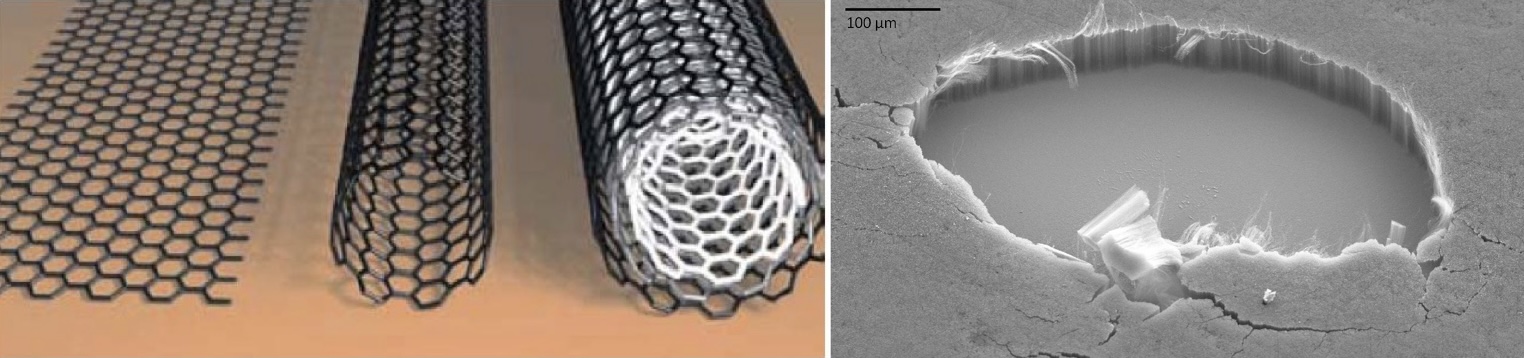
Left; Images of graphene, which is a flat hexagonal array of carbon atoms, including single walled nanotubes which look like rolled up graphene and multiwalled carbon nanotubes which look like nested tubes Right; a carbon nanotube forest which has a section cut out of it revealing vertically aligned tubes
Left: Artist’s conception of graphene, single and multiwalled carbon nanotube structures. Right: Scanning electron microscope image of vertically aligned multiwalled carbon nanotube forest with a section removed in the center.
Credit: Delft University/Dr. Sten Vollebregt and NASA GSFC

Viewing exoplanets is incredibly difficult; the exoplanets revolve around stars that are 10 billion times brighter than they are. It’s like looking at the Sun and trying to see a dim star next to it in the daytime. Specialized instruments called coronagraphs must be used to block the light from the star to enable these exoplanets to be viewed. The carbon nanotube material is employed in the coronagraph to block as much stray light as possible from entering the instrument’s detector.

The image below depicts a notional telescope and coronagraph imaging an exoplanet. The telescope collects the light from the distant star and exoplanet. The light is then directed to a coronagraph that collimates the beam, making the light rays parallel, and then the beam is reflected off the apodizer mirror, which is used to precisely control the diffraction of light.  Carbon nanotubes on the apodizer mirror absorb the stray light that is diffracted off edges of the telescope structures, so it does not contaminate the observations.  The light is then focused on the focal plane mask, which blocks the light from the star but allows light from the exoplanet to pass.  The light gets collimated again and is then reflected off a deformable mirror to correct distortion in the image.  Finally, the light passes through the Lyot Stop, which is also coated with carbon nanotubes to remove the remaining stray light.  The beam is then focused onto the detector array, which forms the image. 

Even with all these measures some stray light still reaches the detector, but the coronagraph creates a dark zone where only the light coming from the exoplanet can be seen. The final image on the right in the figure below shows the remaining light from the star in yellow and the light from the exoplanet in red in the dark zone.
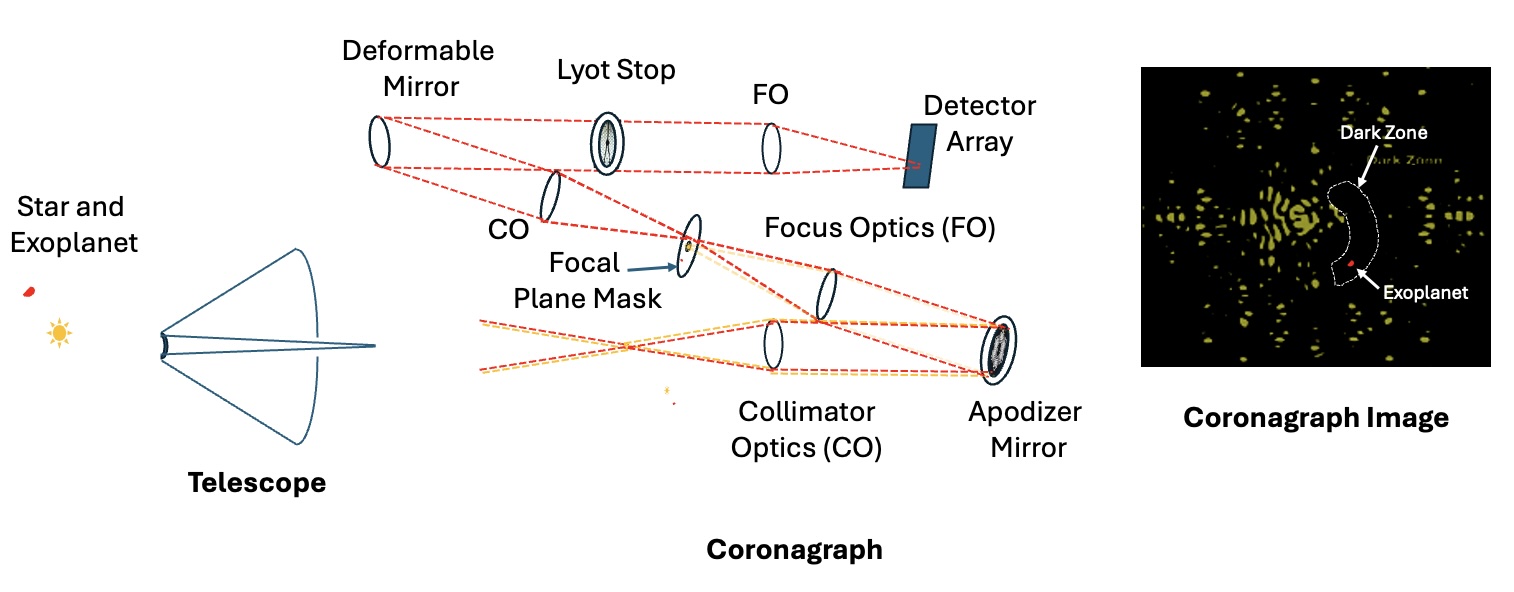
Schematic of a notional telescope and coronagraph imaging an exoplanet
Credit: Advanced Nanophotonics/John Hagopian, LLC

HWO will use a similar scheme to search for habitable exoplanets. Scientists will analyze the spectrum of light captured by HWO to determine the gases in the atmosphere of the exoplanet. The presence of water vapor, oxygen, and perhaps other gases can indicate if an exoplanet could potentially support life.

But how do you make a carbon-nanotube-coated apodizer mirror that could be used on the HWO? Hagopian’s company Advanced Nanophotonics, LLC received Small Business Innovation Research (SBIR) funding to address this challenge.

Carbon nanotubes are grown by depositing catalyst seeds onto a substrate and then placing the substrate into a tube-shaped furnace and heating it to 1382 degrees F, which is red hot! Gases containing carbon are then flowed into the heated tube, and at these temperatures the gases are absorbed by the metal catalyst and transform into a solution, similar to how carbon dioxide in soda water fizzes. The carbon nanotubes literally grow out of the substrate into vertically aligned tubes to form a “forest” wherever the catalyst is located.

Since the growth of carbon nanotubes on the apodizer mirror must occur only in designated areas where stray light is predicted, the catalyst must be applied only to those areas. The four main challenges that had to be overcome to develop this process were: 1) how to pattern the catalyst precisely, 2) how to get a mirror to survive high temperatures without distorting, 3) how to get a coating to survive high temperatures and still be shiny, and 4) how to get the carbon nanotubes to grow on top of a shiny coating. The Advanced Nanophotonics team refined a multi-step process (see figure below) to address these challenges.
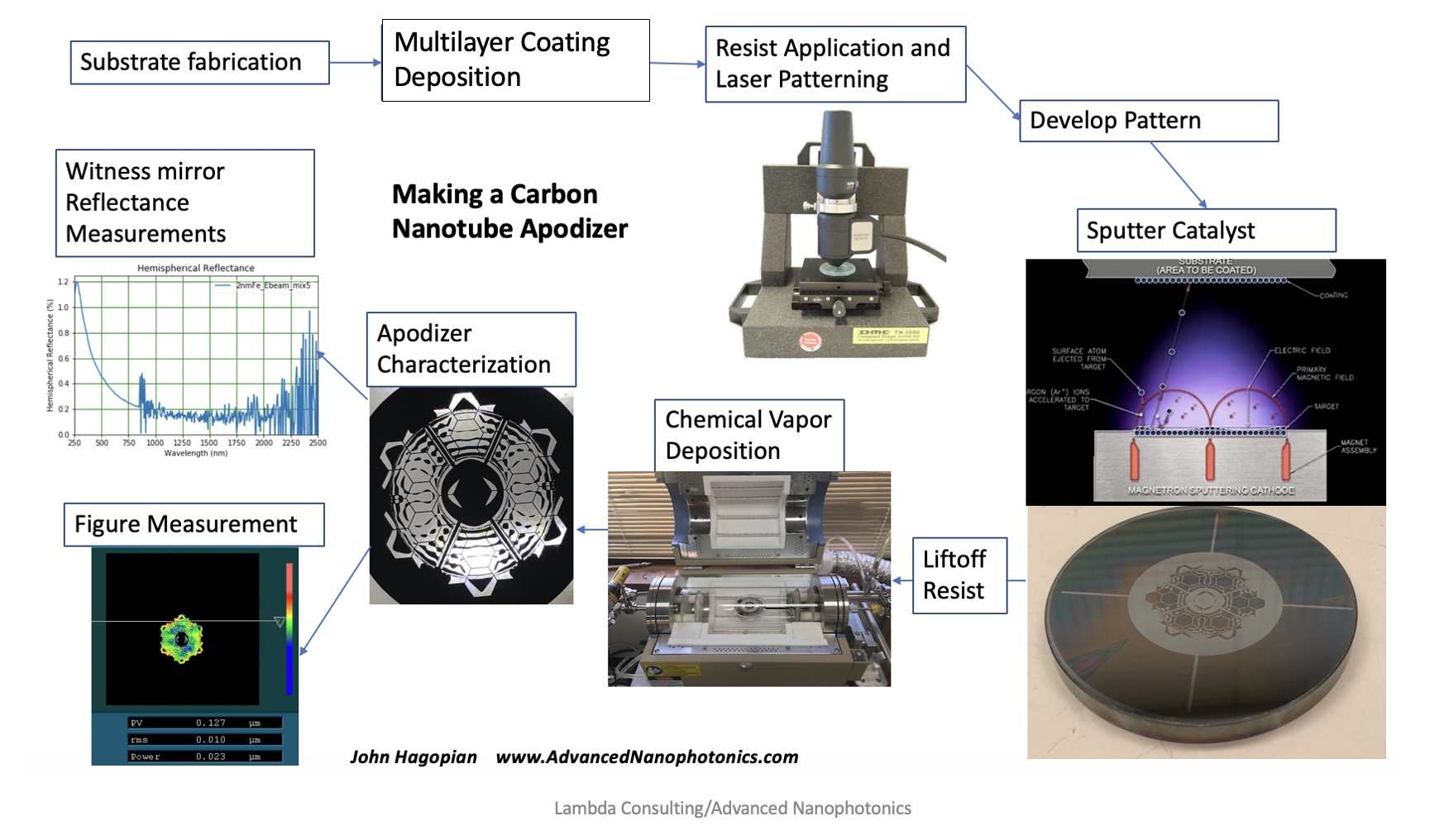
Making an Apodizer Mirror for use in a coronagraph
Credit: Advanced Nanophotonics/John Hagopian, LLC

First a silicon mirror substrate is fabricated to serve as the base for the mirror. This material has properties that allow it to survive very high temperatures and remain flat. These 2-inch mirrors are so flat that if one was scaled to the diameter of Earth, the highest mountain would only be 2.5 inches tall!

Next, the mirror is coated with multiple layers of dielectric and metal, which are deposited by knocking atoms off a target and onto the mirror in a process called sputtering. This coating must be reflective to direct the desired photons, but still be able to survive in the hot environment with corrosive gases that is required to grow carbon nanotubes.

Then a material called resist that is sensitive to light is applied to the mirror and a pattern is created in the resist with a laser. The image on the mirror is chemically developed to remove the resist only in the areas illuminated by the laser, creating a pattern where the mirror’s reflecting surface is exposed only where nanotube growth is desired.

The catalyst is then deposited over the entire mirror surface using sputtering to provide the seeds for carbon nanotube growth. A process called liftoff is used to remove the catalyst and the resist that are located where nanotubes growth is not needed. The mirror is then put in a tube furnace and heated to 1380 degrees Fahrenheit while argon, hydrogen, and ethylene gases are flowed through the tube, which allows the chemical vapor deposition of carbon nanotubes where the catalyst has been patterned. The apodizer mirror is cooled and removed from the tube furnace and characterized to make sure it is still flat, reflective where desired, and very black everywhere else.

The Habitable Worlds Observatory will need a coronagraph with an optimized apodizer mirror to effectively view exoplanets and gather their light for evaluation. To make sure NASA has the best chance to succeed in this search for life, the mirror design and nanotube technology are being refined in test beds across the country.

Under the SBIR program, Advanced Nanophotonics, LLC has delivered apodizers and other coronagraph components to researchers including Remi Soummer at the Space Telescope Science Institute, Eduardo Bendek and Rus Belikov at NASA Ames, Tyler Groff at NASA Goddard, and Arielle Bertrou-Cantou and Dmitri Mawet at the California Institute of Technology. These researchers are testing these components and the results of these studies will inform new designs to eventually enable the goal of a telescope with a contrast ratio of 10 billion to 1.
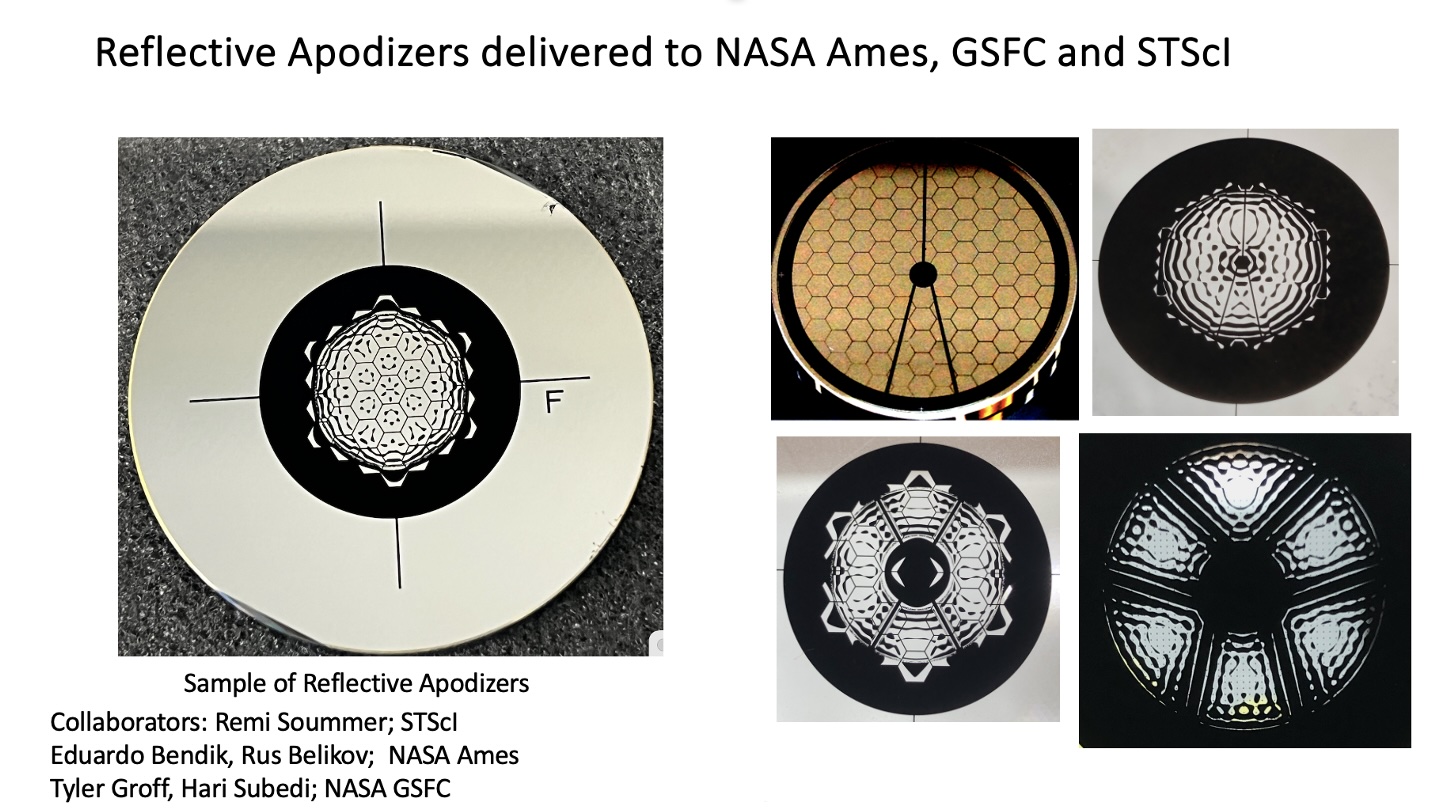
Cool images of a variety of carbon nanotube patterned apodizer mirrors
Reflective Apodizers delivered to Scientists across the country
Credit: Advanced Nanophotonics/John Hagopian, LLC

In addition, although the desired contrast ratio cannot be achieved using telescopes on Earth, testing apodizer mirror designs on ground-based telescopes not only facilitates technology development, but helps determine the objects HWO might observe. Using funding from the SBIR program, Advanced Nanophotonics also developed transmissive apodizers for the University of Notre Dame to employ on another instrument—the Gemini Planet Imager (GPI) Upgrade. In this case the carbon nanotubes were patterned and grown on glass that transmits the light from the telescope into the coronagraph. The Gemini telescope is an 8.1-meter telescope located in Chile, high atop a mountain in thin air to allow for better viewing. Dr. Jeffrey Chilcote is leading the effort to upgrade the GPI and install the carbon nanotube patterned apodizers and Lyot Stops in the coronagraph to allow viewing of exoplanets starting next year. Discoveries enabled by GPI may also drive future apodizer designs.

More recently, the company was awarded a Phase II SBIR contract to develop next-generation apodizers and other carbon nanotube-based components for the test beds of existing collaborators and new partners at the University of Arizona and the University of California Santa Clara.
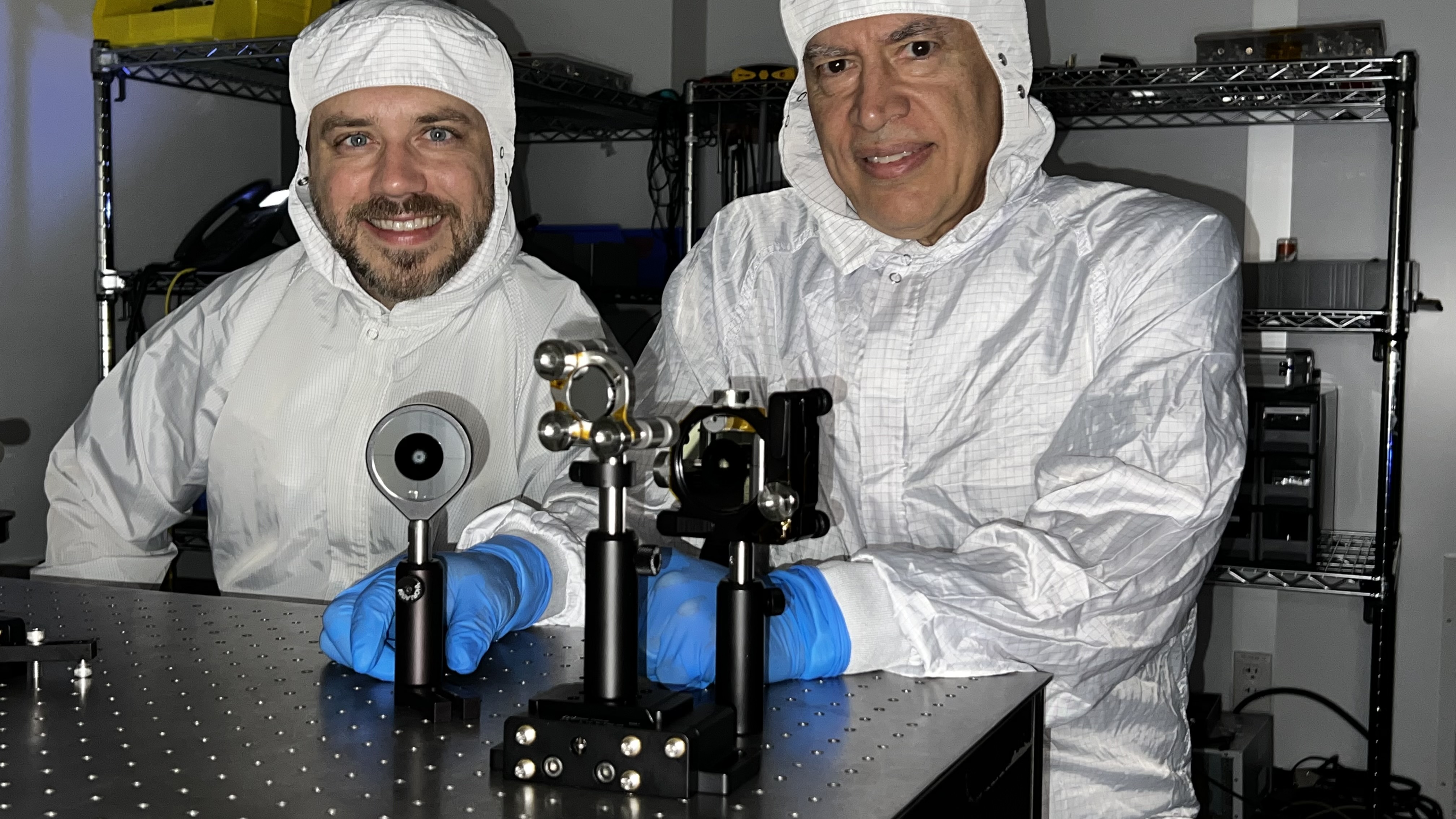
Tyler Groff (left) and John Hagopian (right) display a carbon nanotube patterned apodizer mirror used in the NASA Goddard Space Flight Center coronagraph test bed.
Credit: Advanced Nanophotonics/John Hagopian, LLC

As a result of this SBIR-funded technology effort, Advanced Nanophotonics has collaborated with NASA Scientists to develop a variety of other applications for this nanotube technology.

A special carbon nanotube coating developed by Advanced Nanophotonics was used on the recently launched NASA Ocean Color Instrument onboard the Plankton, Aerosol, Cloud, ocean Ecosystem (PACE) mission that is observing both the atmosphere and phytoplankton in the ocean, which are key to the health of our planet. A carbon nanotube coating that is only a quarter of the thickness of a human hair was applied around the entrance slit of the instrument. This coating absorbs 99.5% of light in the visible to infrared and prevents stray light from reflecting into the instrument to enable more accurate measurements. Hagopian’s team is also collaborating with the Laser Interferometer Space Antenna (LISA) team to apply the technology to mitigate stray light in the European Space Agency’s space-based gravity wave mission.

They are also working to develop carbon nanotubes for use as electron beam emitters for a project sponsored by the NASA Planetary Instrument Concepts for the Advancement of Solar System Observations (PICASSO) Program. Led by Lucy Lim at NASA Goddard, this project aims to develop an instrument to probe asteroid and comet constituents in space.

In addition, Advanced Nanophotonics worked with researcher Larry Hess at NASA Goddard’s Detector Systems Branch and Jing Li at the NASA Ames Research Center to develop a breathalyzer to screen for Covid-19 using carbon nanotube technology. The electron mobility in a carbon nanotube network enables high sensitivity to gases in exhaled breath that are associated with disease.

This carbon nanotube-based technology is paying dividends both in space, as we continue our search for life, and here on Earth.

For additional details, see the entry for this project on NASA TechPort.

PROJECT LEAD

John Hagopian (Advanced Nanophotonics, LLC)

SPONSORING ORGANIZATION

SMD-funded SBIR project

Share

Details

Last Updated
Sep 03, 2024

Powered by WPeMatico
Get The Details…

NASA Sets Coverage for Starliner News Conference, Return to Earth

NASA Sets Coverage for Starliner News Conference, Return to Earth

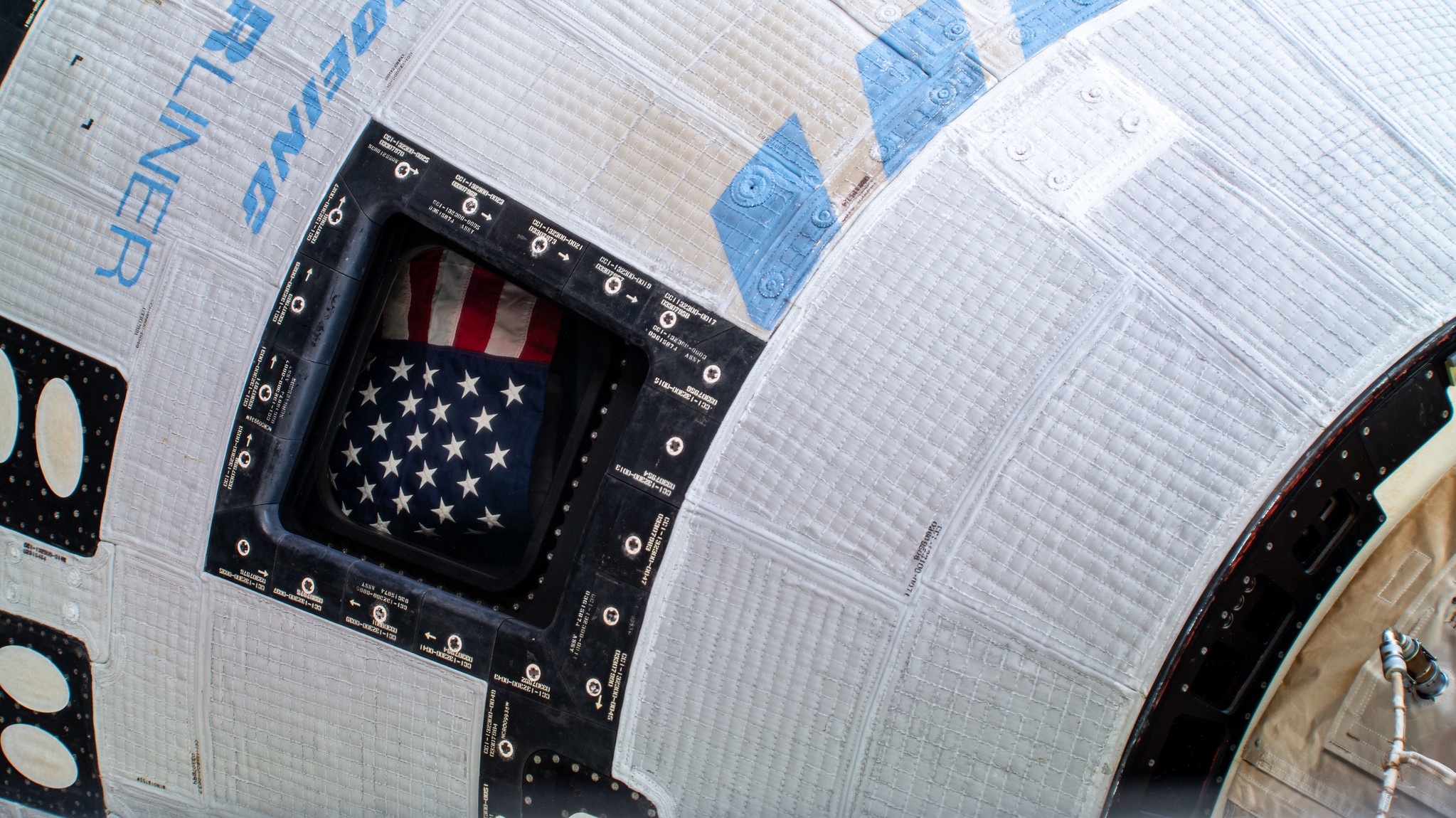
A picture of the American flag inside the window of Boeing's Starliner spacecraft at the International Space Station.
The American flag pictured inside the window of Boeing’s Starliner spacecraft at the International Space Station.
Credit: NASA

NASA will provide live coverage of the upcoming activities for Boeing’s Starliner spacecraft departure from the International Space Station and return to Earth. The uncrewed spacecraft will depart from the orbiting laboratory for a landing at White Sands Space Harbor in New Mexico.

Starliner is scheduled to autonomously undock from the space station at approximately 6:04 p.m. EDT Friday, Sept. 6, to begin the journey home, weather conditions permitting. NASA and Boeing are targeting approximately 12:03 a.m., Saturday, Sept. 7, for the landing and conclusion of the flight test.

NASA’s live coverage of return and related activities will stream on NASA+, the NASA app, and the agency’s website. Learn how to stream NASA programming through a variety of platforms including social media.

Ahead of Starliner’s return, NASA will host a pre-departure news conference at 12 p.m., Wednesday, Sept. 4, from the agency’s Johnson Space Center in Houston. NASA’s Commercial Crew and International Space Station Program managers and a flight director will participate.

To attend the pre-departure news conference in person, U.S. media must contact the NASA Johnson newsroom by 5 p.m., Tuesday, Sept. 3, at jsccommu@mail.nasa.gov or 281-483-5111. To join the pre-departure news conference by phone, media must contact the NASA newsroom no later than two hours prior to the start of the call.

NASA astronauts Butch Wilmore and Suni Williams launched aboard Boeing’s Starliner spacecraft on June 5 for its first crewed flight, arriving at the space station on June 6. As Starliner approached the orbiting laboratory, NASA and Boeing identified helium leaks and experienced issues with the spacecraft reaction control thrusters. For the safety of the astronauts, NASA announced on Aug. 24 that Starliner will return to Earth from the station without a crew. Wilmore and Williams will remain aboard the station and return home in February 2025 aboard the SpaceX Dragon spacecraft with two other crew members assigned to NASA’s SpaceX Crew-9 mission.

NASA’s coverage is as follows (all times Eastern and subject to change based on real-time operations):

Wednesday, Sept. 4

12 p.m. – Starliner pre-departure news conference from NASA’s Johnson Space Center on NASA+, the NASA app, YouTube, and the agency’s website.

Friday, Sept. 6

5:45 p.m. – Undocking coverage begins on NASA+, the NASA app, YouTube, and the agency’s website.

6:04 p.m. – Undocking

10:50 p.m. – Coverage resumes for deorbit burn, entry, and landing on NASA+, the NASA app, YouTube, and the agency’s website.

Saturday, Sept. 7

12:03 a.m. – Targeted landing

1:30 a.m. – Post-landing news conference with the following participants:

  • Joel Montalbano, deputy associate administrator, Space Operations Mission Directorate at NASA Headquarters in Washington
  • Steve Stich, manager, Commercial Crew Program, NASA Kennedy Space Center in Florida
  • Dana Weigel, manager, International Space Station, NASA Johnson
  • John Shannon, vice president, Boeing Exploration Systems
  • Mark Nappi, vice president and program manager, Boeing Commercial Crew Program

Coverage of the post-landing news conference will stream live on NASA+, the NASA app, YouTube, and the agency’s website.

To attend the post-landing news conference in person, U.S. media must contact the NASA Johnson newsroom by 12 p.m., Sept. 6. To join the post-landing news conference by phone, media must contact the NASA Johnson newsroom no later than one hour prior to the start of the event.

See full mission coverage, NASA’s commercial crew blog, and more information about the mission at:

https://www.nasa.gov/commercialcrew

-end-

Joshua Finch / Jimi Russell
Headquarters, Washington
202-358-1100
joshua.a.finch@nasa.gov / james.j.russell@nasa.gov

Leah Cheshier
Johnson Space Center, Houston
281-483-5111
leah.d.cheshier@nasa.gov

Steve Siceloff
Kennedy Space Center, Florida
321-867-2468
steven.p.sieceloff@nasa.gov

Powered by WPeMatico

Get The Details…
Tiernan P. Doyle

Co-creating authentic STEM learning experiences with Latino communities

Co-creating authentic STEM learning experiences with Latino communities

2 min read

Co-creating authentic STEM learning experiences with Latino communities

Led by Arizona State University, the NASA Science Activation Program’s “Engaging Hispanic Communities in Authentic NASA Science” project advances NASA’s vision for science, technology, engineering, and mathematics (STEM) education by co-creating learning experiences with Latino communities in six locations in California, Arizona, New Mexico, and Texas. Partners at each site – including educational organizations, community groups, and subject matter experts – are collaborating to offer culturally sustaining learning experiences that reflect the people, priorities, and assets of each community.

In the San Francisco Bay area, the University of California Berkeley’s Lawrence Hall of Science is working with Bay Area Community Resources to offer hands-on Earth and space activities at hundreds of out-of-school-time programs. In San Diego, the Fleet Science Center and the San Ysidro STEM Committee are planning an annual STEM festival. In the Phoenix/Mesa metro area, Arizona State University and RAIL Community Development Corporation are working with community members and local artists to create STEAM (STEM + art) experiences that will be embedded in Hispanic neighborhoods. In Albuquerque, Explora and Horizons Albuquerque are hosting a teen summit to co-create a new futures-oriented exhibition for the science center. The Brownsville Children’s Museum in Texas is working with a variety of partners to engage families in STEM learning at community events across the area. Finally, in Houston, the Children’s Museum of Houston and Community Family Centers are offering STEM summer camp experiences in underserved Hispanic neighborhoods.

These activities have spanned across Spring and Summer 2024 and engaged over 10,000 learners in authentic STEM learning experiences. Looking ahead to the future, team members will continue to deepen their relationships among organizations and broaden participation across their local communities. The six sites also convene regularly as a community of practice, sharing insights, strategies, and practices. Learnings from the project and professional resources will also be shared widely across the STEM engagement and education professionals.

The Engaging Hispanic Communities in Authentic NASA Science project is supported by NASA under cooperative agreement award number 80NSSC22M0122 and is part of NASA’s Science Activation Portfolio. Learn more about how Science Activation connects NASA science experts, real content, and experiences with community leaders to do science in ways that activate minds and promote deeper understanding of our world and beyond: https://science.nasa.gov/learn

Educators and a family do a hands-on activity together at a science center.
Family doing a hands-on activity at a science center.
NISE Network/Guillermo Delgado

Share

Details

Last Updated
Aug 30, 2024
Editor
NASA Science Editorial Team

Powered by WPeMatico

Get The Details…

CORRECTION: NASA’s SpaceX Crew-9 Changes Ahead of September Launch

CORRECTION: NASA’s SpaceX Crew-9 Changes Ahead of September Launch

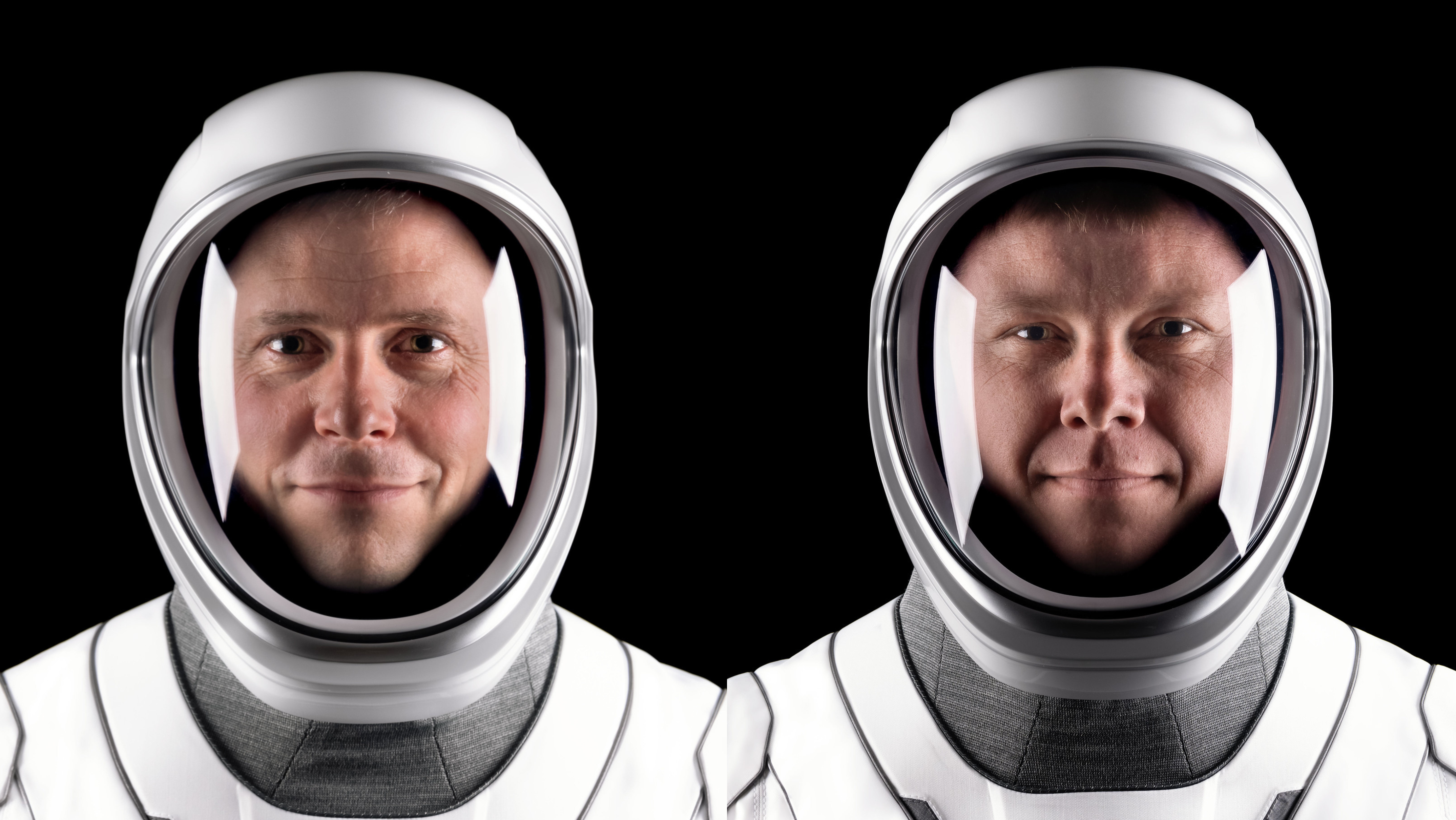
NASA astronaut Nick Hague and Roscosmos cosmonaut Aleksandr Gorbunov (Credit: NASA)

Editor’s note: This release was updated twice on Aug. 30, 2024. First, to correct Roscosmos cosmonaut Aleksandr Gorbunov’s role as a mission specialist. It was updated again to correct a launch date.

NASA astronaut Nick Hague and Roscosmos cosmonaut Aleksandr Gorbunov will launch no earlier than Tuesday, Sept. 24, on the agency’s SpaceX Crew-9 mission to the International Space Station. NASA astronauts Zena Cardman and Stephanie Wilson, previously announced as crewmates, are eligible for reassignment on a future mission. 

Hague and Gorbunov will fly to the space station as commander and mission specialist, respectively, as part of a two-crew member flight aboard a SpaceX Dragon.

The updated crew complement follows NASA’s decision to return the agency’s Boeing Crew Flight Test uncrewed and launch Crew-9 with two unoccupied seats. NASA astronauts Butch Wilmore and Suni Williams, who launched aboard the Starliner spacecraft in June, will fly home with Hague and Gorbunov in February 2025.

The decision to fly Hague was made by NASA chief astronaut Joe Acaba at the agency’s Johnson Space Center in Houston. Acaba had to balance flying a NASA crew member with previous spaceflight experience to command the flight, while ensuring NASA maintains an integrated crew with a Roscosmos cosmonaut who can operate their critical systems for continued, safe station operations.

“While we’ve changed crew before for a variety of reasons, downsizing crew for this flight was another tough decision to adjust to given that the crew has trained as a crew of four,” said Acaba. “I have the utmost confidence in all our crew, who have been excellent throughout training for the mission. Zena and Stephanie will continue to assist their crewmates ahead of launch, and they exemplify what it means to be a professional astronaut.”

The agency will share reassignment details for Cardman and Wilson when available.

“I am deeply proud of our entire crew,” said Cardman, “and I am confident Nick and Alex will step into their roles with excellence. All four of us remain dedicated to the success of this mission, and Stephanie and I look forward to flying when the time is right.” 

Wilson added, “I know Nick and Alex will do a great job with their work aboard the International Space Station as part of Expedition 72.”

With 203 days logged in space, this will be Hague’s third launch and second mission to the orbiting laboratory. During his first launch in October 2018, Hague and his crewmate, Roscosmos’ Alexey Ovchinin, experienced a rocket booster failure, resulting in an in-flight, post-launch abort, ballistic re-entry, and safe landing in their Soyuz MS-10 spacecraft. Five months later, Hague launched aboard Soyuz MS-12 and served as a flight engineer aboard the space station during Expeditions 59 and 60. Hague conducted three spacewalks to upgrade space station power systems and install a docking adapter for commercial spacecraft. An active-duty colonel in the U.S. Space Force, Hague completed a developmental rotation at the Defense Department, and served as the Space Force’s director of test and evaluation from 2020 to 2022. In August 2022, Hague resumed duties at NASA, working on the Boeing Starliner Program until this flight assignment. Follow @astrohague on X and Instagram.

This will be Gorbunov’s first trip to space and the station. Born in Zheleznogorsk, Kursk region, Russia, he studied engineering with qualifications in spacecraft and upper stages from the Moscow Aviation Institute. Gorbunov graduated from the military department with a specialty in operating and repairing aircraft, helicopters, and aircraft engines. Before his selection as a cosmonaut in 2018, he worked as an engineer for Rocket Space Corp. Energia and supported cargo spacecraft launches from the Baikonur Cosmodrome.

Hague and Gorbonov will become members of the Expedition 72 crew aboard the station. They will join Wilmore, Williams, fellow NASA astronaut Don Pettit, and Roscosmos cosmonauts Alexey Ovchinin and Ivan Vagner conducting scientific research and maintenance activities into the station’s 24th year of continuous human presence.

Learn more about International Space Station research and operations at:

https://www.nasa.gov/station

-end-

Josh Finch / Jimi Russell
Headquarters, Washington
202-358-1100
joshua.a.finch@nasa.gov / james.j.russell@nasa.gov

 Courtney Beasley
Johnson Space Center, Houston
281-483-5111
courtney.m.beasley@nasa.gov

Powered by WPeMatico

Get The Details…
Abbey A. Donaldson

Behind the Scenes at the 2024 Mars 2020 Science Team Meeting

Behind the Scenes at the 2024 Mars 2020 Science Team Meeting

3 min read

Behind the Scenes at the 2024 Mars 2020 Science Team Meeting

The Mars 2020 Perseverance Rover Science Team meets in person and online during the July 2024 team meeting in Pasadena, CA.
Credits: R. Hogg and J. Maki.

The Mars 2020 Science Team meets in Pasadena for 3 days of science synthesis

It has become a fun tradition for me to write a summary of our yearly in-person Science Team Meetings (2022 meeting and 2023 meeting). I’ve been particularly looking forward to this year’s update given the recent excitement on the team and in the public about Perseverance’s discovery of a potential biosignature, a feature that may have a biological origin but needs more data or further study before reaching a conclusion about the absence or presence of life.

This past July, ~160 members of the Mars 2020 Science Team met in-person in Pasadena—with another ~50 team members dialed in on-line—for three days of presentations, meetings, and team discussion. For a team that spends most of the year working remotely from around the world, we make the most of these rare opportunities for in-person discussion and synthesis of the rover’s latest science results.

We spent time discussing Perseverance’s most recent science campaign in the Margin unit, an exposure of carbonate-bearing rocks that occurs along the inner rim of Jezero crater. As part of an effort to synthesize what we’ve learned about the Margin unit over the past year, we heard presentations describing surface and subsurface observations collected from the rover’s entire payload. This was followed by a thought-provoking series of presentations that tackled the three hypotheses we’re carrying for the origin of this unit: sedimentary, volcanic (pyroclastic), or crystalline igneous.

Some of our liveliest discussion occurred during presentations about Neretva Vallis, Jezero’s inlet valley that once fed the sedimentary fan and lake system within the crater. Data from the RIMFAX instrument took center stage as we debated the origin and age relationship of the Bright Angel outcrop to other units we’ve studied in the crater.

This context is especially important because the Bright Angel outcrop is home to the Cheyava Falls rock, which contains intriguing features we’ve been calling “leopard spots,” small white spots with dark rims observed in red bedrock of Bright Angel. On the last day of the team meeting, data from our recent “Apollo Temple” abrasion at Cheyava Falls was just starting to arrive on Earth, and team members from the PIXL and SHERLOC teams were huddled in the hallway and at the back of the conference room trying to digest these new results in real time. We had special “pop-up” presentations during which SHERLOC reported compelling evidence for organics in the new abrasion, and PIXL showed interesting new data about the light-toned veins that crosscut this rock.

Between debates about the Margin unit, updates on recently published studies of the Jezero sedimentary fan sequence, and discussion of the newest rocks at Bright Angel, this team meeting was one of our most exciting yet. It also marked an important transition for the Mars 2020 science mission as we prepare to ascend the Jezero crater rim, leaving behind—at least for now—the rocks inside the crater. I can only imagine the interesting new discoveries we’ll make during the upcoming year, and I can’t wait to report back next summer!

Written by Katie Stack Morgan, Mars 2020 Deputy Project Scientist at NASA’s Jet Propulsion Laboratory

Share

Details

Last Updated
Aug 30, 2024

Related Terms

Powered by WPeMatico

Get The Details…