La NASA invita a creadores de las redes sociales al lanzamiento de la misión Europa Clipper

La NASA invita a creadores de las redes sociales al lanzamiento de la misión Europa Clipper
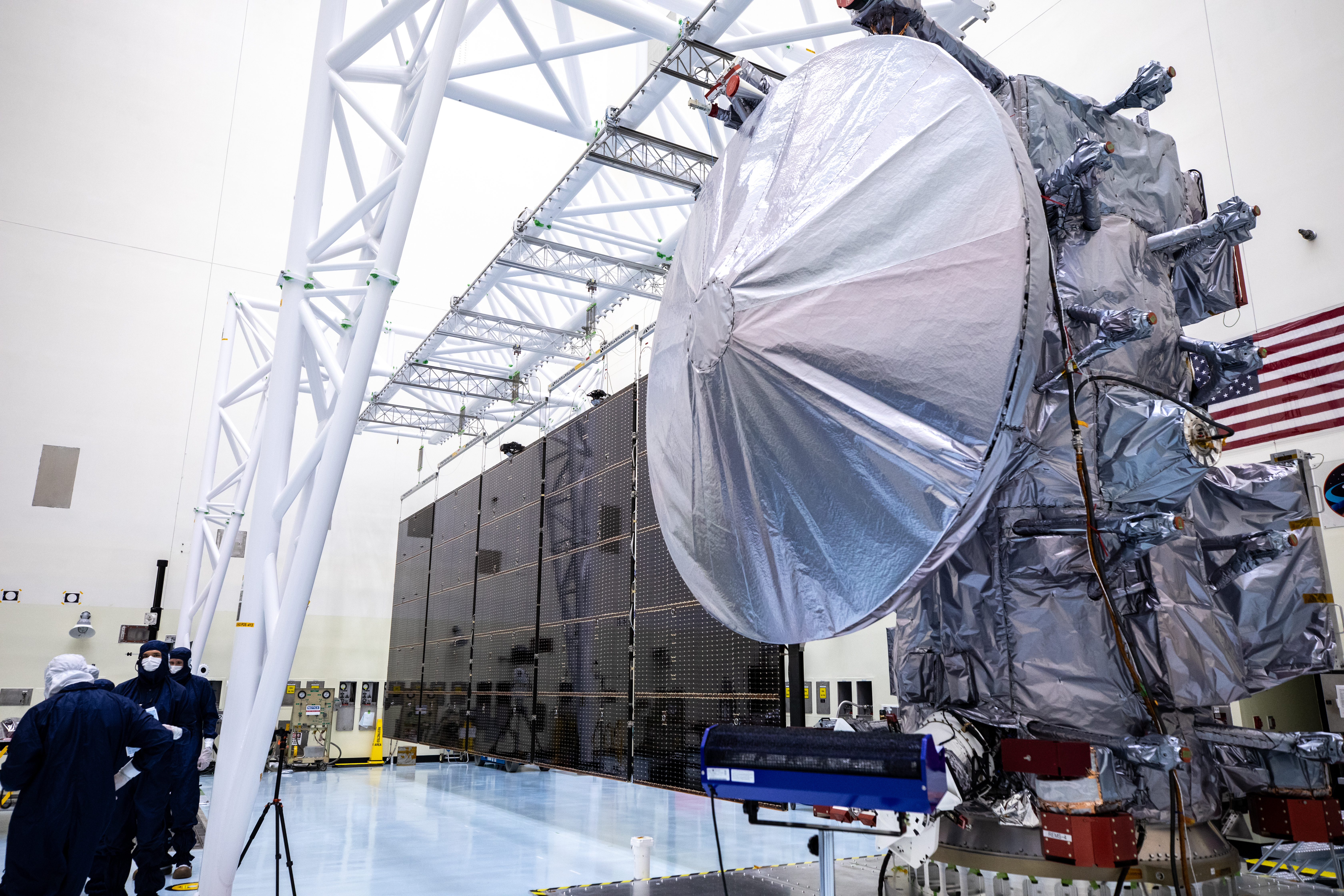
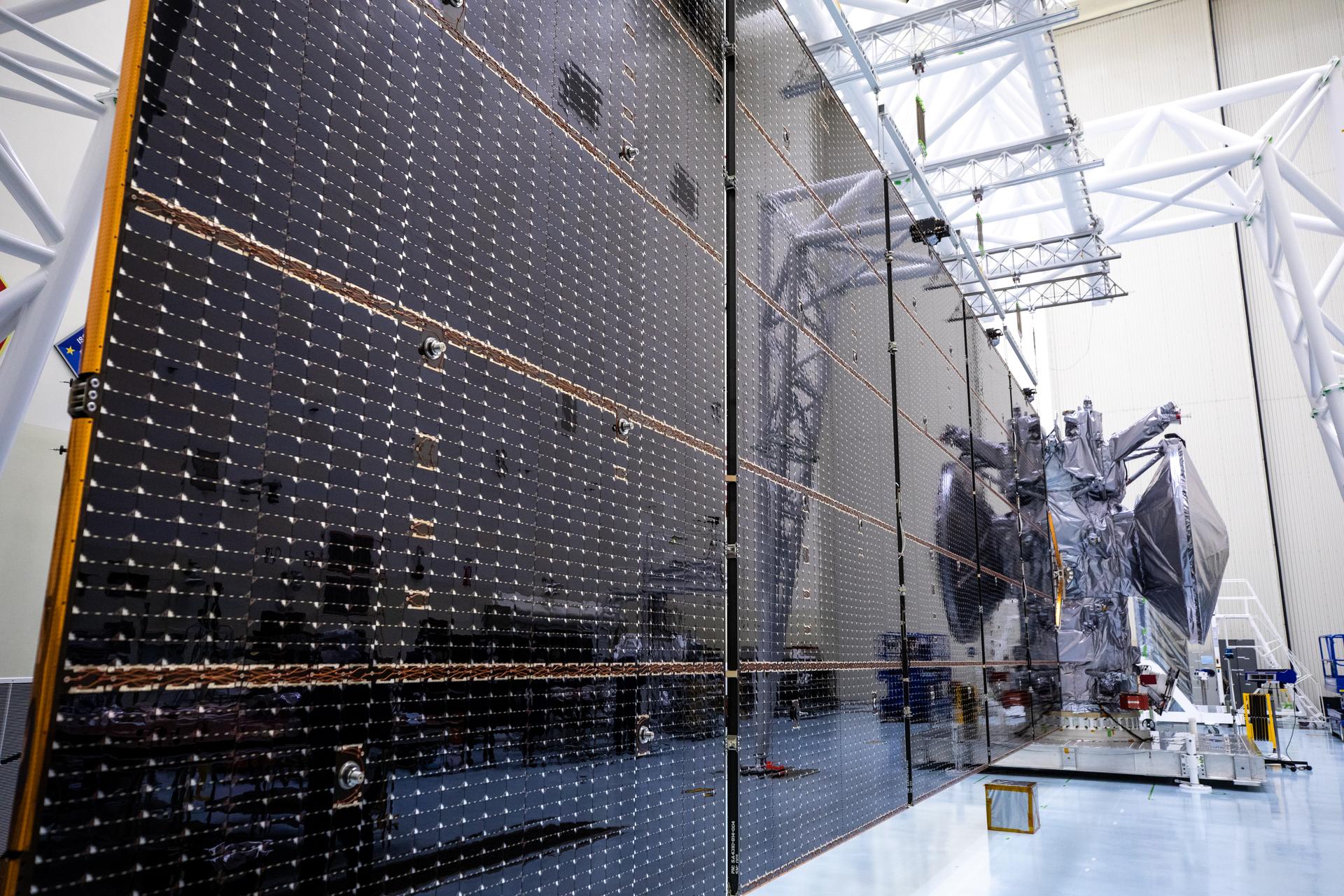
Technicians tested deploying a set of massive solar arrays
Crédito: NASA

Read this article in English here

La NASA invita a los creadores de contenido digital a inscribirse para asistir al lanzamiento de la nave espacial Europa Clipper, la cual recopilará datos para ayudar a los científicos a determinar si Europa, la luna helada de Júpiter, podría albergar vida.

La NASA y SpaceX planean que la ventana de lanzamiento se abra el jueves 10 de octubre. La misión despegará a bordo de un cohete Falcon Heavy de SpaceX, desde el Complejo de Lanzamientos 39A en el Centro Espacial Kennedy de la NASA en Florida.

La nave espacial Europa Clipper llevará a bordo nueve instrumentos científicos para recopilar mediciones detalladas mientras realiza unos 50 sobrevuelos cercanos de esta luna del sistema joviano (es decir, perteneciente al planeta Júpiter). Las investigaciones sugieren que, debajo de la corteza de hielo de Europa, existe un océano que tiene dos veces el volumen de todos los océanos de la Tierra. La exploración detallada de Europa que llevará a cabo esta misión ayudará a los científicos a comprender mejor el potencial astrobiológico de los mundos habitables más allá de nuestro planeta.

Si tu pasión es comunicar e interactuar con el mundo digital, ¡este evento es para ti! Aprovecha la oportunidad para ver y compartir el lanzamiento de la misión Europa Clipper.

Se seleccionará a un máximo de 50 usuarios de las redes sociales para que asistan a este evento de dos días. Estos asistentes tendrán un acceso similar al de los medios de comunicación.

Los participantes de este evento de NASA Social tendrán la oportunidad de:

  • Ver el lanzamiento de un cohete Falcon Heavy de SpaceX y la nave espacial Europa Clipper
  • Recorrer las instalaciones de la NASA en el Centro Espacial Kennedy
  • Conocer a expertos en temas relacionados con Europa Clipper e interactuar con ellos
  • Conocer a otros entusiastas del espacio que están activos en las redes sociales

La inscripción de los participantes de NASA Social para el lanzamiento de Europa Clipper comenzará el martes 3 de septiembre, y la fecha límite para inscribirse es el lunes 9 de septiembre hasta las 10 a.m. hora del este. Todas las solicitudes de los creadores en redes sociales se considerarán caso por caso.

INSCRÍBETE YA

¿Necesito tener una cuenta en las redes sociales para inscribirme?

Sí. Este evento está diseñado para personas que:

  • Utilizan activamente diferentes plataformas y herramientas de redes sociales para difundir información a un público característico
  • Producen con regularidad nuevos contenidos que incluyen elementos multimedia
  • Tienen el potencial de llegar a una gran cantidad de personas que utilizan plataformas digitales, o llegan a un público característico, definido y diferente de los medios de comunicación o los públicos tradicionales de la NASA
  • Deben tener un historial acreditado de publicación de contenido en plataformas de redes sociales
  • Tienen publicaciones anteriores que han logrado una gran visibilidad y que son respetadas y ampliamente reconocidas

Se anima a los usuarios de todas las redes sociales a utilizar la etiqueta #NASASocial. Las actualizaciones y la información sobre el evento se compartirán en X a través de las cuentas @NASASocial, @NASA_ES, y @NASAKennedy, y a través de publicaciones en Facebook e Instagram.

¿Cómo me inscribo?

Las inscripciones para este evento comienzan el martes 3 de septiembre y concluyen a las 10 a.m. hora del este del lunes 9 de septiembre. La inscripción es solo para una persona (tú) y no es transferible. Cada persona que desee asistir debe inscribirse por separado. Todas las solicitudes se considerarán caso por caso.

¿Puedo inscribirme si no tengo ciudadanía estadounidense? 

Sí, cualquiera puede aplicar a este evento.

¿Cuándo sabré si mi inscripción ha sido seleccionada?

Después de que se hayan recibido y procesado las inscripciones, se enviará a los seleccionados un correo electrónico con información de confirmación e instrucciones adicionales. Esperamos enviar las notificaciones de aceptación antes del 30 de septiembre.

¿Qué son las credenciales de NASA Social?

Todas las solicitudes de los creadores en redes sociales se considerarán caso por caso. Las personas seleccionadas deben demostrar a través del proceso de inscripción que cumplen con los criterios específicos de participación.

Aunque tu inscripción no sea elegida en la lista de participantes para este evento de NASA Social, aún puedes asistir al lanzamiento fuera del sitio y participar en la conversación en línea. Descubre las formas en que puedes presenciar un lanzamiento en esta página web (en inglés).

¿Cuáles son los requisitos para la inscripción?

La inscripción debe indicar tu intención de viajar al Centro Espacial Kennedy de la NASA en Florida y de asistir en persona a este evento de dos días de duración. Eres responsable de tus propios gastos de viaje, alojamiento, comida y otros servicios.

La programación de algunos eventos y participantes en el evento está sujeta a cambios sin previo aviso. La NASA no se hace responsable de las pérdidas o daños ocasionados como resultado de la asistencia. Además, la NASA no es responsable de las pérdidas o daños ocasionados si el evento es cancelado con un aviso limitado o sin previo aviso. Por favor, planifica como corresponda.

El centro Kennedy es una instalación del gobierno. Aquellas personas seleccionadas deberán completar un paso de inscripción adicional para recibir autorización de ingresar a las áreas de seguridad.

IMPORTANTE: Para ingresar, deberás proporcionar dos formas de identificación vigentes emitidas por el gobierno; una debe ser una identificación con foto y esta debe coincidir con el nombre proporcionado en tu inscripción. No podrán ingresar personas sin la debida identificación.

Para obtener una lista completa de las formas de identificación aprobadas, visita el sitio web (en inglés): Requisitos de identificación para la acreditación de la NASA.

Todos los solicitantes deben tener al menos 18 años de edad cumplidos.

¿Qué sucede si cambia la fecha de lanzamiento?

Muchos factores diferentes pueden hacer que una fecha de lanzamiento programada cambie varias veces. Si la fecha de lanzamiento cambia, la NASA puede ajustar la fecha del evento de NASA Social como corresponda para que coincida con la nueva fecha de lanzamiento señalada. La NASA notificará por correo electrónico a las personas inscritas de cualquier cambio que ocurra.

Si el lanzamiento se pospone, se invitará a los asistentes a asistir a una fecha de lanzamiento posterior. La NASA no puede alojar a los asistentes por retrasos de más de 72 horas.

Los asistentes al evento de NASA Social son responsables de todos los gastos adicionales ocasionados en relación con cualquier retraso en el lanzamiento. Recomendamos encarecidamente a los participantes que hagan arreglos de viaje que sean reembolsables o flexibles.

¿Qué sucede si no puedo ir al Centro Espacial Kennedy?

Si no puedes venir al Centro Espacial Kennedy y asistir en persona, no debes inscribirte en el evento de NASA Social. Puedes seguir la conversación en línea usando la etiqueta#NASASocial.

Puedes ver el lanzamiento en NASA+ o en el sitio web plus.nasa.gov. La NASA ofrecerá actualizaciones periódicas sobre el lanzamiento y la misión en las cuentas @NASA_ES, @NASA, @NASAKennedy, @NASA_LSP, @NASAJPL y @EuropaClipper, así como en el blog de la misión Europa Clipper de la NASA (en inglés).

Si no puedes asistir a este evento de NASA Social, no te preocupes; ¡la NASA está planificando muchos otros eventos para participantes de las redes sociales en el futuro cercano que se realizarán en diferentes lugares!

Powered by WPeMatico

Get The Details…
Sarah A. Loff
NASA Mission Gets Its First Snapshot of Polar Heat Emissions

NASA Mission Gets Its First Snapshot of Polar Heat Emissions

5 min read

Preparations for Next Moonwalk Simulations Underway (and Underwater)

Data from one of the two CubeSats that comprise NASA’s PREFIRE mission was used to make this data visualization showing brightness temperature — the intensity of infrared emissions — over Greenland. Red represents more intense emissions; blue indicates lower intensities. The data was captured in July.
 NASA’s Scientific Visualization Studio

The PREFIRE mission will help develop a more detailed understanding of how much heat the Arctic and Antarctica radiate into space and how this influences global climate.

NASA’s newest climate mission has started collecting data on the amount of heat in the form of far-infrared radiation that the Arctic and Antarctic environments emit to space. These measurements by the Polar Radiant Energy in the Far-Infrared Experiment (PREFIRE) are key to better predicting how climate change will affect Earth’s ice, seas, and weather — information that will help humanity better prepare for a changing world.

One of PREFIRE’s two shoebox-size cube satellites, or CubeSats, launched on May 25 from New Zealand, followed by its twin on June 5. The first CubeSat started sending back science data on July 1. The second CubeSat began collecting science data on July 25, and the mission will release the data after an issue with the GPS system on this CubeSat is resolved.

The PREFIRE mission will help researchers gain a clearer understanding of when and where the Arctic and Antarctica emit far-infrared radiation (wavelengths greater than 15 micrometers) to space. This includes how atmospheric water vapor and clouds influence the amount of heat that escapes Earth. Since clouds and water vapor can trap far-infrared radiation near Earth’s surface, they can increase global temperatures as part of a process known as the greenhouse effect. This is where gases in Earth’s atmosphere — such as carbon dioxide, methane, and water vapor — act as insulators, preventing heat emitted by the planet from escaping to space.

“We are constantly looking for new ways to observe the planet and fill in critical gaps in our knowledge. With CubeSats like PREFIRE, we are doing both,” said Karen St. Germain, director of the Earth Science Division at NASA Headquarters in Washington. “The mission, part of our competitively-selected Earth Venture program, is a great example of the innovative science we can achieve through collaboration with university and industry partners.”

Earth absorbs much of the Sun’s energy in the tropics; weather and ocean currents transport that heat toward the Arctic and Antarctica, which receive much less sunlight. The polar environment — including ice, snow, and clouds — emits a lot of that heat into space, much of which is in the form of far-infrared radiation. But those emissions have never been systematically measured, which is where PREFIRE comes in.

“It’s so exciting to see the data coming in,” said Tristan L’Ecuyer, PREFIRE’s principal investigator and a climate scientist at the University of Wisconsin, Madison. “With the addition of the far-infrared measurements from PREFIRE, we’re seeing for the first time the full energy spectrum that Earth radiates into space, which is critical to understanding climate change.”

This visualization of PREFIRE data (above) shows brightness temperatures — or the intensity of radiation emitted from Earth at several wavelengths, including the far-infrared. Yellow and red indicate more intense emissions originating from Earth’s surface, while blue and green represent lower emission intensities coinciding with colder areas on the surface or in the atmosphere.

The visualization starts by showing data on mid-infrared emissions (wavelengths between 4 to 15 micrometers) taken in early July during several polar orbits by the first CubeSat to launch. It then zooms in on two passes over Greenland. The orbital tracks expand vertically to show how far-infrared emissions vary through the atmosphere. The visualization ends by focusing on an area where the two passes intersect, showing how the intensity of far-infrared emissions changed over the nine hours between these two orbits.

The two PREFIRE CubeSats are in asynchronous, near-polar orbits, which means they pass over the same spots in the Arctic and Antarctic within hours of each other, collecting the same kind of data. This gives researchers a time series of measurements that they can use to study relatively short-lived phenomena like ice sheet melting or cloud formation and how they affect far-infrared emissions over time.

More About PREFIRE

The PREFIRE mission was jointly developed by NASA and the University of Wisconsin-Madison. A division of Caltech in Pasadena, California, NASA’s Jet Propulsion Laboratory manages the mission for NASA’s Science Mission Directorate and provided the spectrometers. Blue Canyon Technologies built and now operates the CubeSats, and the University of Wisconsin-Madison is processing and analyzing the data collected by the instruments.

To learn more about PREFIRE, visit:
https://science.nasa.gov/mission/prefire/

News Media Contacts

Jane J. Lee / Andrew Wang
Jet Propulsion Laboratory, Pasadena, Calif.
818-354-0307 / 626-379-6874
jane.j.lee@jpl.nasa.gov / andrew.wang@jpl.nasa.gov

2024-116

Powered by WPeMatico

Get The Details…
Anthony Greicius

NASA Invites Media to View Launch of Jupiter Moon Mission

NASA Invites Media to View Launch of Jupiter Moon Mission

A close up image of a set of massive solar arrays measuring about 46.5 feet (14.2 meters) long and about 13.5 feet (4.1 meters) high on NASA’s Europa Clipper spacecraft inside the agency’s Payload Hazardous Servicing Facility at Kennedy Space Center in Florida.
Technicians test a set of massive solar arrays measuring about 46.5 feet (14.2 meters) long and about 13.5 feet (4.1 meters) high for NASA’s Europa Clipper spacecraft inside the agency’s Payload Hazardous Servicing Facility at Kennedy Space Center in Florida on Aug. 7.
Credits: NASA/Kim Shiflett

NASA and SpaceX are targeting a launch period opening Thursday, Oct. 10, for the agency’s Europa Clipper mission, which will help scientists determine if one of Jupiter’s icy moons could support life. The mission will launch on a SpaceX Falcon Heavy rocket from Launch Complex 39A at NASA’s Kennedy Space Center in Florida.

Europa Clipper will carry nine instruments and a gravity science experiment aboard to gather detailed measurements as it orbits Jupiter and conducts multiple close flybys of its moon, Europa. Research suggests an ocean twice the volume of all of Earth’s oceans exists under Europa’s icy crust.

Media interested in covering the Europa Clipper launch must apply for media accreditation. Deadlines for accreditation are as follows:

  • U.S. citizens representing domestic or international media must apply for accreditation by 11:59 p.m. EDT, Friday, Sept. 27.
  • International media without U.S. citizenship must apply by 11:59 p.m., Friday, Sept. 20.

Media requiring special logistical arrangements, such as space for satellite trucks, tents, or electrical connections, should email ksc-media-accreditat@mail.nasa.gov by Tuesday, Oct. 1.

A copy of NASA’s media accreditation policy is available online. For questions about accreditation, please email: ksc-media-accreditat@mail.nasa.gov. For other mission questions, please contact NASA Kennedy’s newsroom at 321-867-2468.

Para obtener información sobre cobertura en español en el Centro Espacial Kennedy o si desea solicitar entrevistas en español, comuníquese con Antonia Jaramillo: 321-501-8425, o Messod Bendayan: 256-930-1371.

Accredited media will have the opportunity to participate in a series of prelaunch briefings and interviews with key mission personnel, including a briefing the week of Sept. 9. NASA will communicate additional details regarding the media event schedule as the launch date approaches.

NASA also will post updates on spacecraft launch preparations on NASA’s Europa Clipper blog.

Clipper’s primary science goal is to determine whether there are places below the surface of Europa that could support life. The mission’s three main science objectives are to understand the nature of the ice shell and the ocean beneath it, along with the moon’s composition and geology. The mission’s detailed exploration of Europa will help scientists better understand the astrobiological potential for habitable worlds beyond our planet.

Managed by Caltech in Pasadena, California, NASA’s Jet Propulsion Laboratory in Southern California leads the development of the Europa Clipper mission in partnership with the Johns Hopkins Applied Physics Laboratory (APL) in Laurel, Maryland, for NASA Headquarters in Washington. The main spacecraft body was designed by APL in collaboration with JPL and NASA’s Goddard Space Flight Center in Greenbelt, Maryland. The Planetary Missions Program Office at NASA’s Marshall Space Flight Center in Huntsville, Alabama, executes program management of the Europa Clipper mission.

NASA’s Launch Services Program, based at Kennedy, manages the launch service for the Europa Clipper spacecraft.

For further details about the mission and updates on launch preparations, visit:

https://science.nasa.gov/mission/europa-clipper

-end-

Leejay Lockhart
Kennedy Space Center, Florida
321-747-8310
leejay.lockhart@nasa.gov

Karen Fox / Alana Johnson
NASA Headquarters, Washington
202-358-1600 / 202-358-1501
karen.c.fox@nasa.govalana.r.johnson@nasa.gov

Julian Coltre
NASA Headquarters, Washington
202-358-1100
Julian.n.coltre@nasa.gov

Powered by WPeMatico

Get The Details…
Tiernan P. Doyle

NASA Invites Social Creators to Experience Launch of Europa Clipper Mission

NASA Invites Social Creators to Experience Launch of Europa Clipper Mission

Technicians tested deploying a set of massive solar arrays

Lee este artículo en español aquí  

Digital content creators are invited to register to attend the launch of the Europa Clipper spacecraft, which will collect data to help scientists determine if Jupiter’s icy moon Europa could support life. 

NASA and SpaceX are targeting a launch period opening Thursday, Oct. 10. The mission will launch on a SpaceX Falcon Heavy rocket from Launch Complex 39A at NASA’s Kennedy Space Center in Florida. 

The Europa Clipper spacecraft will carry nine science instruments on board to gather detailed measurements while performing approximately 50 close flybys of the Jovian moon. Research suggests an ocean twice the volume of all the Earth’s oceans exists under Europa’s icy crust. Detailed exploration of Europa will help scientists better understand the astrobiological potential for habitable worlds beyond our planet. 

If your passion is to communicate and engage the world online, then this is the event for you! Seize the opportunity to see and share the Europa Clipper mission launch. 

A maximum of 50 social media users will be selected to attend this two-day event and will be given access similar to news media. 

NASA Social participants will have the opportunity to: 

  • View a launch of the SpaceX Falcon Heavy rocket and Europa Clipper spacecraft 
  • Tour NASA facilities at Kennedy Space Center 
  • Meet and interact with Europa Clipper subject matter experts 
  • Meet fellow space enthusiasts who are active on social media 

NASA Social registration for the Europa Clipper launch opens on Tuesday, Sept. 3, and the deadline to apply is at 10 a.m. EDT on Monday, Sept. 9. All social applications will be considered on a case-by-case basis. 

APPLY NOW 

Do I need to have a social media account to register? 

 Yes. This event is designed for people who: 

  • Actively use multiple social networking platforms and tools to disseminate information to a unique audience. 
  • Regularly produce new content that features multimedia elements. 
  • Have the potential to reach a large number of people using digital platforms, or reach a unique audience, separate and distinctive from traditional news media and/or NASA audiences. 
  • Must have an established history of posting content on social media platforms. 
  • Have previous postings that are highly visible, respected and widely recognized. 

Users on all social networks are encouraged to use the hashtag #NASASocial. Updates and information about the event will be shared on X via @NASASocial and @NASAKennedy, and via posts to Facebook and Instagram

How do I register? 

Registration for this event opens on Tuesday, Sept. 3, and closes at 10 a.m. EDT on Monday, Sept. 9. Registration is for one person only (you) and is non-transferable. Each individual wishing to attend must register separately. Each application will be considered on a case-by-case basis. 

Can I register if I am not a U.S. citizen? 

Yes, this event is open for all to apply. 

When will I know if I am selected? 

After registrations have been received and processed, an email with confirmation information and additional instructions will be sent to those selected. We expect to send the acceptance notifications by Sept. 30. 

What are NASA Social credentials? 

All social applications will be considered on a case-by-case basis. Those chosen must prove through the registration process they meet specific engagement criteria. 

If you do not make the registration list for this NASA Social, you still can attend the launch offsite and participate in the conversation online. Find out about ways to experience a launch here. 

What are the registration requirements? 

Registration indicates your intent to travel to NASA’s Kennedy Space Center in Florida and attend the two-day event in person. You are responsible for your own expenses for travel, accommodations, food, and other amenities. 

Some events and participants scheduled to appear at the event are subject to change without notice. NASA is not responsible for loss or damage incurred as a result of attending. NASA, moreover, is not responsible for loss or damage incurred if the event is cancelled with limited or no notice. Please plan accordingly. 

Kennedy is a government facility. Those who are selected will need to complete an additional registration step to receive clearance to enter the secure areas. 

IMPORTANT: To be admitted, you will need to provide two forms of unexpired government-issued identification; one must be a photo ID and match the name provided on the registration. Those without proper identification cannot be admitted

For a complete list of acceptable forms of ID, please visit: NASA Credentialing Identification Requirements

All registrants must be at least 18 years old. 

What if the launch date changes? 

Many different factors can cause a scheduled launch date to change multiple times. If the launch date changes, NASA may adjust the date of the NASA Social accordingly to coincide with the new target launch date. NASA will notify registrants of any changes by email. 

If the launch is postponed, attendees will be invited to attend a later launch date. NASA cannot accommodate attendees for delays beyond 72 hours. 

NASA Social attendees are responsible for any additional costs they incur related to any launch delay. We strongly encourage participants to make travel arrangements that are refundable and/or flexible. 

What if I cannot come to the Kennedy Space Center? 

If you cannot come to the Kennedy Space Center and attend in person, you should not register for the NASA Social. You can follow the conversation online using #NASASocial.  

You can watch the launch on NASA+ or plus.nasa.gov. NASA will provide regular launch and mission updates on @NASA, @NASAKennedy, @NASA_LSP, @NASAJPL and @EuropaClipper as well as on NASA’s Europa Clipper Mission blog

If you cannot make this NASA Social, don’t worry; NASA is planning many other Socials in the near future at various locations! 

Powered by WPeMatico

Get The Details…
Gary Daines