Station Science Top News: Oct. 25, 2024

Station Science Top News: Oct. 25, 2024

Better Monitoring of the Air Astronauts Breathe

Ten weeks of operations showed that a second version of the Spacecraft Atmosphere Monitor is sensitive enough to determine variations in the composition of cabin air inside the International Space Station. Volatile organic compounds and particulates in cabin air could pose a health risk for crew members, and this device increases the speed and accuracy of assessing such risk.

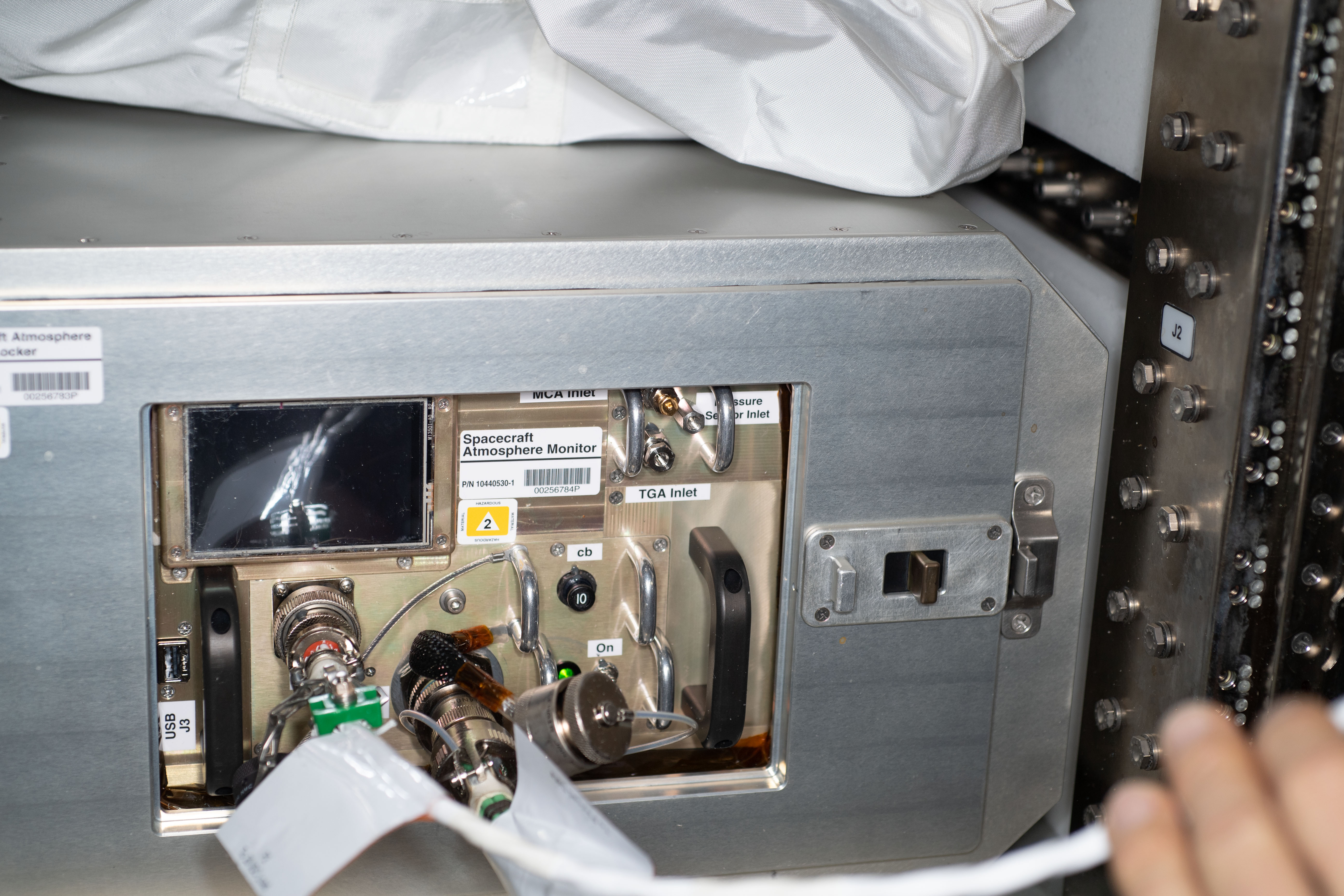
Spacecraft Atmosphere Monitor is a miniaturized gas chromatograph mass spectrometer used to analyze the air inside the space station and ensure that it is safe for the crew and equipment. The device automatically reports results to the ground, eliminating the need to return samples to Earth. This version has several other technological advances, including that it can be relocated, is smaller, and uses less power.

Close-up image of a Spacecraft Atmosphere Monitor inside the International Space Station. The monitor is surrounded by cables, connectors, and metal components.
The first Spacecraft Atmosphere Monitor device on the International Space Station.
NASA/Chris Cassidy

Digging Deeper into Microgravity Effects on Muscle

Prolonged exposure to microgravity affects human muscle precursor cells known as satellite cells and causes changes in the expression of specific genes involved in muscle structure and nerves. Exercise regimens on the space station do not adequately prevent or counteract muscle loss in astronauts, which can affect their motor function during missions and after return to Earth. Results could inform design of nutritional and pharmacological countermeasures to muscle changes during spaceflight.

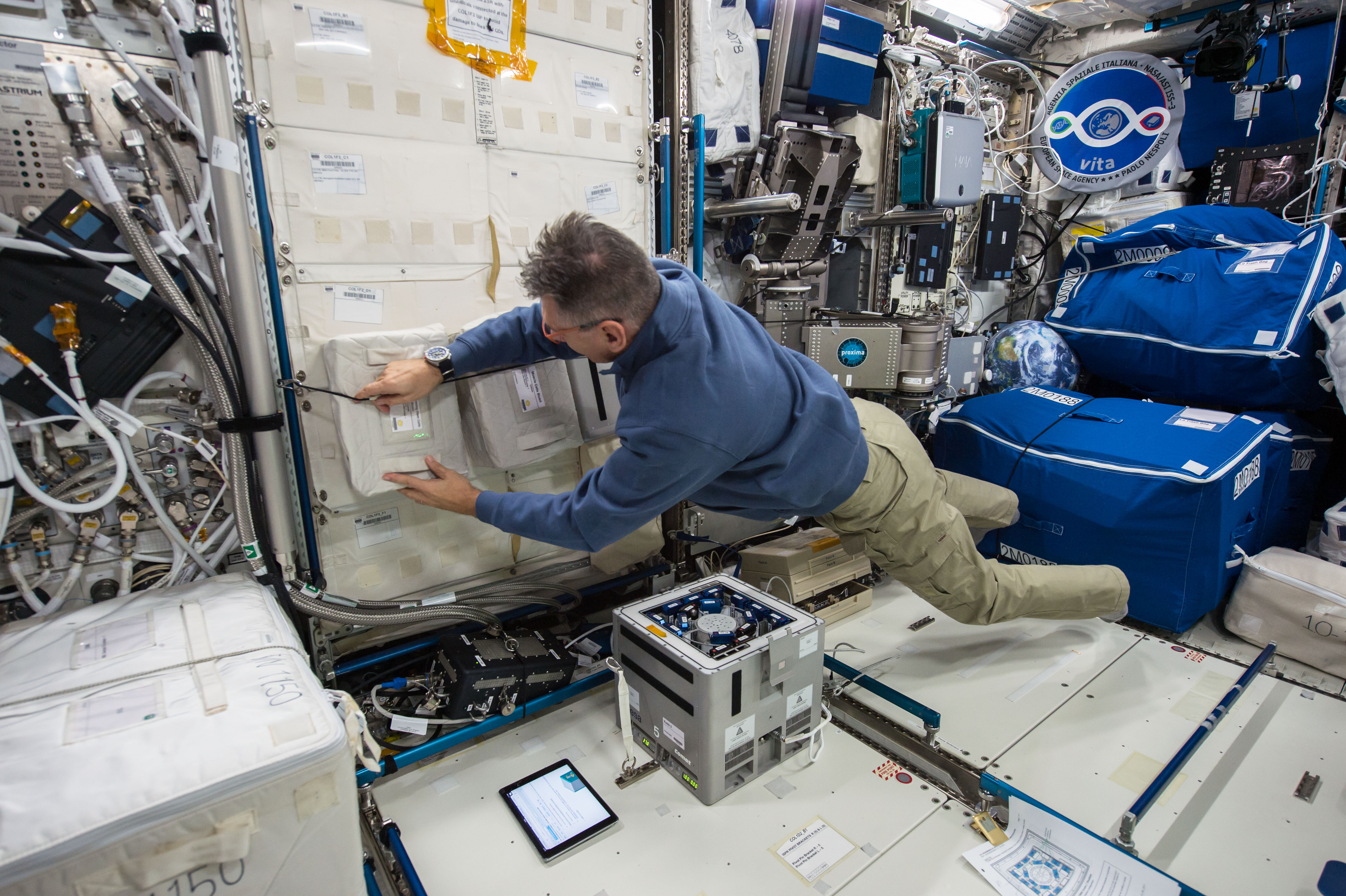
Muscle loss represents a major obstacle to human long-term spaceflight. Myogravity, an investigation developed with the Italian space agency ASI, looked at microgravity-induced changes in adult stem cells involved in the growth, maintenance, and repair of skeletal muscle tissue, known as satellite cells. These cells may play a major role in muscle loss during spaceflight.

NASA astronaut working inside the International Space Station, floating in a microgravity environment while securing a storage container to the wall.
European Space Agency astronaut Paolo Nespoli sets up the Myogravity experiment.
NASA

Validating Next-Generation Earth Measurements

Researchers completed a preliminary evaluation of the station’s Hyperspectral Imager Suite (HISUI) and report that the difference between model-corrected and actual measurements is small. Validation of spaceborne optical sensors like HISUI is important to demonstrate they provide the accuracy needed for scientific research.

The JAXA (Japan Aerospace Exploration Agency) HISUI investigation tests a next-generation spaceborne hyperspectral Earth imaging system for gathering data on reflection of light from Earth’s surface, which reveals characteristics and physical properties of a target area. This technology has potential applications such as monitoring vegetation and identifying natural resources.

The Hyperspectral Imager Suite is visible on the far left in this image outside the space station.
NASA

Powered by WPeMatico

Get The Details…
Sumer Loggins

Carissa Arillo: Testing Spacecraft, Penning the Owner’s Manuals

Carissa Arillo: Testing Spacecraft, Penning the Owner’s Manuals

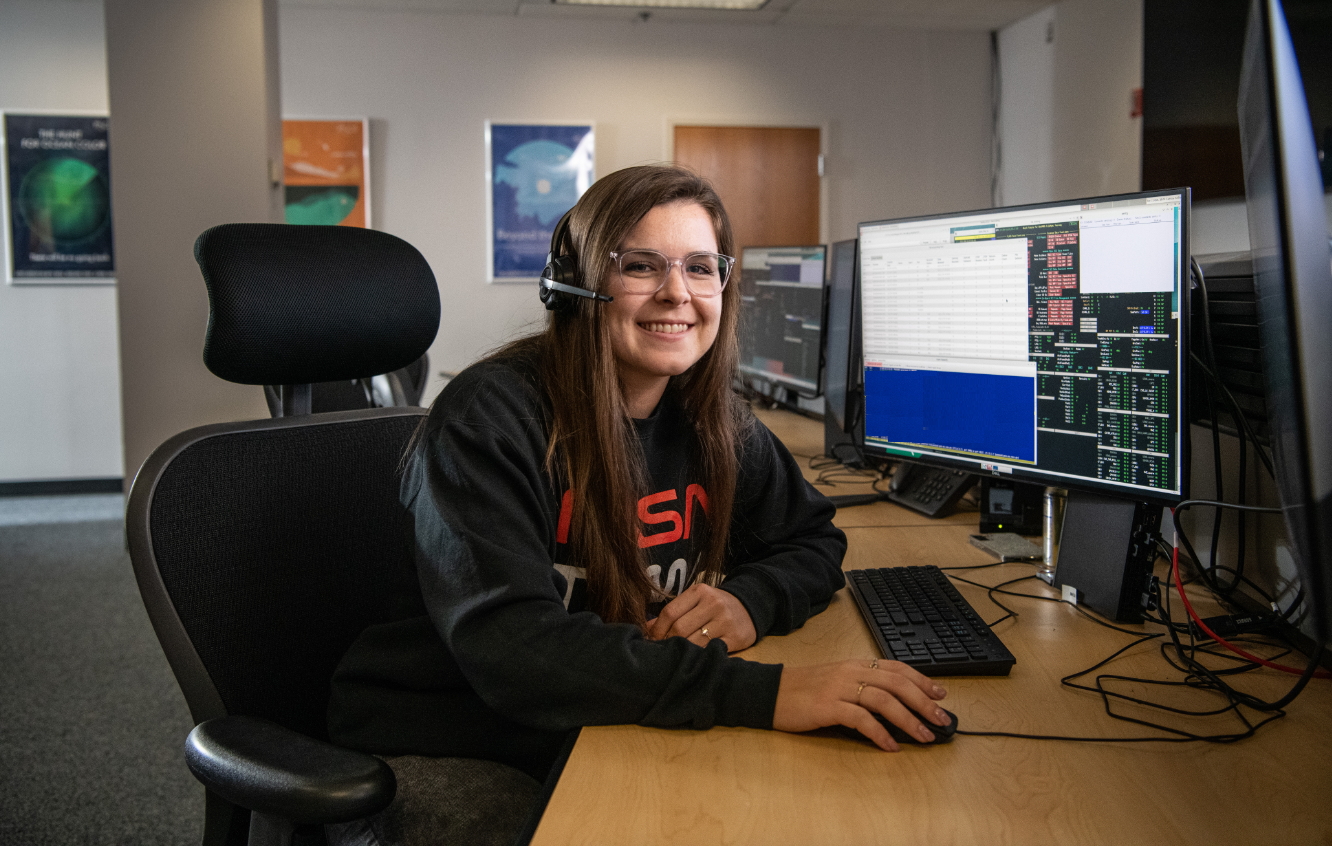
Flight operations engineer Carissa Arillo helped ensure one of the instruments on NASA’s PACE mission made it successfully through its prelaunch testing. She and her group also documented the work rigorously, to ensure the flight team had a comprehensive manual to keep this Earth-observing satellite in good health for the duration of its mission.

Carissa Arillo sits at a table with a monitor and a keyboard, wearing a headset. She smiles at the camera. On the screen is code, but it isn't clearly visible. She is wearing a long sleeve dark colored shirt with the NASA worm logo across the front in red. She has long, brown hair and wears glasses.
Carissa M. Arillo is a flight operations engineer at NASA’s Goddard Space Flight Center in Greenbelt, Md.
Photo courtesy of Carissa Arillo

Name: Carissa M. Arillo
Formal Job Classification: Flight Operations Engineer
Organization: Environmental Test Engineering and Integration Branch (Code 549)

What do you do and what is most interesting about your role here at Goddard?

I developed pre-launch test procedures for the HARP-2 instrument for the Phytoplankton, Aerosol, Cloud and Ecosystem (PACE) Mission. HARP-2 is a wide angle imaging polarimeter designed to measure aerosol particles and clouds, as well as properties of land and water surfaces.

I also developed the flight operations routine and contingency procedures that governed the spacecraft after launch. It is interesting to think about how to design procedures that can sustain the observatory in space for the life of the mission so that the flight operations team that inherits the mission will have a seamless transition.

What is your educational background?

In 2019, I got a Bachelor of Science in mechanical engineering from the University of Maryland, College Park. I am currently pursuing a master’s in robotics there as well.

Why did you become an engineer?

I like putting things together and understanding how they work. After starting my job at NASA Goddard, I became interested in coding and robotics.

How did you come to Goddard?

After getting my undergraduate degree, I worked at General Electric Aviation doing operations management for manufacturing aircraft engines. When I heard about an opening at Goddard, I applied and got my current position.

What was involved in developing pre-launch test procedures for the HARP-2 instrument?

I talked to the instrument manufacturer, which is a team from the University of Maryland, Baltimore County, and asked them what they wanted to confirm works every time we tested the instrument. We kept in constant communication while developing these test procedures to make sure we covered everything. The end product was code that was part of the comprehensive performance tests, the baseline tests throughout the prelaunch test campaign. Before, during, and after each prelaunch environmental test, we perform such a campaign. These prelaunch environmental tests include vibration, thermal (hot and cold), acoustic and radio frequency compatibility (making sure that different subsystems do not interfere with each other’s).

What goes through your head in developing a flight operations procedure for an instrument?

I think about a safe way of operating the instrument to accomplish the goals of the science team. I also think about not being able to constantly monitor the instrument. Every few hours, we can communicate with the instrument for about five to 10 minutes. We can, however, recover all the telemetry for the off-line time.

When we discover an anomaly, we look at all the history that we have and consult with our contingency procedures, our failure review board and potentially the instrument manufacturer. Together we try to figure out a recovery.

When developing a fight operations procedure, we must think of all possible scenarios. Our end product is a written book of procedures that lives with the mission and is updated as needed.

New cars come with an owner’s manual. We create the same sort of manual for the new instrument.

As a Flight Operations Team member, what else do you do?

The flight operations team runs the Mission Operations Center — the “MOC” — for PACE. That is where we command the spacecraft for the life of the mission. My specialty is the HARP-2 instrument, but I still do many supporting functions for the MOC. For example, I helped develop procedures to automate ground station contacts to PACE. These ground stations are positioned all over the world and enable us to talk with the spacecraft during those five to 10 minutes of communication. This automation includes the standard things we do every time we talk to the spacecraft whether or not someone is in the MOC.

Carissa Arillo stands to the right of the PACE observatory in a cleanroom and points at it. She is wearing a white clean room suit that covers her torso, arms, and over the top of her head and forehead. She also wears a white mask that covers her nose and mouth and blue latex gloves. Behind her and slightly to the left is the PACE observatory, which is large, silver colored, and is covered in wires and other metallic pieces of instrumentation and materials.
Carissa developed pre-launch test procedures for the HARP-2 instrument for the Phytoplankton, Aerosol, Cloud and Ecosystem (PACE) Mission. HARP-2 is a wide angle imaging polarimeter designed to measure aerosol particles and clouds, as well as properties of land and water surfaces.
NASA/Dennis Henry

How does it feel to be working on such an amazing mission so early in your career?

It is awesome, I feel very lucky to be in my position. Everything is new to me. At times it is difficult to understand where the ship is going. I rely on my experienced team members to guide me and my robotics curriculum in school to equip me with skills.

I have learned a lot from both the flight operations team and the integration and test team. The flight operations team has years of experience building MOCs that serve the needs of each unique mission. The integration and test team also has a lot of experience developing observatory functional procedures. I wish to thank both teams for taking me under their wings and educating me on the fly to support the prelaunch, launch and post-launch campaigns. I am very grateful to everyone for giving me this unbelievable opportunity.

Who is your engineering hero?

I don’t have one hero in particular but I love biographical movies that tell stories about influential people’s lives, such as the movie “Hidden Figures” that details the great endeavors and accomplishments of three female African-American mathematicians at NASA.

What do you do for fun?

I love to go to the beach and spend time with family and friends.

Who is your favorite author?

I like Kristen Hannah’s storytelling abilities.

What do you hope to be doing in five years?

I hope to be working on another exciting mission at Goddard that will bring us never-before-seen science.

By Elizabeth M. Jarrell
NASA’s Goddard Space Flight Center, Greenbelt, Md.

A banner graphic with a group of people smiling and the text "Conversations with Goddard" on the right. The people represent many genders, ethnicities, and ages, and all pose in front of a soft blue background image of space and stars.

Conversations With Goddard is a collection of Q&A profiles highlighting the breadth and depth of NASA’s Goddard Space Flight Center’s talented and diverse workforce. The Conversations have been published twice a month on average since May 2011. Read past editions on Goddard’s “Our People” webpage.

Share

Details

Last Updated

Oct 29, 2024

Editor
Madison Olson
Contact
Rob Garner
Location
Goddard Space Flight Center

Powered by WPeMatico

Get The Details…
Madison Olson

NASA Sets Coverage for its SpaceX Crew-9 Dragon Station Relocation

NASA Sets Coverage for its SpaceX Crew-9 Dragon Station Relocation

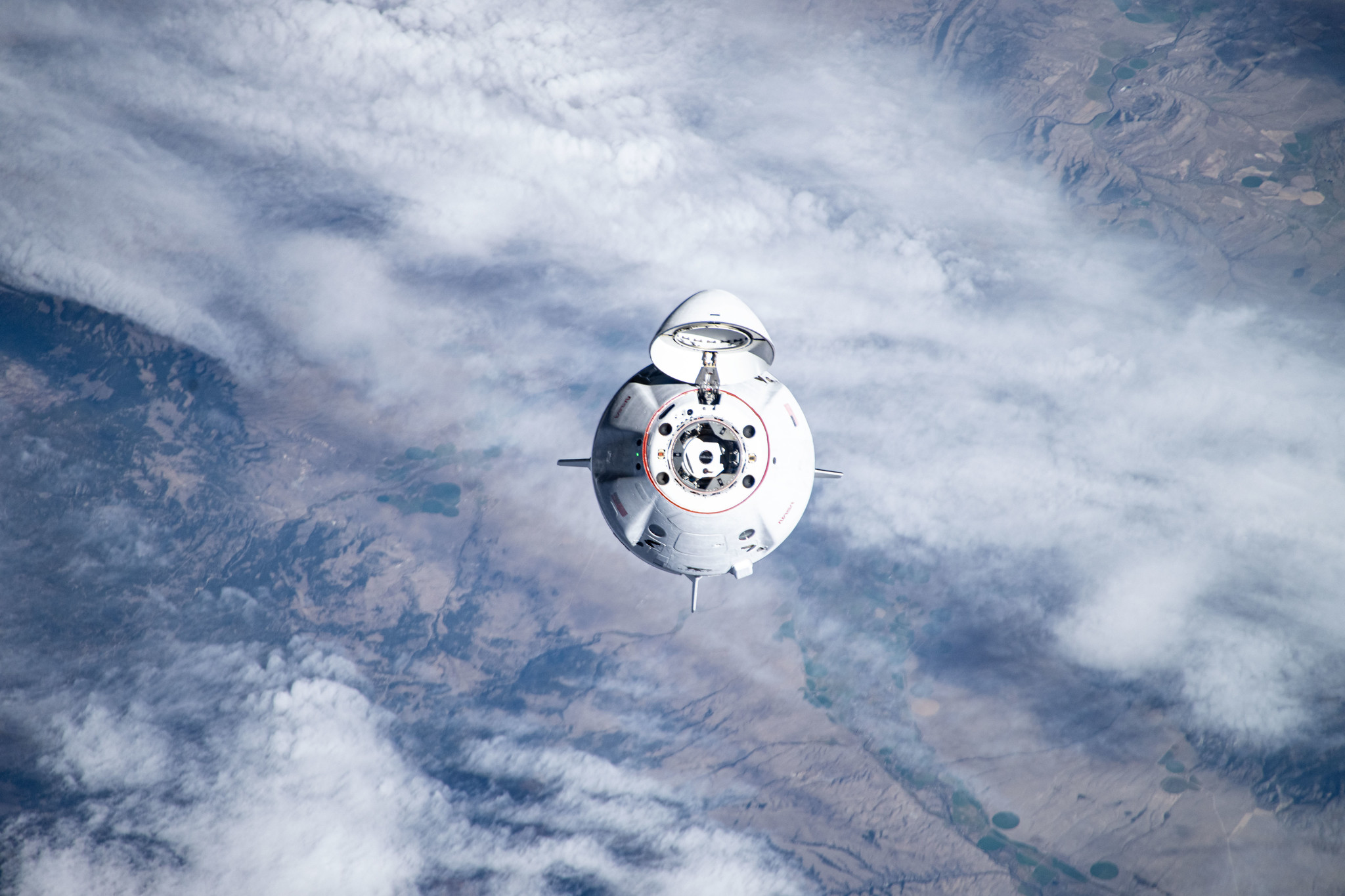
A white SpaceX Dragon spacecraft, with its nose cone open, is seen above Earth's blue water and white clouds.
The SpaceX Dragon spacecraft carrying NASA astronaut Nick Hague and Roscosmos cosmonaut Aleksandr Gorbunov approaches the International Space Station as it orbits 259 miles above Oregon.
Credit: NASA

In preparation for the arrival of NASA’s SpaceX 31st commercial resupply services mission, four crew members aboard the International Space Station will relocate the agency’s SpaceX Crew-9 Dragon spacecraft to a different docking port Sunday, Nov. 3.

Live coverage begins at 6:15 a.m. EST on NASA+ and will end shortly after docking. Learn how to watch NASA content through a variety of platforms, including social media. 

NASA astronauts Nick Hague, Suni Williams, and Butch Wilmore, as well as Roscosmos cosmonaut Aleksandr Gorbunov, will undock the spacecraft from the forward-facing port of the station’s Harmony module at 6:35 a.m., and redock to the module’s space-facing port at 7:18 a.m.

The relocation, supported by flight controllers at NASA’s Johnson Space Center in Houston and the Mission Control team at SpaceX in Hawthorne, California, will free Harmony’s forward-facing port for a Dragon cargo spacecraft mission scheduled to launch no earlier than Monday, Nov. 4.

This will be the fifth port relocation of a Dragon spacecraft with crew aboard following previous moves during the Crew-1, Crew-2, Crew-6, and Crew-8 missions.

Learn more about space station activities by following @space_station and @ISS_Research on X, as well as the ISS Facebook, ISS Instagram, and the space station blog.

NASA’s SpaceX Crew-9 mission launched Sept. 28 from NASA’s Kennedy Space Center in Florida and docked to the space station Sept. 29. Crew-9, targeted to return February 2025, is the company’s ninth rotational crew mission as a part of the agency’s Commercial Crew Program.

Find NASA’s commercial crew blog and more information about the Crew-9 mission at:

https://www.nasa.gov/commercialcrew

-end-

Jimi Russell / Claire O’Shea
Headquarters, Washington
202-358-1100
james.j.russell@nasa.gov / claire.a.o’shea@nasa.gov

Sandra Jones
Johnson Space Center, Houston
281-483-5111
sandra.p.jones@nasa.gov

Share

Details

Last Updated

Oct 29, 2024

Editor
Jessica Taveau

Powered by WPeMatico

Get The Details…
Jessica Taveau

How NASA’s Lunar Trailblazer Could Decipher the Moon’s Icy Secrets

How NASA’s Lunar Trailblazer Could Decipher the Moon’s Icy Secrets

6 min read

Preparations for Next Moonwalk Simulations Underway (and Underwater)

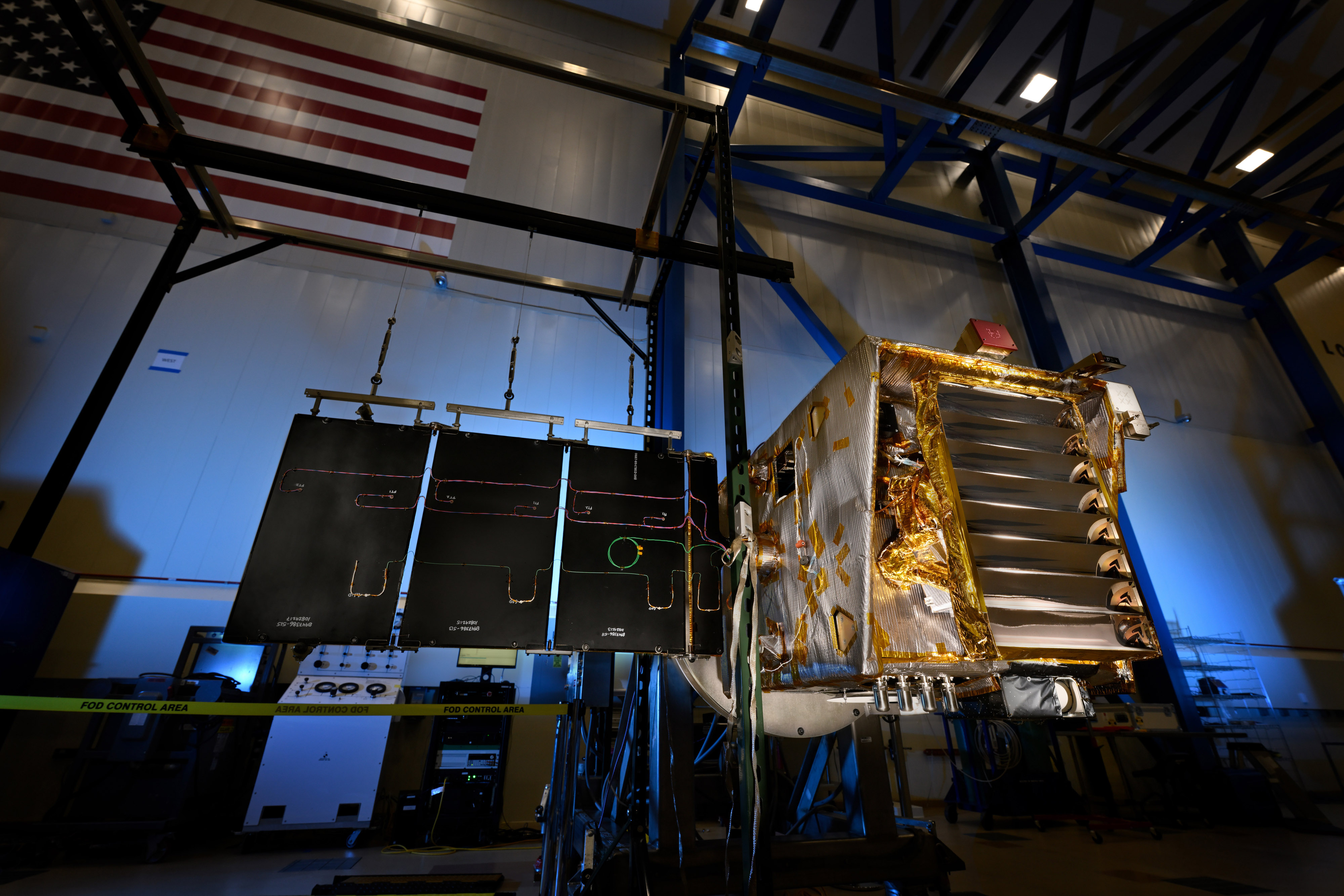
NASA’s Lunar Trailblazer sits in a clean room at Lockheed Martin Space
With one of its solar arrays deployed, NASA’s Lunar Trailblazer sits in a clean room at Lockheed Martin Space. The large silver grate attached to the spacecraft is the radiator for HVM³, one of two instruments that the mission will use to better understand the lunar water cycle.
Lockheed Martin Space

There’s water on the Moon, but scientists only have a general idea of where it is and what form it is in. A trailblazing NASA mission will get some answers.

When NASA’s Lunar Trailblazer begins orbiting the Moon next year, it will help resolve an enduring mystery: Where is the Moon’s water? Scientists have seen signs suggesting it exists even where temperatures soar on the lunar surface, and there’s good reason to believe it can be found as surface ice in permanently shadowed craters, places that have not seen direct sunlight for billions of years. But, so far, there have been few definitive answers, and a full understanding of the nature of the Moon’s water cycle remains stubbornly out of reach.

This is where Lunar Trailblazer comes in. Managed by NASA’s Jet Propulsion Laboratory and led by Caltech in Pasadena, California, the small satellite will map the Moon’s surface water in unprecedented detail to determine the water’s abundance, location, form, and how it changes over time.

“Making high-resolution measurements of the type and amount of lunar water will help us understand the lunar water cycle, and it will provide clues to other questions, like how and when did Earth get its water,” said Bethany Ehlmann, principal investigator for Lunar Trailblazer at Caltech. “But understanding the inventory of lunar water is also important if we are to establish a sustained human and robotic presence on the Moon and beyond.”

Future explorers could process lunar ice to create breathable oxygen or even fuel. And they could also conduct science. Using information from Lunar Trailblazer, future human or robotic scientific investigations could sample the ice for later study to determine where the water came from. For example, the presence of ammonia in ice samples may indicate the water came from comets; sulfur, on the other hand, could show that it was vented to the surface from the lunar interior when the Moon was young and volcanically active.

NASA’s Lunar Trailblazer in Orbit Around the Moon
This artist’s concept depicts NASA’s Lunar Trailblazer in lunar orbit about 60 miles (100 kilometers) from the surface of the Moon. The spacecraft weighs only 440 pounds (200 kilograms) and measures 11.5 feet (3.5 meters) wide when its solar panels are fully deployed.
Lockheed Martin Space

“In the future, scientists could analyze the ice in the interiors of permanently shadowed craters to learn more about the origins of water on the Moon,” said Rachel Klima, Lunar Trailblazer deputy principal investigator at the Johns Hopkins Applied Physics Laboratory in Laurel, Maryland. “Like an ice core from a glacier on Earth can reveal the ancient history of our planet’s atmospheric composition, this pristine lunar ice could provide clues as to where that water came from and how and when it got there.”

Understanding whether water molecules move freely across the surface of the Moon or are locked inside rock is also scientifically important. Water molecules could move from frosty “cold traps” to other locations throughout the lunar day. Frost heated by the Sun sublimates (turning from solid ice to a gas without going through a liquid phase), allowing the molecules to move as a gas to other cold locations, where they could form new frost as the Sun moves overhead. Knowing how water moves on the Moon could also lead to new insights into the water cycles on other airless bodies, such as asteroids

Two Instruments, One Mission

Two science instruments aboard the spacecraft will help unlock these secrets: the High-resolution Volatiles and Minerals Moon Mapper (HVM3) infrared spectrometer and the Lunar Thermal Mapper (LTM) infrared multispectral imager.

Developed by JPL, HVM3 will detect and map the spectral fingerprints, or wavelengths of reflected sunlight, of minerals and the different forms of water on the lunar surface. The spectrometer can use faint reflected light from the walls of craters to see the floor of even permanently shadowed craters.

The LTM instrument, which was built by the University of Oxford and funded by the UK Space Agency, will map the minerals and thermal properties of the same lunar landscape. Together they will create a picture of the abundance, location, and form of water while also tracking how its distribution changes over time.

“The LTM instrument precisely maps the surface temperature of the Moon while the HVM3 instrument looks for the spectral signature of water molecules,” said Neil Bowles, instrument scientist for LTM at the University of Oxford. “Both instruments will allow us to understand how surface temperature affects water, improving our knowledge of the presence and distribution of these molecules on the Moon.”

Weighing only 440 pounds (200 kilograms) and measuring 11.5 feet (3.5 meters) wide when its solar panels are fully deployed, Lunar Trailblazer will orbit the Moon about 60 miles (100 kilometers) from the surface. The mission was selected by NASA’s SIMPLEx (Small Innovative Missions for Planetary Exploration) program in 2019 and will hitch a ride on the same launch as the Intuitive Machines-2 delivery to the Moon through NASA’s Commercial Lunar Payload Services initiative. Lunar Trailblazer passed a critical operational readiness review in early October at Caltech after completing environmental testing in August at Lockheed Martin Space in Littleton, Colorado, where it was assembled.

The orbiter and its science instruments are now being put through flight system software tests that simulate key aspects of launch, maneuvers, and the science mission while in orbit around the Moon. At the same time, the operations team led by IPAC at Caltech is conducting tests to simulate commanding, communication with NASA’s Deep Space Network, and navigation.

More About Lunar Trailblazer

Lunar Trailblazer is managed by JPL, and its science investigation and mission operations are led by Caltech with the mission operations center at IPAC. Managed for NASA by Caltech, JPL also provides system engineering, mission assurance, the HVM3 instrument, as well as mission design and navigation. Lockheed Martin Space provides the spacecraft, integrates the flight system, and supports operations under contract with Caltech.

SIMPLEx mission investigations are managed by the Planetary Missions Program Office at NASA’s Marshall Space Flight Center in Huntsville, Alabama, as part of the Discovery Program at NASA Headquarters in Washington. The program conducts space science investigations in the Planetary Science Division of NASA’s Science Mission Directorate at NASA Headquarters.

For more information about Lunar Trailblazer, visit:

https://www.jpl.nasa.gov/missions/lunar-trailblazer

News Media Contacts

Karen Fox / Molly Wasser
NASA Headquarters, Washington
202-358-1600
karen.c.fox@nasa.gov / molly.l.wasser@nasa.gov

Ian J. O’Neill
Jet Propulsion Laboratory, Pasadena, Calif.
818-354-2649
ian.j.oneill@jpl.nasa.gov

Gordon Squires
IPAC, Pasadena, Calif.
626-395-3121
squires@ipac.caltech.edu

2024-148

Powered by WPeMatico

Get The Details…
Anthony Greicius

Memorable Moment 2024

Memorable Moment 2024

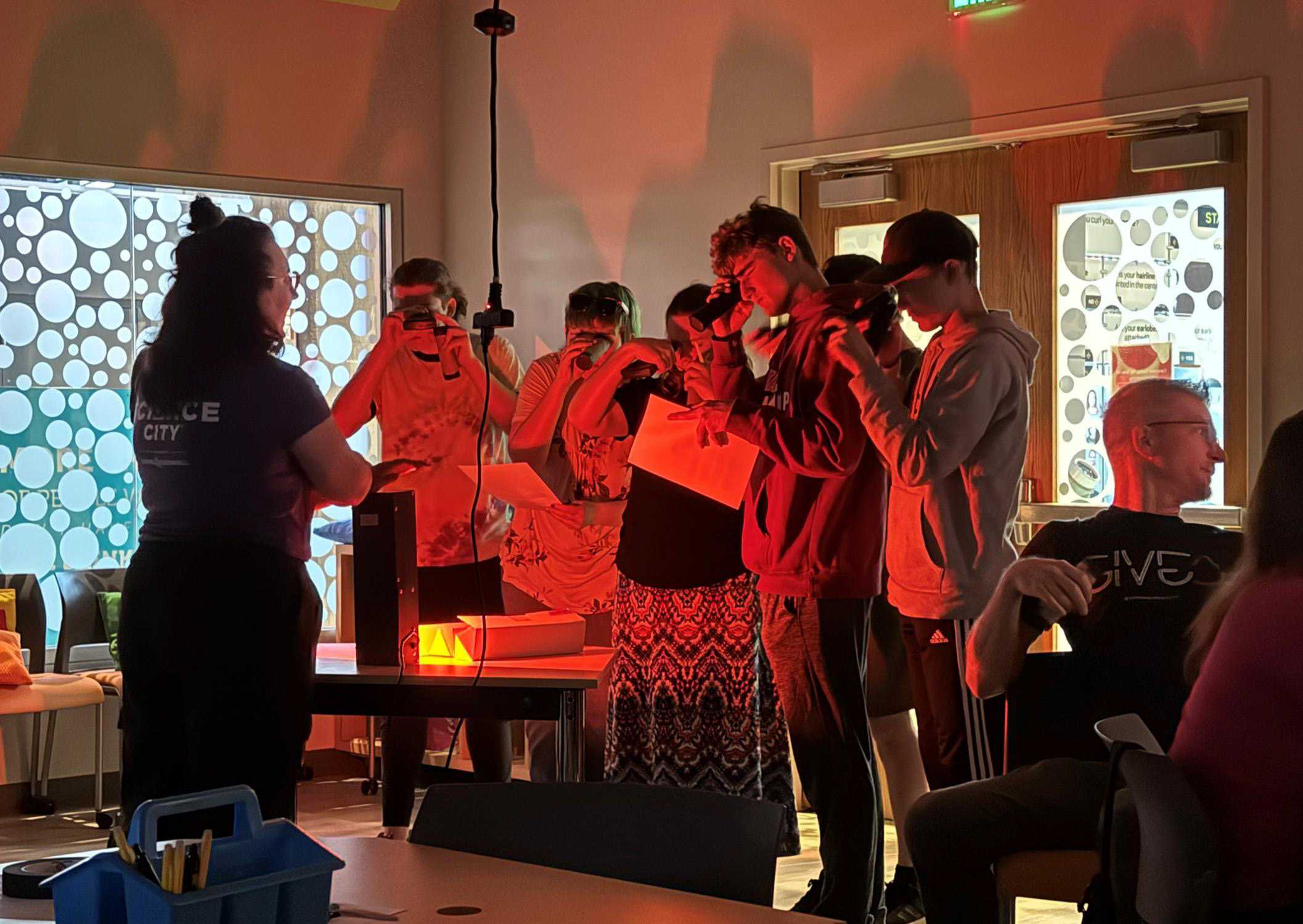
A group of students peer through devices

As a NASA Community Anchor, Union Station (Kansas City, KS) has welcomed over 1,100 students from different Kansas City area schools to our Spectra programming, which includes all expense paid field trips, Planetarium shows, Observation Nights, and tabling at KC PrideFest. This program has allowed us to increase our reach to the Kansas City LGBTQIA+ youth by nearly 50%.

According to a post visit survey, 86% of respondents learned something new during the Planetarium show. One attendee had this to say:

This was awesome! Very good morning program and labs. Instructors were excellent. I love that it is specific in its inclusivity of lgbtq [sic] teens. Thank you!

Respondent

Respondent

Union Station

Union Station has more students to welcome and will be continuing this program through June 2025.

Powered by WPeMatico

Get The Details…
Kaitlyn Adams