60 Years Ago: The First Flight of the Lunar Landing Research Vehicle

60 Years Ago: The First Flight of the Lunar Landing Research Vehicle

President John F. Kennedy’s national commitment to land a man on the Moon and return him safely to the Earth before the end of the decade posed multiple challenges, among them how to train astronauts to land on the Moon, a place with no atmosphere and one-sixth the gravity on Earth. The Lunar Landing Research Vehicle (LLRV) and its successor the Lunar Landing Training Vehicle (LLTV) provided the training tool to simulate the final 200 feet of the descent to the lunar surface. The ungainly aircraft made its first flight on Oct. 30, 1964, at NASA’s Flight Research Center (FRC), now NASA’s Armstrong Flight Research Center (AFRC) in California. The Apollo astronauts who completed landings on the Moon attributed their successes largely to training in these vehicles.
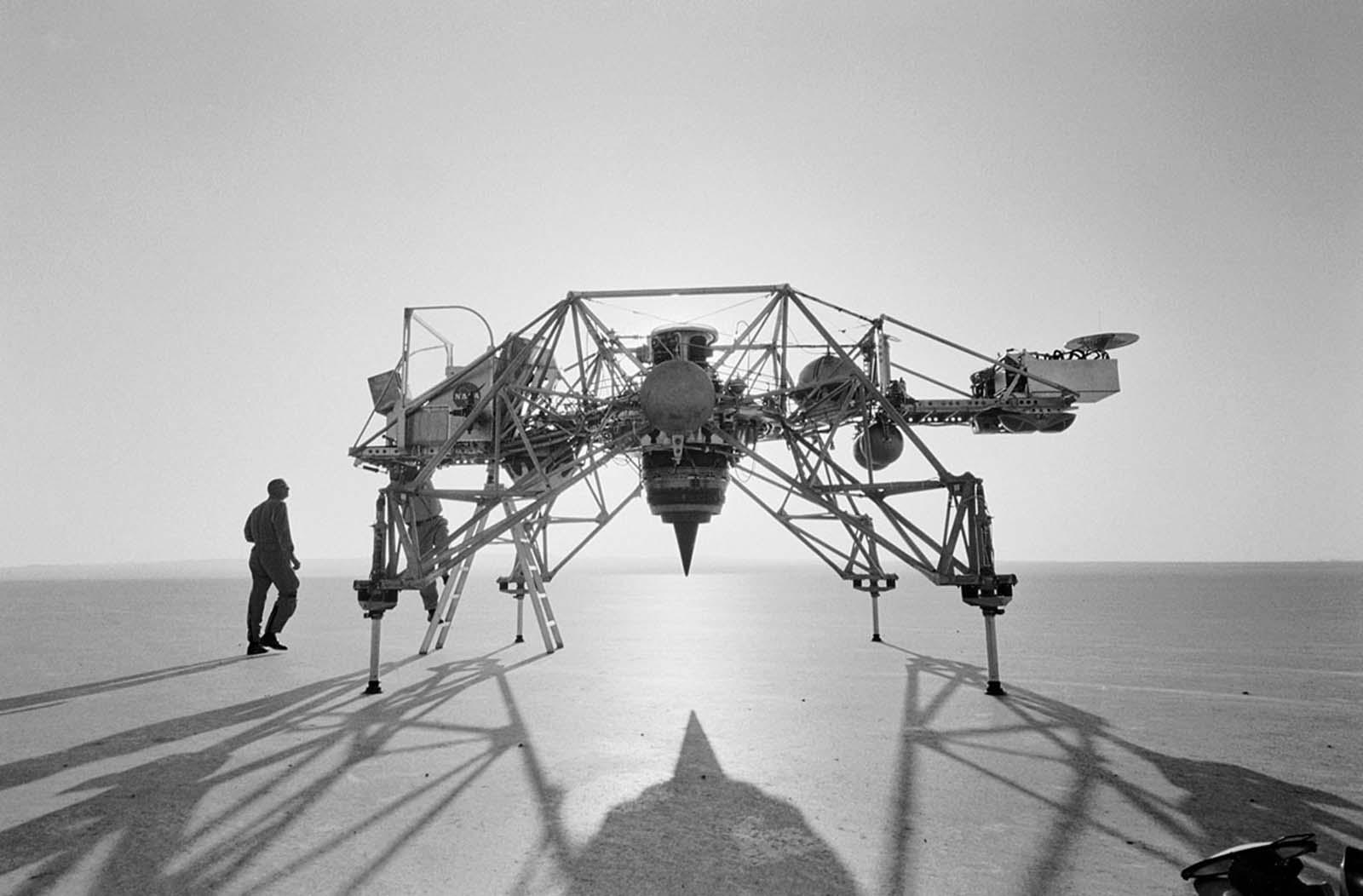
The first Lunar Landing Research Vehicle silhouetted against the rising sun on the dry lakebed at Edwards Air Force Base in California’s Mojave Desert
The first Lunar Landing Research Vehicle silhouetted against the rising sun on the dry lakebed at Edwards Air Force Base in California’s Mojave Desert.

In December 1961, NASA Headquarters in Washington, D.C., received an unsolicited proposal from Bell Aerosystems in Buffalo, New York, for a design of a flying simulator to train astronauts on landing a spacecraft on the Moon. Bell’s approach, using their design merged with concepts developed at NASA’s FRC, won approval and the space agency funded the design and construction of two Lunar Landing Research Vehicles (LLRV). At the time of the proposal, NASA had not yet chosen the method for getting to and landing on the Moon, but once NASA decided on Lunar Orbit Rendezvous in July 1962, the Lunar Module’s (LM) flying characteristics matched Bell’s proposed design closely enough that the LLRV served as an excellent trainer. 
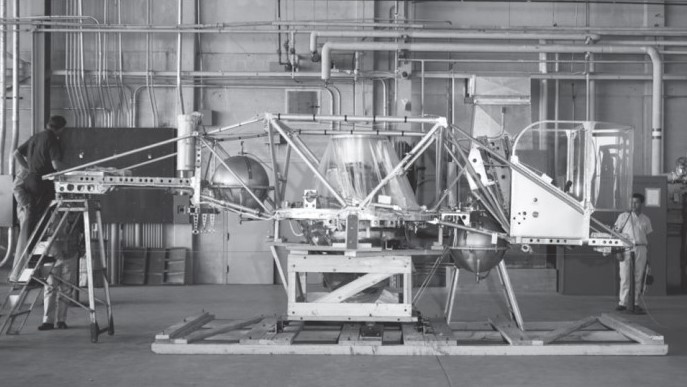
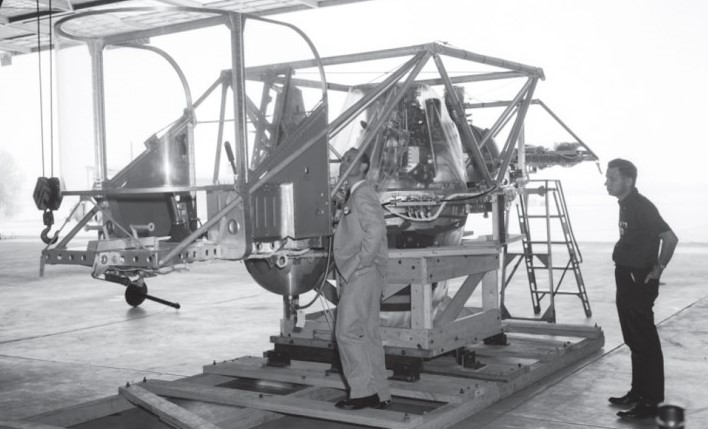
View of the first Lunar Landing Research Vehicle shortly after its arrival and prior to assembly at the Flight Research Center View of the first Lunar Landing Research Vehicle shortly after its arrival and prior to assembly at the Flight Research Center
Two views of the first Lunar Landing Research Vehicle shortly after its arrival and prior to assembly at the Flight Research Center, now NASA’s Armstrong Flight Research Center, in California.

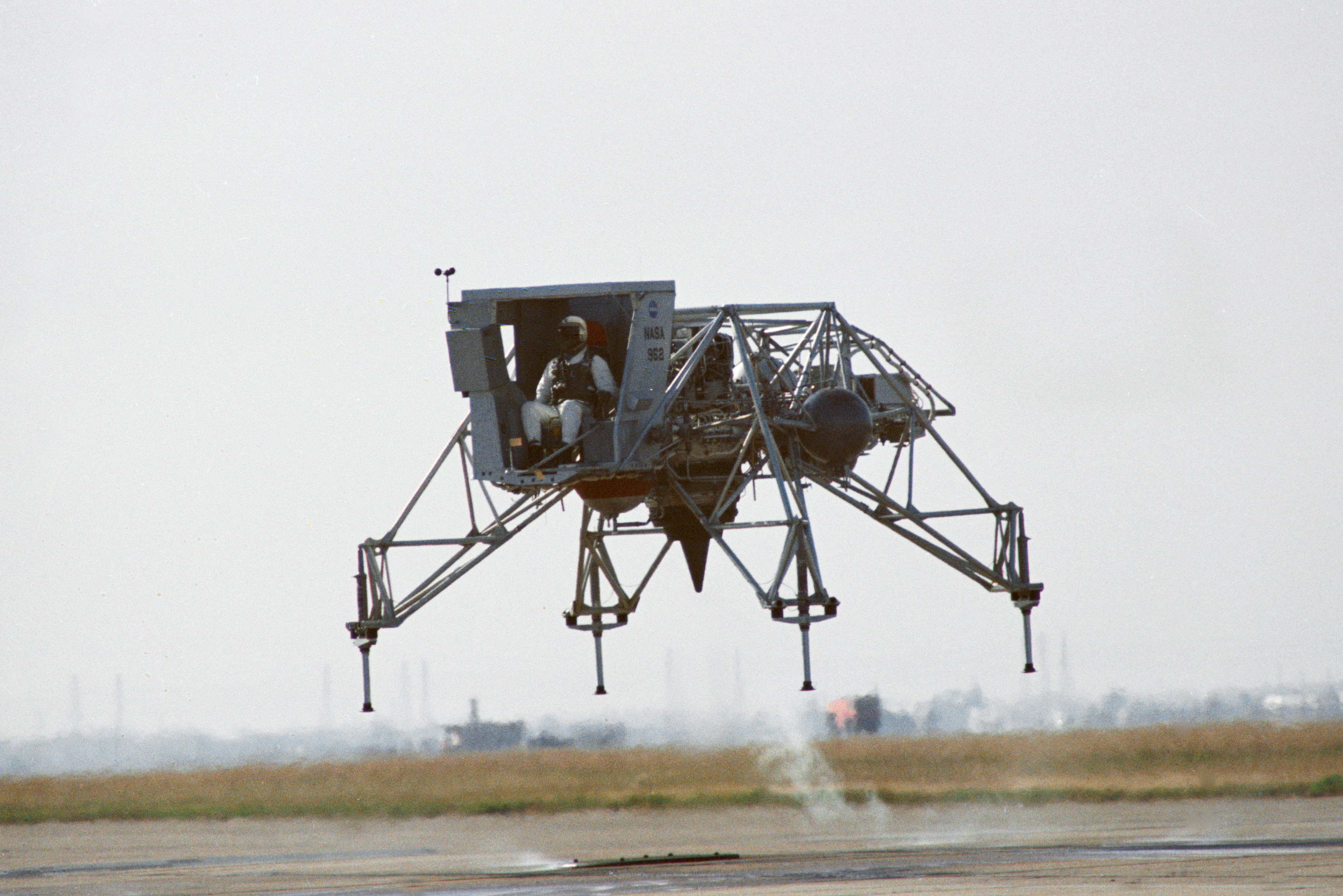
Bell Aerosystems delivered the LLRV-1 to FRC on April 8, 1964, where it made history as the first pure fly-by-wire aircraft to fly in Earth’s atmosphere. Its design relied exclusively on an interface with three analog computers to convert the pilot’s movements to signals transmitted by wire and to execute his commands. The open-framed LLRV used a downward pointing turbofan engine to counteract five-sixths of the vehicle’s weight to simulate lunar gravity, two rockets provided thrust for the descent and horizontal translation, and 16 LM-like thrusters provided three-axis attitude control. The astronauts could thus simulate maneuvering and landing on the lunar surface while still on Earth. The LLRV pilot could use an aircraft-style ejection seat to escape from the vehicle in case of loss of control.
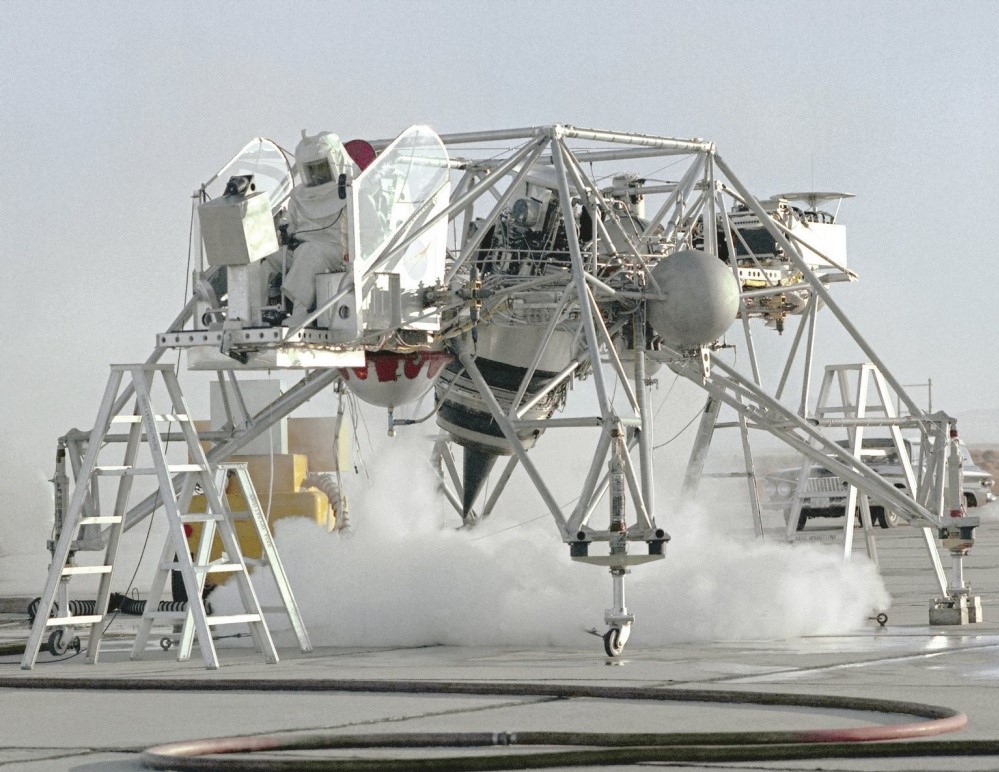
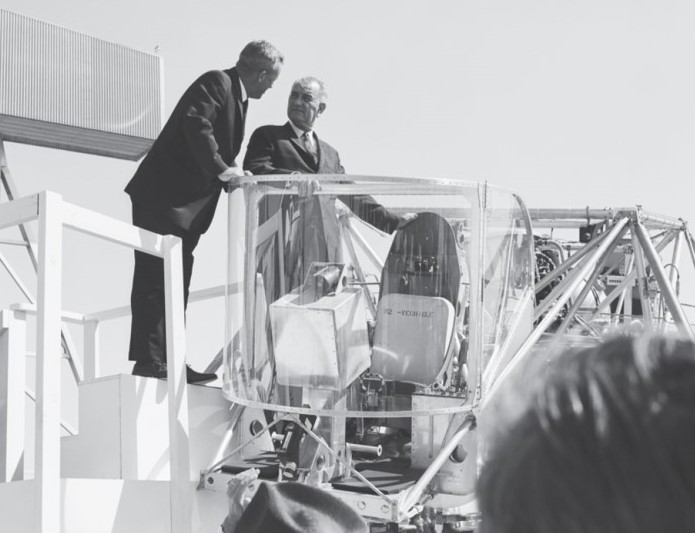
The Lunar Landing Research Vehicle-1 (LLRV-1) during an engine test at NASA’s Flight Research Center (FRC) NASA chief test pilot Joseph “Joe” A. Walker demonstrates the features of LLRV-1 to President Lyndon B. Johnson during his visit to FRC
Left: The Lunar Landing Research Vehicle-1 (LLRV-1) during an engine test at NASA’s Flight Research Center (FRC), now NASA’s Armstrong Fight Research Center, in California’s Mojave Desert. Right: NASA chief test pilot Joseph “Joe” A. Walker, left, demonstrates the features of LLRV-1 to President Lyndon B. Johnson during his visit to FRC.

Engineers conducted numerous tests to prepare the LLRV for its first flight. During one of the engine tests, the thrust generated was higher than anticipated, lifting crew chief Raymond White and the LLRV about a foot off the ground before White could shut off the engines. On June 19, during an official visit to FRC, President Lyndon B. Johnson inspected the LLRV featured on a static display. The Secret Service would not allow the President to sit in the LLRV’s cockpit out of an overabundance of caution since the pyrotechnics were installed, but not yet armed, in the ejection seat. Following a Preflight Readiness Review held Aug. 13 and 14, managers cleared the LLRV for its first flight.
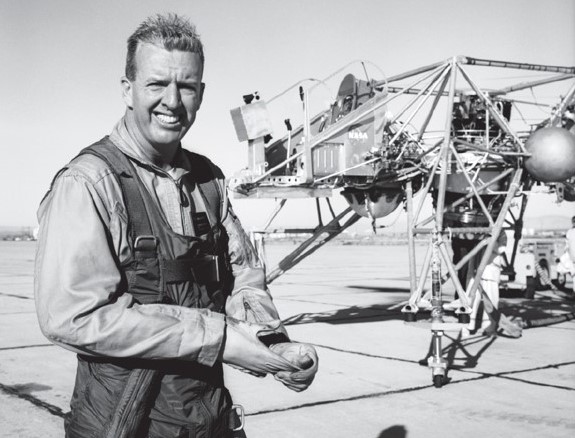
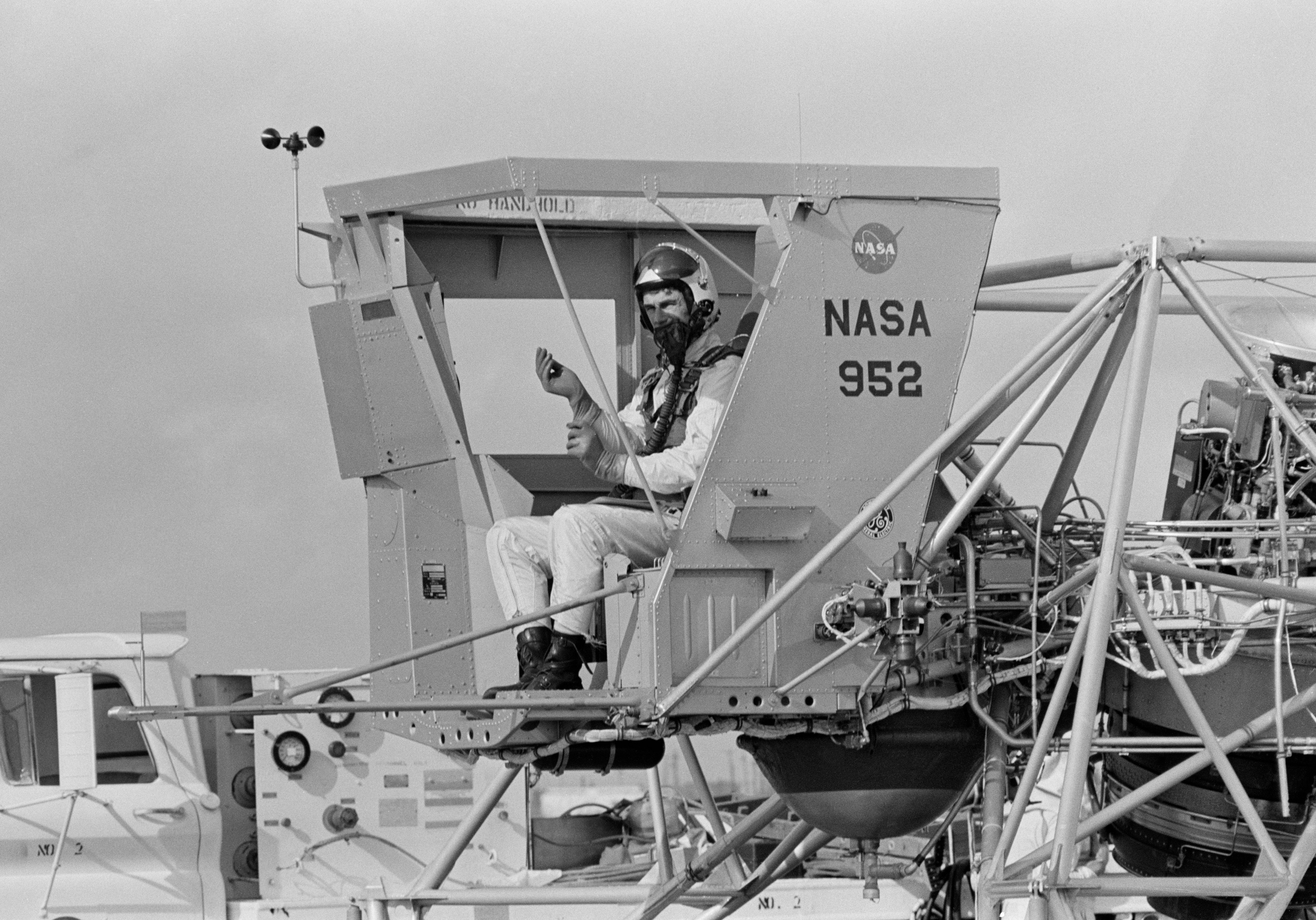
NASA chief test pilot Joseph “Joe” A. Walker during the first flight of the Lunar Landing Research Vehicle (LLRV) Walker shortly after the first LLRV flight
Left: NASA chief test pilot Joseph “Joe” A. Walker during the first flight of the Lunar Landing Research Vehicle (LLRV). Right: Walker shortly after the first LLRV flight.

In the early morning of Oct. 30, 1964, FRC chief pilot Joseph “Joe” A. Walker arrived at Edwards Air Force Base’s (AFB) South Base to attempt the first flight of the LLRV. Walker, a winner of both the Collier Trophy and the Harmon International Trophy, had flown nearly all experimental aircraft at Edwards including 25 flights in the X-15 rocket plane. On two of his X-15 flights, Walker earned astronaut wings by flying higher than 62 miles, the unofficial boundary between the Earth’s atmosphere and space. After strapping into the LLRV’s ejection seat, Walker ran through the preflight checklist before advancing the throttle to begin the first flight. The vehicle rose 10 feet in the air, Walker performed a few small maneuvers and then made a soft landing after having flown for 56 seconds. He lifted off again, performed some more maneuvers, and landed again after another 56 seconds. On his third flight, the vehicle’s electronics shifted into backup mode and he landed the craft after only 29 seconds. Walker seemed satisfied with how the LLRV handled on its first flights.
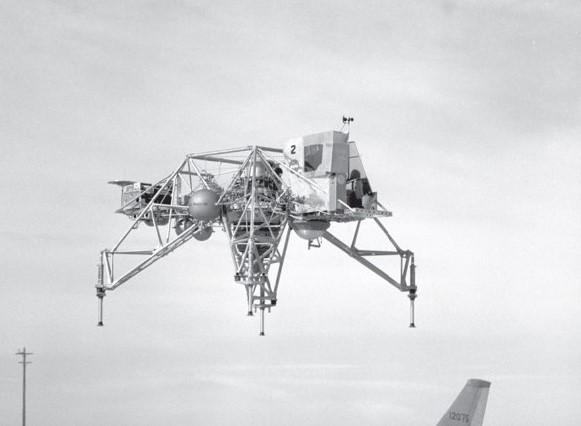
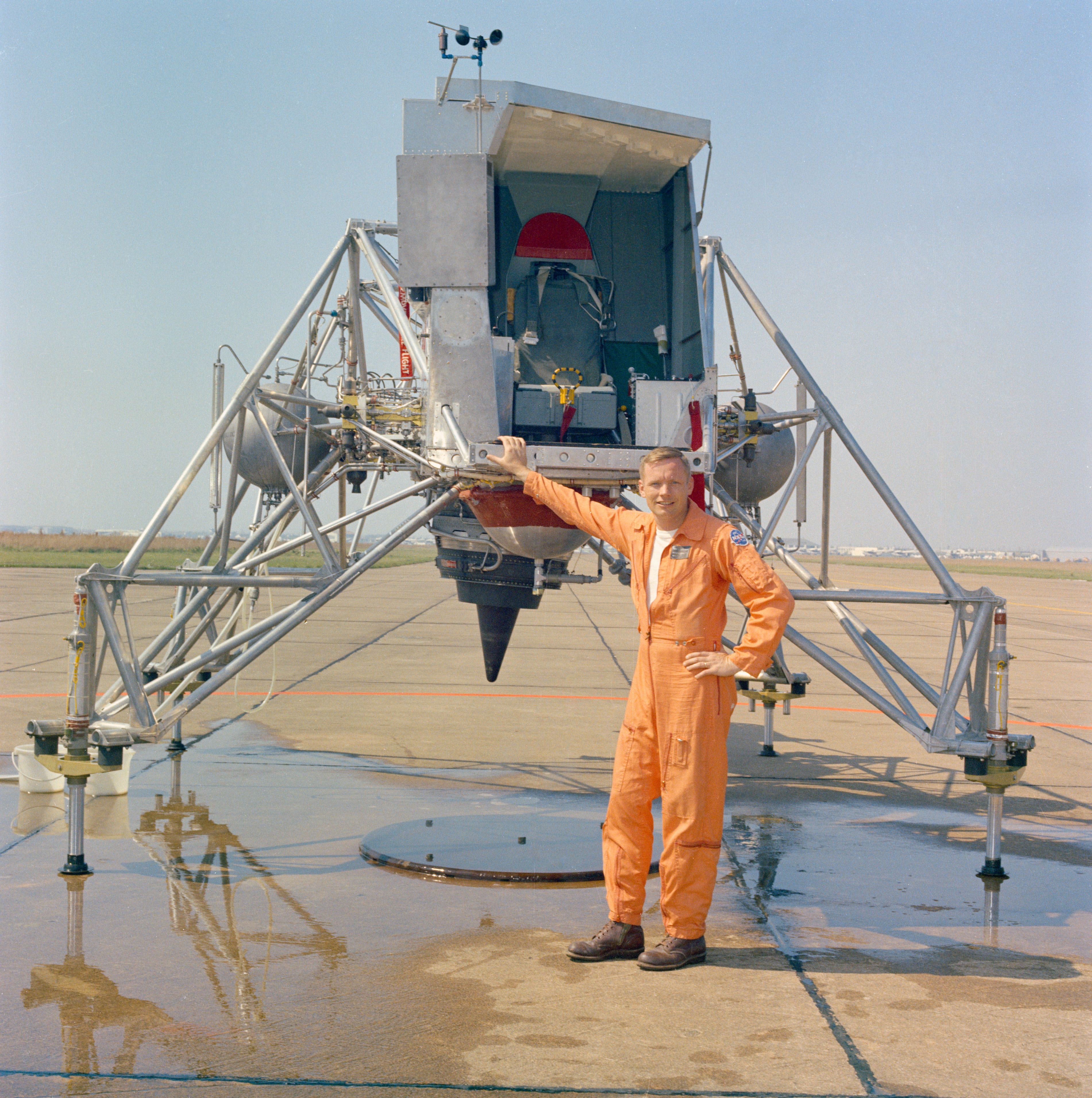
Lunar Landing Research Vehicle-2 (LLRV-2) during one of its six flights at the Flight Research Center NASA astronaut Neil A. Armstrong with LLRV-1 at Ellington Air Force Base in March 1967
Left: Lunar Landing Research Vehicle-2 (LLRV-2) during one of its six flights at the Flight Research Center, now NASA’s Armstrong Flight Research Center, in California in January 1967. Right: NASA astronaut Neil A. Armstrong with LLRV-1 at Ellington Air Force Base in March 1967.

Walker took LLRV-1 aloft again on Nov. 16 and eventually completed 35 test flights with the vehicle. Test pilots Donald “Don” L. Mallick, who completed the first simulated lunar landing profile flight during the LLRV’s 35th flight on Sept. 8, 1965, and Emil E. “Jack” Kluever, who made his first flight on Dec. 13, 1965, joined Walker to test the unique aircraft. Joseph S. “Joe” Algranti and Harold E. “Bud” Ream, pilots at the Manned Spacecraft Center (MSC), now NASA’s Johnson Space Center (JSC) in Houston, travelled to FRC to begin training flights with the LLRV in August 1966. Workers at FRC assembled the second vehicle, LLRV-2, during the latter half of 1966. In December 1966, after 198 flights workers transferred LLRV-1 to Ellington AFB near MSC for the convenience of astronaut training, and LLRV-2 followed in January 1967 after completing six test flights at FRC. The second LLRV made no further flights, partly because the three Lunar Landing Training Vehicles (LLTVs), more advanced models that better simulated the LM’s flying characteristics, began to arrive at Ellington in October 1967. Neil A. Armstrong completed the first astronaut flights aboard LLRV-1 on Mar. 23, 1967, and flew 21 flights before ejecting from the vehicle on May 6, 1968, seconds before it crashed. He later completed his lunar landing certification flights using LLTV-2 in June 1969, one month before peforming the actual feat on the Moon.
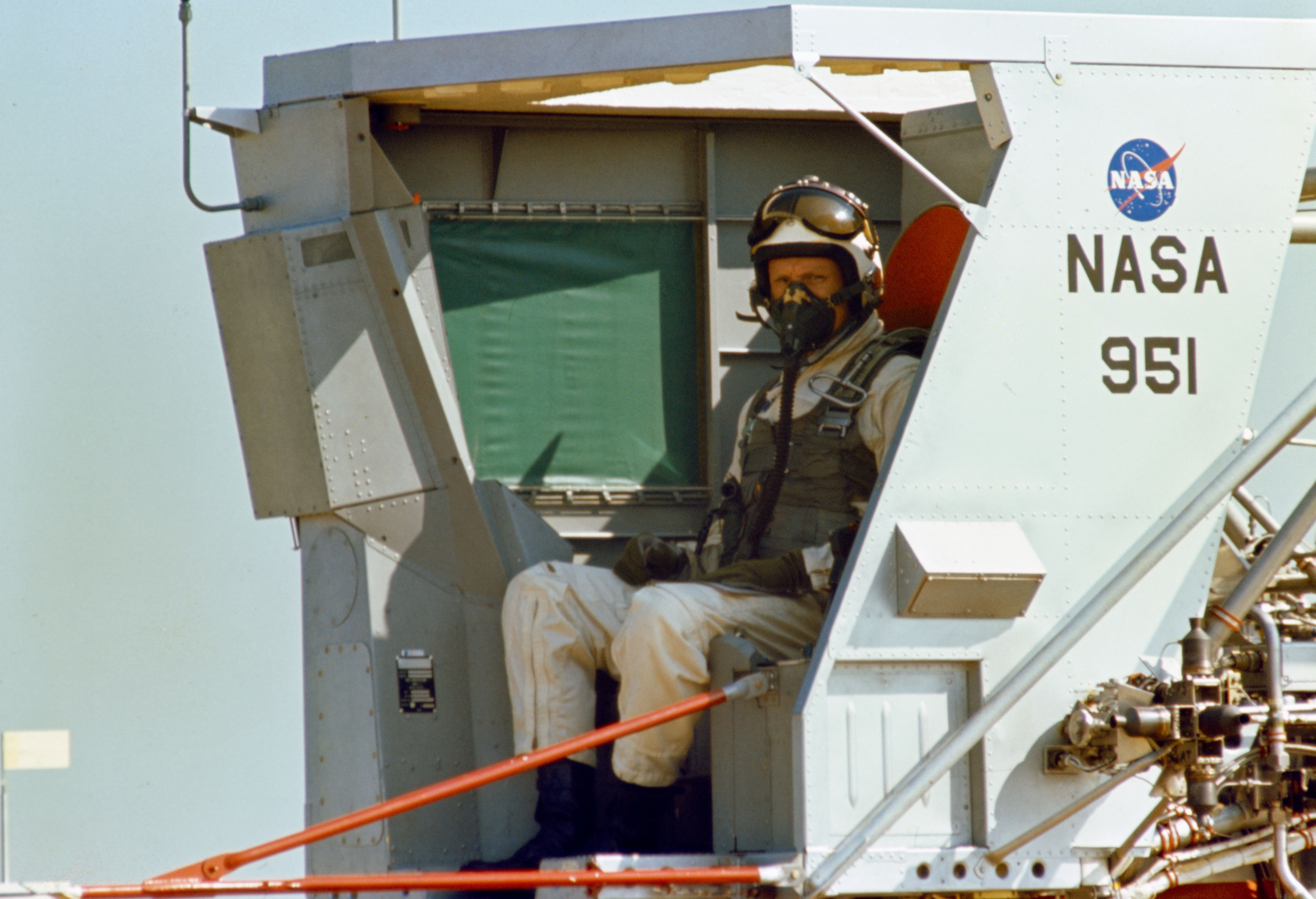
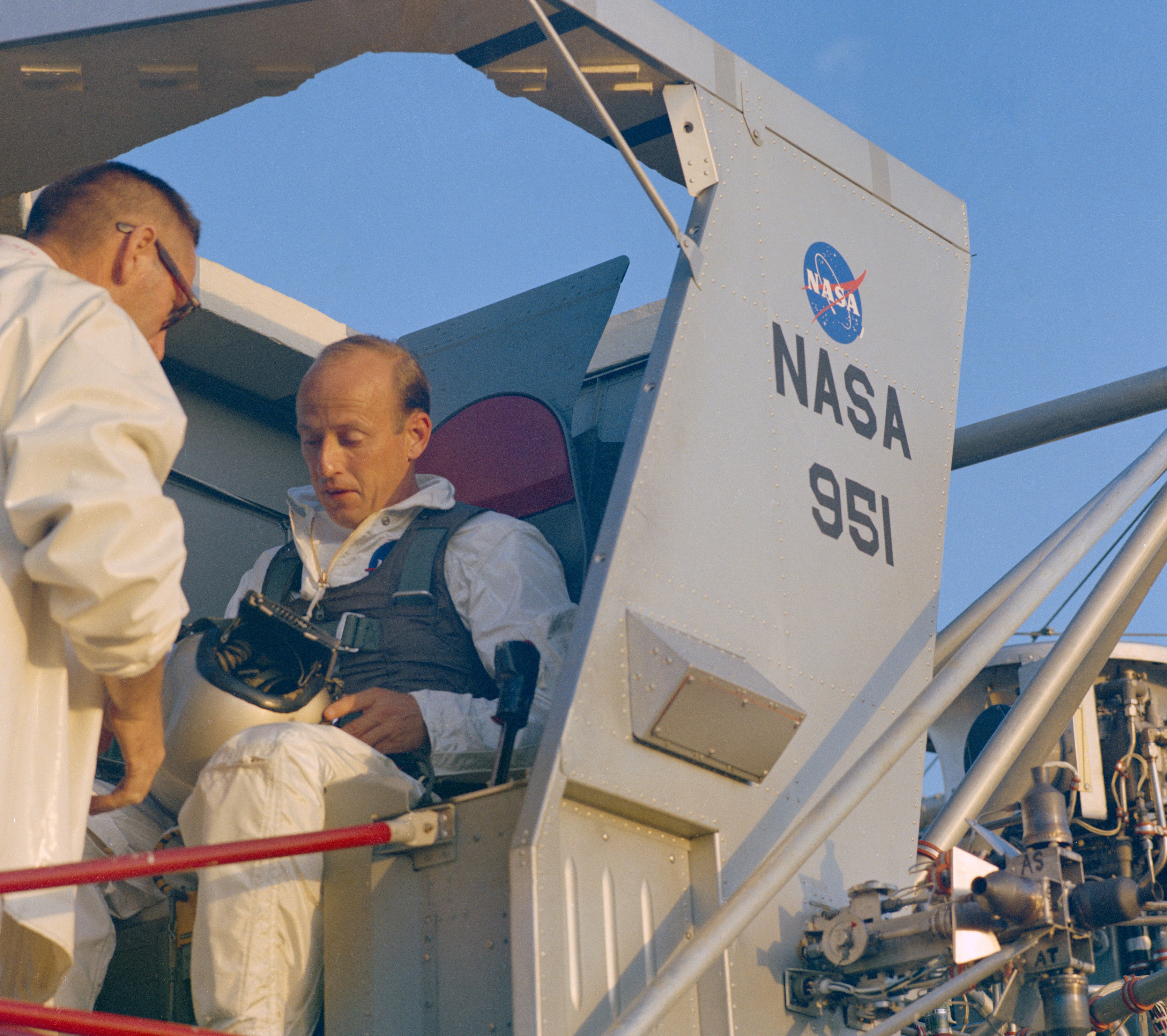
Apollo 11 Commander Neil A. Armstrong prepares to fly a lunar landing profile in LLTV-2 Apollo 12 Commander Charles “Pete” Conrad prepares to fly LLTV-2 Apollo 14 Commander Alan B. Shepard flies LLTV-3
Left: Apollo 11 Commander Neil A. Armstrong prepares to fly a lunar landing profile in Lunar Landing Training Vehicle-2 (LLTV-2) in June 1969. Middle: Apollo 12 Commander Charles “Pete” Conrad prepares to fly LLTV-2 in July 1969. Right: Apollo 14 Commander Alan B. Shepard flies LLTV-3 in December 1970.

All Apollo Moon landing mission commanders and their backups completed their lunar landing certifications using the LLTV, and all the commanders attributed their successful landings to having trained in the LLTV. Apollo 8 astronaut William A. Anders, who along with Armstrong completed some of the early LLRV test flights, called the training vehicle “a much unsung hero of the Apollo program.” During the flight readiness review in January 1970 to clear LLTV-3 for astronaut flights, Apollo 11 Commander Armstrong and Apollo 12 Commander Charles “Pete” Conrad, who had by then each completed manual landings on the Moon, spoke positively of the LLTV’s role in their training. Armstrong’s overall impression of the LLTV: “All the pilots … thought it was an extremely important part of their preparation for the lunar landing attempt,” adding “It was a contrary machine, and a risky machine, but a very useful one.” Conrad emphasized that were he “to go back to the Moon again on another flight, I personally would want to fly the LLTV again as close to flight time as possible.” During the Apollo 12 technical debriefs, Conrad stated the “the LLTV is an excellent training vehicle for the final phases. I think it’s almost essential. I feel it really gave me the confidence that I needed.” During the postflight debriefs, Apollo 14 Commander Alan B. Shepard stated that he “did feel that the LLTV contributed to my overall ability to fly the LM during the landing.”

Apollo 15 Commander David R. Scott flies Lunar Landing Training Vehicle-3 Apollo 16 Commander John W. Young prepares to fly LLTV-3 Apollo 17 Commander Eugene A. Cernan prepares for a flight aboard LLTV-3
Left: Apollo 15 Commander David R. Scott flies Lunar Landing Training Vehicle-3 (LLTV-3) in June 1971. Middle: Apollo 16 Commander John W. Young prepares to fly LLTV-3 in March 1972. Right: Apollo 17 Commander Eugene A. Cernan prepares for a flight aboard LLTV-3 in October 1972.

David R. Scott, Apollo 15 commander, stated in the final mission report that “the combination of visual simulations and LLTV flying provided excellent training for the actual lunar landing. Comfort and confidence existed throughout this phase.” In the Apollo 15 postflight debrief, Scott stated that he “felt very comfortable flying the vehicle (LM) manually, because of the training in the LLTV, and there was no question in my mind that I could put it down where I wanted to. I guess I can’t say enough about that training. I think the LLTV is an excellent simulation of the vehicle.” Apollo 16 Commander John W. Young offered perhaps the greatest praise for the vehicle just moments after landing on the lunar surface: “Just like flying the LLTV. Piece of cake.” Young reiterated during the postflight debriefs that “from 200 feet on down, I never looked in the cockpit. It was just like flying the LLTV.” Apollo 17 Commander Eugene A. Cernan stated in the postflight debrief that “the most significant part of the final phases from 500 feet down, … was that it was extremely comfortable flying the bird. I contribute (sic) that primarily to the LLTV flying operations.”
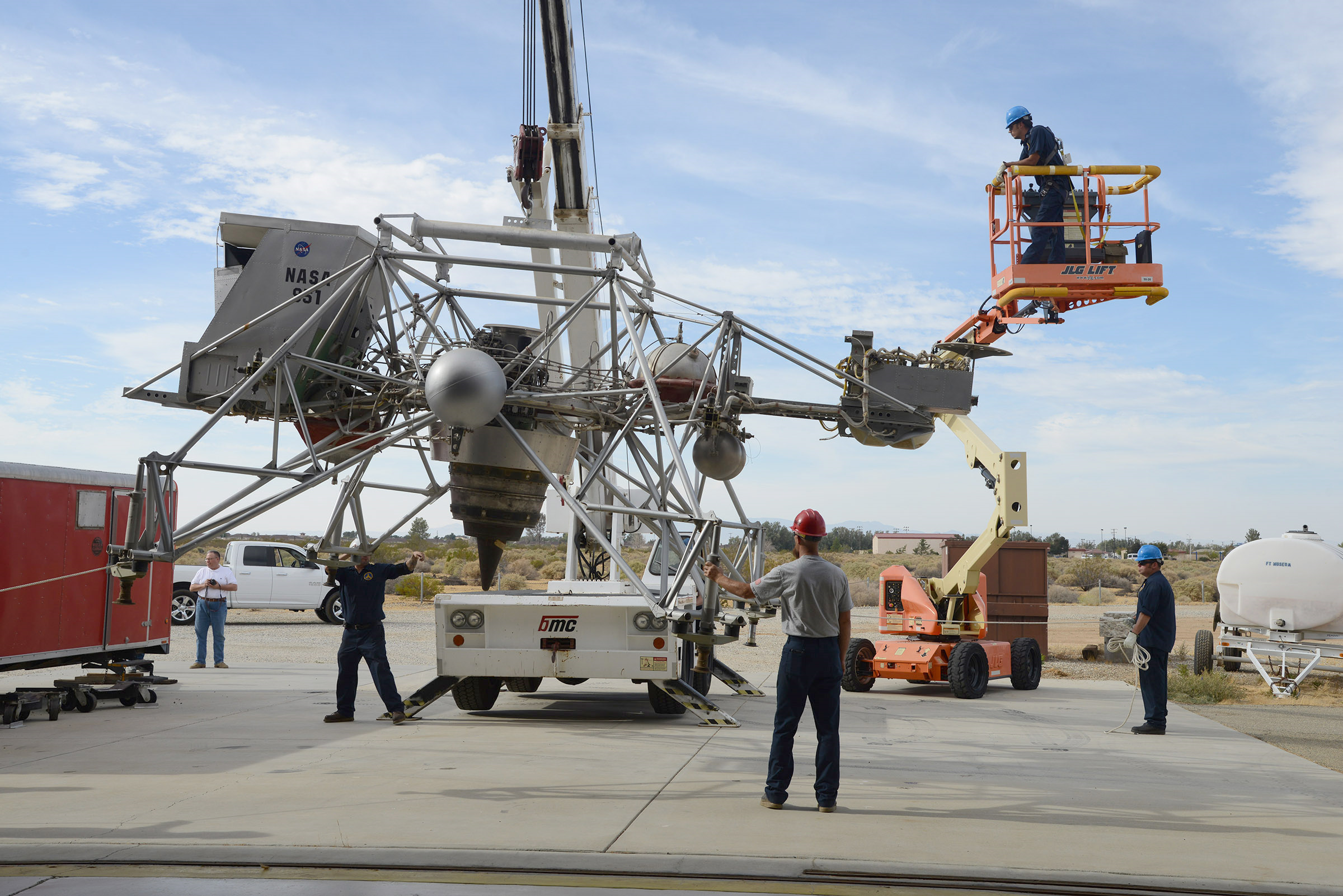
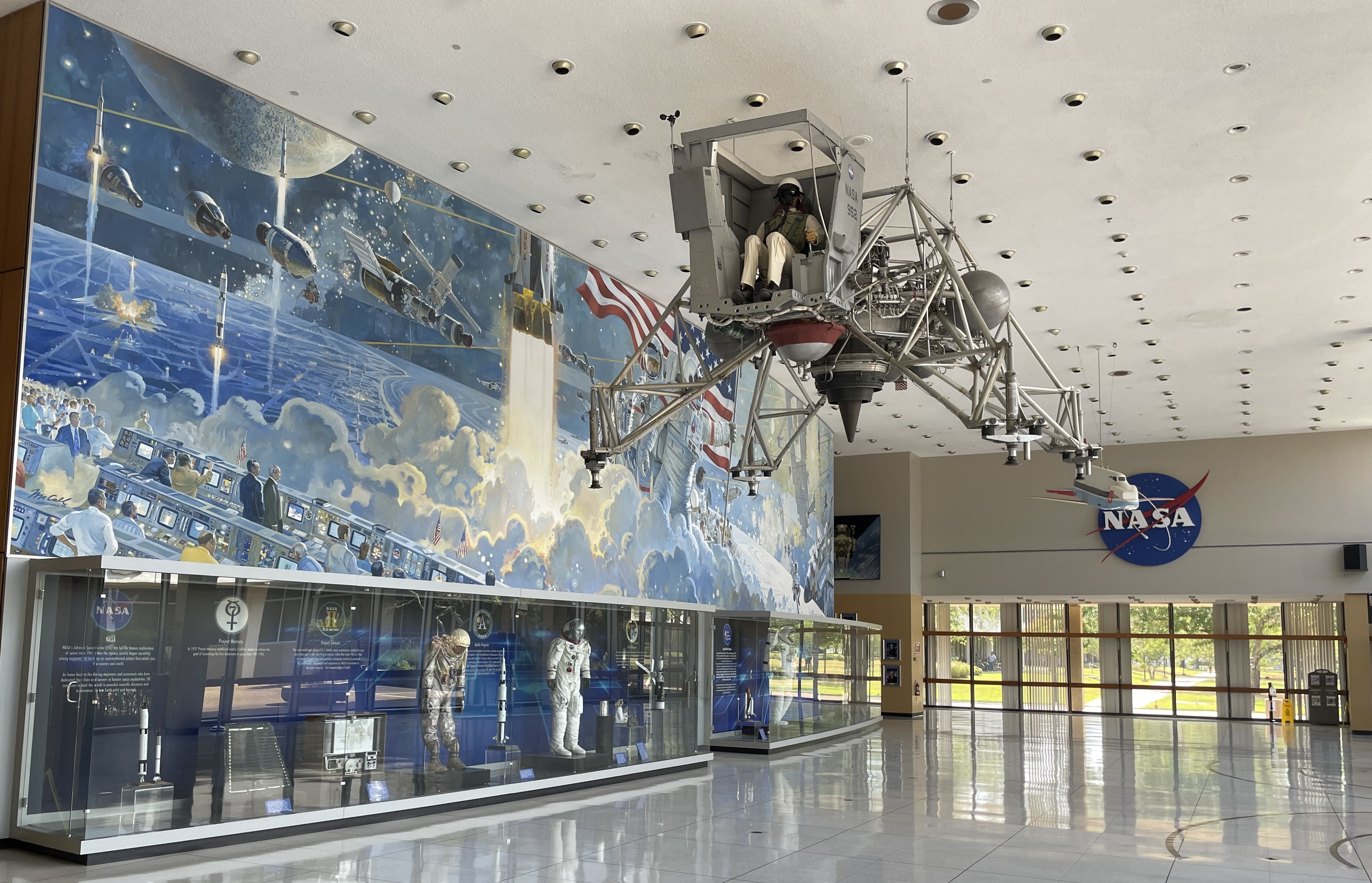
Workers move Lunar Landing Research Vehicle-2 from NASA’s Armstrong Flight Research Center for display at the Air Force Test Flight Museum Lunar Landing Training Vehicle-3 on display outside the Teague Auditorium at NASA’s Johnson Space Center in Houston
Left: Workers move Lunar Landing Research Vehicle-2 from NASA’s Armstrong Flight Research Center for display at the Air Force Test Flight Museum at Edwards Air Force Base. Right: Lunar Landing Training Vehicle-3 on display outside the Teague Auditorium at NASA’s Johnson Space Center in Houston.

In addition to playing a critical role in the Moon landing program, these early research and test vehicles aided in the development of digital fly-by-wire technology for future aircraft. LLRV-2 is on display at the Air Force Flight Test Museum at Edwards AFB (on loan from AFRC). Visitors can view LLTV-3 suspended from the ceiling in the lobby of the Teague Auditorium at JSC.

The monograph Unconventional, Contrary, and Ugly: The Lunar Landing Research Vehicle provides an excellent and detailed history of the LLRV.

Powered by WPeMatico

Get The Details…
Kelli Mars

NASA Technologies Named Among TIME Inventions of 2024

NASA Technologies Named Among TIME Inventions of 2024

As NASA continues to innovate for the benefit of humanity, agency inventions that use new structures to harness sunlight for space travel, enable communications with spacecraft at record-breaking distances, and determine the habitability of a moon of Jupiter, were named Wednesday among TIME’s Inventions of 2024.

“The NASA workforce — wizards, as I call them — have been at the forefront of invention and technology for more than 65 years,” said NASA Administrator Bill Nelson. “From developing Europa Clipper, the largest satellite for a planetary mission that NASA has ever launched, to the Advanced Composite Solar Sail System, and communicating with lasers from deep space, NASA is improving our understanding of life on Earth — and the cosmos — for the benefit of all.”

Solar Sailing with Composite Booms

Mario Perez, back, holds a deployable solar panel as Craig Turczynski, left, secures it to the Advanced Composite Solar Sail System (ACS3) spacecraft in the Integration Facility of NASA Ames Research Center.
Credit: NASA/Don Richey

NASA’s Advanced Composite Solar Sail System is testing technologies that could allow spacecraft to “sail on sunlight,” using the Sun’s rays for propulsion. Like a sailboat turning to catch the wind, a solar sail adjusts its trajectory by angling its sail supported by booms deployed from the spacecraft. This demonstration uses a composite boom technology that is stiffer, lighter, and more stable in challenging thermal environments than previous designs. After launching on April 23, aboard Rocket Lab’s Electron rocket, the mission team met its primary objective by deploying the boom and sail system in space in August. Next, they will work to prove performance by using the sail to maneuver in orbit.  

Results from this mission could provide an alternative to chemical and electric propulsion systems and inform the design of future larger-scale missions that require unique vantage points, such as space weather early warning satellites.

Communicating with Lasers from Deep Space

The Deep Space Optical Communications (DSOC) technology demonstration's flight laser transceiver is seen attached to NASA's Psyche spacecraft inside a clean room at the agency's Jet Propulsion Laboratory in Southern California. DSOC's tube-like gray/silver sunshade can be seen protruding from the side of the spacecraft. The bulge to which the sunshade is attached is DSOC's transceiver, which consists of a near-infrared laser transmitter to send high-rate data to Earth and a sensitive photon-counting camera to receive ground-transmitted low-rate data.
The Deep Space Optical Communications (DSOC) technology demonstration’s flight laser transceiver is seen attached to NASA’s Psyche spacecraft inside a clean room at the agency’s Jet Propulsion Laboratory in Southern California. DSOC’s tube-like gray/silver sunshade can be seen protruding from the side of the spacecraft. The bulge to which the sunshade is attached is DSOC’s transceiver, which consists of a near-infrared laser transmitter to send high-rate data to Earth and a sensitive photon-counting camera to receive ground-transmitted low-rate data.
Credits: NASA/JPL-Caltech

Since launching aboard NASA’s Psyche spacecraft on Oct. 13, 2023, a Deep Space Optical Communications technology demonstration has delivered record-breaking downlink data rates to ground stations as the Psyche spacecraft travels through deep space. To demonstrate the high data rates that are possible with laser communications, photos, telemetry data from the spacecraft, and ultra-high-definition video, including a streamed video of Taters the cat chasing a laser pointer, have been downlinked over hundreds of millions of miles. The mission, which is managed by NASA’s Jet Propulsion Laboratory in Southern California, has also sent and received optical communications out to Mars’ farthest distance from Earth, fulfilling one of the project’s primary goals.

Searching for Life’s Ingredients at Jupiter’s Icy Moon Europa

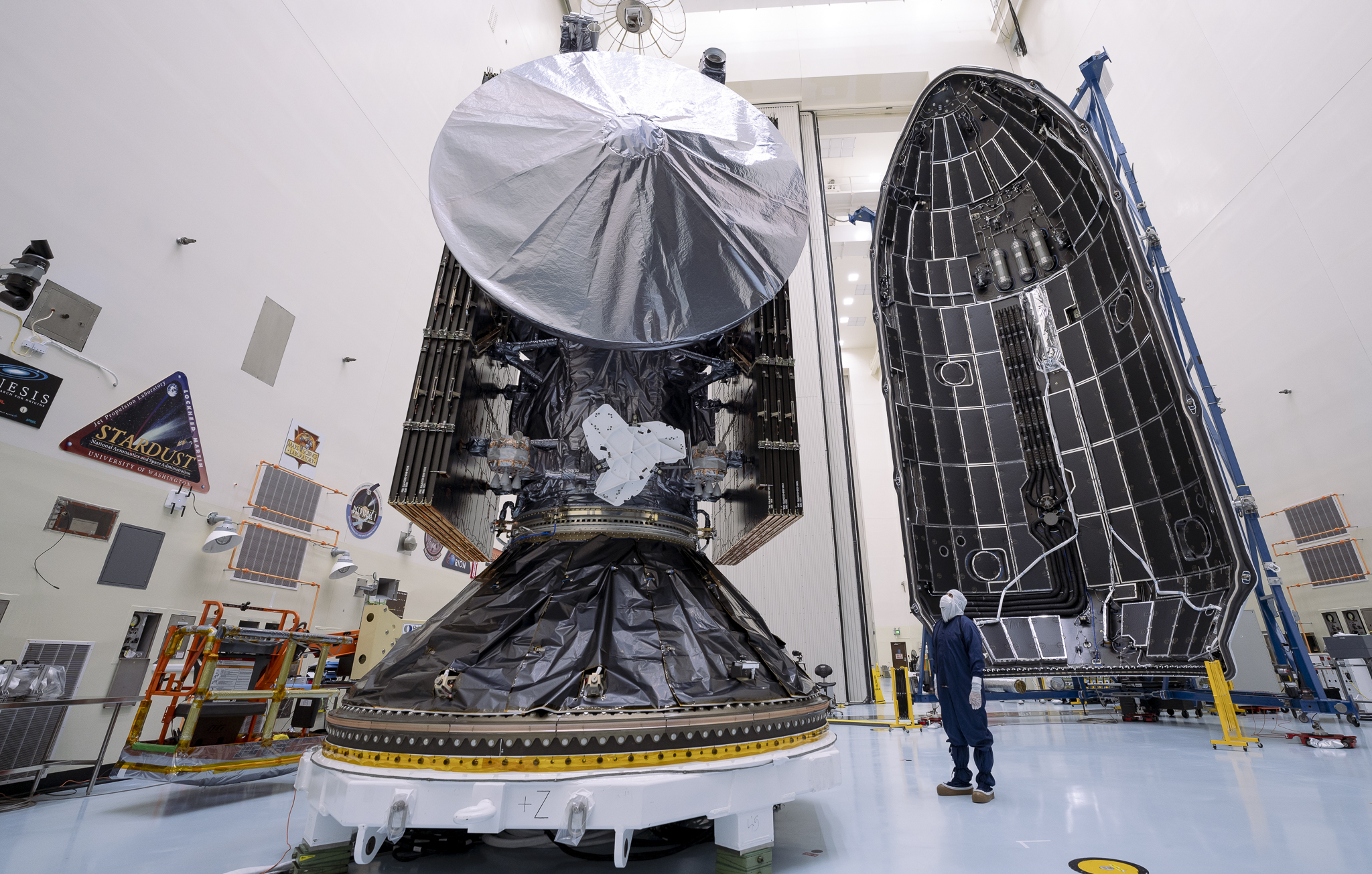
Technicians prepare to encapsulate NASA’s Europa Clipper spacecraft inside SpaceX’s Falcon Heavy payload fairing in the Payload Hazardous Servicing Facility at NASA’s Kennedy Space Center in Florida on Oct. 2, 2024.
Credit: SpaceX

The largest NASA spacecraft ever built for a mission headed to another planet, Europa Clipper also is the agency’s first mission dedicated to studying an ocean world beyond Earth. Using a suite of nine science instruments and a gravity experiment, the mission seeks to determine whether Jupiter’s moon, Europa, has conditions that could support life. There’s strong evidence that under Europa’s ice lies an enormous, salty ocean. Scientists also have found evidence that Europa may host organic compounds and energy sources under its surface. Managed by NASA’s Jet Propulsion Laboratory, the spacecraft launched on Oct. 14, and will begin orbiting Jupiter in 2030, flying by the icy moon 49 times to learn more about it.

Europa Clipper’s main science objectives are to determine the thickness of the moon’s icy shell and its interactions with the ocean below, to investigate its composition, and to characterize its geology. The detailed exploration will help scientists better understand the astrobiological potential for habitable worlds beyond our planet.

NASA’s Ames Research Center in California’s Silicon Valley manages the Advanced Composite Solar Sail System, and NASA’s Langley Research Center in Hampton, Virginia, designed and built the deployable composite booms and solar sail system. Within NASA’s Space Technology Mission Directorate (STMD), the Small Spacecraft Technology program funds and manages the mission and the Game Changing Development program developed the deployable composite boom technology.

The Deep Space Optical Communications experiment is funded by STMD’s Technology Demonstration Missions Program managed at NASA’s Marshall Space Flight Center in Huntsville, Alabama, and the agency’s Space Communications and Navigation program within the Space Operations Mission Directorate. Some of the technology was developed through NASA’s Small Business Innovation Research program.

Managed by Caltech in Pasadena, California, NASA’s Jet Propulsion Laboratory leads the development of the Europa Clipper mission in partnership with Johns Hopkins Applied Physics Laboratory in Laurel, Maryland for NASA’s Science Mission Directorate. The Applied Physics Laboratory designed the main spacecraft body in collaboration with the Jet Propulsion Laboratory as well as NASA’s Goddard Space Flight Center in Greenbelt, Maryland, NASA Marshall, and NASA Langley.

For more information about the agency’s missions, visit:

https://www.nasa.gov

Powered by WPeMatico

Get The Details…
Tiernan P. Doyle

A Spooky Soliday: Haunting Whispers from the Martian Landscape

A Spooky Soliday: Haunting Whispers from the Martian Landscape

2 min read

A Spooky Soliday: Haunting Whispers from the Martian Landscape

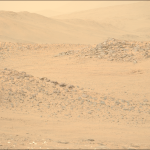
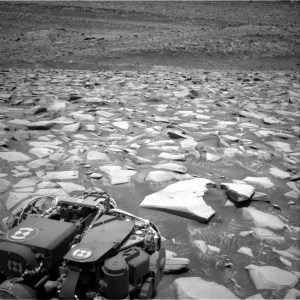
Image taken by Perseverance of rocky slopes of the Jezero crater rim.
NASA’s Mars Perseverance rover acquired this image, which was selected by the public as the rover’s “Image of the Week,” of the martian landscape on the Jezero crater rim using its Left Mastcam-Z camera. The image was acquired on Oct. 22, 2024 (Sol 1306) at the local mean solar time of 13:45:41.
NASA/JPL-Caltech/ASU

The Perseverance rover lurks in the quiet, cold, desolate landscape of Jezero crater on Mars, a place masked in shadows and haunted by past mysteries. Built to endure the planet’s harsh conditions, Perseverance braves the thin atmosphere and extreme temperature swings. Its microphone captures the eerie whispers of martian winds, sending shivers down your spine, and records ghostly dust devils swirling across the barren terrain. Has the microphone caught the sound of a skeleton rattling its bones? We’ll leave that up to your imagination.

Recently, Perseverance navigated the sinister slopes of the Jezero crater rim, seeking out a series of ramshackle ridges to uncover the rim’s hidden geological secrets. The rover emerged from the shadows to descend into a field of light-toned rocks, illuminating the landscape reminiscent of bones and tombstones. Along the way, the rover encountered dark bedrock at Mist Park. Perseverance will then face another daunting climb back up the crater rim, venturing deeper into the great unknown.

Unlike vampires or other creatures of the night, Perseverance needs rest after long days of exploring the mystifying martian landscape. As night falls, the rover sleeps after watching the Sun sink below the horizon, casting ominous shadows across the landscape. The chilling winds howl through the night like a haunting lullaby for the fearless explorer. However, Perseverance sometimes wakes up from things that go bump in the night. While instruments mostly conduct their scientific measurements during the day, they are not afraid of the dark, often tasked with observing what lurks in the shadows and gazing at the martian night sky. Perseverance occasionally looks up to image the auroras and to get a glimpse of Phobos and Deimos, Mars’ two Moons.

Mars is like a hotel you can check in and out of, but you can never leave. It has become a graveyard of long-dead landers and rovers, but Perseverance is nowhere near ready to leave the land of the living. In fact, the ghosts of past rovers and landers guide Perseverance on its journey. As we continue to uncover the secrets of Mars, we are reminded of its past and the mysteries that still linger. Join us in pondering the mysteries of Mars as we explore its haunted history.   

Written by Stephanie Connell, Ph.D. Student Collaborator at Purdue University

Share

Details

Last Updated
Oct 30, 2024

Related Terms

Powered by WPeMatico

Get The Details…

Ken Iliff: Engineering 40 Years of Success

Ken Iliff: Engineering 40 Years of Success

10 min read

Preparations for Next Moonwalk Simulations Underway (and Underwater)

Editor’s note: This article was published May 23, 2003, in NASA Armstrong’s X-Press newsletter. NASA’s Dryden Flight Research Center in Edwards, California, was redesignated Armstrong Flight Research Center on March 1, 2014. Ken Iliff was inducted into the National Hall of Fame for Persons with Disabilities in 1987. He died Jan. 4, 2016.

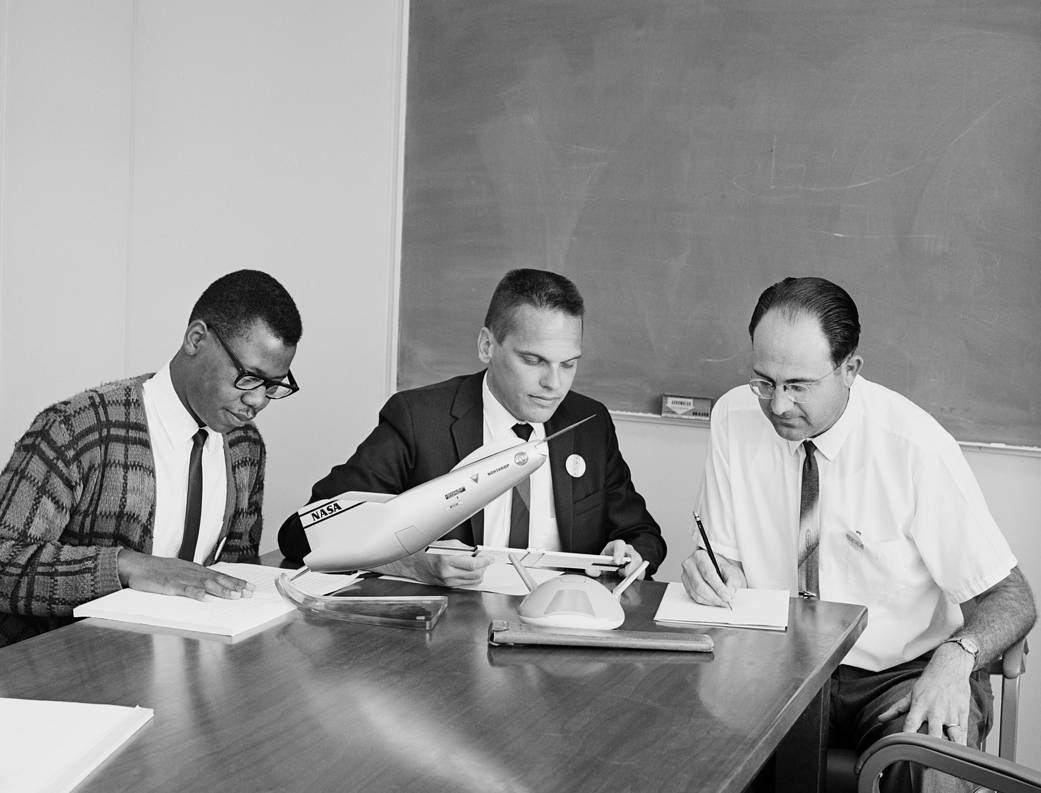
Three men look at aircraft models.
Alphonso Stewart, from left, Ken Iliff, and Dale Reed study lifting body aircraft models at NASA’s Armstrong (then Dryden) Flight Research Center in Edwards, California.
NASA

As an Iowa State University engineering student in the early 1960s, Ken Iliff was hard at work on a glider flight simulation.

Upon examining the final results – which, in those early days of the computer revolution, were viewed on a long paper printout – he noticed one glaring imperfection: the way he had programmed it, his doomed glider would determinedly accelerate as it headed for the ground.

The culprit was a single keystroke. At the time, programming was based on data that had been painstakingly entered into the computer by hand, on punch cards and piece by piece. Somewhere, Iliff had entered a plus sign instead of a minus sign.

The seemingly minor incident was to foreshadow great things to come in Iliff’s career.

Not long after graduation, the West Union, Iowa, native found himself at what was then called simply the NASA Flight Research Center located on Edwards Air Force Base.

“I just knew I didn’t want to be sitting somewhere in a big room full of engineers who were all doing the same thing,” Iliff said of choosing Dryden over other jobs and other NASA centers. “It was a small center doing important things, and it was in California. I knew I wanted to be there.”

Once at Dryden, the issue of data tidbits was central to the new hire’s workday. Iliff’s post called for him and many of his colleagues to spend much of their time “reading up” data – a laborious process of measuring data from film using a single reference line and a ruler. Measurements were made every tenth of a second; for a ten-second maneuver, a total of one hundred “traces” were taken for every quantity being recorded.

“I watched talented people spending entire days analyzing data,” he recalled. “And then, maybe two people would arrive at two entirely different conclusions” from the same data sets.

As has happened so often at the birth of revolutionary ideas, then, one day Iliff had a single, simple thought about the time-intensive and maddeningly inexact data analysis process:

“There just has to be a better way to do this.”

The remedy he devised was to result in a sea change at Dryden, and would reverberate throughout the world of computer-based scientific research.

Iliff’s work spanned the decades that encompassed some of Dryden’s greatest achievements, from the X-15 through the XB-70 and the tentative beginnings of the shuttle program. The solution he created to the problem of inaccuracy in data analysis focused on aerodynamic performance – how to formulate questions about an aircraft’s performance once answers about it are already known, how to determine the “why?” when the “what happens?” has already happened.

The work is known as “parameter estimation,” and is used in aerospace applications to extract precise definitions of aerodynamic, structural and performance parameters from flight data.

His methodology – cemented in computer coding Iliff developed using Fortran’s lumbering binary forerunner, machine code – allowed researchers to determine precisely the type of information previously derived only as best-estimate guesses through analysis of data collected in wind tunnels and other flight-condition simulators. In addition to aerospace science, parameter estimation is also used today in a wide array of research applications, including those involving submarines, economic models, and biomedicine.

With characteristic deference, Iliff now brushes off any suggestion of his discovery’s significance. Instead, he credits other factors for his successes, such as a Midwestern work ethic and Iowa State University’s early commitment to giving its engineering students good access to the new and emerging computer technology.

To hear him tell it, “all good engineers are a little bit lazy. We know how to innovate – how to find an easier way.

“I’d been trained well, and given the right tools – I was just in the right place at the right time.”

But however modestly he might choose to see it characterized, it’s fair to number Iliff’s among the longest and most distinguished careers to take root in the ranks of Dryden research engineers. Though his groundbreaking work will live forever in research science, when Iliff retired in December he brought to a close his official role in some of the most important chapters in Dryden history.

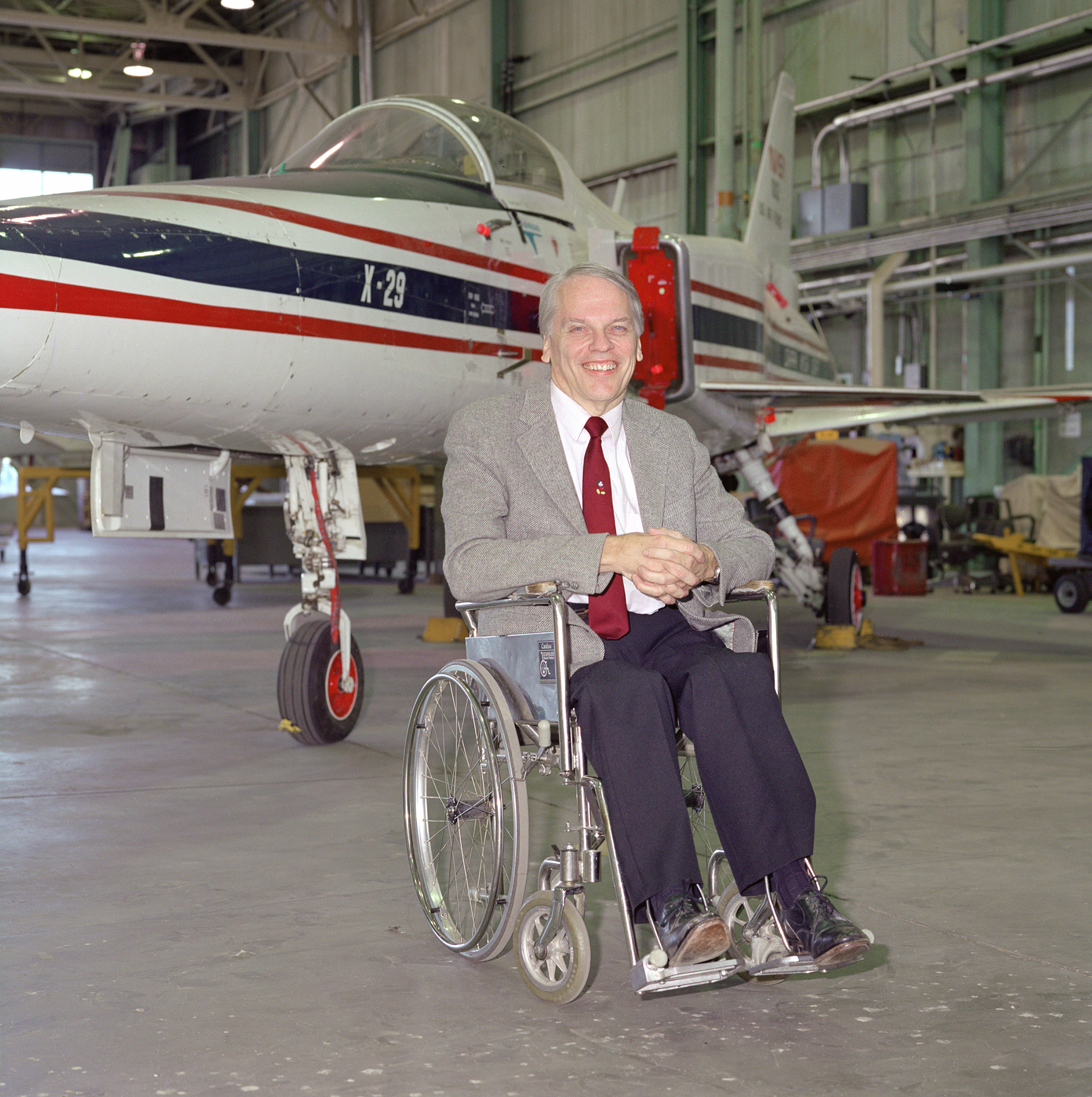
A man sits in a wheelchair with an experimental aircraft in the background.
Ken Iliff worked for four decades on revolutionary aircraft and spacecraft, including the X-29 forward swept wing aircraft behind him, at NASA’s Armstrong (then Dryden) Flight Research Center in Edwards, California.
NASA

His pioneering work with parameter estimation carried through years of aerodynamic assessment and data analysis involving lifting-body and wing-body aircraft, from the X-15 through the M2-F1, M2-F2 and M2-F3 projects, the HL-10, the X-24B and NASA’s entire fleet of space shuttles. His contributions aided in flight research on the forward-swept-wing X-29 and the F/A-18 High Angle of Attack program, on F-15 spin research vehicles, on thrust vectoring and supermaneuverability.

Iliff began work on the space shuttle program when it was little more than a speculative “what’s next?” chapter in manned spaceflight, long before it reached officially sanctioned program status. Together with a group spearheaded by the late NASA research pilot and long-time Dryden Chief Engineer Milt Thompson – who Iliff describes unflinchingly as “my hero” – Iliff helped explore the vast range of possibilities for a new orbiting craft that would push NASA to its next frontier after landing on the moon.

In an environment much more informal than today’s, when there were few designations of “program manager” or “task monitor” or “deputy director” among NASA engineers like Iliff and Thompson, a handful of creative, disciplined minds were at work dreaming up a reusable aircraft that would launch, orbit the Earth and return. Iliff’s role was to offer up the rigor of comparison in size, speed and performance among potential aircraft designs; Thompson and Iliff’s group was responsible, for example, for the decision to abandon the notion of jet engines on the orbiter, decreeing them too heavy, too risky and too inefficient.

Month in and month out, Iliff and his colleagues painstakingly researched and developed the myriad design details that eventually materialized into the shuttle fleet. There was, in Iliff’s words, “a love affair between the shuttle and the engineers.”

And in a display typifying the charged environment of creative collaboration that governed the effort – an effort many observe wryly that it would be difficult to replicate at NASA, today or anytime – the body of research was compiled into the now-legendary aero-data book, a living document that records in minute detail every scrap of design and performance data recorded about the shuttles’ flight activity.

Usually with more than a touch of irony, the compiling of the aero-data book has been described with phrases like “a remarkably democratic process,” involving as it did the need for a hundred independent minds and strong personalities to agree on indisputable facts about heat, air flow, turbulence, drag, stability and a dozen other aerodynamic principles. But Iliff says the success of the mammoth project, last updated in 1996, was ultimately enabled by a shared commitment to a culture that was unique to Dryden, one that made the Center great.

“Well, big, complicated things don’t always come out like you think they will,” Iliff said.

“But we understood completely the idea of ‘informed risk.’ We had a thorough understanding of risks before taking them – nobody ever did anything on the shuttle that they thought was dangerous, or likely to fail.

“The truly great thing (about that era at Dryden) was that they mentored us, and let us take those risks, and helped us get good right away. That was how we were able to do what we did.”

It was an era that Iliff says he was thrilled to be a part of, and which he admits was difficult to leave. It was also, he adds with a note of uncharacteristic nostalgia, a time that would be hard to reinvent today after the intrusion of so many bureaucratic tentacles into the hot zone that spawned Dryden’s greatest achievements.

A man not much given to dwelling on the past, however, Iliff has moved on to a retirement he is making the most of. Together with his wife, Mary Shafer, also retired from her career as a Dryden engineer, he plans to dedicate time to cataloging the couple’s extensive travel experiences with new video and graphics software, and adding to the travel library with footage from new trips. Iraq ranks high on the short list.

During his 40-year tenure, Iliff held the post of senior staff scientist of Dryden’s research division from 1988 to 1994, when he became the Center’s chief scientist. Among numerous awards he received were the prestigious Kelly Johnson Award from the Society of Flight Test Engineers (1989), an award permanently housed in the Smithsonian National Air and Space Museum, and NASA’s highest scientific honor, the NASA Exceptional Scientific Achievement Award (1976).

He was inducted into the National Hall of Fame for Persons with Disabilities in 1987, and served on many national aeronautic and aerospace committees throughout his career. He is a Fellow in the American Institute of Aeronautics and Astronautics (AIAA) and is the author of more than 100 technical papers and reports. He has given eleven invited lectures for NATO and AGARD (Advisory Group for Aerospace Research and Development), and served on four international panels as an expert in aircraft and spacecraft dynamics. Recently, he retired from his position as an adjunct professor of electrical engineering at the University of California, Los Angeles.

Iliff holds dual bachelor of science degrees in mathematics and aerospace engineering from Iowa State University; a master of science in mechanical engineering from the University of Southern California; a master of engineering degree in engineering management and a Ph.D. in electrical engineering, both from UCLA.

Iliff’s is the kind of legacy shared by a select group of American engineers, and to read the papers these days, there’s the suggestion that his is a vanishing breed. NASA and other science-based organizations are often depicted as scrambling for new engineering talent – particularly of the sort personified by Iliff and his pioneering achievements.

But, typical of the visionary approach he applies to life in general as well as to science, Iliff takes a wider view.

“I remember, after the X-1 – people figured all the good things had been done,” he said, with a smile in his voice. “And of course, they had not.

“If I was starting out now, I’d be starting in work with DNA, or biomedicine – improving lives with drug research. There are so many exciting things to be discovered there. They might not be as showy as lighting off a rocket, but they’re there.

“I’ve seen cycles. We’re at a low spot right now – but military, or space, will eventually be at the center again.”

And when that day comes, Iliff says he hopes officials in the flight research world will heed the example of Dryden’s early years, and give its engineers every opportunity to succeed unfettered – as he had been.

“Beware the ‘Chicken Littles’ out there,” he said. “I hope the government will be strong enough to resist them.”

Sarah Merlin
Former X-Press newsletter assistant editor

Former Dryden historian Curtis Peebles contributed to this article.

Share

Details

Last Updated

Oct 29, 2024

Editor
Dede Dinius
Contact

Powered by WPeMatico

Get The Details…
Dede Dinius

A Particular Lenticular Cloud

A Particular Lenticular Cloud


A part of New Zealand's South Island as seen by the Landsat 8 satellite. A long, thin white cloud floats above the green and brown landscape. A bit of water is visible on the right of the image.
New Zealand’s stunning scenery has famously provided the backdrop for fictional worlds in fantasy films. A unique cloud that forms over the Otago region of the country’s South Island also evokes the otherworldly, while very much existing in reality.
NASA/Lauren Dauphin; USGS

Landsat 8’s Operational Land Imager acquired this image of an elongated lenticular cloud, locally nicknamed the “Taieri Pet,” above New Zealand’s South Island on Sept. 7, 2024. Lenticular clouds form when prevailing winds encounter a topographic barrier, such as a mountain range. Wind that is forced to flow up and over the mountains creates a kind of wave in the atmosphere. Air cools at the crest of the wave, and the water vapor it contains condenses into clouds.

Image credit: NASA/Lauren Dauphin; USGS

Powered by WPeMatico

Get The Details…
Monika Luabeya