NASA’s Swift Reaches 20th Anniversary in Improved Pointing Mode

NASA’s Swift Reaches 20th Anniversary in Improved Pointing Mode

5 min read

NASA’s Swift Reaches 20th Anniversary in Improved Pointing Mode

After two decades in space, NASA’s Neil Gehrels Swift Observatory is performing better than ever thanks to a new operational strategy implemented earlier this year. The spacecraft has made great scientific strides in the years since scientists dreamed up a new way to explore gamma-ray bursts, the most powerful explosions in the universe.

“The idea for Swift was born during a meeting in a hotel basement in Estes Park, Colorado, in the middle of a conference,” said John Nousek, the Swift mission director at Pennsylvania State University in State College. “A bunch of astrophysicists got together to brainstorm a mission that could help us solve the problem of gamma-ray bursts, which were a very big mystery at the time.”

Watch to learn how NASA’s Neil Gehrels Swift Observatory got its name.
NASA’s Goddard Space Flight Center

Gamma-ray bursts occur all over the sky without warning, with about one a day detected on average. Astronomers generally divide these bursts into two categories. Long bursts produce an initial pulse of gamma rays for two seconds or more and occur when the cores of massive stars collapse to form black holes. Short bursts last less than two seconds and are caused by the mergers of dense objects like neutron stars.

But in 1997, at the time of that basement meeting, the science community disagreed over the origin models for these events. Astronomers needed a satellite that could move quickly to locate them and move to point additional instruments at their positions.

What developed was Swift, which launched Nov. 20, 2004, from Complex 17A at what is now Cape Canaveral Space Force Station in Florida. Originally called the Swift Observatory for its ability to quickly point at cosmic events, the mission team renamed the spacecraft in 2018 after its first principal investigator Neil Gehrels.

Swift uses several methods for orienting and stabilizing itself in space to study gamma-ray bursts.

Sensors that detect the Sun’s location and the direction of Earth’s magnetic field provide the spacecraft with a general sense of its location. Then, a device called a star tracker looks at stars and tells the spacecraft how to maneuver to keep the observatory precisely pointed at the same position during long observations.

Swift uses three spinning gyroscopes, or gyros, to carry out those moves along three axes. The gyros were designed to align at right angles to each other, but once in orbit the mission team discovered they were slightly misaligned. The flight operations team developed a strategy where one of the gyros worked to correct the misalignment while the other two pointed Swift to achieve its science goals.

The team wanted to be ready in case one of the gyros failed, however, so in 2009 they developed a plan to operate Swift using just two.
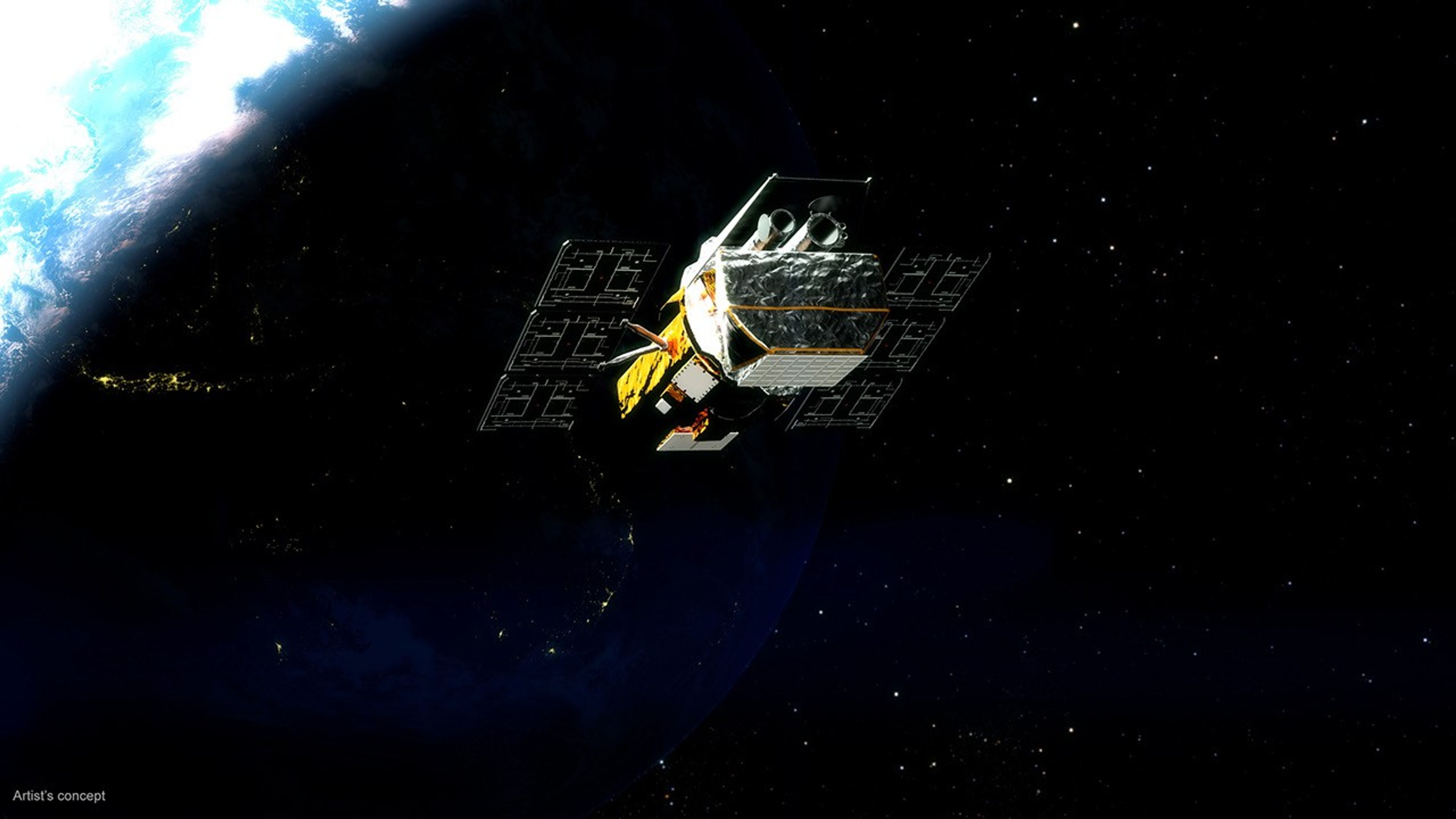
Swift orbits above Earth in this artist's concept.
Swift orbits above Earth in this artist’s concept.
NASA’s Goddard Space Flight Center Conceptual Image Lab

Any change to the way a telescope operates once in space carries risk, however. Since Swift was working well, the team sat on their plan for 15 years.

Then, in July 2023, one of Swift’s gyros began working improperly. Because the telescope couldn’t hold its pointing position accurately, observations got progressively blurrier until the gyro failed entirely in March 2024.

“Because we already had the shift to two gyros planned out, we were able to quickly and thoroughly test the procedure here on the ground before implementing it on the spacecraft,” said Mark Hilliard, Swift’s flight operations team lead at Omitron, Inc. and Penn State. “Actually, scientists have commented that the accuracy of Swift’s pointing is now better than it was since launch, which is really encouraging.”

For the last 20 years, Swift has contributed to groundbreaking results — not only for gamma-ray bursts but also for black holes, stars, comets, and other cosmic objects.

“After all this time, Swift remains a crucial part of NASA’s fleet,” said S. Bradley Cenko, Swift’s principal investigator at NASA’s Goddard Space Flight Center in Greenbelt, Maryland. “The satellite’s abilities have helped pioneer a new era of astrophysics called multimessenger astronomy, which is giving us a more well-rounded view of how the universe works. We’re looking forward to all Swift has left to teach us.”

Swift is a key part of NASA’s strategy to look for fleeting and unpredictable changes in the sky with a variety of telescopes that use different methods of studying the cosmos.

Goddard manages the Swift mission in collaboration with Penn State, the Los Alamos National Laboratory in New Mexico, and Northrop Grumman Space Systems in Dulles, Virginia. Other partners include the University of Leicester and Mullard Space Science Laboratory in the United Kingdom, Brera Observatory in Italy, and the Italian Space Agency.

By Jeanette Kazmierczak
NASA’s Goddard Space Flight Center, Greenbelt, Md.

Media Contact:
Claire Andreoli
301-286-1940
claire.andreoli@nasa.gov
NASA’s Goddard Space Flight Center, Greenbelt, Md.

Share

Details

Last Updated
Nov 20, 2024
Editor
Jeanette Kazmierczak
Location
Goddard Space Flight Center

Powered by WPeMatico

Get The Details…

Gateway Tops Off

Gateway Tops Off

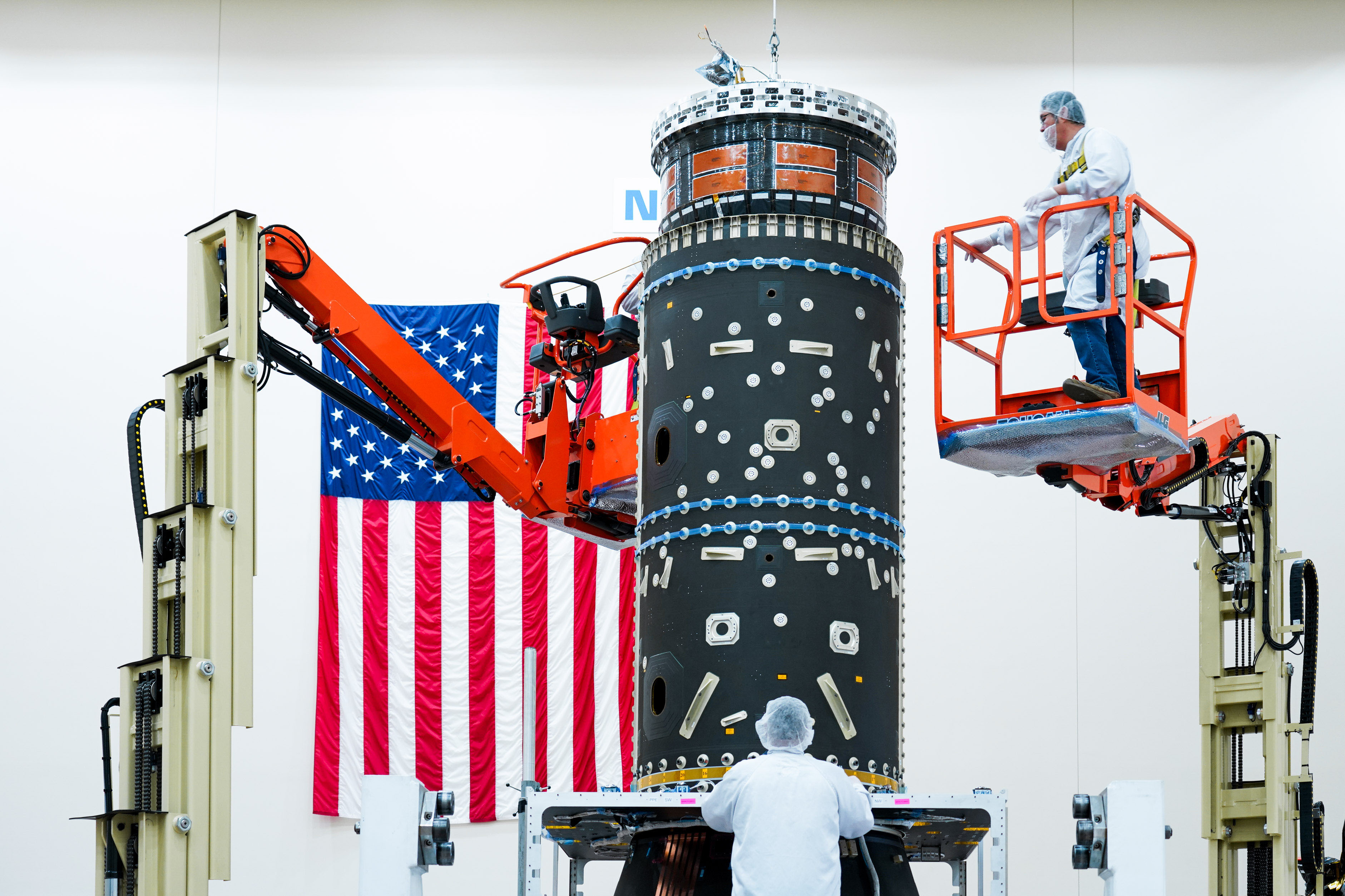
Technicians work on the installation of hardware designed to house Gateway’s xenon fuel tanks, an integral component of its advanced electric propulsion system. The setup is conducted in a cleanroom environment, with one technician on an elevated lift and another standing at the base of the structure. An American flag is displayed prominently in the background.
Technicians carefully install a piece of equipment to house Gateway’s xenon fuel tanks, part of its advanced electric propulsion system.

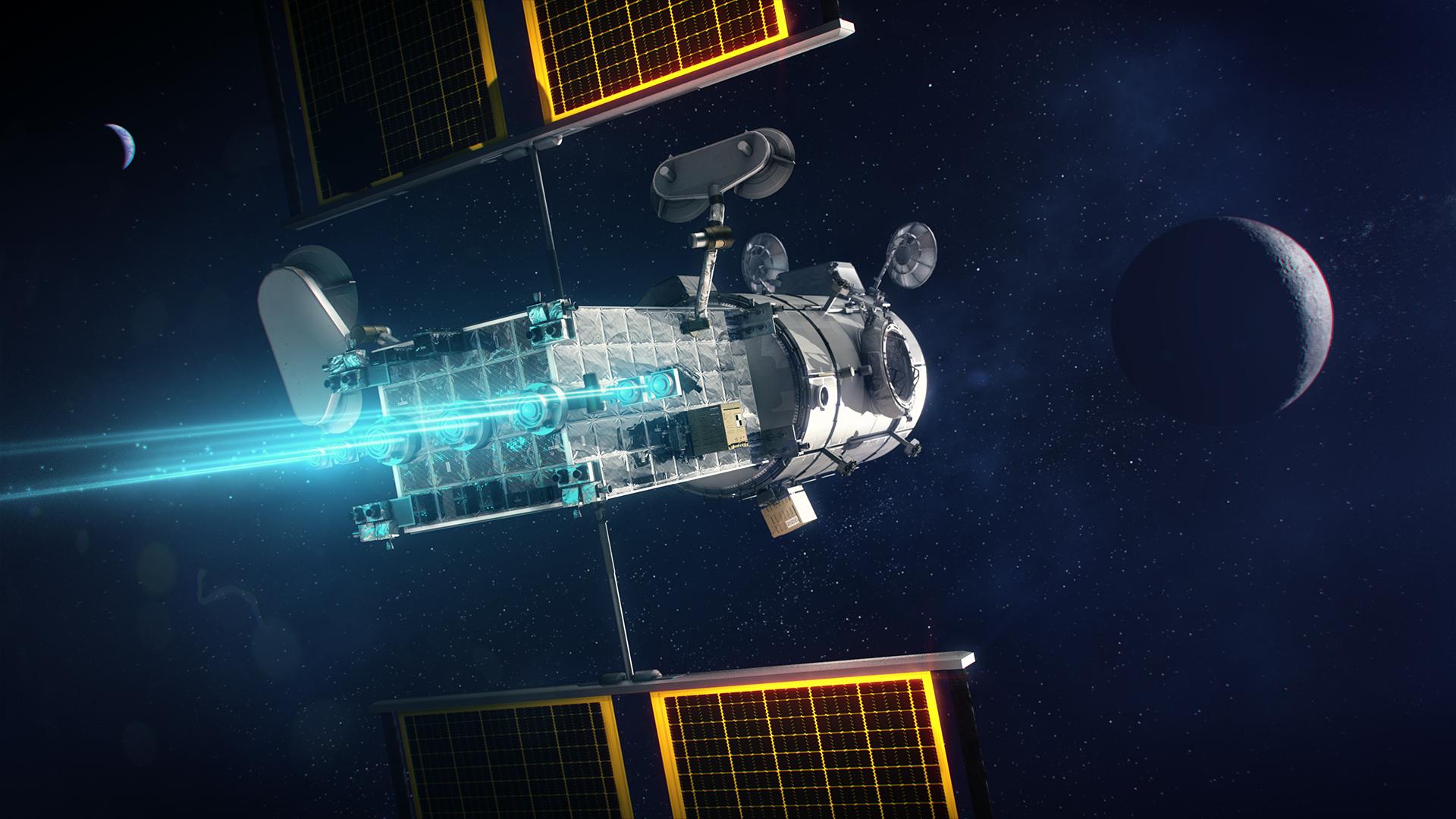
Gateway’s Power and Propulsion Element, which will make the lunar space station the most powerful solar electric spacecraft ever flown, recently received the xenon and liquid fuel tanks for its journey to and around the Moon.

Technicians in Palo Alto, California carefully install a piece of equipment that will house the tanks. Once fully assembled and launched to lunar orbit, the Power and Propulsion Element’s roll-out solar arrays – together about the size of an American football field endzone – will harness the Sun’s energy to energize xenon gas and produce the thrust to get Gateway to the Moon’s orbit where it will await the arrival of its first crew on the Artemis IV mission.

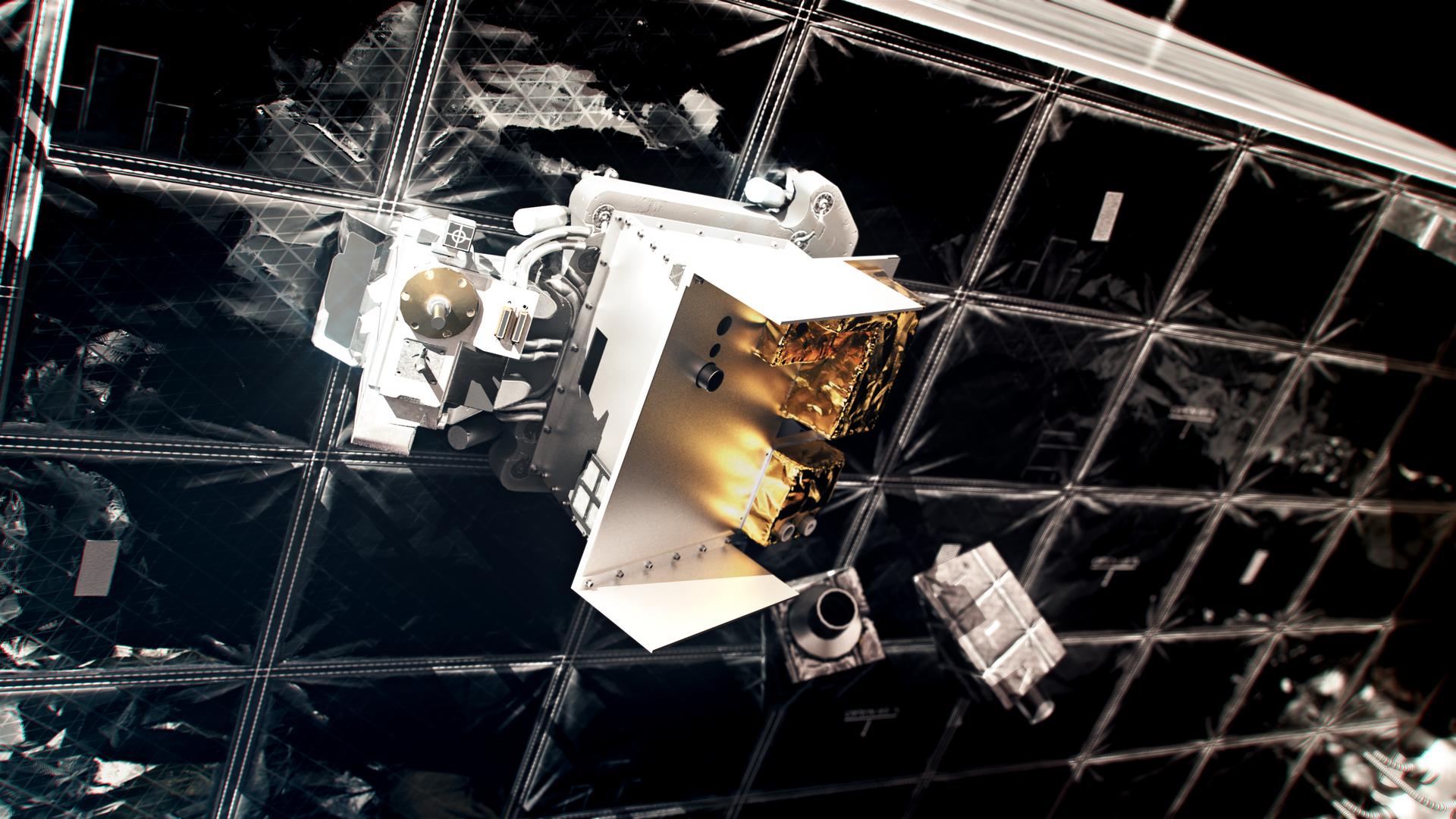
The Power and Propulsion Element will also carry the European Radiation Sensors Array science experiment provided by ESA (European Space Agency) and JAXA (Japan Aerospace Exploration Agency), one of three Gateway science experiments that will study solar and cosmic radiation. The little understood phenomenon is a chief concern for humans and hardware journeying to deep-space destinations like Mars and beyond.

The Power and Propulsion Element is managed out of NASA’s Glenn Research Center in Cleveland, Ohio and built by Maxar Space Systems of Palo Alto, California.

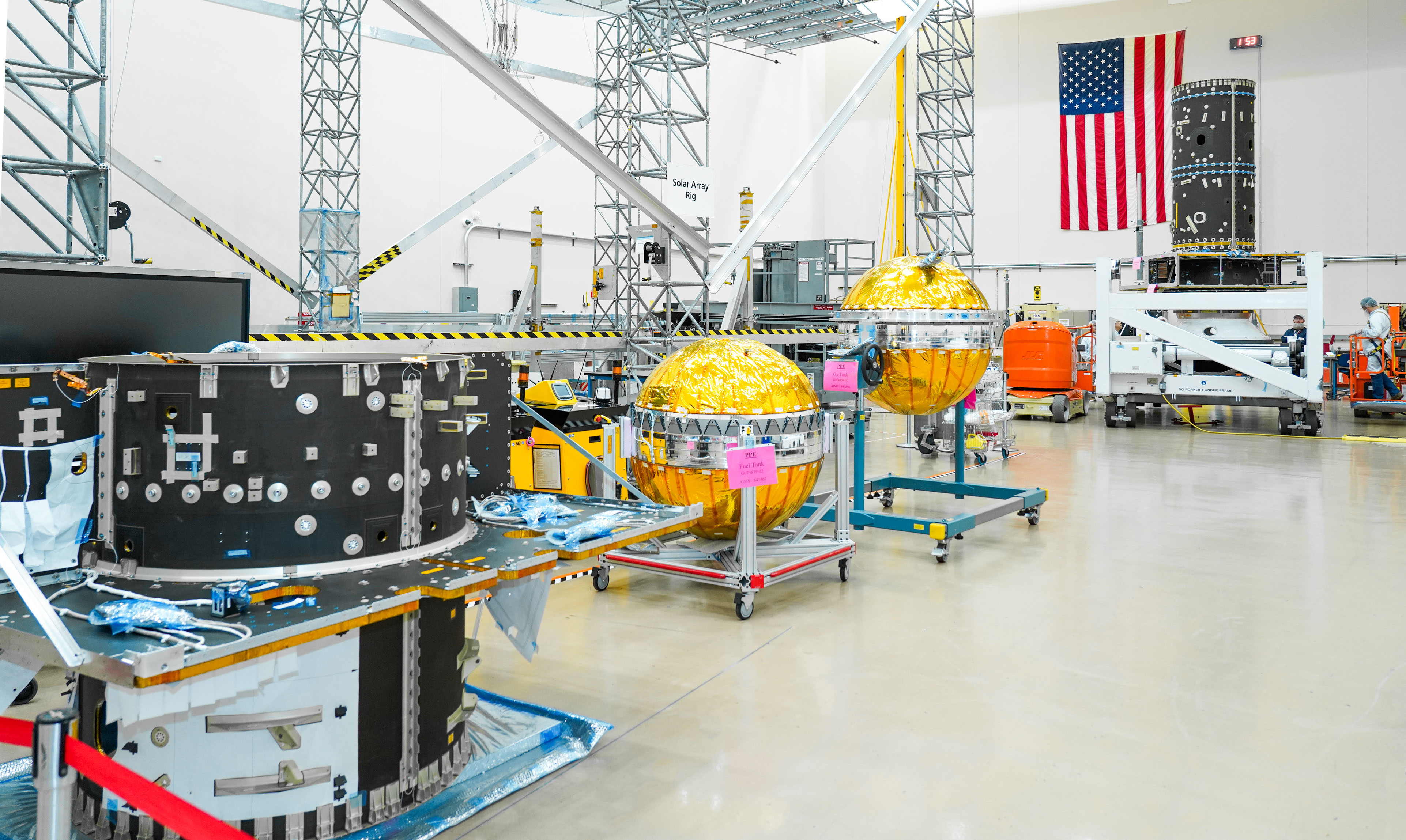
The Power and Propulsion Element (PPE) hardware for the Gateway space station, including its primary structure and gold-coated fuel tanks, is displayed in a cleanroom at Maxar Space Systems in Palo Alto, California. The components are organized for assembly, with an American flag visible in the background.
Hardware for the Gateway space station’s Power and Propulsion element, including its primary structure and fuel tanks ready for assembly, are shown at Maxar Space Systems in Palo Alto, California.
Maxar Space Systems
Artist's rendering of NASA's Gateway space station in its initial configuration, featuring the Habitation and Logistics Outpost (HALO) connected to the Power and Propulsion Element (PPE). The PPE is depicted actively using its Solar Electric Propulsion (SEP) system, with blue plumes of ionized xenon gas streaming from the spacecraft. The Moon and Earth are visible in the distant background, showcasing Gateway's position in deep space.
An artist’s rendering of the Gateway space station’s Power and Propulsion Element.
NASA/Alberto Bertolin
A thruster, part of an advanced electric propulsion system designed for NASA's Gateway space station, emits a focused beam of ionized xenon gas during testing at NASA’s Glenn Research Center. The image captures the thruster in action, highlighting the bright, circular discharge of xenon ions that will propel Gateway in space.
A type of advanced electric propulsion system thruster that will be used on Gateway glows blue as it emits ionized xenon gas during testing at NASA’s Glenn Research Center.
NASA
This artist's concept of the European Radiation Sensors Array (ERSA) shows the instrument suite secured to the external surface of Gateway. ESA (European Space Agency) is developing and managing the ERSA instrument.
An artist’s rendering of European Radiation Sensor Array science experiment that will study both radiation and lunar dust.  
NASA

Powered by WPeMatico

Get The Details…
Dylan Connell

About the Office of the Chief Knowledge Officer (OCKO)

About the Office of the Chief Knowledge Officer (OCKO)

The overarching purpose of the OCKO is to cultivate and sustain a learning culture at Goddard in support of mission success. We have instituted various processes and programs for lessons learned and critical knowledge identification, sharing, and application. The focus of the OCKO is to promote local learning practices that enhances domain-specific expertise within an expanded framework of how NASA works.  The Goddard OCKO provides leadership, coordination and support to center organizations to effectively identify lessons and critical knowledge that can be used to support mission execution.

Mission success at Goddard is driven by many factors including, but not limited to, teamwork, leadership, decision making and risk-informed prioritization of lessons. The OCKO has developed many technical case studies that touch on broad organizational issues, project implementation, technology and engineering development, procurement and contract management challenges, and other topics that contribute to mission success. Our learning programs and knowledge sharing activities are designed to transfer the experiences, technical wisdom and values embedded in our policies, procedures and processes.

The OCKO, whether through formal dissenting opinion processes, pause-and-learn exercises, or project reflective learning sessions, encourages our workforce to speak up in support of mission success. We promote a healthy culture where project teams discuss major events, milestones and reviews to ascertain “what happened and why it happened,” how to sustain strengths, and how to improve on weaknesses to enable collective discovery of contextual lessons for institutional learning.

As the Chief Knowledge Officer (CKO) of the NASA Goddard Space Flight Center, it is my sincere desire to help assure that Goddard operates as a learning organization to enhance the likelihood of mission success.

moses adoko signature

Moses Adoko, Chief Knowledge Officer 

Powered by WPeMatico

Get The Details…
Alysha Bayens

From Houston to the Moon: Johnson’s Thermal Vacuum Chamber Tests Lunar Solar Technology 

From Houston to the Moon: Johnson’s Thermal Vacuum Chamber Tests Lunar Solar Technology 

Imagine designing technology that can survive on the Moon for up to a decade, providing a continuous energy supply. NASA selected three companies to develop such systems, aimed at providing a power source at the Moon’s South Pole for Artemis missions. 

Three companies were awarded contracts in 2022 with plans to test their self-sustaining solar arrays at the Johnson Space Center’s Space Environment Simulation Laboratory (SESL) in Houston, specifically in Chamber A in building 32. The prototypes tested to date have undergone rigorous testing to ensure the technology can withstand the harsh lunar environment and deploy the solar array effectively on the lunar surface. 

A tall structure inside a testing chamber featuring a vertical mast supporting a large array of solar panels.
The Honeybee Robotics prototype during lunar VSAT (Vertical Solar Array Technology) testing inside Chamber A at NASA’s Johnson Space Center in Houston.
NASA/David DeHoyos
The Astrobotic Technology prototype during lunar VSAT testing inside Chamber A at Johnson Space Center.
NASA/James Blair

In the summer of 2024, both Honeybee Robotics, a Blue Origin company from Altadena, California and Astrobotic Technology from Pittsburgh, Pennsylvania put their solar array concepts to the test in Chamber A. 

Each company has engineered a unique solution to design the arrays to withstand the harsh lunar environment and extreme temperature swings. The data collected in the SESL will support refinement of requirements and the designs for future technological advancements with the goal to deploy at least one of the systems near the Moon’s South Pole. 

The contracts for this initiative are part of NASA’s VSAT (Vertical Solar Array Technology) project, aiming to support the agency’s long-term lunar surface operations. VSAT is under the Space Technology Mission Directorate Game Changing Development program and led by the Langley Research Center in Hampton, Virginia, in collaboration with Glenn Research Center in Cleveland.  

“We foresee the Moon as a hub for manufacturing satellites and hardware, leveraging the energy required to launch from the lunar surface,” said Jim Burgess, VSAT lead systems engineer. “This vision could revolutionize space exploration and industry.” 

Built in 1965, the SESL initially supported the Gemini and Apollo programs but was adapted to conduct testing for other missions like the Space Shuttle Program and Mars rovers, as well as validate the design of the James Webb Space Telescope. Today, it continues to evolve to support future Artemis exploration. 

Johnson’s Front Door initiative aims to solve the challenges of space exploration by opening opportunities to the public and bringing together bold and innovative ideas to explore new destinations. 

“The SESL is just one of the hundreds of unique capabilities that we have here at Johnson,” said Molly Bannon, Johnson’s Innovation and Strategy specialist. “The Front Door provides a clear understanding of all our capabilities and services, the ways in which our partners can access them, and how to contact us. We know that we can go further together with all our partners across the entire space ecosystem if we bring everyone together as the hub of human spaceflight.” 

Chamber A remains as one of the largest thermal vacuum chambers of its kind, with the unique capability to provide extreme deep space temperature conditions down to as low as 20 Kelvin. This allows engineers to gather essential data on how technologies react to the Moon’s severe conditions, particularly during the frigid lunar night where the systems may need to survive for 96 hours in darkness. 

“Testing these prototypes will help ensure more safe and reliable space mission technologies,” said Chuck Taylor, VSAT project manager. “The goal is to create a self-sustaining system that can support lunar exploration and beyond, making our presence on the Moon not just feasible but sustainable.” 

The power generation systems must be self-aware to manage outages and ensure survival on the lunar surface. These systems will need to communicate with habitats and rovers and provide continuous power and recharging as needed. They must also deploy on a curved surface, extend 32 feet high to reach sunlight, and retract for possible relocation.  

“Generating power on the Moon involves numerous lessons and constant learning,” said Taylor. “While this might seem like a technical challenge, it’s an exciting frontier that combines known technologies with innovative solutions to navigate lunar conditions and build a dynamic and robust energy network on the Moon.”

Watch the video below to explore the capabilities and scientific work enabled by the thermal testing conducted in Johnson’s Chamber A facility.

Powered by WPeMatico

Get The Details…
Sumer Loggins

On This Day: Apollo 12 Lands on the Moon

On This Day: Apollo 12 Lands on the Moon

On the Moon, an astronaut in a white spacesuit climbs down a ladder on a lunar module. The lunar module is made of metal with gold and silver foil covering some of its lower half.
NASA

NASA astronaut Alan Bean steps off the lunar module ladder in this photo from Nov. 19, 1969, joining astronaut Charles Conrad Jr. on the Moon in the area called the Ocean of Storms. The two would then complete two spacewalks on the lunar surface, deploying science instruments, collecting geology samples, and inspecting the Surveyor 3 spacecraft, which had landed in the same area. While Bean and Conrad worked on the Moon, astronaut Richard F. Gordon completed science from lunar orbit.

Learn more about Apollo 12’s pinpoint landing on the Moon.

Image credit: NASA

Powered by WPeMatico

Get The Details…
Monika Luabeya