More Than 400 Lives Saved with NASA’s Search and Rescue Tech in 2024

More Than 400 Lives Saved with NASA’s Search and Rescue Tech in 2024

2 Min Read

More Than 400 Lives Saved with NASA’s Search and Rescue Tech in 2024

NASA Artemis II crew members are assisted by U.S. Navy personnel as they exit a mockup of the Orion spacecraft in the Pacific Ocean during Underway Recovery Test 11 (URT-11) on Feb. 25, 2024.

NASA Artemis II crew members are assisted by U.S. Navy personnel as they exit a mockup of the Orion spacecraft in the Pacific Ocean during Underway Recovery Test 11 (URT-11) on Feb. 25, 2024.

Credits:
NASA/Kenny Allen

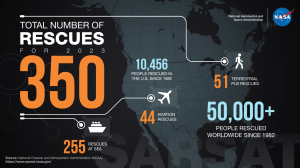
A graphic showing the number of total rescues for 2024, 10,863 people in the U.S. and over 50,000 people worldwide since 1982. Of these Of the 407 lives saved in 2024, 314 were rescues at sea, 41 aviation rescues, and 52 terrestrial personal locator beacon rescues. The graphic has a dark background of the U.S., and the numbers of each rescue are shown in variants of white, yellow, and green.
NASA’s Search and Rescue technologies enabled hundreds of lives saved in 2024.
NASA/Dave Ryan

Did you know that the same search and rescue technologies developed by NASA for astronaut missions to space help locate and rescue people across the United States and around the world? 

NASA’s collaboration with the international satellite-aided search and rescue effort known as Cospas-Sarsat has enabled the development of multiple emergency location beacons for explorers on land, sea, and air. 

Of the 407 lives saved in 2024 through search and rescue efforts in the United States, NOAA (National Oceanic and Atmospheric Administration) reports that 52 rescues were the result of activated personal locator beacons, 314 from emergency position-indicating radio beacons, and 41 from emergency locator transmitters. Since 1982, more than 50,000 lives have been saved across the world. 

Using GPS satellites, these beacons transmit their location to the Cospas-Sarsat network once activated. The beacons then provide the activation coordinates to the network, allowing first responders to rescue lost or distressed explorers.  

NASA Artemis II crew members are assisted by U.S. Navy personnel as they exit a mockup of the Orion spacecraft in the Pacific Ocean during Underway Recovery Test 11 (URT-11) on Feb. 25, 2024.
NASA Artemis II crew members are assisted by U.S. Navy personnel as they exit a mockup of the Orion spacecraft in the Pacific Ocean during Underway Recovery Test 11 (URT-11) on Feb. 25, 2024, while his crewmates look on. URT-11 is the eleventh in a series of Artemis recovery tests, and the first time NASA and its partners put their Artemis II recovery procedures to the test with the astronauts.
NASA/Kenny Allen

The Search and Rescue Office, part of NASA’s SCaN (Space Communications and Navigation) Program, has assisted in search and rescue services since its formation in 1979 Now, the office is building on their long legacy of Earth-based beacon development to support crewed missions to space. 

The beacons also are used for emergency location, if needed, as part of NASA’s crew launches to and from the International Space Station, and will support NASA’s Artemis campaign crew recovery preparations during future missions returning from deep space. Systems being tested, like the ANGEL (Advanced Next-Generation Emergency Locator) beacon, are benefitting life on Earth and missions to the Moon and Mars. Most recently, NASA partnered with the Department of Defense to practice Artemis II recovery procedures – including ANGEL beacon activation – during URT-11 (Underway Recovery Test 11).  

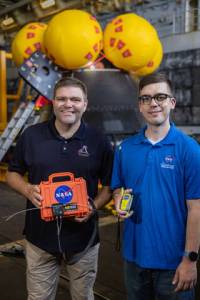
A Miniaturized Advanced Next-Generation Emergency Locator (ANGEL) beacon in an orange gloved hand
Miniaturized Advanced Next-Generation Emergency Locator (ANGEL) beacons will be attached to the astronauts’ life preserver units. When astronauts Reid Wiseman, Victor Glover, Christina Koch, and CSA (Canadian Space Agency) astronaut Jeremy Hanse splash back down to Earth — or in the unlikely event of a launch abort scenario — these beacons will allow them to be found if they need to egress from the Orion capsule.
NASA

The SCaN program at NASA Headquarters in Washington provides strategic oversight to the Search and Rescue office. NOAA manages the U.S. network region for Cospas-Sarsat, which relies on flight and ground technologies originally developed at NASA’s Goddard Space Flight Center in Greenbelt, Maryland. U.S. region rescue efforts are led by the U.S. Coast Guard, U.S. Air Force, and many other local rescue authorities. 

About the Author

Kendall Murphy

Kendall Murphy

Technical Writer

Kendall Murphy is a technical writer for the Space Communications and Navigation program office. She specializes in internal and external engagement, educating readers about space communications and navigation technology.

Share

Details

Last Updated

Feb 06, 2025

Editor
Goddard Digital Team
Contact
Katherine Schauer
Location
NASA Goddard Space Flight Center

Powered by WPeMatico

Get The Details…
Kendall Murphy
Sols 4443-4444: Four Fours for February

Sols 4443-4444: Four Fours for February

2 min read

Sols 4443-4444: Four Fours for February

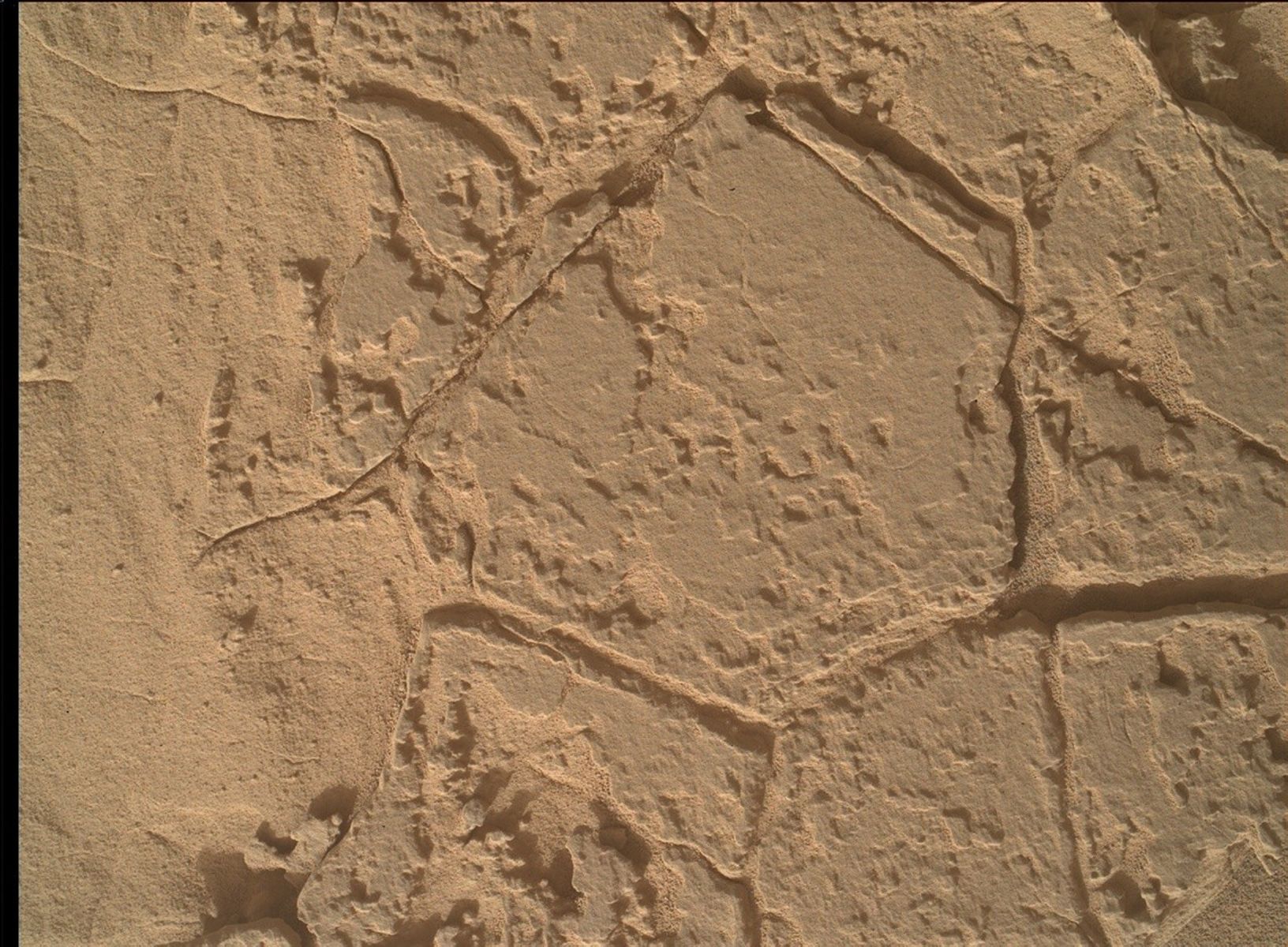
A color image showing a pale tan-orange rock surface, which is smooth in some areas and rough, and layered in others, like a stucco wall. Resting atop the surface are lines creating various shapes – a hexagon dominating the image center, a diamond nestled below that, others off to the lower right and right sides of the image. These lines trace areas making them look like walled gardens viewed overhead from a great height.
NASA’s Mars rover Curiosity acquired this image from about 25 centimeters (about 10 inches) away from the polygonally-fractured bedrock target named “Coldwater Canyon.” Curiosity captured the image using its Mars Hand Lens Imager (MAHLI), located on the turret at the end of the rover’s robotic arm, on Feb. 2, 2025 — sol 4441, or Martian day 4,441 of the Mars Science Laboratory Mission — at 08:40:11 UTC.
NASA/JPL-Caltech/MSSS

Earth planning date: Monday, Feb. 3, 2025

Another successful weekend plan left us about 23 meters (about 75 feet) farther down our Mount Sharp Ascent Route (MSAR), with all our science data downlinked to Earth and the planet clocks aligned once more. We only have until 18:26 Pacific time to get this Monday’s plan uplinked (due to the Soliday over the weekend), and two full days of science to plan! 

Our first sol science block starts at 12:06 local Gale Crater time, including a ChemCam long-distance RMI mosaic and a five-shot laser on bedrock. After ChemCam is done, Mastcam is planning 42 images, including ChemCam’s LIBS spots, some meteorite fragments, sand troughs between bedrock blocks, and interesting vein structures in our surrounding terrain. Navcam is planning to finish out that science block with a large dust devil survey. After our remote science wraps up, we’ve committed the hours between about 15:00 and 22:45 to our full contact science suite. Luckily, SRAP passed yet again and we took the opportunity to plan two targets — “San Rafael Hills” as our DRT target and “Allison Mine” as a potential meteorite target. 

After a nice, long sleep our rover will wake up at 09:53 local Gale time and start another round of remote science to start the sol. This time ChemCam will shoot their laser at the potential meteorite and contact target Allison Mine, with Mastcam following up to document the spots. After one last 20-minute sweep of Texoli butte through Mastcam, it’s time to pack up and head back down the MSAR. Hopefully our drive goes well again and we’ll find ourselves about 36 meters (about 118 feet) away on Wednesday!

Written by Natalie Moore, Mission Operations Specialist at Malin Space Science Systems

Share

Details

Last Updated
Feb 06, 2025

Related Terms

Powered by WPeMatico

Get The Details…

NASA Brings Space to New Jersey Classroom with Astronaut Q&A

NASA Brings Space to New Jersey Classroom with Astronaut Q&A

Astronaut Nick Hague swaps samples of materials to observe how they burn in weightlessness.
(Jan. 13, 2025) Astronaut Nick Hague swaps samples of materials to observe how they burn in weightlessness.
Credit: NASA

Students from the Thomas Edison EnergySmart Charter School in Somerset, New Jersey, will have the chance to connect with NASA astronaut Nick Hague as he answers prerecorded science, technology, engineering, and mathematics (STEM) related questions from aboard the International Space Station.

Watch the 20-minute space-to-Earth call at 11:10 a.m. EST on Tuesday, Feb. 11, on NASA+ and learn how to watch NASA content on various platforms, including social media.

Media interested in covering the event must RSVP by 5 p.m., Thursday, Feb. 6, to Jeanette Allison at: oyildiz@energysmartschool.org or 732-412-7643.

For more than 24 years, astronauts have continuously lived and worked aboard the space station, testing technologies, performing science, and developing skills needed to explore farther from Earth. Astronauts aboard the orbiting laboratory communicate with NASA’s Mission Control Center in Houston 24 hours a day through SCaN’s (Space Communications and Navigation) Near Space Network.

Important research and technology investigations taking place aboard the space station benefit people on Earth and lay the groundwork for other agency missions. As part of NASA’s Artemis campaign, the agency will send astronauts to the Moon to prepare for future human exploration of Mars; inspiring Artemis Generation explorers and ensuring the United States continues to lead in space exploration and discovery.

See videos and lesson plans highlighting space station research at:

https://www.nasa.gov/stemonstation

-end-

Abbey Donaldson
Headquarters, Washington
202-358-1600
Abbey.a.donaldson@nasa.gov

Sandra Jones 
Johnson Space Center, Houston
281-483-5111
sandra.p.jones@nasa.gov

Powered by WPeMatico

Get The Details…
Tiernan P. Doyle

NASA Invites Media to Learn about Spacecraft Autonomous Tech Firsts

NASA Invites Media to Learn about Spacecraft Autonomous Tech Firsts

NASA’s Ames Research Center in Silicon Valley invites media to learn more about Distributed Spacecraft Autonomy (DSA), a technology that allows individual spacecraft to make independent decisions while collaborating with each other to achieve common goals – without human input. The DSA team achieved multiple firsts during tests of such swarm technology as part of the agency’s project. 

DSA develops software tools critical for future autonomous, distributed, and intelligent spacecraft that will need to interact with each other to achieve complex mission objectives. Testing onboard the agency’s Starling mission resulted in accomplishments including the first fully distributed autonomous operation of multiple spacecraft, the first use of space-to-space communications to autonomously share status information between multiple spacecraft, and more. 

DSA’s accomplishments mark a significant milestone in advancing autonomous systems that will make new types of science and exploration possible. 

Caleb Adams, DSA project manager, is available for interview on Wednesday, Feb. 5 and Thursday, Feb. 6. To request an interview, media can contact the Ames Office of Communications by email at arc-dl-newsroom@nasa.gov or by phone at 650-604-4789.  

Learn more about NASA Ames’ world-class research and development in aeronautics, science, and exploration technology at: 

https://www.nasa.gov/ames

-end- 

Tiffany Blake
Ames Research Center, Silicon Valley 
650-604-4789 
tiffany.n.blake@nasa.gov  

To receive local NASA Ames news, email local-reporters-request@lists.arc.nasa.gov with “subscribe” in the subject line. To unsubscribe, email the same address with “unsubscribe” in the subject line.  

Powered by WPeMatico

Get The Details…
Tara Friesen

Wind Over Its Wing: NASA’s X-66 Model Tests Airflow

Wind Over Its Wing: NASA’s X-66 Model Tests Airflow

2 min read

Preparations for Next Moonwalk Simulations Underway (and Underwater)

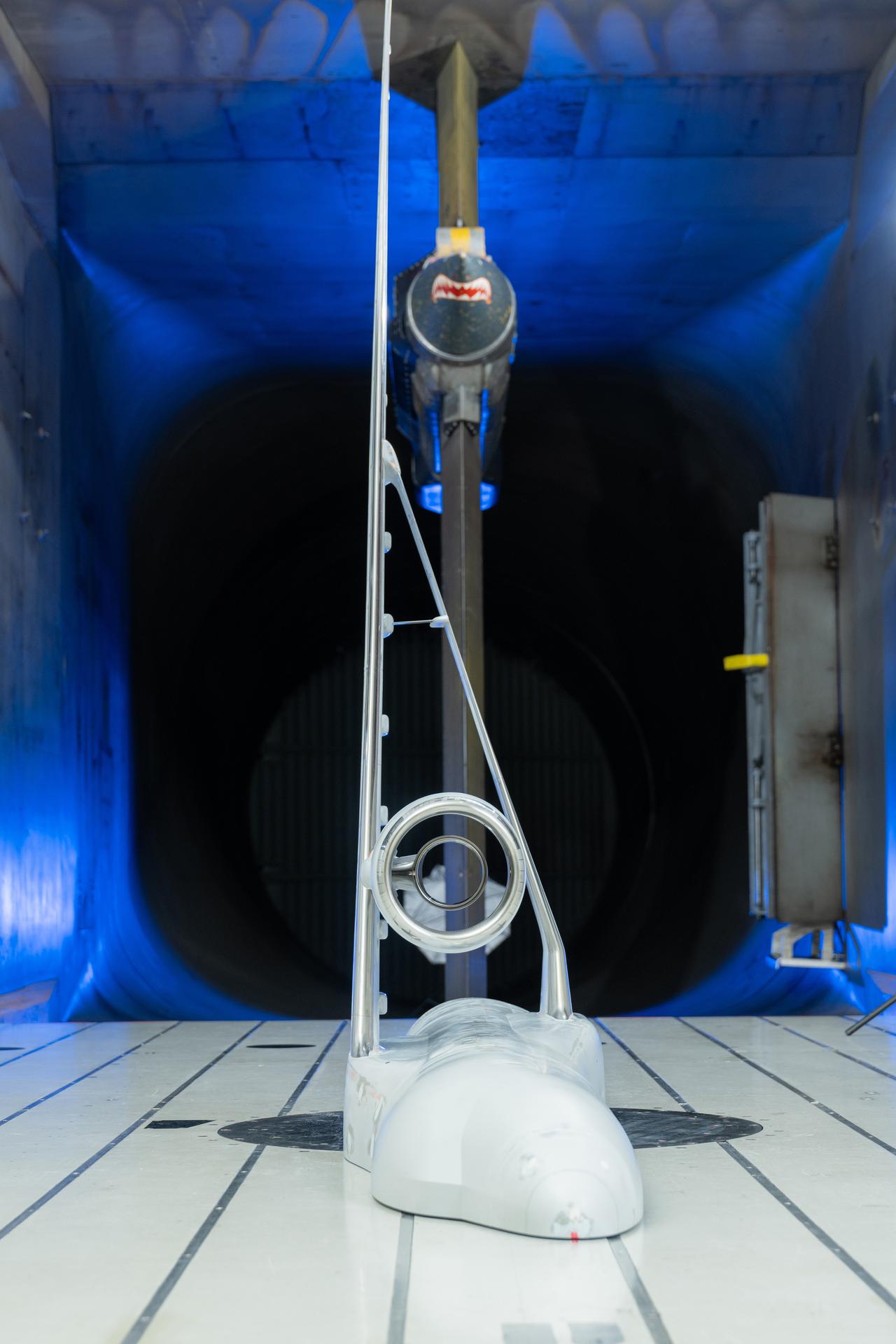
There is a half model of an airplane in the center of the photo that is painted white, the background of the photo is black in the center with blue lights all around the side. The floor that the half model of the plane sits on is white.
NASA’s Sustainable Flight Demonstrator project concluded wind tunnel testing in the fall of 2024. Tests on a Boeing-built X-66 model were completed at NASA’s Ames Research Center in California’s Silicon Valley in its 11-Foot Transonic Unitary Plan Facility. The model underwent tests representing expected flight conditions to obtain engineering information to influence design of the wing and provide data for flight simulators.
NASA/Brandon Torres Navarrete

NASA’s Sustainable Flight Demonstrator (SFD) project recently concluded wind tunnel tests of its X-66 semi-span model in partnership with Boeing. The model, designed to represent half the aircraft, allows the research team to generate high-quality data about the aerodynamic forces that would affect the actual X-66.

Test results will help researchers identify areas where they can refine the X-66 design – potentially reducing drag, enhancing fuel efficiency, or adjusting the vehicle shape for better flying qualities.

Tests on the Boeing-built X-66 semi-span model were completed at NASA’s Ames Research Center in California’s Silicon Valley in its 11-Foot Transonic Unitary Plan Facility. The model underwent tests representing expected flight conditions so the team could obtain engineering information to influence the design of the aircraft’s wing and provide data for flight simulators.

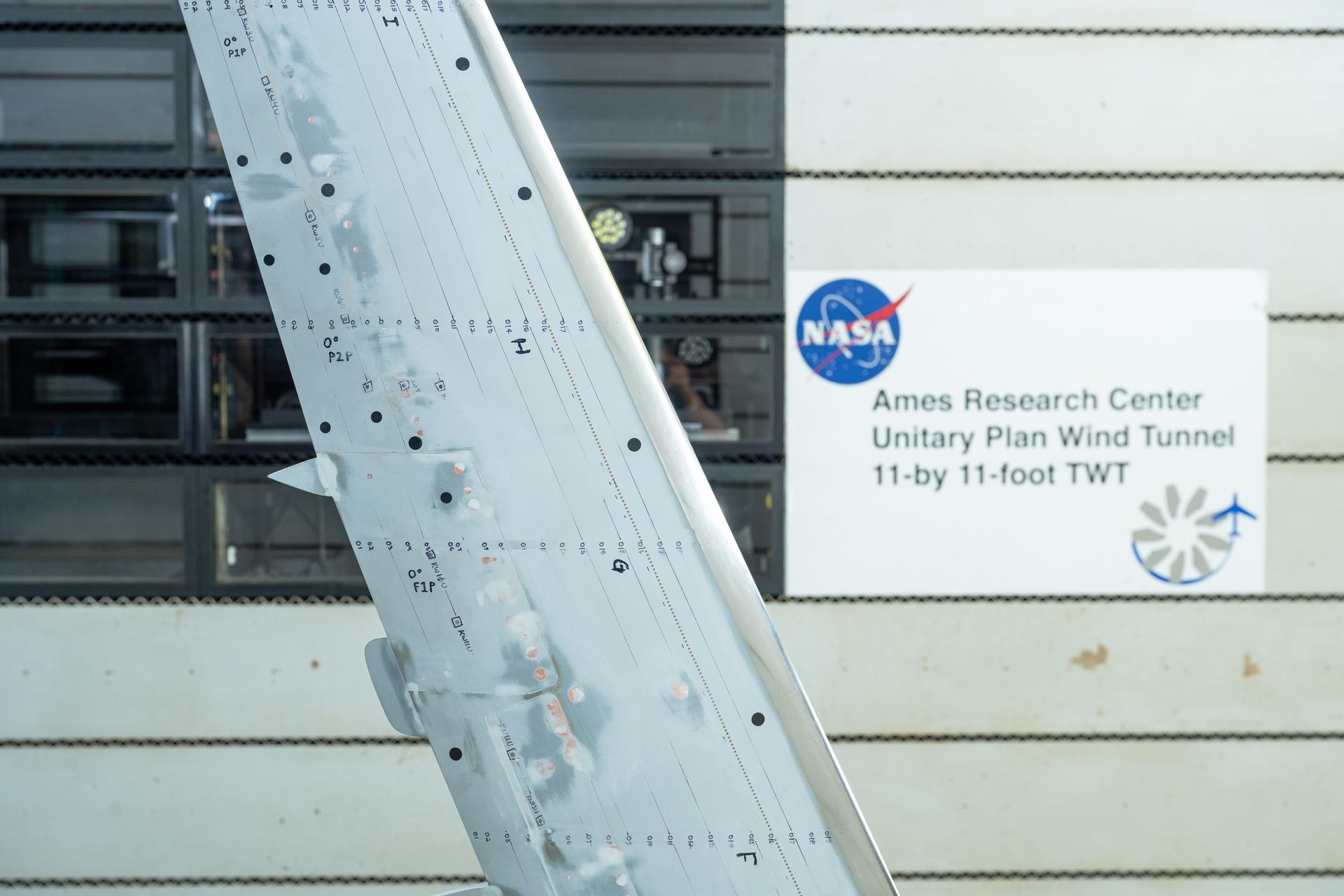
Photo with part of an airplane wing colored white, with markings is in the foreground, the background has white vertical lines.
NASA’s Sustainable Flight Demonstrator project concluded wind tunnel testing in the fall of 2024. Tests on a Boeing-built X-66 model were completed at NASA’s Ames Research Center in California’s Silicon Valley in its 11-Foot Transonic Unitary Plan Facility. Pressure points, which are drilled holes with data sensors attached, are installed along the edge of the wing and allow engineers to understand the characteristics of airflow and will influence the final design of the wing.
NASA/Brandon Torres Navarrete

Semi-span tests take advantage of symmetry. The forces and behaviors on a model of half an aircraft mirror those on the other half. By using a larger half of the model, engineers increase the number of surface pressure measurements. Various sensors were placed on the wing to measure forces and movements to calculate lift, drag, stability, and other important characteristics.

The semi-span tests follow earlier wind tunnel work at NASA’s Langley Research Center in Hampton, Virginia, using a smaller model of the entire aircraft. Engineers will study the data from all of the X-66 wind tunnel tests to determine any design changes that should be made before fabrication begins on the wing that will be used on the X-66 itself.

The SFD project is NASA’s effort to develop more efficient aircraft configurations as the nation moves toward aviation that’s more economically, societally, and environmentally sustainable. The project seeks to provide information to inform the next generation of single-aisle airliners, the most common aircraft in commercial aviation fleets around the world.  Boeing and NASA are partnering to develop the X-66 experimental demonstrator aircraft.

Powered by WPeMatico

Get The Details…
Dede Dinius