Sols 4366–4367: One of Those Days on Mars (Sulfate-Bearing Unit to the West of Upper Gediz Vallis)

Sols 4366–4367: One of Those Days on Mars (Sulfate-Bearing Unit to the West of Upper Gediz Vallis)

3 min read

Sols 4366–4367: One of Those Days on Mars (Sulfate-Bearing Unit to the West of Upper Gediz Vallis)

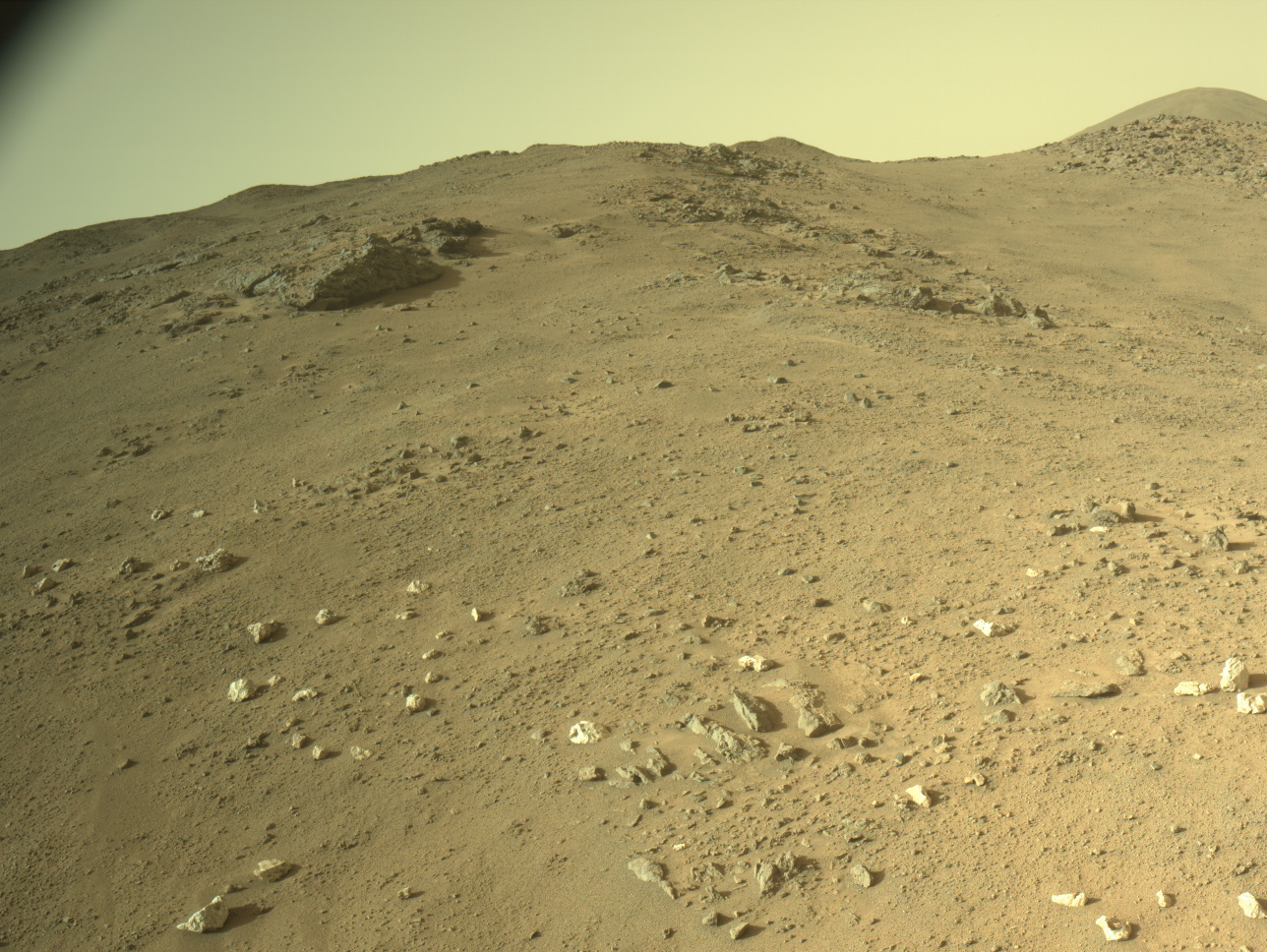
A grayscale landscape photo from Mars, showing a broad, medium gray, rock-strewn plain in the foreground extending far into the distance, surrounded by several hills. The closest hill, in the lower right corner, rises up toward the side of the frame, and is darker than the floor below. A little farther out, on the left, a gentle slope rises from the low middle of the frame to middle of the left side; it’s about the same color as the valley floor, except for a band at its farthest edge, which darkens abruptly as if covered in shadow. The terrain appears softer than the ground below, more sandy than rocky. Beyond that along the same rising plane is a much lighter area, with scattered tiny peaks that are darker – looking like the top of a baked meringue pie. The channel floor runs between these hills, then appears to curve toward the right, behind the first hill and in front of the second. Finally, one other rounded peak appears above the horizon, behind these other two hills in the lower right of the frame, all of this below a light-gray sky filling more than half of the frame above.
NASA’s Mars rover Curiosity acquired this image using its Right Navigation Camera on Nov. 14, 2024 — sol 4363, or Martian day 4,363 of the Mars Science Laboratory mission – at 02:55:34 UTC.
NASA/JPL-Caltech

Earth planning date: Friday, Nov. 15, 2024

The Monday plan and drive had executed successfully, so the team had high hopes for APXS and MAHLI data on several enticing targets in the rover’s workspace. Alas, it was not to be: The challenging terrain had resulted in an awkwardly perched wheel at the end of the drive, so we couldn’t risk deploying the arm from this position. Maybe next drive!

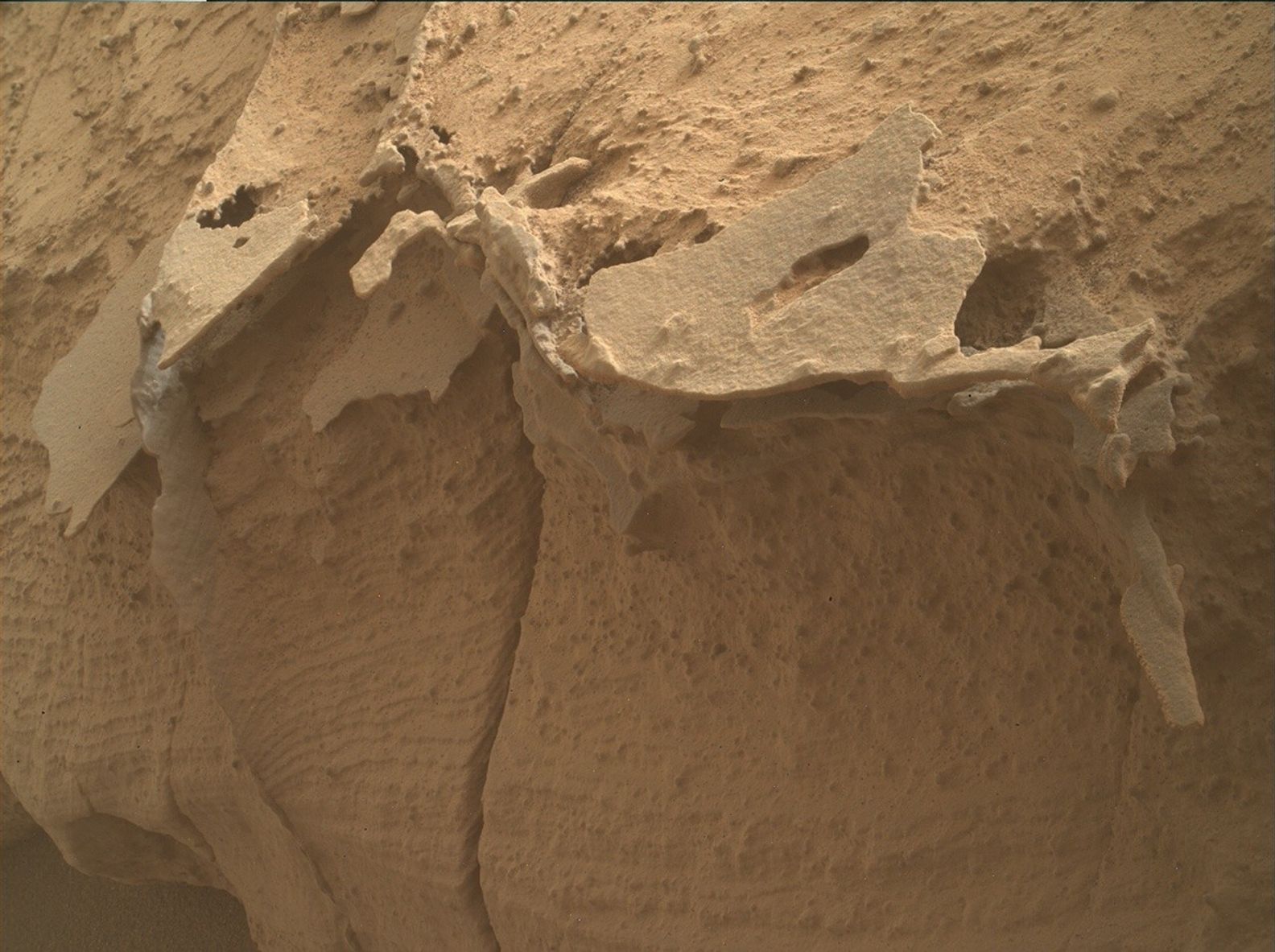
We did plan a busy weekend of non-arm science activities regardless. Due to a “soliday” the weekend has two sols instead of three, but we had enough power available to fit in more than three hours of observations. The two LIBS observations in the plan will measure the composition of the flat, reddish material in the workspace that is fractured in a polygonal pattern (“Bloody Canyon”) and a nearby rock coating in which the composition is suspected to change with depth (“Burnt Camp Creek”). One idea is that the reddish material could be the early stage version of the thicker dark coatings we’ve been seeing.

A large Mastcam mosaic (“Yosemite”) was planned to capture the very interesting view to the rover’s north. Nearby and below the rover is the layer of rocks in which the “Mineral King” site was drilled on the opposite side of the channel back in March. This is a stratum of sulfate-bearing rock that appears dark-toned from orbit and we’re interested to know how consistent its features are from one side of the channel to the other. Higher up, the Yosemite mosaic also captures some deformation features that may reveal past water activity, and some terrain associated with the Gediz Vallis ridge. So there’s a lot of science packed into one mosaic!

Two long-distance RMI mosaics were planned; one is to image back into the channel, where there may be evidence of a late-stage debris flow at the base of the ridge. The second looks “forward” from the rover’s perspective instead, into the wind-shaped yardang unit above us that will hopefully be explored close-up in the rover’s future. This yardang mosaic is intended to form one part of a stereo observation.

The modern environment on Mars will also be observed with dust devil surveys on both sols, line-of-sight and tau observations to measure atmospheric opacity (often increased by dust in the atmosphere), and zenith and suprahorizon movies with Navcam to look for clouds. There will also be standard passive observations of the rover’s environment by REMS and DAN.

We’ll continue driving westward and upward, rounding the Texoli butte to keep climbing through the sulfate-bearing unit. It’s not always easy driving but there’s a lot more science to do!

Written by Lucy Lim, Participating Scientist at NASA’s Goddard Space Flight Center

Share

Details

Last Updated
Nov 18, 2024

Related Terms

Powered by WPeMatico

Get The Details…

Part Ojibwe, All NASA: Linda Spuler’s Role in Protecting Johnson Space Center 

Part Ojibwe, All NASA: Linda Spuler’s Role in Protecting Johnson Space Center 

Linda Spuler, emergency manager at NASA’s Johnson Space Center in Houston, believes that everyone has a story. “Our stories highlight what we have in common, but they also make us each unique,” she said. 

Spuler has worked at Johnson for over 32 years, spending most of her career in Center Operations. Her story has involved helping to coordinate emergency response teams at Johnson in preparation for natural disasters. “Since Johnson is situated on the coast, a good portion of my job revolves around planning for hurricanes,” she said.   

Spuler has dealt with natural disasters at Johnson from Tropical Storm Allison in 2001 to Hurricane Beryl in 2024, but none had a greater personal impact than Hurricane Ike, which wrought havoc in Texas in September 2008. “Participating in the response to Hurricane Ike was a proud moment for me,” she said. “We worked from sunup to sundown restoring the center. Civil servants and contractors from various organizations came together, and for those two weeks, our differences didn’t matter.”  

Group of emergency responders and personnel gathered outdoors at Johnson Space Center during a safety briefing.
NASA’s Johnson Space Center Emergency Manager Linda Spuler, front, leads an emergency exercise for first responders.
Image courtesy of Linda Spuler

Spuler believes that NASA’s mission unites everyone – team members, astronauts, and support teams alike. “Remembering why we are all here energizes us and gets us excited about working for NASA,” she said.  

Spuler’s journey at NASA began as a dream not originally her own. Her path was shaped by the aspirations of her mother, who was born on an Ojibwe (Chippewa) reservation in Ashland, Wisconsin.  

“Although my grandmother lived in Chicago, she returned to the reservation to have her children. My mom is still a voting member of the Bad River Tribe,” said Spuler. 

“My mom was studying aerospace engineering at the University of Chicago when she met my dad, a fun-loving electrical engineering major who traced his lineage back to Davy Crockett on his father’s side and Ireland on his mother’s,” said Spuler. “She chose to abandon aerospace to marry my dad, whose degree and love for space brought him to work at Johnson.” 

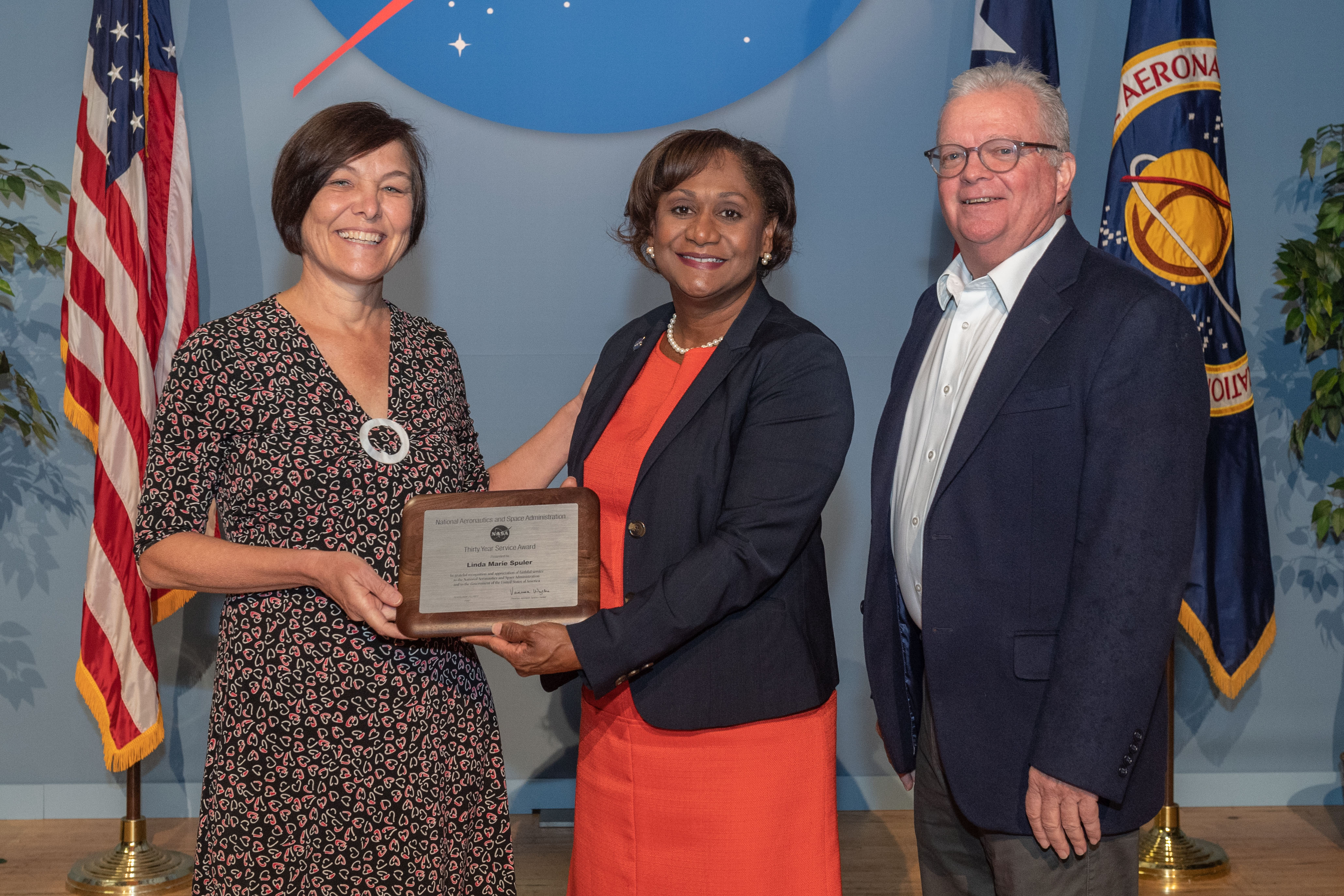
Linda Spuler accepts the Thirty-Year Service Award from Johnson Director Vanessa Wyche to commemorate her service at NASA.
NASA/David DeHoyos

Spuler said her mother was very proud that her father worked for NASA. “She was very happy when I chose to work here, too,” she said. “She taught me the value and reward of working hard. My mom is proud of her heritage but she is cautious of sharing her story.” 

Children participate in an outdoor Easter egg hunt on a grassy field near a chain-link fence. A young child in the foreground holds a small basket.
Linda Spuler at an Easter egg hunt at NASA’s Johnson Space Center in 1971.
Image courtesy of Linda Spuler

Spuler enjoys learning about Ojibwe culture from her mother. “Every Thanksgiving, we enjoy wild rice from the Bad River sent from the “aunties” that still live on the reservation,” Spuler shared. She also represents her culture and pride through her work, honoring the legacy of those who came before her and sharing the story of her mother, her father, and now herself.

Four individuals stand together in front of a NASA logo and an American flag. The person second from the left holds a framed certificate. The group includes two men in suits, one man in a Texas A&M shirt, and one woman in a polka-dot dress with glasses.
Linda Spuler receives the 2019 Furlough Heroes Awards alongside her son, Logan.
NASA/James Blair

“I celebrate the unique story that makes me part Ojibwe, part Polish, part Texas revolutionary, part Irish, part English, and all me,” she said.  

Powered by WPeMatico

Get The Details…
Sumer Loggins

NASA to Provide Coverage of Progress 90 Launch, Space Station Docking

NASA to Provide Coverage of Progress 90 Launch, Space Station Docking

The unpiloted Roscosmos Progress spacecraft pictured on Feb. 7, 2023, from the International Space Station.
Credit: NASA

NASA will provide live launch and docking coverage of a Roscosmos cargo spacecraft delivering nearly three tons of food, fuel, and supplies to the Expedition 72 crew aboard the International Space Station.

The unpiloted Progress 90 spacecraft is scheduled to launch at 7:22 a.m. EST (5:22 p.m. Baikonur time) Thursday, Nov. 21, on a Soyuz rocket from the Baikonur Cosmodrome in Kazakhstan.

Live launch coverage will begin at 7 a.m. on NASA+ and the agency’s website. Learn how to watch NASA content through a variety of platforms, including social media.

After a two-day in-orbit journey to the station, the spacecraft will dock autonomously to the space-facing port of the orbiting laboratory’s Poisk module at 9:35 a.m., Saturday, Nov. 23. NASA’s coverage of rendezvous and docking will begin at 8:45 a.m. on NASA+ and the agency’s website.

The Progress 88 spacecraft will undock from the Poisk module on Tuesday, Nov. 19. NASA will not stream undocking.

The spacecraft will remain docked at the station for approximately six months before departing for a re-entry into Earth’s atmosphere to dispose of trash loaded by the crew.

The International Space Station is a convergence of science, technology, and human innovation that enables research not possible on Earth. For more than 24 years, NASA has supported a continuous U.S. human presence aboard the orbiting laboratory, through which astronauts have learned to live and work in space for extended periods of time. The space station is a springboard for developing a low Earth economy and NASA’s next great leaps in exploration, including missions to the Moon under Artemis and, ultimately, human exploration of Mars.

Get breaking news, images and features from the space station on Instagram, Facebook, and X.

Learn more about the International Space Station, its research, and its crew, at:

https://www.nasa.gov/station

-end-

Claire O’Shea / Josh Finch
Headquarters, Washington
202-358-1100
claire.a.o’shea@nasa.gov / joshua.a.finch@nasa.gov

Sandra Jones
Johnson Space Center, Houston
281-483-5111
sandra.p.jones@nasa.gov

Share

Details

Last Updated

Nov 18, 2024

Editor
Jessica Taveau

Powered by WPeMatico

Get The Details…
Jessica Taveau

Station Science Top News: Nov. 15, 2024

Station Science Top News: Nov. 15, 2024

Anthocyanins protect seeds in space

After exposure to space outside the International Space Station, purple-pigmented rice seeds rich in anthocyanin had higher germination rates than non-pigmented white rice seeds. This result suggests that anthocyanin, a flavonoid known to protect plants from UV irradiation, could help preserve seed viability on future space missions.

Plants are key components for systems being designed to produce nutrients and recycle carbon for future sustained space habitation, but space has been shown to reduce seed viability. Tanpopo-3, part of a series of investigations from JAXA (Japan Aerospace Exploration Agency), examined the role of anthocyanins in maintaining seed viability. Results of this and previous experiments suggest that solar light in space is more detrimental to seeds than radiation.

Grid of metallic square enclosures, each containing a circular opening, arranged in a compact layout against a dark background.
Preflight image of the Tanpopo panel used to expose seeds and other samples to space.
Tanpopo-3 team

Low-cost, autonomous technology validated for space research

Researchers verified a pair of devices for conducting experiments in space that have multi-step reactions and require automatic mixing of solutions. This type of low-cost, autonomous technology expands the possibilities for space-based research, including work by commercial entities.

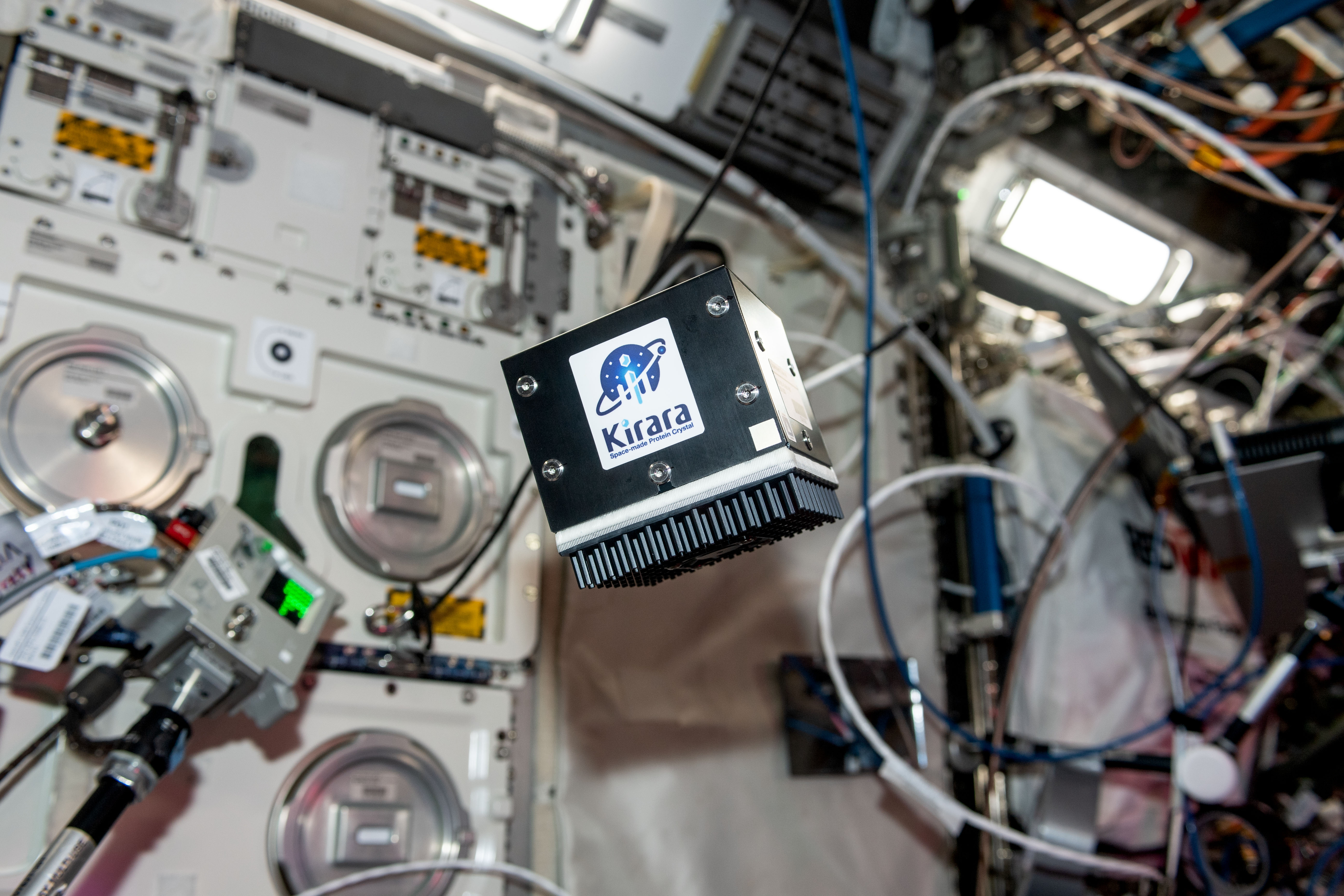
Ice Cubes #6- Kirara, an investigation from ESA (European Space Agency) developed by the Japan Manned Space Systems Corporation, used a temperature-controlled incubator to crystallize proteins in microgravity. The Kirara facility also enables production of polymers, including cellulose, which have different uses than protein crystals. This experiment synthesized and decomposed cellulose.

The Kirara incubator used for experiments in microgravity.
United Arab Emirates/Sultan Alneyadi

Insights from observations of an X-ray binary star

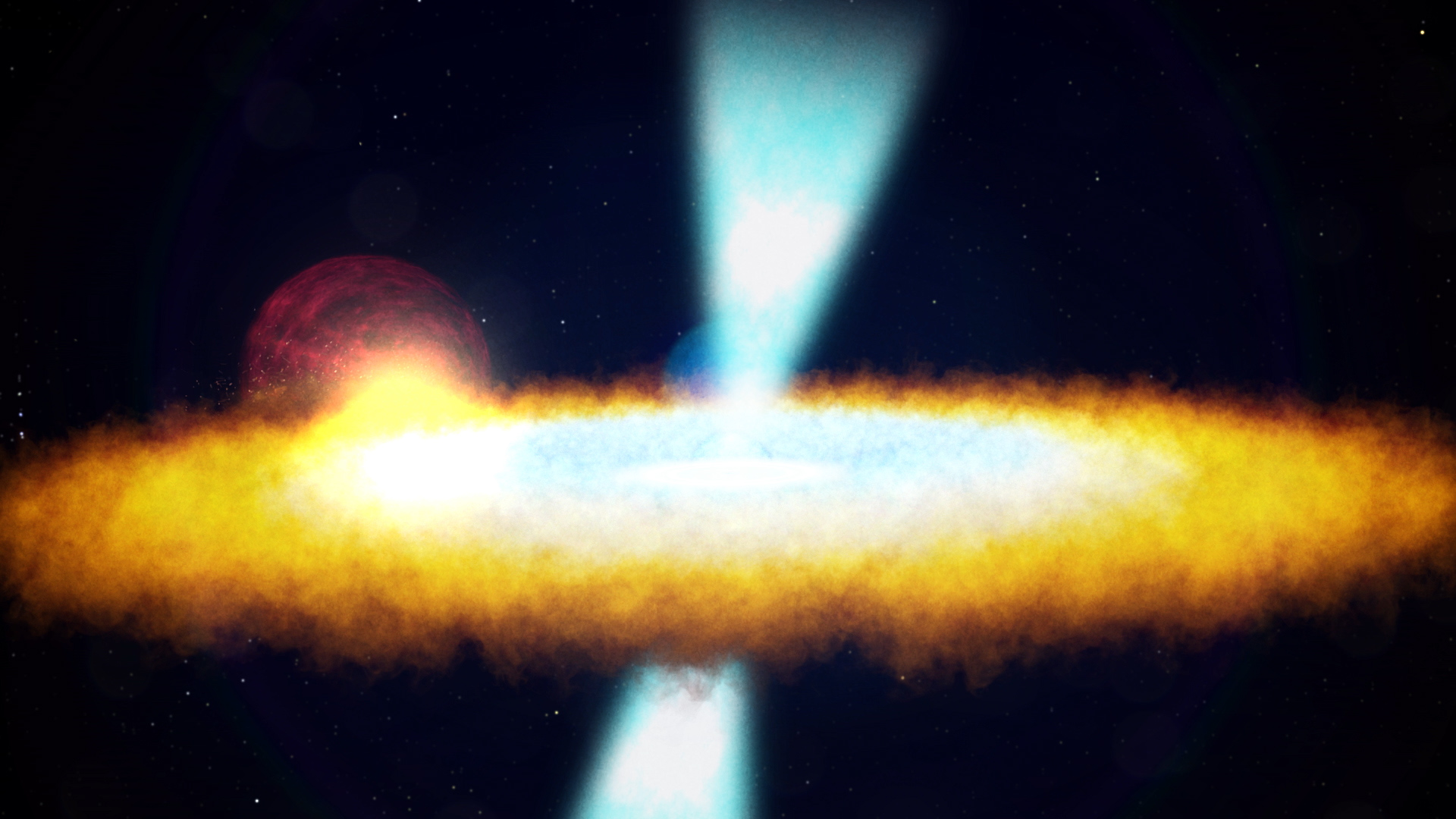
Researchers used Neutron star Interior Composition Explorer (NICER) to observe the timing of 15 X-ray bursts from 4U 1820–30, an ultracompact X-ray binary (UCXB) star. An X-ray binary is a neutron star orbiting a companion from which it takes matter. If confirmed with future observations, this result makes 4U 1820–30 the fastest-spinning neutron star known in an X-ray binary system and provides insights into the physics of neutron stars.

NICER makes high-precision measurements of neutron stars (the ultra-dense matter created when massive stars explode as supernovas) and other phenomena to increase our understanding of the universe. NICER has monitored 4U 1820–30 since its launch in June 2017. A short orbital period indicates a relatively small binary system, and 4U 1820–30 has the shortest known orbital period among low-mass X-ray binaries.

Artistic rendering of a glowing yellow-orange accretion disk with blue jets of energy emitting vertically with a red celestial body in the distance.
Animated image of a binary star system,
NASA’s Goddard Space Flight Center/Chris Smith

Powered by WPeMatico

Get The Details…
Sumer Loggins

November Transformer of the Month: Ariel Vargas

November Transformer of the Month: Ariel Vargas

Protrait of Ariel Vargas

When Ariel Vargas joined NASA in 2023, he knew he wanted to make an impact. Despite his relatively short tenure, he has earned the reputation of a Digital Transformer in his work as a Network and ICAM (Identity, Credential, and Access Management) Service Integrator at Johnson Space Center (JSC). No matter the task at hand, Ariel is motivated by measurable transformation. “I wanted to have my fingerprint on something no matter what it was, big or small. To be able to see an impact,” he says. “And a lot of the things that I’m doing, both within my role and within Digital Transformation, I can see really flourishing already.”  

In his current role, Ariel oversees the integration and management of various network services to ensure compliance and smooth operation. This includes the modernization of NASA’s Voice over Internet Protocol (VoIP) to consolidate the agency’s telephone systems and enhance wireless communications. He is involved in rolling out wall-to-wall wireless and coverage improvements on campus at JSC. Ariel also spearheads efforts in streamlining communications across NASA by integrating new capabilities into familiar platforms like Microsoft Teams. With these projects in progress, he aims to foster a more flexible, collaborative work environment aligned with Digital Transformation’s goal of inclusive teaming.  

Ariel appreciates the cultural side of Digital Transformation, particularly the challenges involved in pursuing constant innovation. He recognizes that growth “often requires a period of adjustment, especially for those encountering new tools or methods for the first time.” Ariel strives to ensure cohesive collaboration across teams and centers in establishing interoperable architectures, processes, and tools. His team measures the impact of their transformation efforts by several metrics, including increased network performance and adoption rates of new tools and technologies. For instance, the VoIP modernization initiative aims to remove 50% of telephones at NASA centers. Of the over 1300 users affected by the NASA-wide service shut-off of non-compliant phones at JSC, only 6% reported issues post-implementation. This reflected a positive and proactive collaboration with users on finding alternative solutions and embracing future innovations. 

I really believe in embracing changes and innovation and driving impactful results, being able to see it.

Ariel Vargas

Ariel Vargas

Network and ICAM (Identity, Credential, and Access Management) Service Integrator at Johnson Space Center (JSC)

Lynn Vernon, JSC’s Digital Transformation lead and Chief Engineer for IT, notes Ariel’s ability to engage with partners, understand their mission needs, and identify innovative solutions to barriers. “Ariel looks at things from a new perspective and is willing to ask ‘why’ or ‘why not.’ Why do we do it this way? Why not try this? He is consistently willing to explore new technologies and capabilities to transform the way we work,” says Lynn. Ariel’s passion for continuous improvement and learning positions him as a natural leader within the Digital Transformation community. 

Ariel took a unique path to NASA and sees his prior experiences as building blocks toward becoming the Digital Transformer he is today. Although his upbringing in Florida near Cape Canaveral sparked an early interest in space, Ariel initially pursued pre-medicine after high school before transitioning into the Army. After his service, he joined NASA as an intern through the Department of Defense’s SkillBridge program, which offers career assistance to transitioning military personnel. His ability to learn NASA’s culture and demonstrate mission value quickly led to a full-time, civil servant position. 

Between his initial interest in medicine, his service in the Army, and his current focus on digital transformation and technology, Ariel sees a common theme of problem-solving. “You have to figure out what the problem is, and you have to be up to date with the newest, the latest and greatest, to help solve these problems.” Ariel followed this thread to complete a master’s degree in computer science and is currently pursuing a doctorate in instructional design and performance technology. Even outside his work at NASA, Ariel pursues pathways that further his capacity as a champion of Digital Transformation initiatives. 

Looking to the future, Ariel is excited by the possibility of supporting NASA’s space missions through AI and data integration. He is motivated by the prospect of seeing his current work make a difference in the near-term future. “I really believe in embracing changes and innovation and driving impactful results, being able to see it,” he says. Given his accomplishments of the past year, Ariel is well on his way to realizing the future he envisions.  

Powered by WPeMatico

Get The Details…
Maya L. Kikuchi