NASA, ESA, and E. Skillman (University of Minnesota – Twin Cities; Processing: Gladys Kober (NASA/Catholic University of America)
Andromeda III is one of at least 13 dwarf satellite galaxies in orbit around the Andromeda galaxy, or Messier 31, the Milky Way’s closest grand spiral galactic neighbor. Andromeda III is a faint, spheroidal collection of old, reddish stars that appears devoid of new star formation and younger stars. In fact, Andromeda III seems to be only about 3 billion years younger than the majority of globular clusters ― dense knots of stars thought to have been mostly born at the same time, which contain some of the oldest stars known in the universe.
Astronomers suspect that dwarf spheroidal galaxies may be leftovers of the kind of cosmic objects that were shredded and melded by gravitational interactions to build the halos of large galaxies. Curiously, studies have found that several of the Andromeda Galaxy’s dwarf galaxies, including Andromeda III, orbit in a flat plane around the galaxy, like the planets in our solar system orbit around the Sun. The alignment is puzzling because models of galaxy formation don’t show dwarf galaxies falling into such orderly formations, but rather moving around the galaxy randomly in all directions. As they slowly lose energy, the dwarf galaxies merge into the larger galaxy.
The odd alignment could be because many of Andromeda’s dwarf galaxies fell into orbit around it as a single group, or because the dwarf galaxies are scraps left over from the merger of two larger galaxies. Either of these theories, which are being researched via NASA’s James Webb Space Telescope, would complicate theories of galaxy formation but also help guide and refine future models.
NASA’s Hubble Space Telescope took this image of Andromeda III as part of an investigation into the star formation and chemical enrichment histories of a sample of M31 dwarf spheroidal galaxies that compared their first episodes of star formation to those of Milky Way satellite galaxies.
Sols 4289-4290: From Discovery Pinnacle to Kings Canyon and Back Again
4 min read
Sols 4289-4290: From Discovery Pinnacle to Kings Canyon and Back Again
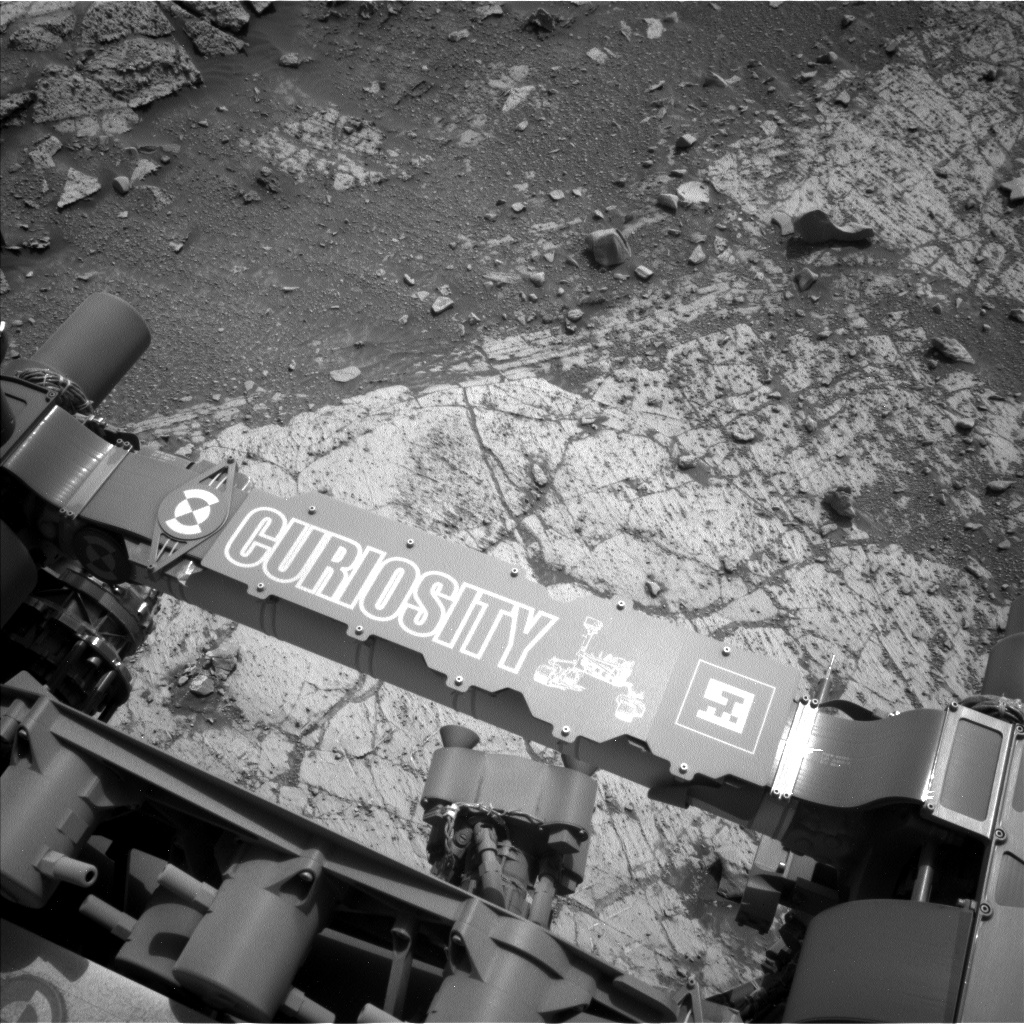
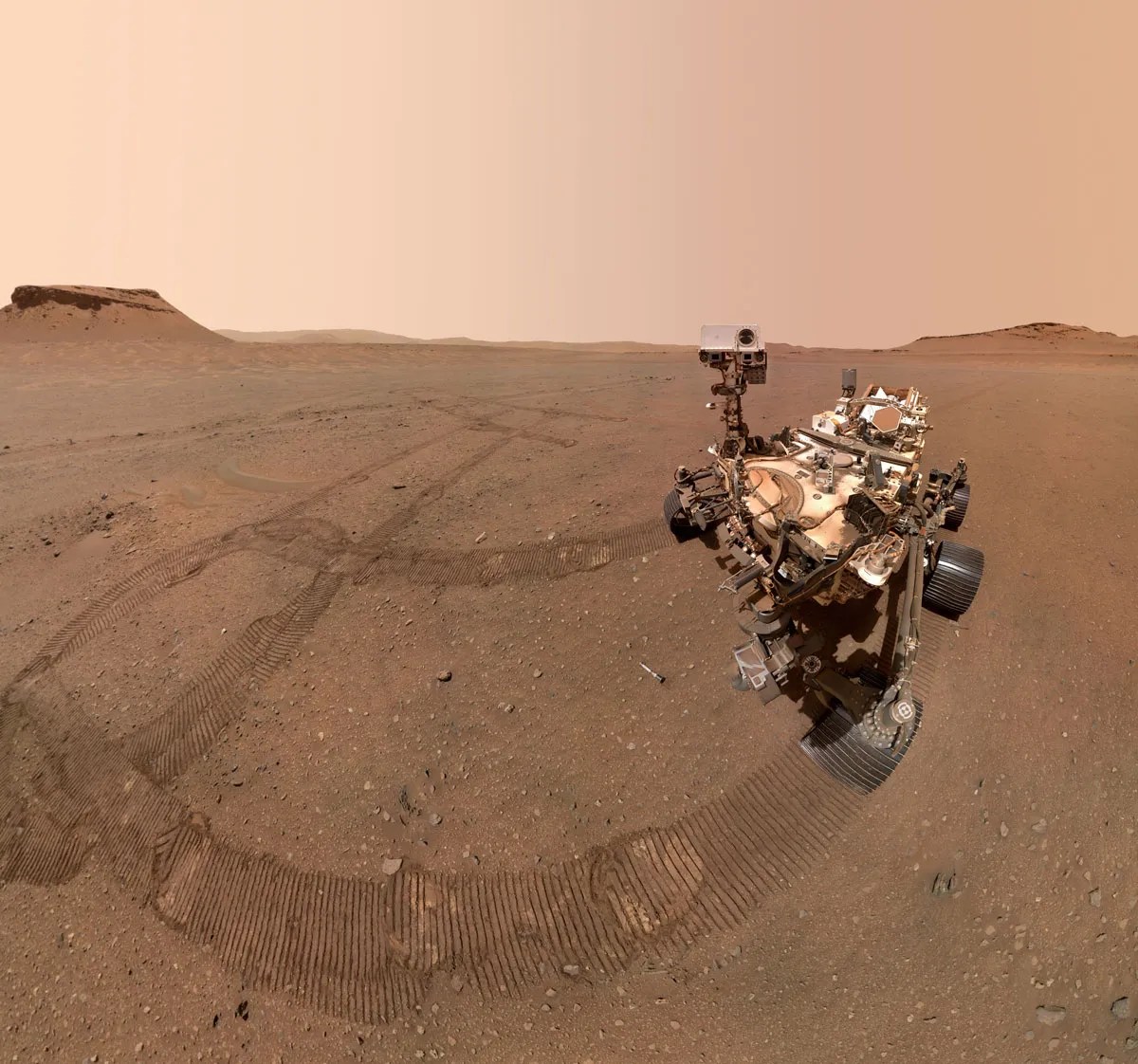
This image shows the workspace in front of NASA’s Mars rover Curiosity, taken by the Left Navigation Camera aboard the rover on sol 4287 — Martian day 4,287 of the Mars Science Laboratory mission — on Aug. 28, 2024, at 02:23:27 UTC.
NASA/JPL-Caltech
Earth planning date: Wednesday, Aug. 28 2024
We are back … almost, anyways. Today’s parking location is very close to where we parked on sol 4253, and in an area near one of the previous contact science targets “Discovery Pinnacle.” You can read in this blog post that most of the team, this blogger included, was in Pasadena for our team meeting when we were last in this area. That was July and Curiosity was about to turn 12 on Mars. Coming back is a very rare occasion and is always planned carefully. Once or twice during the last 12 years it happened because we saw something “in the rear mirror.” One of the examples is the target “Old Soaker,” where we spotted mud cracks in the images from a previous parking position, and promptly went back because this was such an important discovery. At other times it was carefully planned, such as the “walkabout” at “Pink Cliffs,” which you can watch in this video from as long back as Earth year 2015. In the past few planning cycles, it’s more of the latter as we made our way from Discovery Pinnacle, where we were on sol 4253, “Just passing through” “Russell Pass” and arriving at “Kings Canyon,” our drill location, which we reached on sol 4257. You can follow all the action of the drilling at Kings Canyon on the blogs. It took a while — it always does — because it’s an activity with many steps and investigations to complete. We actually celebrated Curiosity’s 12th birthday at Kings Canyon! We departed on sol 4283, came back via “Cathedral Peak,” and are now near the Discovery Pinnacle location again. After that little walkabout through the history of (some) of Curiosity’s walkabouts, especially the very last one, let’s look at today’s plan.
It is a pretty normal two-sol plan, with a one-hour science block before we drive away from this location. We were greeted by a nicely flat surface, and the engineers informed us that we have all six wheels firmly on flat and stable ground. That’s always a relief, because only then can we use the arm. That nice piece of flat rock Curiosity is so firmly parked on became our science target …well, mostly. Some of the little pebbles on the surface attracted our attention, too. The very eagle-eyed can spot a small white spot in the image above. It’s right between the arm and the rover itself, about where the C is written. That’s a rock that we likely broke up with our wheel and that has a very white part to it. We called it “Thousand Island Lake,” and will image it with MAHLI. APXS is investigating a target called “Eichorn Pinnacle,” squarely on the big flat area. LIBS is also making the most of the large target underneath and in front of us, investigating the target “Nine Lakes Basin.”
In recent blogs you will have read about the dust-storm watch making the atmospheric investigations even more important, so we don’t miss any changes. We are looking for dust devils, atmospheric opacity, and are of course monitoring the weather throughout the plan.
Our drive will hopefully — if Mars agrees — be a long one, and we will also plan an activity that we call MARDI sidewalk. That’s when we take very frequent pictures with the MARDI instrument while driving. This results in a long strip of images nicely showing the nature of the terrain the rover has driven over. This is in addition to the MARDI single frame we are taking every time the rover stops. I often get the question, why are we taking an image just downwards whenever the rover stops? Well, humans are easy to bias toward the outliers, toward the things that look special, and of course the Curiosity team is no exception. For some things this is great, because it allows for the discoveries of new things. But it doesn’t provide an unbiased overview. That’s what MARDI does: It always points down and reliably records the terrain under the rover. We don’t have to do anything but put the commands for that one image into our plan after the drive — something that’s pretty routine after 12 years now!
Written by Susanne Schwenzer, Planetary Geologist at The Open University
New! 2016-09-30: ASSURE 2016 concluded successfully. The accepted papers appear in the SAFECOMP 2016 Workshop Proceedings. Thank you for attending! See you in 2017.
2016-07-18: Clive Tomsett, Clinical Strategist at the Cerner Corporation, will give an invited keynote talk!
2016-07-18: The ASSURE 2016 Program has been announced. The final program is contingent on registration. If you haven’t already done so, please register for ASSURE 2016 via SAFECOMP 2016.
2016-06-08: ASSURE 2016 will be held on Tuesday, Sep. 20, 2016. The accepted papers and program will be posted here soon.
2016-06-07: Authors of accepted papers have been notified. The final, camera-ready version and a signed copyright release form are due on June 20, 2016. Instructions on submitting both the final version and the copyright form have been posted.
2016-05-26: Paper submission deadlines have passed. Submission is now closed.
2016-05-16: ASSURE deadlines have been extended by to May 26, 2016. Submit a paper now!
2016-03-28: The deadline to submit papers to ASSURE 2016 is May 17, 2016.
2016-03-28: The ASSURE 2016 call for papers, and the paper submission guidelines are now available.
2016-03-07: The ASSURE 2016 website is live!
Introduction
The 4th International Workshop on Assurance Cases for Software-intensive Systems (ASSURE 2016) is being collocated this year with SAFECOMP 2016, and aims to provide an international forum for high-quality contributions on the application of assurance case principles and techniques to provide assurance that the dependability properties of critical, software-intensive systems have been met.
The main goals of the workshop are to:
Explore techniques for the creation and assessment of assurance cases for software-intensive systems
Examine the role of assurance cases in the engineering lifecycle of critical systems
Identify the dimension of effective practice in the development and evaluation of assurance cases
Investigate the relationship between dependability techniques and assurance cases
Identify critical research challenges and define a roadmap for future development
We invite original, high-quality research, practice, tools and position papers that have not been published/submitted elsewhere. See the full Call for Papers, for more details on topics. Also view the submission deadlines, and guidelines.
Program
08:00 – 09:00 Registration
09:00 – 11:00 Session 1. Introduction, Keynote, and Lifecycles
09:00 – 09:10 Welcome and Introduction, ASSURE 2016 Organizers
09:10 – 10:00 Keynote Talk: Rhetoric or Rigor: The Development and Use of Safety Cases in Health ITClive Tomsett, Cerner Corporation
10:00 – 10:30 The Agile Safety Case, Tor Stålhane and Thor Myklebust
10:30 – 11:00 Towards Faster Maintenance of Safety Cases, Omar Jaradat and Iain Bate
11:00 – 11:30 Morning Coffee/Tea Break
11:30 – 13:00 Session 2. Formal Evidence and Tool Support
11:30 – 12:00 On Using Results of Code-level Bounded Model Checking in Assurance Cases, Carmen Cârlan, Daniel Ratiu, and Bernhard Schätz
12:00 – 12:30 Configuration-aware Contracts, Irfan Šljivo, Barbara Gallina, Jan Carlson, and Hans Hansson
12:30 – 13:00 Developing SNS tool for Consensus Building on Environmental Safety using Assurance Cases, Yutaka Matsuno, Yang Ishigaki, Koichi Bando, Hiroyuki Kido, and Kenji Tanaka
13:00 – 14:00 Lunch Break
14:00 – 15:30 Session 3. Applications
14:00 – 14:30 The 6W1H Model as a Basis for Systems Assurance Argument, Shuji Kinoshita and Yoshiki Kinoshita
14:30 – 15:00 The Assurance Timeline: Building Assurance Cases for Synthetic Biology, Myra Cohen, Justin Firestone, and Massimiliano Pierobon
15:00 – 15:30 Towards Safety Case Integration with Hazard Analysis for Medical Devices, Andrzej Wardziński and Aleksander Jarzębowicz
15:30 – 16:00 Afternoon Coffee/Tea Break
16:00 – 17:30 Session 4. Panel and Conclusion
16:00 – 17:15 PANEL: Assurance Challenges for Safety-critical Autonomous Systems Panelists: – Håkon Olsen, Principal Consultant at Lloyd’s Register, Norway – Jérémie Guiochet, Professor at University of Toulouse, France – Marialena Vagia, Research Scientist at SINTEF, Norway – Ovidiu Drugan, Senior Researcher at DNV GL, Norway
17:15 – 17:30 Conclusion and Wrap-Up, ASSURE 2016 Organizers
Software plays a key role in high-risk systems, e.g., safety-, and security-critical systems. Several certification standards/guidelines now recommend and/or mandate the development of assurance cases for software-intensive systems, e.g., defense (UK MoD DS-0056), aviation (CAP 760, FAA’s operational approval guidance for unmanned aircraft systems), automotive (ISO 26262), and healthcare (FDA infusion pumps total product lifecycle guidance). As such, there is a need to develop models, techniques and tools that target the development of assurance arguments for software.
The goals of the 2016 Workshop on Assurance Cases for Software-intensive Systems (ASSURE 2016) are to:
explore techniques for creating/assessing assurance cases for software-intensive systems;
examine the role of assurance cases in the engineering lifecycle of critical systems;
identify the dimensions of effective practice in the development and evaluation of assurance cases;
investigate the relationship between dependability techniques and assurance cases; and,
identify critical research challenges and define a roadmap for future development.
We solicit high-quality contributions: research, practice, tools and position papers on the application of assurance case principles and techniques to assure that the dependability properties of critical software-intensive systems have been met.
Papers should attempt to address the workshop goals in general.
Topics
Topics of interest include, but are not limited to:
Assurance issues in emerging paradigms, e.g., adaptive and autonomous systems, including self-driving cars, unmanned aircraft systems, complex health care and decision making systems, etc.
Standards: Industry guidelines and standards are increasingly requiring the development of assurance cases, e.g., the automotive standard ISO 26262 and the FDA guidance on the total product lifecycle for infusion pumps.
Certification and Regulations: The role and usage of assurance cases in the certification of critical systems, as well as to show compliance to regulations.
Dependable architectures: How do fault-tolerant architectures and design measures such as diversity and partitioning relate to assurance cases?
Dependability analysis: What are the relationships between dependability analysis techniques and the assurance case paradigm?
Tools: Using the output from software engineering tools (testing, formal verification, code generators) as evidence in assurance cases / using tools for the modeling, analysis and management of assurance cases.
Application of formal techniques to create and analyze arguments.
Exploration of relevant techniques for assurance cases for real-time, concurrent, and distributed systems.
Modeling and Metamodeling: Representation of structured arguments through meta models, such as OMG’s Structured Assurance Case Metamodel (SACM).
Assurance of software quality attributes, e.g., safety, security and maintainability, as well as dependability in general, including tradeoffs, and exploring notions of the quality of assurance cases themselves.
Domain-specific assurance issues, in domains such as aerospace, automotive, healthcare, defense and power.
Reuse and Modularization: Contracts and patterns for improving the reuse of assurance case structures.
Connections between the Goal Structuring Notation for assurance cases, and goal-orientation from the requirements engineering community.
Submit
Submission Instructions for Accepted Papers
If your paper has been accepted for the ASSURE 2016 Program, please follow the instructions below, when preparing your final, camera-ready paper for the proceedings.
1. Deadline
The final paper and the signed copyright form are due on June 20, 2016. This is a firm deadline for the production of the proceedings.
2. Copyright Release
Authors must fill and sign the Springer “Consent to Publish” copyright release form using the following information:
Title of the Book or Conference Name: Computer Safety, Reliability, and Security – SAFECOMP 2016 Workshops – ASSURE, CYBERSUP, DECSoS, SASSUR, and TIPS
Springer does not accept digital signatures, unfortunately. Please physically sign the form, scan, and email it in PDF or any acceptable image format, to the SAFECOMP 2016 Publication Chair by the deadline above.
Alternatively, upload the signed, and completed form via EasyChair using your author account.
3. Corresponding Authors
Please nominate a corresponding author, whose name and email address must be included in the email containing the copyright release form. This author will be responsible for checking the pre-print proof of your paper prepared by Springer.
4. Pre-print Checking
The publisher has recently introduced an extra control loop: once data processing is finished, they will contact all corresponding authors and ask them to check their papers. We expect this to happen shortly before the printing of the proceedings. At that time your quick interaction with Springer-Verlag will be greatly appreciated.
5. Formatting and Page Limits
Please do not change the spacing and dimensions associated with the paper template files. Please ensure that your paper meets the page limits for your paper type.
Regular research/practice papers: 12 pages including figures, references, and appendices.
Tools papers: 10 pages, including figures, references, and appendices.
Position papers: 4 – 6 pages including figures, references, and any appendices.
6. Final Paper Submission
Submit your camera ready paper using your EasyChair author account, for inclusion into the Workshop Proceedings. After you have logged in, follow the “Proceedings” tab in the top panel.
Springer reserves the right to reformat your paper to meet their print and digital publication requirements. Consequently, you will need to submit all the source files associated with your paper. Follow the instructions after the login for uploading two files:
either a zipped file containing all your LaTeX sources or a Word file in the RTF format, and
Crew Works Spacecraft Configurations and Eye Checks on Wednesday
The last rays of an orbital sunset fade below Earth’s horizon illuminating the atmosphere in this photograph from the International Space Station as it soared above the Atlantic Ocean.
Dragon spacecraft configurations topped Wednesday’s task list aboard the International Space Station as the orbital residents prepare for crew swap activities in September and October. Human research duties and lab maintenance tasks rounded out the day for the nine crewmates living and working on the orbital outpost.
Six astronauts worked throughout the day configuring the SpaceX Dragon Endeavour spacecraft’s emergency systems and updating the vehicle’s emergency procedures. The NASA astronauts split up the daylong tasks as Matthew Dominick, Mike Barratt, and Butch Wilmore worked inside the spacecraft configuring its emergency systems and computer tablets as it nears an October return to Earth with four SpaceX Crew-8 members.
NASA astronauts Tracy C. Dyson, Jeanette Epps, and Suni Williams focused on updating emergency procedures including responses to unlikely events such as a depressurization, fire, or ammonia leak aboard Dragon. The trio also documented individual roles and responsibilities for the astronauts in the event of a contingency aboard Dragon after it departs the orbital outpost.
The astronauts still had time for light science tasks and lab upkeep while ensuring Dragon is prepared for its upcoming departure. Epps watered two types of grasses growing inside the Columbus laboratory module’s Veggie space botany facility. The grasses are being studied to observe space-caused changes to photosynthesis and plant metabolism and possibly inform bioregenerative life support systems on future spacecraft. Epps also drained resupply tanks and serviced orbital plumbing systems in the Tranquility module.
In the afternoon, Dominick examined Dyson’s eyes using standard medical imaging hardware in the Harmony module. Cosmonauts Oleg Kononenko and Nikolai Chub also participated in the regularly scheduled eye exams. Doctors on the ground remotely monitored both sessions to understand how living in weightlessness affects a crew member’s cornea, lens, and retina.
Kononenko and Chub kicked off their day with a cardiac study as Kononenko assisted Chub who attached sensors to himself that measured his heart rate while relaxing. The duo would then split up and work on a variety of electronics and life support systems in the station’s Roscosmos segment. Flight Engineer Alexander Grebenkin worked on orbital plumbing duties in the Nauka science module during the morning before spending the afternoon collecting station air samples for analysis.
2015-10-05: ASSURE 2015 concluded successfully. The accepted papers appear in the SAFECOMP 2015 Workshop Proceedings. Thank you for attending! See you in 2016.
2015-06-24: Pippa Moore of the UK Civil Aviation Authority will give an invited keynote talk!
2015-06-24: The ASSURE 2015 Program has been announced. The final program is contingent on registration. If you haven’t already done so, please register for ASSURE 2015 via SAFECOMP 2015.
2015-06-15: ASSURE 2015 will be held on Tuesday, Sep. 22, 2015. The accepted papers and program will be posted here soon.
2015-06-15: Authors of accepted papers have been notified. Final, camera-ready copies and the copyright form are due on June 28, 2015 June 30, 2015.
2015-06-04: Paper submission deadlines have passed. Submission is now closed.
2015-05-28: SAFECOMP 2015 has extended all workshop deadlines, including for ASSURE 2015, by another week to June 3, 2015.
2015-05-19: ASSURE deadlines have been extended by a week to May 29, 2015.
2015-03-13: The ASSURE 2015 call for papers, and the paper submission guidelines are now available.
2015-03-12: The deadline to submit papers to ASSURE 2015 is May 22, 2015.
2015-03-05: The ASSURE 2015 website is live!
Introduction
ASSURE 2015, collocated this year with SAFECOMP 2015, aims to provide an international forum for high-quality contributions on the application of assurance case principles and techniques to assure that the dependability properties of critical, software-intensive systems have been met.
The main goals of the workshop are to:
Explore techniques for the creation and assessment of assurance cases for software-intensive systems
Examine the role of assurance cases in the engineering lifecycle of critical systems
Identify the dimension of effective practice in the development and evaluation of assurance cases
Investigate the relationship between dependability techniques and assurance cases
Identify critical research challenges and define a roadmap for future development
We invite original, high-quality research, practice, tools and position papers that have not been published/submitted elsewhere. See the full Call for Papers, for more details on topics. Also view the submission deadline, and guidelines.
Program
08:00 – 09:00 Registration
09:00 – 11:00 Session 1. Keynote and Foundations
09:00 – 09:10 Welcome and Introduction, ASSURE 2015 Organizers
09:10-10:00 Keynote Talk: Do We Really Want To Start From Here?Pippa Moore, UK Civil Aviation Authority
10:00-10:30 Informing Assurance Case Review through a Formal Interpretation of GSN Core Logic, Victor Bandur, and John McDermid
10:30 – 11:00 Representing Confidence in Assurance Case Evidence, Lian Duan, Sanjai Rayadurgam, Mats Heimdahl, Oleg Sokolsky, and Insup Lee
11:00 – 11:30 Morning Coffee/Tea Break
11:30-1:00 Session 2. Methodology and Patterns
11:30 – 12:00 Safe and Sec Case Patterns, Kenji Taguchi, Daisuke Souma, and Hideaki Nishihara
12:00 – 12:30 A Comprehensive Safety Lifecycle, John Knight, Jonathan Rowanhill, Anthony Aiello, and Kimberly Wasson
12:30 – 13:00 An Approach to Assure Dependability Through ArchiMate, Shuichiro Yamamoto
13:00 – 14:00 Lunch Break
14:00 – 15:30 Session 3. Tool Support and Tool Demonstrations
14:00 – 14:30 Tool Support for Assurance Case Building Blocks: Providing a Helping Hand with CAE, Kateryna Netkachova, Oleksandr Netkachov, and Robin Bloomfield
14:30 – 15:00 Safety.Lab: Model-based Domain Specific Tooling for Safety Argumentation, Daniel Ratiu, Marc Zeller, and Lennart Kilian
15:00 – 15:30 A Safety Condition Monitoring System, John Knight, Jonathan Rowanhill, and Jian Xiang
15:30 – 16:00 Afternoon Coffee/Tea Break
16:00 – 16:45 Session 4. Applications and Project Overviews
16:00 – 16:30 Fault Type Refinement for Assurance of Families of Platform-Based Systems, Sam Procter, John Hatcliff, Sandy Weininger, and Anura Fernando
16:30 – 16:37 Safety and Security Assurance in Railway Standards, Kenji Taguchi
16:37 – 16:45 Towards Assurance Arguments of Disaster Management Plans, Shuji Kinoshita
16:45 – 18:00 Session 5. Panel and Conclusion
16:45 – 18:00 PANEL: The Role of Argumentation in Certification and Safety Risk Management,
John Birch, JaguarLandRover / AVL; Robin Bloomfield, Adelard and City University; Chris Johnson, University of Glasgow; Yoshiki Kinoshita, Kanagawa University; and Pippa Moore, UK CAA.
18:00 Conclusion and Wrap-Up, ASSURE 2015 Organizers
Software plays a key role in high-risk systems, e.g., safety-, and security-critical systems. Several certification standards/guidelines now recommend and/or mandate the development of assurance cases for software-intensive systems, e.g., defense (UK MoD DS-0056), aviation (CAP 670. FAA operational approval guidance for unmanned aircraft systems), automotive (ISO 26262), and healthcare (FDA infusion pumps total product lifecycle guidance). As such, there is a need to develop models, techniques and tools that target the development of assurance arguments for software.
The goals of the 2015 Workshop on Assurance Cases for Software-intensive Systems (ASSURE 2015) are to:
explore techniques for creating/assessing assurance cases for software-intensive systems;
examine the role of assurance cases in the engineering lifecycle of critical systems;
identify the dimensions of effective practice in the development and evaluation of assurance cases;
investigate the relationship between dependability techniques and assurance cases; and,
identify critical research challenges and define a roadmap for future development.
We solicit high-quality contributions: research, practice, tools and position papers on the application of assurance case principles and techniques to assure that the dependability properties of critical software-intensive systems have been met.
Papers should attempt to address the workshop goals in general.
Topics
Topics of interest include, but are not limited to:
Standards: Industry guidelines and standards are increasingly requiring the development of assurance cases, e.g., the automotive standard ISO 26262 and the FDA guidance on the total product lifecycle for infusion pumps.
Certification and Regulations: The role and usage of assurance cases in the certification of critical systems, as well as to show compliance to regulations.
Dependable architectures: How do fault-tolerant architectures and design measures such as diversity and partitioning relate to assurance cases?
Dependability analysis: What are the relationships between dependability analysis techniques and the assurance case paradigm?
Tools: Using the output from software engineering tools (testing, formal verification, code generators) as evidence in assurance cases / using tools for the modeling, analysis and management of assurance cases.
Application of formal techniques to create and analyze arguments.
Exploration of relevant techniques for assurance cases for real-time, concurrent, and distributed systems.
Assurance issues in emerging computational paradigms, e.g., cloud, mobile, virtual, many-core architectures, and adaptive and autonomous systems.
Modeling and Metamodeling: Representation of structured arguments through metamodels, such as OMG’s Structured Assurance Case Metamodel (SACM).
Assurance of software quality attributes, e.g., safety, security and maintainability, as well as dependability in general, including tradeoffs, and exploring notions of the quality of assurance cases themselves.
Domain-specific assurance issues, in domains such as aerospace, automotive, healthcare, defense and power.
Reuse and Modularization: Contracts and patterns for improving the reuse of assurance case structures.
Connections between the Goal Structuring Notation for assurance cases, and goal-orientation from the requirements engineering community.
Submit
Paper submission is now closed.
Papers will be peer-reviewed by at least three members of the program committee. Accepted papers will be published in the SAFECOMP 2015 Workshop Proceedings, to be published by Springer, in the Lecture Notes in Computer Science (LNCS) Series. Authors of the best papers may be invited to submit an extended version for publication in a special journal issue (tentative).
All papers must be original work not published, or in submission, elsewhere.
All papers should be submitted only in PDF. Please verify that papers can be reliably printed and/or viewed on screen before submitting.
Papers should conform to the LNCS paper formatting guidelines.
Regular (research, practice, or position) papers can be up to 12 pages long including figures, references, and any appendices.
Tools papers can be up to 10 pages long including figures, references and any appendices.
Note: Authors of accepted tools papers will be expected to give a demonstration of the tool(s) at the workshop, i.e., no screenshots.
Submit your paper electronically via EasyChair by May 22, 2015 May 29, 2015 June 3, 2015.
Note: After logging into EasyChair, select New Submission .
Then, be sure to select the track Assurance Cases for Software-intensive Systems to submit a paper to this workshop.